- Market Value (2025): USD 2.1 Bn
- Estimated Value (2026): USD 2.2 Bn
- Forecast Value (2036): USD 4.7 Bn
- CAGR (2026-2036): 7.8%
What is the Automated Pet Production Lines Market forecast to be worth by 2036?
USD 2.2 billion in 2026 to USD 4.7 billion by 2036 at a 7.8% CAGR.
- The Automated Pet Production Lines Market reached USD 2.1 billion in 2025.
- Demand is projected to increase from USD 2.2 billion in 2026 to USD 4.7 billion by 2036.
- The market is forecast to record 7.8% CAGR from 2026 to 2036 as pet-food manufacturers invest in controlled extrusion, filling and packing lines.
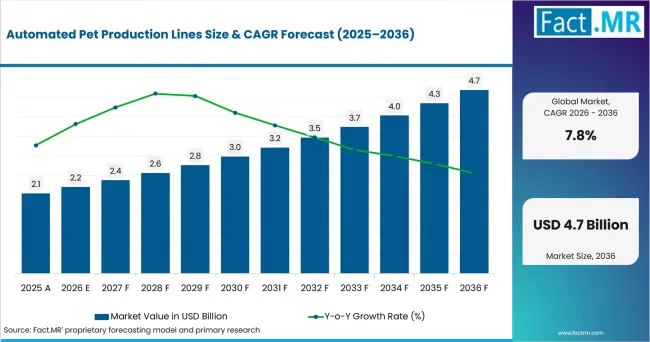
Automated Pet Production Lines Value Analysis | Source: Fact.MR
What are the defining numbers behind Automated Pet Production Lines Market growth?
USD 2.5 billion absolute opportunity by 2036, led by dry pet-food extrusion lines, process control and kibble production.
- Demand Drivers in the Market
- Pet-food plant managers need connected line controls because recipe drift affects density, moisture and coating quality across long kibble runs.
- European Commission animal-feed material states that the European Commission states that 70 million pet-owning households in the EU buy roughly 10 million tonnes of pet feed each year. That volume base is expected to favor higher-throughput production layouts.
- Operations teams need robotic case handling because pouches, trays and bags move through secondary packing at different speeds and pallet patterns.
- Maintenance teams need repeatable cleaning and restart routines since sticky wet recipes and coated kibble raise downtime risk after changeovers.
- Key Segments Analyzed
- By Line Type: Dry pet-food extrusion lines are expected to hold 34.0% share in 2026 due to their central role in kibble processing.
- By Automation Scope: Process control is projected to account for 29.0% share in 2026, supported by recipe accuracy and line stability needs.
- By Capacity: 2-5 t/h systems are anticipated to capture 28.0% share in 2026 because mid-scale plants need flexible output.
- By Product Format: Kibble is estimated to represent 42.0% share in 2026 owing to wide retail availability and extrusion-line throughput.
- Analyst Opinion at Fact.MR
- Shambhu Nath Jha, Principal Consultant at Fact.MR states, "Pet-food line investment is becoming a control problem as much as a capacity problem. Plants are expected to compare suppliers on recipe transfer, hygienic design and restart speed. Vendors with extrusion knowledge, filling integration and service depth are better placed for projects that link process data to packaging output."
- Strategic Implications
- Line integrators should connect extrusion, drying and coating controls so plant teams trace each batch from recipe entry to final bagging.
- Equipment builders should document cleaning access and allergen-control steps since wet and functional recipes raise audit pressure inside plants.
- Automation vendors should document payback for automated material handling equipment used after filling and cartoning. Destatis reported in April 2026 that companies in Germany's producing and service sectors paid an average EUR 45.00 per hour worked in 2025.
- Pet-food brands should evaluate spare-parts access and operator training before approving complete-line retrofits for brownfield factories.
Brazil is projected to record 9.4% CAGR through 2036, led by pet-sector expansion and new wet-format investment. The USA is expected to post 7.5% CAGR due to its animal-food manufacturing base. Germany is forecast to advance at 6.3% CAGR, supported by feed-sector scale. France is anticipated to hold 5.9% CAGR owing to animal-product supply and specialty formats. The UK is estimated to reach 5.6% CAGR as food-manufacturing depth supports selective automation.
How does the Automated Pet Production Lines Market break down by segment?
Dry pet-food extrusion lines lead Line Type at 34.0%; Kibble leads Product Format at 42.0%.
Which Line Type dominates?
Dry pet-food extrusion lines are expected to hold 34.0% share in 2026.
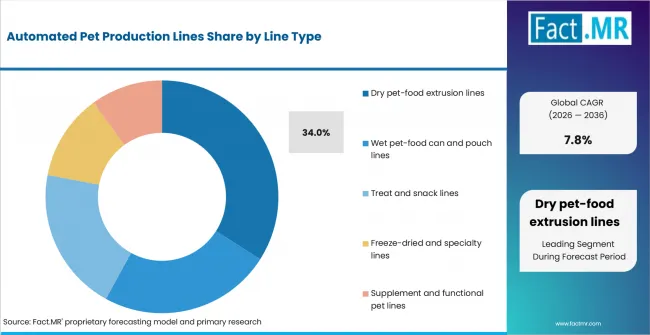
Automated Pet Production Lines Analysis By Line Type | Source: Fact.MR
Dry extrusion lines lead because kibble plants need steady preconditioning, shaping, drying and coating across high-volume runs. Bühler launched the Nutrex 7 Series in May 2026 and stated that customer testing covered pet food, extruded flours and cereals. That development supports buyer interest in modern twin screw extruder platforms with better hygiene and operating efficiency.
What leads the Automation Scope segment?
Process control is projected to account for 29.0% share in 2026.
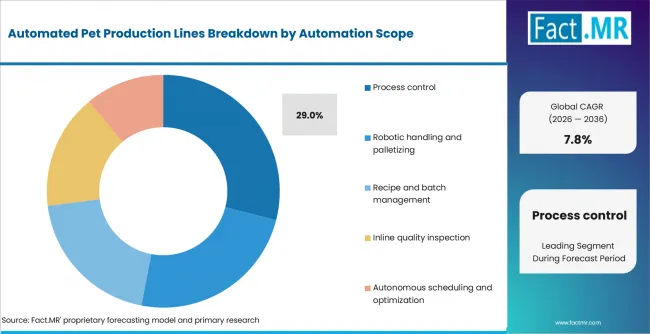
Automated Pet Production Lines Analysis By Automation Scope | Source: Fact.MR
Process control leads because pet-food recipes rely on temperature, pressure, moisture and residence time control. A small shift alters kibble density or wet-pack texture. ANDRITZ stated in September 2025 that ExMax S1021 automates cooking and expansion through DensiFlex. That type of control helps plants reduce manual intervention across startup and shutdown.
How does Capacity shape demand?
2-5 t/h systems are anticipated to capture 17.0% share in 2026.
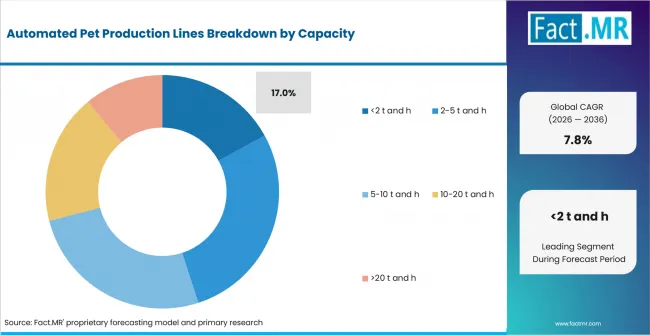
Automated Pet Production Lines Analysis By Capacity | Source: Fact.MR
The 2-5 t/h range fits factories that need commercial output without committing to large continuous lines. Mid-scale systems support SKU changes, private-label runs and regional production. They also allow manufacturers to combine dryers, coolers and industrial dryer choices around existing building space.
What supports Product Format demand?
Kibble is estimated to represent 42.0% share in 2026.
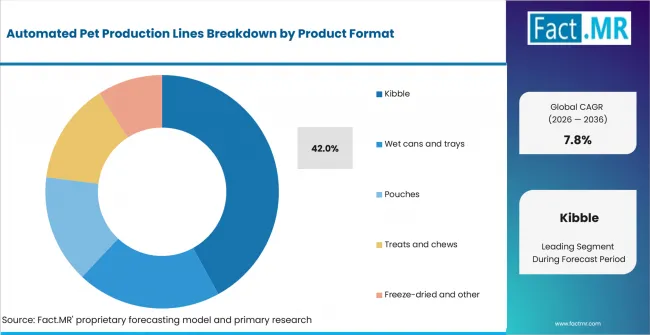
Automated Pet Production Lines Analysis By Product Format | Source: Fact.MR
Kibble leads because dry pet food runs through repeatable extrusion, drying, coating and bulk packing steps. These steps suit complete-line automation. Wet cans, trays and pouches use filling and retort handling, while form fill and sealing equipment supports flexible pouch formats after cooked-product preparation.
What is accelerating Automated Pet Production Lines Market adoption, and what is holding it back?
Adoption is expected to rise through recipe control, labor savings and wet-format automation. Investment is constrained by retrofit cost and validation time.
Drivers Impact Analysis
| DRIVER | (~) % IMPACT ON CAGR | GEOGRAPHIC RELEVANCE | IMPACT TIMELINE |
|---|---|---|---|
| Recipe control and batch traceability | +1.5% | North America, Europe | Short term (<= 2 years) |
| Robotic handling after primary packing | +1.1% | Global | Medium term (2-4 years) |
| Wet pet-food line modernization | +0.9% | Brazil, USA, Western Europe | Medium term (2-4 years) |
| Mid-capacity extrusion upgrades | +0.7% | Global | Long term (>= 4 years) |
Source: Fact.MR analysis. Updated Sep 7, 2026
- Recipe control and batch traceability: Automated dosing, mixing, and extrusion records can improve consistency when plants shift between life-stage, functional, or specialty pet-food formulas. Better batch traceability helps reduce rework and supports faster investigation when formulation or quality issues appear.
- Robotic handling after primary packing: Case-packing and palletizing cells can reduce manual lifting and improve end-of-line consistency on high-volume pouch and bag lines. Automation also supports steadier throughput and more predictable handling across repetitive packaging operations.
- Wet pet-food line modernization: Modern wet pet-food facilities are investing in updated processing and packaging systems to improve hygiene, throughput, and product consistency. Suppliers can benefit where new lines combine automated preparation, filling, sealing, and downstream packaging in integrated production workflows.
Opportunity Impact Analysis
| OPPORTUNITY | (~) % IMPACT ON CAGR | GEOGRAPHIC RELEVANCE | IMPACT TIMELINE |
|---|---|---|---|
| Brownfield automation retrofits | +1.0% | USA, Germany, UK | Short term (<= 2 years) |
| Flexible pouch and tray handling | +0.8% | Brazil, France, UK | Medium term (2-4 years) |
| Specialty and freeze-dried formats | +0.6% | North America, Western Europe | Long term (>= 4 years) |
Source: Fact.MR analysis. Updated Sep 7, 2026
- Brownfield automation retrofits: Existing plants are expected to add controls, conveyors and case packing machines where full-line replacement exceeds budget limits.
- Flexible pouch and tray handling: Wet-format lines are projected to create more demand for packaging robots and inspection cells around frequent format changes.
- Specialty and freeze-dried formats: Premium recipes are expected to create demand for careful drying, low-damage handling and batch-level quality records.
Restraints Impact Analysis
| RESTRAINT | (~) % IMPACT ON CAGR | GEOGRAPHIC RELEVANCE | IMPACT TIMELINE |
|---|---|---|---|
| High retrofit cost in older plants | -0.6% | Europe, North America | Short term (<= 2 years) |
| Validation time for wet and functional recipes | -0.4% | Global | Medium term (2-4 years) |
| Service and spare-parts availability gaps | -0.3% | Latin America, South Asia | Long term (>= 4 years) |
Source: Fact.MR analysis. Updated Sep 7, 2026
- High retrofit cost in older plants: Legacy buildings often require floor, power and hygiene upgrades before automated conveyors or palletizers fit safely.
- Validation time for wet and functional recipes: New lines require trial runs because texture, moisture and fill weight affect shelf life and label accuracy.
- Service and spare-parts availability gaps: Plants outside large food-equipment clusters are expected to phase investment when skilled maintenance cover is limited.
Which countries are scaling the Automated Pet Production Lines Market through 2036?
- The country comparison spans 3.81 percentage points and forms three practical growth bands across the forecast period.
- Brazil remains 1.86 percentage points above the USA due to pet-sector expansion and wet-format investment needs.
- The USA remains 1.17 percentage points above Germany through its large animal-food manufacturing base.
- Germany remains 0.46 percentage point above France, supported by feed-sector scale and automation payback from labor cost.
- France remains 0.32 percentage point above the UK as animal-product supply supports wet and specialty pet-food formats.
- The UK closes the displayed range through food-manufacturing depth and selective packaging-line automation.
Comparable CAGRs create different entry conditions due to plant scale, recipe mix, energy cost and service coverage. Full report coverage includes North America, Latin America, Western Europe, Eastern Europe, East Asia, South Asia & Pacific, Middle East & Africa.
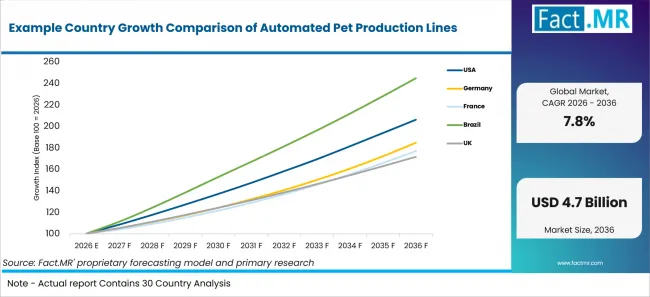
Example Country Growth Comparison Of Automated Pet Production Lines | Source: Fact.MR
| Country | CAGR (2026-2036) |
|---|---|
| USA | 7.5% |
| Germany | 6.3% |
| France | 5.9% |
| Brazil | 9.4% |
| UK | 5.6% |
Source: Fact.MR analysis. Updated Sep 7, 2026
What supports USA adoption?
7.5% CAGR, supported by animal-food manufacturing scale and process-control replacement.
U.S. animal-food manufacturing is a sizable industrial segment. The U.S. Bureau of Labor Statistics reported 76.4 thousand workers in animal food manufacturing (NAICS 3111) in 2025, while sector output decreased 1.2% from 2024 to 2025. These operating-scale indicators provide context for productivity-focused automation investment.
What supports Germany's adoption?
6.3% CAGR, backed by feed-sector scale and high labor-cost pressure.
Germany combines feed-production scale with a high-cost manufacturing base. Germany’s Federal Office for Agriculture and Food reported that 260 businesses produced 22.2 million tonnes of compound feed in the 2024/25 economic year. That production base strengthens the case for automated dosing, conveying and palletizing in pet-food plants.
How is France developing demand?
5.9% CAGR, supported by animal-product supply and specialty formats.
France has a strong animal-product base that supports wet pet-food and treat ingredients. INSEE reported that France’s animal production was valued at EUR 38.1 billion in 2025, excluding subsidies on products. Pet-food manufacturers use that raw-material base to justify filling, cooking and inspection lines for higher-value formats.
How is Brazil scaling demand?
9.4% CAGR, led by pet-sector expansion and wet-format investment.
Brazil records 9.4% CAGR because its pet sector combines national scale with rising format complexity. A MAPA-hosted release from ABINPET and Instituto Pet Brasil projected Brazil’s pet-sector revenue at approximately R$ 78 billion in 2025, based on first-quarter 2025 data. That operating base supports investment in extrusion and wet-pack lines.
What supports the UK's growth?
5.6% CAGR, shaped by food-manufacturing strength and packaging automation.
The UK has a broad food-manufacturing base that supports selective pet-food line upgrades. ONS reported in July 2026 that food manufacture represented 22.9% of total UK manufacturers' product sales in 2025. That base supports automation in pouch filling, case packing and automatic palletizer and depalletizer systems where labor savings are measurable.
Who leads the Automated Pet Production Lines Market?
Bühler is active through pet-food extrusion systems, drying technology and process services. Its May 2026 Nutrex 7 Series launch strengthens its pet-food extrusion offering with a focus on hygienic design, process stability, digital control and service support. The broader Bühler pet-food portfolio also emphasizes energy-efficient drying, reliable throughput and complete-line integration.
ANDRITZ participates through pet-food extrusion, process automation and lifecycle support. The September 2025 ExMax S1021 launch combines hygienic construction with the DensiFlex™ system for automated cooking, expansion and density control, supporting more consistent extrusion processes.
Clextral remains relevant through twin-screw extrusion lines for premium pet food and treats. GEA covers wet, dry and freeze-dried pet-food processing through technologies including extrusion, drying, freeze drying, packaging and automation. JBT Marel combines Wenger and Extru-Tech pet-food extrusion and processing capabilities; in April 2026, the company announced that the two brands were uniting under JBT Marel and would exhibit together at Petfood Forum 2026. Tetra Pak supports wet pet-food production and packaging through Tetra Recart® systems and related expertise in recipe development, processing, filling and retorting.
Competition centers on recipe knowledge, commissioning support and controls integration. Suppliers that link upstream processing with food processing and handling equipment and downstream packing are expected to gain preference in complete-line projects.
Which companies are the key providers?
Key companies include Bühler; ANDRITZ; Clextral; GEA; JBT Marel; and Tetra Pak.
- Bühler
- ANDRITZ
- Clextral
- GEA
- JBT Marel
- Tetra Pak
Bibliography
- ANDRITZ. (2025, September 16). ANDRITZ launches ExMax S1021 for more efficient pet food and aqua feed production.
- Bühler Group. (2026, May 6). Bühler ushers in a new era of extrusion systems with Nutrex 7 Series.
- Bundesministerium für Landwirtschaft, Ernährung und Heimat. (2025). Struktur der Mischfutterhersteller 2024/25.
- Statistisches Bundesamt (Destatis). (2026, April 29). Eine Arbeitsstunde kostete im Jahr 2025 durchschnittlich 45,00 Euro.
- Institut national de la statistique et des études économiques. (2026, July 28). Production et valeur ajoutée de l’agriculture.
- Associação Brasileira da Indústria de Produtos para Animais de Estimação, & Instituto Pet Brasil. (2025, May). Setor pet projeta crescer apenas 3,5% em 2025, com faturamento de R$ 78 bilhões.
- Office for National Statistics. (2026, July 24). UK manufacturers’ sales by product: 2025.
- Tetra Pak. (2026, April 4). Drools pioneers fresh pet food category in India with ₹180 crore investment and collaboration with Tetra Pak.
- U.S. Bureau of Labor Statistics. (2026, June 24). Productivity and costs by industry: Manufacturing and mining industries – 2025.
- JBT Marel. (2026, April 15). Wenger and Extru-Tech unite under JBT Marel at Petfood Forum 2026.
This Report Answers
- The report explains how automated pet production lines are used across line type, automation scope, capacity and product format.
- Segment analysis identifies the leading subsegments and the plant-level reasons manufacturers prioritize them.
- Country analysis examines the listed markets and the manufacturing conditions that support automation investment.
- Competitive analysis reviews extrusion and wet processing providers. It also covers drying, handling and packaging integration.
- Application analysis assesses how recipe control, hygienic design and service coverage influence equipment selection.
What does the Automated Pet Production Lines Market cover?
The Automated Pet Production Lines Market covers integrated machinery and controls used to produce dry, wet, treat and specialty pet-food formats. The assessment includes extrusion, drying and filling when these functions operate as a connected production line. It also covers inspection, conveying, packing and palletizing inside that line.
The assessment covers food industry heat processing equipment that supports cooking or retorting, as well as downstream packing linked to product flow. Demand is assessed across the listed segmentation and country coverage.
What is included in the scope?
The scope includes complete automated pet-food lines, line modules sold for integration, control software bundled with machinery and service packages tied to installation or line performance. It includes extrusion systems, dryers and fillers used inside pet-food plants. Conveyors, inspection units and feed packaging equipment are covered when linked to production flow.
It includes dry kibble lines and wet cans or tray lines. Pouch, treat and specialty pet-food lines are covered inside the same boundary. Systems used only for livestock feed, human food, standalone retail equipment and household pet feeders are outside the market boundary.
What is excluded from the scope?
The scope excludes standalone ingredients and packaging materials sold without machinery. Household pet feeders, basic manual workstations and remote warehouse systems are outside the market boundary.
Livestock-feed mills are excluded when the equipment is sold solely for farm or agricultural feed. General plant software is excluded when it has no direct link to pet-food processing, filling or packing equipment.
How Was the Analysis Built?
The analysis draws on 120+ sources, 35+ company portfolios, 25+ countries, and more than 20 industry interviews.
- Primary Research: Primary research includes discussions with manufacturers, service providers, technology developers, distributors, end users, and subject-matter experts. These conversations examine purchasing priorities, product adoption, operational challenges, approval requirements, competitive positioning, and the factors that influence wider market acceptance.
- Desk Research: Desk research covers government statistics, regulatory publications, company filings, trade data, technical studies, industry associations, standards, public policy, and other authoritative sources. Every source used in the analysis is documented in the bibliography.
- Market Sizing and Forecasting: Market estimates combine historical performance, demand indicators, pricing and volume trends, segment shares, company participation, country-level growth, adoption patterns, investment activity, and barriers to market expansion.
- Data Validation and Update Cycle: Findings are validated by comparing primary interviews with public data, company activity, regulatory changes, trade patterns, and industry developments. Regular updates review new product launches, capacity changes, partnerships, approvals, and shifts in commercial adoption.
Segmentation
What is the report's scope and coverage?
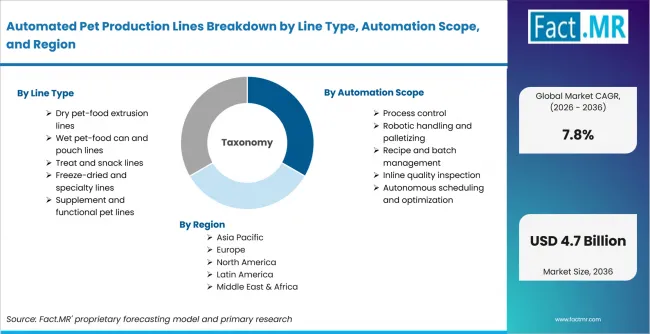
Automated Pet Production Lines Breakdown By Line Type, Automation Scope, And Region | Source: Fact.MR
| Attribute | Details |
|---|---|
| Quantitative Units | USD billion |
| Market Definition | Automated pet production lines used to prepare, process, fill, pack, inspect and palletize pet-food products across dry, wet, treat and specialty formats. |
| Line Type | Dry pet-food extrusion lines; Wet pet-food can and pouch lines; Treat and snack lines; Freeze-dried and specialty lines; Supplement and functional pet lines |
| Automation Scope | Process control; Robotic handling and palletizing; Recipe and batch management; Inline quality inspection; Autonomous scheduling and optimization |
| Capacity | <2 t/h; 2-5 t/h; 5-10 t/h; 10-20 t/h; >20 t/h |
| Product Format | Kibble; Wet cans and trays; Pouches; Treats and chews; Freeze-dried and other |
| Regions Covered | North America; Latin America; Western Europe; Eastern Europe; East Asia; South Asia & Pacific; Middle East & Africa |
| Countries Covered | USA; Germany; France; Brazil; UK |
| Key Companies Profiled | Bühler; ANDRITZ; Clextral; GEA; JBT Marel; Tetra Pak |
| Forecast Period | 2026 to 2036 |
| Approach | Hybrid top-down and bottom-up approach using pet-food line output, equipment scope, segment mix, country adoption and provider portfolio review. |
Source: Fact.MR analysis. Updated Sep 7, 2026
How is the market segmented?
-
By Line Type
- Dry pet-food extrusion lines
- Wet pet-food can and pouch lines
- Treat and snack lines
- Freeze-dried and specialty lines
- Supplement and functional pet lines
-
By Automation Scope
- Process control
- Robotic handling and palletizing
- Recipe and batch management
- Inline quality inspection
- Autonomous scheduling and optimization
-
By Capacity
- <2 t/h
- 2-5 t/h
- 5-10 t/h
- 10-20 t/h
- >20 t/h
-
By Product Format
- Kibble
- Wet cans and trays
- Pouches
- Treats and chews
- Freeze-dried and other
-
By Region
- North America
- Latin America
- Western Europe
- Eastern Europe
- East Asia
- South Asia & Pacific
- Middle East & Africa
Frequently Asked Questions
How big is the automated pet production lines market in 2026?
What is the CAGR of the automated pet production lines market from 2026 to 2036?
Which line type leads the automated pet production lines market?
Which product format leads the automated pet production lines market?
Who are the leading companies in the automated pet production lines market?
Who worked on this report


Preview the report firsthand - request a free sample
Free SampleGet the brochure for pricing and purchase details
Download PDF