- Market Value (2025): USD 1.6 Bn
- Estimated Value (2026): USD 1.9 Bn
- Forecast Value (2036): USD 6.0 Bn
- CAGR (2026-2036): 12.4%
What is the Automated Machine-Tending Cells Market forecast to be worth by 2036?
USD 1.9 billion in 2026 to USD 6.0 billion by 2036 at 12.4% CAGR.
- The automated machine-tending cells market crossed a valuation of USD 1.6 billion in 2025 as manufacturers expanded unattended loading trials.
- Demand is projected to increase from USD 1.9 billion in 2026 to USD 6.0 billion by 2036.
- The market is forecast to record 12.4% CAGR from 2026 to 2036 as machine shops, plastics processors and automotive plants standardize repeatable loading work.
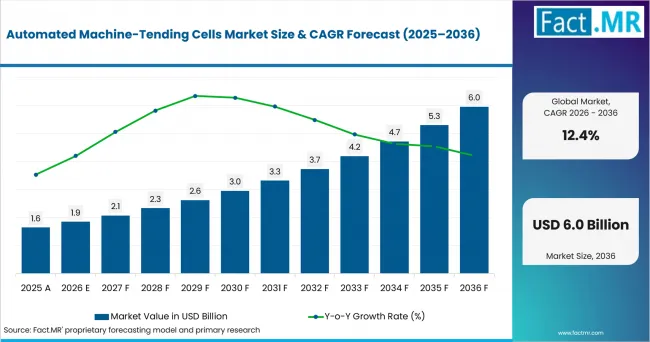
Automated Machine Tending Cells Market Value Analysis | Source: Fact.MR
What are the defining numbers behind Automated Machine-Tending Cells Market growth?
USD 4.10 billion absolute opportunity by 2036, led by Articulated robots, CNC machining and Fixed cells alongside Automotive end use.
- Demand Drivers in the Market
- Machine shops need unattended part loading so CNC spindles spend fewer hours idle.
- Plastics processors need robot-fed molding cells to protect unload timing after each shot.
- Press rooms need safe tending layouts that move formed parts from machine to stack.
- Manufacturing engineers are expected to prioritize machine communication on older lines.
- Key Segments Analyzed
- By Robot Type: Articulated robots are expected to hold 47.0% share in 2026 due to their reach, payload flexibility and wide machine access range.
- By Machine Served: CNC machining is projected to account for 39.0% share in 2026 as lathes and machining centers offer clear repeat-cycle loading work.
- By Cell Type: Fixed cells are anticipated to capture 54.0% share in 2026 owing to repeat production, guarded layouts and stable fixture positions.
- By End-Use Industry: Automotive is estimated to represent 30.0% share in 2026 because parts families often justify dedicated tending cells.
- Analyst Opinion at Fact.MR
- Shambhu Nath Jha, Principal Consultant at Fact.MR, states, “Machine-tending cells draw attention because they convert a familiar manual task into a controlled production step. Acceptance is expected to depend on gripper proof, safety validation and CNC communication before a cell is released. Suppliers that combine application engineering with service response are better placed than vendors selling only a robot arm.”
- Strategic Implications
- Plant managers should rank candidate machines by spindle idle time before selecting a robot package.
- Cell integrators should document gripper changes, part presentation and safety zones before quoting the final system.
- Robot OEMs should support CNC, press and molding interfaces because machine communication decides uptime after installation.
- Investors should separate repeatable machine-tending exposure from broader factory automation claims that lack cell-level evidence.
South Korea is projected to record 14.5% CAGR through 2036, supported by electronics and automotive factories that need repeatable loading. The United States is forecast to post 13.9% as machine shops add automation around CNC and fabricated-metal work. France is anticipated to advance at 12.4% due to robotics projects and factory extensions. Germany is estimated to reach 12.3% as machinery and fabricated-metal orders create tending needs. Japan is expected to register 12.2% through machine-tool depth and fixed-investment plans. Italy is projected to record 11.5% as mechanical manufacturing remains export-oriented.
How does the Automated Machine-Tending Cells Market break down by segment?
Articulated robots lead Robot Type at 47.0%; CNC machining leads Machine Served at 39.0%.
Which Robot Type dominates?
Articulated robots are projected to account for 47.0% share in 2026.
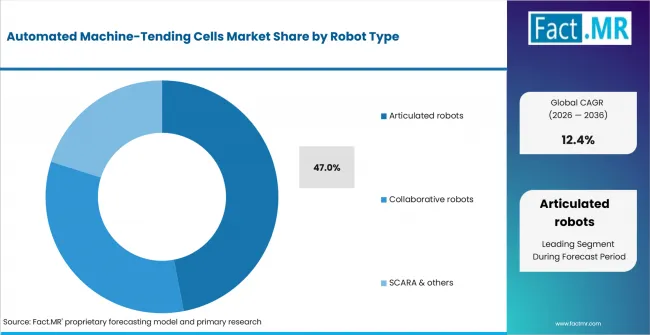
Automated Machine Tending Cells Market Analysis By Robot Type | Source: Fact.MR
Articulated robots lead the Robot Type segment because their reach and flexibility help them access machine openings, clear fixtures and handle varied part weights. FANUC, ABB, KUKA and Yaskawa each maintain machine-tending portfolios that connect robots with machining, press and material-handling tasks across industrial production environments.
What leads the Machine Served segment?
CNC machining is expected to hold 39.0% share in 2026.
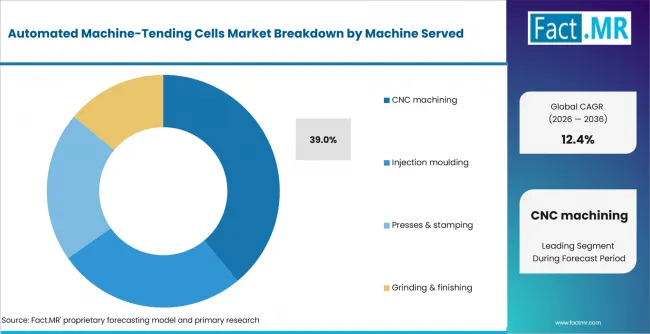
Automated Machine Tending Cells Market Analysis By Machine Served | Source: Fact.MR
CNC machining leads the Machine Served segment because part loading is frequent, repeatable and highly visible across shop-floor operations. Automated tending helps maintain steady machine utilization, supports consistent loading and unloading cycles, and reduces manual intervention where manufacturers run repetitive machining tasks across varied production schedules and component types.
How does Cell Type shape demand?
Fixed cells are anticipated to lead with 54.0% share in 2026.
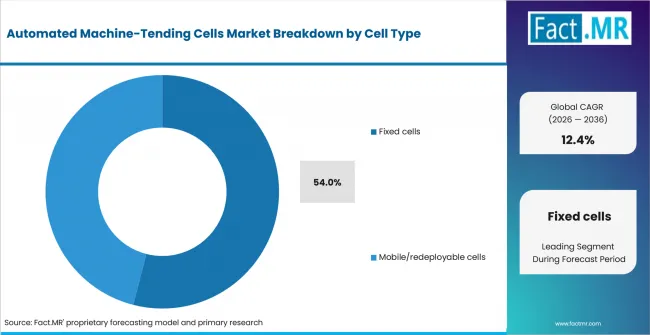
Automated Machine Tending Cells Market Analysis By Cell Type | Source: Fact.MR
Fixed cells lead the Cell Type segment when part flow, safety fencing and machine location remain stable over long production runs. KUKA’s EMO 2025 program focused on loading and unloading, intralogistics and mechanical processing, providing direct product-program evidence for robot automation around machine-tool and industrial production workflows.
What supports Automotive within End-Use Industry?
Automotive is estimated to represent 30.0% share in 2026.
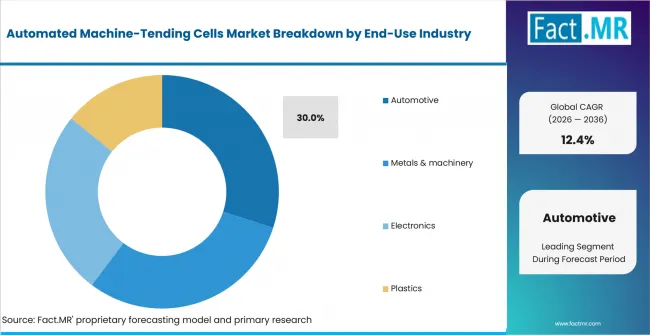
Automated Machine Tending Cells Market Analysis By End Use Industry | Source: Fact.MR
Automotive leads the End-Use Industry segment because engine, transmission, battery and metal components frequently move through machining or press operations. Robot tending supports repeatable loading, unloading and part transfer across high-volume manufacturing lines, helping plants maintain consistent cycle times, reduce manual handling and improve production-flow reliability.
What is accelerating Automated Machine-Tending Cells Market adoption, and what is holding it back?
Unattended machine loading drives it; integration cost and validation work restrain it.
Drivers Impact Analysis
| DRIVER | (~) % IMPACT ON CAGR | GEOGRAPHIC RELEVANCE | IMPACT TIMELINE |
|---|---|---|---|
| Unattended CNC loading | +3.0% | United States, Japan, Germany | Short term (<= 2 years) |
| Articulated robot flexibility | +2.5% | Germany, Japan, South Korea | Short term (<= 2 years) |
| Injection moulding cycle control | +2.0% | United States, Italy, France | Medium term (2-4 years) |
| Automotive flexible cells | +1.7% | Germany, United States, Japan | Medium term (2-4 years) |
| Robot-to-machine interfaces | +1.3% | Europe, Japan, North America | Long term (>= 4 years) |
- Unattended CNC loading: Machine shops are expected to value cells that keep lathes and machining centers fed between operator rounds. Repetitive part exchange makes idle spindle time visible. FANUC’s 2025 Robot G-Code demonstration shows CNC-side robot programming in G-code; any reduction in programming friction is an analytical interpretation rather than a measured result in the source.
- Articulated robot flexibility: Six-axis robots fit many cells because the arm reaches around fixtures and doors. Machining, press and molding machines all have different part-access points. Longer reach options are expected to widen the robot pool for mixed cells.
Opportunity Impact Analysis
| OPPORTUNITY | (~) % IMPACT ON CAGR | GEOGRAPHIC RELEVANCE | IMPACT TIMELINE |
|---|---|---|---|
| Multi-machine tending | +1.5% | United States, Germany, Italy | Medium term (2-4 years) |
| Mobile cells | +1.2% | Japan, France, South Korea | Medium term (2-4 years) |
| Retrofit automation | +0.9% | Europe and North America | Long term (>= 4 years) |
| Integrator service packages | +0.7% | Small and mid-sized plants | Long term (>= 4 years) |
- Multi-machine tending: A single robot serving two machines raises utilization when cycle times are balanced. The opportunity depends on part presentation and safe travel paths.
- Mobile cells: Redeployable cells give smaller plants a path to automation without locking capital to one machine. The value is stronger when one robot serves CNC, finishing or molding work. Mobile cells are forecast to grow where product mix changes often.
- Retrofit automation: Older machine tools often need interface work before robotic tending is reliable. Retrofit packages extend automation to installed assets without machine replacement. Integrators are anticipated to gain from plants that need practical upgrades.
Restraints Impact Analysis
| RESTRAINT | (~) % IMPACT ON CAGR | GEOGRAPHIC RELEVANCE | IMPACT TIMELINE |
|---|---|---|---|
| Fixture and gripper engineering | -1.3% | Global | Short term (<= 2 years) |
| Integrator availability | -1.0% | United States, Germany, Italy | Short term (<= 2 years) |
| Utilization uncertainty | -0.8% | Small manufacturers | Medium term (2-4 years) |
| Safety and maintenance validation | -0.6% | Regulated production sites | Long term (>= 4 years) |
- Fixture and gripper engineering: Cells fail when the robot cannot grip every part variation reliably. Engineering time rises when blanks or molded parts vary by batch.
- Integrator availability: Skilled integrators combine the robot, machine interface and safety system. A shortage of experienced teams can stretch commissioning.
- Utilization uncertainty: Smaller plants hesitate when order volumes do not keep a machine loaded. A cell purchased for one program can sit underused if mix shifts quickly.
Which countries are scaling Automated Machine-Tending Cells Market fastest?
- The country comparison spans 3.00 percentage points and forms three practical growth bands across the forecast period.
- South Korea remains 0.63 percentage point above the United States due to electronics, automotive and AI-factory investment.
- The United States remains 1.44 percentage points above France as CNC-heavy shops and fabricated-metal plants automate loading.
- France remains 0.08 percentage point above Germany through robotics project support and factory-extension activity.
- Germany remains 0.13 percentage point above Japan as machinery orders and fabricated-metal work sustain cell qualification.
- Japan remains 0.72 percentage point above Italy through machine-tool depth and fixed-investment planning.
- Italy closes the displayed range while mechanical manufacturing and export exposure keep machine-tending cells relevant.
Comparable CAGRs can create different entry conditions because machine age, integrator depth and production mix vary by country. Full report coverage includes North America, Latin America, Europe, East Asia, South Asia and Pacific, Middle East and Africa.
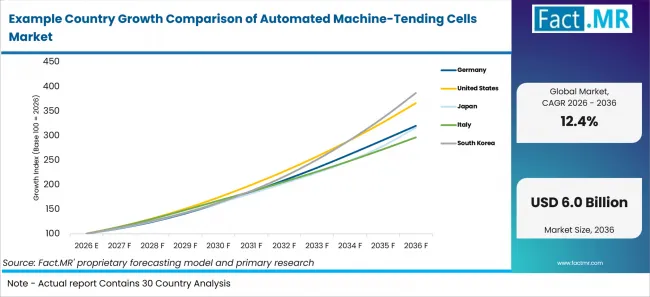
Example Country Growth Comparison Of Automated Machine Tending Cells Market | Source: Fact.MR
| Country | CAGR (2026-2036) |
|---|---|
| South Korea | 14.5% |
| United States | 13.9% |
| France | 12.4% |
| Germany | 12.3% |
| Japan | 12.2% |
| Italy | 11.5% |
What supports South Korea adoption?
14.5% CAGR, supported by AI-factory investment and electronics automation.
South Korea’s growth is shaped by electronics and automotive production where loading work must stay repeatable. MOTIR announced on January 26, 2026 that it would provide KRW 268.5 billion to the Industrial Innovation Infrastructure Project, including AI-based manufacturing infrastructure and shared testing, evaluation, certification and demonstration facilities.
How is the United States scaling demand?
13.9% CAGR, backed by CNC automation and labor-saving loading work.
The United States has a broad installed base of CNC shops, metalworking plants and plastics processors. Machine-tending cells are expected to gain where robots reduce spindle idle time without changing the core machining process. Integrators remain central because they solve gripper design and machine-signal work.
What supports France adoption?
12.4% CAGR, supported by robotics projects and industrial site expansion.
France is developing a policy-backed robotics base that supports integrators and component makers. DGE reported in June 2026 that the France 2030 robots and intelligent machines call selected 31 projects from 60 companies and laboratories.
What supports Germany adoption?
12.3% CAGR, backed by machinery orders and fabricated-metal production needs.
Germany’s demand is tied to machinery and metal products. Destatis reported in February 2026 that real manufacturing orders rose 7.8% month over month in December 2025; fabricated metal products rose 30.2%, and machinery and equipment rose 11.5%.
How does Japan perform?
12.2% CAGR, led by machine-tool depth and production engineering discipline.
Japan’s profile reflects long experience in machine tools and robot deployment. The Bank of Japan’s September 2025 Tankan forecast all-enterprise manufacturing fixed investment for FY2025 at 13.9% year-on-year growth.
What supports Italy growth?
11.5% CAGR, supported by mechanical manufacturing and export-oriented machine users.
Italy’s growth is tied to mechanical engineering companies that use machining and finishing equipment across export supply chains. MIMIT reported on June 23, 2026 that Italy’s mechanical sector counted more than 115,000 local units and more than 1.3 million employees.
Who leads the Automated Machine-Tending Cells Market?
FANUC and KUKA show the clearest direct relevance, while ABB and Yaskawa strengthen the wider machine-tending automation landscape.
FANUC connects industrial robots with CNC controls for machine-tending applications and supports robot programming around machining workflows. KUKA contributes loading, unloading and machine-tool automation capabilities through its robotics and interface portfolio. ABB and Yaskawa add machine-tending solutions for machining and material-handling tasks. Universal Robots extends the competitive field through flexible collaborative robot tending applications, while Acieta adds further integration relevance within automated machine-tending cells.
Which companies are the key providers?
Key companies include FANUC Corporation, KUKA AG, ABB Ltd., Yaskawa Electric Corporation, Universal Robots A/S, and Acieta LLC.
- FANUC Corporation
- KUKA AG
- ABB Ltd.
- Yaskawa Electric Corporation
- Universal Robots A/S
- Acieta LLC
Bibliography
- Bank of Japan. (2025, October 1). Tankan Outline (September 2025).
- U.S. Bureau of Economic Analysis. (2026, June 10). New foreign direct investment in the United States, 2025.
- U.S. Bureau of Labor Statistics. (2026, August 4). Job openings and labor turnover—June 2026: Table 1. Job openings levels and rates by industry and region, seasonally adjusted.
- Federal Statistical Office (Destatis). (2026, February 5). New orders in manufacturing in December 2025: +7.8% on the previous month.
- Direction générale des Entreprises. (2026, June 18). France 2030 : 31 nouveaux projets pour accélérer l’émergence d’une filière française d’excellence en robotique et en drones souverains.
- Direction générale des Entreprises. (2026, March 29). Baromètre industriel de l'État : en 2025, les extensions d'usines portent la réindustrialisation avec un solde positif malgré un contexte international dégradé.
- FANUC America Corporation. (2025, April 23). FANUC demonstrates the latest CNC and robotics innovations at the Manufacturing Technologies Series East Show.
- Federal Employment Agency. (2026, July 15). Employment in the manufacturing sector fell by 177,000.
- Japan Machine Tool Builders’ Association. (2025, August 28). The current condition of the Japanese machine tool industry: Monthly machine tool orders (July 2025).
- KUKA. (2025, June 12). iiQKA.mxAutomation: Extension of the software interface makes automation even easier.
- Ministry of Data and Statistics. (2026, January 30). Monthly industrial statistics, December 2025.
- Ministero delle Imprese e del Made in Italy. (2026, June 23). Meccanica: Urso, “apprezzata dalle imprese la nuova edizione di Transizione 5.0. In dieci giorni già prenotati investimenti per 1,25 mld”.
This Report Answers
- The report provides strategic intelligence on the Automated Machine-Tending Cells Market across Robot Type and Machine Served choices that shape cell design.
- Segment analysis covers Articulated robots and CNC machining as the share leaders within the 2026 market.
- Country outlook evaluates South Korea and the United States alongside France and Germany. Japan and Italy complete the growth comparison across profiled markets.
- Competitive analysis profiles FANUC and KUKA alongside ABB and Yaskawa. Universal Robots and Acieta complete the provider set.
- Cell assessment covers Fixed cells and Mobile or redeployable cells. End-use analysis covers Automotive, Metals and machinery, Plastics and Electronics.
What does the Automated Machine-Tending Cells Market cover?
Automated machine-tending cells serve production machines by moving parts into and out of the work area. The market includes configured cells for CNC machining, injection moulding, presses, stamping and finishing. The scope includes robot arms, tooling, guarding, sensors, controls, interfaces and integration work needed for production release.
Industrial robot components are included when grippers, sensors and tooling are sold as part of the cell package. Machine tools coverage helps frame lathes, milling machines and CNC centers served by tending cells. Metal cutting pages connect to the machining use case where part loading is frequent and repeatable.
What is included in the scope?
The scope includes robotic cells sold for machine loading, unloading and part transfer. Coverage includes fixed and mobile formats when the package includes the robot and operating equipment. Integration, grippers, guarding, sensors and machine communication are included when part of the cell.
What is excluded from the scope?
Standalone robot arms are excluded unless configured for machine-tending cell use. Conveyors, palletizers, storage systems and warehouse robots are excluded unless they directly serve a production machine. Manual fixtures, standalone CNC controls, general factory software and unrelated automation services are also excluded.
How Was the Analysis Built?
The analysis draws on 120+ sources, 35+ company portfolios, 25+ countries, and more than 20 industry interviews.
- Primary Research: Primary research includes discussions with manufacturers, service providers, technology developers, distributors, end users, procurement teams, and subject-matter experts. These conversations examine purchasing priorities, product adoption, operational challenges, approval requirements, competitive positioning, and the factors that influence wider market acceptance.
- Desk Research: Desk research covers government statistics, regulatory publications, company filings, trade data, technical studies, industry associations, standards, public policy, and other authoritative sources. Every source used in the analysis is documented in the bibliography.
- Market Sizing and Forecasting: Market estimates combine historical performance, demand indicators, pricing and volume trends, segment shares, company participation, country-level growth, adoption patterns, investment activity, and barriers to market expansion.
- Data Validation and Update Cycle: Findings are validated by comparing primary interviews with public data, company activity, regulatory changes, trade patterns, and industry developments. Regular updates review new product launches, capacity changes, partnerships, approvals, procurement trends, and shifts in commercial adoption.
What is the report’s scope and coverage?
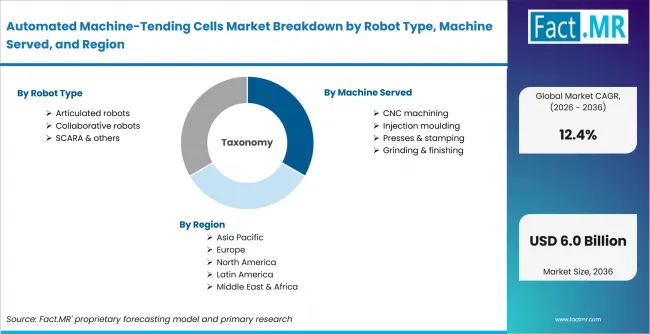
Automated Machine Tending Cells Market Breakdown By Robot Type, Machine Served, And Region | Source: Fact.MR
| Attribute | Details |
|---|---|
| Quantitative Units | USD billion |
| Market Definition | Integrated robotic machine-tending cells used to load, unload, position and monitor production machines where the robot, end-of-arm tooling, guarding, sensing and controls are sold as a cell or configured cell package |
| Robot Type | Articulated robots; Collaborative robots; SCARA and others |
| Machine Served | CNC machining; Injection moulding; Presses and stamping; Grinding and finishing |
| Cell Type | Fixed cells; Mobile and redeployable cells |
| End-Use Industry | Automotive; Metals and machinery; Plastics; Electronics |
| Regions Covered | North America; Latin America; Europe; East Asia; South Asia and Pacific; Middle East and Africa |
| Countries Covered | South Korea; United States; France; Germany; Japan; Italy |
| Key Companies Profiled | FANUC Corporation; KUKA AG; ABB Ltd.; Yaskawa Electric Corporation; Universal Robots A/S; Acieta LLC |
| Forecast Period | 2026 to 2036 |
| Approach | Hybrid top-down and bottom-up approach using machine-tool automation demand; CNC and molding cell adoption; automotive and metalworking production needs; country manufacturing indicators; integrator activity; robot portfolio review and company development validation |
How is the market segmented?
-
By Robot Type:
- Articulated robots
- Collaborative robots
- SCARA and others
-
By Machine Served:
- CNC machining
- Injection moulding
- Presses and stamping
- Grinding and finishing
-
By Cell Type:
- Fixed cells
- Mobile and redeployable cells
-
By End-Use Industry:
- Automotive
- Metals and machinery
- Plastics
- Electronics
-
By Region:
- North America
- Latin America
- Europe
- East Asia
- South Asia and Oceania
- Middle East and Africa