- Market Value (2025): USD 371.4 Mn
- Estimated Value (2026): USD 410 Mn
- Forecast Value (2036): USD 1112.8 Mn
- CAGR (2026-2036): 10.5%
What is the automated gangway systems market forecast to be worth by 2036?
USD 410 million in 2026 to USD 1,112.8 million by 2036, at 10.5% CAGR.
- The automated gangway systems market crossed a valuation of USD 371.4 million in 2025. The market is estimated at USD 410 million in 2026. Revenue is projected to reach USD 1,112.8 million by 2036.
- The market is forecast to record a 10.5% CAGR from 2026 to 2036 as offshore service vessels and passenger terminals specify controlled access equipment.
- Passenger boarding creates a separate source of demand from cruise and ferry terminals. Cruise Lines International Association recorded 34.6 million ocean-going cruise passengers in 2024.
- That volume keeps terminal operators focused on safe boarding flow and predictable turnaround time. [3]
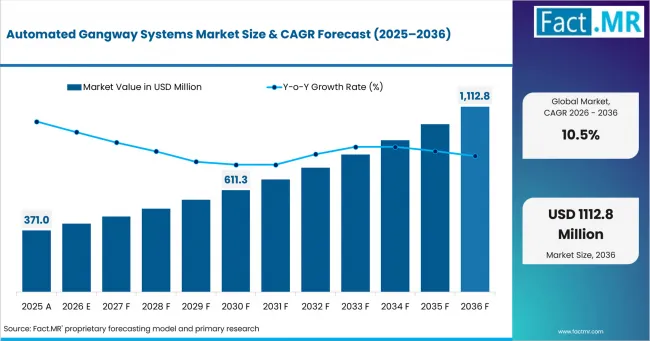
Automated Gangway Systems Market Market Value Analysis | Source: Fact.MR
What are the defining numbers behind automated gangway systems growth?
USD 702.8 million absolute opportunity by 2036, led by the United States and China.
- Demand Drivers in the Market
- Offshore wind operators need controlled walk-to-work access before technicians board turbines from service vessels.
- Cruise terminals need automated boarding bridges to handle passenger flow with fewer manual adjustments.
- Shipowners are specifying motion compensated access during the newbuild stage to reduce later retrofit cost.
- Oil and gas operators continue to replace baskets and ladders where safer personnel transfer is required.
- Key Segments Analyzed
- By Gangway Type: Motion Compensated systems are expected to hold 38.0% share in 2026 because offshore work needs stabilized transfer.
- By Application: Crew Transfer is projected to capture 34.0% share in 2026 as offshore operators prioritize technician movement.
- By Automation: Remote Controlled systems are likely to account for 32.0% share in 2026 since operators need bridge control from safer positions.
- By Installation: Vessel Mounted systems are projected to hold 46.0% share in 2026 because SOV and CSOV fleets use integrated access packages.
- By Buyer Type: Offshore Operators are expected to account for 31.0% share in 2026 due to recurring access needs during field work.
- By Geography: Europe is projected to hold 36.0% share in 2026 because North Sea operations have a high walk-to-work base.
- Analyst Opinion at Fact.MR
- Shambhu Nath Jha, Senior Analyst at Fact.MR, states, "Automated gangways are becoming a buying gate in offshore vessel selection. Buyers do not ask only whether the bridge reaches the platform. They ask whether the system can hold position in rough motion and whether service support is near the project. Offshore wind developers want repeatable technician transfers. Cruise terminals want safer passenger boarding without long exterior queues. Suppliers gain access when they combine mechanical stability, control software and local operators."
- Strategic Implications
- Gangway suppliers should align product packages with SOV and CSOV newbuild schedules before shipyard design freeze.
- Ports need retrofit studies before cruise terminals add automated boarding bridges.
- Offshore operators should compare uptime records and local maintenance coverage before awarding access contracts.
- Shipyards can reduce integration risk by selecting gangway vendors during early vessel design.
The United States is forecast to record 11.8% CAGR through 2036 as offshore wind projects and cruise terminals add controlled transfer systems. China is expected to expand at 11.5% CAGR because shipbuilding scale and port investment support domestic supply. The United Kingdom is projected to grow at 11.1% CAGR as North Sea offshore wind work sustains access system procurement. The Netherlands is forecast to advance at 10.8% CAGR due to offshore wind service hubs and local system suppliers. Germany is expected to post 10.4% CAGR as offshore wind targets support service vessel activity.
How does the automated gangway systems market break down by segment?
Motion compensated systems lead at 38.0%; crew transfer leads at 34.0%.
Which gangway type dominates?
Motion Compensated systems hold 38.0% share in 2026.
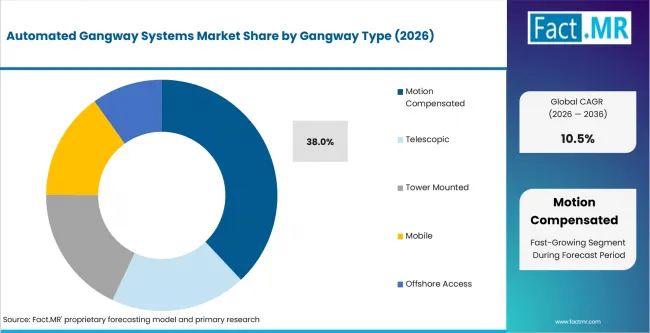
Automated Gangway Systems Market Analysis By Gangway Type | Source: Fact.MR
Motion Compensated systems lead because offshore transfers happen between assets that move independently. The system adjusts the bridge position before workers cross from vessel to turbine or platform. This protects crew access during weather windows and reduces reliance on manual transfer methods.
Which application leads?
Crew Transfer accounts for 34.0% share in 2026.
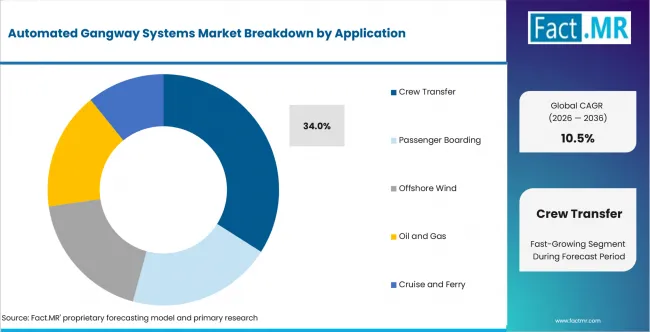
Automated Gangway Systems Market Analysis By Application | Source: Fact.MR
Crew Transfer leads because offshore projects require daily movement of technicians, inspectors and maintenance teams. WindEurope reported 2 GW of new offshore wind capacity connected in Europe in 2025. That activity supports more service vessel work and more controlled boarding systems. [2]
Which automation type leads?
Remote Controlled systems hold 32.0% share in 2026.
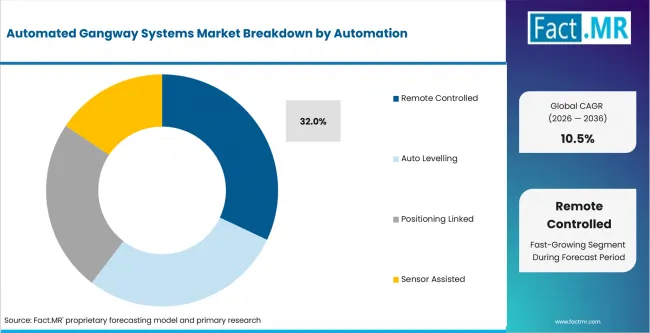
Automated Gangway Systems Market Analysis By Automation | Source: Fact.MR
Remote Controlled systems lead because operators need safer control points during transfer setup. This design helps the operator respond to vessel motion and landing point movement without standing near exposed edges. Sensor-assisted designs add monitoring value when buyers require transfer evidence. Sensor feedback also connects access systems with marine sensors used for position and load monitoring.
Control interfaces are reviewed beside broader connected ship architectures when owners want access data inside vessel monitoring routines.
Which installation type leads?
Vessel Mounted systems lead with 46.0% share in 2026.
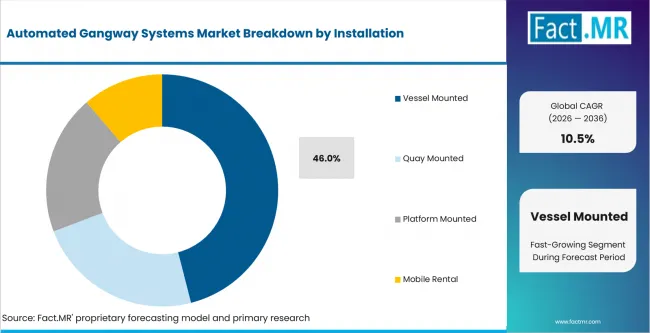
Automated Gangway Systems Market Analysis By Installation | Source: Fact.MR
Vessel Mounted systems lead because offshore access is increasingly specified as part of the service vessel package. The gangway becomes part of the ship mission profile rather than a temporary accessory. This favors suppliers that can support shipyard integration and class documentation. Electric motion designs are also assessed beside electric ship programs when buyers review auxiliary load and vessel power management.
Which buyer type leads?
Offshore Operators hold 31.0% share in 2026.
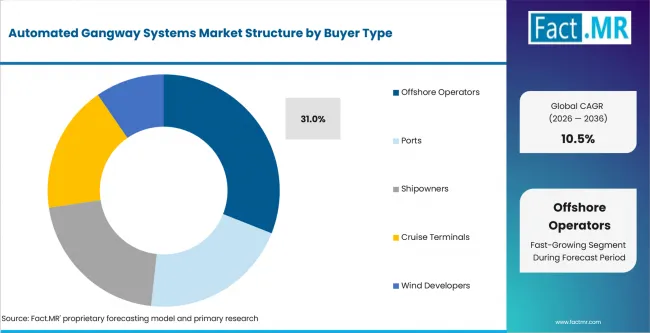
Automated Gangway Systems Market Analysis By Buyer Type | Source: Fact.MR
Offshore Operators lead demand because they manage recurring transfer risk during construction and maintenance campaigns. Their buying decision compares gangway reach and motion envelope. It also compares operator training and service response. Suppliers with field support near offshore clusters have an advantage over equipment-only vendors.
What is accelerating automated gangway systems adoption, and what is holding it back?
Offshore wind service-vessel access and safer crew and passenger transfer drive it, while custom engineering costs and class approval timelines restrain it.
Drivers Impact Analysis
| DRIVER | (~) % IMPACT ON CAGR |
GEOGRAPHIC RELEVANCE | IMPACT TIMELINE |
|---|---|---|---|
| Offshore wind service vessels need motion compensated access | +2.4% | North Sea, USA and China | Medium term |
| Crew transfer safety shifts from baskets into controlled bridges | +2.0% | Global offshore operations | Short term |
| Cruise terminals require safer boarding flow | +1.8% | USA, Europe and Asia | Medium term |
| Remote control reduces operator exposure | +1.4% | Europe, Japan and North America | Long term |
| Shipyards integrate systems at newbuild stage | +1.1% | China, Norway and Netherlands | Medium term |
Source: Fact.MR analysis. Updated Jul 4, 2026
Offshore wind vessel access
Offshore wind projects require repeated technician transfers from service vessels. This links gangway purchases to SOV design, CSOV utilization and wind turbine automation activity around the same assets.
Terminal passenger flow
Cruise and ferry terminals buy automated gangways to reduce manual alignment steps. Passenger volume creates pressure on safety checks and terminal scheduling. Boarding systems become more valuable when ports handle larger ships and shorter port calls. Ports also review boarding bridges beside port equipment upgrades when berth safety is assessed.
Newbuild integration timing
Shipowners prefer early integration because gangway foundations affect deck layout and stability calculations. Class review also becomes easier when documents are built into the vessel package. This favors vendors with shipyard coordination teams.
Opportunity Impact Analysis
| OPPORTUNITY | (~) % IMPACT ON CAGR |
GEOGRAPHIC RELEVANCE | IMPACT TIMELINE |
|---|---|---|---|
| SOV and CSOV newbuild packages | +1.9% | North Sea, China and USA | Medium term |
| Cruise terminal retrofits | +1.6% | USA, Spain, UK and Japan | Medium term |
| Rental fleets for campaign work | +1.3% | Brazil, Gulf of Mexico and North Sea | Short term |
| Lower power electric motion systems | +1.1% | Europe and Japan | Long term |
| Local service hubs near wind clusters | +0.9% | USA, Taiwan and China | Short term |
Source: Fact.MR analysis. Updated Jul 4, 2026
CSOV newbuild packages
Newbuild service vessels are the clearest sales opening. Gangways are specified with cranes, towers and accommodation systems during vessel design. Suppliers that enter before yard selection can reduce integration friction.
Inspection and maintenance access
Inspection demand is expanding around offshore turbines. Access systems can pair with wind turbine drone inspection programs when operators combine human repair work with remote asset checks.
The opportunity is not limited to equipment sales. Training, spare parts and campaign rental can create service revenue after the first installation. This matters where offshore wind projects are far from existing service bases.
Port retrofit packages
Cruise terminals can upgrade passenger access without waiting for a complete terminal rebuild. Automated boarding bridges help match larger ships and changing door positions. Retrofit demand is strongest where ports face high passenger throughput and limited berth time.
Restraints Impact Analysis
| RESTRAINT | (~) % IMPACT ON CAGR |
GEOGRAPHIC RELEVANCE | IMPACT TIMELINE |
|---|---|---|---|
| Custom engineering increases project cost | -1.6% | Global | Short term |
| Class approval extends lead time | -1.2% | Europe and Japan | Medium term |
| Weather windows limit transfer use | -1.0% | North Sea and Japan | Medium term |
| Civil works constrain port retrofits | -0.8% | Older cruise ports | Long term |
| Offshore wind project slippage delays orders | -0.6% | USA and Europe | Short term |
Source: Fact.MR analysis. Updated Jul 4, 2026
Custom engineering cost
Automated gangways are rarely bought as catalog equipment. Buyers often need vessel-specific foundations, control integration and reach studies. This can raise approval time and shift projects toward suppliers with design capacity.
Class approval timing
Marine equipment approval can slow pilot projects because access equipment affects safety-critical operations. Buyers may delay awards until drawings, operating envelopes and maintenance plans are complete. Smaller suppliers can lose work when documentation capacity is thin.
Offshore project delays
Gangway orders are exposed to wind farm and vessel delivery schedules. A delayed project can push system delivery into the next budget period. This restraint is more visible in markets where offshore wind auctions face cost pressure.
Which countries are scaling automated gangway systems fastest?
United States 11.8%; China 11.5%; United Kingdom 11.1%; Netherlands 10.8%; Germany 10.4%.
Based on regional analysis, the automated gangway systems market is segmented into Europe, North America, East Asia, South Asia & Pacific, Latin America, and the Middle East & Africa.
| Country | CAGR |
|---|---|
| United States | 11.8% |
| China | 11.5% |
| United Kingdom | 11.1% |
| Netherlands | 10.8% |
| Germany | 10.4% |
Source: Fact.MR analysis. Updated Jul 4, 2026
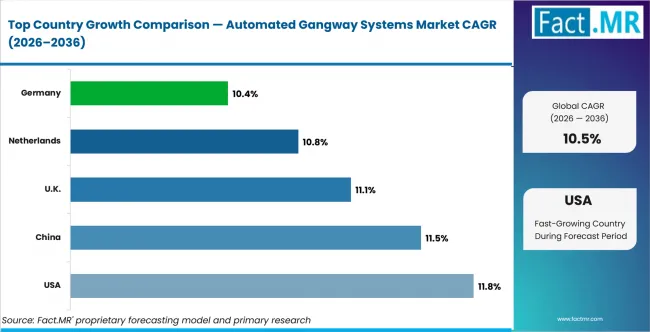
Automated Gangway Systems Market Cagr Analysis By Country | Source: Fact.MR
What is powering the United States lead?
11.8% CAGR, supported by offshore wind construction and cruise terminal renewal.
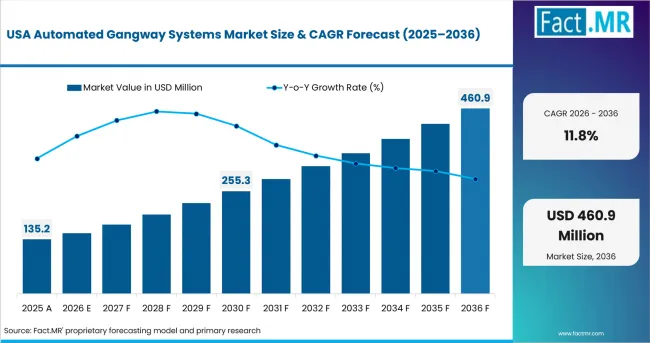
Automated Gangway Systems Market Country Value Analysis | Source: Fact.MR
The United States is moving from pilot offshore wind access toward larger construction and service packages. Ampelmann signed a June 2024 contract with Seaway7 to supply an E5000 gangway for a major US offshore wind project. The United States is projected to record an 11.8% CAGR through 2036, supported by offshore wind project work and cruise terminal access upgrades. Suppliers that combine local operators with offshore access equipment are better placed here.
How is China scaling automated gangway demand?
11.5% CAGR, driven by shipbuilding scale and offshore wind installation depth.
China has a large shipbuilding base and a deep offshore wind pipeline. The Global Wind Energy Council reported China led new offshore wind installations for the seventh year in a row in 2024. China is expected to expand at 11.5% CAGR through 2036, because domestic yards can integrate gangways into offshore service vessels. The market favors suppliers that can localize components and pass shipyard documentation checks.
Why does the United Kingdom remain a high-value market?
11.1% CAGR, supported by North Sea operations and clean power targets.
The United Kingdom has a large North Sea offshore wind base and a procurement culture built around vessel safety records. The Clean Power 2030 Action Plan identifies 43 to 50 GW of offshore wind capacity by 2030. The United Kingdom is forecast to grow at 11.1% CAGR through 2036, supported by SOV demand and port-side service activity. Buyers are likely to favor proven offshore access systems with local maintenance coverage.
What supports the Netherlands outlook?
10.8% CAGR, backed by offshore wind hubs and access system suppliers.
The Netherlands has both offshore wind demand and a local supplier base for walk-to-work equipment. The Netherlands Enterprise Agency stated that the country needs 30 to 40 GW of offshore wind by 2040. The Netherlands is expected to advance at 10.8% CAGR through 2036, because project developers and vessel operators need controlled access near North Sea assets. Suppliers can win by linking engineering, rental and field support in one contract path.
What underpins Germany’s growth?
10.4% CAGR, supported by offshore wind targets and industrial service demand.
Germany combines offshore wind targets with a demanding industrial buyer base. The German Offshore-Wind Energy Foundation reported 9.2 GW of offshore wind capacity in operation by June 2025. Germany is projected to rise at 10.4% CAGR through 2036, as operators add vessel access systems for construction and maintenance. The opportunity is strongest for suppliers that can document safety performance and support German yard requirements.
Who leads the automated gangway systems landscape?
Ampelmann, Uptime International and SMST lead through motion compensated access expertise.
Automated gangway systems are used by offshore operators and wind developers. They are also used by shipowners and ports that need documented access safety. Ampelmann is best positioned in motion compensated offshore access and rental-led work. Uptime International brings a long delivery record in walk-to-work systems. SMST competes through telescopic access bridges and mission equipment packages for SOV fleets.
MacGregor adds vessel integration strength through maritime access, cargo-handling, and offshore equipment portfolios. Marine Aluminium should be positioned as an offshore aluminium structures and gangway supplier, not a broad automated-gangway leader. KenzFigee brings port interface knowledge. ADELTE is relevant in passenger boarding bridges for cruise and ferry terminals. MacGregor now operates as a standalone company under Triton ownership, while TTS Group is treated only as a legacy name after the marine and offshore business acquisition.
Competition through 2036 is expected to depend on motion compensation performance, class documentation and service coverage. Suppliers with local operators and spare parts near offshore clusters are better placed. Equipment-only vendors may win small jobs but face limits in large offshore wind programs.
Which companies are the key players?
Ampelmann Operations; Uptime International AS; SMST Designers & Constructors; MacGregor; Marine Aluminium; KenzFigee; and ADELTE.
- Ampelmann Operations
- Uptime International AS
- SMST Designers & Constructors
- MacGregor
- Marine Aluminium
- KenzFigee
- ADELTE
Bibliography
- Global Wind Energy Council. (2025, June 25). Offshore wind installed capacity reaches 83 GW as new report finds 2024 a record year for construction and auctions.
- Cruise Lines International Association. (2025, June 24). 2024 Global Source Passenger Market Report. CLIA.
- Department for Energy Security and Net Zero. (2025, April 15). Clean Power 2030 Action Plan: A new era of clean electricity — main report. GOV.UK.
- Netherlands Enterprise Agency. (2026, June 10). New offshore wind farms. RVO.
- German Offshore Wind Energy Foundation. (2025, June 30). Status of offshore wind energy development in Germany: First half of 2025.
- Ampelmann. (2024, June 5). Ampelmann confirms major contract for work on US offshore wind project, expands local presence.
- Mohinder FinCo AB. (2025, August 29). Mohinder FinCo AB’s interim report April–June 2025: The acquisition of MacGregor was completed on 31 July 2025. MacGregor.
- UPTIME International AS. (2026). Gangways and logistics solutions. UPTIME International AS. Retrieved July 4, 2026.
- SMST Designers & Constructors B.V. (2026). Telescopic access bridges. SMST. Retrieved July 4, 2026.
- Marine Aluminium. (2026). About us. Marine Aluminium. Retrieved July 4, 2026.
- KenzFigee. (2026). Custom made lifting equipment offshore & marine. KenzFigee. Retrieved July 4, 2026.
- ADELTE Group. (2026). Seaports: Passenger boarding bridges, gangways & global services. ADELTE. Retrieved July 4, 2026.
This Report Addresses
- Strategic intelligence on automated gangway systems across gangway type, application and buyer type.
- Segment analysis covers Motion Compensated systems and Crew Transfer. It also covers Remote Controlled systems and Vessel Mounted systems with Offshore Operators.
- Regional outlook covers United States and China. It also covers United Kingdom, Netherlands and Germany.
- Competitive analysis covers Ampelmann Operations and Uptime International AS. It also covers SMST Designers & Constructors, MacGregor and ADELTE.
- Equipment assessment covers motion compensation and telescopic movement. It also reviews remote control and auto levelling.
- Application assessment covering offshore wind, cruise and ferry terminals and oil and gas transfer routes.
- Primary interviews and supplier checks support the forecast. Official source review and offshore deployment validation support the update cycle.
What does the automated gangway systems market cover?
Automated boarding bridges and walk-to-work systems for vessels, terminals and offshore assets.
The market covers powered gangways that use motion compensation; telescopic movement; auto levelling; remote operation or sensor feedback. These systems connect vessels to quays and offshore platforms. They also connect vessels to wind turbines and passenger terminals. The service focus is safe transfer between two assets that may move differently.
What is included in the scope?
Motion compensated systems and passenger boarding bridges.
The scope includes vessel-mounted walk-to-work gangways and offshore access bridges. It includes quay-mounted passenger boarding systems for cruise and ferry terminals. It also covers tower-mounted and mobile rental units used for construction, maintenance and temporary marine access work.
What is excluded from the scope?
Manual ladders and fixed ramps without automated control.
The scope excludes unpowered brows and simple accommodation ladders. It excludes conventional dockside ramps unless they include automated positioning or control. It also excludes cranes, lifting baskets and marine elevators when no gangway transfer function is included.
How was the analysis built?
100+ sources; 45+ company portfolios; 25+ countries; 20+ interviews.
- Primary Research: Primary research includes interviews with offshore vessel procurement teams and port terminal engineers. It also includes input from gangway system suppliers, shipyard package managers and marine service providers.
- Desk Research: Desk research reviews offshore wind capacity data, cruise passenger statistics and official energy plans. It covers company product lines and contract announcements for walk-to-work systems.
- Market-Sizing and Forecasting: Forecasting uses newbuild vessel activity, offshore wind service demand and port retrofit patterns. The calculation is reconciled against supplier portfolios and system pricing bands.
- Data Validation and Update Cycle: Forecasts are validated through provider checks and vessel deployment signals. New contracts, tender rounds and shipyard awards are reviewed during each update cycle.
Segmentation
What is the report’s scope and coverage?
| Attribute | Details |
|---|---|
| Quantitative Units | USD Billion in 2026 to USD Billion by 2036 at CAGR |
| Market Definition | Automated gangway systems for controlled movement between vessels, quays and offshore assets |
| Gangway Type | Motion Compensated, Telescopic, Tower Mounted, Mobile, Offshore Access |
| Application | Crew Transfer, Passenger Boarding, Offshore Wind, Oil and Gas, Cruise and Ferry |
| Automation | Remote Controlled, Auto Levelling, Positioning Linked, Sensor Assisted |
| Installation | Vessel Mounted, Quay Mounted, Platform Mounted, Mobile Rental |
| Buyer Type | Offshore Operators, Ports, Shipowners, Cruise Terminals, Wind Developers |
| Regions Covered | Europe, North America, East Asia, South Asia and Pacific, Latin America, Middle East and Africa |
| Countries Covered | United States, China, United Kingdom, Netherlands and Germany |
| Key Companies Profiled | Ampelmann Operations, Uptime International AS, SMST Designers & Constructors, MacGregor, Marine Aluminium, KenzFigee and ADELTE |
| Forecast Period | 2026 to 2036 |
| Approach | Hybrid top-down and bottom-up approach using offshore wind capacity, port retrofit demand, vessel packages and supplier validation |
Source: Fact.MR analysis. Updated Jul 4, 2026
How is the market segmented?
-
By Gangway Type:
- Motion Compensated
- Telescopic
- Tower Mounted
- Mobile
- Offshore Access
-
By Application:
- Crew Transfer
- Passenger Boarding
- Offshore Wind
- Oil and Gas
- Cruise and Ferry
-
By Automation:
- Remote Controlled
- Auto Levelling
- Positioning Linked
- Sensor Assisted
-
By Installation:
- Vessel Mounted
- Quay Mounted
- Platform Mounted
- Mobile Rental
-
By Buyer Type:
- Offshore Operators
- Ports
- Shipowners
- Cruise Terminals
- Wind Developers
-
By Region:
- North America
- United States
- Canada
- Mexico
- Latin America
- Brazil
- Argentina
- Chile
- Rest of Latin America
- Europe
- Germany
- United Kingdom
- France
- Italy
- Spain
- Rest of Europe
- Asia Pacific
- China
- India
- Japan
- South Korea
- ASEAN
- Middle East & Africa
- GCC Countries
- South Africa
- UAE
- Rest of Middle East & Africa
- North America
Frequently Asked Questions
Which gangway type leads the Automated Gangway Systems Market?
Which country expands faster in the Automated Gangway Systems Market?
How does China perform in the Automated Gangway Systems Market?
How does the United Kingdom perform in the Automated Gangway Systems Market?
How does the Netherlands perform in the Automated Gangway Systems Market?
How does Germany perform in the Automated Gangway Systems Market?
What is the primary driver in the Automated Gangway Systems Market?
What is the main restraint in the Automated Gangway Systems Market?
Why are motion compensated systems important in this market?
Who worked on this report


Preview the report firsthand - request a free sample
Free SampleGet the brochure for pricing and purchase details
Download PDF