- Base Value(2025): 1.2 Bn
- Estimated Value(2026): 1.3 Bn
- Forecast Value (2036): 2.9 Bn
- CAGR (2026 - 2036): 8.4%
Automated Guided Cart Market Analysis and Forecast by Fact.MR
- The global automated guided cart market is estimated at USD 1.301 billion in 2026 and is forecast to expand at a CAGR of 8.4% to reach USD 2.914 billion by 2036.
- Automated guided carts are low-cost, flexible material transport vehicles that follow magnetic tape, laser, or natural navigation paths within manufacturing and logistics facilities.
- Battery-powered lithium-ion units dominate, with laser guidance gaining share for flexible path planning.
- Growth is concentrated in e-commerce fulfillment, automotive assembly, and manufacturing intralogistics where AGCs provide lower-cost automation than full AGV or AMR systems.
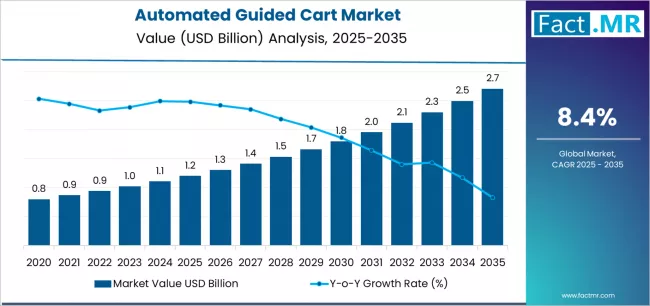
Automated Guided Cart Market Value Analysis | Source: Fact.MR
Summary of the Automated Guided Cart Market
- Market Snapshot
- In 2025, the global Automated Guided Cart Market was valued at approximately USD 1.2 billion.
- The market is estimated to reach USD 1.301 billion in 2026 and is projected to attain USD 2.914 billion by 2036.
- The automated guided cart market is likely to expand at a CAGR of 8.4% during the forecast period.
- The market is anticipated to create an absolute dollar opportunity of USD 1.613 billion between 2026 and 2036.
- Warehousing and Logistics accounts for 37.6% of the application segment share in 2026.
- USA (9.4%) and Mexico (9.0%) are the key growth markets during the forecast period.
- Demand and Growth Drivers
- E-commerce fulfillment automation and automotive assembly line material transport is the primary growth driver.
- Labor cost pressures in warehousing and manufacturing drive adoption of AGCs that reduce material handling headcount supports market expansion.
- Flexible path AGCs eliminating magnetic tape infrastructure reduce deployment cost and time accelerates adoption.
- Manufacturing facility layout flexibility requirements favor AGCs over fixed conveyor systems broadens demand.
- Automotive just-in-sequence part delivery to assembly lines creates structured AGC deployment expands the addressable market.
- Product and Segment View
- Towable Automated Guided Carts accounts for 21.8% of the product segment in 2026.
- Laser Guidance Systems represents 28.4% of the navigation technology segment.
- Medium Duty Carts holds 34.2% of the load capacity segment.
- Key segmentation includes:
- Product: Towable Automated Guided Carts, Manual Hitch Assisted Carts, Semi Automated Towing Carts, Autonomous Navigation Carts
- Navigation Technology: Laser Guidance Systems, LiDAR Mapping Systems, Reflector Based Laser Navigation, Vision Guidance Systems
- Load Capacity: Medium Duty Carts, 500 to 2000 Kg Capacity, Pallet Movement Carts, Light Duty Carts
- Power Source: Battery Powered, Lithium Ion Battery AGCs, Lead Acid Battery AGCs, Hybrid Powered
- These systems enable:
- Primary operational capability
- Flexible deployment and scaling
- Integration with facility management systems
- Geography and Competitive Outlook
- North America holds significant value, with the U.S. at USD 0.447 billion in 2026.
- North America leads by growth, with USA (9.4%) and Mexico (9.0%).
- Europe shows growth led by Germany (7.4%).
- Key companies include JBT Corporation, Toyota Material Handling, Inc., Murata Machinery, Ltd., KUKA AG.
- Analyst Opinion
- Shambhu Nath Jha, Principal Consultant at Fact.MR, says 'The AGC market represents the entry point for intralogistics automation, positioned below AGVs and AMRs in both cost and capability. E-commerce fulfillment and automotive assembly are the primary adoption drivers. Manufacturers offering scalable fleets with simple deployment, fleet management software, and integration with warehouse management systems are capturing share from operators seeking automation at 40 to 60 percent of traditional AGV investment.'
Key Growth Drivers, Constraints, and Opportunities
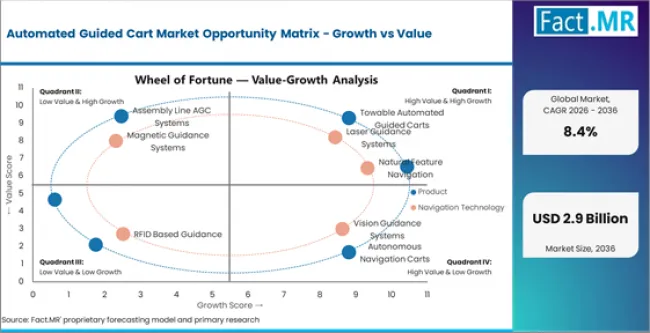
Automated Guided Cart Market Opportunity Matrix Growth Vs Value | Source: Fact.MR
Key Factors Driving Growth
- E-commerce fulfillment automation and automotive assembly line material transport is the primary growth driver.
- Labor cost pressures in warehousing and manufacturing drive adoption of AGCs that reduce material handling headcount supports market expansion.
- Flexible path AGCs eliminating magnetic tape infrastructure reduce deployment cost and time accelerates adoption.
Key Market Constraints
- High capital cost or service complexity creates barriers for smaller operators.
- Market cyclicality tied to construction or manufacturing activity creates demand volatility.
- Competition from alternative solutions limits share in specific application segments.
Key Opportunity Areas
- Technology advancement creates premium product and service tiers.
- Emerging market infrastructure expansion creates greenfield demand.
- Digital platform integration creates service differentiation and recurring revenue.
Segment-wise Analysis of the Automated Guided Cart Market
- Towable Automated Guided Carts accounts for 21.8% of the product segment in 2026.
- Laser Guidance Systems represents 28.4% of the navigation technology segment.
- Medium Duty Carts holds 34.2% of the load capacity segment.
The automated guided cart market is segmented by product, navigation technology, load capacity, power source, and region.
Which Product Segment Dominates the Automated Guided Cart Market?
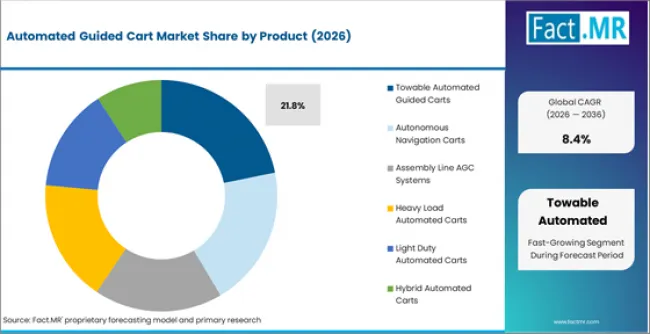
Automated Guided Cart Market Analysis By Product | Source: Fact.MR
Towable Automated Guided Carts accounts for 21.8% in 2026.
Alternative configurations serve specialized niches and are gaining share through technology or service model advancement.
Which Application Segment Dominates the Automated Guided Cart Market?
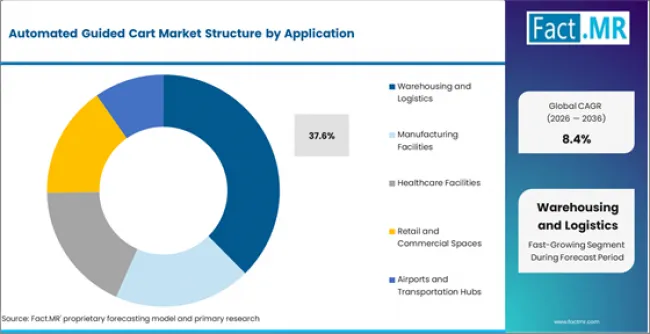
Automated Guided Cart Market Analysis By Application | Source: Fact.MR
Warehousing and Logistics leads with 37.6% share in 2026.
Secondary segments represent growing demand as applications expand beyond core procurement channels.
Which Product Trend is Shaping the Next Phase of Growth in the Automated Guided Cart Market?
Natural navigation AGCs using LiDAR and SLAM algorithms that eliminate magnetic tape infrastructure are the product trend reshaping the market. These systems map facility environments dynamically, adjusting paths around obstacles without fixed guidepath installation. The elimination of floor-mounted magnetic tape reduces deployment time from weeks to days and enables path changes without facility modification.
Natural navigation also enables AGC deployment in environments that were previously impractical for guided carts, including multi-tenant warehouses, seasonal pop-up fulfillment operations, and manufacturing facilities with frequently changing layouts. Manufacturers offering natural navigation with fleet coordination software are capturing specification wins from operations requiring deployment flexibility.
Regional Outlook Across Key Markets
.webp "Top Country Growth Comparison Automated Guided Cart Market Cagr (2026 2036)")
Top Country Growth Comparison Automated Guided Cart Market Cagr (2026 2036) | Source: Fact.MR
- The U.S. leads at 9.4%, supported by e-commerce fulfillment center automation, automotive assembly line material transport investment, and labor cost pressures driving intralogistics automation adoption across manufacturing and warehousing.
- Mexico (9.0%) reflects nearshoring manufacturing investment creating new automated material handling installations at automotive, electronics, and consumer goods assembly plants commissioning AGC fleets from startup.
- Europe shows growth led by Germany (8.2%) and France (8.0%), supported by Industrie 4.0 intralogistics integration, automotive just-in-sequence part delivery, and growing adoption of flexible AGC systems replacing fixed conveyor infrastructure.
CAGR Table
| Country | CAGR (%) |
|---|---|
| USA | 9.4% |
| Mexico | 9.0% |
| Germany | 8.2% |
| France | 8.0% |
| UK | 7.4% |
| South Korea | 7.3% |
| Japan | 7.1% |
Source: Fact.MR analysis. Updated Jun 1, 2026
Source: Fact MR (FMR) analysis, based on proprietary forecasting model and primary research.
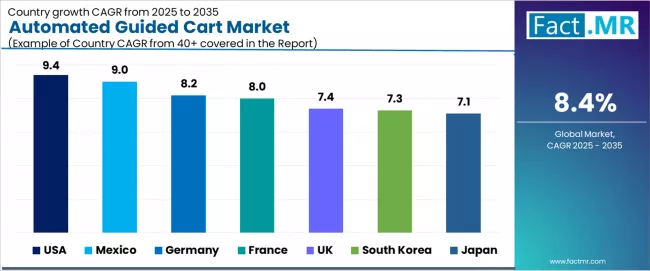
Automated Guided Cart Market Cagr Analysis By Country | Source: Fact.MR
Market Outlook for Automated Guided Carts in the United States
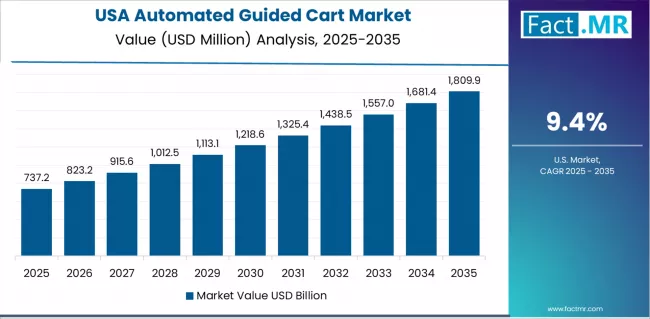
Automated Guided Cart Market Country Value Analysis | Source: Fact.MR
E-commerce fulfillment automation and automotive assembly material transport are the primary demand drivers at 9.4% CAGR. Amazon, Walmart, and third-party logistics providers are deploying AGC fleets in distribution centers where cart-based transport reduces labor costs by 30 to 40 percent compared to manual pallet movement.
- E-commerce fulfillment center construction generates AGC fleet procurement at each new facility, with 50 to 200 carts per distribution center depending on floor area and throughput requirements.
- Automotive just-in-sequence part delivery from staging areas to assembly lines creates structured AGC deployment where precise timing and path reliability are critical to production flow.
Automated Guided Cart Demand Trends in Mexico
Nearshoring automotive and electronics manufacturing investment is creating greenfield AGC demand at 9.0% CAGR. New assembly plants being commissioned in Monterrey, Queretaro, and Aguascalientes are specifying automated material handling from project startup rather than retrofitting manual systems.
- Automotive tier-1 supplier plants are deploying AGCs for component staging and line-side delivery to match OEM production schedules at adjacent assembly facilities.
- Electronics manufacturing expansion is generating AGC procurement for cleanroom-compatible material transport in semiconductor packaging and consumer electronics assembly.
Germany Automated Guided Cart Market Demand Analysis
Industrie 4.0 intralogistics integration and automotive assembly automation shape demand at 8.2% CAGR. German manufacturing facilities are replacing fixed conveyor infrastructure with flexible AGC networks that adapt to changing production layouts and product mix.
- Automotive OEM production facilities are deploying AGC networks for flexible part delivery that accommodates multiple vehicle models on shared assembly lines.
- Industrie 4.0 integration connects AGC fleet management with MES and ERP systems, enabling demand-driven material transport synchronized with production scheduling.
France Automated Guided Cart Growth Outlook
Logistics modernization and aerospace manufacturing material handling are the primary demand channels at 8.0% CAGR. French logistics operators are adopting AGCs as a cost-effective automation tier below AMR and conveyor systems.
- Aerospace component manufacturing in Toulouse and surrounding supply chain facilities generates AGC demand for heavy-part transport between machining and assembly stations.
- Food and beverage distribution centers are deploying AGCs for pallet transport in temperature-controlled environments where labor efficiency improvements justify automation investment.
South Korea Automated Guided Cart Opportunity
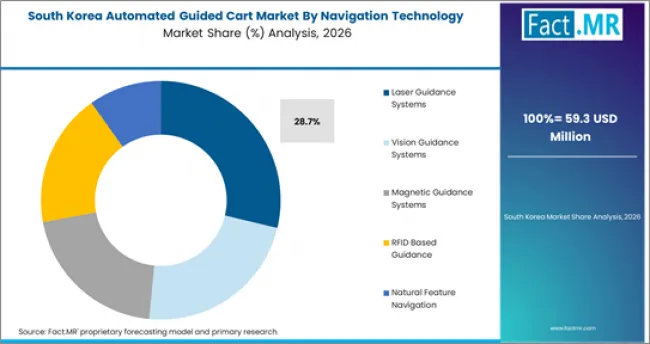
Automated Guided Cart Market South Korea Market Share Analysis By Navigation Technology | Source: Fact.MR
Semiconductor and electronics manufacturing concentration creates high-specification AGC demand at 7.3% CAGR. Korean semiconductor fabs and display panel factories require cleanroom-rated AGCs for wafer carrier and component transport.
- Semiconductor fabrication facilities require ISO-classified cleanroom AGCs for automated wafer carrier transport between processing stations.
- Automotive production for Hyundai and Kia platforms generates AGC procurement for assembly line material staging and just-in-sequence delivery.
Competitive Benchmarking and Company Positioning
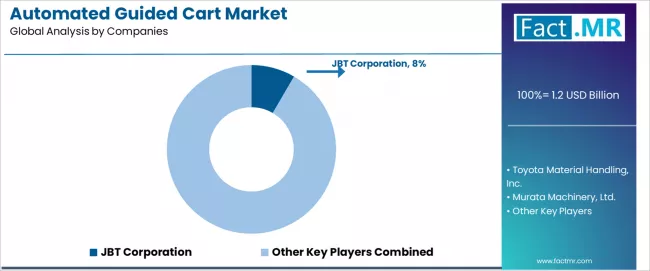
Automated Guided Cart Market Analysis By Company | Source: Fact.MR
Automated Guided Cart Market Analysis By Company
- JBT Corporation holds a leading position with approximately 8.0% share.
- Toyota Material Handling, Inc. and Murata Machinery, Ltd. compete through specialized capabilities and regional strength.
- Fleet management software and deployment flexibility are primary competitive differentiators.
The landscape is moderately fragmented. JBT Corporation leads through technology platform and fleet management.
Toyota Material Handling, Inc., Murata Machinery, Ltd., KUKA AG serve specific segments and regional markets.
Strategic priorities include technology advancement, geographic expansion, and service capability development.
Key Companies in the Automated Guided Cart Market
- JBT Corporation, Toyota Material Handling, Inc., Murata Machinery, Ltd., KUKA AG are among the leading players in the automated guided cart market globally, supported by strong brand visibility, broad service portfolios, and growing positions in managed energy solutions.
- Daifuku Co., Ltd., Seegrid Corporation, Rocla Oy, Savant Automation, Inc. hold established positions across specific service segments, end-use categories, and regional markets, supported by specialized capabilities and established commercial relationships.
- EK Robotics GmbH, Addverb Technologies Pvt. Ltd. continue to compete through focused offerings, technology partnerships, and regional service networks.
Recent Industry Developments
- Seegrid, Technology Enhancement, Natural Navigation AGC Platform (2025)
- Seegrid continued advancement of its vision-guided AGC platform using natural feature navigation without infrastructure modification, targeting manufacturing and logistics operations seeking flexible deployment without magnetic tape installation.
- Toyota Material Handling, Fleet Expansion, AGC Product Line (2025)
- Toyota Material Handling expanded its automated guided cart portfolio for manufacturing and warehousing applications, leveraging its material handling distribution network to reach a broader customer base for entry-level intralogistics automation.
- Daifuku, System Integration, AGC Fleet Management (2025)
- Daifuku advanced its AGC fleet management and WMS integration capability, targeting e-commerce fulfillment center operators seeking coordinated multi-vehicle automated transport within high-throughput warehouse environments.
Leading Companies Shaping the Automated Guided Cart Market
- JBT Corporation
- Toyota Material Handling, Inc.
- Murata Machinery, Ltd.
- KUKA AG
- Daifuku Co., Ltd.
- Seegrid Corporation
- Rocla Oy
- Savant Automation, Inc.
- EK Robotics GmbH
- Addverb Technologies Pvt. Ltd.
Sources and Research References
- JBT Corporation. Product and service developments.
- Toyota Material Handling, Inc.. Market and technology expansion.
- Murata Machinery, Ltd.. Competitive developments.
- Industry associations. Market activity and regulatory data.
- Primary interviews across market participants.
- This bibliography is provided for reader reference and is not exhaustive.
Key Questions This Report Addresses
- What is the current and future size of the Automated Guided Cart Market?
- How fast is the Automated Guided Cart Market expected to grow between 2026 and 2036?
- Which segment leads by 2026?
- What drives demand?
- How is technology influencing the market?
- Why is USA the fastest-growing market?
- Which countries show fastest growth?
- Who are key companies in the Automated Guided Cart Market?
- How does Fact.MR validate the forecast?
Automated Guided Cart Market Definition
The automated guided cart market covers automated guided carts are low-cost, flexible material transport vehicles that follow magnetic tape, laser, or natural navigation paths within manufacturing and logistics facilities.
Automated Guided Cart Market Inclusions
- The scope covers global and regional forecasts for 2026 to 2036.
- It includes regional demand analysis based on industry-specific factors.
- The report includes pricing across product and service categories.
- It covers technology trends, competitive landscape, and market participants.
Automated Guided Cart Market Exclusions
- The scope excludes consumer-grade and non-commercial products.
- It excludes ancillary products sold separately.
- The report excludes custom one-off equipment.
Automated Guided Cart Market Research Methodology
- The methodology combines secondary research, primary interviews, and forecast modelling.
- It draws on 90+ secondary sources.
- Market sizing covers 30+ countries.
- Key inputs include industry activity data and equipment fleet counts.
- The model cross-checks with operator and manufacturer data.
- Primary validation includes 20+ interviews.
- Final estimates go through reconciliation and sensitivity testing.
Segmentation
Scope of Analysis
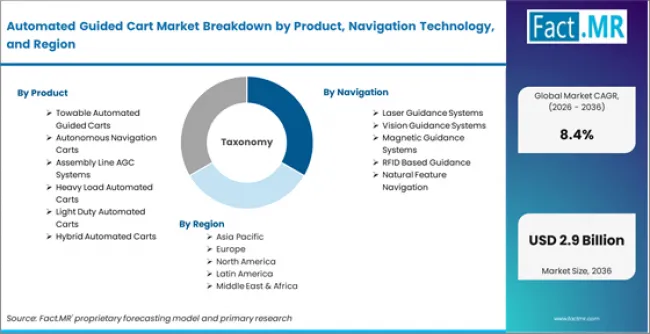
Automated Guided Cart Market Breakdown By Product, Navigation Technology, And Region | Source: Fact.MR
| Parameter | Details |
|---|---|
| Quantitative Units | USD 1.301 billion to USD 2.914 billion, at a CAGR of 8.4% |
| Market Definition | The automated guided cart market covers automated guided carts are low-cost, flexible material transport vehicles that follow magnetic tape, laser, or natural navigation paths within manufacturing and logistics facilities. |
| Regions Covered | North America, Latin America, Europe, East Asia, South Asia and Pacific, Middle East and Africa |
| Countries Covered | USA, Mexico, Germany, France, UK, South Korea, Japan, 30 plus countries |
| Key Companies | JBT Corporation, Toyota Material Handling, Inc., Murata Machinery, Ltd., KUKA AG, Daifuku Co., Ltd., Seegrid Corporation, Rocla Oy, Savant Automation, Inc., EK Robotics GmbH, Addverb Technologies Pvt. Ltd. |
| Forecast Period | 2026 to 2036 |
| Approach | Hybrid demand-side methodology built on industry-specific activity data, equipment fleet counts, and primary interviews across manufacturers, operators, and end users |
Source: Fact.MR analysis. Updated Jun 1, 2026
Automated Guided Cart Market Segmentation
-
Automated Guided Cart Market Segmented by Product:
- Towable Automated Guided Carts
- Manual Hitch Assisted Carts
- Semi Automated Towing Carts
- Autonomous Navigation Carts
- LiDAR Based Navigation Carts
- Vision Guided Navigation Carts
- RFID Guided Navigation Carts
- Assembly Line AGC Systems
- Parts Transport Carts
- WIP Material Movement Carts
- Heavy Load Automated Carts
- Pallet Transport Carts
- Industrial Load Carriers
- Light Duty Automated Carts
- Component Handling Carts
- Small Parcel Transport Carts
- Hybrid Automated Carts
- Manual Mode Assisted AGCs
- Fully Autonomous Mode AGCs
- Towable Automated Guided Carts
-
Automated Guided Cart Market Segmented by Navigation Technology:
- Laser Guidance Systems
- LiDAR Mapping Systems
- Reflector Based Laser Navigation
- Vision Guidance Systems
- Camera Based Navigation
- AI Image Recognition Systems
- Magnetic Guidance Systems
- Floor Embedded Magnetic Tape Navigation
- Route Marked Magnetic Navigation
- RFID Based Guidance
- Tag Based Positioning Systems
- UHF RFID Tracking Systems
- Natural Feature Navigation
- SLAM Based Navigation
- AI Path Optimization Systems
- Laser Guidance Systems
-
Automated Guided Cart Market Segmented by Load Capacity:
- Medium Duty Carts
- 500 to 2000 Kg Capacity
- Pallet Movement Carts
- Light Duty Carts
- Up to 500 Kg Capacity
- Component Transport Carts
- Heavy Duty Carts
- Above 2000 Kg Capacity
- Industrial Material Handling Carts
- Medium Duty Carts
-
Automated Guided Cart Market Segmented by Power Source:
- Battery Powered
- Lithium Ion Battery AGCs
- Lead Acid Battery AGCs
- Hybrid Powered
- Battery and Wired Charging Systems
- Auto Charging Dock Systems
- Wire Powered
- Continuous Power Supply Systems
- Floor Embedded Power Rails
- Battery Powered
-
Automated Guided Cart Market Segmented by Application:
- Warehousing and Logistics
- E Commerce Fulfillment Centers
- Distribution Centers
- Manufacturing Facilities
- Automotive Assembly Plants
- Electronics Manufacturing Units
- Healthcare Facilities
- Hospital Material Transport
- Pharmaceutical Warehouses
- Retail and Commercial Spaces
- Retail Inventory Movement
- Backend Stock Handling
- Airports and Transportation Hubs
- Baggage Handling Systems
- Cargo Movement Systems
- Warehousing and Logistics
-
Automated Guided Cart Market by Region:
- North America
- USA
- Canada
- Mexico
- Latin America
- Brazil
- Chile
- Rest of Latin America
- Western Europe
- Germany
- UK
- Italy
- Spain
- France
- Nordic
- BENELUX
- Rest of Western Europe
- Eastern Europe
- Russia
- Poland
- Hungary
- Balkan & Baltic
- Rest of Eastern Europe
- East Asia
- China
- Japan
- South Korea
- South Asia and Pacific
- India
- ASEAN
- Australia & New Zealand
- Rest of South Asia and Pacific
- Middle East & Africa
- Kingdom of Saudi Arabia
- Other GCC Countries
- Turkiye
- South Africa
- Other African Union
- Rest of Middle East & Africa
- North America
Frequently Asked Questions
How big is the automated guided cart market in 2026?
What will be the size of automated guided cart market in 2036?
How much will be the automated guided cart market growth between 2026 and 2036?
What are the key product types in the automated guided cart market?
Which navigation technology segment is expected to contribute significant share in the automated guided cart market in 2026?
Who worked on this report


Preview the report firsthand - request a free sample
Free SampleGet the brochure for pricing and purchase details
Download PDF