- Market Value (2025): USD 3.79 Bn
- Estimated Value (2026): USD 4.12 Bn
- Forecast Value (2036): USD 9.4 Bn
- CAGR (2026-2036): 8.6%
What is the Automotive Magnesium Alloy Market forecast to be worth by 2036?
USD 4.1 billion in 2026 to USD 9.4 billion by 2036 at an 8.6% CAGR.
- As per Fact.MR analysis, the automotive magnesium alloy market was valued at USD 3.79 billion in 2025.
- Automotive magnesium alloy sales are forecast to increase from USD 4.12 billion in 2026 to USD 9.4 billion by 2036.
- The market is forecast to register an 8.6% CAGR from 2026 to 2036 as more qualified cast and wrought parts enter vehicle programs.
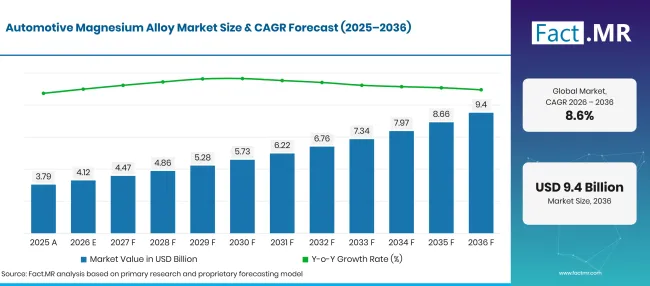
Factmr Automotive Magnesium Alloy Market Forecast Global | Source: Fact.MR
| Year | Basis | Market Value (USD billion) |
|---|---|---|
| 2025 | Actual | 3.78 |
| 2026 | Estimate | 4.10 |
| 2036 | Forecast | 9.40 |
| CAGR 2026 to 2036 | Forecast period | 8.6% |
Source: Fact.MR analysis. Updated Oct 13, 2026
What are the defining numbers behind Automotive Magnesium Alloy Market growth?
USD 5.3 billion in absolute opportunity between 2026 and 2036.
- Demand Drivers in the Market
- Automotive design engineers will continue to use weight targets to identify magnesium alloys for components where a single casting can take the place of a heavier assembly. Material selection will still depend on performance requirements, load conditions, and the overall cost of the finished component.
- Vehicle manufacturers will increasingly review weight reduction opportunities across electric and hybrid vehicle programs. As the number of electrified vehicle platforms grows, light metal materials such as magnesium alloys will receive greater attention for applications where reducing vehicle mass can support efficiency and overall vehicle performance.
- Purchasing teams will continue to prioritize suppliers that provide consistent alloy quality and maintain reliable delivery schedules. Component quality will remain a major consideration, particularly when magnesium castings are combined with other metals.
- Key Segments Analyzed
- By Product Type: Cast Magnesium Alloy holds 64.2% share in 2026, because it suits formed housings and structural casting designs.
- By Application: Body Structure accounts for 28.6% share in 2026 as component engineers assess lighter supports and reinforcements.
- By Vehicle Type: Passenger Vehicles lead with78.4% share in 2026 because model production supports repeated part programs.
- By Manufacturing Process: Die Casting represents 42.7% share in 2026, helped by repeatable near-net-shape component production.
- Analyst Opinion at Fact.MR
- Shambhu Nath Jha, Principal Consultant at Fact.MR, states, “Choosing magnesium will involve more than replacing one metal with another, as automakers will need to approve the finished part for regular vehicle production. They will be more likely to increase purchases when a lighter casting also meets cost, joining, and finishing requirements.”
- Strategic Implications
- Automakers will compare finished part costs and weight savings for each design rather than selecting materials based on weight alone. Similar weight and cost considerations will continue to influence material selection in automotive metal wheel design.
- Foundries will place early focus on casting trials that demonstrate consistent dimensions and stable rejection rates.
- Alloy producers will align material availability with the specific corrosion protection and joining requirements of vehicle components.
- Component engineers will assess the complete assembly, as fasteners and protective finishes will continue to influence final cost and service life.
Fact.MR projects different growth rates for automotive magnesium alloy sales across the five countries. Japan will grow at 10.7% CAGR as engineers assess lighter vehicle components. The United Kingdom follows at 9.7%, with Brazil at 8.7%. The United States records 7.4% and Germany 6.7%, reflecting different production programs and sourcing conditions.
How does the Automotive Magnesium Alloy Market break down by segment?
Cast Magnesium Alloy leads at 64.2%; Body Structure at 28.6%; Passenger Vehicles at 78.4%; Die Casting at 42.7%.
Which Product Type dominates?
Cast Magnesium Alloy holds 64.2% share in 2026.
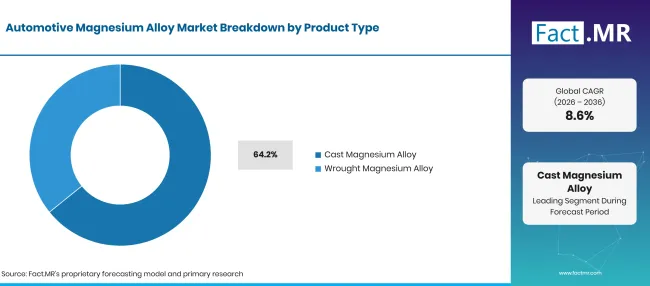
Factmr Automotive Magnesium Alloy Market Breakdown Product Type | Source: Fact.MR
| Product Type | Share (2026) |
|---|---|
| Cast Magnesium Alloy (Leading segment) | 64.2% |
| Other segments combined | 35.8%* |
| Total | 100.0% |
Source: Fact.MR analysis. Updated Oct 13, 2026
Cast magnesium alloy will suit vehicle components that require complex shapes and uniform wall thickness. The casting process will produce parts close to their final form and will reduce the need for extensive machining in suitable applications. Wrought magnesium alloys will remain suitable for applications where rolled or extruded forms better handle mechanical loads. Engineers will evaluate forming limitations and surface protection requirements before selecting these materials.
What leads the Application segment?
Body Structure is expected to account for a 28.6% share in 2026.
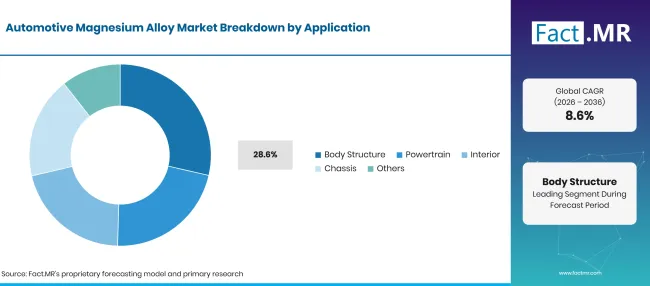
Factmr Automotive Magnesium Alloy Market Breakdown Application | Source: Fact.MR
| Application | Share (2026) |
|---|---|
| Body Structure (Leading segment) | 28.6% |
| Other segments combined | 71.4%* |
| Total | 100.0% |
Source: Fact.MR analysis. Updated Oct 13, 2026
Body structure applications will include selected supports and housings where automakers will use lower mass without compromising assembly strength. Powertrain components will provide another opportunity for magnesium alloys, depending on heat exposure and durability requirements. Interior structures will continue to attract interest where a single casting can simplify brackets and mounting points. Chassis applications will face strict impact and fatigue requirements, which will influence the pace of broader adoption.
How does Vehicle Type shape sales?
Passenger Vehicles are expected to account for a 78.4% share in 2026.
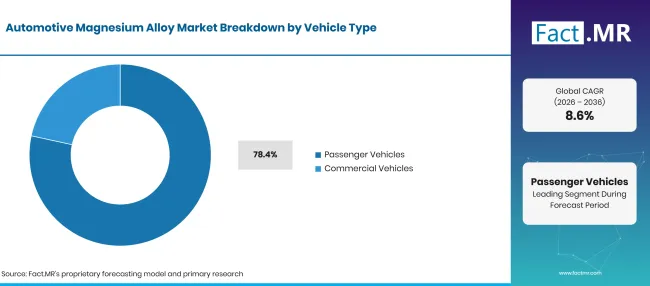
Factmr Automotive Magnesium Alloy Market Breakdown Vehicle Type | Source: Fact.MR
| Vehicle Type | Share (2026) |
|---|---|
| Passenger Vehicles (Leading segment) | 78.4% |
| Other segments combined | 21.6%* |
| Total | 100.0% |
Source: Fact.MR analysis. Updated Oct 13, 2026
Passenger vehicle programs will create steady demand when an alloy component meets design and quality requirements. Carmakers will spread tooling costs across production runs and use the same component across selected vehicle models. Commercial vehicles will present further opportunities, although payload requirements and longer service life expectations will continue to influence material choices.
Which Manufacturing Process leads?
Die Casting is forecast to represent a 42.7% share in 2026.
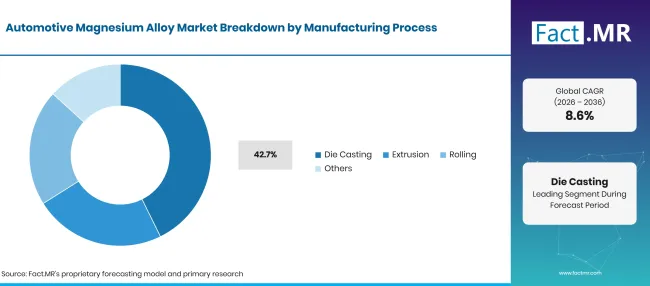
Factmr Automotive Magnesium Alloy Market Breakdown Manufacturing Process | Source: Fact.MR
| Manufacturing Process | Share (2026) |
|---|---|
| Die Casting (Leading segment) | 42.7% |
| Other segments combined | 57.3%* |
| Total | 100.0% |
Source: Fact.MR analysis. Updated Oct 13, 2026
Die casting will remain suitable for high-volume production of detailed magnesium components where tooling costs can be supported by vehicle production volumes. Extrusion will produce profile-based components, while rolling will provide sheet material for suitable formed applications. Other manufacturing processes will serve specialized requirements but will require dedicated equipment and testing. Casting yield and surface finishing requirements will continue to influence overall production economics.
What is accelerating Automotive Magnesium Alloy Market adoption, and what is holding it back?
Fact.MR expects that vehicle weight reduction will continue to support material trials, while qualification costs and magnesium supply conditions will remain key factors limiting broader adoption.
Drivers Impact Analysis
| DRIVER | (~) % IMPACT ON CAGR | GEOGRAPHIC RELEVANCE | IMPACT TIMELINE |
|---|---|---|---|
| Vehicle mass-reduction programs | +1.3% | Global | Long term (>= 4 years) |
| Complex automotive castings | +1.0% | East Asia, Europe | Medium term (2–4 years) |
| Electrified vehicle design changes | +0.9% | Europe, North America | Medium term (2–4 years) |
| Passenger vehicle platform renewal | +0.7% | Global | Long term (>= 4 years) |
| Part consolidation opportunities | +0.5% | Global | Medium term (2–4 years) |
Source: Fact.MR analysis. Updated Oct 13, 2026
Opportunity Impact Analysis
| OPPORTUNITY | (~) % IMPACT ON CAGR | GEOGRAPHIC RELEVANCE | IMPACT TIMELINE |
|---|---|---|---|
| More integrated cast components | +0.9% | Global | Medium term (2–4 years) |
| Higher-value interior supports | +0.7% | North America, Europe | Medium term (2–4 years) |
| Local casting supply contracts | +0.6% | Latin America | Long term (>= 4 years) |
| Improved recycling and scrap handling | +0.5% | Global | Long term (>= 4 years) |
Source: Fact.MR analysis. Updated Oct 13, 2026
Restraints Impact Analysis
| RESTRAINT | (~) % IMPACT ON CAGR | GEOGRAPHIC RELEVANCE | IMPACT TIMELINE |
|---|---|---|---|
| Raw magnesium price swings | -0.9% | Global | Short term (<= 2 years) |
| Corrosion and joining requirements | -0.7% | Global | Medium term (2–4 years) |
| Qualification and tooling expense | -0.6% | Global | Medium term (2–4 years) |
| Uncertain vehicle build schedules | -0.4% | Europe, Americas | Short term (<= 2 years) |
Source: Fact.MR analysis. Updated Oct 13, 2026
Which countries are scaling the Automotive Magnesium Alloy Market through 2036?
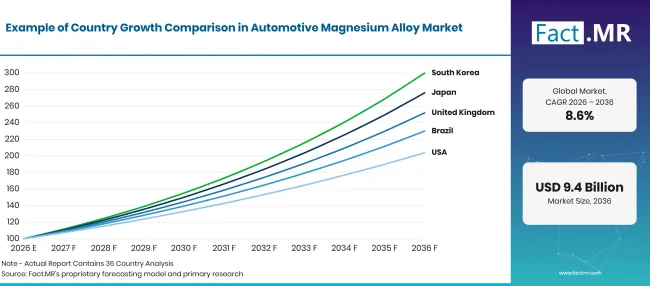
Factmr Automotive Magnesium Alloy Market Growth Index | Source: Fact.MR
| Country | CAGR (2026–2036) |
|---|---|
| Japan | 10.7% |
| United Kingdom | 9.7% |
| Brazil | 8.7% |
| United States | 7.4% |
| Germany | 6.7% |
Source: Fact.MR analysis. Updated Oct 13, 2026
What supports Japan’s magnesium alloy outlook?
10.7% CAGR, supported by passenger vehicle redesign and new casting opportunities.
Japan’s automotive production base will continue to provide component makers with regular opportunities to introduce lighter magnesium parts during vehicle redesigns. The Ministry of Economy, Trade and Industry reported that the automotive industry production index increased 1.2% in 2025 [3]. Magnesium suppliers will benefit when thin-wall castings and selected wrought parts meet automakers’ requirements for lower weight, surface finish, and long-term durability.
How is the United Kingdom developing demand?
9.7% CAGR, shaped by export-focused vehicle manufacturing and new model programs.
UK vehicle production will continue to create opportunities for magnesium suppliers to participate in new casting programs when vehicle models are redesigned. The Society of Motor Manufacturers and Traders reported that 717,371 passenger cars were built in the United Kingdom in 2025 [2]. Suppliers will gain business opportunities where lower component weight and simpler assembly help justify tooling, corrosion protection, and qualification costs.
What shapes magnesium alloy sales in Brazil?
8.7% CAGR, driven by domestic vehicle assembly and local supplier qualification.
Brazil’s opportunity will remain closely tied to local vehicle production and the ability of component makers to qualify magnesium castings for vehicle assembly programs. ANFAVEA reported that vehicle production reached 2.644 million units in 2025 [1]. Local suppliers will be better positioned to compete when they provide consistent alloy quality, reliable deliveries, and finished parts that deliver clear weight advantages over existing steel and aluminum designs.
What supports United States adoption?
7.4% CAGR, supported by vehicle weight reduction and electrified-platform design changes.
U.S. automakers will continue to evaluate magnesium in applications where larger vehicles and electric platforms create new weight reduction and packaging requirements. The U.S. Department of Energy reported 1,843,100 registered electric light-duty vehicles in California in 2025 [4]. Domestic casting suppliers will benefit by participating in early tooling trials and demonstrating reliable alloy control, corrosion resistance, and effective scrap management.
Who leads the Automotive Magnesium Alloy Market?
Competition will continue to span primary magnesium producers and companies that convert alloys into automotive components. Meridian Lightweight Technologies will continue to be recognized for its magnesium die-casting capabilities for vehicle components. Wanfeng Auto Holding Group will remain involved in automotive component production. Producers and component manufacturers will compete at different stages of the value chain, so purchasing teams will assess them based on their specific material or finished-part requirements.
Dead Sea Magnesium Ltd. will remain associated with primary magnesium supply. RIMA Group will continue to maintain metals operations that require clear product-level distinction from finished automotive magnesium components
Which companies are the key providers?
Key companies include Meridian Lightweight Technologies; Wanfeng Auto Holding Group; Shanxi Wenxi Yinguang Magnesium Industry (Group) Co., Ltd.; Dynacast International LLC; Dead Sea Magnesium Ltd.; and RIMA Group.
- Meridian Lightweight Technologies
- Wanfeng Auto Holding Group
- Shanxi Wenxi Yinguang Magnesium Industry (Group) Co., Ltd.
- Dynacast International LLC
- Dead Sea Magnesium Ltd.
- RIMA Group
What is the report’s scope and coverage?
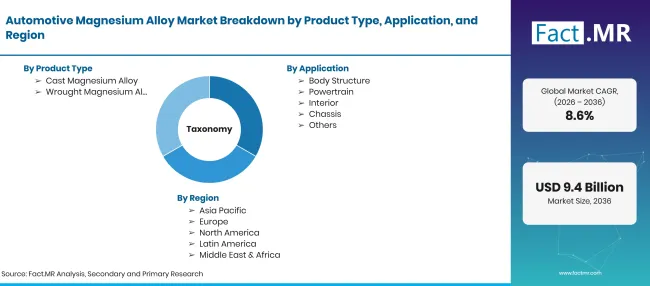
Factmr Automotive Magnesium Alloy Market Taxonomy | Source: Fact.MR
| Attribute | Details |
|---|---|
| Quantitative Units | USD billion |
| Market Definition | Magnesium-based alloy materials and automotive parts intended for passenger and commercial vehicle applications. |
| Product Type | Cast Magnesium Alloy; Wrought Magnesium Alloy |
| Application | Body Structure; Powertrain; Interior; Chassis; Others |
| Vehicle Type | Passenger Vehicles; Commercial Vehicles |
| Manufacturing Process | Die Casting; Extrusion; Rolling; Others |
| Regions Covered | North America; Latin America; Western Europe; Eastern Europe; East Asia; South Asia & Pacific; Middle East & Africa |
| Countries Covered | Japan; United Kingdom; Brazil; United States; Germany |
| Key Companies Profiled | Meridian Lightweight Technologies; Wanfeng Auto Holding Group; Shanxi Wenxi Yinguang Magnesium Industry (Group) Co., Ltd.; Dynacast International LLC; Dead Sea Magnesium Ltd.; RIMA Group |
| Forecast Period | 2026 to 2036 |
| Approach | Review of automotive magnesium alloy applications, product forms, vehicle programs, manufacturing processes, country growth, supplier participation, and official automotive production indicators. |
Source: Fact.MR analysis. Updated Oct 13, 2026
Bibliography
- [1] Associação Nacional dos Fabricantes de Veículos Automotores. (2026, January 15). Produção e venda de autoveículos crescem em 2025 e Anfavea projeta nova alta em 2026.
- [2] Society of Motor Manufacturers and Traders. (2026, January 29). Tough year for auto but new models and Industrial Strategy can deliver growth.
- [3] Ministry of Economy, Trade and Industry. (2026, June 30). Indices of Industrial Production: Preliminary Report for May 2026.
- [4] U.S. Department of Energy, Alternative Fuels Data Center. (n.d.). Vehicle registration counts by state.
- [5] Statistisches Bundesamt (Destatis). (2026, March 23). Neuzulassungen von Kraftfahrzeugen in Deutschland [New registrations of motor vehicles in Germany].
This Report Answers
- The report covers magnesium revenue in 2026 and 2036.
- Product analysis compares cast and wrought magnesium alloy applications in vehicle components.
- Country analysis reviews the five named markets and their stated forecast growth rates.
- Competitive analysis separatees metal producers from businesses that produce finished automotive parts.
- Process analysis explains how die casting and wrought forms fit automotive component design
What does the Automotive Magnesium Alloy Market cover?
The market covers magnesium alloys intended for automotive components, including cast alloy parts and wrought materials used in appropriate vehicle designs. Coverage follows the four listed segmentation dimensions and vehicle production applications. The scope connects to automotive lightweight material applications used in vehicle structures.
What is included in the scope?
Included activities involve magnesium alloy use in selected body structure, powertrain, interior and chassis applications.
Material processing covers die casting alongside extrusion and rolling where those methods produce components for vehicle programs.
What is excluded from the scope?
Nonautomotive magnesium uses fall outside the boundary, including metal used mainly for chemical processing or general industrial equipment.
Aluminum alloys containing only a magnesium addition are not automatically counted as structural magnesium alloy components.
How Was the Analysis Built?
The analysis draws on 120+ sources, 35+ company portfolios, 25+ countries, and more than 20 industry interviews.
- Primary Research: Primary research includes discussions with manufacturers, service providers, technology developers, distributors, end users, and subject-matter experts. These conversations examine purchasing priorities, product adoption, operational challenges, approval requirements, competitive positioning, and the factors that influence wider market acceptance.
- Desk Research: Desk research covers government statistics, regulatory publications, company filings, trade data, technical studies, industry associations, standards, public policy, and other authoritative sources. Every source used in the analysis is documented in the bibliography.
- Market Sizing and Forecasting: Market estimates combine historical performance, demand indicators, pricing and volume trends, segment shares, company participation, country-level growth, adoption patterns, investment activity, and barriers to market expansion.
- Data Validation and Update Cycle: Findings are validated by comparing primary interviews with public data, company activity, regulatory changes, trade patterns, and industry developments. Regular updates review new product launches, capacity changes, partnerships, approvals, and shifts in commercial adoption.
Segmentation
How is the market segmented?
-
By Product Type:
- Cast Magnesium Alloy
- Wrought Magnesium Alloy
-
By Application:
- Body Structure
- Powertrain
- Interior
- Chassis
- Others
-
By Vehicle Type:
- Passenger Vehicles
- Commercial Vehicles
-
By Manufacturing Process:
- Die Casting
- Extrusion
- Rolling
- Others
-
By Region:
- North America
- Latin America
- Western Europe
- Eastern Europe
- East Asia
- South Asia & Pacific
- Middle East & Africa
Frequently Asked Questions
How big is the automotive magnesium alloy market in 2026?
What is the CAGR through 2036?
Which product type accounts for the biggest share?
Which vehicle category leads magnesium alloy use?
Who are the main companies in the automotive magnesium alloy market?
Who worked on this report


Preview the report firsthand - request a free sample
Free SampleGet the brochure for pricing and purchase details
Download PDF