The Autonomous Inspection Robots Market is analyzed across its key product, application and end-use segments, with the study covering market dynamics, regional trends and demand outlook, forecast 2026 to 2036.
By Fact.MR Industrial Goods DeskFact-checked under the Fact.MR editorial processUpdated
12 min read
Autonomous Inspection Robots Market Forecast and Outlook 2026 to 2036
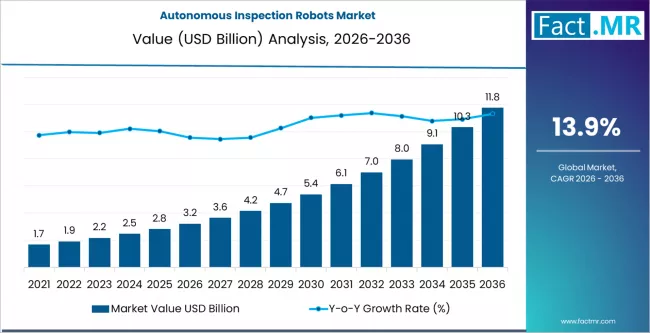
Adoption of autonomous inspection robots is projected to grow from USD 3.2 billion in 2026 to USD 11.8 billion by 2036, depicting a compound annual growth rate (CAGR) of 13.9% between 2026 and 2036.
Autonomous Inspection Robots Market Market Value Analysis | Source: Fact.MR
Summary of Autonomous Inspection Robots Market
Market Snapshot
Global autonomous inspection robots market revenue stood at USD 3.2 billion in 2026 and is forecast to reach USD 11.8 billion by 2036.
At a 13.9% CAGR from 2026 to 2036, this market is set to expand ~3.7x in value, adding USD 8.6 billion in absolute opportunity.
Growth is driven by increasing adoption of autonomous robotic systems for inspection, monitoring, and maintenance, particularly across industrial and infrastructure applications.
Autonomous inspection robots areemergingas critical tools for asset integrity management, enabling real-time monitoring, reduced human intervention, and enhanced operational safety.
Demand and Growth Drivers
Rising demand for automated inspection in hazardous and hard-to-access environments is accelerating adoption.
Increasing focus on asset integrity, predictive maintenance, and operational efficiency is driving deployment across industries.
Expansion of industrial automation and digital transformation initiatives is supporting market growth.
Growing need to reduce operational downtime and inspection costs is reinforcing adoption.
Advancements in AI, robotics, and sensor technologies are enhancing system capabilities and performance.
Product and Segment View
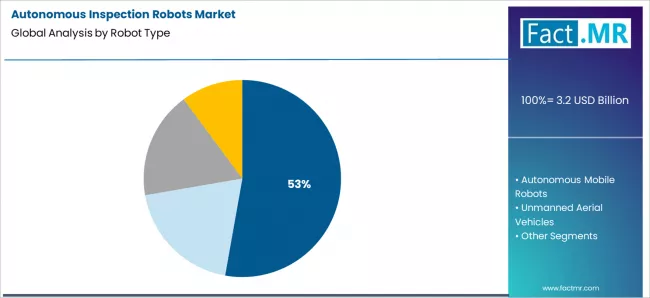
ROVs (Remotely Operated Vehicles) hold 52.8% of device category share in 2026,emergingas the leading segment due to their effectiveness in underwater and remote inspection environments.
Autonomous inspection robots are deployed across applications including infrastructure inspection, industrial monitoring, and maintenance operations, supporting diverse use cases.
Device types include ROVs, drones, and ground-based robots, tailored for specific inspection environments.
Geography and Competitive Outlook
Asia Pacific, North America, and Europe represent the key growth regions, supported by increasing industrial automation and infrastructure monitoring needs.
Market expansion is closely tied to smart infrastructure development, energy sector investments, and digital inspection technologies.
Emerging markets arewitnessingincreased adoption driven by industrial expansion and safety requirements.
Key companies active in this market includeANYbotics, Boston Dynamics,EddyfiTechnologies, GECKO Robotics, and General Electric.
Autonomous Inspection Robots Market — At a Glance
Attribute
Details
Market Value 2026
USD 3.2 billion
Market Value 2036
USD 11.8 billion
Absolute Dollar Opportunity 2026–2036
USD 8.6 billion
Total Growth 2026–2036
268.8%
CAGR 2026–2036
13.9%
Growth Multiple
~3.7x
Key Demand Theme
Increasing adoption of autonomous robotic systems for inspection, monitoring, and asset management
Leading Segment by Device Type (2026)
ROV
Segment Share (2026)
52.8%
Key Growth Regions
Asia Pacific, North America, Europe
Top Companies
ANYbotics, Boston Dynamics,EddyfiTechnologies, GECKO Robotics, General Electric
North America, Europe, Asia Pacific, Latin America, MEA
Demand for autonomous inspection robots is gaining momentum as asset owners shift from periodic manual inspections toward continuous, data-driven monitoring models. Adoption is strongest in industries where safety exposure, access constraints, and downtime risks are structurally high, including energy, utilities, heavy manufacturing, transport infrastructure, and process industries. Near-term spending outlook reflects steady budget allocation toward autonomous ground and mobile inspection platforms that can operate in hazardous, remote, or enclosed environments without human presence. Enterprises are prioritizing deployments that support predictive maintenance, regulatory compliance, and asset life extension, rather than experimental automation. Capital spending is increasingly justified through avoided shutdowns, reduced inspection-related incidents, and higher inspection frequency with consistent data quality. Over the next planning cycles, procurement is expected to favor scalable fleets, software upgrades, and sensor payload expansion over one-off trials. As a result, autonomous inspection robots are moving into routine operations, with spending tied closely to reliability engineering programs and long-term asset management strategies rather than discretionary innovation budgets.
What adoption horizon and timing milestones are being indicated by current deployments?
Adoption of autonomous inspection robots is shifting from early experimentation toward broader operational use, with current deployments offering a clearer sense of timing milestones and the overall adoption horizon. Early adopters in energy, utilities, petrochemical, and process manufacturing have moved past proof-of-concept stages and are now standardizing deployments across multiple sites within enterprise portfolios. These implementations reveal a pattern where initial pilots are completed within a few months, followed by phased fleet expansion over the ensuing one to two years.
Many organizations plan to embed autonomous inspection capabilities into routine maintenance cycles on a multi-year cadence, treating these systems as core components of reliability and condition-based maintenance strategies. Roadmaps shared by integrators and end users suggest that significant scaling across business units and facilities is expected within the next two to three planning cycles, with measurable productivity and safety benefits emerging as key drivers of continued investment. Integration with asset data platforms and predictive analytics tools is often scheduled shortly after baseline deployments to amplify value.
Segmental Analysis
By Robot Type, Which Segment Holds the Dominant Share in the Autonomous Inspection Robots Market?
Autonomous Inspection Robots Market Analysis By Robot Type | Source: Fact.MR
In terms of robot type, the remotely operated vehicles (ROV) segment leads the market with 52.8% share. Commercial professionals and inspection specialists increasingly utilize ROV autonomous inspection robots for their superior monitoring control properties and operational reliability characteristics.
Manufacturing investments in advanced robotic inspection technology and commercial infrastructure continue to strengthen adoption among performance-focused commercial facilities.
With commercial professionals prioritizing equipment system performance and operational validation, ROV modules align with both efficiency objectives and safety requirements, making them the central component of comprehensive commercial inspection monitoring strategies.
By End Use, Which Segment Registers the Highest Share in the Autonomous Inspection Robots Market?
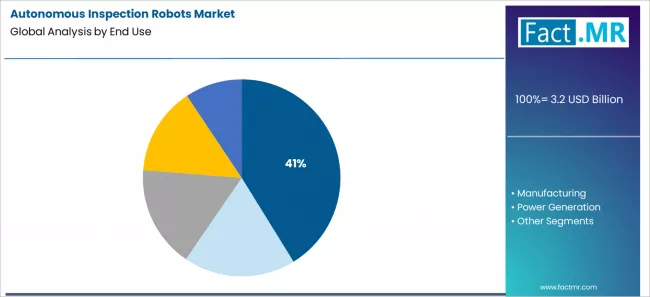
Autonomous Inspection Robots Market Analysis By End Use | Source: Fact.MR
By end use, oil and gas dominates with 41.2% share, underscoring its critical role as the primary application category for commercial facilities seeking superior inspection capabilities and enhanced operational compliance credentials. Infrastructure engineers and facility operators prefer autonomous inspection robot solutions for oil and gas facilities due to their established performance validation requirements.
Commercial facilities are optimizing equipment selections to support application-specific requirements and comprehensive operational monitoring strategies.
As inspection technology continues to advance and operators seek efficient commercial management methods, oil and gas applications will continue to drive market growth while supporting operational performance optimization and maintenance cost reduction strategies.
What enterprise spending patterns are expected over the next 12 to 24 months?
Over the next 12 to 24 months, enterprises are expected to allocate a growing share of maintenance and operations budgets toward autonomous inspection technologies as part of broader digital transformation initiatives. Spending patterns show a shift from isolated pilot projects toward defined capital programs with clear performance targets, prioritizing systems that deliver consistent inspection frequency, higher data fidelity, and lower operational risk in hazardous or remote environments. Procurement cycles are aligning with reliability and asset performance plans, with larger rollouts scheduled after initial validation phases complete.
Enterprises are increasingly locking in multi-year support, software updates, and sensor enhancement contracts at the time of purchase, indicating confidence in long-term use. Budgets are being set to secure not only hardware platforms but also integration services, data analytics subscriptions, and operator training to ensure rapid adoption. Discretionary innovation spend remains selective, directing funds toward technologies that replace or augment high-cost manual inspections rather than speculative experimentation. This disciplined spending behaviour reflects a maturing view of autonomous inspection robots as essential components of mission-critical operations.
Analysis of the Autonomous Inspection Robots Market by Key Country
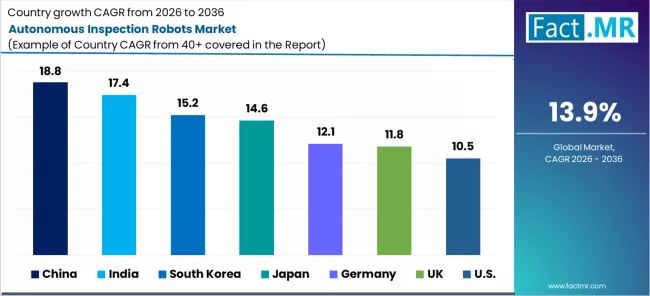
Autonomous Inspection Robots Market Cagr Analysis By Country | Source: Fact.MR
Country
CAGR (2026-2036)
China
18.8%
India
17.4%
South Korea
15.2%
Japan
14.6%
Germany
12.1%
UK
11.8%
U.S.
10.5%
Canada
9.7%
The report covers an in-depth analysis of 40+ countries; top-performing countries are highlighted below.
What Opportunities Can Autonomous Inspection Robots Manufacturers Expect in China?
Revenue from autonomous inspection robots consumption and sales in China is projected to exhibit exceptional growth with a CAGR of 18.8% through 2036, driven by the country's rapidly expanding industrial infrastructure, regulatory frameworks promoting inspection efficiency initiatives, and initiatives supporting advanced automation technologies across major commercial regions.
Established industrial infrastructure and expanding operational consciousness are driving demand for autonomous inspection robot solutions across commercial facilities, infrastructure developments, and comprehensive monitoring systems throughout Chinese commercial markets.
Strong regulatory development and technology initiatives are supporting the rapid adoption of premium inspection services among quality-focused operators seeking to meet evolving operational standards and performance requirements.
What is the Indian Autonomous Inspection Robots Market Size?
Revenue from autonomous inspection robots products in India is projected to expand at a CAGR of 17.4%, supported by rising commercial investment, growing operational consciousness, and expanding technology service capabilities. The country's developing infrastructure and increasing investment in automation technologies are driving demand for autonomous inspection robot solutions across both traditional and modern commercial applications.
Rising infrastructure development and expanding performance capabilities are creating opportunities for inspection technology adoption across commercial monitoring projects.
Growing operational awareness initiatives and automation technology advancement are driving the adoption of specialized inspection equipment and services among commercial users.
What is the South Korean Autonomous Inspection Robots Market Size?
Revenue from autonomous inspection robots products in South Korea is projected to expand at a CAGR of 15.2%, supported by rising commercial investment, growing operational consciousness, and expanding technology service capabilities. The country's advanced manufacturing infrastructure and increasing investment in robotic technologies are driving demand for autonomous inspection robot solutions across both traditional and modern commercial applications.
Advanced manufacturing capabilities and expanding performance infrastructure are creating opportunities for inspection technology adoption across commercial monitoring projects.
Growing operational awareness initiatives and robotic technology advancement are driving the adoption of specialized inspection equipment and services among commercial users.
What Opportunities Can Autonomous Inspection Robots Manufacturers Expect in Japan?
Revenue from autonomous inspection robots consumption and sales in Japan is projected to exhibit growth with a CAGR of 14.6% through 2036, driven by the country's advanced industrial infrastructure, regulatory frameworks promoting inspection precision initiatives, and initiatives supporting advanced robotic technologies across major commercial regions.
Established commercial infrastructure and expanding operational consciousness are driving demand for autonomous inspection robot solutions across commercial facilities, infrastructure developments, and comprehensive monitoring systems throughout Japanese commercial markets.
Strong regulatory development and technology initiatives are supporting the adoption of premium inspection services among quality-focused operators seeking to meet evolving operational standards and performance requirements.
What is the German Autonomous Inspection Robots Market Size?
Revenue from autonomous inspection robots products in Germany is projected to grow at a CAGR of 12.1% through 2036, supported by the country's emphasis on operational precision, inspection excellence, and advanced technology integration requiring efficient monitoring solutions. German commercial operators and technology-focused establishments prioritize precision performance and operational control, making specialized autonomous inspection robot services essential components for both traditional and modern commercial applications.
Advanced precision technology capabilities and growing commercial applications are driving demand for inspection services across specialty performance applications.
Strong focus on analytical precision and technology excellence is encouraging users and service providers to adopt autonomous inspection robot solutions that support operational objectives.
What is the U.S. Autonomous Inspection Robots Market Size?
Revenue from autonomous inspection robots products in the U.S. is projected to grow at a CAGR of 10.5% through 2036, supported by the country's emphasis on operational precision, inspection excellence, and advanced technology integration requiring efficient monitoring solutions. American commercial operators and performance-focused establishments prioritize inspection monitoring and cost efficiency precision, making specialized autonomous inspection robot services essential components for both traditional and modern commercial applications.
Advanced precision inspection technology capabilities and growing commercial applications are driving demand for autonomous inspection robot services across specialty performance applications.
Strong focus on operational precision and inspection excellence is encouraging users and service providers to adopt monitoring solutions.
What are the Opportunities for Autonomous Inspection Robots Companies in Next 5 Years?
Over the next five years, companies in the autonomous inspection robot space are expected to take several strategic actions that reflect maturation of the technology and broader enterprise adoption. Established industrial automation and robotics firms such as ABB, Fanuc, KUKA, and Universal Robots are likely to enhance their inspection platforms by embedding more advanced AI and perception capabilities, making autonomous inspection a standard feature in new systems rather than a premium add-on. These companies are expected to deepen integration with predictive maintenance and asset management software to deliver higher value to industrial customers.
Startups with strong patent activity and innovation focus, such as Gecko Robotics, are anticipated to push the frontier in specialized autonomy and sensor fusion, driving efficiency in complex inspection tasks. Collaborations between robotics hardware firms and software or vision system specialists will expand, improving real-time decision-making and adaptive behaviors in unstructured environments.
Key Players in the Autonomous Inspection Robots Market
ANYbotics
Boston Dynamics
Eddyfi Technologies
GECKO Robotics
General Electric
Cognex Corporation
FARO Technologies
Universal Robots
SuperDroid Robots
Clearpath Robotics
Bibliography
International Robotics Technology Association Research Committee. (2023). Robotic inspection technologies and performance optimization in commercial automation systems. International Robotics Technology Association.
International Organization for Standardization. (2023). Commercial quality management: Assessment of robotic inspection technology, operational efficiency, and quality control of autonomous inspection robot systems (ISO Technical Report). ISO.
European Committee for Standardization. (2022). Commercial quality management: Evaluation of robotic inspection processing, quality control, and operational compliance in commercial facilities (EN Technical Report). CEN.
Journal of Commercial Robotics Technology Editorial Board. (2024). Robotic inspection processing, quality control, and performance optimization in modern commercial facilities. Journal of Commercial Robotics Technology, 150(4), 245-262.
Robotics Technology Agency, Technical Committee. (2023). Advances in robotic inspection processing and quality control technologies for commercial and manufacturing applications. Robotics Technology Agency.
Scope of the Report
Items
Values
Quantitative Units (2026)
USD 3.2 Billion
Robot Type
Remotely Operated Vehicles (ROV), Autonomous Mobile Robots, Unmanned Aerial Vehicles, Other
End Use
Oil and Gas, Manufacturing, Power Generation, Infrastructure, Other
Technology
Visual Inspection, Ultrasonic Testing, Thermal Imaging, Laser Scanning, Other
Sales Channel
Direct OEM Sales, System Integrators, Industrial Distributors, Other
Regions Covered
North America, Europe, Asia Pacific, Latin America, Middle East & Africa
Countries Covered
China, India, South Korea, Japan, Germany, UK, U.S., Canada, and other countries
Key Companies Profiled
ANYbotics, Boston Dynamics, Eddyfi Technologies, GECKO Robotics, General Electric, and other leading robotics companies
Additional Attributes
Dollar revenue by robot type, end use, technology, sales channel, and region; regional demand trends, competitive landscape, technological advancements in inspection technology, operational performance optimization initiatives, commercial enhancement programs, and premium inspection development strategies
Autonomous Inspection Robots Market by Segments
Robot Type :
Remotely Operated Vehicles (ROV)
Autonomous Mobile Robots
Unmanned Aerial Vehicles
Other
End Use :
Oil and Gas
Manufacturing
Power Generation
Infrastructure
Other
Technology :
Visual Inspection
Ultrasonic Testing
Thermal Imaging
Laser Scanning
Other
Sales Channel :
Direct OEM Sales
System Integrators
Industrial Distributors
Other
Region :
North America
U.S.
Canada
Mexico
Europe
Germany
UK
France
Italy
Spain
Nordic Countries
BENELUX
Rest of Europe
Asia Pacific
China
Japan
South Korea
India
Australia
Rest of Asia Pacific
Latin America
Brazil
Argentina
Rest of Latin America
Middle East and Africa
Kingdom of Saudi Arabia
United Arab Emirates
South Africa
Rest of Middle East and Africa
Other Regions
Oceania
Central Asia
Other Markets
Frequently Asked Questions
How big is the autonomous inspection robots market in 2026?
The global autonomous inspection robots market is estimated to be valued at USD 3.2 billion in 2026.
What will be the size of autonomous inspection robots market in 2036?
The market size for the autonomous inspection robots market is projected to reach USD 11.8 billion by 2036.
How much will be the autonomous inspection robots market growth between 2026 and 2036?
The autonomous inspection robots market is expected to grow at a 13.9% CAGR between 2026 and 2036.
What are the key product types in the autonomous inspection robots market?
The key product types in autonomous inspection robots market are remotely operated vehicles (rov) , autonomous mobile robots , unmanned aerial vehicles and other .
Which end use segment to contribute significant share in the autonomous inspection robots market in 2026?
In terms of end use, oil and gas segment to command 41.2% share in the autonomous inspection robots market in 2026.