- Base Value(2025): 16.8 Bn
- Estimated Value(2026): 19.8 Bn
- Forecast Value (2036): 122 Bn
- CAGR (2026 - 2036): 18.0%
Battery Black Mass Sorting Systems Market Forecast and Outlook By FACT.MR
In 2025, the battery black mass sorting systems market was valued at USD 16.8 billion. Based on Fact.MR analysis, demand for battery black mass sorting systems is estimated to grow to USD 19.8 billion in 2026 and USD 122 billion by 2036. FACT.MR projects a CAGR of 18.0% during the forecast period.
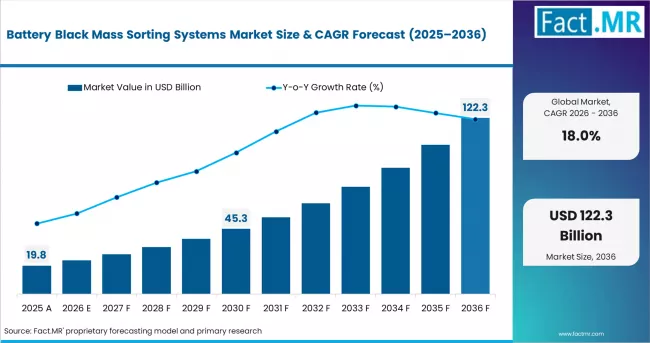
Battery Black Mass Sorting Systems Market Value Analysis | Source: Fact.MR
Summary of Battery Black Mass Sorting Systems Market
- Market Definition
- The market covers AI-based optical, sensor-based, and mechanical sorting systems. Used in battery black mass processing for critical mineral recovery across global recycling and manufacturing facilities.
- Demand Drivers
- U.S. IRA battery recycling grants are scaling black mass sorting infrastructure. Driven by domestic critical mineral supply chain investment targets.
- EU Battery Regulation extended producer responsibility mandates are increasing sorting system procurement. Driven by mandatory lithium and cobalt recovery rate compliance.
- China EV battery end-of-life volumes are driving recycling facility expansion. Supported by state-backed critical mineral recovery and battery material localisation policy.
- Key Segments Analyzed
- By Technology: AI-based optical sorting leads at 45% in 2026. Critical for high-purity black mass separation in precision recycling facilities.
- By Application: Lithium-ion battery recycling leads at 65% in 2026. Driven by EV battery end-of-life volumes and critical mineral recovery mandates.
- By End Use: Recycling facilities lead at 58% in 2026. Driven by dedicated black mass processing infrastructure expansion across all major markets.
- Analyst Opinion at FACT.MR
- Shambhu Nath Jha, Principal Consultant at Fact.MR, opines, 'CXOs will find a clear divide between AI-validated high-purity sorting platforms and legacy mechanical systems; the former captures disproportionate margin and contract value in regulated recycling markets.'
- Strategic Implications
- Invest in AI-based optical sorting platform development targeting lithium-ion battery recycling purity specifications.
- Develop modular sorting systems for gigafactory waste stream integration targeting IRA and EU Battery Regulation-compliant recycling programmes.
- Separate performance-grade and industrial-grade sorting system lines. Capture premium pricing in closed-loop battery manufacturer recycling contracts.
- Methodology
- Market sizing based on equipment revenues and facility throughput volumes. Validated with 2024–2025 financial and procurement data.
- Supported by IRA programme data, EU Battery Regulation compliance records, and China critical mineral recovery policy statistics.
- Forecasts include EV battery recycling volume growth, sorting technology adoption curves, and expert inputs from facility operators.
| Metric | Value |
|---|---|
| Estimated Value in 2026 | USD 19.8 billion |
| Forecast Value in 2036 | USD 122 billion |
| Forecast CAGR (2026 to 2036) | 18.0% |
Source: Fact.MR analysis. Updated Apr 22, 2026
The market is expected to generate USD 102.2 billion in incremental revenue during the forecast period. Growth is transformational and regulation-led. Demand is driven by EV battery end-of-life volumes and critical mineral recovery mandates. Scale-up of dedicated black mass sorting infrastructure remains the primary capacity constraint limiting faster growth.
Procurement is shifting toward high-throughput, multi-modal sorting platforms. Recycling facilities and battery manufacturers require documented lithium, cobalt, and nickel recovery rates. Certified purity outputs and system integration with hydrometallurgical downstream processes are becoming standard. Suppliers without AI-validated sorting performance data are being excluded from major recycling facility procurement contracts.
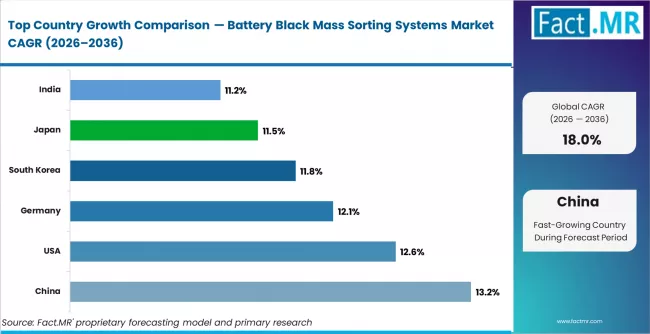
China leads at 13.2% CAGR through 2036, anchored by the world's largest EV battery recycling ecosystem. The United States follows at 12.6%, driven by IRA-funded battery recycling infrastructure buildout. Germany records 12.1%, supported by EU Battery Regulation extended producer responsibility mandates. South Korea grows at 11.8%, reflecting tight battery manufacturing and recycling integration. Japan records 11.5%, driven by advanced critical material recovery focus. India follows at 11.2%, supported by emerging gigafactory expansion and battery recycling policy development.
Segmental Analysis
Battery Black Mass Sorting Systems Market Analysis by Technology
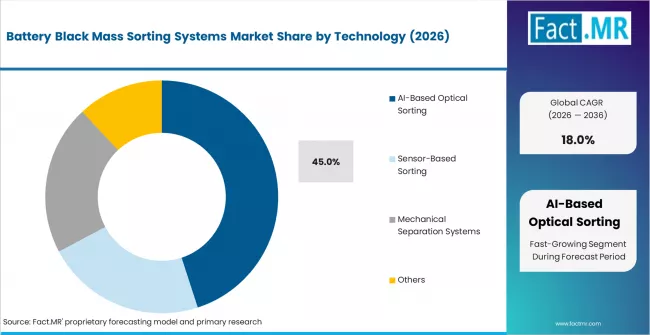
Battery Black Mass Sorting Systems Market Analysis By Technology | Source: Fact.MR
Based on FACT.MR analysis, AI-based optical sorting holds 45% share in 2026. This technology delivers high material purity. It supports downstream processing requirements. AI systems provide validated recovery data. This meets regulatory procurement standards.
- TOMRA Investment: TOMRA expanded technology development in 2024. Focus is on AI-based sorting capacity. It supports long-term contracts [4].
- STEINERT Technology: STEINERT launched a new system in 2025. It combines X-ray and infrared detection. It meets EU recovery standards [5].
- Demand Trend: Optical sorting demand grew 22% in 2024. Adoption is rising in major recycling markets [6].
Battery Black Mass Sorting Systems Market Analysis by Application
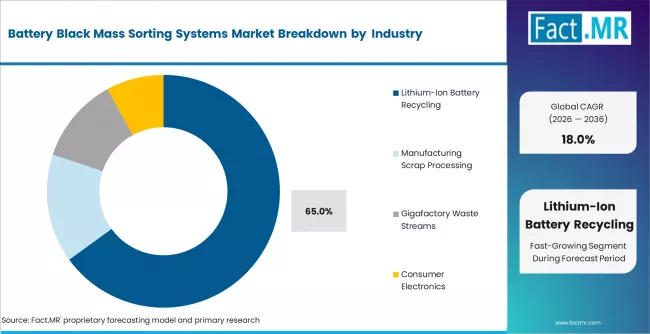
Battery Black Mass Sorting Systems Market Analysis By Application | Source: Fact.MR
Based on FACT.MR analysis, lithium-ion battery recycling holds 65% share in 2026. This segment leads due to EV battery volumes. High throughput sorting is required. Purity standards are critical for reuse.
- Metso Partnership: Metso expanded recycling partnerships in 2024. It integrates sorting systems in Europe. Projects align with EU regulations [7].
- Bühler Development: Bühler launched gigafactory sorting systems in 2024. Focus is on production scrap processing. Deployment is in Europe and the U.S. [8].
- Electronics Recycling Trend: Small battery recycling increased 17% in 2024. Compact systems are gaining adoption [2].
Drivers, Restraints, and Opportunities
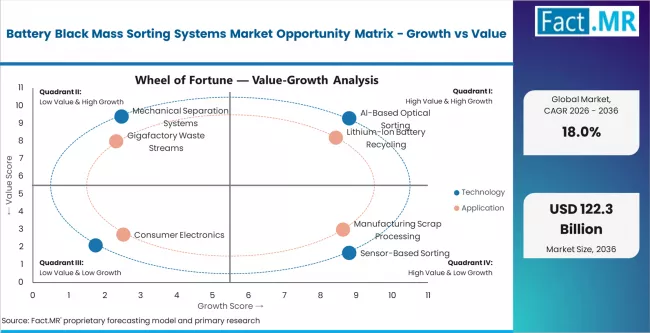
Battery Black Mass Sorting Systems Market Opportunity Matrix Growth Vs Value | Source: Fact.MR
FACT.MR notes the market is high-growth and regulation-driven. Demand is concentrated in lithium-ion battery recycling. Gigafactory waste processing is also a key driver. These segments are supported by producer responsibility laws. Critical mineral recovery mandates are strengthening demand. Growth is consistent across major battery-producing regions.
Mechanical systems are no longer a differentiator. Recycling operators prefer AI-validated sorting platforms. Throughput and purity data are required for procurement. High-performance systems command premium pricing. Global supply of advanced sorting capacity is limited. This supports strong pricing power for suppliers. A mid-tier segment is emerging in scrap and electronics recycling.
-
EU Battery Regulation Mandate: EU Regulation 2023/1542 set recovery targets from 2025. Recyclers are upgrading sorting systems. TOMRA reported strong demand in 2024 [1].
-
U.S. IRA Funding: The U.S. DOE allocated USD 3 billion in 2024. Funded plants require advanced sorting systems. Eriez expanded supply in 2025.
-
China Recycling Expansion: China introduced stricter standards in 2024. Certified sorting is now required. CATL and others increased capacity.
Regional Analysis
The battery black mass sorting systems market is assessed across Asia Pacific, North America, Europe, Latin America, and Middle East and Africa, covering 40+ countries with distinct demand profiles shaped by EV battery recycling regulation intensity, gigafactory expansion scale, critical mineral recovery policy frameworks, and recycling infrastructure investment levels. The full report offers market attractiveness analysis by region and country.
.webp "Top Country Growth Comparison Battery Black Mass Sorting Systems Market Cagr (2026 2036)")
Top Country Growth Comparison Battery Black Mass Sorting Systems Market Cagr (2026 2036) | Source: Fact.MR
| Country | CAGR (2026 to 2036) |
|---|---|
| China | 13.2% |
| United States | 12.6% |
| Germany | 12.1% |
| South Korea | 11.8% |
| Japan | 11.5% |
| India | 11.2% |
Source: Fact.MR analysis. Updated Apr 22, 2026
Source: Fact.MR (FACT.MR) analysis, based on proprietary forecasting model and primary research
Battery Black Mass Sorting Systems Market Cagr Analysis By Country | Source: Fact.MR
Asia Pacific Battery Black Mass Sorting Systems Market Analysis
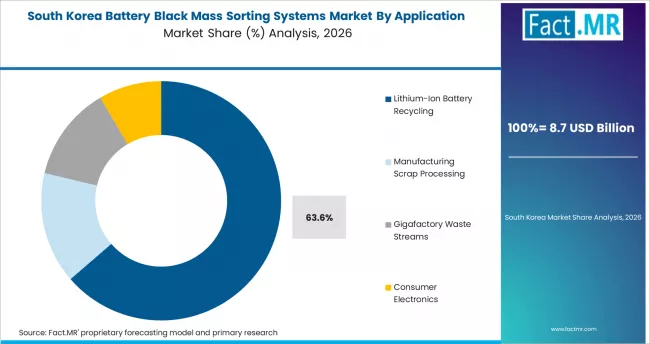
Battery Black Mass Sorting Systems Market South Korea Market Share Analysis By Application | Source: Fact.MR
Asia Pacific remains the core production and consumption hub for battery recycling infrastructure. Growth is supported by EV scale, policy enforcement, and integrated supply chains. Procurement is becoming highly specification-driven. Buyers now require validated recovery rates and documented purity levels. Technology selection is increasingly tied to downstream refining efficiency.
-
China: China dominates due to its unmatched EV battery end-of-life volume and policy enforcement strength. The market is projected to expand at 13.2% CAGR through 2036. National regulations mandate traceability and certified recycling processes. This creates structured and recurring procurement cycles for sorting systems. Large players are expanding in-house recycling capacity to secure raw materials. Provincial pilot programmes are scaling licensed recyclers rapidly. Demand is concentrated in high-throughput, high-purity systems aligned with hydrometallurgical processing.
-
South Korea:South Korea benefits from a tightly integrated battery ecosystem linking manufacturing, recycling, and material recovery. Growth is estimated at 11.8% CAGR through 2036. Leading battery manufacturers are investing in closed-loop recycling to reduce dependence on imported raw materials. Government regulations require certified sorting deployment across facilities. Technology adoption focuses on precision recovery and cost optimisation. Vendor partnerships are strengthening to support advanced sorting infrastructure
-
Japan:Japan’s market is driven by advanced recycling standards and technology innovation. Growth is expected at 11.5% CAGR through 2036. National policy prioritises critical mineral recovery. Public funding is supporting development of high-precision sorting systems. OEMs are investing in premium-grade recovery platforms. Procurement cycles are longer but focused on performance validation. Demand is concentrated in high-purity, low-loss material separation systems.
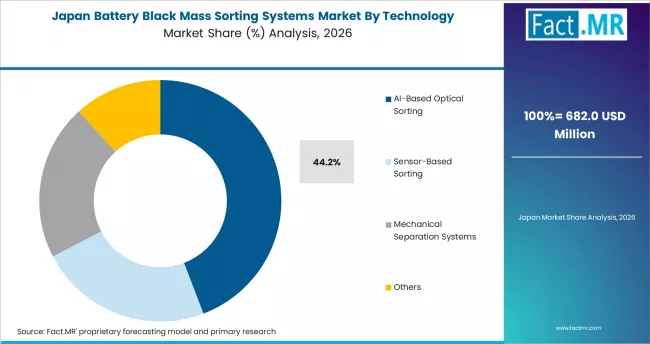
Battery Black Mass Sorting Systems Market Japan Market Share Analysis By Technology | Source: Fact.MR
-
India: India is emerging as a high-growth market supported by regulatory enforcement and manufacturing expansion. Growth is expected at 11.2% CAGR through 2036. Battery waste management rules mandate formal recycling systems. Incentives for cell manufacturing are increasing scrap volumes. Recycling infrastructure is developing alongside gigafactories. Sorting systems are being integrated into early-stage facility design. Demand is rising for cost-efficient yet compliant solutions.
Fact.MR covers China, Japan, South Korea, India, ASEAN, and ANZ. It includes recycling capacity expansion, policy enforcement trends, and sorting system procurement benchmarks.
Europe Battery Black Mass Sorting Systems Market Analysis
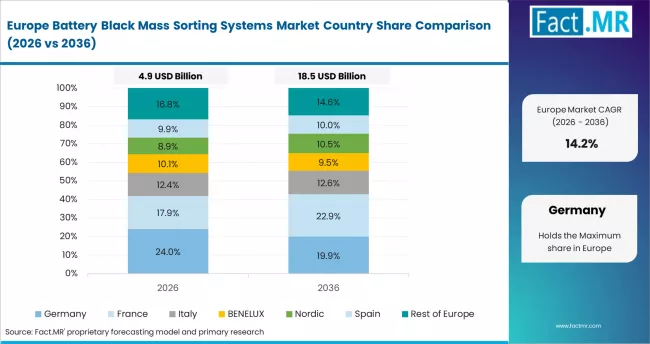
Battery Black Mass Sorting Systems Market Europe Country Market Share Analysis, 2026 & 2036 | Source: Fact.MR
Europe operates as the regulatory benchmark for battery recycling systems. Market growth is directly linked to compliance with strict recovery targets. Procurement is structured, documentation-heavy, and performance-focused.
-
Germany: Germany leads due to strong industrial infrastructure and early regulatory enforcement. The market is projected to grow at 12.1% CAGR through 2036. EU Battery Regulation mandates lithium and cobalt recovery targets. Technical standards define minimum sorting efficiency levels. Recycling facilities are scaling capacity to meet compliance timelines. Automotive OEMs are investing in closed-loop supply chains. Demand is focused on high-accuracy systems that meet regulatory documentation requirements.
Fact.MR covers Germany, France, the UK, Italy, Spain, Nordic Countries, and BENELUX. It includes regulatory benchmarks, recycling facility expansion, and procurement standards.
North America Battery Black Mass Sorting Systems Market Analysis
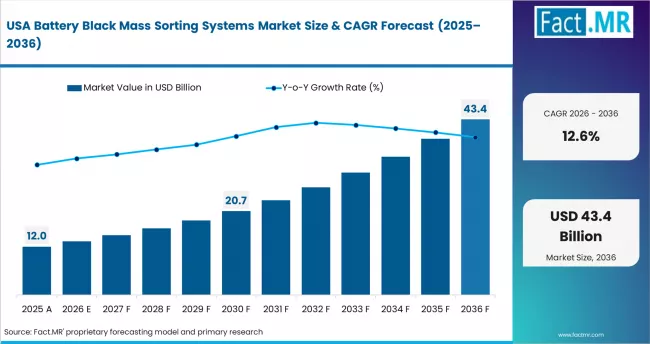
Battery Black Mass Sorting Systems Market Country Value Analysis | Source: Fact.MR
North America is a policy-led and investment-driven market. Growth is supported by federal funding and domestic supply chain goals. Procurement is tied closely to grant eligibility and compliance standards.
-
United States: The U.S. market is expanding through large-scale government funding and recycling infrastructure development. Growth is projected at 12.6% CAGR through 2036. Federal programmes are financing battery recycling facilities. These projects require certified and high-performance sorting systems. Domestic content rules are influencing supplier selection. Technology adoption focuses on scalability and regulatory compliance. Demand is strongest in gigafactory-linked recycling hubs.
Fact.MR covers the United States, Canada, and Mexico. It includes funding programmes, regulatory frameworks, and infrastructure development trends.
Competitive Aligners for Market Players
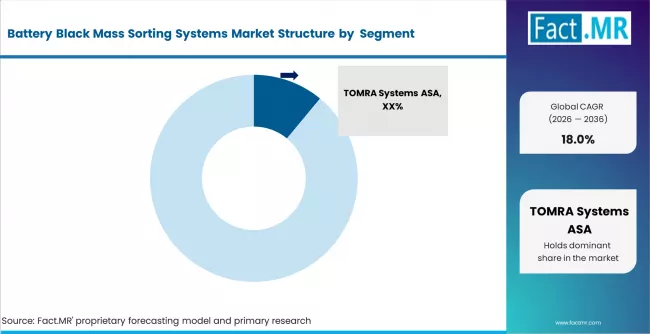
Battery Black Mass Sorting Systems Market Analysis By Company | Source: Fact.MR
Competition in the battery black mass sorting systems market is not just about company size. It depends on how closely suppliers work with recycling facility teams during design and setup. Advanced sorting providers are involved early in project planning. They tailor systems based on battery chemistry and recovery targets. This approach takes time but creates long-term contracts once approved.
Companies like TOMRA Systems ASA and STEINERT GmbH have a strong position because of their long-standing relationships in recycling. Their systems are tested across different battery types. They also provide detailed compliance documentation required under EU and U.S. regulations. Their advantage comes from performance validation rather than pricing.
Metso Corporation and Bühler Group operate with a broader approach. They combine sorting with full processing systems. This includes crushing, separation, and classification. Their strength lies in delivering complete recycling lines instead of standalone equipment. Other players focus on niche capabilities. Eriez Manufacturing Co. specialises in magnetic and metal recovery systems. Binder+Co AG focuses on compliance-driven solutions in Europe. Buyers are becoming more selective. Recycling firms prioritise systems with proven recovery rates and clear documentation. Many large operators work with multiple suppliers to reduce risk. However, once a system is integrated into a facility, switching becomes difficult, creating long-term dependence on selected vendors.
Key Players
- TOMRA Systems ASA
- STEINERT GmbH
- Eriez Manufacturing Co.
- Metso Corporation
- Bühler Group
- Binder+Co AG
Bibliography
- [1] European Commission. (2024). EU Battery Regulation 2023/1542 Implementation: Mandatory Lithium and Cobalt Recovery Rate Thresholds for Recycling Facilities and Extended Producer Responsibility Compliance Guidelines. ec. europa.eu/environment/topics/waste-and-recycling/batteries
- [2] U.S. Department of Energy. (2024). IRA Battery Materials Processing and Manufacturing Programme: USD 3 Billion Grant Awards for Battery Recycling Infrastructure Including Black Mass Sorting and Critical Mineral Recovery Facilities. energy.gov/oe/battery-recycling
- [3] Ministry of Industry and Information Technology, China. (2024). Battery Traceability and Recovery Standards Update: Certified Sorting Equipment Requirements for Licensed Battery Recycling Facilities Under New Energy Vehicle Battery Recycling Pilot Programme Expansion. miit.gov.cn/english
- [4] TOMRA Systems ASA. (Q3 2024). Technology Programme Announcement: Expansion of Battery Black Mass Sorting Development Programme Targeting AI-Based Optical Sorting System Capacity for European and North American Recycling Facility Customers. tomra.com/investor-relations
- [5] STEINERT GmbH. (Early 2025). Product Launch: Sensor-Based Black Mass Sorting System Incorporating X-Ray Transmission and Near-Infrared Detection for Electrode Material Separation Validated for EU Battery Regulation Recovery Rate Documentation. steinert.de/news
- [6] International Energy Agency. (2024). Critical Minerals and Clean Energy Transitions Report 2024: Battery Recycling Infrastructure Investment Growth Including AI-Based Black Mass Sorting System Procurement and In-House Battery Manufacturer Recycling Adoption Data. iea.org/reports/critical-minerals
- [7] Metso Corporation. (2024). Partnership Announcement: Battery Black Mass Processing Equipment Integration with European Lithium-Ion Battery Recycling Operators for EV Battery End-of-Life Processing Under EU Battery Regulation Compliance Contracts. metso.com/news
- [8] Bühler Group. (Q4 2024). Product Launch: Integrated Gigafactory Waste Stream Sorting System for Electrode Scrap and Formation Waste Processing at Battery Cell Manufacturing Facilities in Germany and the United States. buhlergroup.com/news
This Report Addresses
- Strategic intelligence on battery black mass sorting system demand across AI-based optical, sensor-based, and mechanical separation platforms for lithium-ion recycling and gigafactory waste processing globally.
- Market forecast from USD 19.8 billion in 2026 to USD 122 billion by 2036, at a CAGR of 18.0%.
- Growth opportunity mapping across China EV battery recycling scale-up, U.S. IRA infrastructure grants, Germany EU Battery Regulation compliance, South Korea battery manufacturer integration, Japan critical mineral recovery, and India gigafactory expansion.
- Segment analysis by technology (AI optical, sensor-based, mechanical), application (Li-ion recycling, gigafactory waste, manufacturing scrap, consumer electronics), and end use (recycling facilities, battery manufacturers, closed-loop systems).
- Regional outlook covering Asia Pacific recycling volume-led growth, North America incentive-driven infrastructure buildout, and Europe regulation-led compliance equipment demand.
- Competitive analysis of TOMRA, STEINERT, Eriez, Metso, Bühler, and Binder+Co. Focus on AI sorting validation depth, recovery rate certification, and OEM programme alignment.
- Regulatory analysis covering EU Battery Regulation 2023/1542, U.S. IRA battery recycling grants, China MIIT battery traceability standards, India Battery Waste Management Rules, and South Korea extended producer responsibility guidelines.
- Report delivered in PDF, Excel, and presentation formats. Supported by primary interviews, recycling facility data, regulatory records, and procurement benchmarks.
Battery Black Mass Sorting Systems Market Definition
The market includes AI-based optical sorters, sensor-based separation systems, and mechanical sorting equipment used to process battery black mass. These systems separate electrode materials, current collectors, and contaminants to recover lithium, cobalt, nickel, and manganese for closed-loop recycling.
Battery Black Mass Sorting Systems Market Inclusions
Covers global and regional forecasts from 2026 to 2036. Includes technology type, application, and end use segments. Covers recycling facilities, battery manufacturers, and gigafactory waste streams. Includes OEM capital equipment and system integration supply channels.
Battery Black Mass Sorting Systems Market Exclusions
Excludes hydrometallurgical and pyro metallurgical processing equipment downstream of sorting. Omits battery disassembly and discharge systems. Also excludes general-purpose industrial sorting equipment not adapted for black mass applications. Focus remains on sorting system hardware supplied for battery material streams.
Battery Black Mass Sorting Systems Market Research Methodology
- Primary Research
- Interviews with sorting system suppliers and recycling facility operators. Covers EV battery recyclers, gigafactory waste managers, and critical mineral procurement teams.
- Desk Research
- Uses TOMRA, STEINERT, and Metso disclosure data. Includes EV battery recycling capacity and critical mineral trade statistics from 2024–2025.
- Market-Sizing and Forecasting
- Uses a hybrid top-down and bottom-up model. Based on equipment revenues and application-level volumes. Segmented by technology type and end use.
- Data Validation and Update Cycle
- Validated using equipment revenue data and recycling facility throughput statistics. Cross-checked with procurement volumes and expert interviews. Updated regularly.
Segmentation
Scope of Report
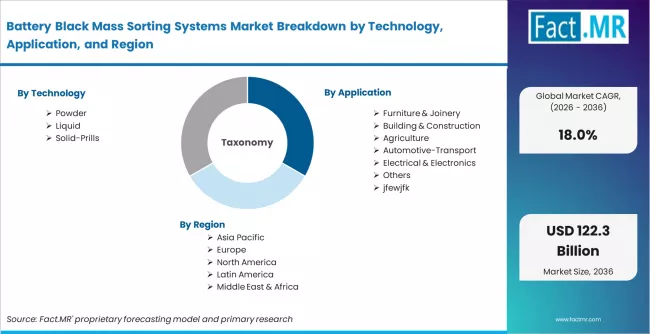
Battery Black Mass Sorting Systems Market Breakdown By Technology, Application, And Region | Source: Fact.MR
| Attribute | Details |
|---|---|
| Quantitative Units | USD 19.8 billion (2026) to USD 122 billion (2036), at a CAGR of 18.0% |
| Market Definition | AI-based optical sorters, sensor-based separation systems, and mechanical sorting equipment supplied for battery black mass processing and critical mineral recovery across lithium-ion battery recycling, gigafactory waste streams, and manufacturing scrap applications globally. |
| Technology Segmentation | AI-Based Optical Sorting, Sensor-Based Sorting, Mechanical Separation Systems, Others |
| Application Segmentation | Lithium-Ion Battery Recycling, Manufacturing Scrap Processing, Gigafactory Waste Streams, Consumer Electronics |
| End Use Segmentation | Recycling Facilities, Battery Manufacturers, Closed-Loop Recycling Systems, Others |
| Application Coverage | EV battery end-of-life black mass sorting, gigafactory electrode scrap separation, manufacturing waste stream critical mineral recovery, and consumer electronics battery material processing. |
| Regions Covered | North America, Europe, Asia Pacific, Latin America, Middle East and Africa |
| Countries Covered | USA, Canada, Mexico, Germany, UK, France, Italy, Spain, Nordic, BENELUX, China, Japan, South Korea, India, ASEAN, Australia and New Zealand, Brazil, Argentina, Chile, Saudi Arabia, GCC, Turkey, South Africa, Rest of MEA |
| Key Companies Profiled | TOMRA Systems ASA, STEINERT GmbH, Eriez Manufacturing Co., Metso Corporation, Bühler Group, Binder+Co AG |
| Forecast Period | 2026 to 2036 |
| Approach | Hybrid top-down and bottom-up model using sorting system manufacturer revenues, facility throughput volumes by technology type, average selling prices by application and end use, recycling programme procurement benchmarks, and primary interviews with battery recyclers and gigafactory procurement managers. |
Source: Fact.MR analysis. Updated Apr 22, 2026
Battery Black Mass Sorting Systems Market by Segments
-
By Technology:
- AI-Based Optical Sorting
- Sensor-Based Sorting
- Mechanical Separation Systems
- Others
-
By Application:
- Lithium-Ion Battery Recycling
- Manufacturing Scrap Processing
- Gigafactory Waste Streams
- Consumer Electronics
-
By End Use:
- Recycling Facilities
- Battery Manufacturers
- Closed-Loop Recycling Systems
- Others
-
By Region:
- North America
- United States
- Canada
- Mexico
- Latin America
- Brazil
- Mexico
- Argentina
- Chile
- Rest of Latin America
- Western Europe
- Germany
- United Kingdom
- France
- Italy
- Spain
- Nordic Countries
- BENELUX
- Rest of Western Europe
- Eastern Europe
- Russia
- Poland
- Hungary
- Balkan and Baltic
- Rest of Eastern Europe
- East Asia
- China
- Japan
- South Korea
- South Asia and Pacific
- India
- ASEAN
- Australia and New Zealand
- Rest of South Asia and Pacific
- Middle East and Africa
- Kingdom of Saudi Arabia
- Other GCC Countries
- Turkey
- South Africa
- Rest of Middle East and Africa
- North America
Frequently Asked Questions
How large is the battery black mass sorting systems market in 2025?
What will the market size be in 2026?
What is the projected market size by 2036?
What is the expected CAGR of the battery black mass sorting systems market?
What is the absolute dollar opportunity in this market?
Which technology segment leads the market?
Which application segment is poised to lead?
Which country shows the fastest growth?
Who worked on this report


Preview the report firsthand - request a free sample
Free SampleGet the brochure for pricing and purchase details
Download PDF