- Market Value (2025): USD 101.4 Bn
- Estimated Value (2026): USD 106.2 Bn
- Forecast Value (2036): USD 169.8 Bn
- CAGR (2026-2036): 4.8%
What is the Benzene and Its Derivatives Market forecast to be worth by 2036?
USD 106.2 billion in 2026 to USD 169.8 billion by 2036 at a 4.8% CAGR.
- The benzene and its derivatives market stood at USD 101.4 billion in 2025.
- According to Fact.MR analysis, market value is projected to increase from USD 106.2 billion in 2026 to USD 169.8 billion by 2036.
- A 4.8% CAGR from 2026 to 2036 reflects demand from resin producers and chemical plants converting benzene into industrial intermediates.
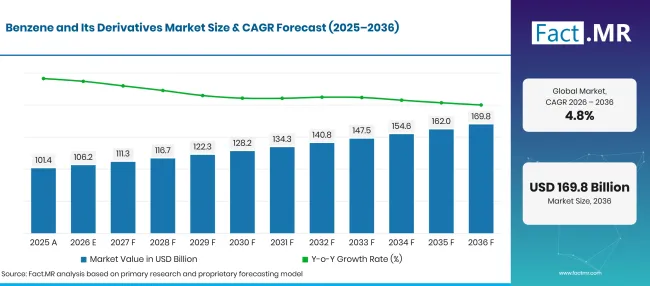
Benzene And Its Derivatives Market Forecast Global | Source: Fact.MR
| Year | Basis | Market Value (USD billion) |
|---|---|---|
| 2025 | Actual | 101.4 |
| 2026 | Estimate | 106.2 |
| 2036 | Forecast | 169.8 |
| CAGR 2026 to 2036 | Forecast period | 4.8% |
Source: Fact.MR analysis. Updated Nov 4, 2026
What are the defining numbers behind Benzene and Its Derivatives Market growth?
As per Fact.MR analysis, the market is projected to gain USD 63.6 billion between 2026 and 2036.
- Demand Drivers in the Market
- Ethylbenzene producers need a steady benzene supply to keep styrene plants running according to schedule. Even a short disruption can affect downstream deliveries to resin manufacturers.
- Phenol producers connect benzene purchases to cumene production and the operating schedules of phenol and acetone units. Cumene conversion connects aromatic feedstock with phenol and acetone manufacturing.
- Automotive suppliers use plastics and synthetic materials made through benzene-derived chemical routes. Orders for these materials depend on the design and production schedule of individual vehicle components.
- Detergent-ingredient manufacturers also purchase alkylbenzene intermediates. They select linear or branched feedstocks according to the intended formulation and the process used at the next production stage.
- Key Segments Analyzed
- By Derivative Type: Ethylbenzene is estimated to account for 28.4% share in 2026 as the principal feedstock route to styrene.
- By Application: Resins are forecast to represent 22.8% share in 2026 because benzene-derived intermediates feed several polymer systems.
- By End-User Industry: Automotive is projected to hold 35.7% share in 2026 through its use of polymer-based parts and materials.
- Analyst Opinion at Fact.MR
- Shambhu Nath Jha, Principal Consultant at Fact.MR, states, “Benzene purchases depend heavily on how much capacity chemical plants operate and how reliably they can receive feedstock. For a styrene or phenol producer with fixed delivery commitments, a dependable supply contract may matter more than a small saving on an individual shipment.”
- Strategic Implications
- Refiners can coordinate aromatic extraction with nearby derivative plants to reduce freight exposure and uneven supply.
- Derivative manufacturers should assess benzene purity alongside supply continuity because feed quality affects plant operation. Phenol-based materials form part of resin and plastic production.
- Resin producers can plan purchase volumes using confirmed production schedules and finished-product orders.
- Distributors should maintain clear handling information for benzene and its derivatives, particularly where industrial deliveries cross borders.
Germany is projected to grow at 5.5% CAGR through 2036, followed by Brazil at 5.0%. The USA advances at 4.6% while the UK records 4.1%. Japan follows at 3.6%. These rates differ because industrial conversion capacity, chemical trade patterns and downstream manufacturing conditions are not identical across the five countries.
How does the Benzene and Its Derivatives Market break down by segment?
Ethylbenzene accounts for 28.4% of derivative type sales; resins account for 22.8% of application demand; automotive represents 35.7% of end-user industry value.
Which derivative type accounts for the largest share?
Ethylbenzene represents 28.4% of 2026 derivative type value.
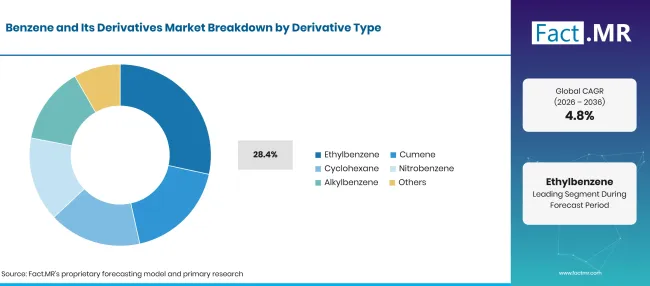
Benzene And Its Derivatives Market Breakdown Derivative Type | Source: Fact.MR
| Derivative Type | Share (2026) |
|---|---|
| Ethylbenzene (Leading segment) | 28.4% |
| Other derivative types combined | 71.6% |
| Total | 100.0% |
Source: Fact.MR analysis. Updated Nov 4, 2026
Ethylbenzene is made by reacting benzene with ethylene and is used chiefly to manufacture styrene. Its place between aromatic feedstocks and polymer production explains the commercial value of reliable bulk deliveries. Cumene feeds phenol and acetone production and is closely tied to the economics of benzene and propylene. Cyclohexane supports nylon intermediate manufacture.
What leads the application segment?
Resins capture 22.8% of 2026 application value.
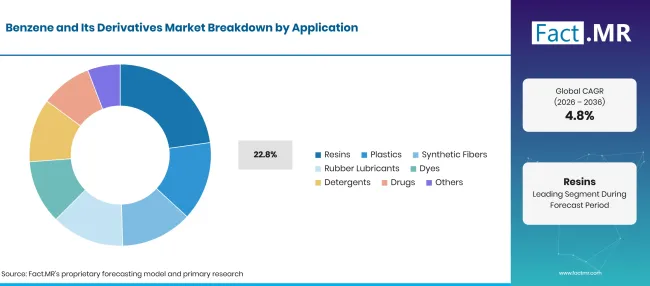
Benzene And Its Derivatives Market Breakdown Application | Source: Fact.MR
| Application | Share (2026) |
|---|---|
| Resins (Leading segment) | 22.8% |
| Other applications combined | 77.2% |
| Total | 100.0% |
Source: Fact.MR analysis. Updated Nov 4, 2026
Resin manufacturers depend on several benzene-derived building blocks. Styrene can enter polystyrene and related resin production, while phenol-derived intermediates support certain engineered polymers. Plastics applications overlap with resins at the material stage but are distinguished by the use classification in this report. Synthetic fibers draw on nylon intermediates, and dyes use selected aromatic compounds.
How does end-user industry influence demand?
Automotive leads with 35.7% of 2026 end-user industry value.
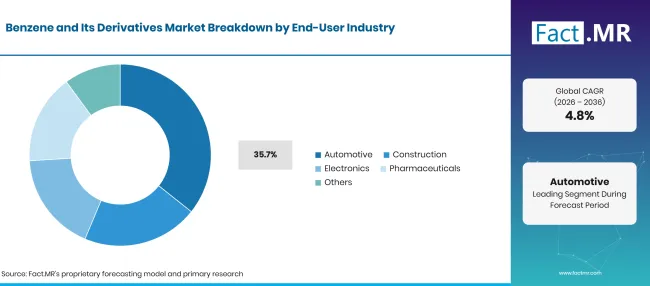
Benzene And Its Derivatives Market Breakdown End User Industry | Source: Fact.MR
| End-User Industry | Share (2026) |
|---|---|
| Automotive (Leading segment) | 35.7% |
| Other end-user industries combined | 64.3% |
| Total | 100.0% |
Source: Fact.MR analysis. Updated Nov 4, 2026
Automotive use includes interior and exterior polymer parts containing benzene-derived materials. Material selection depends on the required performance of a particular component, which means vehicle production alone cannot measure derivative purchases precisely. Construction creates demand for insulation and resin-based products. Nitrobenzene manufacturing connects benzene to aniline production and downstream chemicals.
What is accelerating Benzene and Its Derivatives Market adoption, and what is holding it back?
Demand comes from established chemical-processing routes, particularly styrene, phenol and nylon intermediates. Feedstock prices, operating costs and controls on benzene exposure influence how plants schedule production and purchases.
Drivers Impact Analysis
| Driver | (~) % IMPACT ON CAGR | Geographic Relevance | Impact Timeline |
|---|---|---|---|
| Styrene and polymer conversion | +1.1% | North America, East Asia, Europe | Medium term |
| Phenol and cumene processing | +0.9% | Europe, East Asia | Medium term |
| Automotive polymer requirements | +0.7% | Germany, USA, Japan | Long term |
| Nylon intermediates | +0.6% | East Asia, Europe | Medium term |
| Detergent alkylbenzene chains | +0.4% | Global | Long term |
Source: Fact.MR analysis. Updated Nov 4, 2026
Opportunity Impact Analysis
| Opportunity | (~) % IMPACT ON CAGR | Geographic Relevance | Impact Timeline |
|---|---|---|---|
| Integration with derivative assets | +0.7% | Europe, Asia | Long term |
| Supply contracts for high-purity grades | +0.5% | Global | Medium term |
| Expanded nylon-related conversion | +0.4% | East Asia | Long term |
| More efficient chemical logistics | +0.3% | Global | Medium term |
Source: Fact.MR analysis. Updated Nov 4, 2026
Restraints Impact Analysis
| Restraint | (~) % IMPACT ON CAGR | Geographic Relevance | Impact Timeline |
|---|---|---|---|
| Energy and feedstock cost swings | -0.8% | Global | Short term |
| Benzene exposure and emission controls | -0.6% | Europe, North America | Long term |
| Reduced chemical plant utilization | -0.5% | Brazil, Europe | Medium term |
| Import pressure on local conversion | -0.3% | Latin America | Medium term |
Source: Fact.MR analysis. Updated Nov 4, 2026
Which countries are scaling the Benzene and Its Derivatives Market through 2036?
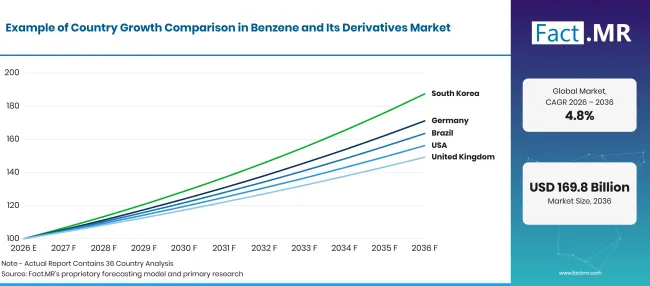
Benzene And Its Derivatives Market Growth Index | Source: Fact.MR
| Country | CAGR (2026 to 2036) |
|---|---|
| Germany | 5.5% |
| Brazil | 5.0% |
| USA | 4.6% |
| UK | 4.1% |
| Japan | 3.6% |
Source: Fact.MR analysis. Updated Nov 4, 2026
What shapes Germany demand?
5.5% CAGR, linked to established chemical conversion sites.
German chemical sites combine aromatic feedstock handling with customers for phenol-based resins and styrene materials. Germany Trade & Invest reports that the German chemical industry generated EUR 189 billion in revenue during 2025 [2]. The German Chemical Industry Association reported in August 2025 that German chemical output fell 2.7% in the first half of 2025 [6]. Energy expenses and occupational exposure requirements are expected to shape investment decisions for older aromatic processing units.
What shapes Brazil demand?
5.0% CAGR, shaped by domestic processing economics and imports.
Brazilian resin makers purchase aromatic intermediates from domestic chemical sites and overseas suppliers. The Brazilian chemical industry association Abiquim reported in 2026 that idle production capacity reached 41% in 2025 [7]. Chemical terminals and inland freight links affect delivery schedules for bulk feedstock. Local resin converters are expected to compare the cost of imported intermediates with domestic transformation costs.
What shapes USA demand?
4.6% CAGR, led by refinery integration and polymer demand.
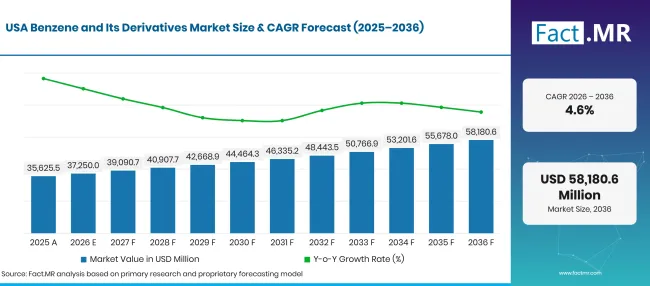
Benzene And Its Derivatives Market Forecast Usa | Source: Fact.MR
United States aromatic producers operate within an established refinery and petrochemical network that supplies chemical converters. Styrene and phenol pathways connect benzene to resins used in industrial materials. For these plants, consistent feedstock specifications help maintain conversion quality and operating schedules. The US Environmental Protection Agency published its 2025 chemical risk evaluation work plan in January 2025 [5]. Exposure monitoring and emission management are expected to remain part of the operating cost for facilities handling benzene.
What shapes UK demand?
4.1% CAGR, reflecting specialist chemical demand and overseas sourcing.
UK chemical manufacturers depend on dependable deliveries of aromatic intermediates for specialist resins and formulated materials. The Department for Environment, Food & Rural Affairs published its 2025 benzene air-quality compliance assessment in October 2026 [4]. Air monitoring obligations and controlled handling remain relevant for plants and distribution sites working with this chemical. Domestic processors are expected to compare imported intermediate prices with the cost of local conversion.
What shapes Japan demand?
3.6% CAGR, supported by aromatic conversion and nylon intermediates.
Japanese petrochemical sites produce benzene for domestic conversion into styrene and cyclohexane-related chemicals. The Japan Petrochemical Industry Association recorded benzene production of 2,725,031 tonnes in 2025 [3]. Domestic derivative manufacturers can align aromatic purchases with output targets at integrated plants.
Who leads the Benzene and Its Derivatives Market?
Competition spans integrated refinery and chemical producers, businesses focused on aromatic intermediates and suppliers of downstream polymers.
Shell maintained an updated benzene handling document in October 2025 [1]. The updated instructions address practical controls for commercial benzene handling. Chevron Phillips Chemical is associated with cyclohexane supply, while large integrated producers are exposed to aromatic feedstock and downstream conversion economics.
Which companies are the key providers?
Key companies include BASF SE; ExxonMobil Corporation; Shell plc; China National Petroleum Corporation (CNPC); SABIC; Dow Inc.; Reliance Industries Limited; Chevron Phillips Chemical Company LLC; LG Chem Ltd.; China Petroleum & Chemical Corporation (Sinopec).
- BASF SE
- ExxonMobil Corporation
- Shell plc
- China National Petroleum Corporation (CNPC)
- SABIC
- Dow Inc.
- Reliance Industries Limited
- Chevron Phillips Chemical Company LLC
- LG Chem Ltd.
- China Petroleum & Chemical Corporation (Sinopec)
Bibliography
- [1] Shell. (2025, October 22). Cargo handling sheet: Benzene (Revision 11) [Cargo handling sheet].
- [2] Germany Trade & Invest. (n.d.). The chemical industry in Germany.
- [3] Japan Petrochemical Industry Association. (n.d.). 石油化学製品の生産 [Production of petrochemical products].
- [4] Department for Environment, Food & Rural Affairs. (2026, October 9). Benzene compliance assessment 2025.
- [5] U.S. Environmental Protection Agency. (2025, January 17). 2025 annual plan for chemical risk evaluations under TSCA.
- [6] Verband der Chemischen Industrie. (2025, August). World Chemistry Report: Facts and figures on the development of production in the global chemical industry.
- [7] Cordeiro, A. P. (2026, June 24). ARTIGO – O conflito e a realidade: o Brasil não está diante de um risco de desabastecimento. Associação Brasileira da Indústria Química.
This Report Answers
- The report compares benzene derivative routes that serve styrene, phenol, nylon intermediates and detergent chemistry.
- Application analysis separates resins from plastics and identifies the distinct uses represented by fibers, detergents and pharmaceutical chemicals.
- The country outlook compares industrial production and trade conditions across Germany, Brazil, USA, UK and Japan.
- The competitive discussion distinguishes aromatic feedstock activities from downstream manufacturing without assigning company shares.
What does the Benzene and Its Derivatives Market cover?
The scope covers industrial benzene derivative products used in chemical conversion, including ethylbenzene, cumene, cyclohexane, nitrobenzene and alkylbenzene. Application value is organized by the immediate downstream use, while the end-user industry view describes where the resulting products are consumed.
What is included in the scope?
Production and commercial supply of the listed derivatives are included. Conversion into styrene, phenol intermediates, nylon precursors and detergent ingredients is considered when explaining demand. Regional analysis addresses differences in feedstock access and downstream chemical manufacturing.
What is excluded from the scope?
Motor fuels containing incidental benzene are outside the derivative product boundary. Finished vehicles, consumer detergents and pharmaceutical medicines are not counted as benzene derivative revenue. Duplicate transactions within an integrated chemical chain must be excluded from total market value.
How Was the Analysis Built?
The analysis draws on 120+ sources, 35+ company portfolios, 25+ countries, and more than 20 industry interviews.
- Primary Research: Primary research includes discussions with manufacturers, service providers, technology developers, distributors, end users, and subject-matter experts. These conversations examine purchasing priorities, product adoption, operational challenges, approval requirements, competitive positioning, and the factors that influence wider market acceptance.
- Desk Research: Desk research covers government statistics, regulatory publications, company filings, trade data, technical studies, industry associations, standards, public policy, and other authoritative sources. Every source used in the analysis is documented in the bibliography.
- Market Sizing and Forecasting: Market estimates combine historical performance, demand indicators, pricing and volume trends, segment shares, company participation, country-level growth, adoption patterns, investment activity, and barriers to market expansion.
- Data Validation and Update Cycle: Findings are validated by comparing primary interviews with public data, company activity, regulatory changes, trade patterns, and industry developments. Regular updates review new product launches, capacity changes, partnerships, approvals, and shifts in commercial adoption.
Segmentation
What is the report’s scope and coverage?
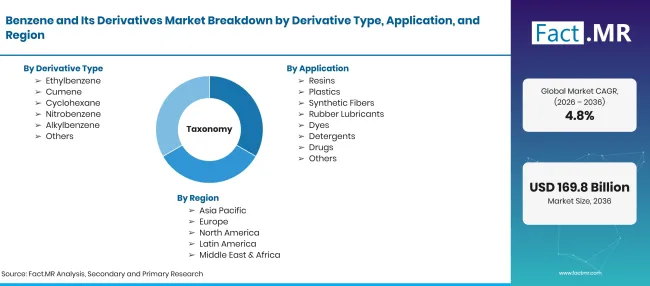
Benzene And Its Derivatives Market Taxonomy | Source: Fact.MR
| Attribute | Details |
|---|---|
| Quantitative Units | USD billion |
| Market Definition | Benzene and its principal industrial derivatives valued within the defined derivative product market; avoid double-counting benzene when resold as an input. |
| Derivative Type | Ethylbenzene; Cumene; Cyclohexane; Nitrobenzene; Alkylbenzene; Others |
| Application | Resins; Plastics; Synthetic Fibers; Rubber Lubricants; Dyes; Detergents; Drugs; Others |
| End-User Industry | Automotive; Construction; Electronics; Pharmaceuticals; Others |
| Regions Covered | North America; Latin America; Western Europe; Eastern Europe; East Asia; South Asia & Pacific; Middle East & Africa |
| Countries Covered | Germany; Brazil; USA; UK; Japan |
| Companies Profiled | BASF SE; ExxonMobil Corporation; Shell plc; China National Petroleum Corporation (CNPC); SABIC; Dow Inc.; Reliance Industries Limited; Chevron Phillips Chemical Company LLC; LG Chem Ltd.; China Petroleum & Chemical Corporation (Sinopec). |
| Forecast Period | 2026 to 2036 |
| Approach | Top-down end-use review with bottom-up derivative capacity, material balance and country demand checks |
Source: Fact.MR analysis. Updated Nov 4, 2026
How is the market segmented?
-
By Derivative Type
- Ethylbenzene
- Cumene
- Cyclohexane
- Nitrobenzene
- Alkylbenzene
- Others
-
By Application
- Resins
- Plastics
- Synthetic Fibers
- Rubber Lubricants
- Dyes
- Detergents
- Drugs
- Others
-
By End-User Industry
- Automotive
- Construction
- Electronics
- Pharmaceuticals
- Others
-
By Region
- North America
- Latin America
- Western Europe
- Eastern Europe
- East Asia
- South Asia & Pacific
- Middle East & Africa
Frequently Asked Questions
How big is the Benzene and Its Derivatives Market in 2026?
What is the forecast CAGR between 2026 and 2036?
Which derivative type leads market value?
Which application has the largest recorded share?
Which firms participate in these chemical value chains?
Who worked on this report


Preview the report firsthand - request a free sample
Free SampleGet the brochure for pricing and purchase details
Download PDF