- Market Value (2025): USD 149.9 Mn
- Estimated Value (2026): USD 157.0 Mn
- Forecast Value (2036): USD 250.0 Mn
- CAGR (2026-2036): 4.8%
What is the Beta Phthalocyanine Blue Market forecast to be worth by 2036?
USD 157 million in 2026 to USD 250 million by 2036, at 4.8% CAGR.
- The USD 149.9 million value in 2025 reflects beta blue's broad installed use across masterbatch, industrial coatings, printing inks, automotive finishes, and specialty compounds.
- Market value is forecast to increase from USD 157 million in 2026 to USD 250 million by 2036 as plastics and coating producers standardize dependable blue grades across more product lines.
- The 4.8% CAGR is anchored by heat stability, weather resistance, and dispersion efficiency rather than a single new end-use application.
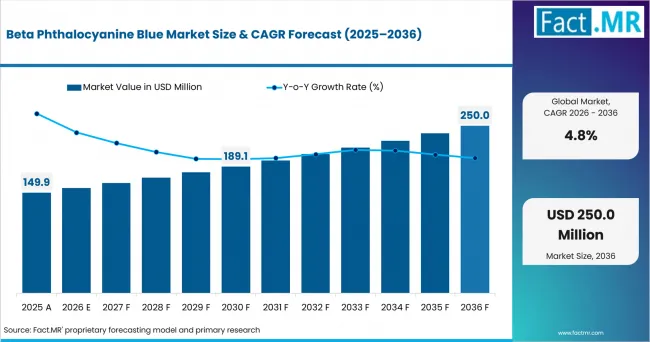
Beta Phthalocyanine Blue Market Value Analysis | Source: Fact.MR
What are the defining numbers behind Beta Phthalocyanine Blue Market growth?
USD 93 million absolute opportunity by 2036, led by Standard beta blue and Plastic masterbatches within their respective segments.
- Demand Drivers in the Market
- Plastic masterbatch producers rely on beta blue for green-shade color, strong tinting, and a crystal form suited to many polymer processes.
- Industrial and automotive coating systems require pigments that maintain appearance under heat, weather, and chemical exposure.
- Printing-ink makers continue to use beta PB15 grades where clean cyan direction, gloss, and stable rheology are commercially important.
- Compounders are pushing suppliers to document dispersion, filter pressure, heat history, and polymer compatibility at the grade level.
- Key Segments Analyzed
- By Beta Grade Type: Standard beta blue leads at 28.0% of demand because unmilled beta CuPC crude, roughly half of it between 1.5 and 5 micron with a coarser tail reaching about 45 micron, already delivers the opacity and tinting strength that mass-tone plastic and coating colorants need, while premium transparent grades require jet-milling that same crude down toward the sub-2 micron range, a step standard-grade buyers do not pay for.
- By Application: Plastic masterbatches leads at 32.0% of demand as compounders run the same beta blue through polyolefin, engineering-resin (PET, PA, PC), and styrenic lines without requalifying the pigment for each polymer, which concentrates purchasing in this single application.
- By Performance Need: Heat stability leads at 29.0% of demand given that every compounding pass pushes the pigment through an extrusion melt running from roughly 200 degrees C in polyolefins to above 260 degrees C in engineering resins, where a color shift disqualifies the batch before light fastness or chemical resistance are ever measured.
- By Supply Form: Dry powder leads at 43.0% of demand because, unlike presscake, which carries water weight and spoilage risk that make it impractical to ship far or store long, it holds its color strength over time and is not locked into one carrier the way flush pastes and wax predispersions are, so a single lot can feed masterbatch, paint, and ink production interchangeably.
- By Customer Type: Masterbatch producers leads at 31.0% of demand because most downstream molders and converters do not operate the twin-screw compounding equipment that uniform pigment dispersion requires, so they buy finished color concentrate rather than raw pigment and purchasing concentrates among dedicated compounders instead.
- Analyst Opinion at Fact.MR
- Shambhu Nath Jha, Senior Analyst at Fact.MR, states, "Beta blue is mature chemistry, yet its value is decided in the processing details: how quickly it disperses, how it behaves at temperature, and whether the shade repeats after scale-up. Suppliers that turn those details into polymer- and coating-specific evidence can defend margins in a category often treated as a commodity."
- Strategic Implications
- Producers should map each beta grade to polymer family, processing temperature, and filter-pressure behavior instead of promoting universal suitability.
- Masterbatch companies can improve line efficiency by qualifying pigment strength and dispersion ease alongside raw-material cost.
- Coating firms should distinguish grades optimized for weathering from those designed mainly for mass-tone strength or ink rheology.
- Distributors need inventory discipline because standard, heat-stable, plastics, coating, and ink grades may share a color index but are not operationally identical.
Official Sudarshan product pages position PB15:3 beta blue around high heat stability, weather fastness, and polymer compatibility, while prepared beta dispersions are offered for flexographic and gravure water-based inks. The contrast shows suppliers creating separate value propositions from the same beta chemistry for plastics and liquid-ink customers.
The United States is projected to expand at a 4.8% CAGR from 2026 to 2036, with established plastics and coating users emphasizing evidence, consistency, and compliance. Germany follows at 4.6% because engineering plastics and durable coatings reward controlled heat and weather performance, while France at 4.4% and Italy at 4.3% add dependable European ink, coating, and masterbatch demand. From 2026 to 2036, Japan is anticipated to advance at a 4.5% CAGR in quality-sensitive formulations with long approval lives.
How does the Beta Phthalocyanine Blue Market break down by segment?
The leading shares are Standard beta blue at 28.0% by Beta Grade Type and Plastic masterbatches at 32.0% by Application.
Why does standard beta blue retain the largest grade share?
At 28.0% share in 2026, the leading position goes to Standard beta blue because it gives formulators a familiar balance of shade, stability, availability, and cost.
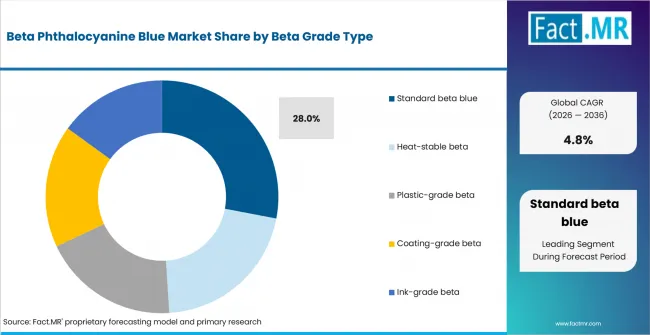
Beta Phthalocyanine Blue Market Analysis By Beta Grade Type | Source: Fact.MR
Standard beta blue holds 28.0%, ahead of heat-stable beta at 21.0% and plastic-grade beta at 19.0%. Its broad processing history makes it easier to approve where operating temperatures and end-use exposure are moderate. More specialized grades gain ground when heat, weather, dispersion, or coating rheology creates a measurable failure risk.
What makes plastic masterbatches the leading application?
The 2026 leader is Plastic masterbatches at 32.0% share as compounders need a durable green-shade blue that can be concentrated and let down across polymer recipes.
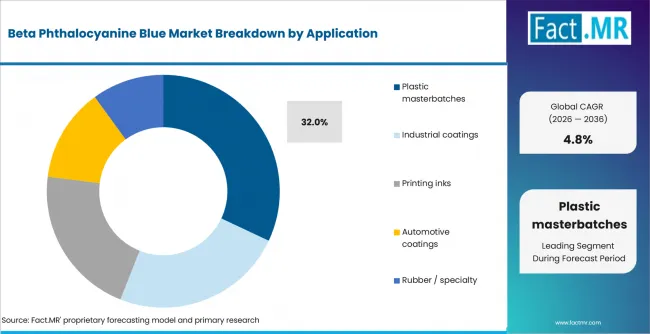
Beta Phthalocyanine Blue Market Analysis By Application | Source: Fact.MR
Plastic masterbatches account for 32.0% of demand, followed by industrial coatings at 24.0%. Masterbatch producers value pigment that can reach target color with manageable filter pressure and reliable dispersion through melt processing. Coatings emphasize film appearance and weathering, while printing inks at 21.0% place more weight on flow, transparency, and gloss.
Which performance criterion directs beta blue selection?
A 29.0% share puts Heat stability first in 2026 because heat stability determines whether color and processing survive polymer conversion and coating cure.
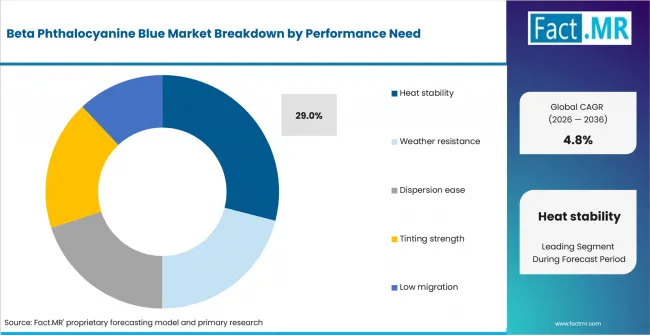
Beta Phthalocyanine Blue Market Analysis By Performance Need | Source: Fact.MR
Heat stability leads with a 29.0% share of performance need. Weather resistance follows at 21.0%, narrowly above dispersion ease at 20.0%, indicating that buyers evaluate both service life and plant behavior. Tinting strength improves color economics, but low migration becomes the decisive screen in selected packaging and regulated applications.
Why is dry powder still the main commercial form?
For Supply Form, the top 2026 position is Dry powder at 43.0% share as large compounders prefer concentrated pigment and retain their own dispersion capability.
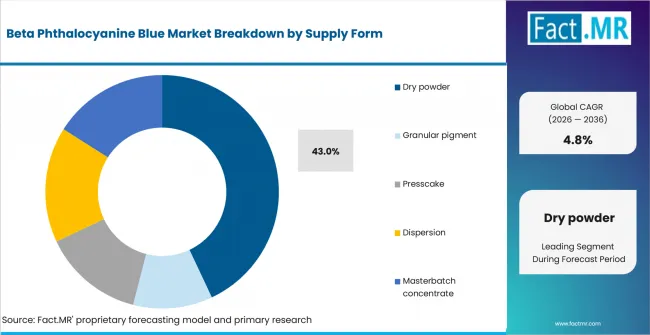
Beta Phthalocyanine Blue Market Analysis By Supply Form | Source: Fact.MR
Dry powder commands 43.0% of supply-form demand. Its high pigment concentration and flexibility suit masterbatch and coating plants that already operate heavy-duty mixing and milling equipment. Dispersions and masterbatch concentrates each hold 16.0%, serving customers that prefer lower dust, faster incorporation, or pre-controlled color development.
Which customer group has the strongest influence on beta blue demand?
The leading 2026 share is 31.0% for Masterbatch producers because masterbatch producers convert pigment performance into repeatable color concentrates for many plastics users.
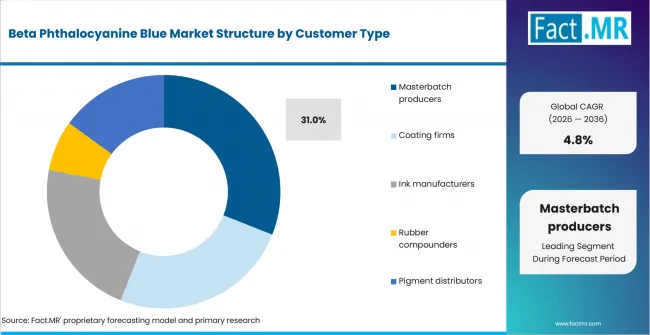
Beta Phthalocyanine Blue Market Analysis By Customer Type | Source: Fact.MR
Masterbatch producers lead with 31.0%, followed by coating firms at 25.0% and ink manufacturers at 22.0%. Their scale gives them bargaining power on strength consistency, particle dispersion, and delivery reliability. Rubber compounders use smaller volumes, while pigment distributors connect regional users to a wide set of application-specific grades.
What is accelerating Beta Phthalocyanine Blue Market adoption, and what is holding it back?
The leading accelerator is the need for a heat-stable, weather-resistant blue across plastics and industrial coatings. The principal restraint is the burden of proving dispersion and color stability in each polymer, process temperature, and end-use condition.
Drivers Impact Analysis
| DRIVER | (~) % IMPACT ON CAGR | GEOGRAPHIC RELEVANCE | IMPACT TIMELINE |
|---|---|---|---|
| Masterbatch color consistency | +0.7% | North America, Europe, and Japan | Medium term (2-4 years) |
| Higher polymer processing temperatures | +0.6% | Global plastics manufacturing hubs | Long term (>= 4 years) |
| Weatherable industrial finishes | +0.5% | Europe and North America | Long term (>= 4 years) |
| Liquid ink performance | +0.4% | Asia Pacific and the Americas | Medium term (2-4 years) |
| Grade-specific technical data | +0.3% | Global | Short term (<= 2 years) |
Source: Fact.MR analysis. Updated Jul 16, 2026
- Masterbatch color consistency: Masterbatch producers need beta blue that disperses into concentrated color without unstable filter pressure or shade variation. A consistent pigment lets them serve several downstream customers from one controlled color platform.
- Higher polymer processing temperatures: Engineering resins and demanding molding conditions expose pigment to longer or hotter processing histories. Heat-stable beta grades gain preference when standard material cannot hold shade or dispersion under those conditions.
- Weatherable industrial finishes: Outdoor equipment, construction products, and durable goods require blue coatings that retain appearance over time. Beta pigments with weathering evidence can become part of long-lived coating specifications.
Opportunity Impact Analysis
| OPPORTUNITY | (~) % IMPACT ON CAGR | GEOGRAPHIC RELEVANCE | IMPACT TIMELINE |
|---|---|---|---|
| Low-filter-pressure plastics grades | +0.4% | Germany, United States, and Japan | Medium term (2-4 years) |
| Weather-fast blue concentrates | +0.3% | Europe, North America, and East Asia | Long term (>= 4 years) |
| Water-based beta blue dispersions | +0.3% | North America, Europe, Japan, and South Korea | Medium term (2-4 years) |
| Application rationalization | +0.2% | Global multi-plant customers | Short term (<= 2 years) |
Source: Fact.MR analysis. Updated Jul 16, 2026
- Low-filter-pressure plastics grades: Masterbatch and fiber users can benefit from grades designed to reduce screen blockage and dispersion defects. Suppliers that combine particle control with high strength can create value beyond a basic PB15:3 specification.
- Weather-fast blue concentrates: Predispersed concentrates can give coating and plastics customers a controlled route to weatherable blue. The opportunity is strongest where color consistency and shorter batch preparation offset the concentrate premium.
- Water-based beta blue dispersions: Prepared aqueous PB15:3 products already target flexographic and gravure ink systems. Further adoption can come from converters seeking lower-VOC processing without losing cyan strength, gloss, or print stability.
Restraints Impact Analysis
| RESTRAINT | (~) % IMPACT ON CAGR | GEOGRAPHIC RELEVANCE | IMPACT TIMELINE |
|---|---|---|---|
| Commodity price pressure | -0.3% | Global | Short term (<= 2 years) |
| Polymer-specific performance gaps | -0.3% | Global plastics markets | Medium term (2-4 years) |
| Migration and compliance screening | -0.2% | Europe, North America, Japan, and export-oriented Asia | Long term (>= 4 years) |
| Alternative blue chemistries | -0.2% | Specialty global applications | Long term (>= 4 years) |
Source: Fact.MR analysis. Updated Jul 16, 2026
- Commodity price pressure: Standard beta blue is widely available and can be purchased against a familiar color index. This comparability compresses margins unless a supplier proves processing or service advantages.
- Polymer-specific performance gaps: A grade that disperses well in one polymer may show plate-out, warpage, filtering, or shade issues in another. Customers therefore require application testing before consolidating specifications.
- Migration and compliance screening: Packaging and sensitive applications may add migration, impurity, or documentation requirements beyond standard color performance. The extra screening can narrow the usable grade set and lengthen approvals.
Which countries define beta phthalocyanine blue demand?
United States 4.8% CAGR. Germany 4.6%. Japan 4.5%.
Regional analysis spans North America, Europe, and Asia Pacific, with country chapters on the United States, Germany, France, Italy, and Japan. The complete study carries this analysis across more than 30 countries.
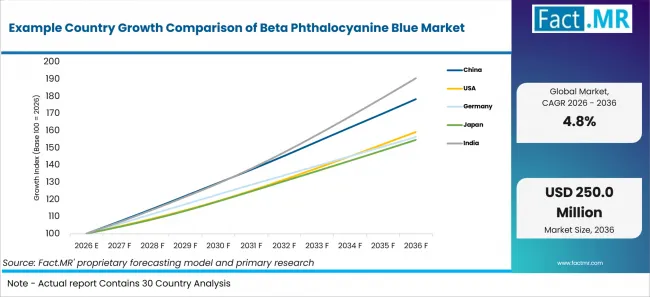
Example Country Growth Comparison Of Beta Phthalocyanine Blue Market | Source: Fact.MR
| COUNTRY | CAGR |
|---|---|
| United States | 4.8% |
| Germany | 4.6% |
| Japan | 4.5% |
Source: Fact.MR analysis. Updated Jul 16, 2026
Why Does US Demand Track Reshored Compounding Capacity Rather Than New Applications?
US beta phthalocyanine blue demand is set to grow at a 4.8% CAGR from 2026 to 2036, tracking reshored masterbatch compounding more than new end uses.
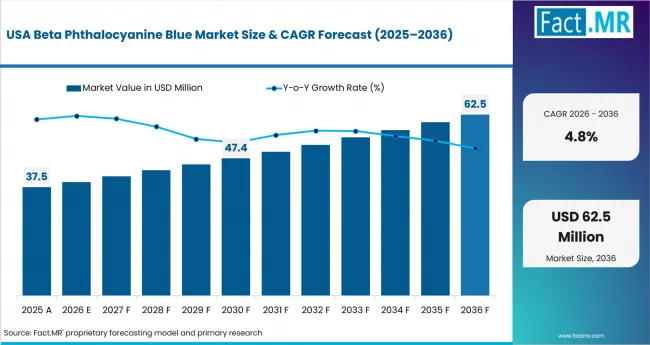
Beta Phthalocyanine Blue Market Country Value Analysis | Source: Fact.MR
Copper phthalocyanine's US regulatory position goes back further than one rulemaking. EPA removed C.I. Pigment Blue 15 from the copper compounds toxic-release reporting category in 1991, concluding the copper ion in the phthalocyanine ring does not become bioavailable; a related 1994 EPA rulemaking on copper monochlorophthalocyanine leaned on that same reasoning. That three-decade-old paper trail keeps compliance overhead low while tariff pressure pushes processors to reshore compounding lines the Plastics Industry Association tracked moving out of Asia through late 2025, and buyers requalifying new domestic capacity default to pigments with settled paperwork.
Does German Demand Run Through the Country's Automotive OEM Color-Approval System?
Germany's beta phthalocyanine blue market is projected to grow at a 4.6% CAGR from 2026 to 2036, a rate set largely by the pigment's path through automotive OEM color-approval systems.
German carmakers run their own material qualification chains through the Verband der Automobilindustrie; interior plastic parts are said to carry manufacturer-specific delivery standards such as Mercedes-Benz's DBL 7384, tested per industry sources against VDA emission and odor protocols. A colorant must clear those internal tests before it reaches a production part number, and beta phthalocyanine blue's heat and migration stability keep it a repeat candidate for that approval list. Germany also hosts K, the triennial Duesseldorf plastics fair that drew more than 3,275 exhibitors from 66 countries in October 2025, keeping German compounders close to new colorant formulations entering Europe's automotive supply chain.
Is French Demand Being Reshaped by the AGEC Anti-Waste Law?
French demand for beta phthalocyanine blue is forecast to grow at a 4.4% CAGR from 2026 to 2036, the slowest of the five markets covered here, shaped by packaging-format rules more than raw volume growth.
France's 2020 AGEC anti-waste law targets a 20% cut in single-use plastic packaging tonnage by the end of 2025 against a 2018 baseline and makes producers fund end-of-life collection, pushing converters toward mono-material, lighter-gauge formats that still need consistent, heat-stable color. Demand concentrates around the Ain department's Plastics Vallee cluster near Oyonnax, which the town's own economic profile lists as home to some 660 plastics companies across 14 industrial parks, where the Plastipolis competitiveness cluster links automotive and packaging converters directly to colorant formulators reworking recipes for the new rules.
Why Does Italian Demand Track the Country's Compounding Machinery Base?
Italy's beta phthalocyanine blue market is projected to grow at a 4.3% CAGR from 2026 to 2036, shaped less by domestic end use than by Italy's role as a source of the machinery that compounds pigment into plastic worldwide.
AMAPLAST, the trade body still widely known by its former name Assocomaplast, represents around 170 Italian plastics and rubber machinery and mould makers, publishes the MACPLAS trade magazine, and runs the triennial PLAST exhibition in Milan, making Italy a persistent exporter of extrusion and compounding lines rather than only a consumer of finished masterbatch.
Does Japanese Demand Reflect DIC's Century-Long Phthalocyanine Pigment Base?
Japan's beta phthalocyanine blue market is expected to grow at a 4.5% CAGR from 2026 to 2036, reflecting its dual role as an early producer of phthalocyanine pigment chemistry and a heavy user of it in precision plastics.
DIC Corporation, the Tokyo-headquartered company founded in 1908 and known through most of the twentieth century as Dainippon Ink and Chemicals, began producing its own organic pigments in 1925 and built one of the industry's deepest phthalocyanine blue product lines. That pigment base sits alongside Japan's electronics connector industry, where board-to-board and FPC/FFC connectors built from heat-resistant plastics such as LCP and PPS make up more than half of domestic connector value and support a connector trade surplus estimated at USD 400 to 600 million a year, giving formulators a steady base of precision, high-heat parts that need stable blue pigment.
Who leads the Beta Phthalocyanine Blue Market?
Sudarshan Chemical Industries Limited and DIC lead the listed supplier group, with Solar Organics, and Meghmani Organics competing across standard and application-specific beta grades.
Sudarshan Chemical Industries Limited holds the largest source share at 9.0%, followed by DIC at 8.0%. Solar Organics and Meghmani Organics each account for 6.0%, maintaining a closely contested field rather than a single dominant franchise.
Portfolio differentiation is visible in heat-stable PB15:3 powders, weather-fast plastics grades, coating-oriented products, and aqueous ink dispersions. The commercial contest will be decided by batch consistency, usable application data, regional stock, and the speed with which suppliers resolve dispersion or heat-performance issues.
Which companies are the key providers?
The company set includes Solar Organics, Sudarshan Chemical Industries Limited, DIC, and Meghmani Organics.
- Solar Organics
- Sudarshan Chemical Industries Limited
- DIC
- Meghmani Organics
These five names frame the competitive discussion, while the complete report reviews more than 30 companies supplying beta blue pigments and preparations.
Bibliography
- Sudarshan Chemical Industries Limited. (n.d.). Sudafast BLUE 2789.
- Sudarshan Chemical Industries Limited. (n.d.). PV Fast Blue BG.
- Sudarshan Chemical Industries Limited. (n.d.). HEUCOSPERSE BS9590.
- DIC Corporation. (n.d.). Plastics pigments.
- Meghmani Organics Limited. (n.d.). Company profile.
- Solar Organics. (n.d.). Phthalocyanine pigments.
This Report Addresses
- The report examines how crystal stability, heat, weathering, dispersion, and migration requirements shape beta blue demand.
- Regional comparison concentrates on the United States, Germany, France, Italy, and Japan, within analysis that covers more than 30 countries.
- The competitive section contrasts Solar Organics, Sudarshan Chemical Industries Limited, DIC, and Meghmani Organics, and the full report assesses 30+ companies in total.
- Product coverage differentiates standard, heat-stable, plastic, coating, and ink grades across five supply forms.
- Application intelligence follows plastic masterbatches, industrial coatings, printing inks, automotive coatings, and rubber or specialty uses.
- Forecast evidence combines shipments, prices, customer approvals, process requirements, and recurring demand from masterbatch, coating, and ink producers.
What does the Beta Phthalocyanine Blue Market cover?
Beta phthalocyanine blue powders and preparations used where a stable green-shade blue must withstand industrial processing and service.
The report measures beta pigment sales into plastics masterbatches, industrial and automotive coatings, printing inks, and rubber or specialty formulations. It follows the source segmentation exactly across grade, application, performance, form, and customer type.
Country coverage runs to more than 30 markets, led by the United States and Europe, and company analysis profiles the five named suppliers within a broader review of 30+ participants over the 2026-2036 period.
What is included in the scope?
Included products span standard beta powder, higher-performance grades, and prepared dispersions or concentrates.
The market includes beta grades optimized for heat stability, plastics, coatings, and inks, as well as standard material. Performance coverage addresses heat stability, weather resistance, dispersion ease, tinting strength, and low migration.
Supply forms include dry powder, granules, presscake, liquid dispersion, and masterbatch concentrate purchased by masterbatch producers, coating firms, ink manufacturers, rubber compounders, and distributors.
What is excluded from the scope?
Alpha blue, unrelated pigments, soluble dyes, and downstream finished-product value are outside the scope.
The market does not count complete masterbatch, paint, ink, automotive component, or rubber-product revenue beyond the pigment or pigment preparation. It excludes colorants and services that do not fall within the beta blue taxonomy.
How was the analysis built?
PB15:3 portfolio evidence, plant interviews, trade data, and forecast cross-checks compiled from more than 30 countries.
- Primary Research: Interview groups included beta pigment producers, masterbatch companies, polymer processors, coating chemists, ink manufacturers, distributors, and procurement managers. Primary work tested the price buyers place on heat stability, weathering, dispersion, low filter pressure, and prepared forms.
- Desk Research: The desk phase mapped official PB15:3 and PB15:4 portfolios before reviewing technical sheets, corporate disclosures, and application guidance. Plastics, coatings, ink, and regulatory material can then test end-use assumptions without importing third-party market estimates.
- Market-Sizing and Forecasting: The model first separated standard powder tonnage from heat-stable grades, dispersions, and concentrates, then apply the relevant price to each stream. Masterbatch, coating, and ink output was translated into pigment consumption while excluding resin and downstream product value.
- Data Validation and Update Cycle: Validation compared supplier volumes, distributor stocks, customer approvals, and repeat-order behavior across polymer and coating systems. Forecast updates tracked heat-stable grade introductions, changes in masterbatch production, coating demand, migration requirements, and substitution among blue chemistries.
Segmentation
What is the report's scope and coverage?
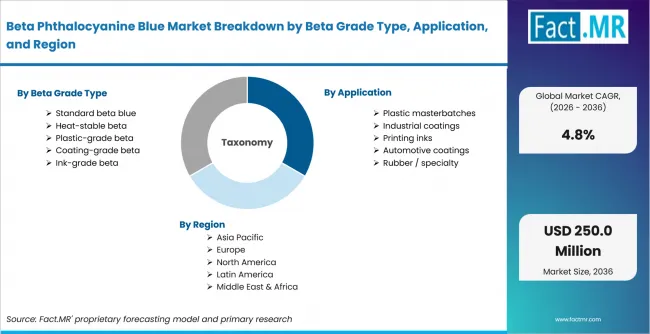
Beta Phthalocyanine Blue Market Breakdown By Beta Grade Type, Application, And Region | Source: Fact.MR
| ATTRIBUTE | DETAILS |
|---|---|
| Quantitative Units | USD 157 million in 2026 to USD 250 million by 2036 at 4.8% CAGR |
| Market Definition | The market includes beta-crystal copper phthalocyanine blue pigments and beta-based preparations sold for green-shade blue coloration in plastics, coatings, inks, automotive finishes, rubber, and specialty applications. |
| Beta Grade Type | Standard beta blue; Heat-stable beta; Plastic-grade beta; Coating-grade beta; Ink-grade beta |
| Application | Plastic masterbatches; Industrial coatings; Printing inks; Automotive coatings; Rubber / specialty |
| Performance Need | Heat stability; Weather resistance; Dispersion ease; Tinting strength; Low migration |
| Supply Form | Dry powder; Granular pigment; Presscake; Dispersion; Masterbatch concentrate |
| Customer Type | Masterbatch producers; Coating firms; Ink manufacturers; Rubber compounders; Pigment distributors |
| Regions Covered | North America; Europe; Asia Pacific |
| Countries Covered | United States; Germany; France; Italy; Japan (30+ countries analyzed in the full report) |
| Key Companies Profiled | Solar Organics; Sudarshan Chemical Industries Limited; DIC; Meghmani Organics |
| Forecast Period | 2026 to 2036 |
| Approach | The sizing model reconciles beta pigment shipment volume, grade and supply-form pricing, application usage, customer conversion, and heat- or weather-performance qualification cycles. |
Source: Fact.MR analysis. Updated Jul 16, 2026
How is the market segmented?
-
By Beta Grade Type
- Standard beta blue
- Heat-stable beta
- Plastic-grade beta
- Coating-grade beta
- Ink-grade beta
-
By Application
- Plastic masterbatches
- Industrial coatings
- Printing inks
- Automotive coatings
- Rubber / specialty
-
By Performance Need
- Heat stability
- Weather resistance
- Dispersion ease
- Tinting strength
- Low migration
-
By Supply Form
- Dry powder
- Granular pigment
- Presscake
- Dispersion
- Masterbatch concentrate
-
By Customer Type
- Masterbatch producers
- Coating firms
- Ink manufacturers
- Rubber compounders
- Pigment distributors
-
By Region
- North America
- United States
- Europe
- Germany
- France
- Italy
- Asia Pacific
- Japan
Frequently Asked Questions
What value is the Beta Phthalocyanine Blue Market expected to reach?
Which beta grade type holds the largest share?
Which application leads beta blue consumption?
What is the leading performance need?
How does demand develop across the United States and Europe?
What supports Japan's beta blue outlook?
What is the central market driver?
What restrains beta blue adoption?
Who worked on this report


Preview the report firsthand - request a free sample
Free SampleGet the brochure for pricing and purchase details
Download PDF