- Base Value(2025): 7.0 Bn
- Estimated Value(2025): 7.0 Bn
- Forecast Value (2035): 24.3 Bn
- CAGR (2025 - 2035): 13.3%
Blue Hydrogen Market Forecast and Outlook 2025 to 2035
The global blue hydrogen market is projected to grow from USD 7.0 billion in 2025 to approximately USD 24.3 billion by 2035, recording an extraordinary absolute increase of USD 17.3 billion over the forecast period. This translates into a total growth of 247.1%, with the market forecast to expand at a compound annual growth rate (CAGR) of 13.3% between 2025 and 2035.
Demand for blue hydrogen is expected to grow by over 3.5X during this period, supported by exponential demand for low-carbon hydrogen production, rising adoption of carbon capture and storage integration protocols, and growing emphasis on industrial decarbonization and energy transition optimization across global hydrogen infrastructure operations.
Quick Stats on Blue Hydrogen Market
- Blue Hydrogen Market Value (2025): USD 7.0 billion
- Blue Hydrogen Market Forecast Value (2035): USD 24.3 billion
- Blue Hydrogen Market Forecast CAGR (2025 to 2035): 13.3%
- Leading Technology in Blue Hydrogen Market: Steam Methane Reforming (60.9%)
- Leading Application in Blue Hydrogen Market: Power Generation (37.2%)
- Leading Transportation Mode in Blue Hydrogen Market: Pipeline (70.0%)
- Key Growth Regions in Blue Hydrogen Market: Asia Pacific, North America, and Europe
- Key Players in Blue Hydrogen Market: Linde plc, Shell Group of Companies, Air Liquide, Air Products and Chemicals, Inc., Engie, Equinor ASA, SOL Group, Iwatani Corp., INOX Air Products Ltd., Exxon Mobil Corp.
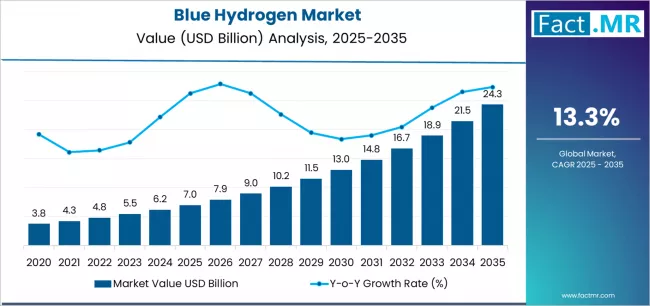
Blue Hydrogen Market Market Value Analysis | Source: Fact.MR
The blue hydrogen market is positioned for substantial expansion, driven by increasing recognition of hydrogen economy importance, growing industrial decarbonization commitments with enhanced emission reduction standards, and rising adoption of advanced carbon capture technologies across hydrogen production facilities globally.
The market demonstrates robust fundamentals supported by expanding hydrogen infrastructure networks, energy sector professionals' focus on transition fuel protocols, and rising recognition of blue hydrogen services as critical energy components in achieving enhanced climate mitigation outcomes, industrial process optimization capabilities, and emission reduction effectiveness within modern energy architectures across diverse industrial applications.
Market growth is underpinned by technological innovations in hydrogen production procedures, particularly advanced carbon capture and storage techniques and steam methane reforming system integration, which offer enhanced efficiency, improved carbon sequestration outcomes, and superior compatibility with comprehensive industrial decarbonization protocols prevalent in contemporary energy practices.
Energy providers increasingly prioritize hydrogen production technologies that deliver optimal balance between production economics, carbon reduction reliability, and cost-effectiveness while adhering to increasingly stringent climate commitments and industrial decarbonization requirements across global hydrogen markets.
The convergence of refinery hydrogen demand expansion in petrochemical regions, power generation applications growth in developed economies, and specialized hydrogen infrastructure development in emerging markets creates multifaceted growth opportunities for blue hydrogen producers and energy facility operators.
The hydrogen production landscape is experiencing transformative changes as operators adopt sophisticated carbon capture equipment including post-combustion capture systems, advanced pre-combustion separation technologies, and integrated storage solutions that enable significant emission reduction and precise production management.
These technological advancements are complemented by evolving transportation capabilities encompassing pipeline infrastructure expansion, cryogenic liquid hydrogen handling procedures, and innovative distribution techniques that significantly improve supply chain efficiency and energy delivery outcomes.
The integration of digital monitoring platforms and real-time emission tracking capabilities further enhances production reliability, particularly benefiting industrial facilities and large-scale consumers where consistent low-carbon hydrogen availability remains critical.
Between 2025 and 2030, the blue hydrogen market is projected to expand from USD 7.0 billion to USD 13.0 billion, demonstrating strong foundational growth driven by global industrial decarbonization expansion, increasing awareness of hydrogen economy development, and initial deployment of advanced carbon capture and storage technologies across refinery and chemical manufacturing platforms. This growth phase establishes market infrastructure, validates specialized hydrogen production protocols, and creates comprehensive supply delivery networks supporting global energy transition operations.
From 2030 to 2035, the market is forecast to reach USD 24.3 billion, driven by mature blue hydrogen production penetration, next-generation carbon capture procedures requiring sophisticated technical expertise, and comprehensive integration of advanced sequestration systems demanding enhanced environmental performance capabilities. The growing adoption of hydrogen economy programs, specialized facility development initiatives, and industrial decarbonization commitment expansion will drive demand for comprehensive blue hydrogen production services with enhanced emission reduction outcomes and seamless energy infrastructure integration functionality.
Blue Hydrogen Market Key Takeaways
| Metric | Value |
|---|---|
| Estimated Value (2025E) | USD 7.0 billion |
| Forecast Value (2035F) | USD 24.3 billion |
| Forecast CAGR (2025 to 2035) | 13.3% |
Source: Fact.MR analysis. Updated Dec 8, 2025
Why is the Blue Hydrogen Market Growing?
Market expansion is being supported by the exponential increase in industrial decarbonization spending and the corresponding need for sophisticated low-carbon energy solutions in industrial applications across global manufacturing operations. Energy producers are increasingly focused on advanced hydrogen production technologies that can improve emission reduction outcomes, enhance industrial efficiency, and optimize climate commitment protocols while meeting stringent regulatory requirements.
The proven efficacy of blue hydrogen production in various industrial applications makes it an essential component of comprehensive energy transition strategies and industrial decarbonization management programs. The growing emphasis on climate commitments and hydrogen economy integration is driving demand for advanced production technologies that meet stringent performance specifications and operational requirements for industrial applications.
Energy providers' preference for reliable, high-performance production protocols that can ensure consistent supply outcomes is creating opportunities for innovative carbon capture techniques and customized hydrogen solutions. The rising influence of energy transition standards and climate regulations is also contributing to increased adoption of premium-grade blue hydrogen production services across different industrial categories and energy systems requiring advanced decarbonization technology.
Opportunity Pathways - Blue Hydrogen Market
The blue hydrogen market represents a transformative growth opportunity, expanding from USD 7.0 billion in 2025 to USD 24.3 billion by 2035 at a 13.3% CAGR. As energy producers prioritize industrial decarbonization optimization, specialized emission reduction, and operational excellence in complex energy environments, blue hydrogen production services have evolved from a niche energy source to an essential transition component enabling precise carbon management, comprehensive climate compliance strategies, and multi-sector decarbonization operations across refinery platforms and power generation applications.
The convergence of climate commitment acceleration, increasing hydrogen economy penetration, advanced carbon capture technology integration, and stringent emission reduction mandates creates momentum in demand. High-precision production facilities offering superior carbon sequestration outcomes, cost-effective hydrogen solutions balancing functionality with economics, and specialized services for refinery applications will capture market premiums, while geographic expansion into high-growth Middle Eastern energy markets and emerging Asian hydrogen ecosystems will drive volume leadership. Energy provider emphasis on climate innovation and production reliability provides structural support.
- Pathway A - Steam Methane Reforming Technology Dominance: Leading with 60.9% market share, steam methane reforming applications drive primary demand through mature production workflows requiring comprehensive carbon capture integration for industrial hydrogen supply. Advanced production protocols enabling improved carbon sequestration, reduced emission intensity, and enhanced operational efficiency outcomes command premium pricing from industrial operators requiring stringent performance specifications and regulatory compliance. Expected revenue pool: USD 4.3-14.8 billion.
- Pathway B - Power Generation Application Leadership: Dominating with 37.2% market share through optimal balance of energy transition necessity and low-carbon fuel requirements, power generation applications serve most hydrogen demand requirements while meeting diverse energy sector needs. This application category addresses both existing hydrogen use conversion and new power facility requirements, making it the preferred segment for energy producers and industrial operations seeking comprehensive decarbonization capabilities. Opportunity: USD 2.6-9.0 billion.
- Pathway C - Middle Eastern Market Acceleration: Saudi Arabia (15.4% CAGR) and UAE (13.3% CAGR) lead global growth through state-led hydrogen programs, energy export diversification, and hydrogen hub capability advancement. Strategic partnerships with international energy providers, production localization expertise, and infrastructure network optimization enable the expansion of blue hydrogen facilities in major energy production hubs. Geographic expansion upside: USD 1.9-5.3 billion.
- Pathway D - Pipeline Transportation Segment: Pipeline infrastructure with 70.0% market share serves critical hydrogen distribution applications requiring cost-effective transport for industrial facilities. Optimized delivery protocols supporting multiple industrial users, large-scale supply requirements, and proven operational effectiveness maintain significant volumes from energy producers and chemical manufacturing facilities. Revenue potential: USD 4.9-17.0 billion.
- Pathway E - Advanced Carbon Capture Technologies & Integration Systems: Companies investing in sophisticated sequestration techniques, emission monitoring innovations, and advanced capture system integration gain competitive advantages through consistent carbon reduction delivery and production reliability. Advanced capabilities enabling customized emission specifications and rapid regulatory compliance development capture premium industrial partnerships. Technology premium: USD 1.5-4.4 billion.
- Pathway F - Infrastructure Optimization & Production Excellence: Specialized hydrogen production facilities, strategic carbon storage integration, and reliable supply management systems create competitive differentiation in energy markets requiring consistent hydrogen availability. Companies offering guaranteed carbon reduction quality, continuous monitoring services, and regulatory compliance support gain preferred supplier status with climate-focused industrial operators. Infrastructure network value: USD 1.2-3.6 billion.
- Pathway G - Emerging Applications & Market Development: Beyond traditional refinery applications, blue hydrogen in transportation fuel cells, industrial heating systems, and specialized chemical feedstock production represent growth opportunities. Companies developing new production protocols, supporting innovation initiatives, and expanding into adjacent hydrogen markets and synthetic fuel applications capture incremental demand while diversifying revenue streams. Emerging opportunity: USD 1.0-2.9 billion.
Segmental Analysis
The market is segmented by technology, application, transportation mode, and region. By technology, the market is divided into steam methane reforming, auto thermal reforming, and gas partial oxidation. Based on application, the market is categorized into power generation, refinery, chemicals, and others.
By transportation mode, the market is segmented into pipeline and cryogenic liquid tankers. Regionally, the market is divided into Asia Pacific, North America, Europe, Latin America, and Middle East & Africa.
Which Technology Occupies the Dominant Position in the Blue Hydrogen Market?
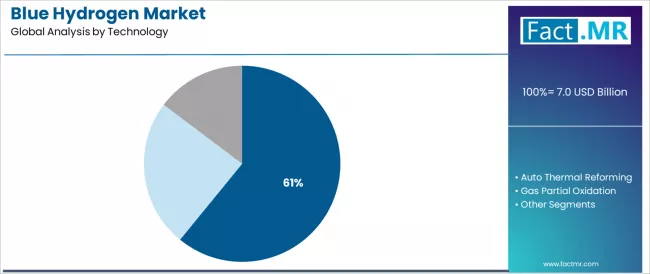
Blue Hydrogen Market Analysis By Technology | Source: Fact.MR
Steam methane reforming technology segment is projected to account for 60.9% of the blue hydrogen market in 2025, reaffirming its position as the category's dominant production specification. Energy producers increasingly recognize the optimal balance of production efficiency and carbon capture integration offered by steam methane reforming technologies for industrial hydrogen applications, particularly in refinery operations and chemical manufacturing environments.
This technology category addresses both production cost requirements and emission reduction demands while providing reliable hydrogen output across diverse industrial operations. This segment forms the foundation of most industrial hydrogen production protocols for refinery management and chemical processing, as it represents the most economically proven and commercially established technology category in the blue hydrogen industry.
Technical validation standards and extensive operational deployment continue to strengthen confidence in steam methane reforming among energy operators and industrial facility professionals. With increasing recognition of carbon capture integration capabilities and production scalability requirements, steam methane reforming technologies align with both current industrial practices and hydrogen economy evolution goals, making them the central growth driver of comprehensive energy transition strategies across multiple production platforms.
Auto thermal reforming represents 22.0% of technology applications, reflecting growing adoption of advanced gasification processes with improved thermal efficiency characteristics. Gas partial oxidation accounts for 17.1% of the segment, driven by specialized applications requiring high-temperature hydrogen production and integration with specific industrial processes.
What Drives Power Generation Application Segment Prominence?
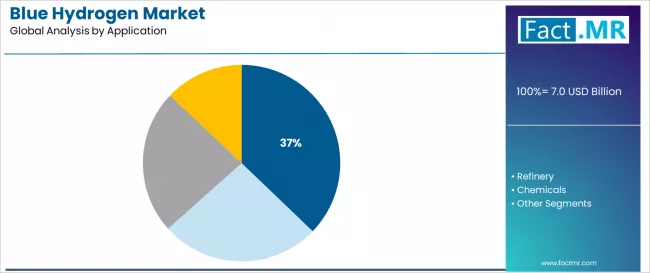
Blue Hydrogen Market Analysis By Application | Source: Fact.MR
Power generation applications are projected to represent 37.2% of blue hydrogen demand in 2025, underscoring its role as the primary application category driving market adoption and hydrogen infrastructure deployment. Energy producers recognize that power generation requirements, including diverse turbine applications, varied fuel cell systems, and comprehensive grid integration protocols, provide the largest addressable market that traditional hydrogen applications cannot match in energy transition significance and decarbonization value.
Power generation applications utilized in hydrogen economy development offer enhanced emission reduction capabilities and broad system compatibility essential for serving baseload power requirements and renewable energy storage needs. The segment is supported by the expanding nature of global power sector decarbonization, requiring fuels capable of addressing coal replacement, natural gas conversion, and renewable energy integration, and the increasing recognition that advanced hydrogen combustion protocols can improve grid reliability and emission outcomes.
Energy operators are increasingly adopting hydrogen turbine technologies that mandate specialized fuel supply integration for optimal power output and regulatory compliance. As understanding of hydrogen power capabilities advances and grid requirements become more sophisticated, hydrogen-enabled power generation applications will continue to play a crucial role in comprehensive energy transition differentiation strategies.
Refinery applications represent 28.4% of the market, driven by established hydrogen demand for hydrocracking and desulfurization processes. Chemicals account for 21.5% of applications, reflecting hydrogen requirements for ammonia production and methanol synthesis. Other applications comprise 12.9%, encompassing specialized industrial uses including steel production, glass manufacturing, and food processing operations requiring hydrogen feedstock.
Which is the Preferred Transportation Mode for Blue Hydrogen?
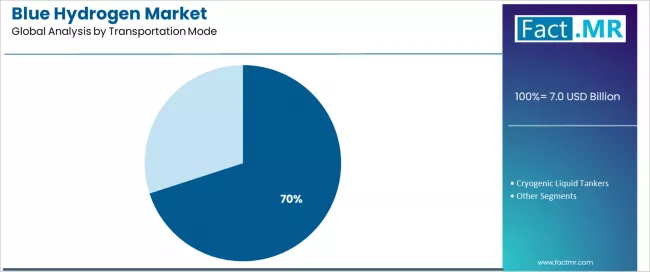
Blue Hydrogen Market Analysis By Transportation Mode | Source: Fact.MR
Pipeline transportation is projected to account for 70.0% all blue hydrogen shipments in 2025, establishing its position as the leading distribution method. Energy operators increasingly recognize that pipeline infrastructure, encompassing dedicated hydrogen networks and natural gas blending systems, represents the most economically viable and operationally proven category for large-scale hydrogen distribution due to cost advantages and infrastructure reliability.
This transportation mode addresses both high-volume supply requirements and continuous delivery demands while delivering critical distribution outcomes across concentrated industrial regions. The segment is supported by the continuing nature of hydrogen distribution economics in industrial clusters, driven by infrastructure capital efficiency, operational cost advantages, and established regulatory frameworks supporting pipeline deployment.
Energy providers are increasingly focusing on pipeline network expansion protocols that enhance distribution capacity and supply chain reliability while maintaining safety standards. As hydrogen infrastructure development accelerates and industrial hub formation grows, pipeline transportation services will continue to serve a crucial role in ensuring supply reliability and cost competitiveness within the global hydrogen economy.
Cryogenic liquid tankers represent 30.0% of transportation modes, driven by requirements for long-distance hydrogen transport, maritime shipping applications, and supply to regions lacking pipeline infrastructure, enabling market access for geographically dispersed industrial facilities and emerging hydrogen markets.
What are the Drivers, Restraints, and Key Trends of the Blue Hydrogen Market?
The blue hydrogen market is advancing rapidly due to increasing recognition of energy transition importance and growing demand for low-carbon energy solutions across the industrial sector.
The market faces challenges, including production cost pressures in price-sensitive energy markets, carbon capture infrastructure availability in emerging regions, and concerns about long-term carbon storage reliability in developing hydrogen economies. Innovation in carbon sequestration technologies and advanced production efficiency algorithms continues to influence facility development and market expansion patterns.
Proliferation of Advanced Carbon Capture Technologies and Storage Systems
The accelerating adoption of sophisticated carbon sequestration platforms is enabling the development of more efficient blue hydrogen production applications and emission reduction protocols that can meet stringent climate and regulatory requirements.
Energy producers demand comprehensive carbon capture integration for hydrogen facilities, including high-efficiency capture capabilities and multi-stage sequestration formulations that are particularly important for achieving ambitious emission reduction requirements in complex industrial applications.
Advanced capture technologies provide access to real-time emission monitoring that can optimize production strategies and enhance environmental outcomes while maintaining cost-effectiveness for diverse energy facility environments.
Integration of Digital Monitoring Platforms and Production Management Capabilities
Modern energy organizations are incorporating advanced technologies such as digital control systems, remote facility monitoring capabilities, and automated optimization interfaces to enhance hydrogen production utility and operational efficiency.
These systems improve emission verification opportunities, enable seamless production optimization transitions, and provide better integration between hydrogen facilities and industrial consumers throughout the supply and distribution experience.
Advanced digital capabilities also enable customized production protocols and early identification of operational inefficiencies or equipment degradation, supporting proactive maintenance management and improved facility performance outcomes.
Analysis of the Blue Hydrogen Market by Key Countries
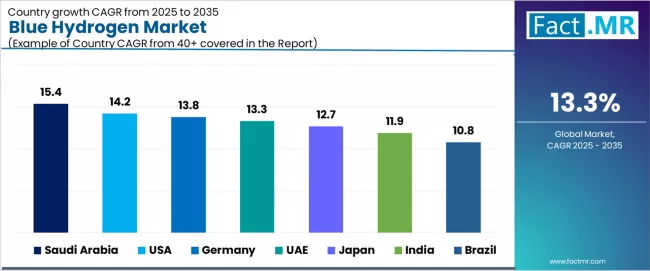
Blue Hydrogen Market Cagr Analysis By Country | Source: Fact.MR
| Country | CAGR (2025 to 2035) |
|---|---|
| Saudi Arabia | 15.4% |
| USA | 14.2% |
| Germany | 13.8% |
| UAE | 13.3% |
| Japan | 12.7% |
| India | 11.9% |
| Brazil | 10.8% |
Source: Fact.MR analysis. Updated Dec 8, 2025
The blue hydrogen market is experiencing exceptional growth globally, with Saudi Arabia leading at a 15.4% CAGR through 2035, driven by state-led hydrogen mega-projects, energy export diversification strategies, and massive infrastructure investment across major industrial and energy production centers. USA follows at 14.2%, supported by large refinery hydrogen integration, carbon capture incentive programs, and comprehensive energy transition initiatives. Germany records 13.8% growth, benefiting from EU hydrogen strategy support and industrial decarbonization leadership.
UAE demonstrates 13.3% growth, emphasizing regional hydrogen hub formation and clean energy economy development. Japan shows 12.7% growth with hydrogen import infrastructure and fuel cell transportation focus. India records 11.9% growth, representing National Hydrogen Mission implementation and industrial growth emphasis, while Brazil shows 10.8% growth, representing gas resource optimization and renewable energy integration leadership.
How does Saudi Arabia Demonstrate Market Leadership with State-Led Hydrogen Programs?
Revenue from blue hydrogen in Saudi Arabia is projected to exhibit exceptional growth with a CAGR of 15.4% through 2035, driven by ambitious national hydrogen strategies and strategic positioning as a global clean energy supplier through massive infrastructure investment and production capacity development. The country's abundant natural gas resources and government commitment to energy transition are creating significant opportunities for blue hydrogen deployment across both domestic industrial applications and international export market segments.
Major international energy companies and national operators are establishing comprehensive production facilities to serve the expanding demand for low-carbon hydrogen across chemical production, power generation, and hydrogen export operations throughout Saudi Arabia's diverse industrial and energy regions.
The Saudi government's strategic emphasis on hydrogen economy development and energy diversification is driving substantial investments in carbon capture capabilities and production infrastructure availability. This policy support, combined with the country's energy sector expertise and international market access, creates a favorable environment for blue hydrogen market development. Saudi energy operators are increasingly focusing on world-scale production facilities to establish global supply leadership, with advanced blue hydrogen production representing a key component in this energy export capability building.
- Government initiatives supporting hydrogen mega-projects and clean energy transition are driving demand for blue hydrogen production across domestic and export segments
- Infrastructure capacity expansion and carbon capture technology deployment are supporting appropriate scale-up of production facilities among operators and energy companies nationwide
- Energy sector operators and international partners are increasingly recognizing hydrogen economy opportunities in industrial diversification, creating new production demand capabilities
- Rising clean energy investment and growing recognition of export market benefits are accelerating blue hydrogen facility development across energy sectors
What makes USA Demonstrate Industrial Integration Leadership?
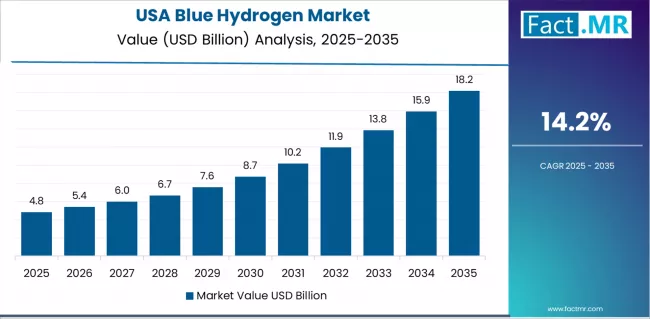
Blue Hydrogen Market Country Value Analysis | Source: Fact.MR
Revenue from blue hydrogen in USA is expanding at a CAGR of 14.2%, supported by extensive refinery infrastructure, advancing carbon capture incentive frameworks, and comprehensive industrial decarbonization commitment integration across the country's developed energy and manufacturing corridors.
The country's established hydrogen production capacity and increasing focus on emission reduction technologies are driving demand for blue hydrogen solutions in both existing refinery operations and emerging power generation applications. National energy producers and industrial operators are establishing production capacity to serve the growing demand for low-carbon hydrogen while supporting the country's position as a leading industrial and energy market.
USA hydrogen sector continues to benefit from favorable policy frameworks, established industrial infrastructure, and growing corporate commitment to emission reduction. The country's focus on expanding carbon capture deployment capabilities is driving investments in critical production technologies including advanced sequestration systems and monitoring platforms. This development is particularly important for blue hydrogen applications, as operators seek reliable carbon management sources to enhance environmental performance and reduce dependence on higher-emission hydrogen production methods.
- Rising awareness about climate commitments and improving domestic carbon capture capabilities are creating opportunities for advanced blue hydrogen solutions
- Growing refinery modernization and industrial facility decarbonization are supporting increased deployment of blue hydrogen production across energy sectors
- Expanding incentive program capacity and emerging regulatory standards are driving innovative applications of blue hydrogen in refinery and power generation applications
- Production capability advancement is enabling delivery of sophisticated emission reduction protocols, supporting market growth and enhancing climate compliance capabilities
Why does Germany Maintain European Hydrogen Leadership?
Revenue from blue hydrogen in Germany is projected to exhibit strong growth with a CAGR of 13.8% through 2035, driven by comprehensive EU hydrogen strategy implementation and industrial decarbonization excellence. The country's position as Europe's industrial powerhouse and commitment to energy transition are creating significant opportunities for blue hydrogen integration across both manufacturing operations and power sector applications. German energy operators are leveraging industrial expertise to serve the growing demand for low-carbon hydrogen while supporting the country's position as a leading European energy economy.
The German market benefits from strong policy support for hydrogen economy development, enabling optimized production facility deployment and comprehensive industrial integration. This development is particularly important for blue hydrogen applications, as operators seek sophisticated carbon management solutions that maximize emission reduction while ensuring industrial competitiveness in manufacturing and chemical production environments.
Strategic Market Considerations:
- Chemical and refinery sectors leading growth with focus on industrial decarbonization and manufacturing emission reduction applications
- Industrial competitiveness requirements and EU climate policy are driving diverse hydrogen portfolios from existing facility retrofits to new production capacity platforms
- Engineering excellence and chemical industry expertise supporting competitive positioning in European hydrogen markets
- Carbon pricing mechanisms and emission regulations beginning to influence production economics and technology adoption timelines
How does UAE Accelerate Regional Hydrogen Hub Development?
The UAE's advancing hydrogen market demonstrates strategic positioning with documented effectiveness in regional hub formation and clean energy economy development through integration with natural gas resources and carbon management capabilities. The country leverages energy sector leadership and comprehensive infrastructure planning to maintain a 13.3% CAGR through 2035.
Major industrial zones, including facilities in Abu Dhabi and strategic export terminals, showcase blue hydrogen implementations where production capacity integrates with comprehensive export infrastructure and ongoing hydrogen economy initiatives to optimize supply chain effectiveness and market positioning.
Emirati energy operators prioritize strategic positioning and international partnership development in hydrogen production, creating demand for integrated blue hydrogen facilities with advanced features, including sophisticated carbon capture integration and connection with comprehensive energy export systems. The market benefits from established energy infrastructure and commitment to clean energy leadership that drives hydrogen economy advancement.
Strategic Market Considerations:
- Export-oriented and industrial segments leading growth with focus on international supply chain integration and regional energy hub applications
- Strategic positioning requirements are driving sophisticated facility portfolios from domestic production capacity to international hydrogen export platforms
- Energy sector expertise and international partnership capabilities supporting competitive positioning in Middle Eastern hydrogen markets
- Clean energy mandates and economic diversification programs ensuring consistent production development and market expansion optimization
What drives Japan’s Market Growth with Hydrogen Import Focus?
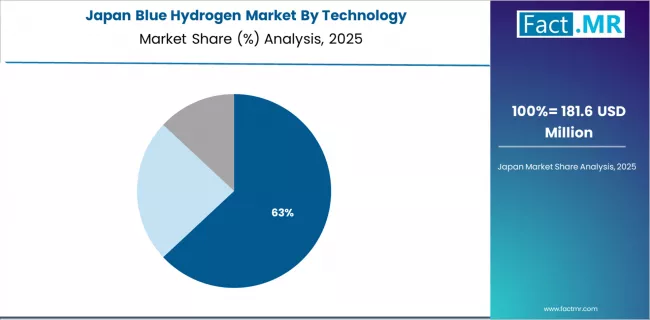
Blue Hydrogen Market Japan Market Share Analysis By Technology | Source: Fact.MR
Japan's expanding blue hydrogen market demonstrates accelerating adoption with a 12.7% CAGR through 2035, driven by national hydrogen strategy implementation, fuel cell transportation development, and comprehensive import infrastructure planning across major industrial and metropolitan regions.
The country's commitment to hydrogen economy development and limited domestic energy resources are creating substantial demand for blue hydrogen solutions across diverse power generation and industrial platforms. Japanese energy operators and trading companies are increasingly prioritizing hydrogen supply chains that incorporate international sourcing for optimal energy security and emission reduction enhancement.
Market dynamics focus on reliable hydrogen supply services that balance emission reduction capabilities with energy security considerations important to Japanese industrial standards and long-term economic requirements. Growing import infrastructure expertise creates opportunities for integrated supply chain development programs and international partnership deployment.
Strategic Market Considerations:
- Power generation and industrial segments demonstrating focused growth with emphasis on energy security and emission reduction applications
- High reliability requirements driving premium hydrogen specifications with advanced supply chain characteristics and delivery assurance optimization
- Energy security supported by international partnership expertise and comprehensive import infrastructure capabilities
- Energy operator preferences emphasizing proven supply reliability and comprehensive quality verification in hydrogen sourcing applications
How does India Demonstrate National Mission Implementation?
India's expanding blue hydrogen market demonstrates accelerating adoption with a 11.9% CAGR through 2035, driven by National Hydrogen Mission implementation, industrial growth acceleration, and energy transition policy development across major manufacturing and refining regions.
The country's massive refinery capacity and growing industrial base are creating substantial demand for blue hydrogen solutions across diverse petrochemical and fertilizer production platforms. Indian energy operators and industrial facilities are increasingly prioritizing hydrogen production technologies that incorporate domestic resource utilization for optimal economic development and industrial competitiveness enhancement.
Market dynamics focus on cost-effective hydrogen production services that balance emission reduction capabilities with economic development considerations important to Indian industrial growth requirements. Growing domestic production expertise creates opportunities for integrated industrial development programs and technology deployment.
Strategic Market Considerations:
- Refinery and fertilizer segments leading growth with focus on industrial efficiency and emission reduction applications
- Cost-effectiveness requirements are driving optimized production portfolios from existing facility integration to new capacity development platforms
- Industrial capability development supported by domestic energy resources and manufacturing sector expertise
- National policy frameworks emphasizing energy security and industrial growth in hydrogen economy applications
What drives Brazil’s Market Growth with Gas Resource Integration?
Brazil's expanding blue hydrogen market demonstrates steady growth with a 10.8% CAGR through 2035, driven by natural gas resource development, renewable energy integration opportunities, and industrial decarbonization initiatives across major refining and chemical production regions.
The country's expanding gas production capacity and commitment to emission reduction are creating opportunities for blue hydrogen deployment across both existing industrial facilities and emerging clean energy applications. Brazilian energy operators are leveraging resource availability to serve the growing interest in low-carbon hydrogen while supporting the country's position in Latin American energy markets.
Market dynamics focus on resource-optimized hydrogen production services that balance emission reduction capabilities with economic viability considerations important to Brazilian industrial development requirements. Growing domestic energy sector expertise creates opportunities for integrated production development programs and industrial application deployment.
Strategic Market Considerations:
- Refinery and chemical segments demonstrating growth with focus on resource utilization and industrial emission reduction applications
- Economic development priorities driving production portfolios from conventional facility operations to blue hydrogen capacity platforms
- Energy sector expertise and gas resource availability supporting competitive positioning in Latin American hydrogen markets
- Industrial development programs and climate commitment initiatives beginning to influence production planning and technology adoption patterns
Europe Market Split by Country
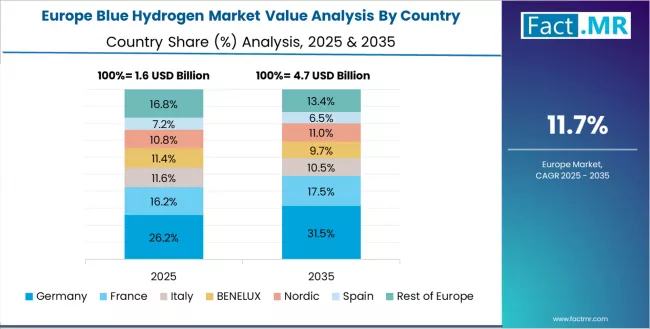
Blue Hydrogen Market Europe Country Market Share Analysis, 2025 & 2035 | Source: Fact.MR
The blue hydrogen market in Europe is projected to grow from USD 1.8 billion in 2025 to USD 4.2 billion by 2035, registering a CAGR of 8.9% over the forecast period. Germany is expected to maintain its leadership position with a 34.2% market share in 2025, rising to 35.8% by 2035, supported by its dominant industrial base, comprehensive hydrogen strategy implementation, and advanced carbon capture infrastructure throughout major chemical production regions and refinery networks.
France follows with a 22.6% share in 2025, projected to reach 23.4% by 2035, driven by nuclear power integration opportunities, industrial decarbonization initiatives, and hydrogen economy development serving both domestic and European markets. The Netherlands holds a 16.8% share in 2025, expected to increase to 17.2% by 2035, supported by port infrastructure advantages and industrial cluster concentration. United Kingdom commands a 14.4% share in 2025, projected to reach 13.8% by 2035, while Norway accounts for 8.2% in 2025, expected to reach 7.6% by 2035.
The rest of Europe region, including emerging Eastern European hydrogen projects, Nordic industrial applications, and smaller Western European production facilities, is anticipated to hold 3.8% in 2025, declining slightly to 2.2% by 2035, attributed to market consolidation toward larger core markets with established industrial infrastructure and carbon capture expertise.
Competitive Landscape of the Blue Hydrogen Market
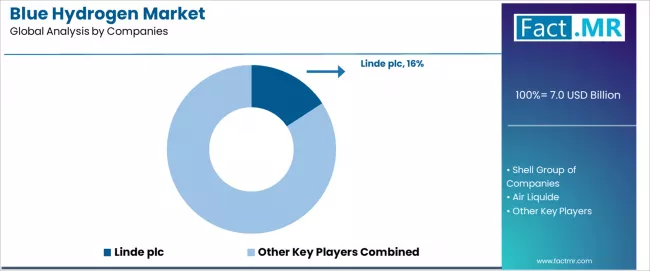
Blue Hydrogen Market Analysis By Company | Source: Fact.MR
The blue hydrogen market is characterized by intense competition among established energy companies, specialized hydrogen producers, and integrated industrial gas suppliers focused on delivering reliable, cost-effective, and low-carbon hydrogen solutions.
Companies are investing in carbon capture technology advancement, production facility expansion, strategic industrial partnerships, and comprehensive emission monitoring initiatives to deliver effective, efficient, and reliable hydrogen production that meets stringent climate standards and industrial requirements. Production optimization, carbon sequestration verification, and supply chain reliability strategies are central to strengthening market portfolios and industry presence.
Linde plc leads the market with a 15.8% market share, offering comprehensive blue hydrogen production solutions with a focus on industrial gas integration expertise and advanced carbon management capabilities for diverse industrial applications. Shell Group of Companies provides integrated energy transition platforms with emphasis on large-scale production facilities and comprehensive carbon capture integration across global refining markets.
Air Liquide focuses on industrial gas supply networks and comprehensive hydrogen production solutions serving international manufacturing communities. Air Products and Chemicals, Inc. delivers advanced gas processing excellence with strong production facility capabilities and carbon capture integration.
Engie operates with a focus on renewable energy integration and comprehensive energy transition solutions across European industrial markets. Equinor ASA provides offshore carbon storage expertise emphasizing geological sequestration capabilities and comprehensive emission management.
SOL Group specializes in regional industrial gas services and hydrogen production support with emphasis on European market accessibility. Iwatani Corp. delivers specialized hydrogen infrastructure expertise to enhance Asian market development and provide comprehensive supply solutions.
INOX Air Products Ltd. and Exxon Mobil Corp. focus on integrated industrial applications and refinery hydrogen production solutions, emphasizing production reliability and comprehensive carbon management protocols through dedicated facility operation strategies.
Key Players in the Blue Hydrogen Market
- Linde plc
- Shell Group of Companies
- Air Liquide
- Air Products and Chemicals, Inc.
- Engie
- Equinor ASA
- SOL Group
- Iwatani Corp.
- INOX Air Products Ltd.
- Exxon Mobil Corp.
Segmentation
Scope of the Report
| Items | Values |
|---|---|
| Quantitative Units (2025) | USD 7.0 Billion |
| Technology | Steam Methane Reforming, Auto Thermal Reforming, Gas Partial Oxidation |
| Application | Power Generation, Refinery, Chemicals, Others |
| Transportation Mode | Pipeline, Cryogenic Liquid Tankers |
| Regions Covered | Asia Pacific, North America, Europe, Latin America, Middle East & Africa |
| Countries Covered | USA, Germany, UK, Japan, India, China, Brazil, Saudi Arabia, UAE and 40+ countries |
| Key Companies Profiled | Linde plc, Shell Group of Companies, Air Liquide, Air Products and Chemicals, Inc., Engie, Equinor ASA, SOL Group, Iwatani Corp., INOX Air Products Ltd., Exxon Mobil Corp. |
| Additional Attributes | Dollar sales by technology, application, transportation mode, regional demand trends, competitive landscape, industrial operator preferences for specific production technologies, integration with comprehensive carbon capture systems, innovations in sequestration technique development, emission monitoring advancement, and production efficiency optimization capabilities |
Source: Fact.MR analysis. Updated Dec 8, 2025
Blue Hydrogen Market by Segments
-
Technology :
- Steam Methane Reforming
- Auto Thermal Reforming
- Gas Partial Oxidation
-
Application :
- Power Generation
- Refinery
- Chemicals
- Others
-
Transportation Mode :
- Pipeline
- Cryogenic Liquid Tankers
-
Region :
- Asia Pacific
- China
- India
- Japan
- South Korea
- ASEAN
- Australia & New Zealand
- Rest of Asia Pacific
- North America
- USA
- Canada
- Mexico
- Europe
- Germany
- France
- United Kingdom
- Italy
- Spain
- Nordic
- BENELUX
- Rest of Europe
- Latin America
- Brazil
- Argentina
- Chile
- Rest of Latin America
- Middle East & Africa
- Kingdom of Saudi Arabia
- Other GCC Countries
- Turkey
- South Africa
- Other African Countries
- Rest of Middle East & Africa
- Asia Pacific
Frequently Asked Questions
How big is the blue hydrogen market in 2025?
What will be the size of blue hydrogen market in 2035?
How much will be the blue hydrogen market growth between 2025 and 2035?
What are the key product types in the blue hydrogen market?
Which application segment to contribute significant share in the blue hydrogen market in 2025?
Who worked on this report


Preview the report firsthand - request a free sample
Free SampleGet the brochure for pricing and purchase details
Download PDF