- Market Value (2025): USD 84 Mn
- Estimated Value (2026): USD 88 Mn
- Forecast Value (2036): USD 140 Mn
- CAGR (2026-2036): 4.8%
What is the Alpha Phthalocyanine Blue Market forecast to be worth by 2036?
USD 88 million in 2026 to USD 140 million by 2036, at 4.8% CAGR.
- A 2025 value of USD 84 million indicates a durable commercial base in printing inks, coatings, plastic colorants, and specialty dispersions.
- The market is expected to rise from USD 88 million in 2026 to USD 140 million by 2036 as converters broaden the use of reddish blue shades while demanding steadier processing.
- A 4.8% CAGR reflects continuing demand for stabilized alpha grades, dry powder, and application-ready forms that reduce the risk of crystal growth or flocculation.
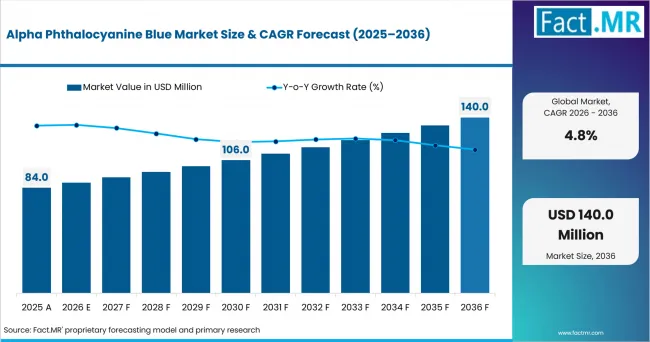
Alpha Phthalocyanine Blue Market Value Analysis | Source: Fact.MR
What are the defining numbers behind Alpha Phthalocyanine Blue Market growth?
USD 52 million absolute opportunity by 2036, led by Stabilized alpha and Printing inks within their respective segments.
- Demand Drivers in the Market
- Printing-ink producers use alpha blue to build clean reddish-blue shades and transparent cyan-to-blue formulations for packaging and publication work.
- Stabilized alpha grades reduce the formulation risk associated with crystal change in aggressive carriers or during storage.
- Coating formulators value high color strength and dispersibility when developing decorative and powder-coating shades from a compact pigment palette.
- Masterbatch and plastics customers are creating room for heat-stable alpha grades that retain the desired red-shade character under melt processing.
- Key Segments Analyzed
- By Alpha Grade Type: Stabilized alpha leads at 31.0% of demand because raw, unmodified alpha copper phthalocyanine must be stabilized to avoid crystal growth or conversion to the greener beta form under heat and aromatic-solvent exposure during ink milling, and introducing small amounts of chlorine into the pigment molecule is the stabilization method that prevents that shift.
- By Application: Printing inks lead at 38.0% of demand. Gravure, flexographic, offset and letterpress formulators specify alpha phthalocyanine blue for its strong reddish mass tone and high tinting strength at low loading, a combination the greener beta form cannot match in the same shade.
- By Color Character: Reddish blue leads at 37.0% of demand as the direct output of the alpha crystal lattice itself, the property buyers are paying for when they choose an alpha grade over a beta one, since any slide toward the beta structure pulls the pigment toward green and erases that distinction.
- By Supply Form: Dry powder leads at 42.0% of demand. Powder ships and stores without the water or oil carrier that presscake and flush forms need, so a single stabilized alpha batch can reach ink, paint, coating and plastics compounders through the standard high-energy dispersion equipment those buyers already run, rather than being tied to one captive formulation line the way flush pigment is.
- By Buyer Type: Ink producers lead purchasing at 34.0% of demand, a direct reflection of printing inks already being the largest end-use application, since formulators buying stabilized alpha powder for their own gravure, flexo, offset and letterpress lines are placing the bulk of direct orders.
- Analyst Opinion at Fact.MR
- Shambhu Nath Jha, Senior Analyst at Fact.MR, states, "Alpha blue earns its place when the formulator needs a redder phthalocyanine shade without surrendering control of dispersion and crystal behavior. The winning supplier will make the distinction between stabilized, non-stabilized, transparent, and prepared grades easy to translate into a production recipe."
- Strategic Implications
- Alpha pigment producers should document crystal-stability limits by solvent, binder, and storage condition instead of relying on color-index identity alone.
- Ink manufacturers can simplify shade development by separating transparent alpha grades from stronger, more opaque alternatives at the qualification stage.
- Masterbatch producers should test filter pressure, heat history, and shade drift before carrying an ink-oriented alpha grade into plastics.
- Procurement teams need to compare powder price with dispersion yield, milling time, and off-shade risk when choosing supply form.
Sudarshan's official portfolio presents alpha Pigment Blue 15:1 both as a versatile dry pigment and as grades positioned for masterbatch and powder-coating use, while its aqueous PB15 dispersion targets flexographic and gravure inks. The portfolio illustrates how alpha chemistry is being packaged around process needs rather than offered as one undifferentiated grade.
The United States is assessed at a 4.8% CAGR through 2036 as documented grades win approval in packaging inks, coatings, and specialist color systems. Germany follows at 4.7% because coating and plastics users demand repeatable processing along with color precision, while the United Kingdom at 4.6% and France at 4.5% add steady European demand from packaging and decorative work. Brazil is projected to expand at a 5.6% CAGR from 2026 to 2036, with printing, decorative coatings, and plastic colorants creating a diverse customer base.
How does the Alpha Phthalocyanine Blue Market break down by segment?
The leading shares are Stabilized alpha at 31.0% by Alpha Grade Type and Printing inks at 38.0% by Application.
What makes stabilized alpha the leading grade?
At 31.0% share in 2026, the leading position goes to Stabilized alpha because buyers want the reddish alpha shade without carrying crystallization and flocculation risk.
Stabilized alpha represents 31.0% of the grade mix, compared with 23.0% for non-stabilized alpha. Surface or crystal stabilization makes the pigment easier to hold within a target shade and dispersion state during formulation, storage, and application. Non-stabilized material remains relevant where formulators control the carrier closely, while solvent-resistant and transparent grades address narrower performance and optical goals.
Why do printing inks account for the largest application share?
The 2026 leader is Printing inks at 38.0% share as alpha blue supplies the reddish tone, transparency, and strength used in many ink shade systems.
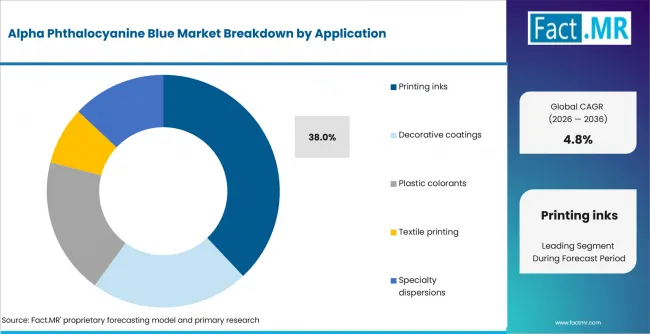
Alpha Phthalocyanine Blue Market Analysis By Application | Source: Fact.MR
Printing inks hold 38.0% of demand and stand well ahead of decorative coatings at 22.0%. Ink makers can exploit alpha blue's shade character in blends, but press stability depends on controlling dispersion and crystal behavior in the chosen vehicle. Plastic colorants at 19.0% require a different proof point, with heat exposure and melt dispersion taking priority over ink rheology.
Which color character defines alpha blue purchasing?
A 37.0% share puts Reddish blue first in 2026 because the reddish-blue tone is the principal reason formulators select the alpha crystal form.
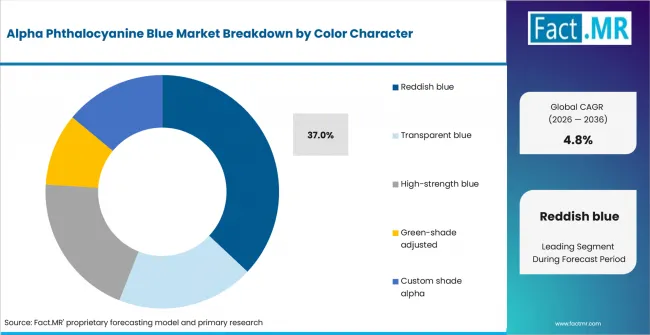
Alpha Phthalocyanine Blue Market Analysis By Color Character | Source: Fact.MR
Reddish blue leads the color-character segment with a 37.0% share. High-strength blue follows at 20.0%, showing that some buyers prioritize color yield even within an alpha-focused palette. Transparent and custom-shade grades serve jobs where overprint behavior, clean mixing, or a narrow brand-color target matters more than maximum mass-tone strength.
Why does dry powder remain central to alpha blue supply?
For Supply Form, the top 2026 position is Dry powder at 42.0% share as integrated ink and coating producers prefer concentrated pigment they can disperse in their own vehicle.
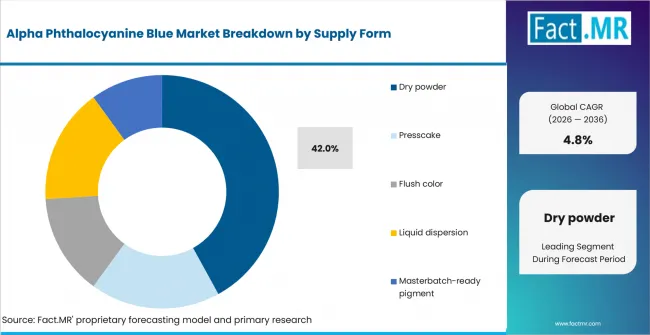
Alpha Phthalocyanine Blue Market Analysis By Supply Form | Source: Fact.MR
Dry powder accounts for 42.0%, more than twice the 18.0% share of presscake. It gives experienced formulators wide latitude over resin choice, pigment loading, and milling conditions. Liquid dispersions and flush colors trade some of that flexibility for faster incorporation, while masterbatch-ready pigment targets customers that want dispersion work completed upstream.
Which buyers shape the alpha blue specification most strongly?
The leading 2026 share is 34.0% for Ink producers because ink producers translate reddish shade and transparency into high-volume formulation decisions.
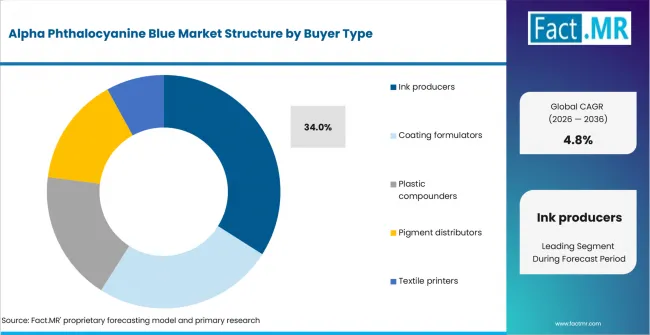
Alpha Phthalocyanine Blue Market Analysis By Buyer Type | Source: Fact.MR
Ink producers lead with 34.0%, followed by coating formulators at 25.0%. Ink customers focus on color development, rheology, and compatibility with their varnish or liquid vehicle, whereas coating firms add weathering and film-performance checks. Plastic compounders, distributors, and textile printers form smaller but distinct channels with different requirements for heat, handling, and shade reproduction.
What is accelerating Alpha Phthalocyanine Blue Market adoption, and what is holding it back?
Demand is being accelerated by the need for a controlled reddish-blue shade across printing and surface-coating formulations. Adoption is restrained by alpha blue's sensitivity to crystal behavior and by the qualification work needed to prove that a grade remains stable in each carrier.
Drivers Impact Analysis
| DRIVER | (~) % IMPACT ON CAGR | GEOGRAPHIC RELEVANCE | IMPACT TIMELINE |
|---|---|---|---|
| Reddish-blue ink demand | +0.7% | United States, Europe, and Latin America | Medium term (2-4 years) |
| Crystal stabilization | +0.6% | Global | Short term (<= 2 years) |
| Decorative and powder coatings | +0.5% | Germany, France, and United States | Long term (>= 4 years) |
| Prepared pigment adoption | +0.4% | North America, Europe, Japan, and urban Asian converter hubs | Medium term (2-4 years) |
| Supplier application support | +0.3% | Brazil, Southern Europe, and North America | Short term (<= 2 years) |
Source: Fact.MR analysis. Updated Jul 16, 2026
- Reddish-blue ink demand: Packaging and commercial printers use alpha blue where a red-shade phthalocyanine gives cleaner color development than beta blue. Stable dispersion over the print run is essential because hue alone cannot compensate for viscosity drift or flocculation.
- Crystal stabilization: Stabilized alpha grades reduce the risk that solvent or storage conditions alter pigment crystal form. That reliability widens the set of formulations in which buyers can approve alpha blue without extensive corrective work.
- Decorative and powder coatings: Coating producers need strong blue shades that disperse well and retain appearance through curing and service. Alpha grades with documented heat and weather performance can extend beyond traditional ink demand.
Opportunity Impact Analysis
| OPPORTUNITY | (~) % IMPACT ON CAGR | GEOGRAPHIC RELEVANCE | IMPACT TIMELINE |
|---|---|---|---|
| Stabilized alpha for broader solvent windows | +0.4% | Asia Pacific and Latin America | Medium term (2-4 years) |
| Transparent packaging shades | +0.3% | Europe and North America | Medium term (2-4 years) |
| Alpha blue in masterbatch systems | +0.3% | Germany, France, and United States | Long term (>= 4 years) |
| Small-batch custom dispersions | +0.2% | Global specialty markets | Short term (<= 2 years) |
Source: Fact.MR analysis. Updated Jul 16, 2026
- Stabilized alpha for broader solvent windows: Converters using mixed solvent and resin platforms need alpha grades that tolerate more than one standard formulation. Suppliers can gain share by publishing comparative stability data and providing a clear operating window.
- Transparent packaging shades: Transparent alpha grades can support clean overprints and shade blending in selected packaging inks. The opportunity depends on balancing transparency with strength, migration requirements, and press stability.
- Alpha blue in masterbatch systems: Heat-stable alpha grades give masterbatch producers another route to reddish blue beyond conventional ink uses. Commercial conversion will require polymer-specific evidence on dispersion, heat history, and filter behavior.
Restraints Impact Analysis
| RESTRAINT | (~) % IMPACT ON CAGR | GEOGRAPHIC RELEVANCE | IMPACT TIMELINE |
|---|---|---|---|
| Crystallization and flocculation risk | -0.3% | Global | Short term (<= 2 years) |
| Beta blue substitution | -0.3% | Global | Medium term (2-4 years) |
| Qualification fragmentation | -0.2% | North America, Europe, and export-oriented Asian plants | Medium term (2-4 years) |
| Prepared-form cost premium | -0.2% | Price-sensitive markets | Short term (<= 2 years) |
Source: Fact.MR analysis. Updated Jul 16, 2026
- Crystallization and flocculation risk: Alpha blue can change behavior when the crystal form encounters an unsuitable solvent, resin, or storage condition. Buyers therefore hesitate to substitute grades without full formulation testing.
- Beta blue substitution: Beta blue offers a more stable green-shade crystal form for many plastics, coating, and ink applications. Where color direction is flexible, customers may choose beta grades to reduce formulation risk.
- Qualification fragmentation: A pigment may need separate approval for each ink vehicle, coating binder, polymer, or end-customer specification. This fragmented process lengthens commercialization and raises the cost of supporting small accounts.
How does demand for alpha phthalocyanine blue differ across major countries?
United States 4.8% CAGR. Germany 4.7%. United Kingdom 4.6%. France 4.5%. Brazil 5.6%.
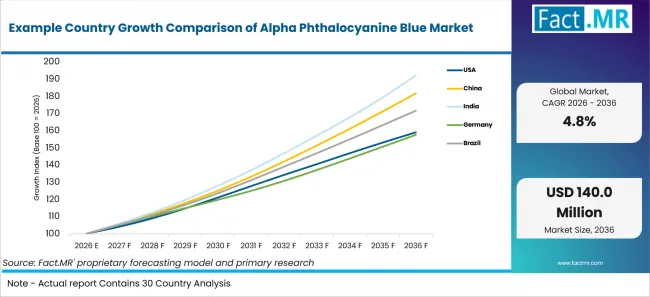
Example Country Growth Comparison Of Alpha Phthalocyanine Blue Market | Source: Fact.MR
| COUNTRY | CAGR |
|---|---|
| United States | 4.8% |
| Germany | 4.7% |
| Brazil | 5.6% |
Source: Fact.MR analysis. Updated Jul 16, 2026
Why is a slow-moving TSCA review process shaping how new pigment grades reach US converters?
US demand for alpha phthalocyanine blue is set to expand at a 4.8% CAGR between 2026 and 2036, pushed less by ink volume growth than by the cost of getting new pigment grades cleared for sale.
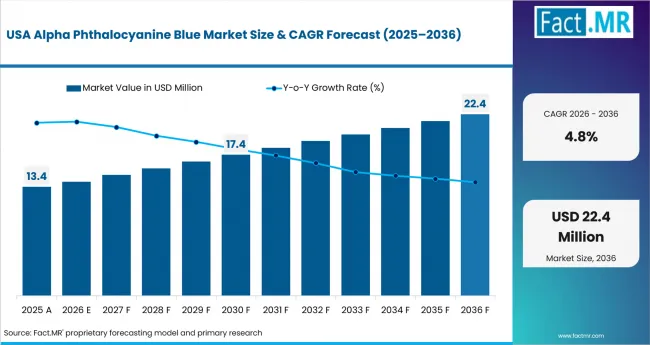
Alpha Phthalocyanine Blue Market Country Value Analysis | Source: Fact.MR
Since the 2016 Lautenberg amendments to the Toxic Substances Control Act, premanufacture notice reviews that once cleared in under 180 days now routinely stretch past three years, a shift the Color Pigments Manufacturers Association, the sector's only dedicated US trade body since 1925, has flagged as a structural cost burden on new pigment introductions. Ink formulators are responding by leaning on established, already-registered alpha blue chemistries rather than newer variants, concentrating demand growth in flexible packaging inks, where converters are also switching to water-based and low-migration UV systems ahead of tightening food-contact scrutiny.
Does domestic alpha blue production at Ludwigshafen give German converters an edge?
Germany's alpha phthalocyanine blue demand is projected to grow at a 4.7% CAGR from 2026 to 2036, anchored by a domestic production base that few other European markets can match.
BASF's Ludwigshafen site is one of Europe's few plants producing alpha-crystal-form copper phthalocyanine blue pigments at scale, and the company expanded alpha blue production capacity there in 2016 to meet rising ink and coatings demand. German converters can source volume domestically rather than importing from Asian producers, an advantage reinforced by the Verband der deutschen Lack- und Druckfarbenindustrie, formed in 2009 when the country's separate paint and printing ink associations merged and which now represents roughly 85% of German paint, coatings and ink output. That combination of local supply and industry coordination gives German converters shorter lead times than counterparts elsewhere in the EU that import most of their pigment from Asia.
How is France's mineral oil ban reshaping ink formulation for pigment buyers?
French demand for alpha phthalocyanine blue is projected to rise at a 4.5% CAGR from 2026 to 2036, the slowest pace among the five countries here but shaped by a distinct regulatory event rather than by softer demand.
Under the AGEC circular economy law passed in February 2020, France began phasing in a ban on mineral oil hydrocarbons in printing inks: first on packaging from January 2022, then across all printing intended for the public from January 2025. The rule, tracked by trade federation FIPEC through its AFEI printing-ink section, has pushed ink makers supplying the French market to reformulate around vegetable oil and other non-mineral vehicles, a switch that changes how pigments disperse and can shift the alpha blue loading needed in a given batch. Demand also benefits from France's wine, cosmetics and luxury packaging sectors, which favor premium, high-chroma inks over commodity grades.
Why is Brazil's pigment demand growing faster than the other four markets?
Brazil's alpha phthalocyanine blue demand is set to expand at a 5.6% CAGR between 2026 and 2036, the fastest of the five countries covered here, tracking a paint and printing sector still consolidating and industrializing.
Brazil produced a record 1.98 billion liters of paint and coatings in 2024 in a market worth roughly R$40 billion a year, according to ABRAFATI, the Brazilian Coatings Manufacturers Association, which also represents the country within the Latin American Coatings Federation. On the printing side, ABIGRAF reports the number of Brazilian printing companies fell from about 19,000 in 2019 to 15,000 today even as sector turnover approached US$14 billion in 2023, pointing to consolidation among larger converters rather than a drop in ink demand. Imported pigment shipments must also clear Brazil's RADAR import license and the SISCOMEX customs system, an extra administrative step domestic producers avoid.
Who leads the Alpha Phthalocyanine Blue Market?
Sudarshan Chemical Industries Limited eads the while Solar Organics, Meghmani Organics, and DIC give buyers several routes to alpha blue grades and preparations.
The shares place Sudarshan Chemical Industries Limited at 9.0%, followed by Solar Organics, Meghmani Organics, and DIC at 7.0%. This close grouping points to a market where grade selection and technical service can matter as much as nominal scale.
Official product pages show alpha PB15:1 positioned for printing inks, packaging, automotive uses, powder coatings, and masterbatch applications, while prepared aqueous forms target easier incorporation. Suppliers will compete by demonstrating where each grade is stable and by making that evidence usable for procurement and plant teams.
Which companies are the key providers?
The company set includes Solar Organics, Sudarshan Chemical Industries Limited, Meghmani Organics, and DIC.
- Solar Organics
- Sudarshan Chemical Industries Limited
- Meghmani Organics
- DIC
Bibliography
- DIC Corporation. (2025, November 4). DIC and Sun Chemical to showcase latest resin and colour-material technologies at CHINACOAT 2025.
- Sun Chemical Corporation. (2025, September 10). Sun Chemical to showcase world-class colour and PPS solutions at K 2025
- Sudarshan Chemical Industries Limited. (2025). Colorants for the plastics industry.
- Sudarshan Chemical Industries Limited. (2025). Business responsibility and sustainability report 2024-25.
This Report Addresses
- The report explains how stabilization, shade direction, transparency, and dispersion shape alpha blue procurement.
- Country analysis concentrates on the United States, Germany, the United Kingdom, France, and Brazil, drawn from coverage of more than 30 countries.
- Grade analysis distinguishes non-stabilized, stabilized, solvent-resistant, transparent, and flush or paste alpha forms.
- Application coverage follows printing inks, decorative coatings, plastic colorants, textile printing, and specialty dispersions.
- The forecast links value growth to customer approvals, crystal-stability needs, color character, supply form, and buyer capability.
What does the Alpha Phthalocyanine Blue Market cover?
Alpha phthalocyanine blue pigments and preparations selected for a reddish-blue shade and controlled formulation behavior.
The analysis follows sales into printing inks, decorative coatings, plastics, textile printing, and specialty dispersions. It uses the five-dimension taxonomy and does not add adjacent pigment chemistries.
Geographic coverage extends to more than 30 countries, led by detailed United States and European analysis, while company discussion profiles the five named players within a wider review of 30+ suppliers over the 2026-2036 USD million forecast.
What is included in the scope?
The scope includes alpha blue crystal variants from economical powder through stabilized and application-ready forms.
Products include non-stabilized alpha, stabilized alpha, solvent-resistant alpha, transparent grades, and flush or paste alpha. Color-character analysis covers reddish, transparent, high-strength, green-shade-adjusted, and custom-shade positions.
Buyer coverage includes ink producers, coating formulators, plastic compounders, pigment distributors, and textile printers purchasing the listed supply forms.
What is excluded from the scope?
Beta blue, unrelated colorants, and downstream finished formulations fall outside the market boundary.
The market does not include the full value of inks, coatings, plastics, or printed textiles that contain alpha blue. It also excludes soluble blue dyes and other pigment classes not identified in the source segmentation.
How was the analysis built?
Trade evidence, buyer interviews, and forecast cross-checks assembled across 30+ countries.
- Primary Research: Primary research included conversations with alpha pigment manufacturers, ink colorists, coating chemists, masterbatch developers, textile-printing specialists, distributors, and procurement heads. Interviews probed why customers select stabilized versus non-stabilized material and when they pay for transparency or a prepared form.
- Desk Research: Desk research reviewed official technical data, corporate reports, and application literature for alpha PB15 variants. Trade and government material on pigments, inks, coatings, and plastics can test the plausibility of end-use and regional assumptions.
- Market-Sizing and Forecasting: Sizing multiplied grade-level shipment volume by selling price while separating dry pigment from higher-value dispersions, flush colors, and masterbatch-ready products. Application and buyer shares were reconciled so the same pigment volume is not counted twice through distributor and end-user channels.
- Data Validation and Update Cycle: Validation compared reported shipments with plant utilization, distributor movement, customer trial activity, and recurring orders. Forecast updates track formulation changes, stability-related complaints, new grade launches, raw-material economics, and substitution between alpha and beta blue.
Segmentation
What is the report's scope and coverage?
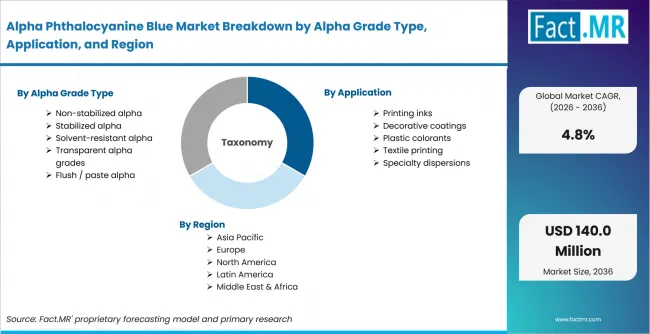
Alpha Phthalocyanine Blue Market Breakdown By Alpha Grade Type, Application, And Region | Source: Fact.MR
| ATTRIBUTE | DETAILS |
|---|---|
| Quantitative Units | USD 88 million in 2026 to USD 140 million by 2036 at 4.8% CAGR |
| Market Definition | The market comprises alpha-crystal copper phthalocyanine blue pigments and alpha-based preparations sold for reddish-blue coloration in inks, coatings, plastics, textiles, and specialty dispersions. |
| Alpha Grade Type | Non-stabilized alpha; Stabilized alpha; Solvent-resistant alpha; Transparent alpha grades; Flush / paste alpha |
| Application | Printing inks; Decorative coatings; Plastic colorants; Textile printing; Specialty dispersions |
| Color Character | Reddish blue; Transparent blue; High-strength blue; Green-shade adjusted; Custom shade alpha |
| Supply Form | Dry powder; Presscake; Flush color; Liquid dispersion; Masterbatch-ready pigment |
| Buyer Type | Ink producers; Coating formulators; Plastic compounders; Pigment distributors; Textile printers |
| Regions Covered | North America; Europe; Latin America |
| Countries Covered | United States; Germany; United Kingdom; France; Brazil (full report covers 30+ countries) |
| Key Companies Profiled | Solar Organics; Sudarshan Chemical Industries Limited; Meghmani Organics; DIC |
| Forecast Period | 2026 to 2036 |
| Approach | Sizing uses alpha pigment shipment volumes, grade and supply-form selling prices, application attachment, buyer conversion rates, and requalification cycles across ink, coating, and plastics customers. |
Source: Fact.MR analysis. Updated Jul 16, 2026
How is the market segmented?
-
By Alpha Grade Type:
- Non-stabilized alpha
- Stabilized alpha
- Solvent-resistant alpha
- Transparent alpha grades
- Flush / paste alpha
-
By Application:
- Printing inks
- Decorative coatings
- Plastic colorants
- Textile printing
- Specialty dispersions
-
By Color Character:
- Reddish blue
- Transparent blue
- High-strength blue
- Green-shade adjusted
- Custom shade alpha
-
By Supply Form:
- Dry powder
- Presscake
- Flush color
- Liquid dispersion
- Masterbatch-ready pigment
-
By Buyer Type:
- Ink producers
- Coating formulators
- Plastic compounders
- Pigment distributors
- Textile printers
-
By Region:
- North America
- United States
- Europe
- Germany
- United Kingdom
- France
- Latin America
- Brazil
Frequently Asked Questions
How large will the Alpha Phthalocyanine Blue Market be in 2036?
Which alpha grade type leads the market?
Which application consumes the most alpha blue?
Which supply form is dominant?
How is demand distributed between the United States and Europe?
What is Brazil's outlook?
What chiefly drives alpha blue demand?
What most limits adoption?
Who worked on this report


Preview the report firsthand - request a free sample
Free SampleGet the brochure for pricing and purchase details
Download PDF