- Market Value (2025): USD 665.5 Mn
- Estimated Value (2026): USD 760.0 Mn
- Forecast Value (2036): USD 2867.3 Mn
- CAGR (2026-2036): 14.2%
What is the Biomass-Balanced Dispersants Market forecast to be worth by 2036?
The Biomass-Balanced Dispersants market is projected to increase from USD 760.0 million in 2026 to USD 2,867.3 million by 2036 at a CAGR of 14.2%.
- 2025 Market Value: USD 665.5 million
- 2026 to 2036 Market Progression: USD 760.0 million to USD 2867.3 million
- Forecast CAGR (2026-2036): 14.2%
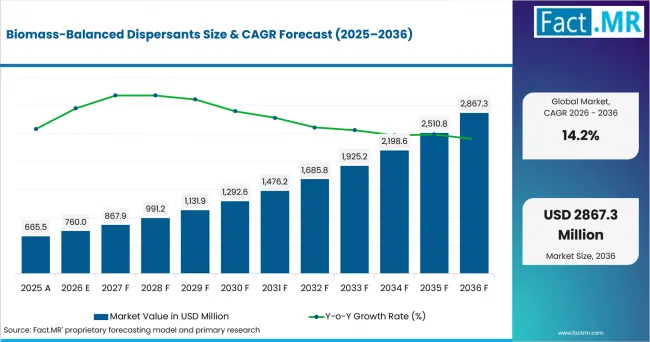
Biomass Balanced Dispersants Value Analysis | Source: Fact.MR
What are the defining numbers behind Biomass-Balanced Dispersants Market growth?
The market adds USD 2107.3 million in absolute opportunity between 2026 and 2036. Growth is tied to a specific formulation problem: coatings, inks and other formulated products need lower fossil-feedstock exposure without forcing a full change in pigment wetting, viscosity, storage stability or color development.
A practical commercial route is therefore a drop-in attributed grade that can enter an existing formulation with familiar performance. This lowers the requalification burden compared with a new chemistry whose renewable content is physically segregated but whose behavior changes at the pigment, resin or process interface.
- Demand Drivers in the Market
- Product carbon footprint and Scope 3 programs are moving renewable feedstock choices into additive procurement. BASF introduced Dispex AA 4145 MB in July 2026 as a certified biomass-balanced dispersing agent for water-based coatings, positioning lower product carbon footprint together with the performance of the conventional grade.
- Mass-balance chain-of-custody systems allow renewable feedstock to enter existing chemical production assets while the attributed output is tracked through certification. This matters for additives because customers can pursue lower fossil feedstock without waiting for a separate production route for every dispersant chemistry.
- Waterborne coatings raise the technical value of dispersants because pigment stabilization, grind viscosity and storage stability must be controlled without relying on higher solvent content. Current EU Ecolabel criteria for paints and varnishes include reduced VOC requirements, while U.S. architectural-coating rules continue to limit VOC content.
- Supplier portfolios are expanding beyond a single proof point. Arkema now lists mass-balance versions of ECODIS dispersants, while Clariant operates an ISCC PLUS mass-balanced Terra platform for coatings ingredients and Evonik has launched mass-balanced coating additives using certified attributed feedstock.
- These shifts sit inside the broader dispersing agents market, but this market counts only the renewable-attributed portion that meets the defined biomass-balance or bio-attributed boundary.
- Key Segments Analyzed
- Dispersant Family: Polymeric pigment dispersants account for 36.0% in 2026 because polymer architecture can combine strong pigment anchoring with steric stabilization while allowing the feedstock claim to change without changing the primary dispersion function.
- Attribution: ISCC PLUS mass balance represents 52.0% in 2026 because the certification framework is widely used across chemical supply chains and gives buyers a documented chain-of-custody route for attributed renewable or circular feedstock.
- Application: Coatings account for 39.0% in 2026 because pigment loading, gloss, hiding, storage stability and waterborne formulation work make dispersants a recurring performance additive rather than an optional sustainability ingredient.
- Customer Driver: PCF reduction accounts for 38.0% in 2026 because buyers can connect attributed renewable feedstock directly to product carbon-footprint and upstream-emissions programs while preserving existing formulation performance.
- The formulation overlap is strongest with the coating additives market, where dispersants compete for qualification alongside rheology, defoaming and surface-control additives.
- Analyst Opinion at Fact.MR
- “Biomass-balanced dispersants will scale when the sustainability change is invisible to the formulator. A coatings or ink producer does not want to trade color strength, viscosity or storage stability for a lower-carbon feedstock claim. Suppliers that can document chain of custody, product carbon-footprint improvement and drop-in performance within the same grade have the clearest path from trial to recurring specification,” notes Shambhu Nath Jha, Principal Consultant, Fact.MR.
- Strategic Implications
- Dispersant suppliers should treat renewable attribution as a specification layer on top of proven application performance. Chain-of-custody documentation, product carbon-footprint evidence and consistent technical data need to travel with the same formulation support used for conventional grades.
- Coatings and ink producers should qualify the attributed version against the original grade in pigment grind, let-down, storage and final-film testing. A lower-carbon claim creates value only when the formulation can move without extended reformulation or a new defect mechanism.
- Procurement teams should separate mass-balanced, segregated bio-based and partially bio-based products in their supplier scorecards. These routes can all reduce fossil dependence, but the carbon accounting, physical renewable content and certification evidence are not interchangeable.
How does the Biomass-Balanced Dispersants Market break down by segment?
The market is segmented by Dispersant Family, Attribution, Application and Customer Driver.
Why do Polymeric pigment dispersants lead Dispersant Family?
Polymeric pigment dispersants account for 36.0% of Dispersant Family in 2026.
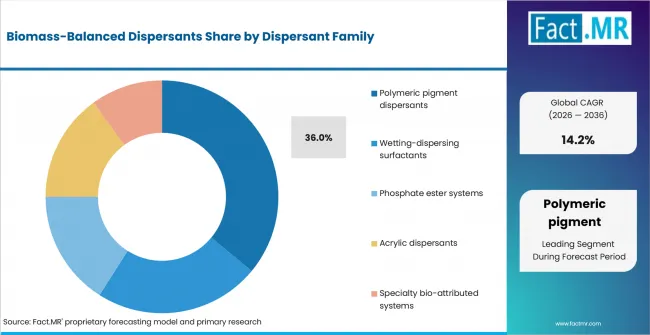
Biomass Balanced Dispersants Analysis By Dispersant Family | Source: Fact.MR
Polymeric dispersants are used where formulators need strong adsorption to pigment or filler surfaces together with steric stabilization in the surrounding medium. That combination can lower mill-base viscosity, improve color development and keep particles separated through storage and application.
The same performance logic is visible in the wider dispersing agents market, where polymeric systems are used across coatings, inks and other high-solids formulations.
BASF positions Dispex AA 4145 MB as a biomass-balanced dispersant for inorganic pigments and fillers in water-based coatings. Lubrizol also markets polymeric Solsperse dispersants with bio-based content, showing that renewable-feedstock strategies can be applied to high-performance dispersion chemistry without abandoning the polymeric route.
Why does ISCC PLUS mass balance lead Attribution?
ISCC PLUS mass balance accounts for 52.0% of Attribution in 2026.
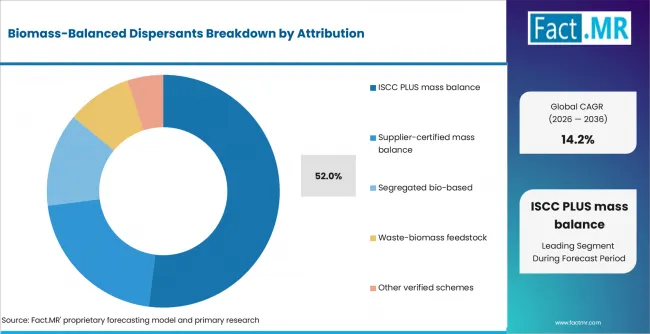
Biomass Balanced Dispersants Analysis By Attribution | Source: Fact.MR
Mass balance allows certified renewable, bio-circular or circular feedstock to enter a shared production system while the attributed output is tracked through auditable bookkeeping. That model fits integrated chemical plants because it avoids building a physically segregated production route for each additive while still giving the buyer documented chain-of-custody evidence.
Arkema states that its mass-balance coatings supply chain is ISCC PLUS certified, while Clariant uses ISCC PLUS for its Terra mass-balanced coatings products. BASF uses REDcert2 for Dispex AA 4145 MB, illustrating why the market also retains supplier-certified and other verified schemes outside the leading ISCC PLUS category.
Why do Coatings lead Application?
Coatings account for 39.0% of Application in 2026.
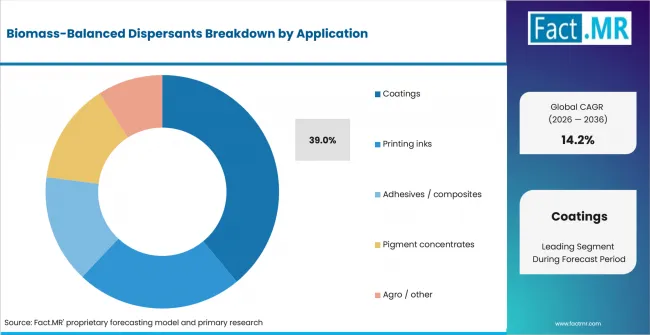
Biomass Balanced Dispersants Analysis By Application | Source: Fact.MR
Coatings consume dispersants repeatedly across pigment grinds, tint bases, architectural paints and industrial finishes. Incomplete wetting can lengthen dispersion time, while flocculation can reduce gloss, hiding power or color strength. A renewable-attributed dispersant therefore has to pass a performance test before its carbon claim matters commercially.
This requirement links the market to the broader formulation additives market, where additive choice is governed by the finished formulation rather than by feedstock origin alone.
BASF launched its biomass-balanced dispersant specifically for water-based coatings, and Arkema lists ECODIS P 30 MB, P 50 MB and P 90 MB as 100% bio-attributed dispersing agents for water-based systems. These launches give coatings the clearest direct evidence of current commercial supply.
Why does PCF reduction lead Customer Driver?
PCF reduction accounts for 38.0% of Customer Driver in 2026.
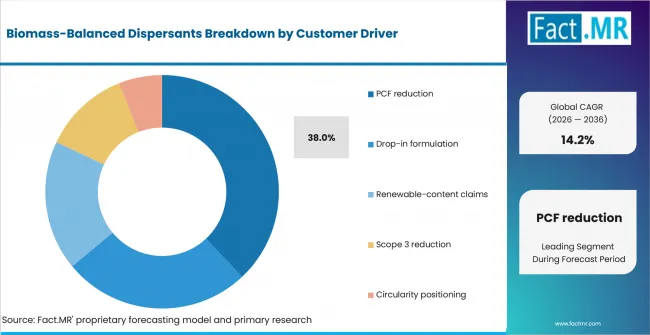
Biomass Balanced Dispersants Analysis By Customer Driver | Source: Fact.MR
Product carbon footprint gives procurement teams a measurable reason to choose an attributed grade. The buyer can compare the conventional and lower-fossil option at product level while keeping formulation performance, dosage and manufacturing assets broadly unchanged.
The need to retain wetting performance while lowering the environmental burden also overlaps with the wetting additives market, particularly in waterborne and lower-VOC systems.
BASF explicitly links its new BMB additives to lower PCF, while Evonik says its mass-balanced coating additives are intended to support customers in reducing upstream Scope 3 emissions. This makes carbon accounting a purchasing mechanism rather than a general sustainability statement.
What is accelerating Biomass-Balanced Dispersants Market adoption, and what is holding it back?
Adoption is accelerating because suppliers can now offer attributed dispersants or adjacent coating additives with third-party certification and drop-in positioning. The main restraint is proof: buyers need credible chain-of-custody accounting and a formulation result that remains equivalent to the conventional grade. The opportunity is to extend this model beyond architectural coatings into printing inks, pigment concentrates, adhesives, composites and selected agricultural formulations.
Drivers Impact Analysis
| DRIVER | (~) % IMPACT ON CAGR | GEOGRAPHIC RELEVANCE | IMPACT TIMELINE |
|---|---|---|---|
| PCF and Scope 3 targets moving feedstock choice into additive procurement | +2.4% | Europe, USA, UK | Near to Mid-term |
| Drop-in mass-balance grades reducing reformulation burden | +1.8% | Germany, France, USA, Netherlands | Near-term |
| Expansion of certified coating-additive supply across global sites | +1.2% | Europe, USA, Global accounts | Mid-term |
Opportunity Impact Analysis
| OPPORTUNITY | (~) % IMPACT ON CAGR | GEOGRAPHIC RELEVANCE | IMPACT TIMELINE |
|---|---|---|---|
| Waterborne pigment dispersion and architectural-coating reformulation | +1.6% | Germany, France, USA, Netherlands, UK | Near to Mid-term |
| Printing inks and pigment concentrates adopting attributed feedstock | +1.1% | Europe, USA | Mid-term |
| Broader certified portfolio across acrylic, surfactant and specialty systems | +0.8% | Global | Mid to Long-term |
Restraints Impact Analysis
| RESTRAINT | (~) % IMPACT ON CAGR | GEOGRAPHIC RELEVANCE | IMPACT TIMELINE |
|---|---|---|---|
| Renewable feedstock premium and certification cost | -1.0% | Global | Near-term |
| Chain-of-custody and sustainability-claim verification complexity | -0.7% | Europe, USA, UK | Near to Mid-term |
| Limited certified supply for every dispersant chemistry and application | -0.6% | Global | Mid-term |
Which countries are scaling the Biomass-Balanced Dispersants Market through 2036?
- Germany: BASF launched Dispex AA 4145 MB from Ludwigshafen in 2026, giving the country direct commercial evidence of biomass-balanced dispersant supply. Germany also promotes industrial bioeconomy pathways that substitute non-fossil raw materials in chemical production.
- France: Arkema is expanding bio-attributed coating materials through ISCC PLUS certified sites and mass-balance dispersants, while French industrial policy is pushing deep decarbonisation and wider use of biomass and bio-based chemistry.
- USA: Low-VOC coating requirements sustain waterborne formulation work, and multinational additive suppliers can introduce attributed grades into an established coatings and inks customer base without changing the end-use function of the dispersant.
- Netherlands: The government targets a fully circular economy by 2050 and explicitly encourages industry to use more biomaterials instead of fossil resources. That policy direction supports demand for certified renewable-attributed chemical inputs.
- UK: The industrial decarbonisation strategy covers chemicals and calls for lower-carbon industrial products, resource efficiency and material substitution. Adoption remains tied to documented carbon benefit and formulation equivalence.
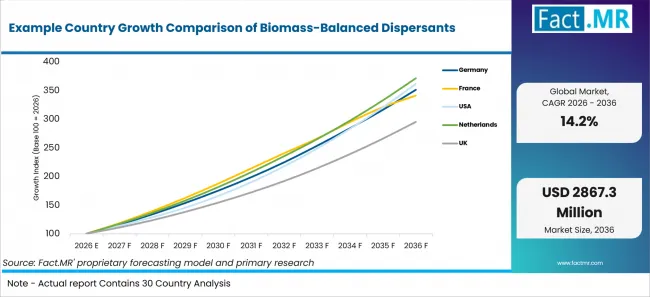
Example Country Growth Comparison Of Biomass Balanced Dispersants | Source: Fact.MR
Country CAGR (2026-2036)
| Country | CAGR (2026-2036) |
|---|---|
| Germany | 13.4% |
| France | 13.1% |
| USA | 13.7% |
| Netherlands | 14.0% |
| UK | 11.4% |
What is driving Germany's growth through 2036?
Germany is projected to expand at a CAGR of 13.4% from 2026 to 2036.
BASF introduced Dispex AA 4145 MB in July 2026 as a certified biomass-balanced dispersing agent for water-based coatings. The product is positioned as a drop-in route to lower product carbon footprint while maintaining the performance of the conventional additive, giving German formulators a direct domestic reference point for adoption.
Germany also treats industrial bioeconomy as a route to replace petroleum and other fossil raw materials with biomass-derived feedstocks in chemicals and materials. This policy direction supports procurement models that value renewable attribution when the chemistry remains technically qualified.
What is driving France's growth through 2036?
France is projected to expand at a CAGR of 13.1% from 2026 to 2036.
Arkema offers mass-balance versions of ECODIS dispersants and states that more than 70% of its coating facilities are ISCC PLUS certified. Its coating-solutions platform therefore gives French customers access to bio-attributed additives without requiring a separate manufacturing route for every grade.
France is also tightening industrial decarbonisation through its national low-carbon strategy. ADEME identifies paints, detergents and inks as categories where bio-based offerings are expanding, supporting a wider customer base for renewable-feedstock formulation ingredients.
What is driving USA's growth through 2036?
The USA is projected to expand at a CAGR of 13.7% from 2026 to 2036.
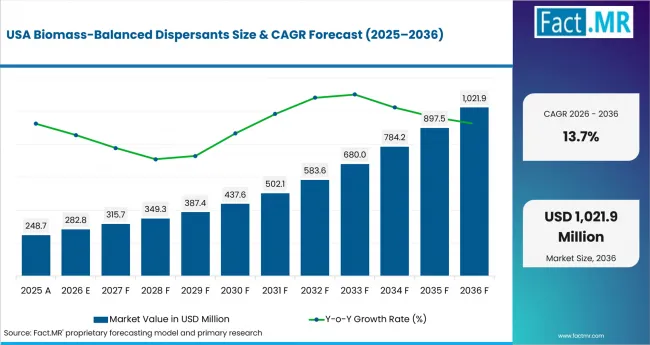
Biomass Balanced Dispersants Country Value Analysis | Source: Fact.MR
U.S. EPA rules limit VOC content in architectural coatings, sustaining formulation work around waterborne and lower-solvent systems where dispersant efficiency is critical. Biomass-balanced grades can enter this reformulation cycle as a carbon-footprint improvement without changing the core wetting and stabilization function.
BASF states that Dispex AA 4145 MB is available globally, while Lubrizol supplies polymeric dispersants with bio-based content across coatings and inks. This gives U.S. buyers multiple routes to test lower-fossil dispersion chemistry within established application platforms.
What is driving Netherlands' growth through 2036?
The Netherlands is projected to expand at a CAGR of 14.0% from 2026 to 2036.
The Dutch government targets a fully circular economy by 2050 and explicitly encourages industry to replace fossil resources with sustainable biomaterials where practical. Chemical and coatings buyers can therefore treat renewable-attributed additives as part of raw-material substitution rather than as a separate niche procurement category.
Mass-balance systems are particularly relevant in a trading and chemical-processing hub because certified attribution can move through shared supply chains without requiring full physical segregation at each stage. Commercial growth still depends on credible certificates and product-level documentation.
What is driving UK's growth through 2036?
The UK is projected to expand at a CAGR of 11.4% from 2026 to 2036.
The UK industrial decarbonisation strategy includes chemicals and calls for lower-carbon industrial products, improved resource efficiency and material substitution. This creates a procurement environment in which feedstock origin and product carbon data can influence additive qualification alongside price and performance.
Growth is slower than in the other listed markets because a biomass-balanced dispersant still has to clear the same formulation and customer-claim requirements as the conventional grade. Buyers therefore need both technical equivalence and auditable carbon-accounting evidence before broad conversion.
Who Leads the Biomass-Balanced Dispersants Market?
Key players in the Biomass-Balanced Dispersants Market include BASF, Evonik, BYK, Clariant, Arkema and Lubrizol. BASF has direct public evidence through the 2026 launch of Dispex AA 4145 MB, a certified biomass-balanced dispersing agent for water-based coatings. Arkema also has direct market relevance through ECODIS P 30 MB, P 50 MB and P 90 MB, which are listed as mass-balance, 100% bio-attributed dispersing agents for water-based systems.
Evonik has established a mass-balanced coating-additives route through ISCC certified feedstock and continues to supply wetting and dispersion technologies for coatings and inks. Clariant combines a mass-balanced Terra coatings platform with a broad Dispersogen dispersant portfolio, creating a pathway to renewable-attributed formulation support even where exact dispersant grades differ by region and application.
BYK brings one of the broadest wetting and dispersing additive portfolios and separately markets additives with measured bio-based carbon content. Lubrizol competes through Solsperse polymeric dispersants, including products with partial or full bio-based content. These positions are relevant to the transition, but direct public evidence of biomass-balanced dispersant grades is stronger for BASF and Arkema.
Competitive advantage therefore depends on three things together: a verified feedstock-attribution route, evidence that the dispersant performs like the qualified incumbent, and technical service that can prove the claim inside the customer formulation.
Which companies are the key providers?
Key providers in the Biomass-Balanced Dispersants market include BASF, Evonik, BYK, Clariant, Arkema and Lubrizol.
- BASF
- Evonik
- BYK
- Clariant
- Arkema
- Lubrizol
Bibliography
- BASF. (2026, July 13). BASF expands certified biomass-balanced additives portfolio for architectural coatings.
- BASF. (2026). Dispex AA 4145 MB product information.
- Evonik. (2025, March). Coating Additives launches first mass balanced products for coatings and inks.
- Arkema Coating Materials. (2026). Dispersing agents portfolio including ECODIS P 30 MB, P 50 MB and P 90 MB.
- Arkema Coating Materials. (2026). Mass balance approach and ISCC PLUS certification for coating solutions.
- Clariant. (2026). Terra Products: ISCC PLUS mass-balanced paints and coatings ingredients.
- Clariant. (2026, June 25). Dispersogen AN 200 dispersing agent product information.
- BYK. (2026). Wetting and dispersing additives product portfolio.
- BYK. (2026). Additives made from bio-based raw materials.
- Lubrizol. (2026). Solsperse 86000 polymeric dispersant with bio-based carbon content.
- Lubrizol. (2026). Aqueous dispersants and Solsperse Hyperdispersants for coatings and inks.
- ISCC System. (2026). ISCC PLUS chain-of-custody and mass-balance requirements.
- European Commission. (2026). EU Ecolabel criteria for paints and varnishes.
- U.S. Environmental Protection Agency. (2026). Architectural Coatings: National Volatile Organic Compounds Emission Standards.
- Federal Ministry for Economic Affairs and Energy, Germany. (2026). Industrial bioeconomy: growth and innovation for Germany.
- ADEME. (2025). Bio-based products: a market in transition.
- Ministry for Ecological Transition, France. (2026). National low-carbon strategy for industry.
- Government of the Netherlands. (2026). Circular economy by 2050.
- UK Government. (2021, current policy). Industrial Decarbonisation Strategy.
This Report Answers
- How quickly is revenue from biomass-balanced dispersants projected to expand through 2036?
- Why do polymeric pigment dispersants hold the leading Dispersant Family position?
- Why does ISCC PLUS mass balance account for the leading Attribution share?
- Why do coatings account for the leading application share?
- How does product carbon-footprint reduction influence additive procurement?
- What prevents a renewable-attributed dispersant from replacing the conventional grade immediately?
- How do Germany, France, USA, Netherlands and UK differ in growth outlook?
- Which suppliers have direct biomass-balanced dispersant evidence and which compete through adjacent sustainable-additive platforms?
What does the Biomass-Balanced Dispersants Market cover?
The market counts revenue from specialty dispersing and wetting additives sold with a verified biomass-balance, mass-balance bio-attributed, segregated bio-based, waste-biomass or other defined renewable-feedstock claim within the specified segmentation. The additive must perform a dispersing, wetting or pigment-stabilization function in the covered applications.
The market includes polymeric pigment dispersants, wetting-dispersing surfactants, phosphate ester systems, acrylic dispersants and specialty bio-attributed systems. It covers coatings, printing inks, adhesives and composites, pigment concentrates, and agricultural or other specified uses where the renewable-feedstock claim applies to the dispersant product.
What is included in the scope?
- Polymeric pigment dispersants, wetting-dispersing surfactants, phosphate ester systems, acrylic dispersants and specialty bio-attributed dispersant systems.
- ISCC PLUS mass balance, supplier-certified mass balance, segregated bio-based, waste-biomass feedstock and other verified attribution schemes within the defined categories.
- Coatings, printing inks, adhesives and composites, pigment concentrates, and agro or other specified applications.
- Customer demand linked to PCF reduction, drop-in formulation, renewable-content claims, Scope 3 reduction and circularity positioning.
- Revenue from qualifying dispersant products sold into the defined global market and country outlook.
What is excluded from the scope?
- Conventional fossil-based dispersants with no qualifying renewable-feedstock, biomass-balance or bio-attributed claim.
- Pigments, fillers, resins, solvents, binders and finished paints, inks, adhesives or composites sold without a separately identifiable qualifying dispersant.
- Rheology modifiers, defoamers, surface additives and other formulation ingredients when dispersing or wetting is not their defined commercial function.
- Upstream biomass, bio-naphtha, biogas, recycled feedstock or certificate transactions that are not sold as part of a qualifying dispersant product.
- Carbon offsets or book-and-claim instruments that do not meet the defined product-attribution boundary for the dispersant.
How Was the Analysis Built?
- Primary Research:
- Primary validation focuses on dispersant manufacturers, coatings and ink formulators, pigment-concentrate producers, procurement teams, sustainability managers, application chemists and technical-service teams. Interviews test formulation equivalence, certification requirements, product carbon-footprint evidence, dosage, qualification time, price premium and switching conditions.
- Desk Research:
- Desk research uses certification-system documentation, official coatings and industrial-decarbonisation policy, first-party product documentation, company sustainability disclosures and current technical literature. These sources support analysis of adoption mechanisms, company relevance and country conditions.
- Market Sizing and Forecasting:
- Market sizing maps qualifying dispersant demand across Dispersant Family, Attribution, Application and Customer Driver. Forecasting considers conversion from conventional grades, certified feedstock availability, waterborne formulation growth, customer carbon targets, additive qualification cycles, regional production coverage and adoption of mass-balance accounting.
- Data Validation and Update Cycle:
- Validation checks current product status, qualifying attribution claims, certificate framework, company identity, application fit and country policy changes. Updates focus on new attributed grades, certified site expansion, changes in chain-of-custody rules and evidence that customer formulations are moving from pilot qualification to recurring purchase.
What is the report's scope and coverage?
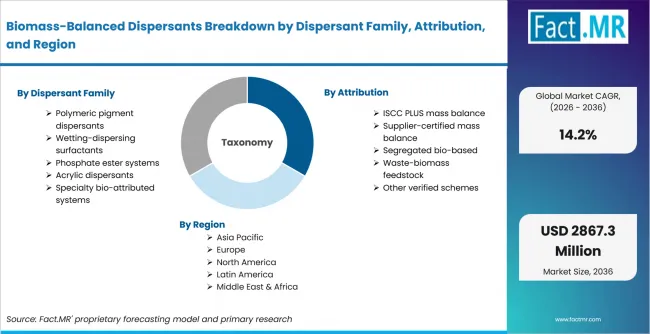
Biomass Balanced Dispersants Breakdown By Dispersant Family, Attribution, And Region | Source: Fact.MR
| Attribute | Details |
|---|---|
| Quantitative Units | USD million; CAGR in % |
| Market Definition | Qualifying wetting and dispersing additives sold with a verified biomass-balance, bio-attributed or comparable renewable-feedstock claim. |
| Segments Covered | Dispersant Family; Attribution; Application; Customer Driver |
| Countries Covered | Germany; France; USA; Netherlands; UK |
| Key Companies | BASF; Evonik; BYK; Clariant; Arkema; Lubrizol |
| Forecast Period | 2026-2036 |
| Base Year | 2026 |
| Market Value, 2026 | USD 760.0 million |
| Market Value, 2036 | USD 2,867.3 million |
| CAGR, 2026-2036 | 14.2% |
| Absolute Opportunity | USD 2,107.3 million |
| Approach | Bottom-up qualifying dispersant demand by chemistry and application, adjusted for attribution route, conversion from conventional grades, certification coverage and country conditions |
How is the market segmented?
-
By Dispersant Family
- Polymeric pigment dispersants
- Wetting-dispersing surfactants
- Phosphate ester systems
- Acrylic dispersants
- Specialty bio-attributed systems
-
By Attribution
- ISCC PLUS mass balance
- Supplier-certified mass balance
- Segregated bio-based
- Waste-biomass feedstock
- Other verified schemes
-
By Application
- Coatings
- Printing inks
- Adhesives / composites
- Pigment concentrates
- Agro / other
-
By Customer Driver
- PCF reduction
- Drop-in formulation
- Renewable-content claims
- Scope 3 reduction
- Circularity positioning