- Market Value (2025): USD 1.32 Bn
- Estimated Value (2026): USD 1.43 Bn
- Forecast Value (2036): USD 3.21 Bn
- CAGR (2026-2036):8.4%
What is the Biopolymer Paint Market forecast to be worth by 2036?
USD 1.4 billion in 2026 to USD 3.2 billion by 2036 at a stated CAGR of 8.4%.
- Fact.MR estimates that the Biopolymer Paint Market reached USD 1.32 billion in 2025.
- Revenue is projected to increase from USD 1.43 billion in 2026 to USD 3.21 billion by 2036 as manufacturers explore renewable feedstocks and lower-carbon coating formulations.
- A stated CAGR of 8.4% over the 2026–2036 period reflects the forecast, with growth opportunities linked to sustainable construction, waterborne paints, and industrial coating innovation.
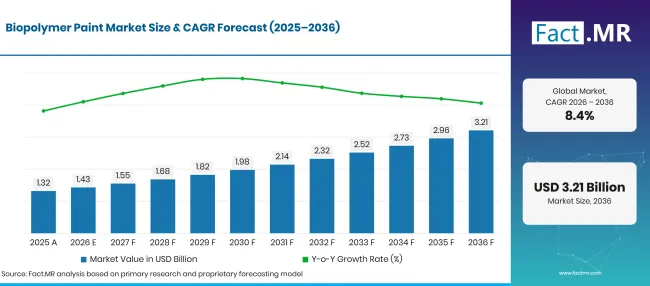
Biopolymer Paint Market Forecast Global | Source: Fact.MR
| Year | Basis | Market Value (USD billion) |
|---|---|---|
| 2025 | Actual | 1.32 |
| 2026 | Estimate | 1.43 |
| 2036 | Forecast | 3.21 |
| CAGR 2026 to 2036 | Forecast period | 8.4% |
Source: Fact.MR analysis. Updated Oct 22, 2026
What are the defining numbers behind Biopolymer Paint Market growth?
Approximately USD 1.8 billion in additional revenue is projected between 2026 and 2036.
- Demand Drivers in the Market
- Growing demand for renewable raw materials is encouraging formulation innovation. Paint manufacturers are exploring bio-based resins, binders, and additives derived from renewable feedstocks such as vegetable oils, fats, sugars, and wood. BASF identifies renewable-content additives for applications that include architectural, automotive, and industrial coatings. These materials provide options for reducing reliance on fossil-derived ingredients [1].
- Increasing preference for waterborne paints is supporting product development. Waterborne formulations offer opportunities to reduce reliance on conventional solvent systems and develop lower-emission coatings. Arkema's SYNAQUA 4856 is a bio-based alkyd emulsion designed for low-VOC, low-emission interior wall paints, demonstrating the application of renewable chemistry in architectural coatings [2].
- Sustainable construction practices are creating opportunities for lower-carbon coatings. Building owners, paint formulators, and construction-material suppliers are evaluating products that can reduce environmental impacts while preserving durability and appearance. In September 2025, BASF, AkzoNobel, and Arkema announced a collaboration involving bio-attributed raw materials for architectural powder coatings. The companies reported an up to 40% lower calculated cradle-to-gate product carbon footprint for selected superdurable architectural powder coatings compared with their former calculated baseline, using supplier-specific data and bio-attributed raw materials [3]. [3]
- Investment in sustainable coating technologies is strengthening the competitive landscape. Companies are developing bio-based binders, renewable-content additives, and coating systems intended to improve environmental performance without compromising application quality. PPG evaluates sustainably advantaged products against environmental and operational attributes, while Sherwin-Williams highlights sustainability-certified coatings and products designed to support green-building objectives [4] [9].
- Key Segments Analyzed
- By Product Type: Waterborne paints are projected to account for 42.3% of the market in 2026.
- By Application: Architectural applications hold 38.7% of the market in 2026. Other applications include automotive, industrial, and other coating uses.
- By End-User: Residential applications represent 36.8% of the market in 2026.
- Analyst Opinion at Fact.MR
- Shambhu Nath Jha, Principal Consultant at Fact.MR, states, “Biopolymer Paint Market is positioned at the intersection of renewable chemistry and coating performance. Manufacturers investing in bio-based resins, waterborne technologies, and scalable renewable feedstock sourcing may be better positioned to address demand for lower-carbon paint formulations. However, commercial expansion will depend on cost competitiveness, consistent raw material quality, and the ability to meet application-specific durability and performance requirements.”
- Strategic Implications
- Paint manufacturers need to prioritize renewable feedstock sourcing and establish reliable supply arrangements for bio-based resins, binders, and additives to reduce exposure to fossil-derived raw material volatility.
- Product developers can expand waterborne biopolymer paint portfolios for residential and architectural applications while maintaining adhesion, washability, weather resistance, and finish quality.
- Coating suppliers can strengthen application-specific development for automotive and industrial customers, where performance, substrate compatibility, and operating requirements influence adoption.
- Companies need to enhance life-cycle assessment and material traceability to substantiate environmental claims, measure renewable content, and distinguish bio-based ingredients from products that are merely marketed as sustainable.
Germany leads the country growth outlook at 10.5% CAGR, followed by Brazil at 10.1% and the United Kingdom at 9.0%. The United States is projected to grow at 7.6%, while Japan is expected to record a 7.1% CAGR over the 2026–2036 period.
How does the Biopolymer Paint Market break down by segment?
Waterborne paints will account for 42.3% of Product Type; Architectural applications will lead Application at 38.7%; Residential end-users will account for 36.8%.
Which Product Type leads?
Waterborne paints will represent 42.3% of 2026 share.
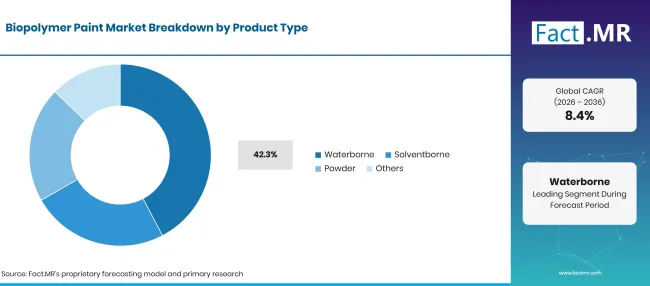
Biopolymer Paint Market Breakdown Product Type 1 | Source: Fact.MR
| Product Type | Share (2026) |
|---|---|
| Waterborne (Leading segment) | 42.3% |
| Other segments combined | 57.7%* |
| Total | 100.0% |
Source: Fact.MR analysis. Updated Oct 22, 2026
Waterborne biopolymer paints are emerging as a leading segment of the biopolymer paint market due to their lower volatile organic compound (VOC) emissions, reduced reliance on organic solvents, and compatibility with renewable binders, resins, and additives. Growing demand for environmentally preferable coatings across residential, commercial, and architectural applications further supports segment expansion. Their ease of application, low odor, and potential to meet increasingly stringent environmental regulations strengthen adoption among paint manufacturers and end users.
What supports Architectural applications within Application?
Architectural is set to hold 38.7% share in 2026.
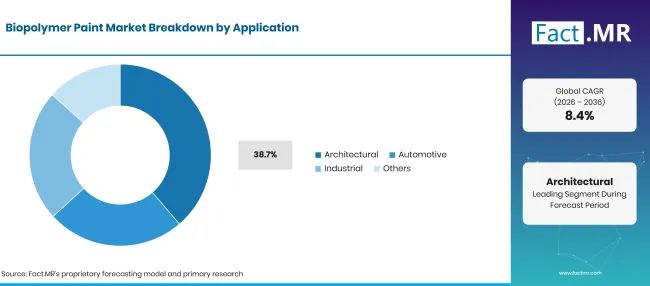
Biopolymer Paint Market Breakdown Application | Source: Fact.MR
| Application | Share (2026) |
|---|---|
| Architectural (Leading segment) | 38.7% |
| Other segments combined | 61.3%* |
| Total | 100.0% |
Source: Fact.MR analysis. Updated Oct 22, 2026
Architectural biopolymer paints are used for interior and exterior walls, ceilings, decorative surfaces, and building components. Demand is influenced by construction activity, renovation spending, indoor-air-quality considerations, and efforts to reduce the environmental footprint of building materials. The U.S. Environmental Protection Agency identifies VOC emissions from architectural coatings as an air-quality concern and maintains national standards intended to limit those emissions. Bio-based formulations can contribute to lower-impact product development, although renewable content alone does not establish a product's VOC level or overall environmental performance [5].
What supports Residential end-users?
Residential will account for 36.8% share in 2026.
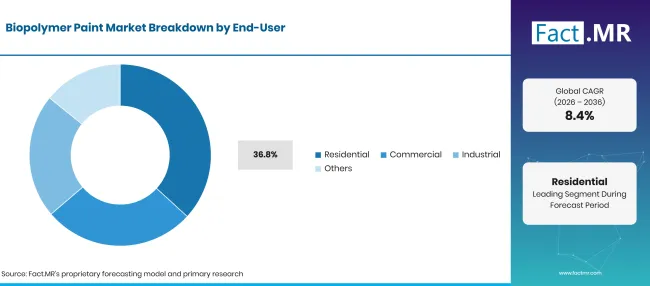
Biopolymer Paint Market Breakdown End User | Source: Fact.MR
| End-User | Share (2026) |
|---|---|
| Residential (Leading segment) | 36.8% |
| Other segments combined | 63.2%* |
| Total | 100.0% |
Source: Fact.MR analysis. Updated Oct 22, 2026
Residential demand is linked to new housing, repainting, home renovation, decorative finishes, and interest in lower-emission interior products. Paint manufacturers can use bio-based binders and additives to develop formulations that address these requirements while preserving finish quality, washability, and durability. Commercial buildings and industrial facilities also present opportunities, particularly where purchasers assess material sustainability alongside lifecycle performance and maintenance requirements.
What is accelerating Biopolymer Paint Market adoption, and what is holding it back?
Growing interest in renewable raw materials, lower-carbon construction products, and waterborne coating technologies is creating opportunities for the Biopolymer Paint Market. However, higher formulation costs, variable feedstock availability, performance requirements, and limited large-scale production of certain bio-based ingredients may constrain adoption.
Drivers Impact Analysis
| DRIVER | (~) % IMPACT ON CAGR | GEOGRAPHIC RELEVANCE | IMPACT TIMELINE |
|---|---|---|---|
| Growing demand for low-VOC and environmentally preferable paints | +1.0% | Europe, North America | Medium term (2–4 years) |
| Increasing adoption of renewable bio-based resins and binders | +0.9% | Global | Medium term (2–4 years) |
| Expansion of waterborne biopolymer paint applications | +0.7% | Global | Short term (≤ 2 years) |
| Stringent environmental regulations for coating formulations | +0.5% | Europe, North America | Short term (≤ 2 years) |
| Advancements in bio-based coating technologies | +0.4% | Global | Long term (≥ 4 years) |
Source: Fact.MR analysis. Updated Oct 22, 2026
Opportunity Impact Analysis
| OPPORTUNITY | (~) % IMPACT ON CAGR | GEOGRAPHIC RELEVANCE | IMPACT TIMELINE |
|---|---|---|---|
| Development of high-performance bio-based resins | +0.8% | Global | Medium term (2–4 years) |
| Expansion of waterborne biopolymer paints in architectural coatings | +0.6% | Europe, Asia | Medium term (2–4 years) |
| Integration of renewable feedstocks into paint manufacturing | +0.5% | Americas, Europe | Long term (≥ 4 years) |
| Improved product certification and bio-based content traceability | +0.4% | Global | Short term (≤ 2 years) |
Source: Fact.MR analysis. Updated Oct 22, 2026
Restraints Impact Analysis
| RESTRAINT | (~) % IMPACT ON CAGR | GEOGRAPHIC RELEVANCE | IMPACT TIMELINE |
|---|---|---|---|
| Higher production costs of bio-based raw materials | -0.8% | Global | Short term (≤ 2 years) |
| Limited availability and inconsistent supply of renewable feedstocks | -0.6% | Global | Medium term (2–4 years) |
| Performance limitations in demanding coating applications | -0.5% | Global | Medium term (2–4 years) |
| Compatibility challenges with existing paint manufacturing processes | -0.4% | Global | Short term (≤ 2 years) |
| RESTRAINT | (~) % IMPACT ON CAGR | GEOGRAPHIC RELEVANCE | IMPACT TIMELINE |
Source: Fact.MR analysis. Updated Oct 22, 2026
Which countries are scaling the Biopolymer Paint Market through 2036?
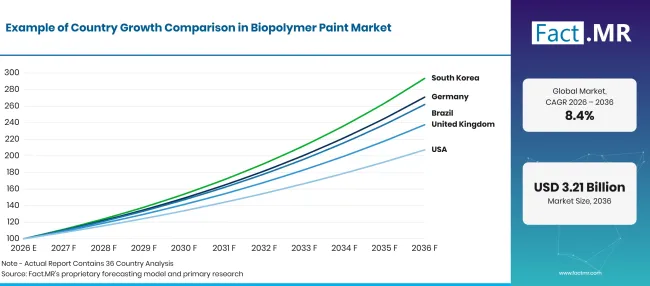
Biopolymer Paint Market Growth Index | Source: Fact.MR
| Country | CAGR (2026–2036) |
|---|---|
| Germany | 10.5% |
| Brazil | 10.1% |
| USA | 7.6% |
| UK | 9.0% |
| Japan | 7.1% |
Source: Fact.MR analysis. Updated Oct 22, 2026
What supports Germany's adoption?
10.5% CAGR, reflecting opportunities in sustainable coatings, renewable materials, and lower-carbon construction products.
Germany's established chemical and coatings industries provide a foundation for developing and commercializing renewable coating ingredients. Manufacturers can pursue opportunities in bio-based resins, additives, and architectural paints as building-material suppliers seek to reduce the environmental footprint of their products.
What supports Brazil's adoption?
10.1% CAGR, led potential opportunities in residential construction, architectural paints, and renewable feedstock sourcing.
Brazil's agricultural resources offer opportunities to explore renewable raw materials for coating formulations. Paint manufacturers can evaluate plant-derived oils and other biomass-based feedstocks for developing bio-based binders and additives. Residential construction, repainting, and commercial building projects also represent potential demand channels.
Fact.MR analysis indicates that local feedstock availability, competitive manufacturing costs, and investment in coating formulation technologies could influence the country's market development.
What supports adoption in the United States?
7.6% CAGR, shaped by opportunities in sustainable architectural coatings and industrial paint formulations.
The United States has an established coatings industry and regulatory frameworks addressing emissions from architectural paints. Fact.MR analysis indicates that manufacturers could expand bio-based formulations for residential, commercial, automotive, and industrial applications. Adoption will depend on the cost of renewable ingredients, formulation performance, and the ability to demonstrate measurable environmental benefits alongside compliance with applicable standards.
How does the United Kingdom perform?
9.0% CAGR, backed opportunities in lower-carbon building materials and sustainable coating development.
The United Kingdom's construction sector is increasingly considering environmental performance and lifecycle impacts when evaluating building products. Government work on construction-product reform has examined environmental requirements and more transparent environmental information for covered products [8].
Fact.MR analysis indicates that demand for lower-carbon architectural paints could create opportunities for suppliers offering bio-based binders, renewable additives, and low-emission formulations. Commercial adoption will depend on product durability, cost competitiveness, and the availability of credible environmental performance data.
How is Japan developing demand?
7.1% CAGR, driven opportunities in sustainable materials, advanced coatings, and environmentally conscious procurement.
Japan's established manufacturing sector offers potential applications for bio-based paints across buildings, industrial equipment, and selected automotive uses. Government green-procurement policies provide a framework for encouraging the purchase of products with lower environmental impacts. Japan's Ministry of the Environment identifies green purchasing as a means of encouraging suppliers to develop environmentally preferable products [6].
Fact.MR analysis indicates that manufacturers may find opportunities in high-performance bio-based coatings that combine renewable ingredients with durability and application efficiency. Wider adoption will depend on formulation costs, performance standards, and the availability of suitable renewable feedstocks.
Who leads the Biopolymer Paint Market?
The Biopolymer Paint Market includes established coatings manufacturers and specialty chemical companies developing sustainable coating technologies, resins, and additives. Akzo Nobel N.V. participates in architectural and industrial coatings, while BASF supplies coating ingredients, including additives with renewable content. PPG Industries and Sherwin-Williams maintain broad coatings portfolios, and Arkema develops bio-based resins and additives for decorative and industrial coating applications.
Competition depends on the availability of renewable raw materials, coating performance, formulation costs, product development, and the ability to substantiate environmental claims. In September 2025, AkzoNobel, BASF, and Arkema announced a value-chain collaboration to reduce the carbon footprint of selected architectural powder coatings using bio-attributed raw materials. This illustrates how partnerships between raw material suppliers and coating manufacturers can help advance lower-carbon coating technologies [7].
Which companies are the key providers?
Key companies in the Biopolymer Paint Market include:
- Akzo Nobel N.V.
- BASF
- PPG Industries
- Sherwin-Williams
- Arkema
Bibliography
- [1] BASF. (n.d.). Additives with biorenewable content.
- [2] Arkema. (n.d.). SYNAQUA® 4856.
- [3] BASF. (2025, September 11). BASF, AkzoNobel and Arkema team up to lower carbon footprint of architectural powder coatings.
- [4] PPG. (n.d.). Sustainably advantaged products.
- [5] U.S. Environmental Protection Agency. (2026, March 4). Architectural coatings: National volatile organic compounds emission standards.
- [6] Ministry of the Environment, Government of Japan. (n.d.). Green purchasing.
- [7] AkzoNobel. (2025). AkzoNobel, Arkema and BASF team up to lower carbon footprint of architectural powder coatings.
- [8] Ministry of Housing, Communities and Local Government. (2025, February 26). Construction Products Reform Green Paper.
- [9] Sherwin-Williams. (n.d.). Products with sustainability certifications.
- [10] Lasarte López, J., & M’Barek, R. (2025, November 19). The EU bioeconomy at a glance: Focus on economic value added, employment and innovation. European Commission, Joint Research Centre.
This Report Answers
- Biopolymer Paint Market revenue is segmented by product type, application, and end-user, including waterborne paints, architectural coatings, and residential applications.
- For each segment, the leading subsegment is identified alongside the factors influencing adoption.
- Renewable feedstock availability, coating formulation development, and environmental requirements frame the country-level comparison of Germany, Brazil, the United States, the United Kingdom, and Japan.
- Company profiles cover manufacturers and specialty chemical suppliers developing coating products, renewable resins, and additives.
- Drivers, opportunities, and restraints are assessed for their potential influence on market growth through 2036.
What does the Biopolymer Paint Market cover?
The Biopolymer Paint Market covers paint formulations that use bio-based polymers or renewable polymer ingredients as part of their binder, resin, or coating system. These products are developed for applications that may include architectural surfaces, automotive components, and industrial substrates.
The market encompasses relevant waterborne, solventborne, and powder formulations where bio-based polymer ingredients form part of the product. Demand is influenced by renewable raw material availability, product performance, cost, durability, and customer requirements for lower-impact materials.
What is included in the scope?
The market includes waterborne, solventborne, powder, and other paint formulations containing relevant bio-based polymer ingredients. Applications include architectural, automotive, and industrial coatings, with end-users spanning residential, commercial, and industrial sectors.
Bio-based resins, binders, and polymer additives are considered where they form part of the paint formulation being assessed. The market definition should distinguish finished paint revenue from revenue generated by upstream raw materials to avoid double counting.
What is excluded from the scope?
Unless explicitly included in the market definition, the assessment excludes conventional paints without qualifying bio-based polymer ingredients, standalone raw materials sold independently of finished paint, and unrelated specialty chemicals.
General construction services, painting labor, application equipment, and diagnostic or testing services are excluded from finished-paint market revenue. Coatings containing recycled or mass-balance-attributed materials should be classified separately unless they meet the report's defined bio-based criteria.
How Was the Analysis Built?
The analysis draws on 120+ sources, 35+ company portfolios, 25+ countries, and more than 20 industry interviews.
- Primary Research: Primary research includes discussions with manufacturers, service providers, technology developers, distributors, end users, and subject-matter experts. These conversations examine purchasing priorities, product adoption, operational challenges, approval requirements, competitive positioning, and the factors that influence wider market acceptance.
- Desk Research: Desk research covers government statistics, regulatory publications, company filings, trade data, technical studies, industry associations, standards, public policy, and other authoritative sources. Every source used in the analysis is documented in the bibliography.
- Market Sizing and Forecasting: Market estimates combine historical performance, demand indicators, pricing and volume trends, segment shares, company participation, country-level growth, adoption patterns, investment activity, and barriers to market expansion.
- Data Validation and Update Cycle: Findings are validated by comparing primary interviews with public data, company activity, regulatory changes, trade patterns, and industry developments. Regular updates review new product launches, capacity changes, partnerships, approvals, and shifts in commercial adoption.
Segmentation
What is the report's scope and coverage?
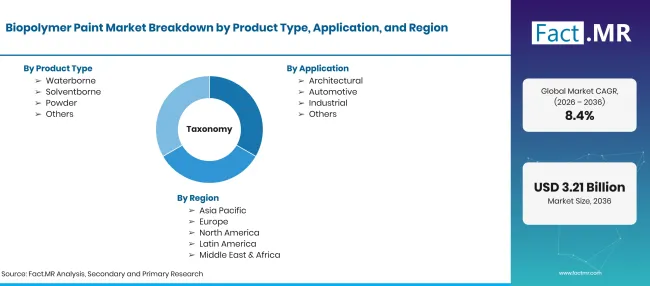
Biopolymer Paint Market Taxonomy | Source: Fact.MR
| Attribute | Details |
|---|---|
| Quantitative Units | USD billion |
| Market Definition | The Biopolymer Paint Market covers paint formulations using bio-based polymers, resins, binders, or other renewable polymer ingredients. |
| Product Type | Waterborne; Solventborne; Powder; Others |
| Application | Architectural; Automotive; Industrial; Others |
| End-User | Residential; Commercial; Industrial; Others |
| Regions Covered | North America; Latin America; Western Europe; Eastern Europe; East Asia; South Asia & Pacific; Middle East & Africa |
| Countries Covered | Germany; Brazil; United States; United Kingdom; Japan |
| Companies Profiled | Akzo Nobel N.V.; BASF; PPG Industries; Sherwin-Williams; Arkema |
| Forecast Period | 2026 to 2036 |
| Approach | Proposed hybrid top-down and bottom-up approach using paint demand, renewable feedstock availability, coating production, pricing, application adoption, company portfolios, and country-level indicators. |
Source: Fact.MR analysis. Updated Oct 22, 2026
How is the market segmented?
-
By Product Type
- Waterborne
- Solventborne
- Powder
- Others
-
By Application
- Architectural
- Automotive
- Industrial
- Others
-
By End-User
- Residential
- Commercial
- Industrial
- Others
-
By Region
- North America
- Latin America
- Western Europe
- Eastern Europe
- East Asia
- South Asia & Pacific
- Middle East & Africa
Frequently Asked Questions
How big is the Biopolymer Paint Market in 2026?
What is the CAGR of the Biopolymer Paint Market from 2026 to 2036?
Which Product Type leads the Biopolymer Paint Market?
Which Application leads the Biopolymer Paint Market?
Which End-User leads the Biopolymer Paint Market?
Which country will grow the most in the Biopolymer Paint Market?
Who are the main companies in the Biopolymer Paint Market?
Who worked on this report


Preview the report firsthand - request a free sample
Free SampleGet the brochure for pricing and purchase details
Download PDF