- Market Value (2025): USD 5.74 Bn
- Estimated Value (2026): USD 5.95 Bn
- Forecast Value (2036): USD 8.52 Bn
- CAGR (2026-2036): 3.5%
What is the C2 Chlorinated Solvents Market forecast to be worth by 2036?
USD 6.0 billion in 2026 to USD 8.5 billion in 2036, representing an implied CAGR of approximately 3.5% (subject to Fact.MR model confirmation).
- As per Fact.MR analysis, the C2 chlorinated solvents market was valued at USD 5.74 billion in 2025.
- Demand will grow from USD 5.95 billion in 2026 to USD 8.52 billion by 2036.
- The stated endpoints imply approximately 3.5% CAGR from 2026 to 2036. Fact.MR must confirm the underlying forecast and chemical scope before publication.
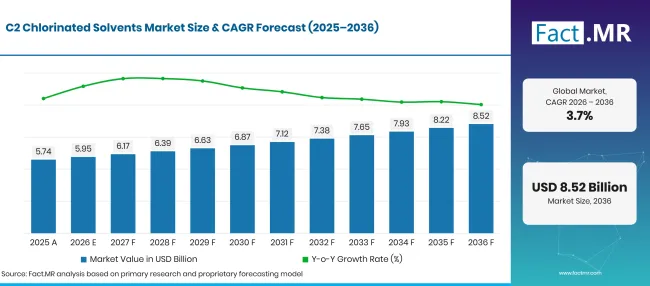
Chlorinated Solvents Market Forecast Global | Source: Fact.MR
| Year | Basis | Market Value (USD billion) |
|---|---|---|
| 2025 | Actual | 5.8 |
| 2026 | Estimate | 6.0 |
| 2036 | Forecast | 8.5 |
| CAGR 2026 to 2036 | Forecast period | ~3.5%* |
Source: Fact.MR analysis. Updated Oct 22, 2026
What are the defining numbers behind C2 Chlorinated Solvents Market growth?
USD 2.5 billion in additional revenue is projected between 2026 and 2036.
- Demand Drivers in the Market
- Automotive component cleaning forms part of industrial manufacturing. OICA publishes vehicle production statistics for major producing countries; these show the scale of manufacturing activity but do not measure chlorinated-solvent consumption. The use of C2 solvents in individual cleaning applications depends on material suitability and local chemical restrictions [1].
- Chemical feedstock and processing applications remain relevant to selected C2 chlorinated compounds. EPA identifies perchloroethylene as an intermediate in refrigerant production and a processing aid in petroleum refining. Its December 2024 rule regulates PCE, and EPA finalized extensions of certain workplace protection compliance dates in July 2026. Continued applications must meet the applicable restrictions [2].
- Industrial use of C2 chlorinated solvents depends on compound-specific permissions and end-use requirements. EPA’s trichloroethylene risk-management rule restricts most commercial and industrial uses, with selected transition arrangements; a September 2025 interim final rule extended compliance dates for specified applications [3].
- Key Segments Analyzed
- By Product Type: Perchloroethylene has an internally estimated 38.5% share in 2026, pending scope reconciliation. Other C2 categories include trichloroethylene and other defined two-carbon chlorinated compounds. Methylene chloride is a C1 compound and is excluded from a strict C2 definition.
- By Application: Degreasing lead with 34.2% share in 2026. Other applications include dry cleaning, chemical processing, electronics, pharmaceuticals, and others.
- By End-User Industry: Automotive capture 36.4% share in 2026.
- Analyst Opinion at Fact.MR
- Shambhu Nath Jha, Principal Consultant at Fact.MR, states, “Demand for chlorinated solvents is shaped by application-specific performance requirements, industrial processing needs, and changing regulatory expectations. Manufacturers that maintain consistent product quality, reliable supply, and appropriate technical documentation will be better positioned to address customer requirements. Solvent handling, recovery, and the evaluation of suitable alternatives will remain important considerations across industrial applications.”
- Strategic Implications
- Manufacturers need to provide clear product specifications and technical documentation to help industrial buyers assess solvent suitability for particular applications.
- Suppliers are expected to maintain reliable distribution and application support for customers in industrial cleaning, chemical processing, electronics, and related manufacturing sectors.
- Producers must evaluate how environmental restrictions and workplace exposure requirements affect individual chlorinated compounds and their applications.
- Industrial users can assess solvent recovery and process-efficiency improvements where technically and economically feasible.
- Market participants need to distinguish between individual compounds because product characteristics, regulatory treatment, and suitable applications differ across chlorinated chemicals.
The country forecasts indicate that the United States is set to record the highest CAGR at 4.7% through 2036, followed by Brazil at 4.3%, Japan at 3.8%, Germany at 3.3%, and the United Kingdom at 2.6%.
How does the C2 Chlorinated Solvents Market break down by segment?
Fact.MR's data identifies Perchloroethylene as the leading Product Type at 38.5%, Degreasing as the leading Application at 34.2%, and Automotive as the leading End-User Industry at 36.4% in 2026.
Which Product Type dominates?
Perchloroethylene is set to account for 38.5% of the market in 2026.
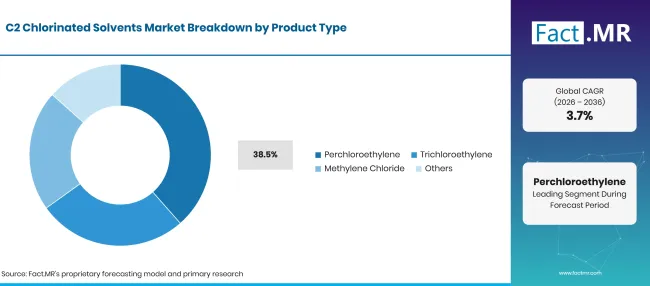
C2 Chlorinated Solvents Market Breakdown Product Type | Source: Fact.MR
| Product Type | Share (2026) |
|---|---|
| Perchloroethylene (Leading segment) | 38.5% |
| Other segments combined | 61.5%* |
| Total | 100.0% |
Source: Fact.MR analysis. Updated Oct 22, 2026
Perchloroethylene is the leading category in the supplied Fact.MR estimate, subject to scope validation. OxyChem lists industrial, technical, vapor-degreasing and other perchloroethylene grades but states that it sells PCE only to approved purchasers for feedstock use, not for dry cleaning [4]. EPA regulates PCE use, and its July 2026 action extended certain workplace-plan compliance dates [2]. Technical grade listings do not establish that all historical applications remain permitted.
What leads the Application segment?
Degreasing is set to represent 34.2% of the market in 2026.
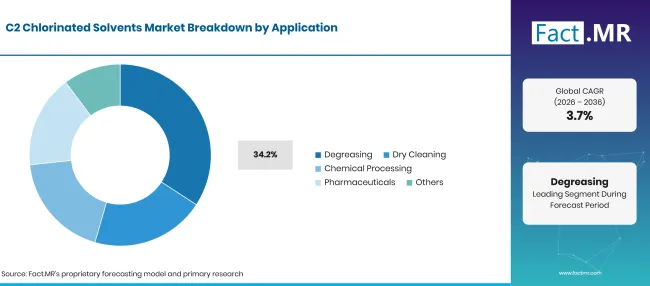
C2 Chlorinated Solvents Market Breakdown Application | Source: Fact.MR
| Application | Share (2026) |
|---|---|
| Degreasing (Leading segment) | 34.2% |
| Other segments combined | 65.8%* |
| Total | 100.0% |
Source: Fact.MR analysis. Updated Oct 22, 2026
Degreasing is used to remove oils, grease, and residues from industrial components and equipment. Solvent selection depends on the material being cleaned, the type of contamination, the required cleaning performance, and applicable handling requirements.
Dry cleaning, chemical processing, electronics, and pharmaceutical applications should be assessed separately because the relevant compounds, technical requirements, and regulatory conditions can differ.
How does End-User Industry shape demand?
Automotive is projected to account for 36.4% of the market in 2026.
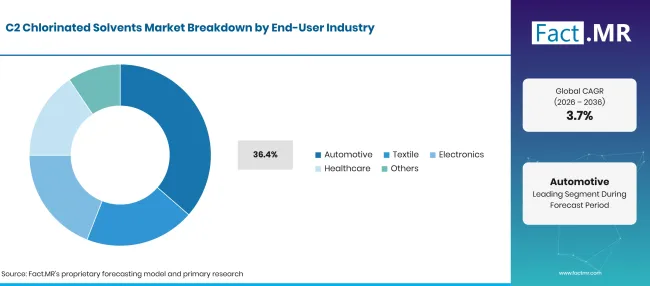
C2 Chlorinated Solvents Market Breakdown End User Industry | Source: Fact.MR
| End-User Industry | Share (2026) |
|---|---|
| Automotive (Leading segment) | 36.4% |
| Other segments combined | 63.6%* |
| Total | 100.0% |
Source: Fact.MR analysis. Updated Oct 22, 2026
Automotive manufacturing and associated industrial operations may require cleaning and degreasing processes for selected components and equipment. Demand for chlorinated solvents depends on the specific cleaning application, material compatibility, product specifications, and requirements governing safe handling. Other listed end-user industries include textiles and healthcare, although the precise uses and products included under these categories should be defined and validated before publication.
What is accelerating C2 Chlorinated Solvents Market adoption, and what is holding it back?
Industrial cleaning, degreasing, chemical processing, and electronics-related applications may support demand for selected chlorinated solvents. However, environmental requirements, occupational exposure concerns, hazardous-material handling, and substitution by alternative solvents can constrain demand for individual compounds.
Drivers Impact Analysis
| DRIVER | Impact assessment (model validation required) | GEOGRAPHIC RELEVANCE | IMPACT TIMELINE |
|---|---|---|---|
| Industrial degreasing requirements | Not independently verified | North America, Europe | Medium term (2–4 years) |
| Demand for precision component cleaning | Not independently verified | Global | Short term (≤ 2 years) |
| Chemical processing applications | Not independently verified | Global | Medium term (2–4 years) |
| Solvent performance in industrial cleaning | Not independently verified | Asia, North America | Short term (≤ 2 years) |
Source: Fact.MR analysis. Updated Oct 22, 2026
Opportunity Impact Analysis
| OPPORTUNITY | Impact assessment (model validation required) | GEOGRAPHIC RELEVANCE | IMPACT TIMELINE |
|---|---|---|---|
| High-purity solvent grades for specialized applications | Not independently verified | Global | Medium term (2–4 years) |
| Solvent recovery and recycling systems | Not independently verified | Europe, North America | Medium term (2–4 years) |
| Improved industrial cleaning process efficiency | Not independently verified | Americas, Asia | Long term (≥ 4 years) |
| Application-specific solvent formulations and technical support | Not independently verified | Global | Short term (≤ 2 years) |
Source: Fact.MR analysis. Updated Oct 22, 2026
Restraints Impact Analysis
| RESTRAINT | Impact assessment (model validation required) | GEOGRAPHIC RELEVANCE | IMPACT TIMELINE |
|---|---|---|---|
| Environmental restrictions on selected chlorinated solvents | Not independently verified | Europe, North America | Short term (≤ 2 years) |
| Occupational exposure and workplace safety requirements | Not independently verified | Global | Medium term (2–4 years) |
| Availability of alternative cleaning technologies and solvents | Not independently verified | Global | Short term (≤ 2 years) |
| Solvent handling, storage, and disposal costs | Not independently verified | Global | Medium term (2–4 years) |
Source: Fact.MR analysis. Updated Oct 22, 2026
Which countries are scaling the C2 Chlorinated Solvents Market through 2036?
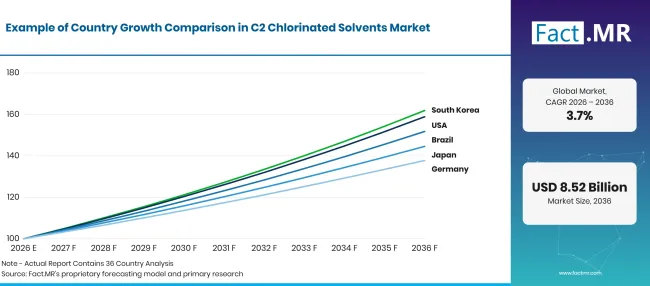
C2 Chlorinated Solvents Market Growth Index | Source: Fact.MR
| Country | CAGR (2026–2036) |
|---|---|
| Germany | 3.3% |
| Brazil | 4.3% |
| USA | 4.7% |
| UK | 2.6% |
| Japan | 3.8% |
Source: Fact.MR analysis. Updated Oct 22, 2026
What supports Germany adoption?
3.3% CAGR, supported by its established chemical manufacturing base and demand for specialized industrial solvents.
Germany's industrial and chemical manufacturing base may support demand for selected solvents used in cleaning, degreasing, and chemical processing. Industrial buyers assess solvent performance, material compatibility, product quality, cost, and compliance with applicable handling and environmental requirements. The extent of demand depends on the individual compound and its suitability for the intended process.
How is Brazil developing chlorinated-solvent adoption?
4.3% CAGR, driven by industrial chemical processing and expanding manufacturing applications.
Brazil's market may be influenced by industrial production, chemical processing, automotive-related manufacturing, and demand for industrial cleaning products. Suppliers must meet application requirements and provide reliable product availability, technical documentation, and appropriate handling guidance. Brazil market development will depend on industrial demand, the use of individual chlorinated compounds, and the availability of suitable alternatives.
What supports United States adoption?
4.7% CAGR, backed by industrial cleaning requirements and demand from established chemical and manufacturing industries.
The United States is projected to record the highest growth rate among the five countries listed. Its established chemical manufacturing base and automotive, aerospace, and electronics industries support demand for selected C2 chlorinated solvents used in degreasing, metal cleaning, and specialized industrial processes. Manufacturers require solvents that meet specific cleaning performance, material compatibility, and process-efficiency requirements. Demand also depends on the availability of suitable product grades and reliable technical support from suppliers.
How is the United Kingdom developing adoption?
2.6% CAGR, led by specialized chemical applications and regulatory requirements for solvent handling and use.
The United Kingdom's market may be influenced by demand from industrial cleaning, chemical processing, and manufacturing applications. Solvent selection depends on the required chemical properties, cleaning performance, material compatibility, and applicable environmental and workplace requirements.
What supports Japan adoption?
3.8% CAGR, shaped by precision manufacturing, electronics production, and specialized industrial cleaning applications.
Japan's industrial manufacturing, electronics, and automotive sectors may generate demand for selected solvents used in cleaning and processing applications. Buyers evaluate solvent suitability based on performance requirements, product specifications, material compatibility, and compliance with relevant handling standards.
Who leads the C2 Chlorinated Solvents Market?
BEFAR GROUP, Westlake Corporation, and OxyChem participate in chlorinated chemical supply for industrial users, where product grade, handling requirements, and application fit shape purchasing decisions. OxyChem’s portfolio includes perchloroethylene for approved industrial uses, while buyers also compare technical documentation and supply reliability before selecting a solvent for cleaning or processing work.
AGC and SRF Limited have documentation relating to chlorinated solvent products, while the specific C2 commercial offerings of INEOS Inovyn require additional product-level confirmation. Competitive assessment should verify the compound and region supplied, current product availability and the lawful use of each grade before treating a company as a direct market participant.
Which companies are the key providers?
Key companies include BEFAR Group Co., Ltd., Westlake Corporation, OxyChem (Berkshire Hathaway), INEOS Inovyn, AGC Inc., and SRF Limited.
- BEFAR GROUP CO., LTD.
- Westlake Corporation
- OxyChem (Berkshire Hathaway)
- INEOS Inovyn
- AGC Inc.
- SRF Limited
Bibliography
- [1] International Organization of Motor Vehicle Manufacturers. (n.d.). Production statistics.
- [2] U.S. Environmental Protection Agency. (2026, July). Risk management for perchloroethylene (PCE) [Regulatory update]. https://www.epa.gov/assessing-and-managing-chemicals-under-tsca/risk-management-perchloroethylene-pce
- [3] U.S. Environmental Protection Agency. (2025, September 12). EPA issues interim final rule on compliance date extensions for TSCA risk management for TCE. https://www.epa.gov/chemicals-under-tsca/epa-issues-interim-final-rule-compliance-date-extensions-tsca-risk-management
- [4] OxyChem (Berkshire Hathaway). (n.d.). Chlorinated organics
- [5] U.S. Environmental Protection Agency. (2026, April 16). EPA empowers Americans with 2024 Chemical Data Reporting information. https://www.epa.gov/chemicals-under-tsca/epa-empowers-americans-2024-chemical-data-reporting-information
This Report Answers
- The report examines the C2 Chlorinated Solvents Market by product type, application, end-user industry, and region.
- Segment analysis compares the specified product categories and their 2026 shares.
- Country analysis compares the growth forecasts for Germany, Brazil, the USA, the UK, and Japan.
- The competitive overview identifies BEFAR GROUP CO., LTD., Westlake Corporation, OxyChem (Berkshire Hathaway), INEOS Inovyn, AGC Inc., and SRF Limited for product-level verification.
- Market drivers, opportunities, and restraints are assessed in relation to industrial demand, product suitability, regulatory requirements, and alternative-solvent adoption.
What does the C2 Chlorinated Solvents Market cover?
The proposed strict C2 scope includes perchloroethylene, trichloroethylene, and any other explicitly defined two-carbon chlorinated compounds. Methylene chloride (dichloromethane, CH2Cl2) is a one-carbon compound and falls outside that strict definition. The original market values and shares require reconciliation before publication if they previously included C1 solvent revenue.
The assessment considers product categories, application requirements, end-user industries, country-level growth estimates, and supplier participation. Because chlorinated compounds have different chemical structures, properties, applications, and regulatory considerations, the substances included in the market valuation should be clearly identified before publication.
What is included in the scope?
The proposed scope includes the specified chlorinated solvent products and their relevant industrial applications, categorized by product type, application, and end-user industry. It also considers regional demand, company participation, market growth estimates, and factors influencing product adoption.
Products should be counted only where they meet the agreed chemical definition and revenue methodology. Supplier participation and product-level inclusion should be verified through company documentation and relevant technical sources.
What is excluded from the scope?
Non-chlorinated solvents are excluded unless explicitly included in the final market definition. Unrelated chemical intermediates, finished pharmaceutical products, finished automotive components, laboratory equipment, and general chemical-processing services are also excluded from the solvent market valuation.
The analysis should avoid double-counting chemicals classified both as solvents and as chemical intermediates. Product categories and revenue recognition should be defined consistently to maintain a clear market boundary.
How Was the Analysis Built?
The report describes primary and desk research; underlying research logs are required to substantiate any claimed source, company, country or interview counts.
- Primary Research: Primary research includes discussions with manufacturers, service providers, technology developers, distributors, end users, and subject-matter experts. These conversations examine purchasing priorities, product adoption, operational challenges, approval requirements, competitive positioning, and the factors that influence wider market acceptance.
- Desk Research: Desk research covers government statistics, regulatory publications, company filings, trade data, technical studies, industry associations, standards, public policy, and other authoritative sources. The bibliography lists the sources cited in the report; complete supporting research records require internal confirmation.
- Market Sizing and Forecasting: Market estimates combine historical performance, demand indicators, pricing and volume trends, segment shares, company participation, country-level growth, adoption patterns, investment activity, and barriers to market expansion.
- Data Validation and Update Cycle: Findings are validated by comparing primary interviews with public data, company activity, regulatory changes, trade patterns, and industry developments. Regular updates review new product launches, capacity changes, partnerships, approvals, and shifts in commercial adoption.
Segmentation
What is the report’s scope and coverage?
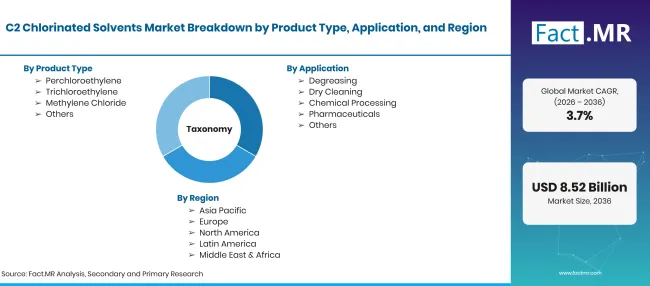
C2 Chlorinated Solvents Market Taxonomy | Source: Fact.MR
| Attribute | Details |
|---|---|
| Quantitative Units | USD billion |
| Market Definition | Chlorinated solvent products within the agreed chemical and commercial scope. The exact compounds covered should be explicitly defined. |
| Product Type | Perchloroethylene; Trichloroethylene; Other C2 Chlorinated Solvents (scope to confirm); Others |
| Application | Degreasing; Dry Cleaning; Chemical Processing; Electronics; Pharmaceuticals; Others |
| End-User Industry | Automotive; Textile; Healthcare; Others |
| Regions Covered | North America; Latin America; Western Europe; Eastern Europe; East Asia; South Asia & Pacific; Middle East & Africa |
| Countries Covered | Germany; Brazil; USA; UK; Japan |
| Companies Profiled | BEFAR GROUP CO., LTD.; Westlake Corporation; OxyChem (Berkshire Hathaway); INEOS Inovyn; AGC Inc.; SRF Limited |
| Forecast Period | 2026 to 2036 |
| Approach | Market segmentation and forecast analysis supported by market estimates, industrial demand indicators, company product portfolios, trade data, and regulatory information |
Source: Fact.MR analysis. Updated Oct 22, 2026
How is the market segmented?
-
By Product Type
- Perchloroethylene
- Trichloroethylene
- Other C2 Chlorinated Solvents (to be defined)
- Others
-
By Application
- Degreasing
- Dry Cleaning
- Chemical Processing
- Electronics
- Pharmaceuticals
- Others
-
By End-User Industry
- Automotive
- Textile
- Healthcare
- Others
-
By Region
- North America
- Latin America
- Western Europe
- Eastern Europe
- East Asia
- South Asia & Pacific
- Middle East & Africa
Frequently Asked Questions
How big is the C2 Chlorinated Solvents Market in 2026?
What is the CAGR of the C2 Chlorinated Solvents Market from 2026 to 2036?
Which Product Type category leads the C2 Chlorinated Solvents Market?
Which application segment leads the C2 Chlorinated Solvents Market?
Which end-user industry leads the C2 Chlorinated Solvents Market?
Which companies are covered?
Who worked on this report


Preview the report firsthand - request a free sample
Free SampleGet the brochure for pricing and purchase details
Download PDF