- Market Value (2025): USD 660.9 Mn
- Estimated Value (2026): USD 760.0 Mn
- Forecast Value (2036): USD 3075.0 Mn
- CAGR (2026-2036): 15.0%
What is the Camelina Bio Oils Market forecast to be worth by 2036?
USD 760.0 million in 2026 to USD 3075.0 million by 2036 at a 15.0% CAGR.
- The Camelina bio oils market reached USD 660.9 million in 2025.
- Demand is projected to increase from USD 760.0 million in 2026 to USD 3075.0 million by 2036.
- The market is forecast to record 15.0% CAGR from 2026 to 2036 as biofuel blenders, lubricant formulators and personal-care brands qualify camelina-derived inputs.
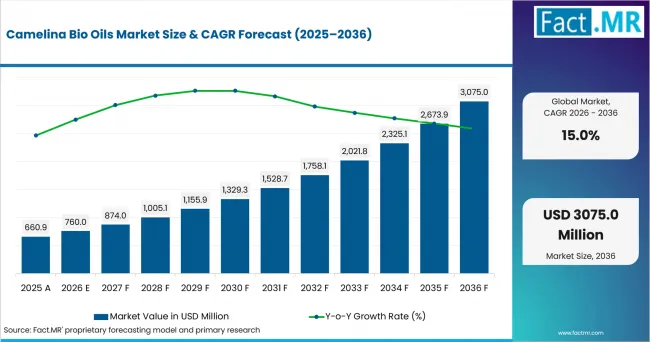
Camelina Bio Oils Market Value Analysis | Source: Fact.MR
What are the defining numbers behind Camelina Bio Oils Market growth?
An absolute opportunity of USD 2315.0 million is expected between 2026 and 2036.
- Demand Drivers in the Market
- Biofuel blenders need non-soy oilseed inputs that fit renewable diesel and SAF pathways while adding flexibility to food-oil supply pools.
- USDA RMA expanded written agreements for camelina to all areas for the 2026 and succeeding crop years, broadening crop-insurance access for contracted camelina producers.
- Lubricant formulators need plant ester inputs that provide useful lubricity and clear origin records for specialty industrial fluids.
- Personal-care brands need botanical emollients with stable refinement quality, giving camelina oil a practical role in creams and hair oils.
- Key Segments Analyzed
- By Product: Plant esters are expected to hold 36.0% share in 2026 due to their role in bio-based lubricant and fuel-additive formulations.
- By Function: Lubricity is projected to account for 38.0% share in 2026 since ester chemistry helps reduce friction in specialty fluid systems.
- By Application: Personal care is anticipated to capture 35.0% share in 2026 as formulators use camelina oil in emollient-rich products.
- By Form: Liquid is estimated to represent 47.0% share in 2026 owing to simpler blending, dosing and handling across formulation plants.
- Analyst Opinion at Fact.MR
- Shambhu Nath Jha, Principal Consultant at Fact.MR, states, "Camelina bio oils attract interest because the crop links agronomy, oil chemistry and carbon accounting in one purchase decision. Demand is expected to favor suppliers that prove identity-preserved seed flow, reliable oil specifications and practical grower economics. Contracting depth, refinery qualification and formulation data should separate durable suppliers from spot sellers."
- Strategic Implications
- Seed developers should connect variety performance with oil-profile records so crushers and biofuel offtakers can qualify contracts faster.
- Processors should document peroxide value and storage stability before selling camelina oil into personal-care or industrial-fluid channels.
- Formulators should test camelina oil against rapeseed, sunflower and synthetic ester alternatives to justify switching costs.
The USA is projected to record 16.5% CAGR through 2036 supported by crop insurance access. Germany is expected to post 15.8% CAGR through oilseed processing depth. Japan is anticipated to advance at 14.7% CAGR owing to SAF qualification. France is forecast to hold 14.1% CAGR due to biodiesel channels. Brazil is estimated to reach 13.5% CAGR as B15 blending supports intermediate crops.
How does the Camelina Bio Oils Market break down by segment?
Plant esters lead Product at 36.0%; Liquid leads Form at 47.0%.
Which Product dominates?
Plant esters are expected to hold 36.0% share in 2026.
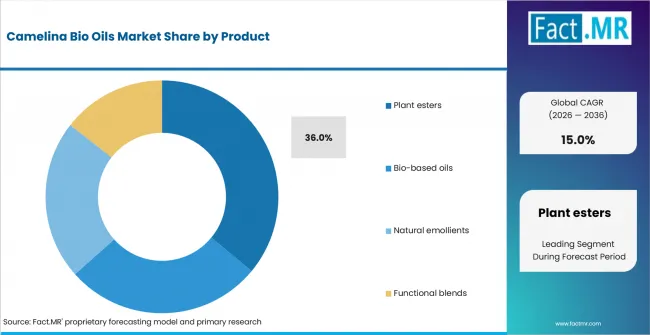
Camelina Bio Oils Market Analysis By Product | Source: Fact.MR
Plant esters lead product demand because they connect camelina oil chemistry to lubricity and base-fluid blending. Bio-based oils serve direct oil use where fatty acid profile supports brand positioning. EIA reported 48 U.S. biodiesel plants with 1,986 MMgal/yr of capacity as of January 1, 2025, documenting the scale of the U.S. biodiesel production base.
What leads the Function segment?
Lubricity is projected to account for 38.0% share in 2026.
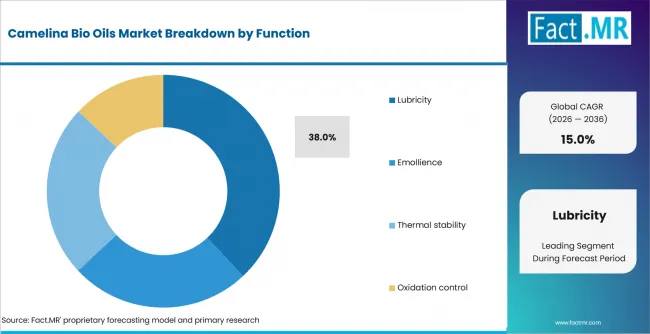
Camelina Bio Oils Market Analysis By Function | Source: Fact.MR
Lubricity leads within function because camelina-derived esters support friction reduction in fuel and specialty fluids. Emollience stays tied to personal-care oils where skin feel and oxidation behavior influence testing. Cargill, Incorporated highlighted winter camelina in January 2025 as part of its winter crop innovation program, noting its potential to provide another source of renewable fuels.
How does Application shape demand?
Personal care is anticipated to capture 35.0% share in 2026.
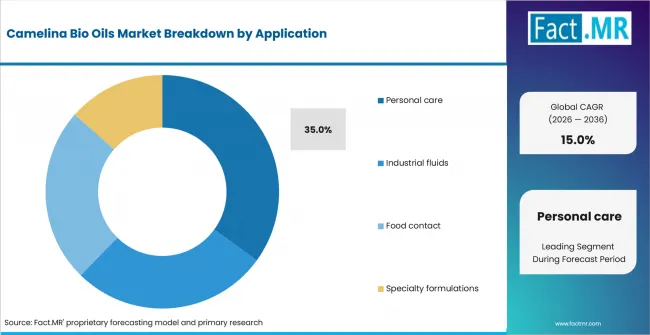
Camelina Bio Oils Market Analysis By Application | Source: Fact.MR
Personal care leads application demand because camelina oil offers a botanical input for creams, hair oils and emollient blends. Industrial fluids use camelina oil where bio-based content and lubricity guide selection. French renewable-energy statistics reported that biodiesel represented 73.0% of national biofuel consumption in 2024, with fatty-acid methyl esters accounting for the majority of biodiesel use.
What supports demand for Liquid within Form?
Liquid is estimated to represent 47.0% share in 2026.
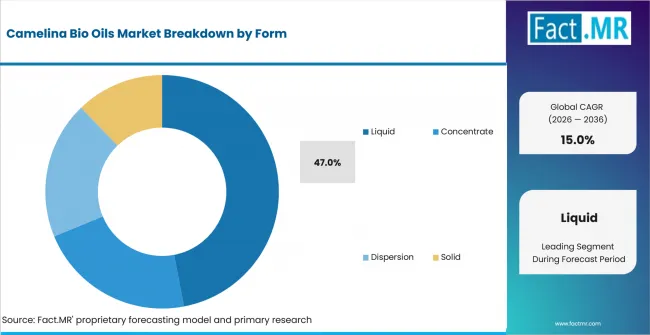
Camelina Bio Oils Market Analysis By Form | Source: Fact.MR
Liquid form holds the central position because processors, blenders and cosmetic formulators can meter it into existing tanks. Concentrates serve customers that want a higher active level for batch dosing. Liquid handling remains the practical route for early commercial volumes in fuel, lubricant and personal-care applications.
What is accelerating Camelina Bio Oils Market adoption, and what is holding it back?
Contracted camelina acreage drives it; feedstock qualification restrains it.
Drivers Impact Analysis
| DRIVER | (~) % IMPACT ON CAGR | GEOGRAPHIC RELEVANCE | IMPACT TIMELINE |
|---|---|---|---|
| Contracted acreage and grower risk tools | +1.8% | USA, Brazil | Short term (<= 2 years) |
| Biofuel feedstock diversification | +1.5% | USA, Brazil, Europe | Medium term (2-4 years) |
| Plant ester use in lubricity formulations | +1.1% | North America, Europe, Japan | Medium term (2-4 years) |
| Botanical oil use in personal care | +0.8% | Europe, Japan, USA | Long term (>= 4 years) |
Source: Fact.MR analysis. Updated Aug 28, 2026
- Contracted acreage and grower risk tools: Camelina bio oils depend on reliable seed availability before processors can commit to larger production volumes. Contract farming, crop-risk support and clearer procurement arrangements can improve supply visibility and strengthen grower participation.
- Biofuel feedstock diversification: Renewable diesel and sustainable aviation fuel programs are creating opportunities for oilseed feedstocks beyond conventional vegetable oils. Camelina suppliers can benefit where they demonstrate suitable conversion pathways, processing performance and dependable feedstock supply.
- Plant ester use in lubricity formulations: Camelina-derived oils and esters can support lubricity and equipment-protection applications where friction reduction and renewable feedstocks are valued. Supplier selection depends on oxidation stability, formulation performance and consistent technical testing against competing vegetable and synthetic esters.
- Botanical oil use in personal care: Camelina oil can support personal-care formulations seeking plant-based oils with distinctive sensory and ingredient-positioning attributes. Wider adoption depends on oxidation control, cosmetic-grade quality, formulation compatibility and dependable specialty-oil supply.
Opportunity Impact Analysis
| OPPORTUNITY | (~) % IMPACT ON CAGR | GEOGRAPHIC RELEVANCE | IMPACT TIMELINE |
|---|---|---|---|
| South American intermediate crop programs | +1.3% | Brazil, Latin America | Medium term (2-4 years) |
| Specialty lubricant ester replacement | +0.9% | Germany, USA, Japan | Long term (>= 4 years) |
| Personal-care emollient sourcing | +0.7% | France, Japan, USA | Short term (<= 2 years) |
Source: Fact.MR analysis. Updated Aug 28, 2026
- South American intermediate crop programs: Camelina can fit between major crop cycles where agronomy, contracting and offtake are coordinated. Brazil offers a practical route for expansion when camelina acreage can use established oilseed handling, crushing and logistics infrastructure.
- Specialty lubricant ester replacement: Industrial-fluid formulators can evaluate camelina-derived esters where lower fossil content, lubricity and equipment protection are important. Adoption is likely to begin in specialized blends that can demonstrate suitable oxidation stability and formulation performance.
- Personal-care emollient sourcing: Cosmetic formulators can use camelina oil in face, hair and body products where traceable sourcing, plant-based positioning and a differentiated sensory profile are valued. Broader adoption depends on consistent refining quality, oxidation control and reliable cosmetic-grade supply.
Restraints Impact Analysis
| RESTRAINT | (~) % IMPACT ON CAGR | GEOGRAPHIC RELEVANCE | IMPACT TIMELINE |
|---|---|---|---|
| Limited crop familiarity | -0.7% | USA, Brazil, Europe | Short term (<= 2 years) |
| Oil-quality and storage proof requirements | -0.5% | Global | Medium term (2-4 years) |
| Competition from rapeseed, sunflower and soybean oils | -0.4% | Europe, North America, Asia | Medium term (2-4 years) |
Source: Fact.MR analysis. Updated Aug 28, 2026
- Limited crop familiarity: Growers often compare camelina with established crops that have familiar agronomic practices, marketing channels and yield expectations. Contract support can improve participation, but local growing knowledge and dependable offtake remain important for acreage expansion.
- Oil-quality and storage proof requirements: Camelina oil must meet defined quality specifications before use in personal-care and industrial-fluid formulations. Seed handling, storage and processing conditions can influence peroxide value, color and oxidation stability, making documented quality control important for buyer approval.
- Competition from rapeseed, sunflower and soybean oils: Established vegetable oils benefit from mature supply chains, refining infrastructure and widespread formulation familiarity. Camelina bio oils therefore need differentiated performance, sourcing or sustainability advantages to justify adoption where lower-cost alternatives are readily available.
Which countries are scaling the Camelina Bio Oils Market through 2036?
- The country comparison spans 3.0 percentage points and forms three practical growth bands across the forecast period.
- The USA remains 0.7 percentage point above Germany as crop insurance access and renewable fuel obligations improve contracting confidence.
- Germany remains 1.1 percentage points above Japan because oilseed processing depth supports technical qualification for plant ester uses.
- Japan remains 0.6 percentage point above France as SAF qualification and biodiesel policy review create selective feedstock demand.
- France remains 0.6 percentage point above Brazil through biodiesel consumption depth and personal-care formulation channels.
- Brazil closes the displayed range as B15 blending and South American camelina programs widen the route from acreage to oil supply.
Comparable CAGRs create different entry conditions because crop insurance, oilseed processing depth, biofuel policy and personal-care formulation channels vary by country. Full report coverage includes North America, Latin America, Western Europe, Eastern Europe, East Asia, South Asia & Pacific, Middle East & Africa.
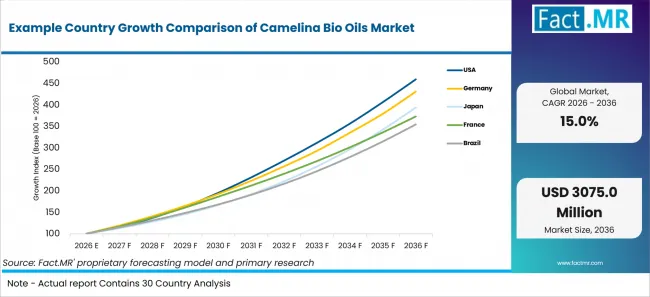
Example Country Growth Comparison Of Camelina Bio Oils Market | Source: Fact.MR
| Country | CAGR |
|---|---|
| USA | 16.5% |
| Germany | 15.8% |
| Japan | 14.7% |
| France | 14.1% |
| Brazil | 13.5% |
Source: Fact.MR analysis. Updated Aug 28, 2026
What supports USA adoption?
16.5% CAGR, supported by crop insurance access and renewable fuel compliance.
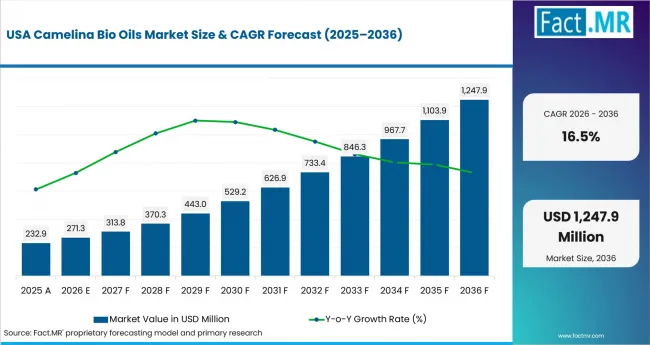
Camelina Bio Oils Market Country Value Analysis | Source: Fact.MR
U.S. camelina demand is expected to build where growers receive clearer risk tools. The USA is projected to record 16.5% CAGR through 2036. EPA set the biomass-based diesel total applicable volume at 9.07 billion RINs for 2026. Combined with expanded crop-insurance access, renewable-fuel obligations can strengthen commercial incentives for contracted oilseed production programs.
What supports Germany’s outlook?
15.8% CAGR, backed by oilseed processing depth and plant ester qualification.
Germany brings established crushing knowledge and buyers that understand oilseed-based ester chemistry. Germany is expected to post 15.8% CAGR through 2036. Destatis reported Germany’s winter rapeseed harvest reached 4.0 million tons in 2025.
How does Japan perform?
14.7% CAGR, led by biodiesel review and SAF qualification.
Japan’s camelina route is tied to selective biofuel qualification and premium formulation channels. Japan is anticipated to advance at 14.7% CAGR through 2036. Cosmo Energy reported that domestic SAF supply began in April 2025 from a facility with annual capacity of about 30,000 kiloliters.
What supports France’s development?
14.1% CAGR, driven by biodiesel consumption and botanical formulation channels.
France links ester fuel use with plant-based ingredient positioning. France is forecast to hold 14.1% CAGR through 2036. Agreste estimated France’s winter rapeseed harvest at 4.2 Mt in 2025.
How is Brazil building demand?
13.5% CAGR, supported by B15 blending and intermediate-crop programs.
Brazil is developing camelina around biofuel blending policy and South American acreage programs. Brazil is estimated to reach 13.5% CAGR through 2036. Brazil’s ANP stated that biodiesel in diesel rose from 14.0% to 15.0% from August 1, 2025.
Who leads the Camelina Bio Oils Market?
Nufarm Limited / Nuseed adds camelina seed-technology capabilities associated with omega-3 and bioenergy applications. Cargill, Incorporated is researching winter camelina as an intermediate crop with potential use as a renewable-fuel feedstock.
Smart Earth Camelina Corp. remains active in camelina as a wholly owned subsidiary of Grapevine Energy Holdings. Bayer acquired Smart Earth Camelina’s camelina germplasm, intellectual property and related materials in January 2025; Smart Earth can therefore be treated as the historical source of those transferred breeding assets rather than their current owner.
Which companies are the key providers?
Key companies include Grapevine Energy Holdings, Nufarm Limited / Nuseed, Cargill, Incorporated, Smart Earth Camelina Corp., and Smart Earth Camelina.
- Grapevine Energy Holdings
- Nufarm Limited / Nuseed
- Cargill, Incorporated
- Smart Earth Camelina Corp.
- Smart Earth Camelina
Bibliography
- U.S. Department of Agriculture, Risk Management Agency. (2025, June 25). PM-25-040: Camelina Pilot Crop Provisions changes effective for the 2026 and succeeding crop years.
- U.S. Environmental Protection Agency. (2026, March 27). Final renewable fuel standards for 2026 and 2027.
- U.S. Energy Information Administration. (2025, September 26). U.S. biodiesel plant production capacity.
- Louis Dreyfus Company. (2025, March 11). Louis Dreyfus Company & Global Clean Energy renew agreement to expand camelina cultivation in South America.
- Nufarm Limited. (2025, November 19). Nufarm announces 2025 full year results.
- Cargill, Incorporated, Incorporated. (2025, January 15). Pioneering the future of agriculture, Cargill, Incorporated wins two BIG Innovation Awards.
- Got, C., & Wellenreiter, S. (2025, September). Chiffres clés des énergies renouvelables – Édition 2025. Service des données et études statistiques.
- Cosmo Oil Co., Ltd., JGC Holdings Corporation, REVO International Inc., & Saffaire Sky Energy LLC. (2025, May 12). Cosmo Oil, JGC, and REVO partner with Tokyo Metropolitan Government on household oil collection for SAF feedstock: Leveraging the World Athletics Championships to promote citizen participation in sustainable aviation.
- Caray, J. (2025, June 17). Grandes cultures. Rebond attendu des productions d’orge et de colza d’hiver grâce à de meilleurs rendements. Agreste.
- Agência Nacional do Petróleo, Gás Natural e Biocombustíveis. (2025, August 21). Revendedores de combustíveis: ANP divulga orientações devido à chegada do E30 e B15.
- Bayer AG. (2025, January 9). Bayer acquires Camelina assets from Smart Earth Camelina Corp. to advance biofuels.
This Report Answers
- The report explains where camelina bio oils are used across product and function. It also covers application and form.
- Segment analysis identifies plant esters, lubricity, personal care and liquid formats as the main demand centers.
- Country analysis examines the USA, Germany, Japan, France and Brazil with the mechanisms shaping adoption.
- Competitive analysis reviews the listed company set while distinguishing current operators from predecessor or historical entities where ownership changed.
- Application analysis assesses how biofuel qualification, personal-care formulation and industrial-fluid testing influence purchase decisions.
What does the Camelina Bio Oils Market cover?
The Camelina Bio Oils Market covers oils derived from Camelina sativa seed and converted into plant esters, bio-based oils, natural emollients and functional blends. It includes direct oil use and formulated oil inputs where camelina identity is central to the product claim or performance case.
The assessment differs from broad vegetable oils because it focuses on camelina-derived oil streams and applications that use the crop’s fatty-acid profile or feedstock story. Commodity edible oils are covered only when they are blended with camelina oil in a defined formulation or transition program.
What is included in the scope?
The scope includes camelina-derived plant esters, refined oils, functional blends and oil concentrates used in fuels, industrial fluids, personal care and food-contact formulations. It connects adjacent demand in vegetable oil processing, specialty fat and oil inputs, and bio lubricant formulations where oil identity and performance records guide selection.
It also covers links with biofuel lubricity additives, liquid biofuels, lubricant ester formulations and bio-based coolants when camelina oil serves as a feedstock or formulation input. Personal-care coverage includes botanical emollient use in creams, oils and hair products. Evaluation extends to oleochemical applications, plant-based skincare products and hydrogenated vegetable oils where the link is a plant-oil input or processing route.
What is excluded from the scope?
The scope excludes raw camelina seed trading when the seed is sold only as an agricultural commodity. General edible oils, crop inputs and unrelated cosmetic ingredients are outside coverage unless camelina-derived oil is part of the stated formulation.
The scope also excludes petroleum lubricants, synthetic base stocks and biofuel facilities when no camelina oil feedstock or camelina-derived ester input is involved. Broad oilseed farming is treated as context, while the market boundary remains the oil and its formulated uses.
How Was the Analysis Built?
The analysis draws on 120+ sources, 35+ company portfolios, 25+ countries, and more than 20 industry interviews.
- Primary Research: Primary research includes discussions with manufacturers, service providers, technology developers, distributors, end users, and subject-matter experts. These conversations examine purchasing priorities, product adoption, operational challenges, approval requirements, competitive positioning, and the factors that influence wider market acceptance.
- Desk Research: Desk research covers government statistics, regulatory publications, company filings, trade data, technical studies, industry associations, standards, public policy, and other authoritative sources. Every source used in the analysis is documented in the bibliography.
- Market Sizing and Forecasting: Market estimates combine historical performance, demand indicators, pricing and volume trends, segment shares, company participation, country-level growth, adoption patterns, investment activity, and barriers to market expansion.
- Data Validation and Update Cycle: Findings are validated by comparing primary interviews with public data, company activity, regulatory changes, trade patterns, and industry developments. Regular updates review new product launches, capacity changes, partnerships, approvals, and shifts in commercial adoption.
Segmentation
What is the report’s scope and coverage?
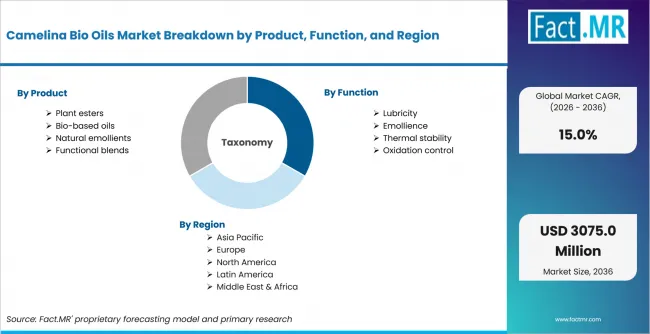
Camelina Bio Oils Market Breakdown By Product, Function, And Region | Source: Fact.MR
| Attribute | Details |
|---|---|
| Quantitative Units | USD million |
| Market Definition | Bio-based oils derived from Camelina sativa seed and processed into plant esters, bio-based oils, natural emollients and functional blends for fuel, industrial-fluid, personal-care, food-contact and specialty formulation uses. |
| Product | Plant esters; Bio-based oils; Natural emollients; Functional blends |
| Function | Lubricity; Emollience; Thermal stability; Oxidation control |
| Application | Personal care; Industrial fluids; Food contact; Specialty formulations |
| Form | Liquid; Concentrate; Dispersion; Solid |
| Regions Covered | North America; Latin America; Western Europe; Eastern Europe; East Asia; South Asia & Pacific; Middle East & Africa |
| Countries Covered | USA; Germany; Japan; France; Brazil |
| Key Companies Profiled | Grapevine Energy Holdings, Nufarm Limited / Nuseed, Cargill, Incorporated, Smart Earth Camelina Corp., and Smart Earth Camelina |
| Forecast Period | 2026 to 2036 |
| Approach | Hybrid top-down and bottom-up approach using crop acreage signals, oilseed processing routes, formulation demand, biofuel policy, country-level growth and provider portfolio review. |
Source: Fact.MR analysis. Updated Aug 28, 2026
How is the market segmented?
-
By Product:
- Plant esters
- Bio-based oils
- Natural emollients
- Functional blends
-
By Function:
- Lubricity
- Emollience
- Thermal stability
- Oxidation control
-
By Application:
- Personal care
- Industrial fluids
- Food contact
- Specialty formulations
-
By Form:
- Liquid
- Concentrate
- Dispersion
- Solid
-
By Region:
- North America
- Latin America
- Western Europe
- Eastern Europe
- East Asia
- South Asia & Pacific
- Middle East & Africa
Frequently Asked Questions
How big is the camelina bio oils market in 2026?
What is the CAGR of the camelina bio oils market from 2026 to 2036?
Which product leads the camelina bio oils market?
Which function leads the camelina bio oils market?
Who are the leading companies in the camelina bio oils market?
Who worked on this report


Preview the report firsthand - request a free sample
Free SampleGet the brochure for pricing and purchase details
Download PDF