- Base Value(2025): 410 Mn
- Estimated Value(2026): 436 Mn
- Forecast Value (2036): 762 Mn
- CAGR (2026 - 2036): 6.4%
Biofuel Lubricity-Boosting Agents Market Forecast 2026 to 2036
In 2025, the biofuel lubricity-boosting agents market was valued at USD 410 million. Based on FMR's analysis, demand for biofuel lubricity-boosting agents is estimated to grow to USD 436 million in 2026 and USD 762 million by 2036. FMR projects a CAGR of 6.4% during the forecast period.
The absolute dollar growth from 2026 to 2036 is USD 326 million. This growth is driven by the increasing demand for biofuels and the need for additives that improve lubricity and reduce wear in engines using bio-based fuels. However, the market faces challenges such as fluctuations in biofuel prices and regulatory constraints regarding the use of certain additives.
Brazil leads with a CAGR of 7.8%, driven by its strong biofuel industry and commitment to sustainable energy solutions. China follows with a 6.7% CAGR, fueled by its increasing biofuel production and the demand for lubricity-enhancing additives. The USA grows at 6.2%, supported by expanding biofuel usage in transportation and industrial sectors. South Korea grows at 6.1%, driven by rising biofuel adoption in both automotive and industrial applications. Germany, with a 6.1% CAGR, benefits from increasing focus on green technologies and sustainable energy. The United Kingdom and Europe show similar growth rates of 6.0%, driven by stricter environmental regulations and increasing biofuel adoption. Japan experiences slower growth at 5.4%, influenced by a more mature market and limited biofuel use compared to other regions.
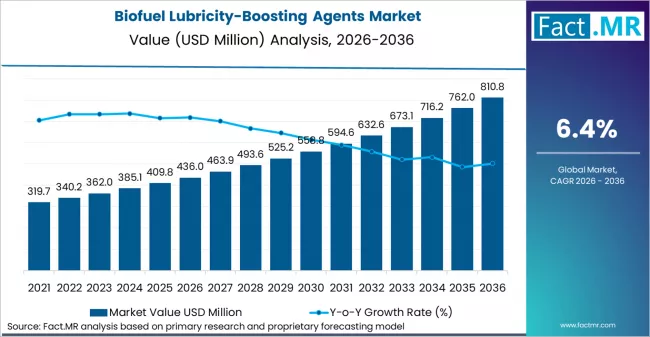
Biofuel Lubricity Boosting Agents Market Market Value Analysis | Source: Fact.MR
Biofuel Lubricity‑Boosting Agents Market Definition
The Biofuel Lubricity‑Boosting Agents Market refers to the production and sale of additives specifically formulated to improve the lubricating properties of biofuels such as biodiesel and ethanol blends. Biofuels often have lower natural lubricity than petroleum diesel, which can increase wear in fuel pumps and injectors. These agents reduce friction and wear, helping protect engine components and extend service life. Key end uses include road transport fleets, off‑highway equipment, marine engines, and power generation units that operate on biofuel blends requiring enhanced lubrication.
Market Inclusions
This report covers global and regional market sizes for biofuel lubricity‑boosting agents with a defined forecast period. It includes segment breakdowns by agent type (esters, fatty acids, synthetic additives), fuel type (biodiesel, ethanol blends, renewable diesel), and end use (transport, agriculture, marine, power generation). Pricing trends, raw material supply, and trade flow data are also analyzed to capture overall market dynamics.
Market Exclusions
The scope excludes unrelated fuel additives such as detergents, corrosion inhibitors, and cetane improvers not intended for lubricity enhancement. Finished biofuels and complete engine fuel systems are not covered. Niche lubrication technologies used exclusively in non‑fuel applications, such as industrial gear oils or greases, are omitted to focus strictly on biofuel lubricity agents.
Research Methodology
Primary Research: Interviews were conducted with formulation chemists, additive suppliers, and fuel producers.
Desk Research: Data was sourced from industry reports, regulatory filings, and trade association publications.
Market‑Sizing and Forecasting: A hybrid model was used, combining top‑down fuel additive demand with bottom‑up shipment and revenue estimates.
Data Validation and Update Cycle: Findings were validated through expert review and aligned with recent production and trade figures, with periodic updates.
Biofuel Lubricity-Boosting Agents Market Summary
Biofuel Lubricity-Boosting Agents Market Definition
The Biofuel Lubricity-Boosting Agents Market refers to the production and sale of additives formulated to improve the lubricating properties of biofuels such as biodiesel, ethanol blends, and renewable diesel. Biofuels, compared to petroleum-based diesel, often exhibit lower natural lubricity, which can result in increased friction and wear on fuel pumps and injectors. Lubricity-boosting agents reduce these issues, improving engine performance, extending component life, and ensuring smooth operation. Key end uses include road transport fleets, off-highway equipment, marine engines, and power generation units, all relying on biofuel blends for enhanced lubrication.
Demand Drivers in the Market
- Growing Biofuel Adoption: Increased demand for biofuels, particularly biodiesel blends and renewable diesel, is fueling the need for lubricity-boosting additives to meet performance standards.
- Regulatory Pressure: Tightening regulations on fuel quality and emissions are encouraging the use of lubricity-boosting agents to comply with standards such as EN 590 and ASTM D975.
- Need for Engine Protection: As biofuels grow in popularity, engine wear protection becomes a key focus, with lubricity-enhancing agents playing a critical role in preserving fuel system life.
- Sustainability Focus: The transition to renewable energy and biofuels emphasizes the need for performance-enhancing additives that do not compromise environmental goals, driving demand for lubricity agents in the biofuel market.
Key Segments Analyzed in the FMR Report
- Additive Chemistry: Fatty Acid Esters are expected to dominate, driven by their proven effectiveness in enhancing biofuel lubricity, particularly in biodiesel blends (FAME).
- Fuel Type: Biodiesel Blends (FAME) will capture 47% of the market by 2026, as the most common biofuel blend, requiring lubricity-boosting agents to optimize engine performance and reduce wear.
- Additive Injection Point: Refinery/Terminal Injection will account for 51% of the market by 2026 due to its efficiency in incorporating lubricity-enhancing agents directly during the biofuel production process.
Analyst Opinion at FMR
Fact MR analysts predict that "The biofuel lubricity-boosting agents market will continue to expand due to the increasing adoption of biofuels in the transportation and industrial sectors, alongside regulatory pressures to ensure fuel performance and reduce emissions. The ongoing shift toward renewable fuels presents a significant opportunity for lubricity-enhancing additives."
Strategic Implications/Executive Takeaways
- Focus on Advanced Additives: Manufacturers should develop multifunctional lubricity-boosting agents that not only enhance fuel performance but also comply with stringent regulatory standards.
- Target Growing Biofuel Markets: Regions with strong biofuel mandates, like Brazil and the EU, present high growth opportunities for lubricity-boosting agent suppliers.
- Sustainability Integration: There is a growing demand for eco-friendly lubricity solutions that align with renewable energy initiatives and sustainability goals.
Methodology
- Primary Research: Interviews with formulation chemists, fuel producers, and suppliers provided insights into market needs and technological developments.
- Desk Research: Data was collected from industry reports, regulatory filings, and trade publications to identify market trends and dynamics.
- Market Sizing and Forecasting: A hybrid approach combining top-down fuel demand with bottom-up shipment and revenue data was used to estimate market growth over the forecast period.
Segmental Analysis
Biofuel Lubricity-Boosting Agents Market Analysis by Additive Injection Point
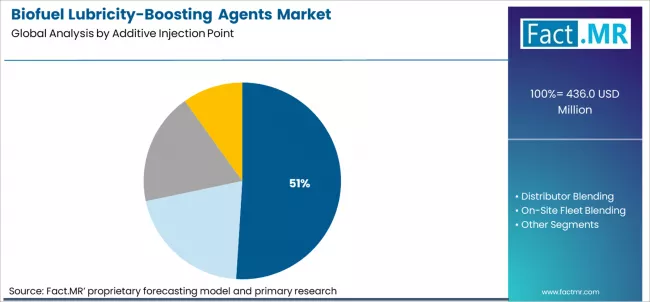
Biofuel Lubricity Boosting Agents Market Analysis By Additive Injection Point | Source: Fact.MR
- Market Overview: Additive injection at the point of biodiesel fuel production is expected to hold 51% of the biofuel lubricity-boosting agents market by 2026. Adding lubricity-boosting agents during the biofuel production process ensures that the fuel maintains optimal lubrication properties right from the production phase, offering benefits such as smoother engine performance and extended engine life.
- Demand Drivers:
- Integration During Production: Injecting lubricity-boosting agents directly at the point of biofuel production ensures uniform distribution and consistent performance in the final fuel. This method is highly effective for biofuels, especially biodiesel, which often faces issues with friction and wear due to low lubricity.
- Regulatory and Performance Standards: As fuel quality regulations tighten and performance expectations increase, biofuel producers are increasingly turning to lubricity-boosting agents to meet industry standards, ensuring their products are compatible with modern engine technologies.
- Cost and Efficiency: This injection method is cost-effective and efficient for large-scale biofuel producers, streamlining the production process and improving the overall performance of the final fuel product.
Biofuel Lubricity-Boosting Agents Market Analysis by Fuel Type
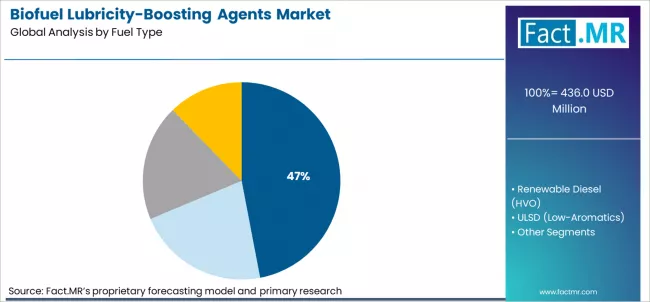
Biofuel Lubricity Boosting Agents Market Analysis By Fuel Type | Source: Fact.MR
- Market Overview: Biodiesel blends (FAME) are expected to capture 47% of the biofuel lubricity-boosting agents market by 2026. FAME (Fatty Acid Methyl Esters) is a popular type of biodiesel that often requires lubricity-boosting agents to improve its lubricating properties, particularly when used in higher blends with petroleum diesel.
- Demand Drivers:
- Lubricity Enhancement for Biodiesel Blends: Biodiesel, especially in higher blends (B20, B30, etc.), has a tendency to cause increased engine wear and friction due to its lower lubricity compared to traditional diesel. Lubricity-boosting agents are essential for improving the fuel’s performance and reducing engine damage.
- Shift Toward Sustainable Fuels: With the growing adoption of biodiesel as part of renewable energy initiatives, the demand for lubricity-boosting agents to ensure fuel reliability and engine longevity is increasing. Biodiesel blends are gaining popularity in both commercial and residential fleets, further driving this need.
- Economic and Environmental Benefits: Biodiesel’s environmental benefits, such as reduced carbon emissions, make it a preferred choice for many. To maintain these benefits without sacrificing performance, lubricity-boosting agents are necessary to optimize the fuel’s compatibility with modern diesel engines.
Biofuel Lubricity Boosting Agents Market Drivers, Restraints, and Opportunities
FMR analysts observe that the biofuel lubricity‑boosting agents market is a growth‑aligned compliance segment driven by the widespread shift from fossil diesel toward biodiesel, renewable diesel, and ethanol blends. Historically, conventional diesel provided inherent lubrication, but many biofuel blends lack sufficient natural lubricity, creating structural demand for additives that protect fuel pumps and injectors. The 2026 valuation reflects this regulatory and performance imperative, especially where fuel quality standards require minimum lubricity levels to avoid wear and preserve engine life.
While demand for basic diesel lubricity components declines with lower fossil content, advanced bio‑based and multifunctional agents are gaining share because they meet stricter specification requirements in modern engines. These advanced agents carry higher per‑unit pricing, contributing to net value growth even as volumes fluctuate with fuel blend adoption rates. The market exists at its current size because fuel suppliers and OEMs must meet regulatory and manufacturer minimum lubricity thresholds, anchoring demand across global transport and machinery fleets.
- Fuel Quality Compliance: Regulations such as EN 590 and ASTM D975 set minimum lubricity (HFRR) standards for diesel and biodiesel blends, forcing use of additives in low‑lubricity biofuels to meet defined criteria.
- Engine Protection Demand: As biofuel blends increase in heavy‑duty and passenger fleets, lubricity‑boosting agents replace natural diesel lubrication to reduce wear and extend fuel system life.
- Regional Biofuel Dynamics: In Europe and Brazil, where high biofuel blend mandates exist, demand for lubricity‑boosting additives is stronger, while in regions with slower blend adoption cost remains more influential.
Regional Analysis
The market analysis covers key global regions, including North America, East Asia, South Korea, Western Europe, Latin America, and Germany. It is segmented geographically, with specific market dynamics for each region. The full report provides a detailed market attractiveness analysis.
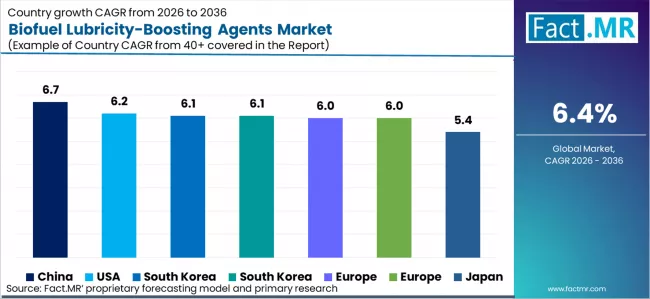
Biofuel Lubricity Boosting Agents Market Cagr Analysis By Country | Source: Fact.MR
| Country | CAGR (2026-2036) |
|---|---|
| USA | 6.2% |
| Japan | 5.4% |
| South Korea | 6.1% |
| Europe | 6.0% |
| Germany | 6.1% |
| China | 6.7% |
| United Kingdom | 6.0% |
| Brazil | 7.8% |
Source: Fact.MR analysis. Updated Feb 18, 2026
Source: Fact MR (FMR) analysis, based on proprietary forecasting model and primary research.
North America:
North America, particularly the USA, plays a "key role in driving demand" for biofuel lubricity-boosting agents, supported by regulations and the growing shift toward biofuels in the transportation and industrial sectors.
- USA: Demand for biofuel lubricity-boosting agents in the U.S. is projected to rise at 6.2% CAGR through 2036. Regulatory support for biofuels and the increasing adoption of biofuel technologies in the transportation sector continue to fuel market growth.
East Asia:
East Asia, especially China, remains a "major market for biofuel lubricity-boosting agents" due to the growing demand for biofuels in transportation and industrial applications.
- China: Demand for biofuel lubricity-boosting agents in China is projected to rise at 6.7% CAGR through 2036. China’s strong push towards biofuel adoption and rapid growth in the transportation sector continue to drive demand for lubricity-enhancing additives.
- Japan: Demand for biofuel lubricity-boosting agents in Japan is projected to rise at 5.4% CAGR through 2036. Japan’s commitment to biofuels and its focus on renewable energy sources contribute to steady growth in this market.
South Korea:
South Korea remains a "growing market" for biofuel lubricity-boosting agents, driven by government policies encouraging renewable fuels and the country’s expanding biofuel production.
- South Korea: Demand for biofuel lubricity-boosting agents in South Korea is projected to rise at 6.1% CAGR through 2036. Government initiatives to reduce emissions and adoption of biofuels in transportation continue to drive the demand for lubricity-boosting additives.
Western Europe:
Europe is a "mature market" for biofuel lubricity-boosting agents, with countries like Germany and the UK leading the way due to stringent environmental regulations and widespread biofuel use in transportation.
- Germany: Demand for biofuel lubricity-boosting agents in Germany is projected to rise at 6.1% CAGR through 2036. Germany’s commitment to biofuels and environmental sustainability policies support the growing demand for lubricity-boosting agents in biofuels.
- United Kingdom: Demand for biofuel lubricity-boosting agents in the UK is projected to rise at 6.0% CAGR through 2036. The UK’s renewable energy focus and government regulations to improve fuel quality continue to contribute to market growth.
Latin America:
In Latin America, particularly in Brazil, the demand for biofuel lubricity-boosting agents is growing due to Brazil's significant biofuel production and use.
- Brazil: Demand for biofuel lubricity-boosting agents in Brazil is projected to rise at 7.8% CAGR through 2036. Brazil’s leadership in biofuel production, along with government support for biofuel use in transportation, drives strong market growth.
Fact MR's analysis of the Biofuel Lubricity-Boosting Agents Market in North America, East Asia, South Korea, Western Europe, Latin America, and Germany consists of country-wise assessments that include the USA, Japan, South Korea, Germany, China, the United Kingdom, and Brazil. Readers can find detailed trends, regulatory updates, and company-specific investments shaping the market’s growth in these countries.
How Are Key Players Competing in the Biofuel Lubricity-Boosting Agents Market?
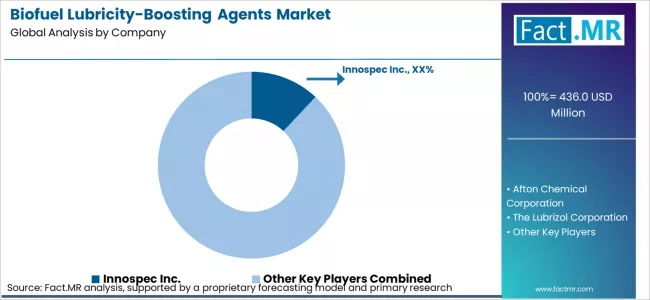
Biofuel Lubricity Boosting Agents Market Analysis By Company | Source: Fact.MR
The biofuel lubricity-boosting agents market is witnessing significant competition as companies focus on enhancing the performance of biofuels, particularly with the shift toward sustainable energy. Innospec Inc. and Afton Chemical Corporation are leading with innovative additives that improve the lubricity and stability of biofuels, addressing the demand for cleaner energy solutions. The Lubrizol Corporation and Infineum International Limited are advancing their additive technologies to ensure compatibility with various biofuel formulations, improving engine efficiency and reducing wear. BASF SE and Evonik Operations GmbH are leveraging their chemical expertise to develop high-performance agents that optimize fuel properties, promoting engine longevity. Clariant AG and Croda International Plc are focusing on eco-friendly solutions, while Dorf Ketal Chemicals and Chevron Oronite Company LLC aim to expand their product lines to meet the growing demand in emerging biofuel markets. These companies are concentrating on eco-efficient products to meet environmental and regulatory standards in the rapidly evolving biofuels sector.
Recent Industry Developments
- BASF launched a new multifunctional fuel additive production facility at its Shanghai Pudong site to secure the local supply of lubricity improvers and performance agents for the rapidly expanding Asian biofuel market. [1]
- In September 2025, Afton Chemical introduced HiTEC® 12582, the world’s first commercially available dedicated additive series designed to address the specific lubricity, water handling, and corrosion challenges of hydrogen-combustion and high-blend renewable engines. [2]
- The European Union’s Renewable Energy Directive (RED III), which entered national implementation phases in January 2026, legally mandated higher greenhouse gas reduction quotas that have eliminated double-counting for advanced feedstocks, forcing a surge in physical biofuel blending and a corresponding demand for standardized lubricity additives. [3]
Key Players of the Biofuel Lubricity-Boosting Agents Market
- Innospec Inc.
- Afton Chemical Corporation
- The Lubrizol Corporation
- Infineum International Limited
- BASF SE
- Evonik Operations GmbH (Oil Additives business)
- Clariant AG
- Croda International Plc
- Dorf Ketal Chemicals India Private Limited
- Chevron Oronite Company LLC
Report Scope
| Metric | Value |
|---|---|
| Quantitative Units | USD 436 million (2026) to USD 762 million (2036), at a CAGR of 6.4% |
| Market Definition | The Biofuel Lubricity-Boosting Agents Market includes additives designed to improve the lubricity of biofuels, ensuring smooth engine operation and reducing wear, particularly in biodiesel and renewable diesel applications. |
| By Additive Chemistry | Fatty Acid Esters, Glycerides / Monoesters, Amide-Based Friction Modifiers, Polymeric Lubricity Improvers |
| By Fuel Type | Biodiesel Blends (FAME), Renewable Diesel (HVO), ULSD (Low-Aromatics), Other Middle Distillates |
| By Additive Injection Point | Refinery / Terminal Injection, Distributor Blending, On-Site Fleet Blending, Pipeline Injection |
| By End User | Oil Majors / Refiners, Fuel Marketers, Transport Fleets, Marine / Off-Road Suppliers |
| Regions Covered | North America, Latin America, Europe, East Asia, South Asia, Oceania, Middle East and Africa |
| Countries Covered | United States, Canada, Mexico, Brazil, Argentina, Germany, France, United Kingdom, Italy, Spain, China, India, Japan, South Korea, Indonesia, Australia, and 40+ countries |
| Key Companies Profiled | Innospec Inc., Afton Chemical Corporation, The Lubrizol Corporation, Infineum International Limited, BASF SE, Evonik Operations GmbH (Oil Additives business), Clariant AG, Croda International Plc, Dorf Ketal Chemicals India Private Limited, Chevron Oronite Company LLC |
| Forecast Period | 2026 to 2036 |
| Approach | Hybrid top-down and bottom-up market modeling validated through primary interviews with manufacturers and supported by trade data benchmarking and market research. |
Source: Fact.MR analysis. Updated Feb 18, 2026
Bibliographies
- BASF Launch of Multifunctional Fuel Additive Production Facility in Shanghai: BASF. (2025). BASF launches new multifunctional fuel additive production facility at its Shanghai Pudong site. BASF News. [1]
- Afton Chemical Launch of HiTEC® 12582 Additive Series: Afton Chemical. (2025, September). Afton Chemical introduces HiTEC® 12582 for hydrogen-combustion and renewable engines. Afton Chemical. [2]
- EU Renewable Energy Directive (RED III) Implementation: Argus Media. (2026). EU RED III implementation and its impact on biofuel blending and lubricity additives. Argus Media. [3]
Segmentation
Biofuel Lubricity-Boosting Agents Market Key Segments
-
By Additive Chemistry :
- Fatty Acid Esters
- Glycerides / Monoesters
- Amide-Based Friction Modifiers
- Polymeric Lubricity Improvers
-
By Fuel Type :
- Biodiesel Blends (FAME)
- Renewable Diesel (HVO)
- ULSD (Low-Aromatics)
- Other Middle Distillates
-
By Additive Injection Point :
- Refinery / Terminal Injection
- Distributor Blending
- On-Site Fleet Blending
- Pipeline Injection
-
By End User :
- Oil Majors / Refiners
- Fuel Marketers
- Transport Fleets
- Marine / Off-Road Suppliers
-
Region :
- North America
- USA
- Canada
- Mexico
- Europe
- Germany
- UK
- France
- Italy
- Spain
- Nordic Countries
- BENELUX
- Rest of Europe
- Asia Pacific
- China
- Japan
- South Korea
- India
- Australia
- Rest of Asia Pacific
- Latin America
- Brazil
- Argentina
- Rest of Latin America
- Middle East and Africa
- Kingdom of Saudi Arabia
- United Arab Emirates
- South Africa
- Rest of Middle East and Africa
- Other Regions
- Oceania
- Central Asia
- Other Markets
- North America
Frequently Asked Questions
How large is the demand for Biofuel Lubricity-Boosting Agents in the global market in 2026?
What will be the market size of Biofuel Lubricity-Boosting Agents in the global market by 2036?
What is the expected demand growth for Biofuel Lubricity-Boosting Agents in the global market between 2026 and 2036?
Which additive injection point is expected to dominate the market?
Which region is expected to show the highest growth rate for Biofuel Lubricity-Boosting Agents?
How significant is the growth outlook for China in this market?
What is the growth outlook for the United States in this report?
What is the growth forecast for Germany in the Biofuel Lubricity-Boosting Agents market?
What is the growth forecast for South Korea in the Biofuel Lubricity-Boosting Agents market?
Which company is identified as a leading player in the Biofuel Lubricity-Boosting Agents market?
What are Biofuel Lubricity-Boosting Agents used for?
What does the Biofuel Lubricity-Boosting Agents market include in this report?
How is the market forecast developed in this report?
What is meant by the Biofuel Lubricity-Boosting Agents market in this report?
Who worked on this report


Preview the report firsthand - request a free sample
Free SampleGet the brochure for pricing and purchase details
Download PDF