- Market Value (2025): USD 8.1 Bn
- Estimated Value (2026): USD 8.6 Bn
- Forecast Value (2036): USD 14.8 Bn
- CAGR (2026-2036): 5.6%
What is the Campus Development Services Market forecast to be worth by 2036?
USD 8.6 billion in 2026 to USD 14.8 billion by 2036 at a 5.6% CAGR.
- 2025 market value: USD 8.1 billion.
- 2026 to 2036 market progression: USD 8.6 billion to USD 14.8 billion.
- Forecast CAGR, 2026 to 2036: 5.6%.
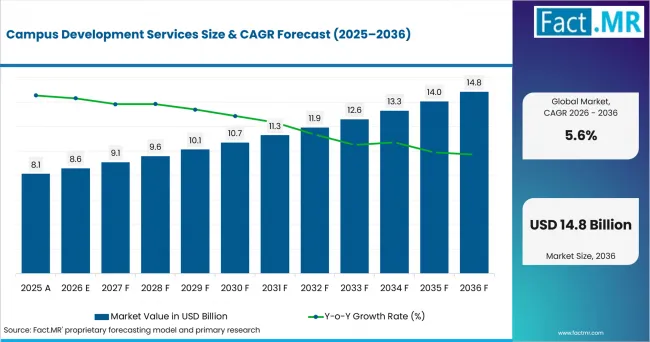
Campus Development Services Value Analysis | Source: Fact.MR
What are the defining numbers behind Campus Development Services Market growth?
Between 2026 and 2036, the market adds USD 6.2 billion in absolute opportunity. A campus rarely changes through one isolated project. Owners have to decide how new buildings fit with existing utilities, how space should be reused, and which projects should receive capital first. That estate-wide coordination keeps planning and development advisers involved across several investment cycles.
- Demand Drivers in the Market
- Higher-education systems continue to place more demand on physical estates. UNESCO IESALC reported 269 million higher-education students worldwide in 2024. When institutions accommodate more teaching, research and student activity, they need additional space or have to make existing campuses work harder. Both routes create planning assignments before construction begins.
- Energy performance is now part of the capital decision rather than a separate facilities issue. UNEP reported in 2026 that half of the buildings expected to exist in 2050 are still to be built or renovated, while the IEA continues to treat retrofit activity as an important efficiency measure in advanced economies. Campus owners therefore need to compare reuse, retrofit and replacement options before allocating capital.
- The size of institutional estates creates another source of demand. The U.S. Department of Energy estimates that higher education occupies about 5 billion square feet in the United States. In the UK, HESA tracks estate condition and capital expenditure across providers. Once an estate reaches this scale, planning has to work across buildings and infrastructure instead of treating each asset as a separate decision.
- Campus development overlaps with architectural services, but the buyer is paying for coordination across an estate rather than a single building design. The mandate connects multiple assets and project phases under one campus-level plan.
- Key Segments Analyzed
- Service: Master planning holds 26.0% in 2026. It gives owners the land-use and infrastructure framework needed before individual projects can be released in sequence.
- Campus Type: Higher education accounts for 34.0% in 2026. Universities combine academic space with research facilities and student uses, all of which depend on shared campus infrastructure.
- Project Scope: New campus development represents 31.0% in 2026. Starting from an undeveloped site creates an early need to coordinate access, utilities and the location of future buildings.
- Commercial Model: Design-bid-build advisory accounts for 28.0% in 2026. Institutional clients often want to retain direct control over the design brief before opening construction to competitive bids.
- Analyst Opinion at Fact.MR
- “A campus plan earns its value before the first major construction package is awarded. Owners have to decide which assets deserve investment, where reuse is practical, and how utility capacity should be staged. Advisers that can turn those choices into a workable capital sequence are more useful than firms that approach each building as a standalone commission.”
- Shambhu Nath Jha, Senior Consultant, Fact.MR
- Strategic Implications
- For campus owners, the first discipline is sequencing. Approving buildings one at a time can create avoidable utility work or lock land into uses that later constrain the estate. A portfolio plan gives each project a place in the longer capital program.
- The handover should be designed while the project is still being planned. Asset records and commissioning information need to arrive in a form that can feed directly into facility management after occupancy, instead of forcing the owner to rebuild the information base later.
- Decarbonization works better when it is built into the estate sequence. Comparing reuse with retrofit or replacement can support a wider net-zero retrofit program and prevent an energy project from conflicting with a later redevelopment decision.
How does the Campus Development Services Market break down by segment?
The market is segmented by Service, Campus Type, Project Scope and Commercial Model.
Why does Master planning lead Service?
Master planning accounts for 26.0% of Service in 2026.
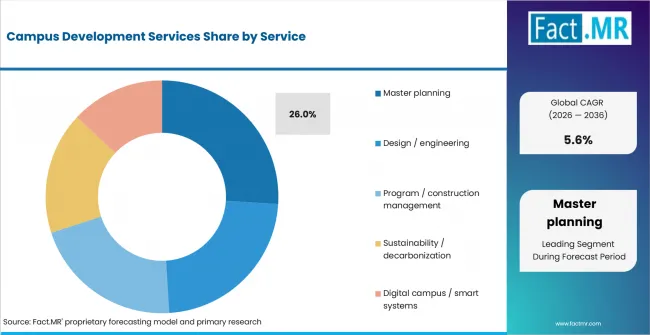
Campus Development Services Analysis By Service | Source: Fact.MR
It is commissioned before most individual building packages because owners need an agreed view of land use and infrastructure capacity. It also sets the order in which development can proceed without creating conflicts across the estate.
Jacobs describes higher-education master planning as a way to connect long-term institutional goals with the physical campus. WSP uses the same process to bring transport and sustainability requirements into one development framework. For a buyer, the practical benefit is fewer downstream changes caused by decisions that were made building by building.
The plan also becomes a reference point for later commissions. Design teams and program managers can work from the same assumptions about phasing and infrastructure instead of reopening the estate strategy every time a new project starts.
Why does Higher education lead Campus Type?
Higher education accounts for 34.0% of Campus Type in 2026.
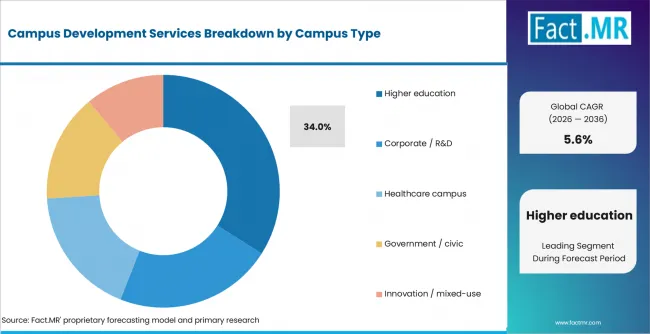
Campus Development Services Analysis By Campus Type | Source: Fact.MR
Universities are unusual estates because teaching space sits beside research facilities and student accommodation, while much of the infrastructure is shared. A change in one part of the campus can therefore affect several other capital priorities.
UNESCO IESALC reported 269 million higher-education students worldwide in 2024. In the United States alone, the Department of Energy estimates that colleges and universities occupy about 5 billion square feet. That combination of scale and changing academic requirements creates recurring work around space use and renewal planning.
A campus program can include specialist packages such as laboratories or interior design. The development-services fee, however, is tied to the estate-level work that decides how those packages fit together and when they should be delivered.
Why does New campus development lead Project Scope?
New campus development accounts for 31.0% of Project Scope in 2026.
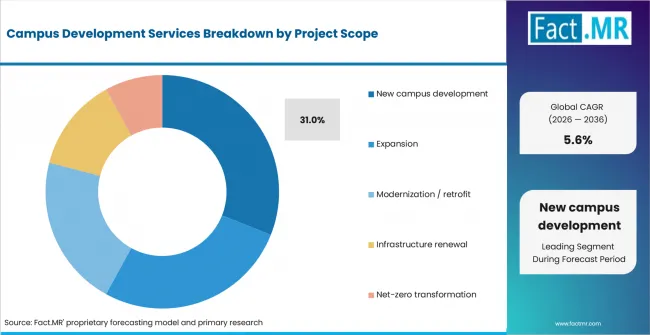
Campus Development Services Analysis By Project Scope | Source: Fact.MR
On a new site, the service brief begins before detailed building design. Access and utility corridors have to be settled early so that the first phase does not restrict later expansion.
This makes the front end of a new campus unusually service-intensive. Planners have to define how the site will grow and what infrastructure must be installed in advance. Engineering advice is often needed before an individual building has reached detailed design.
Modernization work can be spread across many smaller packages. A new campus is different because the owner usually needs one development framework that can carry the project from feasibility into delivery governance.
Why does Design-bid-build advisory lead Commercial Model?
Design-bid-build advisory accounts for 28.0% of Commercial Model in 2026.
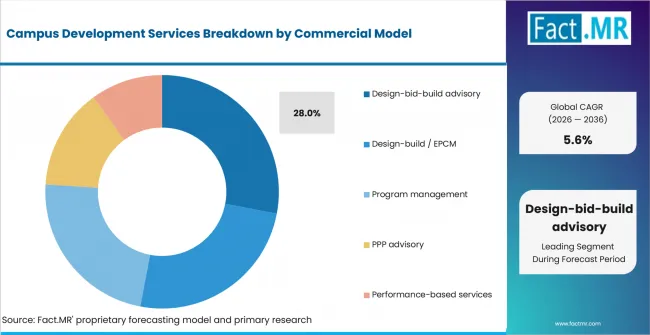
Campus Development Services Analysis By Commercial Model | Source: Fact.MR
The owner keeps the design and advisory relationship separate from the construction contract. That separation is useful when an institution wants to settle scope and cost expectations before contractors compete for the work.
Campus projects often pass through internal governance and funding approvals before construction can begin. An independent adviser can refine the brief during that period and test whether the proposed phasing still fits the budget.
Integrated EPC services suit selected campus packages. Design-bid-build advisory remains useful where the owner wants to retain control of the brief and preserve competitive construction procurement.
What is accelerating Campus Development Services Market adoption, and what is holding it back?
Campus renewal and research expansion are creating steady demand for development advice. Decarbonization adds another layer because energy upgrades have to be coordinated with building condition and future space needs. The common requirement is an estate plan that can guide several projects, not a single design commission.
Funding is the main counterweight. Institutional budgets can move slowly, approvals may take several cycles, and occupied campuses cannot tolerate unlimited disruption. Construction-cost changes can also force a project back into scope review. Plans that can be phased without losing their overall logic are therefore easier for owners to keep alive.
Drivers Impact Analysis
| DRIVER | (~) % IMPACT ON CAGR | GEOGRAPHIC RELEVANCE | IMPACT TIMELINE |
|---|---|---|---|
| Higher-education and research capital programs | +1.4% | USA; UK; Saudi Arabia; France; Germany | 2026-2036 |
| Campus decarbonization and energy-performance upgrades | +1.0% | USA; UK; France; Germany | 2026-2036 |
| Multi-building master planning and infrastructure sequencing | +0.8% | USA; UK; Saudi Arabia; France; Germany | 2026-2034 |
Source: Fact.MR analysis. Updated Sep 9, 2026
Opportunity Impact Analysis
| OPPORTUNITY | (~) % IMPACT ON CAGR | GEOGRAPHIC RELEVANCE | IMPACT TIMELINE |
|---|---|---|---|
| Digital campus and smart-system integration | +0.7% | Saudi Arabia; USA; UK; Germany | 2026-2035 |
| PPP and alternative delivery advisory | +0.5% | UK; France; Saudi Arabia; USA | 2027-2036 |
| Corporate, R&D and healthcare campus expansion | +0.6% | USA; Saudi Arabia; Germany; France | 2026-2036 |
Source: Fact.MR analysis. Updated Sep 9, 2026
Restraints Impact Analysis
| RESTRAINT | (~) % IMPACT ON CAGR | GEOGRAPHIC RELEVANCE | IMPACT TIMELINE |
|---|---|---|---|
| Capital-budget pressure and project deferrals | -0.9% | USA; UK; France; Germany | 2026-2031 |
| Lengthy approvals and institutional procurement cycles | -0.6% | France; Germany; UK; USA | 2026-2034 |
| Construction-cost volatility and scope reprioritization | -0.5% | USA; Europe; Saudi Arabia | 2026-2030 |
Source: Fact.MR analysis. Updated Sep 9, 2026
Which countries are scaling the Campus Development Services Market through 2036?
- USA: Public educational construction was running at a seasonally adjusted annual rate of USD 113.1 billion in June 2026, according to the U.S. Census Bureau. The U.S. Department of Energy also points to a very large higher-education building footprint. Together, those conditions support repeat demand for estate planning and modernization advice before capital projects move into delivery.
- UK: Universities work with unusually detailed estate information. HESA publishes data on building condition and capital expenditure across higher-education providers. That visibility helps institutions identify where renewal is necessary, but it also makes prioritization more disciplined when budgets are tight.
- Saudi Arabia: Universities are being used as part of the Kingdom's research and innovation agenda. The Ministry of Education highlighted expansion of research centers and greater use of digital technology in 2025. As specialized facilities are added, campus planning has to account for laboratory needs and the digital infrastructure that supports them.
- France: Higher-education estate management is closely tied to public oversight. The Ministry of Higher Education and Research monitors real-estate conditions across roughly 140 institutions and continues to track major Campus operations. This creates a formal planning environment for renovation and other long-duration campus programs.
- Germany: The pressure comes from an aging university estate and slow project cycles. In July 2026, the German Science and Humanities Council said renovation backlogs remain visible and noted that some projects can take up to 15 years. That makes early project definition and disciplined phasing especially valuable.
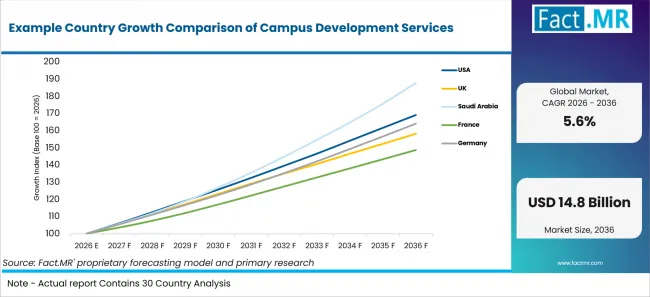
Example Country Growth Comparison Of Campus Development Services | Source: Fact.MR
Country CAGR (2026-2036)
| Country | CAGR (2026-2036) |
|---|---|
| USA | 5.4% |
| UK | 4.7% |
| Saudi Arabia | 6.5% |
| France | 4.1% |
| Germany | 5.1% |
Source: Fact.MR analysis. Updated Sep 9, 2026
What is driving USA's growth through 2036?
A 5.4% CAGR is projected for the USA from 2026 to 2036.
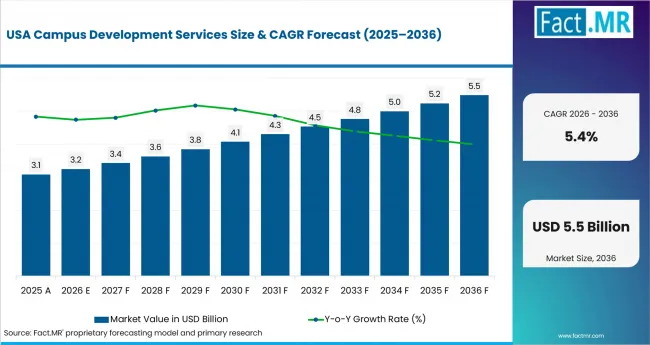
Campus Development Services Country Value Analysis | Source: Fact.MR
The U.S. Department of Energy estimates that colleges and universities occupy about 5 billion square feet. At that scale, renewal decisions can affect teaching space, research buildings and shared utility systems at the same time, so institutions often need a campus-wide capital sequence before individual projects are approved.
DOE's Better Buildings program gives higher education a dedicated pathway for improving energy and water performance. On an occupied campus, those upgrades have to be staged around academic schedules and research continuity. Development advisers help translate performance targets into projects that can be delivered without disrupting the wider estate.
What is driving UK's growth through 2036?
The UK is projected to grow at a 4.7% CAGR from 2026 to 2036.
In July 2026, the Office for Students opened its 2026-27 capital-grant process, with providers required to submit competitive project bids by 4 September. That process pushes institutions to define scope and investment cases before capital is released, creating demand for front-end planning and cost advice.
HESA's published estate and capital-expenditure statistics give providers a consistent view of asset condition and spending over time. That evidence helps campus teams separate urgent renewal from work that can be phased later, which supports portfolio-level advisory mandates rather than isolated building studies.
What is driving Saudi Arabia's growth through 2036?
Saudi Arabia is projected to record a 6.5% CAGR between 2026 and 2036.
The Research Development and Innovation Authority reported in April 2025 that the Kingdom had more than 1,000 research laboratories across 30 universities and research centers. A research estate of that scale requires institutions to plan specialist space, utilities and shared infrastructure before expansion projects are released.
RDIA's open-access platform connects researchers with infrastructure across universities and research centers nationwide. As institutions make more facilities available across organizational boundaries, campus planning has to account for how laboratories are accessed, supported and expanded. That increases the value of advisers who can coordinate research requirements with estate capacity.
What is driving France's growth through 2036?
France is projected to grow at a 4.1% CAGR from 2026 to 2036.
A June 2026 report from the Ministry of Higher Education and Research described 69 universities with 13.9 million square metres across 5,394 buildings, with 34% of surfaces rated in a less-than-satisfactory condition. That estate profile creates a clear planning need around renewal, accessibility and energy performance.
Because much of the work takes place in operating universities, investment cannot be planned building by building. Institutions have to decide which assets should be renewed, consolidated or repurposed first, then sequence projects around teaching and research activity. Campus advisers are used to turn those estate choices into deliverable programs.
What is driving Germany's growth through 2036?
Germany is projected to grow at a 5.1% CAGR from 2026 to 2036.
In April 2026, the German Science and Humanities Council adopted revised guidance for research buildings that applies from the 2028 funding phase. The process requires projects to be defined against scientific quality and wider significance before federal-state funding decisions are made.
The same research-building program works through staged submissions and formal review, so universities have to settle research requirements, technical scope and governance well before construction. That front-loaded process supports planning and advisory work on specialist research campuses.
Who Leads the Campus Development Services Market?
Key players in the Campus Development Services Market include AECOM, Jacobs, WSP, Arup, Turner & Townsend and JLL. Clients do not select these firms on design credentials alone. The differentiator is whether a provider can turn an estate strategy into a funded program and then maintain control as multiple projects move through approval and delivery.
AECOM works across university facilities and campus infrastructure. Jacobs combines campus planning with program management and smart-infrastructure work. WSP and Arup bring multidisciplinary planning and design capability. Turner & Townsend is closely associated with capital-program control, while JLL adds real-estate strategy and space planning to the advisory mix.
The preferred provider can therefore change by stage. An institution may start with a planning adviser, then retain the same provider when continuity in cost and schedule control becomes more valuable than changing teams between phases.
Which companies are the key providers?
Key providers include AECOM, Jacobs, WSP, Arup, Turner & Townsend and JLL.
- AECOM
- Jacobs
- WSP
- Arup
- Turner & Townsend
- JLL
Bibliography
- UNESCO International Institute for Higher Education in Latin America and the Caribbean. (2026). Higher Education Global Trends Report. UNESCO IESALC.
- United Nations Environment Programme. (2026). Global Status Report for Buildings and Construction 2025-2026. UNEP and GlobalABC.
- International Energy Agency. (2025). Energy Efficiency 2025: Buildings. IEA.
- U.S. Census Bureau. (2026, August 3). Monthly Construction Spending, June 2026. U.S. Department of Commerce.
- U.S. Department of Energy. (n.d.). Higher Education: Better Buildings & Better Plants Initiative. U.S. Department of Energy.
- Higher Education Statistics Agency. (2026). HE Provider Data: Estates Management, Academic Years 2015/16 to 2024/25. HESA.
- Higher Education Statistics Agency. (2026). Table 9: Capital Expenditure 2015/16 to 2024/25. HESA and Office for Students.
- Office for Students. (2026, July 16). Capital funding for financial year 2026 to 2027. Office for Students.
- Ministry of Education, Kingdom of Saudi Arabia. (2025, October 8). Saudi Universities Are a Key Driver of Progress and Sustainable Development, Aligning with Vision 2030. Government of Saudi Arabia.
- Research Development and Innovation Authority. (2025). Open Access to Research Infrastructure. Government of Saudi Arabia.
- Research Development and Innovation Authority. (2025, April 27). 1,000 Research Laboratories Belonging to 30 Entities to Develop Research and Innovation in the Kingdom. Government of Saudi Arabia.
- Ministry of Higher Education and Research, France. (2025). Programme 2025 des opérations statistiques et de contrôle de gestion des directions d’administration centrale. Government of France.
- Ministry of Higher Education and Research, France. (2026). Rapport des Assises du financement des universités. Government of France.
- German Science and Humanities Council. (2026, July 9). Wege aus dem Sanierungsstau an deutschen Hochschulen. Wissenschaftsrat.
- German Science and Humanities Council. (2026). Leitfaden zur Begutachtung von Forschungsbauten, gültig ab Förderphase 2028. Wissenschaftsrat.
- AECOM. (n.d.). Colleges & Universities. AECOM.
- Jacobs. (n.d.). Higher Education Construction and Campus Design. Jacobs.
- WSP. (n.d.). Planning, Community Development and Environmental Assessment: Master Planning. WSP.
- Arup. (n.d.). Education. Arup.
- Turner & Townsend. (n.d.). Education. Turner & Townsend.
- JLL. (2026, April 24). Five Strategies to Reduce Costs and Maximize Your Campus Assets. JLL.
This Report Answers
- Which services take the main share of campus-development spending in 2026?
- Why does higher education create sustained demand for campus development advice?
- How does a new-campus mandate differ from work on an existing estate?
- Why do institutions continue to use design-bid-build advisory?
- How does decarbonization change the way campus capital is planned?
- What is supporting demand in the USA, UK, Saudi Arabia, France and Germany?
- Which funding or approval issues can delay a campus program?
- What capabilities matter when institutions select a development adviser?
What does the Campus Development Services Market cover?
This market counts professional fees earned for shaping and delivering campus development programs. The work can begin with the estate strategy and continue into owner-side delivery support when several campus assets are being coordinated under one capital program.
The scope includes higher-education campuses as well as corporate or R&D estates, healthcare campuses, government or civic sites, and innovation or mixed-use campuses. Revenue is counted when the engagement is tied to campus development, not routine property operation or brokerage.
What is included in the scope?
The scope includes master planning, design and engineering advisory, program or construction management, sustainability or decarbonization planning, and digital-campus or smart-system integration. It covers new development, expansion, modernization or retrofit, infrastructure renewal and net-zero transformation. The commercial models are design-bid-build advisory, design-build or EPCM, program management, PPP advisory and performance-based services.
What is excluded from the scope?
Land value and construction materials are outside the market. Contractor revenue is excluded when it is unrelated to the professional development-service layer, as is the sale of completed campus real estate. Routine operations such as cleaning or security are also excluded unless they form part of a development transition. A standalone architecture or engineering commission outside a campus program sits in an adjacent professional-services market.
How Was the Analysis Built?
- Primary Research: Primary work focuses on people who make campus-capital decisions, including university estate directors, campus planners, capital-program managers, facilities or energy leaders, corporate real-estate teams, healthcare campus planners and specialist advisers.
- Desk Research: Desk research uses public construction data and higher-education estate records, then adds research-infrastructure programs, building-policy material, procurement frameworks and verified company evidence where those sources explain the market mechanism.
- Market Sizing and Forecasting: Sizing is built around the professional-fee pool attached to campus projects. The model considers project pipeline and project size, then adjusts for advisory intensity, campus type, project scope, delivery model and the balance between new-build and retrofit work.
- Data Validation and Update Cycle: Forecast assumptions are revisited against project starts, capital-program announcements, estate-condition evidence, research-building programs, building-performance requirements and changes in procurement or provider capability.
Segmentation
What is the report's scope and coverage?
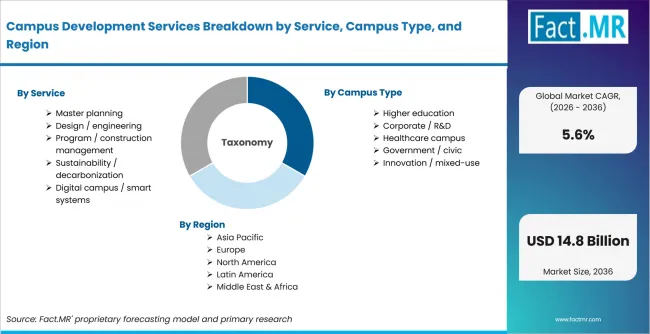
Campus Development Services Breakdown By Service, Campus Type, And Region | Source: Fact.MR
| Attribute | Details |
|---|---|
| Quantitative Units | USD billion |
| Market Definition | Professional services used to plan and deliver multi-building campuses, including design or engineering advice, program management, decarbonization planning and digital-campus integration |
| Segments Covered | Service; Campus Type; Project Scope; Commercial Model |
| Regions Covered | Global |
| Countries Covered | USA; UK; Saudi Arabia; France; Germany |
| Key Companies | AECOM; Jacobs; WSP; Arup; Turner & Townsend; JLL |
| Forecast Period | 2026 to 2036 |
| Base Year | 2026 |
| Market Value, 2026 | USD 8.6 billion |
| Market Value, 2036 | USD 14.8 billion |
| CAGR, 2026-2036 | 5.6% |
| Absolute Opportunity | USD 6.2 billion |
| Approach | Hybrid bottom-up and top-down assessment using campus project pipelines, professional fee intensity, capital-program mix, campus type, project scope and delivery model |
Source: Fact.MR analysis. Updated Sep 9, 2026
How is the market segmented?
-
By Service
- Master planning
- Design / engineering
- Program / construction management
- Sustainability / decarbonization
- Digital campus / smart systems
-
By Campus Type
- Higher education
- Corporate / R&D
- Healthcare campus
- Government / civic
- Innovation / mixed-use
-
By Project Scope
- New campus development
- Expansion
- Modernization / retrofit
- Infrastructure renewal
- Net-zero transformation
-
By Commercial Model
- Design-bid-build advisory
- Design-build / EPCM
- Program management
- PPP advisory
- Performance-based services
-
By Region
- North America
- Latin America
- Western Europe
- Eastern Europe
- East Asia
- South Asia and Pacific
- Middle East & Africa
Frequently Asked Questions
What is the Campus Development Services Market value in 2026?
At what CAGR is the market projected to grow?
What is the projected market value by 2036?
Which Service category accounts for the main 2026 share?
Which Campus Type accounts for the main 2026 share?
Which Project Scope category accounts for the main 2026 share?
Which Commercial Model accounts for the main 2026 share?
Which countries are covered in the country outlook?
What is a primary demand driver for campus development services?
What is a primary restraint on market growth?
Which companies are active in the Campus Development Services Market?
Who worked on this report


Preview the report firsthand - request a free sample
Free SampleGet the brochure for pricing and purchase details
Download PDF