- Market Value (2025): USD 210.0 Mn
- Estimated Value (2026): USD 268.0 Mn
- Forecast Value (2036): USD 1,650.0 Mn
- CAGR (2026-2036): 19.9%
What is the Carbon Capture Membrane Contactors Market forecast to be worth by 2036?
USD 1,650.0 million by 2036 at 19.9% CAGR.
- The Carbon Capture Membrane Contactors Market reached USD 210.0 million in 2025.
- Demand is projected to increase from USD 268.0 million in 2026 to USD 1,650.0 million by 2036.
- The market is forecast to record a 19.9% CAGR from 2026 to 2036.
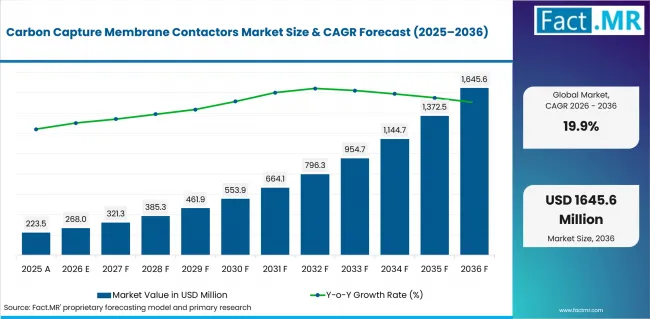
Carbon Capture Membrane Contactors Market Value Analysis | Source: Fact.MR
What are the defining numbers behind Carbon Capture Membrane Contactors Market growth?
An absolute opportunity of USD 1,382.0 million is expected between 2026 and 2036.
- Demand Drivers in the Market
- Power and industrial plants need carbon-capture routes that can be retrofitted to flue-gas streams without redesigning the underlying combustion process.
- Hollow-fiber hydrophobic contactors create a large gas-liquid interface in a compact module while keeping flue gas and absorbent physically separated.
- Amine-based absorbents use established carbon-dioxide reaction chemistry, allowing developers to change the contacting hardware without introducing an unfamiliar solvent system.
- Post-combustion power provides a continuous flue-gas stream for long operating campaigns that validate membrane wetting, solvent compatibility and module life.
- CCUS project development is increasing the number of pilot and small-commercial sites where compact membrane-contacting systems can be tested before larger capture trains.
- Key Segments Analyzed
- Hollow-fiber hydrophobic accounts for 34.0% of Membrane Type in 2026 because many fibers provide high gas-liquid interfacial area within a compact module.
- Amine-based holds 40.0% of Absorbent System in 2026 because established CO2 reaction chemistry reduces solvent uncertainty during early commercial deployment.
- Post-combustion power represents 36.0% of Application in 2026 because power plants provide continuous flue gas that can be treated downstream of combustion.
- Small commercial captures 29.0% of Scale in 2026 because developers can collect operating evidence beyond pilot scale while limiting initial capital exposure.
- Power generation comprises 42.0% of End User in 2026 because continuous flue gas and decarbonization requirements create a clear operating case for long-duration capture trials.
- Analyst Opinion at Fact.MR
- Shambhu Nath Jha, Principal Consultant at Fact.MR, states, "Buyer decisions in the Carbon Capture Membrane Contactors Market will centre on modular projects that prove mass transfer and solvent stability before larger installations. Buyers will compare the 2026 segment leaders with qualification evidence and the operating cost of the full process. Suppliers that support application trials and preserve formulation or equipment consistency can move more quickly into repeat production."
- Strategic Implications
- Suppliers should document the process conditions that allow Hollow-fiber hydrophobic to deliver repeatable performance.
- Customer trials should use the intended substrate, fluid path or process stream before commercial qualification.
- Regional technical support is important in USA and China because adoption depends on local production or infrastructure conditions.
- Commercial positioning should distinguish qualified application performance from general material or equipment capability.
- SINTEF is a research and licensing participant within the company list.
How does the Carbon Capture Membrane Contactors Market break down by segment?
The market is segmented by Membrane Type, Absorbent System, Application, Scale and End User.
Why does Hollow-fiber hydrophobic lead Membrane Type?
Hollow-fiber hydrophobic is projected to account for a 33.5% share in 2026.
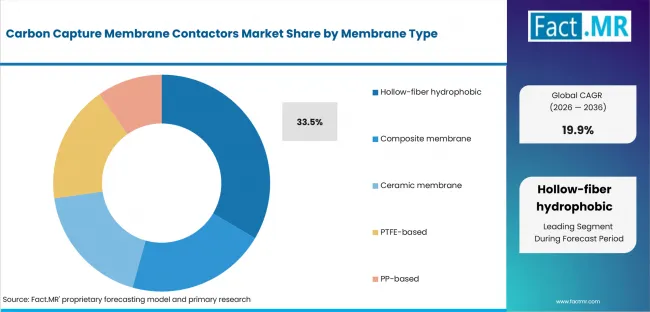
Carbon Capture Membrane Contactors Market Analysis By Membrane Type | Source: Fact.MR
Hollow-fiber contactors pack a large membrane surface into a small footprint, increasing the area available for carbon dioxide to transfer from flue gas into the absorbent.
Hydrophobic pores keep gas and liquid phases separated, but membrane wetting and solvent compatibility must remain controlled during long campaigns.
Why does Amine-based lead Absorbent System?
Amine-based is projected to account for a 40.2% share in 2026.
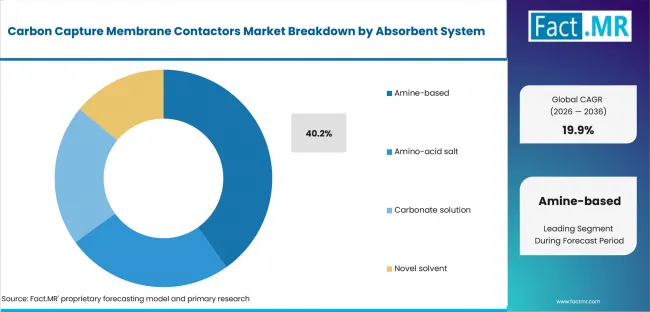
Carbon Capture Membrane Contactors Market Analysis By Absorbent System | Source: Fact.MR
Amine solvents have an established role in post-combustion capture, so developers can evaluate membrane contactors without changing the underlying carbon-dioxide reaction chemistry at the same time.
This reduces one layer of scale-up uncertainty, although solvent degradation and membrane compatibility still influence module life.
Why does Post-combustion power lead Application?
Post-combustion power is projected to account for a 36.4% share in 2026.
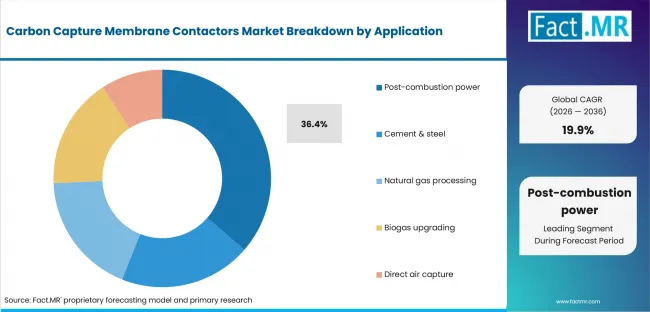
Carbon Capture Membrane Contactors Market Analysis By Application | Source: Fact.MR
Post-combustion power offers a continuous flue-gas stream that can be treated after combustion, allowing capture equipment to be added without altering the primary process.
Long operating hours also provide the data needed to assess capture rate, solvent stability and membrane life under realistic contaminants.
Why does Small commercial lead Scale?
Small commercial is projected to account for a 28.8% share in 2026.
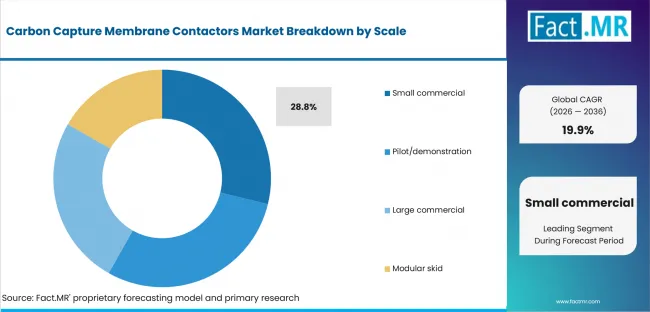
Carbon Capture Membrane Contactors Market Analysis By Scale | Source: Fact.MR
Small-commercial projects bridge the gap between short pilot campaigns and large capture trains by providing sustained operating evidence without immediate full-scale capital.
Modular contactors can be added in parallel as performance is proven, supporting scale-out after risk is reduced.
Why does Power generation lead End User?
Power generation is projected to account for a 42.5% share in 2026.
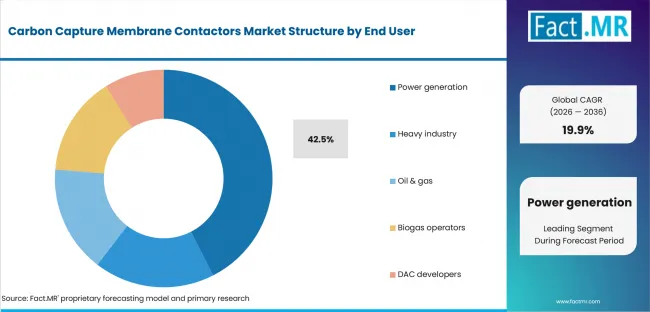
Carbon Capture Membrane Contactors Market Analysis By End User | Source: Fact.MR
Power generators produce large continuous flue-gas streams and face direct decarbonization pressure, making them suitable hosts for membrane-contactor demonstrations.
Extended operating campaigns let buyers test membrane wetting, absorbent consumption and maintenance requirements before larger deployment.
What is accelerating Carbon Capture Membrane Contactors Market adoption, and what is holding it back?
Drivers Impact Analysis
| Factor | (~) % Impact on CAGR | Geographic Relevance | Impact Timeline |
|---|---|---|---|
| Compact contact through Hollow-fiber hydrophobic | +5.4% | USA | Short term (<= 2 years) |
| Capture chemistry using Amine-based | +4.4% | China | Medium term (2-4 years) |
| Decarbonization demand in Post-combustion power | +3.2% | Germany | Long term (>= 4 years) |
Opportunity Impact Analysis
| Factor | (~) % Impact on CAGR | Geographic Relevance | Impact Timeline |
| Modular small-commercial units | +2.8% | USA | Short term (<= 2 years) |
|---|---|---|---|
| Industrial capture expansion | +2.2% | China | Medium term (2-4 years) |
| Solvent-resistant membranes | +1.6% | Germany | Long term (>= 4 years) |
Restraints Impact Analysis
| Factor | (~) % Impact on CAGR | Geographic Relevance | Impact Timeline |
|---|---|---|---|
| Wetting under flue gas | -2.6% | USA | Short term (<= 2 years) |
| Solvent compatibility | -2.0% | China | Medium term (2-4 years) |
| Scale-up risk | -1.4% | Germany | Long term (>= 4 years) |
Which countries are scaling the Carbon Capture Membrane Contactors Market through 2036?
- USA: The USA has federal carbon-capture research and several industrial demonstration pathways.
- China: China has substantial power and heavy-industry emissions with domestic membrane research.
- Germany: Germany has cement, chemical and industrial sites facing carbon-reduction requirements.
- Norway: Norway has a defined capture and storage pathway through the Longship programme.
- Saudi Arabia: Saudi Arabia is developing carbon-management projects around energy and industrial assets.
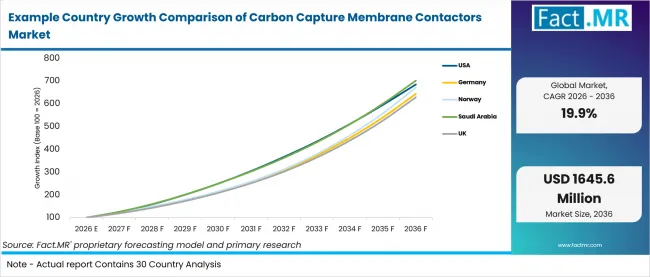
Example Country Growth Comparison Of Carbon Capture Membrane Contactors Market | Source: Fact.MR
Country CAGR (2026-2036)
| Country | CAGR (2026-2036) |
|---|---|
| USA | 21.1% |
| Germany | 20.4% |
| Norway | 21.0% |
| Saudi Arabia | 21.6% |
What is driving the USA's growth through 2036?
The USA is forecast to expand at a 21.1% CAGR from 2026 to 2036.
The USA has an established federal carbon-capture research base, with DOE and NETL programmes supporting membrane separation and engineering-scale validation.
Federal programmes provide host sites and performance data on capture efficiency, energy use and module durability before commercial scale-up.
What is driving Germany's growth through 2036?
Germany is forecast to expand at a 20.4% CAGR from 2026 to 2036.
Germany's cement, chemical and process industries face increasing carbon-reduction requirements, creating demand for capture technologies that can be retrofitted to existing plants.
Engineering capability supports small-commercial trials where membrane life and solvent compatibility can be tested under industrial flue gas.
What is driving Norway's growth through 2036?
Norway is forecast to expand at a 21.0% CAGR from 2026 to 2036.
Norway's Longship project entered operation in 2025, establishing a complete capture, transport and storage chain for industrial carbon management.
An operating downstream transport and storage system reduces infrastructure uncertainty for new capture technologies and demonstrations.
What is driving Saudi Arabia's growth through 2036?
Saudi Arabia is forecast to expand at a 21.6% CAGR from 2026 to 2036.
Saudi Arabia is developing carbon-management projects around refining, petrochemicals and energy production, creating potential host sites for modular capture systems.
Suppliers must prove compact capture equipment under demanding industrial gas conditions and high ambient temperatures.
Who leads the Carbon Capture Membrane Contactors Market?
Membrane Technology & Research (MTR) is positioned through membrane-based carbon separation and scale-up experience. 3M, Air Liquide and the other listed participants contribute membrane materials or capture-system development.
Competition depends on capture rate, energy use, membrane life and solvent compatibility under real gas.
Pilot references remain important because customers need evidence beyond laboratory mass transfer.
SINTEF is a research and licensing participant within the company list.
Which companies are the key providers?
Key companies profiled include Membrane Technology & Research (MTR); 3M; Air Liquide; Fujifilm; Compact Membrane Systems; and SINTEF (licensees).
- Membrane Technology & Research (MTR)
- 3M
- Air Liquide
- Fujifilm
- Compact Membrane Systems
- SINTEF (licensees)
Bibliography
- U.S. Department of Energy. (2025). Carbon Capture Technologies and Membrane Separation. U.S. Government.
- U.S. Department of Energy. (2024). Carbon Capture Supply Chain Assessment. U.S. Government.
- International Energy Agency. (2026). Carbon Capture, Utilisation and Storage. IEA.
- International Energy Agency. (2026). CCUS Projects Database. IEA.
- National Energy Technology Laboratory. (2025). Membrane-Based Carbon Dioxide Capture Research. U.S. Department of Energy.
- U.S. Department of Commerce. (2025). CHIPS for America Advanced Packaging Manufacturing Program. U.S. Government.
- Ministry of Industry and Information Technology, China. (2026). Development of the Electronic Information Manufacturing Industry in 2025. Government of China.
- Federal Ministry for Economic Affairs and Climate Action, Germany. (2025). Industrial and Automotive Transformation Programmes. Government of Germany.
- Ministry of Energy, Norway. (2025). Longship Carbon Capture and Storage Programme. Government of Norway.
- Saudi Water Authority. (2025). Desalination and Water Innovation Programmes. Government of Saudi Arabia.
- Membrane Technology and Research, Inc. (2026). Membrane Carbon Capture Systems. MTR.
- Compact Membrane Systems. (2026). Membrane Solutions for Carbon Dioxide Separation. Compact Membrane Systems.
Bibliography
- U.S. Department of Energy. (2025). Carbon Capture Technologies and Membrane Separation. U.S. Government.
- U.S. Department of Energy. (2024). Carbon Capture Supply Chain Assessment. U.S. Government.
- International Energy Agency. (2026). Carbon Capture, Utilisation and Storage. IEA.
- International Energy Agency. (2026). CCUS Projects Database. IEA.
- National Energy Technology Laboratory. (2025). Membrane-Based Carbon Dioxide Capture Research. U.S. Department of Energy.
- U.S. Department of Commerce. (2025). CHIPS for America Advanced Packaging Manufacturing Program. U.S. Government.
- Ministry of Industry and Information Technology, China. (2026). Development of the Electronic Information Manufacturing Industry in 2025. Government of China.
- Federal Ministry for Economic Affairs and Climate Action, Germany. (2025). Industrial and Automotive Transformation Programmes. Government of Germany.
- Ministry of Energy, Norway. (2025). Longship Carbon Capture and Storage Programme. Government of Norway.
- Saudi Water Authority. (2025). Desalination and Water Innovation Programmes. Government of Saudi Arabia.
- Membrane Technology and Research, Inc. (2026). Membrane Carbon Capture Systems. MTR.
- Compact Membrane Systems. (2026). Membrane Solutions for Carbon Dioxide Separation. Compact Membrane Systems.
This Report Answers
- The report examines demand across Membrane Type, Absorbent System, Application, Scale, End User.
- Segment analysis explains the operating reason behind each leading category.
- Country analysis evaluates the listed markets and adoption conditions through 2036.
- Competitive analysis reviews the listed companies and clarifies ownership or research roles where relevant.
- The analysis considers qualification, process control and application fit that influence purchasing decisions.
What does the Carbon Capture Membrane Contactors Market cover?
What does the Carbon Capture Membrane Contactors Market cover?
Membrane contactor systems for CO2 capture that combine gas-permeable membranes with liquid absorbents for compact, energy-efficient post-combustion and process carbon capture.
The assessment follows the stated segmentation by Membrane Type, Absorbent System, Application, Scale, End User. Revenue is counted only where the stated product or equipment is sold for the listed applications.
What is included in the scope?
The scope includes Hollow-fiber hydrophobic, Composite membrane, Ceramic membrane, PTFE-based, PP-based.
It also covers Amine-based, Amino-acid salt, Carbonate solution, Novel solvent.
Demand is assessed across Application: Post-combustion power, Cement & steel, Natural gas processing, Biogas upgrading, Direct air capture; Scale: Pilot/demonstration, Small commercial, Large commercial, Modular skid; End User: Power generation, Heavy industry, Oil & gas, Biogas operators, DAC developers.
What is excluded from the scope?
Standalone membrane polymers or laboratory coupons sold without a module or contactor function are excluded.
Conventional biological treatment, reverse osmosis or packed absorption is excluded unless inseparable from the in-scope system.
Engineering services are counted only when embedded in contactor deployment.
How Was the Analysis Built?
The analysis combines product scope, segment demand, country outlook and supplier coverage.
- Primary Research: Interviews focus on membrane developers, system integrators, utilities, industrial operators and engineering companies.
- Desk Research: The review covers government water or carbon-capture programmes, project disclosures and module information.
- Market Sizing and Forecasting: Estimates combine installed and planned module capacity, system value, application mix, project scale and country deployment.
- Data Validation and Update Cycle: Findings are checked against public evidence and supplier portfolios. Updates review ownership changes, demonstration results and infrastructure policy.
What is the report's scope and coverage?
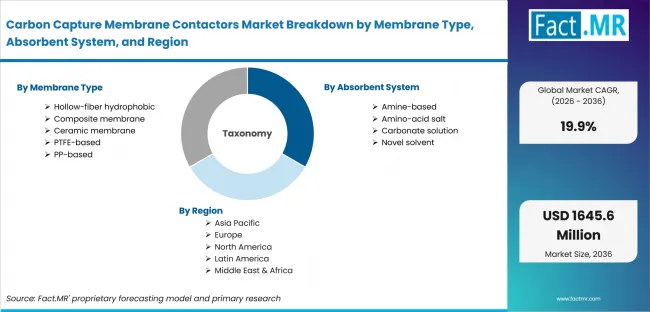
Carbon Capture Membrane Contactors Market Breakdown By Membrane Type, Absorbent System, And Region | Source: Fact.MR
| Attribute | Details |
|---|---|
| Quantitative Units | USD 268.0 million in 2026 to USD 1,650.0 million by 2036 at a 19.9% CAGR |
| Market Definition | Membrane contactor systems for CO2 capture that combine gas-permeable membranes with liquid absorbents for compact, energy-efficient post-combustion and process carbon capture. |
| Segments Covered | Membrane Type; Absorbent System; Application; Scale; End User |
| Regions Covered | North America; Latin America; Europe; East Asia; South Asia and Oceania; Middle East and Africa |
| Countries Covered | USA; China; Germany; Norway; Saudi Arabia |
| Key Companies Profiled | Membrane Technology & Research (MTR); 3M; Air Liquide; Fujifilm; Compact Membrane Systems; SINTEF (licensees) |
| Forecast Period | 2026 to 2036 |
| Base Year | 2025 |
| Market Value, 2026 | USD 268.0 million |
| Market Value, 2036 | USD 1,650.0 million |
| CAGR, 2026-2036 | 19.9% |
| Absolute Opportunity | USD 1,382.0 million |
| Approach | Combines installed and planned module capacity, system value, application mix, project scale and country deployment. |
How is the market segmented?
-
By Membrane Type
- Hollow-fiber hydrophobic
- Composite membrane
- Ceramic membrane
- PTFE-based
- PP-based
-
By Absorbent System
- Amine-based
- Amino-acid salt
- Carbonate solution
- Novel solvent
-
By Application
- Post-combustion power
- Cement & steel
- Natural gas processing
- Biogas upgrading
- Direct air capture
-
By Scale
- Pilot/demonstration
- Small commercial
- Large commercial
- Modular skid
-
By End User
- Power generation
- Heavy industry
- Oil & gas
- Biogas operators
- DAC developers
-
By Region
- North America
- Latin America
- Western Europe
- Eastern Europe
- East Asia
- South Asia and Pacific
- Middle East & Africa