- Market Value (2025): USD 17.2 Bn
- Estimated Value (2026): USD 18.8 Bn
- Forecast Value (2036): USD 46.9 Bn
- CAGR (2026-2036): 9.6%
What is the Carbon-Negative Building Materials Market forecast to be worth by 2036?
USD 18.8 billion in 2026 to USD 46.9 billion by 2036, at 9.6% CAGR.
- The carbon-negative building materials market crossed a valuation of USD 17.2 billion in 2025 following wider embodied-carbon screening across material specifications.
- Demand is projected to increase from USD 18.8 billion in 2026 to USD 46.9 billion by 2036 across verified carbon-storing and mineralizing material systems.
- The market is forecast to record a 9.6% CAGR from 2026 to 2036 supported by contractors and developers favoring materials with measurable carbon removal and familiar installation methods.
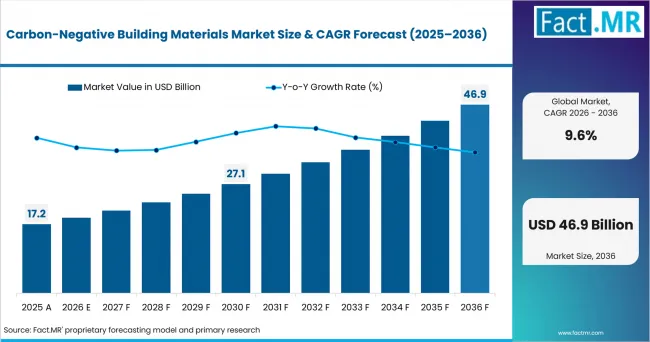
Carbon Negative Building Materials Market Market Value Analysis | Source: Fact.MR
What are the defining numbers behind Carbon-Negative Building Materials Market growth?
USD 28.1 billion absolute opportunity by 2036, led by cementitious materials, residential applications and contractors.
- Demand Drivers in the Market
- Contractors need verified product declarations and compatible installation methods for project approvals that increasingly depend on measurable embodied carbon performance.
- Developers need materials that store or mineralize carbon while meeting fire and structural codes across repeatable building systems.
- Public agencies need comparable carbon accounting and procurement thresholds so procurement teams screen material bids before project-level design changes begin.
- Architectural teams need performance data across concrete panels and insulation systems owing to specification risk across unfamiliar material assemblies.
- Key Segments Analyzed
- By Material Type: Cementitious is expected to account for 32.9% share in 2026 supported by carbon mineralization and cement-replacement routes that fit established concrete production.
- By Application: Residential is projected to garner 32.2% share in 2026 due to repeated material decisions across walls and floors in housing construction.
- By Construction Type: New build is anticipated to record 45.1% share in 2026 owing to early-stage freedom to specify net-negative materials before designs are locked.
- By Buyer: Contractor is estimated to hold 34.4% share in 2026 shaped by direct responsibility for approved submittals and site-ready material delivery.
- By Performance: Structural is forecast to capture 31% share in 2026 attributable to procurement value concentrated in load-bearing concrete and panel systems.
- Analyst Opinion at Fact.MR
- Shambhu Nath Jha, Principal Consultant at Fact.MR states, “The commercial bottleneck is proof that a carbon-negative claim survives product-level accounting and building-code review. Adoption is expected to favor suppliers that integrate third-party declarations into routine contractor workflows and project approval systems. Providers should combine verified carbon storage with dependable supply and practical application support across design review and site delivery.”
- Strategic Implications
- Cement producers should link carbon mineralization claims to product-specific declarations and batch-level quality records for contractor review during submittal approval.
- Panel manufacturers should secure reliable biomass feedstock agreements and prove moisture durability before expanding into structural applications across multiple climates.
- Developers should screen material choices during concept design so embodied carbon gains do not arrive after technical specifications are already locked.
- Public procurement teams should define acceptable carbon accounting boundaries before tender release and require comparable declarations across all submitted material bids.
Expanding the commercialization of carbon-negative concrete technologies, Carbonaide secured significant funding in January 2026 to scale its carbon mineralization platform and accelerate international market development. The company reported commercial production since 2024 and scheduled production at two additional Finnish factories for early 2026. The move fits the market boundary by linking permanent CO2 storage with operating concrete plants and repeatable carbon data.
India is expected to post an 11.4% CAGR during the forecast period supported by carbon capture and utilization testbed activity and expanding low-carbon cement qualification. China is projected to record a 10.7% CAGR by 2036 owing to prefabricated construction scale and certified material procurement. Australia is anticipated to advance at a 9.4% CAGR over the assessment period shaped by upfront carbon measurement across buildings and infrastructure. The United Kingdom is estimated to post a 9.1% CAGR between 2026 and 2036 due to embodied-emissions reporting work and low-carbon procurement policy development. The United States is forecast to record an 8.9% CAGR across the forecast, reinforced by federal material thresholds and broader product declaration infrastructure.
How does the Carbon-Negative Building Materials Market break down by segment?
Cementitious accounts for 32.9%, while Residential garners 32.2%.
Which material type dominates?
Cementitious accounts for 32.9% share in 2026.
Cementitious materials are projected to record 32.9% share in 2026 supported by mineralization and cement-replacement routes compatible with existing concrete workflows. Metal materials follow where lower-emission steel or recycled content supports procurement specifications and whole-building carbon targets. Wood products serve projects seeking carbon storage in engineered panels and framing systems with established installation methods. In April 2025 U.S. General Services Administration requirements set a lowest-emission concrete masonry unit threshold at 217 kg CO2e per cubic meter. These thresholds give contractors a basis for comparing product declarations during submittal review and substitution decisions.
Which Application is projected to account for the largest share?
Residential is projected to garner 32.2% share in 2026.
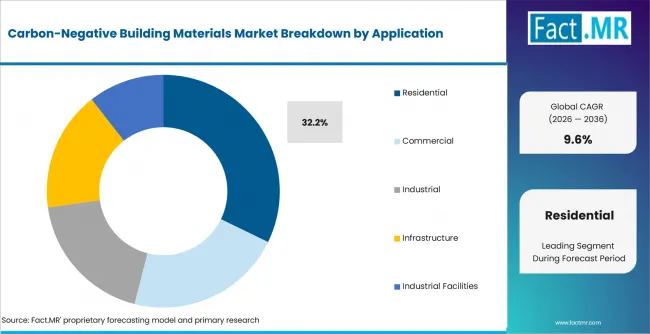
Carbon Negative Building Materials Market Analysis By Application | Source: Fact.MR
Residential applications are projected to account for 32.2% share in 2026 due to repeated specification choices across walls and floors in housing projects. Commercial construction follows under developer programs that use product declarations to support project carbon targets. Industrial projects focus on durable floors and structural materials backed by traceable production data for large facilities. In May 2026 the United Nations Environment Programme reported global building floor area had reached 273 billion square meters during 2024. Continued expansion enlarges the project base for embodied-carbon choices that architects and developers fix during design development.
How does Construction Type shape demand?
New build is estimated to record 45.1% share in 2026.
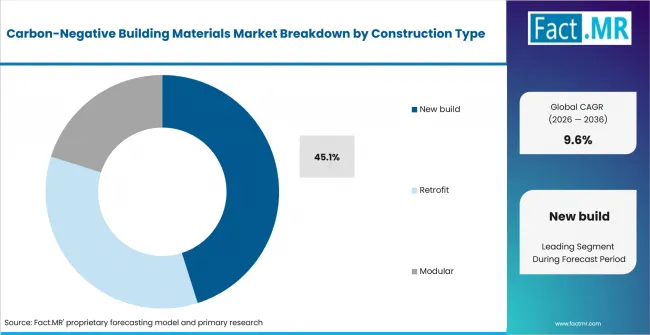
Carbon Negative Building Materials Market Analysis By Construction Type | Source: Fact.MR
New build is anticipated to capture 45.1% share in 2026 owing to specification freedom before structural systems and supply packages are fixed. Retrofit activity follows for insulation and non-structural panel replacements that avoid changes to the complete load path or major structural redesign. Modular construction provides controlled factory conditions that help producers track product quantities and carbon data. In November 2025 China stated that prefabricated projects represented over 30% of all new buildings during 2024. Factory-led construction creates repeatable material bills that simplify qualification for verified low-carbon and carbon-storing products.
What supports Contractor demand within Buyer?
Contractor is forecast to capture 34.4% share in 2026.
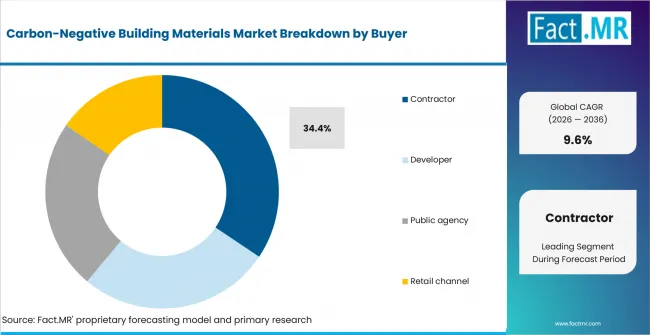
Carbon Negative Building Materials Market Analysis By Buyer | Source: Fact.MR
Contractors are estimated to represent 34.4% share in 2026 shaped by responsibility for substitutions and site delivery performance. Developers follow in projects that set embodied carbon targets during finance and design coordination before tender. Public agencies influence material selection through procurement thresholds that require environmental evidence before purchase approval. Retail channels serve smaller projects that source insulation and panel products through established distribution routes. In June 2026 CarbonCure reported a joint MIT study that identified a previously unconfirmed hydration pathway in CO2-mineralized cement. The research gives engineering teams another evidence layer for reviewing process compatibility and early-strength performance.
What is accelerating carbon-negative building materials demand, and what is holding it back?
Procurement thresholds drive industry growth; qualification cost restrains it.
Drivers Impact Analysis
| DRIVER | (~) % IMPACT ON CAGR | GEOGRAPHIC RELEVANCE | IMPACT TIMELINE |
|---|---|---|---|
| Public procurement thresholds and Buy Clean programs | +1.5% | North America and Europe | Short term (<= 2 years) |
| Carbon mineralization inside existing concrete plants | +1.2% | North America and Asia Pacific | Medium term (2-4 years) |
| Product declarations and embodied-carbon reporting | +0.9% | Global with public-project emphasis | Medium term (2-4 years) |
| Carbon-storing panels and natural-fiber insulation | +0.7% | North America and Europe | Long term (>= 4 years) |
| Material intensity of continuing construction expansion | +0.5% | Asia Pacific and urban regions | Long term (>= 4 years) |
Source: Fact.MR analysis. Updated Jul 8, 2026
- Public procurement thresholds: Government material standards turn carbon accounting into a bid requirement for public construction programs and major projects. In July 2024, the U.S. EPA selected nearly USD 160 million for cleaner construction-material reporting and reduction projects. Procurement programs are expected to expand supplier investment in verified declarations and lower-carbon manufacturing routes.
- Embodied-carbon reporting: Contractors need comparable declarations before material substitutions so technical approvals stay aligned with procurement schedules. In May 2026, the United Kingdom government reported 109 valid consultation responses received during 2025 from organizations involved in policy and procurement discussions. Reporting rules are projected to improve screening for cement and concrete bids judged on performance and verified emissions data.
- Concrete mineralization deployment: Carbon mineralization gains commercial weight if ordinary batching and quality-control procedures preserve established production routines. By November 2025, CarbonCure had already reported more than 690,000 metric tons of CO2 kept from the atmosphere across its network. Adoption is anticipated to broaden among producers that preserve compressive performance while lowering cement intensity across routine concrete production.
- Plant-based carbon storage: Natural-fiber insulation and biomass panels give project teams a carbon-storage route beyond mineral construction systems. In January 2025, Hempitecture reported operating a 33,000-square-foot hemp insulation factory in the United States to supply hemp insulation materials. Demand is estimated to widen among manufacturers that pair stored-carbon claims with moisture testing and dependable feedstock supply.
- Construction material footprint: Buildings continue to pull large material volumes into long-lived assets across expanding urban construction pipelines. In May 2026, the United Nations Environment Programme reported the sector accounted for nearly 50% of global material extraction. Suppliers are forecast to gain specifications for products that tie carbon removal to performance and transparent life-cycle boundaries.
Opportunity Impact Analysis
| OPPORTUNITY | (~) % IMPACT ON CAGR | GEOGRAPHIC RELEVANCE | IMPACT TIMELINE |
|---|---|---|---|
| Carbon utilization within cement production | +0.8% | India and North America | Medium term (2-4 years) |
| Certified carbon-storing products for repeat projects | +0.6% | China and Europe | Medium term (2-4 years) |
| Like-for-like material substitution in public infrastructure | +0.5% | Australia and North America | Short term (<= 2 years) |
| Regional manufacturing partnerships for cement-free masonry | +0.4% | Europe and North America | Long term (>= 4 years) |
Source: Fact.MR analysis. Updated Jul 8, 2026
- Carbon utilization integration: Cement plants provide concentrated emissions streams and established handling systems that support site-based carbon utilization trials. In July 2025 India confirmed plans for five CCU testbeds across the cement sector under an academia-industry collaboration program. Opportunity is expected to expand once pilots prove consistent output inside operating plants and support wider procurement commitments.
- Certified product pipelines: Product certification gives designers a shorter route from environmental intent to approved material schedules. By June 2025 China had more than 10,000 products carrying certified building material labels under its national product certification program. Suppliers are projected to benefit from certification paired with declarations that show an explicit net-negative life-cycle boundary.
- Like-for-like substitution: Public infrastructure owners reduce upfront emissions by qualifying lower-carbon equivalents that retain familiar installation requirements. In July 2024, Infrastructure Australia estimated practical substitution strategies were capable of reducing projected emissions by 23% during the period ending in 2026-27. Contractors are anticipated to favor replacements that preserve familiar handling and specification language across repeat projects.
- Regional production partnerships: Cement-free masonry needs production partners near construction markets to limit freight exposure and supply risk. In March 2026, CarbiCrete received CAD 700,000 for work using lower-concentration flue gas in decarbonized concrete. Commercial routes are estimated to improve under partnerships connecting technology firms with established block producers.
Restraints Impact Analysis
| RESTRAINT | (~) % IMPACT ON CAGR | GEOGRAPHIC RELEVANCE | IMPACT TIMELINE |
|---|---|---|---|
| Qualification and testing requirements | -0.8% | Global | Short term (<= 2 years) |
| Capital needs and uneven manufacturing scale | -0.6% | North America and emerging regions | Medium term (2-4 years) |
| Inconsistent carbon accounting boundaries | -0.5% | Global | Medium term (2-4 years) |
| Construction-cycle volatility and project timing | -0.4% | Europe and North America | Long term (>= 4 years) |
Source: Fact.MR analysis. Updated Jul 8, 2026
- Qualification burden: Structural materials need code evidence and environmental documentation before contractors accept substitutions in active projects. The April 2025 U.S. General Services Administration requirements cover six material categories under procurement rules evaluating embodied-carbon performance during federal purchases. Adoption is expected to remain selective among suppliers lacking product declarations or established testing evidence.
- Manufacturing scale: Carbon-negative processes often need new curing equipment or feedstock logistics before dependable volume production begins. In January 2025 the U.S. Department of Energy announced USD 18.6 million for laboratory-led industrial demonstration collaboration. Market expansion is projected to remain uneven in regions facing financing gaps and plant integration delays.
- Accounting inconsistency: Net-negative claims depend on system boundaries and allocation methods that differ across construction materials. The United Kingdom is developing an embodied-emissions reporting framework for steel and cement alongside concrete. Supplier acceptance is anticipated to improve after contractors receive comparable product data across material families.
- Project-cycle volatility: New construction demand moves with financing and tender timing while retrofit work follows different spending patterns. In June 2026, the Office for National Statistics reported new work grew only 0.3% during the three months to April. Suppliers are estimated to reduce exposure by serving new-build and retrofit-friendly product categories across varying project cycles.
Which countries are scaling Carbon-Negative Building Materials fastest?
India 11.4%; China 10.7%; Australia 9.4%; United Kingdom 9.1%; United States 8.9%.
Regional analysis covers North America and Europe within the market framework used for country comparison. Coverage also extends to Asia Pacific alongside Central & South America and the Middle East & Africa for global assessment.
| COUNTRY | CAGR |
|---|---|
| India | 11.4% |
| China | 10.7% |
| Australia | 9.4% |
| United Kingdom | 9.1% |
| United States | 8.9% |
| Germany | 8.6% |
| Japan | 8.3% |
Source: Fact.MR analysis. Updated Jul 8, 2026
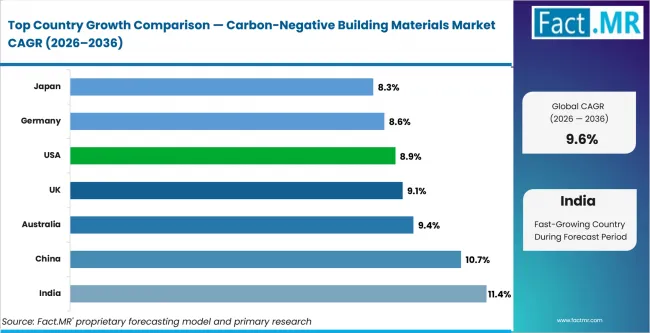
Carbon Negative Building Materials Market Cagr Analysis By Country | Source: Fact.MR
What is powering India's lead?
11.4% CAGR, driven by cement-sector carbon utilization trials and expanding local material qualification.
India’s market is gaining momentum as cement-sector pilots create direct qualification pathways for carbon-utilizing construction materials across regional supply chains. In July 2025, the Department of Science and Technology reported a Ballabhgarh pilot targeting 2 tonnes of CO₂ capture per day. The market is expected to post an 11.4% CAGR between 2026 and 2036 as industrial testing supports commercial material validation. Local technology partnerships can move qualified outputs from demonstration sites into regional cement and concrete procurement channels more efficiently.
How is China scaling carbon-negative material demand?
10.7% CAGR, supported by prefabricated construction and expanding certified material procurement.
China’s market is scaling through industrialized construction methods that create repeatable specifications for lower-emission materials across large project programs. In November 2025, official government reporting stated that prefabricated projects under construction covered 672 million square meters during 2024. Demand is projected to record a 10.7% CAGR during the forecast period as standardized construction expands material qualification opportunities. Producers can improve scaling pathways when carbon documentation fits factory-based production systems and structured public procurement requirements.
What supports the Australia outlook?
9.4% CAGR, shaped by upfront carbon measurement across major project pipelines.
Australia’s market opportunity is strengthening as infrastructure planning increasingly measures embodied emissions before material choices become fixed within project specifications. Infrastructure Australia projected 247 Mt CO₂e of upfront carbon across the national five-year buildings and infrastructure pipeline without deliberate reduction action. The market is anticipated to advance at a 9.4% CAGR over the assessment period as project teams expand carbon measurement and substitution analysis. Suppliers benefit when early material approvals preserve delivery schedules and reduce redesign risk during major construction procurement programs.
What underpins the United Kingdom's growth?
9.1% CAGR, due to embodied-emissions reporting and expanding procurement guidance development.
United Kingdom demand is developing through refurbishment activity that creates practical opportunities for lower-emission materials within existing building portfolios. In June 2026, the Office for National Statistics reported that repair and maintenance output grew 3.4% during the three months to April. Demand is estimated to post a 9.1% CAGR between 2026 and 2036 as project teams compare material carbon evidence across refurbishment programs. Manufacturers can improve specification access when product documentation supports procurement reviews without disrupting established approval and installation procedures.
How is the United States developing carbon-negative material demand?
8.9% CAGR, reinforced by federal material thresholds and expanding declaration infrastructure.
United States demand is gaining structure as federal construction programs connect procurement decisions with documented global warming potential performance requirements. In January 2025, GSA reported that its low-embodied-carbon material program covered more than 150 federal projects. The market is forecast to record an 8.9% CAGR during the forecast period as material screening becomes more closely integrated with federal project procurement. Contractors can improve project access when suppliers provide compliant declarations alongside standard submittal packages and dependable regional production capacity.
Which companies shape competition in the Carbon-Negative Building Materials Market?
CarbonCure Technologies and CarbiCrete stand out in direct carbon-mineralized concrete coverage while Plantd and Hempitecture strengthen carbon-storing panel and insulation options.
CarbonCure Technologies supplies CO2 injection systems that integrate with ready-mix and precast concrete production while preserving normal batching workflows. CarbiCrete develops cement-free concrete that replaces cement with steel slag and permanently mineralizes injected CO2 during curing. Partanna supplies Portland-cement-free concrete materials that absorb carbon dioxide during curing and continued exposure while using brine-based mineral inputs. These providers compete on verified carbon impact and production fit alongside contractor acceptance across existing concrete and masonry channels.
Prometheus Materials offers an algae-derived cement replacement for ready-mix and block applications while Plantd converts fast-growing biomass into structural panel products. Hempitecture manufactures hemp-based insulation that stores plant-based carbon inside building envelopes while addressing thermal performance and installation requirements. Carbonaide supplies CO2 mineralization technology for concrete factories and supports carbon-negative product routes built around permanent storage inside precast materials. Competition over the assessment period is expected to be shaped by verified life-cycle accounting and code acceptance alongside regional manufacturing scale and repeatable contractor support.
Which companies are the key providers?
CarbonCure Technologies, CarbiCrete, Partanna, Prometheus Materials, Plantd, Hempitecture, Carbonaide are some of the companies profiled
- CarbonCure Technologies
- CarbiCrete
- Partanna
- Prometheus Materials
- Plantd
- Hempitecture
- Carbonaide
Bibliography
- CarbonCure Technologies. (2025, November 24). CarbonCure producers reach milestone of 10 million truckloads. CarbonCure Technologies.
- CarbonCure Technologies. (2026, June 11). New study reveals how CO₂ drives early strength gains in cement and concrete at the molecular level. CarbonCure Technologies.
- CarbiCrete. (2026, March 30). CarbiCrete to further advance decarbonization technology with support from the Government of Canada. CarbiCrete.
- Carbonaide. (2026, January 28). Carbonaide closes new investment round to accelerate growth. Carbonaide.
- Department for Energy Security and Net Zero. (2026, May 28). A policy framework to grow the market for low carbon industrial products: Government response factsheet. GOV.UK.
- Department of Science and Technology. (2025, July 17). India launches first cluster of CCU testbeds in academia-industry collaboration for cement industry. Government of India.
- General Services Administration. (2025, April 10). Inflation Reduction Act low-embodied carbon material requirements. U.S. General Services Administration.
- State Council Information Office. (2025, November 8). Carbon peaking and carbon neutrality: China’s plans and solutions. State Council of the People’s Republic of China.
- Hempitecture. (2025, January 29). Hempitecture’s Reg CF round simplified. Hempitecture.
- Partanna. (2025, May 21). Exeed Industries signs MoU with Partanna Oasis to explore sustainable cement solutions in the UAE. Partanna.
- Plantd. (2026, February 23). In a world of walls, one wall stands apart. Plantd.
- Prometheus Materials. (2025, October 20). Prometheus Materials completes landmark collaboration with SOM, Skanska USA and D’Annunzio Group to bring its ProZERO carbon negative cement and concrete to the New York Climate Exchange’s Climate Campus. Prometheus Materials.
- Infrastructure Australia. (2024, July 15). Embodied carbon projections for Australian infrastructure and buildings. Australian Government.
- Office for National Statistics. (2026, June 12). Construction output in Great Britain: April 2026. Office for National Statistics.
- United Nations Environment Programme. (2026, May 19). Climate action key to affordable housing, but buildings decarbonisation stalls. United Nations Environment Programme.
- U.S. Department of Energy. (2025, January 10). DOE announces $18.6 million to three national lab-led projects supporting commercial-scale industrial demonstrations. U.S. Department of Energy.
- U.S. Environmental Protection Agency. (2024, July 16). Biden-Harris Administration announces nearly $160 million in grants to support clean U.S. manufacturing of steel and other construction materials. U.S. Environmental Protection Agency.
This Report Addresses
- The report provides strategic intelligence on Carbon-Negative Building Materials across Material Type and Application choices shaping specification and procurement.
- Segment analysis covers Cementitious materials and Residential applications which are the supplied share leaders within the 2026 market structure.
- Regional outlook evaluates India and China alongside Australia while the United Kingdom and United States complete the country comparison.
- Competitive analysis profiles CarbonCure Technologies and CarbiCrete alongside Partanna and Prometheus Materials before reviewing three additional providers.
- Material assessment covers Cementitious and Metal options alongside Wood and Stone products supported by verified net-negative life-cycle accounting.
- Application assessment covers Residential and Commercial projects alongside Industrial facilities and Infrastructure uses with different qualification and procurement routes.
- The forecast combines official construction statistics and procurement evidence with company portfolio checks and interviews across contractor and manufacturer roles.
What does the Carbon-Negative Building Materials Market cover?
Cementitious and Metal materials alongside Wood and Stone materials used in buildings with verified life-cycle accounting that records net carbon removal.
The Carbon-Negative Building Materials Market covers construction products that store more carbon than their defined life-cycle boundary releases or permanently mineralize captured carbon into durable products. Coverage spans structural and non-structural materials used across buildings and infrastructure projects where product-level evidence directly supports the stated carbon claim.
The category differs from the broader low-carbon construction materials field under a stricter product-accounting boundary for verified net-negative performance. Conventional lower-carbon products remain outside the boundary unless a verified assessment supports net-negative performance across the stated accounting scope.
What is included in the scope?
Carbon-negative building materials used across structural systems, envelopes and project delivery channels with verified product-level carbon evidence.
The scope includes Cementitious and Metal materials alongside Wood and Stone products supported by net-negative life-cycle evidence. Applications cover Residential and Commercial projects alongside Industrial uses and Infrastructure work that affects upfront carbon accounting. Construction coverage includes New build and Retrofit activity together with Modular production under controlled factory material accounting. Buyer coverage follows Contractor and Developer routes while Public agency and Retail channel activity are also considered. Performance analysis covers Structural and Thermal requirements alongside Acoustic and Seismic needs that influence engineering review. Adjacent intelligence on low-carbon cement systems informs binder substitution during cementitious material development and procurement screening. Research on carbon capture additives frames mineralization pathways that permanently store captured carbon during material curing.
What is excluded from the scope?
Conventional materials without verified net-negative life-cycle performance and standalone operational-energy technologies are outside the scope.
The scope excludes ordinary cement and steel products that only show relative carbon reductions without a net-negative result across the stated assessment boundary. Building controls and heating systems remain outside coverage and address operating emissions instead of carbon storage inside construction materials. General biochar cement additives remain adjacent unless product evidence supports net-negative performance across the stated boundary.
How was the analysis built?
120+ sources, 40+ company portfolios, 25+ countries, 20+ interviews.
- Primary Research
- Primary research includes interviews with building material manufacturers, sustainable construction specialists, architects, project developers and procurement managers. It also covers input from carbon-accounting experts, green building consultants, engineering firms and distributors involved in the adoption and commercialization of carbon-negative construction materials.
- Desk Research
- Desk research reviews green building regulations, carbon reduction policies, embodied carbon frameworks, sustainable construction reports and manufacturer product portfolios. Company announcements, environmental product declarations (EPDs), lifecycle assessment studies and industry publications are also assessed to evaluate market developments and competitive positioning.
- Market-Sizing and Forecasting
- Forecasting uses sustainable construction activity, green building investments, adoption of low-carbon materials, infrastructure development trends and average material pricing across major regions. Models consider regulatory support, carbon reduction targets, certification program requirements and technological advancements influencing demand for carbon-negative building materials.
- Data Validation and Update Cycle
- Forecasts are validated through manufacturer checks and industry interviews that test assumptions on material adoption, project pipelines and sustainability-driven procurement trends. Portfolio mapping, regional construction activity analysis and stakeholder feedback help confirm market direction, while ongoing reviews of policy developments, certification standards and product innovations support forecast updates.
Segmentation
What is the report’s scope and coverage?
| Attribute | Details |
|---|---|
| Quantitative Units | USD Billion |
| Market Definition | Construction materials that achieve verified net-negative carbon performance through permanent carbon mineralization or durable biogenic carbon storage within defined life-cycle boundaries |
| Material Type | Cementitious; Metal; Wood; Stone |
| Application | Residential; Commercial; Industrial; Infrastructure |
| Construction Type | New Build; Retrofit; Modular |
| Buyer | Contractor; Developer; Public Agency; Retail Channel |
| Performance | Structural; Thermal; Acoustic; Seismic; Low-carbon Performance |
| Regions Covered | North America; Europe; Asia Pacific; Central & South America; Middle East & Africa |
| Countries Covered | India; China; Australia; United Kingdom; United States |
| Key Companies Profiled | CarbonCure Technologies; CarbiCrete; Partanna; Prometheus Materials; Plantd; Hempitecture; Carbonaide |
| Forecast Period | 2026 to 2036 |
| Approach | Hybrid top-down and bottom-up approach using construction activity; material substitution rates; carbon-accounting evidence; product declarations; procurement thresholds; qualification cycles; regional manufacturing availability and supplier validation |
Source: Fact.MR analysis. Updated Jul 8, 2026
How is the market segmented?
-
By Material Type :
- Cementitious
- Metal
- Wood
- Stone
-
By Application :
- Residential
- Commercial
- Industrial
- Infrastructure
-
By Construction Type :
- New Build
- Retrofit
- Modular
-
By Buyer :
- Contractor
- Developer
- Public Agency
- Retail Channel
-
By Performance :
- Structural
- Thermal
- Acoustic
- Seismic
- Low-carbon Performance
-
By Region :
- North America
- United States
- Canada
- Europe
- Germany
- United Kingdom
- France
- Italy
- Spain
- Asia Pacific
- India
- China
- Japan
- South Korea
- Australia
- Latin America
- Brazil
- Argentina
- Mexico
- Chile
- Middle East & Africa
- UAE
- Saudi Arabia
- South Africa
- North America
Frequently Asked Questions
Which material type is estimated to hold the leading share?
What share is projected for Residential applications?
How much demand is estimated for New build projects?
Which buyer group is forecast to hold the leading share?
What performance category is expected to hold the top share?
Which country is projected to expand fastest?
What CAGR is estimated for China?
What CAGR is projected for Australia?
What is the estimated growth outlook for the United Kingdom?
What CAGR is forecast for the United States?
What is the strongest demand driver?
What most limits wider adoption?
Why do Cementitious materials retain high commercial relevance?
Why are Contractors estimated to command the notable Buyer share?
Who worked on this report


Preview the report firsthand - request a free sample
Free SampleGet the brochure for pricing and purchase details
Download PDF