- Market Value (2025): USD 487.1 Mn
- Estimated Value (2026): USD 530.5 Mn
- Forecast Value (2036): USD 1244.4 Mn
- CAGR (2026-2036): 8.9%
What is the Carbon Fiber Reinforced 3D Printing Polymers Market forecast to be worth by 2036?
USD 530.5 million in 2026 to USD 1,244.4 million by 2036 at 8.9% CAGR.
- The carbon fiber reinforced 3D printing polymers market crossed a valuation of USD 487.1 million in 2025 across industrial material qualification programs.
- Demand is projected to increase from USD 530.5 million in 2026 to USD 1,244.4 million by 2036 across the assessment period.
- The market is forecast to record an 8.9% CAGR from 2026 to 2036 as aerospace engineers and tooling teams qualify reinforced polymers for lighter functional parts.
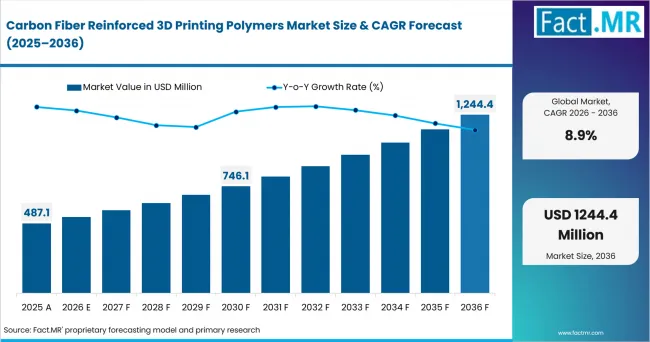
Carbon Fiber Reinforced 3d Printing Polymers Market Market Value Analysis | Source: Fact.MR
What are the defining numbers behind Carbon Fiber Reinforced 3D Printing Polymers Market growth?
USD 713.9 million absolute opportunity by 2036 led by Nylon (PA) and Filament.
- Demand Drivers in the Market
- Aerospace production engineers need repeatable stiffness-to-weight performance supported by documented conditioning procedures and print-path controls before formal part qualification starts.
- Automotive tooling teams need lighter fixtures with shorter iteration cycles driven by frequent line changes and ergonomic handling requirements across production cells.
- Maintenance engineering teams need low-volume spares attributable to stored part files and local printing near operating sites with long equipment lifecycles.
- Medical device developers need reinforced PEEK options owing to metal-free implant workflows and patient-specific geometries that require controlled material orientation.
- Key Segments Analyzed
- By Polymer Type: Nylon (PA) is expected to represent 36.0% share in 2026, supported by broad processing familiarity and established reinforced filament availability.
- By Form: Filament is projected to account for 63.0% share in 2026, owing to standardized spool handling and wide compatibility across industrial FFF platforms.
- By Technology: FDM/FFF is anticipated to capture 58.0% share in 2026, driven by installed printer fleets and accessible carbon-fiber filament workflows.
- By End Use: Aerospace & Defense is estimated to represent 29.0% share in 2026, attributable to lightweight tooling needs and qualification-led low-volume production.
- Analyst Opinion at Fact.MR
- Shambhu Nath Jha, Senior Analyst at Fact.MR states, “Qualification is the commercial bottleneck in this market and access to another carbon-filled spool is not enough. Demand is expected to shift toward suppliers that publish moisture controls and orientation guidance alongside practical process windows. Providers should combine resin knowledge with application engineering and test evidence that survives procurement review.”
- Strategic Implications
- Material producers should publish conditioning guidance and anisotropy data that engineering teams transfer directly into internal qualification plans.
- Printer manufacturers should map reinforced resin settings to nozzle wear and maintenance intervals before promoting broader production deployment across industrial accounts.
- Aerospace engineering teams should separate tooling qualification from flight-part qualification so low-risk applications progress without unnecessary documentation burdens.
- Industrial distributors should pair material inventory with drying support and parameter guidance because reinforced polymers often fail before printing starts.
Stratasys announced an agreement in May 2026 to acquire Markforged and expand its aerospace and defense capabilities. The transaction also broadens industrial production access through two established reinforced-polymer printing portfolios. The development highlights consolidation around qualification support and machine compatibility. It also strengthens industrial application access.
India is expected to record a 10.7% CAGR between 2026 and 2036, supported by vehicle production scale and local tooling programs. China is projected to post a 10.0% CAGR during the forecast period, driven by expanding 3D-printing equipment output and industrial deployment. Australia is anticipated to advance at an 8.7% CAGR over the assessment period, owing to machinery investment and defense manufacturing activity. The United Kingdom is estimated to record an 8.4% CAGR by 2036, attributable to aerospace networks and broader industrial technology adoption. The United States is forecast to post an 8.2% CAGR across the forecast period, shaped by aerospace qualification depth and broad reinforced-polymer portfolios. Germany is projected to record a 7.9% CAGR during the assessment period, supported by engineering-intensive manufacturing and tooling demand. Japan is anticipated to post a 7.6% CAGR between 2026 and 2036, driven by precision manufacturing and machine-tool modernization.
How does the Carbon Fiber Reinforced 3D Printing Polymers Market break down by segment?
Nylon (PA) accounts for 36.0% share in 2026, while Filament garners 63.0%.
Which Polymer Type is expected to account for the leading share?
Nylon (PA) is estimated to account for 36.0% share in 2026
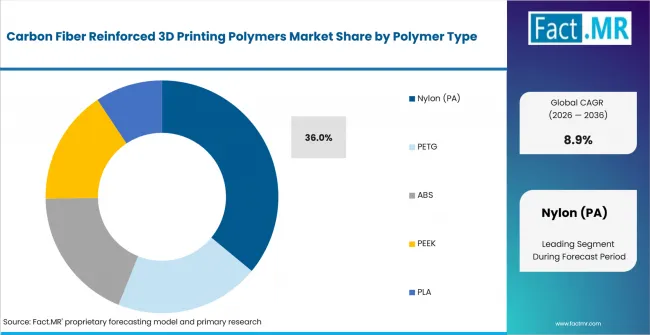
Carbon Fiber Reinforced 3d Printing Polymers Market Analysis By Polymer Type | Source: Fact.MR
Nylon (PA) is estimated to account for 36.0% share in 2026 because it combines established processing knowledge with wide availability across reinforced filament portfolios. PETG supports parts that need easier processing and dimensional stability during iterative factory use. ABS remains relevant for fixtures and tooling where impact resistance and accessible FDM processing matter. PEEK serves high-temperature aerospace and medical programs that justify tighter equipment controls. PLA remains concentrated in less demanding prototypes and consumer applications where printability carries more weight than sustained thermal performance.
Which Form is projected to account for the notable share?
Filament is projected to garner 63.0% share in 2026
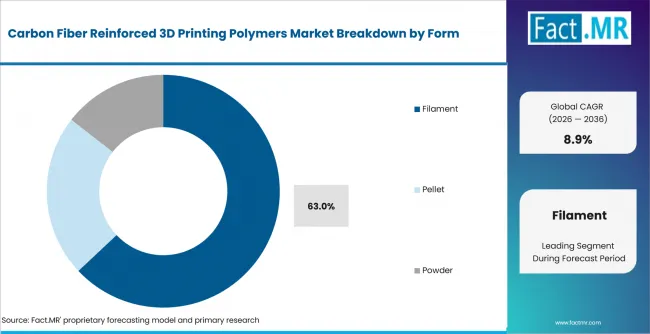
Carbon Fiber Reinforced 3d Printing Polymers Market Analysis By Form | Source: Fact.MR
Filament is projected to account for 63.0% share in 2026 owing to standardized handling and broad support across industrial FDM and FFF printers. Pellet feedstocks support larger parts and higher-throughput extrusion systems where material cost and deposition rate carry more weight. Powder remains relevant for SLS workflows that need batch production and support-free nesting. Form selection therefore depends on machine architecture and part scale. Qualification requirements vary across each production environment.
How does Technology shape demand?
FDM/FFF is forecast to record 58.0% share in 2026
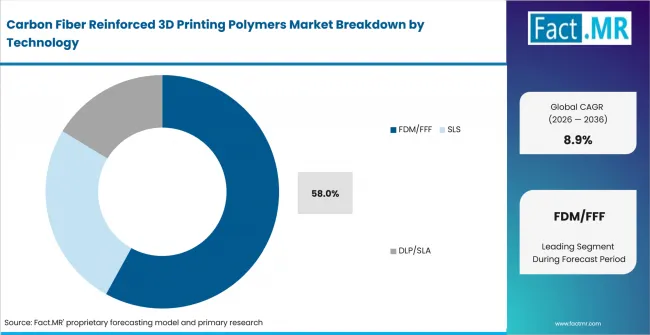
Carbon Fiber Reinforced 3d Printing Polymers Market Analysis By Technology | Source: Fact.MR
FDM/FFF is anticipated to capture 58.0% share in 2026 because reinforced filament systems are widely accessible across prototyping and industrial tooling programs. SLS supports complex powder-based geometries that benefit from batch nesting and reduced support requirements. DLP/SLA remains selective because suspended fiber loading can complicate resin handling and curing consistency. Technology choice is therefore tied to feedstock form and part geometry. Documentation burdens also vary across each application.
What underpins Aerospace & Defense demand?
Aerospace & Defense is estimated to capture 29.0% share in 2026.
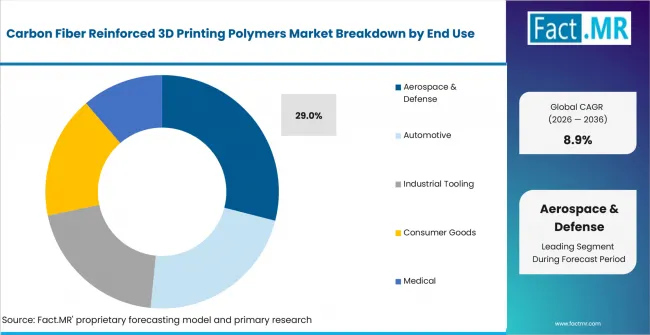
Carbon Fiber Reinforced 3d Printing Polymers Market Analysis By End Use | Source: Fact.MR
Aerospace & Defense is estimated to account for 29.0% share in 2026 because weight-sensitive tooling and low-volume programs reward qualified reinforced polymers. Automotive teams use these materials for fixtures and production aids that reduce handling mass. Industrial Tooling applications prioritize rapid redesign and shorter replacement cycles across factory operations. Consumer Goods use remains selective where stiffness and appearance support specialized product designs. Medical programs evaluate reinforced polymers for controlled device and implant workflows that require traceability and validated processing.
What is accelerating Carbon Fiber Reinforced 3D Printing Polymers Market adoption, and what is holding it back?
Qualification-backed tooling substitution drives adoption while anisotropy and conditioning risk restrain broader production approval across industrial programs.
Drivers Impact Analysis
| Driver | (~) % Impact on CAGR | Geographic Relevance | Impact Timeline |
|---|---|---|---|
| Qualification-backed tooling substitution | +1.0% | North America, Europe and East Asia | Medium term (2-4 years) |
| Aerospace maintenance and lightweight parts | +0.8% | United States, United Kingdom and India | Long term (>=4 years) |
| Automotive tooling and robotic EOAT | +0.6% | China, India and Europe | Medium term (2-4 years) |
| Broader engineering-resin portfolios | +0.4% | Industrial manufacturing hubs | Medium term (2-4 years) |
| Distributed spare-part production | +0.3% | Remote industrial and defense sites | Long term (>=4 years) |
Source: Fact.MR analysis. Updated Jul 9, 2026
- Qualification-backed tooling substitution
- Factory teams often begin with jigs and fixtures because those parts avoid the certification burden attached to safety-critical production components. Reinforced polymers cut tool weight while allowing file-based redesign after operators identify ergonomic or access problems during actual use. Adoption is expected to widen where suppliers provide documented drying conditions and repeatable orientation guidance before customer trials begin.
- Aerospace maintenance and lightweight parts
- Aerospace programs create recurring needs for low-volume tooling and service parts that must balance stiffness against handling weight. In January 2026, IATA reported that full-year passenger demand during 2025 rose 5.3% from the prior year. Material suppliers are projected to gain more qualification work where fleet activity supports maintenance capacity and cabin modification programs.
- Automotive tooling and robotic EOAT
- Vehicle plants use fixtures and robotic tooling across frequent model changes that make long machining cycles commercially difficult for some low-volume aids. In July 2025, Eurostat reported EU motor vehicle and trailer sold production worth €707 billion during 2024. Reinforced polymer use is anticipated to expand where plant engineers validate surface durability and repeatable dimensions under production contact before wider deployment.
- Broader engineering-resin portfolios
- Material portfolios now extend beyond carbon-filled nylon into high-temperature PEEK grades that address demanding service conditions. In March 2025, Evonik named 3DChimera an official United States distributor for selected INFINAM PA12 SLS powders. The same official release also listed carbon-fiber-reinforced PEEK filament among Evonik’s additive manufacturing portfolio examples. Demand is estimated to broaden where resin suppliers connect material performance with printer settings and regulated-use documentation.
- Distributed spare-part production
- Remote operating sites often need low-volume replacement components long after conventional inventory plans have become expensive or unreliable. Stored part files create a route for local printing when load cases and environmental limits are already understood. Adoption is forecast to grow selectively where maintenance teams control material storage and verify printer condition before each production batch.
Opportunity Impact Analysis
| Opportunity | (~) % Impact on CAGR | Geographic Relevance | Impact Timeline |
|---|---|---|---|
| High-temperature PEEK parts | +0.5% | Aerospace, medical and industrial hubs | Medium term (2-4 years) |
| Large-format pellet tools and molds | +0.4% | North America, Europe and Australia | Medium term (2-4 years) |
| Reinforced medical PEEK devices | +0.3% | United States and Europe | Long term (>=4 years) |
| Documented material recovery pathways | +0.2% | Europe and regulated manufacturing sites | Long term (>=4 years) |
Source: Fact.MR analysis. Updated Jul 9, 2026
- High-temperature PEEK parts
- High-temperature polymers open applications that ordinary carbon-filled nylons cannot serve because thermal limits and chemical exposure differ sharply across operating environments. Suppliers are expected to focus on controlled drying and heated build systems that keep process windows stable during long prints. Commercial gains remain tied to application evidence that links printed orientation with service conditions instead of relying on resin pedigree alone.
- Large-format pellet tools and molds
- Pellet extrusion reduces feedstock handling constraints for large fixtures and molds that require long print times on smaller filament systems. Toolmakers are projected to evaluate these systems where machining allowances and thermal cycling plans are defined before printing begins. In July 2025, ORNL reported carbon-fiber-reinforced ABS forms with sections roughly 10 feet square for its Janus shielding demonstration. Suppliers that connect material shrinkage data with finishing workflows gain a clearer route into composite tooling and factory fixture accounts.
- Reinforced medical PEEK devices
- Carbon-fiber PEEK offers a metal-free material route for selected implant concepts and device components that need stiffness with radiolucent behavior. Qualification is anticipated to remain narrow because medical programs require traceability and process evidence beyond basic printer repeatability. Opportunity expands when material producers coordinate resin controls with machine validation and application-specific testing across regulated development programs.
- Documented material recovery pathways
- Reinforced polymer scrap presents a commercial challenge because fiber length and resin history change after each processing cycle. Recovery programs are estimated to attract more attention where factories generate predictable waste streams from support material or rejected tooling. Credible pathways need measured property retention and clear segregation rules before recovered feedstock enters another engineering application.
Restraints Impact Analysis
| Restraint | (~) % Impact on CAGR | Geographic Relevance | Impact Timeline |
|---|---|---|---|
| Anisotropy and moisture sensitivity | -0.6% | Global industrial accounts | Short term (<=2 years) |
| Qualification and documentation cost | -0.5% | Aerospace, medical and defense programs | Medium term (2-4 years) |
| Abrasive fiber wear on hardware | -0.3% | Extrusion-based printer fleets | Medium term (2-4 years) |
| Limited recovery of reinforced scrap | -0.2% | Europe and high-volume print centers | Long term (>=4 years) |
Source: Fact.MR analysis. Updated Jul 9, 2026
- Anisotropy and moisture sensitivity
- Carbon fibers improve stiffness yet printed properties still depend on bead direction and layer bonding across each part geometry. Hygroscopic polymers introduce another variable when drying discipline changes between qualification builds and later production batches. Adoption is expected to remain selective where teams cannot control material conditioning and verify orientation against actual load paths.
- Qualification and documentation cost
- Aerospace and medical engineering groups need traceable material lots and repeatable process records before reinforced polymer parts enter controlled applications. Testing costs rise when each geometry needs separate evidence for directional strength or long-term environmental exposure. Market expansion is projected to slow where suppliers provide material data without the process context needed for customer qualification plans.
- Abrasive fiber wear on hardware
- Carbon-filled polymers abrade nozzles and feed components faster than unfilled thermoplastics during sustained extrusion workloads. Worn hardware changes bead width and flow behavior before a visible print failure alerts the operator. Fleet operators are anticipated to manage reinforced-polymer capacity cautiously unless maintenance intervals and replacement parts fit existing service routines.
- Limited recovery of reinforced scrap
- Reinforced scrap is difficult to return into equivalent applications because repeated melt history and fiber shortening alter material performance. Mixed resin streams further reduce recovery value when facilities process several engineering polymers on shared equipment. Procurement teams are forecast to demand clearer recovery routes where internal waste goals influence material approval across larger printing operations.
Which countries are scaling Carbon Fiber Reinforced 3D Printing Polymers Market fastest?
India 10.7%; China 10.0%; Australia 8.7%; United Kingdom 8.4%; United States 8.2%; Germany 7.9%; Japan 7.6%
Regional analysis covers North America and Europe alongside Asia Pacific across the main industrial manufacturing demand centers. Oceania and the Middle East & Africa complete coverage for smaller manufacturing and defense programs with selective reinforced-polymer adoption.
| Country | CAGR |
|---|---|
| India | 10.7% |
| China | 10.0% |
| Australia | 8.7% |
| United Kingdom | 8.4% |
| United States | 8.2% |
| Germany | 7.9% |
| Japan | 7.6% |
Source: Fact.MR analysis. Updated Jul 9, 2026
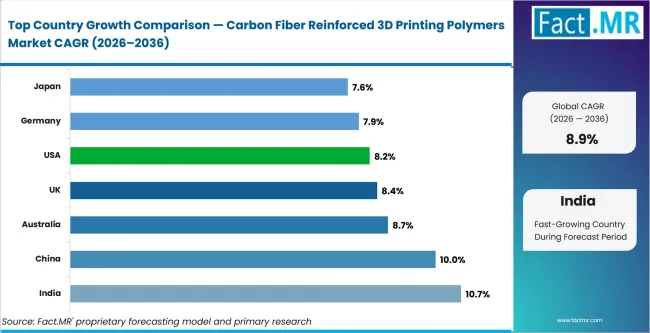
Carbon Fiber Reinforced 3d Printing Polymers Market Cagr Analysis By Country | Source: Fact.MR
Why is automotive production strengthening India’s market position?
10.7% CAGR, supported by vehicle production scale and localized tooling demand across manufacturing clusters.
Automotive production scale gives India a practical demand base for lightweight fixtures and short-run manufacturing aids. In February 2026, the Press Information Bureau reported passenger-vehicle production of 5.38 million units during 2025. The market is expected to record a 10.7% CAGR during the forecast period as localized production creates additional tooling requirements. Material suppliers gain stronger access when drying support and process guidance remain close to automotive manufacturing clusters.
How is equipment output accelerating China’s reinforced polymer demand?
10.0% CAGR, owing to expanding 3D-printing equipment output and wider industrial deployment.
Rapid equipment production is widening access to additive manufacturing across China’s industrial base. In January 2026, the National Bureau of Statistics reported that production of 3D printing devices increased 52.5% during 2025. Demand is projected to post a 10.0% CAGR over the assessment period as more industrial accounts move into repeatable part qualification. Material providers improve their position by connecting feedstock handling with machine settings and documented processing windows.
Where is Australia creating practical adoption opportunities?
8.7% CAGR, driven by machinery investment and specialized manufacturing programs across a dispersed industrial base.
Equipment renewal is opening targeted opportunities for reinforced polymers across tooling and low-volume functional parts. In May 2026, the Australian Bureau of Statistics reported an 18.1% increase in equipment and machinery expenditure during the March quarter. The market is anticipated to advance at an 8.7% CAGR by 2036 as specialized manufacturers test more localized production routes. Distributor support remains important because reinforced polymers require controlled storage and dependable process guidance across dispersed operating sites.
Why is SME adoption important to the United Kingdom outlook?
8.4% CAGR, shaped by aerospace networks and broader industrial technology adoption across specialist manufacturing clusters.
SME adoption gives the United Kingdom a route to broaden reinforced polymer printing beyond large aerospace programs. In August 2025, a government study reported that 17.1% of surveyed North-West SMEs had adopted 3D printing. Demand is estimated to record an 8.4% CAGR between 2026 and 2036 as specialist manufacturers gain confidence in additive workflows. Suppliers improve commercial access when application guidance reduces uncertainty around drying and machine compatibility.
What makes the United States a qualification-intensive market?
8.2% CAGR, attributable to aerospace qualification depth and broad reinforced-polymer development activity.
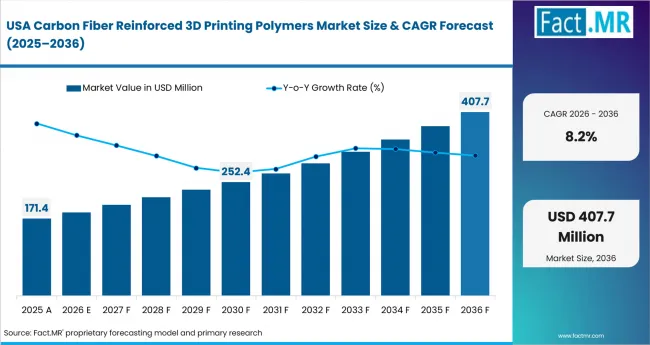
Carbon Fiber Reinforced 3d Printing Polymers Market Country Value Analysis | Source: Fact.MR
Aerospace material development gives the United States a demanding environment for reinforced polymer qualification and controlled processing. In November 2025, NASA reported a printed carbon-fiber-filled thermoset polyimide composite with a glass transition temperature of 370°C. The market is forecast to post an 8.2% CAGR across the forecast period as aerospace teams evaluate higher-performance printed components. Suppliers compete through material data and application engineering that can shorten customer validation work.
How does Germany’s manufacturing depth support market growth?
7.9% CAGR, supported by engineering-intensive manufacturing and recurring demand for factory tooling.
Engineering-heavy production creates recurring opportunities for reinforced polymer fixtures and low-volume tooling across German factories. In February 2026, Destatis reported that manufacturing orders increased 7.8% during December 2025 from the previous month. The market is projected to record a 7.9% CAGR during the assessment period as manufacturers evaluate lighter production aids and specialized components. Adoption improves when suppliers provide repeatable processing windows and local qualification support.
Why is precision manufacturing shaping Japan’s demand outlook?
7.6% CAGR, driven by precision manufacturing and machine-tool modernization across industrial supply chains.
Precision manufacturing creates a strong fit for additive processes that deliver controlled dimensions across short production runs. In March 2025, METI set a goal to raise Japan’s share of the global metal additive manufacturing market from below 10% to 20% by 2040. Demand is estimated to advance at a 7.6% CAGR over the forecast horizon as industrial suppliers evaluate higher-value additive applications. Reinforced polymer printing gains relevance when material controls integrate with established factory quality systems.
Who leads the Carbon Fiber Reinforced 3D Printing Polymers Market?
Markforged and Stratasys compete through integrated printing workflows, while Forward AM / Mass Additive Manufacturing GmbH and Solvay broaden reinforced polymer material choice.
Key players such as Markforged focus on FFF systems that support continuous carbon-fiber reinforcement for tooling and functional parts. Stratasys offers carbon-fiber-filled FDM materials for rigid fixtures and production components across industrial accounts. Forward AM / Mass Additive Manufacturing GmbH expands material choice through reinforced filament grades for FFF workflows. Solvay contributes high-performance polymer expertise for demanding thermal and chemical service conditions.
Toray Industries contributes carbon-fiber expertise that supports material development across composite value chains. Evonik Industries adds engineering polymer chemistry and additive manufacturing material knowledge for demanding industrial applications. Competition over the assessment period is expected to center on process documentation and machine compatibility. Local technical support and qualification evidence will also shape supplier positioning.
Which companies are the key providers?
Key players include Markforged and Stratasys. Forward AM / Mass Additive Manufacturing GmbH and Solvay add material portfolios. Toray Industries provides fiber expertise. Evonik Industries completes the profiled company set.
- Markforged
- Stratasys
- Forward AM / Mass Additive Manufacturing GmbH
- Solvay
- Toray Industries
- Evonik Industries
Bibliography
- Australian Bureau of Statistics. (2026, May 28). Private New Capital Expenditure and Expected Expenditure, Australia. Australian Bureau of Statistics.
- Department for Science, Innovation & Technology. (2025, August 22). Factors affecting adoption of 3D printing by SMEs: The case of Greater Manchester. GOV.UK.
- Eurostat. (2025, July). Industrial production statistics. European Commission.
- Evonik Industries. (2025, March 27). Evonik partners with 3DChimera to distribute 3D-printing powders in the US. Evonik Industries.
- International Air Transport Association. (2026, January 29). Strong 2025 passenger demand masks ongoing capacity constraints. IATA.
- Ministry of Heavy Industries. (2026, February 10). Heavy industries sector. Press Information Bureau, Government of India.
- National Aeronautics and Space Administration. (2025, November 30). Additive Manufacturing: Stronger, Lighter, Cheaper, Faster. NASA Technology Transfer Program.
- National Bureau of Statistics of China. (2026, January 19). National economy pushed forward with innovation-led and high-quality development and expected targets achieved successfully in 2025. National Bureau of Statistics of China.
- Oak Ridge National Laboratory. (2025, July 23). 3D printing reshapes construction for nuclear energy. Oak Ridge National Laboratory.
- Stratasys Ltd. (2026, March 15). 3D printing carbon fiber for the factory floor. Stratasys.
- Stratasys Ltd. (2026, May 27). Stratasys to acquire MarkForged, Inc., expanding aerospace, defense, and industrial production capabilities. Stratasys Ltd.
- Federal Statistical Office of Germany. (2026, March 9). New orders in manufacturing in January 2026: -11.1% on the previous month. Destatis.
- Ministry of Economy, Trade and Industry. (2025, March 28). FY2025 Vision for the Machine Parts and Tooling Industries Formulated. METI.
This Report Addresses
- The report provides strategic intelligence on the Carbon Fiber Reinforced 3D Printing Polymers market across material types, reinforcement formats, technologies, and end-use industries influencing market growth and adoption.
- Segment analysis covers Carbon Fiber Reinforced Nylon and Carbon Fiber Reinforced PLA as key revenue-generating material categories within the current market structure.
- Regional outlook evaluates North America and Europe alongside Asia-Pacific. The assessment also covers Latin America and the Middle East & Africa, with country-level analysis including the United States, Germany, China, Japan, and India.
- Competitive analysis profiles Markforged and Stratasys alongside 3D Systems. The competitive landscape also covers BASF, Solvay, SABIC, Arkema, Evonik Industries, and Mitsubishi Chemical Group.
- Material Type assessment covers Carbon Fiber Reinforced Nylon and Carbon Fiber Reinforced PLA alongside Carbon Fiber Reinforced ABS, PETG, PEEK, PEKK, and other high-performance polymer formulations.
- Technology assessment covers Fused Deposition Modeling (FDM/FFF) and Continuous Fiber Reinforcement alongside Selective Laser Sintering (SLS) and other advanced additive manufacturing processes.
- Application assessment covers Aerospace & Defense and Automotive alongside Industrial Manufacturing, Tooling, Consumer Products, Healthcare, and Research & Development applications.
- End Use assessment covers OEMs and Manufacturing Enterprises alongside Service Providers, Prototyping Centers, Educational Institutions, and Engineering Organizations.
- Market dynamics analysis evaluates demand drivers, technological advancements, sustainability trends, supply chain developments, and investment opportunities shaping the industry outlook.
- The report examines emerging opportunities in lightweight structural components, customized production, high-strength functional parts, and next-generation additive manufacturing materials.
What does the Carbon Fiber Reinforced 3D Printing Polymers Market cover?
Nylon (PA) and PETG composites support accessible reinforced-polymer printing across industrial tooling and functional parts.
The market covers print-ready polymer systems reinforced with carbon fiber across FDM/FFF and SLS routes. DLP/SLA completes the technology framework. Coverage includes filament and pellet forms alongside powder used across qualified programs.
The market differs from the broader carbon-fiber composites category because value comes from polymer feedstock engineered for additive processing and documented machine compatibility. Conventional prepreg and laminate systems remain outside the boundary unless they are feedstock within a defined additive manufacturing workflow.
What is included in the scope?
Carbon fiber reinforced polymer feedstocks used across industrial additive manufacturing tooling and functional-part programs worldwide.
Coverage includes Nylon (PA) and PETG systems alongside ABS. PEEK and PLA complete the polymer framework. The study covers Filament and Pellet forms alongside Powder. Technology coverage includes FDM/FFF and SLS alongside DLP/SLA. End-use coverage spans Aerospace & Defense and Automotive programs. Industrial Tooling and Consumer Goods follow within the framework. Medical programs complete coverage where reinforced polymers support controlled production needs.
What is excluded from the scope?
Neat polymers and conventional carbon-fiber laminates used outside additive manufacturing workflows are excluded from the scope.
The scope excludes unreinforced polymer feedstocks and standalone carbon fiber sold for conventional composite processing. Metal additive manufacturing and continuous-fiber prepreg laminates remain outside the boundary unless carbon fiber is integrated within a print-ready polymer system for additive manufacturing.
How was the analysis built?
140+ sources and 45+ company portfolios support the analysis across 30+ countries and 24+ interviews.
- Primary Research
- Primary research includes interviews with additive manufacturing engineers and materials formulators alongside aerospace tooling specialists and factory automation teams. Procurement managers and application engineers were also consulted about qualification timing and resin handling requirements across reinforced polymer programs.
- Desk Research
- Desk research reviews official manufacturing statistics and additive manufacturing benchmark programs alongside supplier portfolios and technical product pages. Company announcements and material data sheets were evaluated to confirm portfolio activity and current carbon-fiber polymer coverage.
- Market-Sizing and Forecasting
- Forecasting uses additive manufacturing equipment activity and polymer mix alongside feedstock form. Technology adoption and end-use qualification patterns also inform average pricing assumptions. Models consider replacement cycles and tooling substitution behavior while separating filament use from pellet and powder workflows.
- Data Validation and Update Cycle
- Forecasts are validated through provider checks and technical interviews that test assumptions on qualification timing and application adoption. Portfolio mapping and country demand assessment support periodic updates when ownership changes or material launches alter competitive coverage.
Segmentation
What is the report’s scope and coverage?
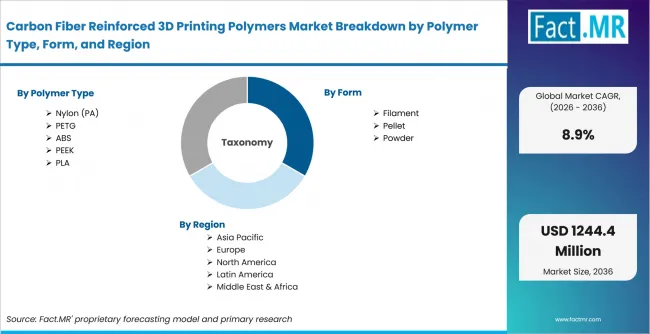
Carbon Fiber Reinforced 3d Printing Polymers Market Breakdown By Polymer Type, Form, And Region | Source: Fact.MR
| Attribute | Details |
|---|---|
| Quantitative Units | USD Million |
| Market Definition | Print-ready polymer feedstocks reinforced with carbon fiber for additive manufacturing across tooling, functional parts, prototypes, and qualified end-use components. |
| Polymer Type | Nylon (PA); PETG; ABS; PEEK; PLA |
| Form | Filament; Pellet; Powder |
| Technology | FDM/FFF; SLS; DLP/SLA |
| End Use | Aerospace & Defense; Automotive; Industrial Tooling; Consumer Goods; Medical |
| Regions Covered | North America; Europe; Asia Pacific; Oceania; Middle East & Africa |
| Countries Covered | India; China; Australia; United Kingdom; United States; Germany; Japan |
| Key Companies Profiled | Markforged; Stratasys; Forward AM / Mass Additive Manufacturing GmbH; Solvay; Toray Industries; Evonik Industries |
| Forecast Period | 2026 to 2036 |
| Approach | Hybrid top-down and bottom-up approach using additive manufacturing equipment activity; polymer mix; feedstock form; technology adoption; end-use qualification patterns; average pricing; replacement cycles; and tooling substitution behavior |
Source: Fact.MR analysis. Updated Jul 9, 2026
How is the market segmented?
-
By Polymer Type
- Nylon (PA)
- PETG
- ABS
- PEEK
- PLA
-
By Form
- Filament
- Pellet
- Powder
-
By Technology
- FDM/FFF
- SLS
- DLP/SLA
-
By End Use
- Aerospace & Defense
- Automotive
- Industrial Tooling
- Consumer Goods
- Medical
-
By Region
- North America
- United States
- Canada
- Europe
- Germany
- United Kingdom
- France
- Italy
- Spain
- Asia Pacific
- India
- China
- Japan
- South Korea
- Australia
- Latin America
- Brazil
- Argentina
- Mexico
- Chile
- Middle East & Africa
- UAE
- Saudi Arabia
- South Africa
- North America
Frequently Asked Questions
How is Nylon (PA) positioned within the Carbon Fiber Reinforced 3D Printing Polymers Market?
What role does Filament play in the Carbon Fiber Reinforced 3D Printing Polymers Market?
How prominent is FDM/FFF technology in the Carbon Fiber Reinforced 3D Printing Polymers Market?
What contribution does Aerospace & Defense make to market demand?
Which country demonstrates strong growth potential in the Carbon Fiber Reinforced 3D Printing Polymers Market?
How is the Carbon Fiber Reinforced 3D Printing Polymers Market expected to progress in China?
What outlook is anticipated for Australia in the Carbon Fiber Reinforced 3D Printing Polymers Market?
How is demand projected to evolve in the United Kingdom?
What trend characterizes the United States market?
How does Germany perform in the Carbon Fiber Reinforced 3D Printing Polymers Market?
What growth pattern is expected in Japan?
What factor primarily supports market expansion?
Which challenge continues to influence market adoption?
Why does Nylon (PA) maintain an important position in the market?
What supports Aerospace & Defense demand for carbon fiber reinforced 3D printing polymers?
Who worked on this report


Preview the report firsthand - request a free sample
Free SampleGet the brochure for pricing and purchase details
Download PDF