- Market Value (2025): USD 490.3 Mn
- Estimated Value (2026): USD 523.0 Mn
- Forecast Value (2036): USD 997.6 Mn
- CAGR (2026-2036): 6.7%
What is the Cationic Aqueous Polyurethane Market forecast to be worth by 2036?
USD 523.1 million in 2026 to USD 997.6 million by 2036 at a 6.7% CAGR.
- According to Fact.MR, the cationic aqueous polyurethane market reached USD 490.3 million in 2025, with coatings and automotive programs taking the bulk of volume.
- Revenue will nearly double over the decade, climbing from USD 523.0 million in 2026 to USD 997.6 million by 2036 as solvent-borne binders lose ground.
- A 6.7% CAGR will carry the market from 2026 to 2036, helped by tighter VOC limits and wider use in textile and leather finishing.
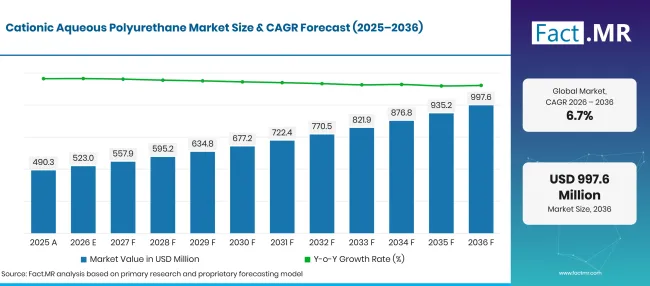
Factmr Cationic Aqueous Polyurethane Market Forecast Global | Source: Fact.MR
| Year | Basis | Market Value (USD million) |
|---|---|---|
| 2025 | Actual | 490.3 |
| 2026 | Estimate | 523.0 |
| 2036 | Forecast | 997.6 |
| CAGR 2026 to 2036 | Forecast period | 6.7% |
Source: Fact.MR analysis. Updated Oct 21, 2026
What are the defining numbers behind Cationic Aqueous Polyurethane Market growth?
The 2026 to 2036 period will add USD 474.5 million in new value, led by coatings and automotive uses.
- Demand Drivers in the Market
- Solvent emission limits keep pushing coating and adhesive producers toward aqueous dispersions. The European Environment Agency reported that EU emissions of non-methane volatile organic compounds fell by 35% between 2005 and 2023 [1]. Paints and adhesives remain among the solvent uses under review, and water-based binders give formulators a direct way to cut VOC content.
- Vehicle makers specify low-emission binders for interior trim, seat fabrics, bonding and sealing. Cationic dispersions meet durability and appearance targets while keeping solvent use low in plants that operate under strict air permits.
- Textile and leather processors are adopting cationic grades for the way their positive charge bonds to negatively charged fibers and hides. This charge match improves binder uptake and wash fastness in fiber treatment and finishing.
- Air quality policy keeps pressure on solvent emissions from buildings and factories. WHO/Europe estimated in November 2025 that air pollution kills more than 500,000 people a year in the WHO European Region [2]. Specifiers respond by choosing low-VOC paints and joint fillers for indoor spaces.
- Product innovation is widening buyer choice. Solvent-free, self-crosslinking and bio-based dispersions now let customers meet sustainability goals without giving up film performance.
- Key Segments Analyzed
- By Product Type: Waterborne Polyurethane Dispersions will account for 66.2% share in 2026, since water as the carrier cuts solvent emissions for most coating, adhesive and textile processors.
- By Application: Coatings will capture 42.3% share in 2026 through steady use of cationic dispersions in durable, low-emission finishes.
- By End-User Industry: Automotive will hold 38.6% share in 2026, given that vehicle plants need low-emission coatings, adhesives and sealants.
- Analyst Opinion at Fact.MR
- Shambhu Nath Jha, Principal Consultant at Fact.MR, states, “Buyers now judge cationic polyurethane on two things: how well it grips difficult substrates and how little solvent it carries. Automotive, textile and construction formulators will keep moving volume to dispersions that pass their qualification tests without forcing changes to the rest of the system. Suppliers that pair solvent-free and bio-based cationic grades with local technical service will win a growing number of customer programs through 2036.”
- Strategic Implications
- Dispersion producers should widen their solvent-free and low-VOC cationic ranges, since formulators are retiring solvent-borne systems as emission rules tighten.
- Resin developers should bring bio-based and self-crosslinking chemistries to market so that customers can reach sustainability targets without weaker films.
- Suppliers to automotive, textile and leather customers should plan for long qualification cycles, given that these buyers test adhesion and durability before approving a new source.
- Coating and adhesive formulators should screen cationic grades against anionic additives and pigments early, because a charge conflict can destabilize a batch.
Germany leads at 7.8% on a deep chemical base and strict solvent limits for coaters. Brazil follows at 7.1% as car, construction and leather output expands. The United States will post 6.5%, drawing on a broad coatings and adhesives industry. In the United Kingdom, specialty coatings and building work support 5.8%. Japan rounds out the group at 5.1% with demand tied to automotive, electronics and textile makers.
How does the Cationic Aqueous Polyurethane Market break down by segment?
Waterborne Polyurethane Dispersions will lead Product Type at 66.2%; Coatings will top Application at 42.3%; Automotive will head End-User Industry at 38.6%.
Which Product Type holds first place?
Waterborne Polyurethane Dispersions make up 66.2% of 2026 sales.
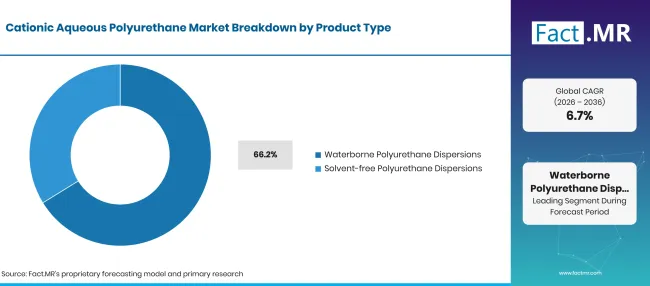
Factmr Cationic Aqueous Polyurethane Market Breakdown Product Type | Source: Fact.MR
| Product Type | Share (2026) |
|---|---|
| Waterborne Polyurethane Dispersions (Leading segment) | 66.2% |
| Other segments combined | 33.8%* |
| Total | 100.0% |
Source: Fact.MR analysis. Updated Oct 21, 2026
Formulators default to water-carried dispersions because their existing mixing, coating and curing lines handle them with only minor changes. Water as the main carrier lowers solvent emissions and fits the compliance needs of coating, adhesive and textile processors. The wider pool of polyurethane dispersions also gives cationic grades shared raw materials and process know-how. Solvent-free Polyurethane Dispersions will add a growing slice of demand. They avoid co-solvents such as NMP entirely, which appeals to automotive interior suppliers and indoor construction users facing the tightest emission limits. Producers often pair these grades with self-crosslinking chemistry to keep water resistance high.
What leads the Application segment?
Coatings take 42.3% of 2026 sales.
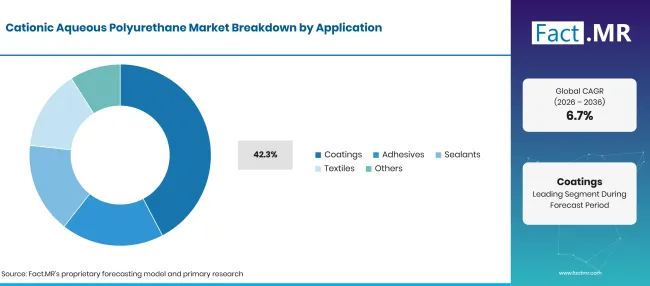
Factmr Cationic Aqueous Polyurethane Market Breakdown Application | Source: Fact.MR
| Application | Share (2026) |
|---|---|
| Coatings (Leading segment) | 42.3% |
| Other segments combined | 57.7%* |
| Total | 100.0% |
Source: Fact.MR analysis. Updated Oct 21, 2026
Coaters turn to cationic dispersions where a film must grip glass, mineral, metal or fiber surfaces that carry a negative charge. The binders build hard, adherent layers at low solvent content, which suits wood coatings and industrial finishes. Growth in automotive, construction and industrial finishing keeps formulators ordering these grades. Regulation backs the shift away from solvents. A post-implementation review rated by the UK Regulatory Policy Committee in March 2025 put VOC reductions from the paints and vehicle refinishing regulations at 364 kilotonnes between 2007 and 2021 [3]. Adhesives rely on cationic dispersions for bonding to charged surfaces. Sealants use them for flexible joints, and textile mills apply them in fiber finishing.
How does End-User Industry shape demand?
Automotive accounts for 38.6% of 2026 sales.
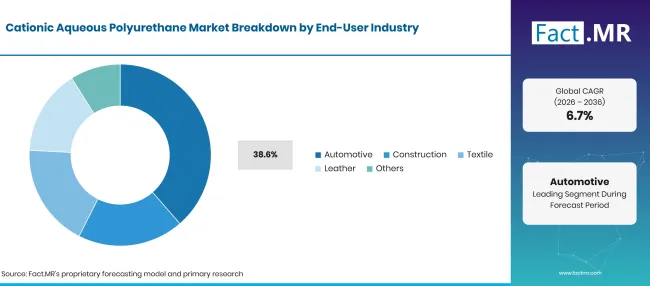
Factmr Cationic Aqueous Polyurethane Market Breakdown End User Industry | Source: Fact.MR
| End-User Industry | Share (2026) |
|---|---|
| Automotive (Leading segment) | 38.6% |
| Other segments combined | 61.4%* |
| Total | 100.0% |
Source: Fact.MR analysis. Updated Oct 21, 2026
Vehicle makers and Tier 1 suppliers use water-based coatings, automotive adhesives and sealants to meet plant emission permits without losing durability or appearance. Interior parts, seat textiles and trim add steady volume. The Kraftfahrt-Bundesamt counted 545,142 new battery electric cars in Germany in 2025, a 19.1% share of new registrations and 43.2% more than a year earlier [4]. Each new platform opens a fresh qualification window for low-emission binders. Construction uses cationic dispersions in floor coatings, waterproofing chemicals and joint sealants. Leather processors apply them as base coats and finishing binders, where adhesion to the hide is prized. Paper and packaging converters make up the remaining demand.
What is accelerating Cationic Aqueous Polyurethane Market adoption, and what is holding it back?
Stricter VOC rules, automotive programs and textile and leather finishing will keep adoption moving. Raw material price swings and the premium charged for specialty cationic grades remain the main brakes on wider use.
Drivers Impact Analysis
| DRIVER | (~) % IMPACT ON CAGR | GEOGRAPHIC RELEVANCE | IMPACT TIMELINE |
|---|---|---|---|
| Tightening solvent emission limits accelerating the shift to aqueous dispersions | +2.0% | Global | Short term (<= 2 years) |
| Expanding automotive demand for durable, low-emission coatings, adhesives and sealants | +1.5% | Western Europe, North America, East Asia | Medium term (2-4 years) |
| Rising adoption of cationic grades in textile and leather finishing | +1.2% | South Asia & Pacific, East Asia, Latin America | Medium term (2-4 years) |
| Growth in low-VOC coatings and sealants for indoor construction applications | +0.8% | Global | Long term (>= 4 years) |
Source: Fact.MR analysis. Updated Oct 21, 2026
Opportunity Impact Analysis
| OPPORTUNITY | (~) % IMPACT ON CAGR | GEOGRAPHIC RELEVANCE | IMPACT TIMELINE |
|---|---|---|---|
| Commercialization of solvent-free and bio-based dispersions | +1.2% | Global | Medium term (2-4 years) |
| Self-crosslinking grades delivering enhanced film durability | +0.8% | Western Europe, East Asia | Long term (>= 4 years) |
| Partnerships between dispersion producers and automotive OEMs for compliant formulations | +0.6% | North America, Western Europe | Medium term (2-4 years) |
| Adoption in emerging markets with stricter air quality norms | +0.4% | Latin America, South Asia & Pacific | Short term (<= 2 years) |
Source: Fact.MR analysis. Updated Oct 21, 2026
Restraints Impact Analysis
| RESTRAINT | (~) % IMPACT ON CAGR | GEOGRAPHIC RELEVANCE | IMPACT TIMELINE |
|---|---|---|---|
| Higher cost relative to solvent-borne and conventional anionic systems | -0.8% | Global | Short term (<= 2 years) |
| Raw material price volatility for isocyanates and polyols | -0.6% | Global | Medium term (2-4 years) |
| Formulation compatibility limits with anionic additives and pigments | -0.4% | Global | Long term (>= 4 years) |
Source: Fact.MR analysis. Updated Oct 21, 2026
Which countries are scaling the Cationic Aqueous Polyurethane Market through 2036?
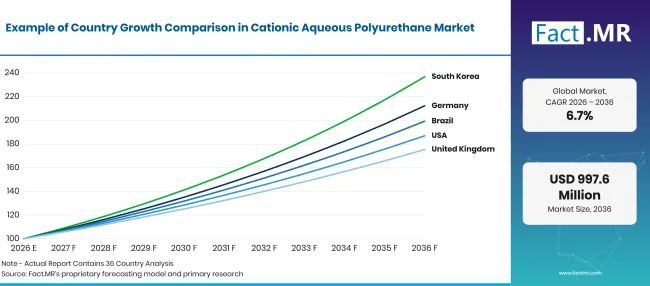
Factmr Cationic Aqueous Polyurethane Market Growth Index | Source: Fact.MR
| Country | CAGR (2026–2036) |
|---|---|
| Germany | 7.8% |
| Brazil | 7.1% |
| United States | 6.5% |
| United Kingdom | 5.8% |
| Japan | 5.1% |
Source: Fact.MR analysis. Updated Oct 21, 2026
What supports Germany’s adoption?
7.8% CAGR, backed by a strong chemical and automotive base and strict solvent limits.
Germany pairs a large chemical manufacturing base with major automotive and industrial coating sectors. The Umweltbundesamt reported that national NMVOC emissions fell to just under 1 million tonnes in 2024, down 75.8% from 1990 [5]. Industrial processes and product use, which include solvent applications, still made up 49% of that total [5]. Local formulators will keep shifting adhesion-critical textile, fiber and coating work to cationic water-based grades.
How is Brazil scaling demand?
7.1% CAGR, on the back of growing automotive, construction and leather activity.
Brazil’s automotive, construction, leather and textile industries are raising demand for water-based coatings and adhesives. IBGE reported that tanneries acquired 11.13 million raw cattle hides in the fourth quarter of 2025, up 11.8% from a year earlier [6]. More hides in process mean more finishing binder orders. Tighter environmental compliance will also move local processors away from solvent-based systems.
What supports United States adoption?
6.5% CAGR, reflecting a large automotive, construction and coatings base.
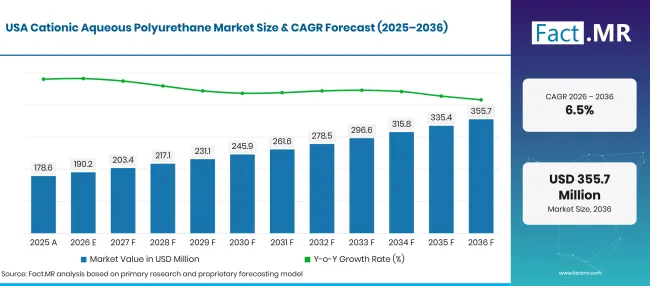
Factmr Cationic Aqueous Polyurethane Market Forecast Usa | Source: Fact.MR
The Census Bureau put 2025 construction spending in the United States at USD 2.16 trillion, 1.4% below 2024 [7]. That base still absorbs large volumes of architectural and industrial coatings. In January 2025, EPA amended its national VOC standards for aerosol coatings, adding reactivity factors and updating category emission limits [8]. New volume will come mainly from solvent-free, high-performance and bio-based grades.
How does the United Kingdom perform?
5.8% CAGR, helped by specialty coatings and construction chemicals demand.
The United Kingdom has a smaller industrial base, so demand gathers in specialty coatings, adhesives and construction chemicals. The Office for National Statistics reported that construction output rose 1.8% in 2025 compared with 2024 [9]. Low-emission requirements in building work favor water-based products. Gains will lean on higher-value grades designed for specific applications.
How is Japan developing demand?
5.1% CAGR, as automotive and textile users adopt high-performance grades.
Japan has a mature base of automotive, electronics and textile manufacturers that need precise, high-performance coatings and adhesives. Japan’s land and transport ministry (MLIT) forecast FY2025 construction investment at about JPY 75.6 trillion, up 3.2% from FY2024 [10]. Building work gives water-based sealants and floor coatings a second outlet. Future gains will come from solvent-free, high-durability and specialty cationic grades.
Who leads the Cationic Aqueous Polyurethane Market?
Supplier roles fall into three tiers.
Integrated chemical groups make dispersions from their own isocyanates and polyols, which gives them cost control and global reach. BASF sells Luphen water-based polyurethane dispersions for adhesives. In October 2025, it expanded dispersion capacity at Dilovası in Türkiye for low-VOC architectural and construction uses [11]. Covestro offers Bayhydrol and Impranil grades and launched Bayhydrol UH 2896 and UH 2897 for China’s waterproofing market in November 2025 [12]. Wanhua Chemical Group offers Lacper waterborne polyurethane dispersions for coatings. Resin specialists form the second tier and compete on formulation know-how. Allnex Group scheduled seminars on high bio-based polyurethane dispersions for China Coat 2025 [13]. Lubrizol (Sancure), Alberdingk Boley and Mitsui Chemicals (Takelac W) serve wood, packaging and textile coaters. Leather and fabric experts make up the third tier. DIC Corporation lists a cationic water-based urethane resin next to its HYDRAN range, and Stahl sells polyurethane dispersion base coats to tanneries. Charge stability with anionic additives, solvent-free options and local application labs will decide which suppliers win new programs.
Which companies are the key providers?
Key companies include BASF SE; Covestro AG; Wanhua Chemical Group Co., Ltd.; Mitsui Chemicals, Inc.; DIC Corporation; Lubrizol Corporation; Allnex Group; Alberdingk Boley GmbH; and Stahl Holdings B.V.
- BASF SE
- Covestro AG
- Wanhua Chemical Group Co., Ltd.
- Mitsui Chemicals, Inc.
- DIC Corporation
- Lubrizol Corporation
- Allnex Group
- Alberdingk Boley GmbH
- Stahl Holdings B.V.
Bibliography
- [1] European Environment Agency. (2025, September 23). Emissions of the main air pollutants in Europe.
- [2] World Health Organization, Regional Office for Europe. (2025, November 27). WHO updates guidance to better inform decisions on clean air and climate change mitigation policies.
- [3] Regulatory Policy Committee. (2025, March 11). RPC opinion: The Volatile Organic Compounds in Paints, Varnishes and Vehicle Refinishing Products Regulations 2012, post implementation review.
- [4] Kraftfahrt-Bundesamt. (2026, January 6). Fahrzeugzulassungen im Dezember 2025: Jahresbilanz [Vehicle registrations in December 2025: Annual review].
- [5] Umweltbundesamt. (2026, June 25). Emission flüchtiger organischer Verbindungen ohne Methan (NMVOC) [Emissions of non-methane volatile organic compounds (NMVOC)].
- [6] Instituto Brasileiro de Geografia e Estatística (IBGE). (2026, February 12). Trimestrais da pecuária: abate de bovinos, suínos e frangos cresce no 4° trimestre [Quarterly livestock surveys: cattle, pig and chicken slaughter grows in the 4th quarter].
- [7] U.S. Census Bureau. (2026, February 27). Monthly Construction Spending, December 2025.
- [8] U.S. Environmental Protection Agency. (2025, January 17). National Volatile Organic Compound Emission Standards for Aerosol Coatings Amendments.
- [9] Office for National Statistics. (2026, February 12). Construction output in Great Britain: December 2025, new orders and Construction Output Price Indices, October to December 2025.
- [10] Ministry of Land, Infrastructure, Transport and Tourism, Japan. (2025, August 29). 令和7年度(2025年度)建設投資見通し [FY2025 Construction Investment Outlook].
- [11] BASF. (2025, October 7). BASF expands production capacity for dispersions for the architectural coatings and construction industries in Dilovası, Türkiye.
- [12] Covestro. (2025, November 18). Covestro launches new coatings solutions and lab automation in Asia Pacific.
- [13] allnex. (2025, November 25). allnex to Showcase Sustainable Coating Innovations at China Coat 2025.
This Report Answers
- How are cationic aqueous polyurethane sales split by product type, application and end-user industry?
- Which subsegment comes first in each segment, and which customer needs shape its 2026 share?
- How do industrial base, emission rules and growth outlook differ across Germany, Brazil, the United States, the United Kingdom and Japan?
- Who supplies the market, from integrated chemical producers to resin specialists and leather and fabric experts?
- How fast will solvent emission limits and low-VOC requirements move buyers from solvent-borne to water-based systems?
What does the Cationic Aqueous Polyurethane Market cover?
Water-based polyurethane dispersions that carry positively charged groups form the Cationic Aqueous Polyurethane Market. The charge improves adhesion to negatively charged surfaces such as textile fibers, glass fibers, paper and leather.
Waterborne and solvent-free cationic dispersions are tracked in coating, adhesive and sealant uses as well as textile and other applications. Revenue is measured at the dispersion level for automotive, construction, leather and other end-user industries.
What is included in the scope?
Cationic polyurethane dispersions in water-based and solvent-free forms are counted, including self-crosslinking and bio-based grades. Sales to formulators and industrial processors that use them as binders, film formers and treatment agents are in scope.
Grades sold into fiber finishing alongside other textile chemicals are counted at the dispersion value. Cationic binders used in automotive coatings and interior trim finishes are also covered. Blends count when cationic polyurethane forms the active base.
What is excluded from the scope?
This assessment leaves out anionic and non-ionic polyurethane dispersions, as well as solvent-borne polyurethane systems. Acrylic and other non-polyurethane dispersions are excluded as well.
Finished coatings, adhesives, sealants and treated textiles or leather goods are not valued here. Only the dispersion sold to the formulator or processor counts toward market revenue.
How Was the Analysis Built?
The analysis draws on 120+ sources, 35+ company portfolios, 25+ countries, and more than 20 industry interviews.
- Primary Research: Primary research includes discussions with manufacturers, service providers, technology developers, distributors, end users, and subject-matter experts. These conversations examine purchasing priorities, product adoption, operational challenges, approval requirements, competitive positioning, and the factors that influence wider market acceptance.
- Desk Research: Desk research covers government statistics, regulatory publications, company filings, trade data, technical studies, industry associations, standards, public policy, and other authoritative sources. Every source used in the analysis is documented in the bibliography.
- Market Sizing and Forecasting: Market estimates combine historical performance, demand indicators, pricing and volume trends, segment shares, company participation, country-level growth, adoption patterns, investment activity, and barriers to market expansion.
- Data Validation and Update Cycle: Findings are validated by comparing primary interviews with public data, company activity, regulatory changes, trade patterns, and industry developments. Regular updates review new product launches, capacity changes, partnerships, approvals, and shifts in commercial adoption.
Segmentation
What is the report’s scope and coverage?
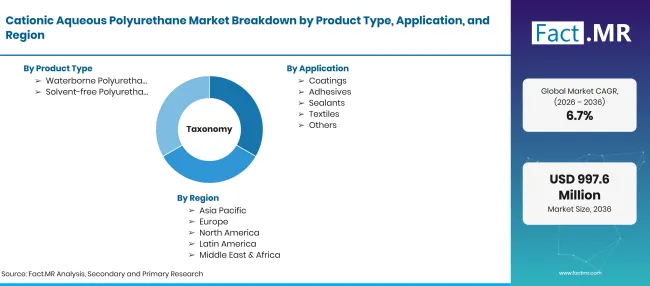
Factmr Cationic Aqueous Polyurethane Market Taxonomy | Source: Fact.MR
| Attribute | Details |
|---|---|
| Quantitative Units | USD million in 2026 to USD million by 2036 at CAGR |
| Market Definition | Water-based polyurethane dispersions carrying cationic (positively charged) groups, used as binders and film formers in coatings, adhesives, sealants, textile treatment and related industrial applications. |
| Product Type | Waterborne Polyurethane Dispersions; Solvent-free Polyurethane Dispersions |
| Application | Coatings; Adhesives; Sealants; Textiles; Others |
| End-User Industry | Automotive; Construction; Leather; Others |
| Regions Covered | North America; Latin America; Western Europe; Eastern Europe; East Asia; South Asia & Pacific; Middle East & Africa |
| Countries Covered | Germany; Brazil; United States; United Kingdom; Japan |
| Companies Profiled | BASF SE; Covestro AG; Wanhua Chemical Group Co., Ltd.; Mitsui Chemicals, Inc.; DIC Corporation; Lubrizol Corporation; Allnex Group; Alberdingk Boley GmbH; Stahl Holdings B.V. |
| Forecast Period | 2026 to 2036 |
| Approach | Hybrid top-down and bottom-up approach using coatings, adhesives and textile demand by application; product type mix; automotive, construction and leather output; country emission rules; and supplier portfolio review. |
Source: Fact.MR analysis. Updated Oct 21, 2026
How is the market segmented?
-
By Product Type
- Waterborne Polyurethane Dispersions
- Solvent-free Polyurethane Dispersions
-
By Application
- Coatings
- Adhesives
- Sealants
- Textiles
- Others
-
By End-User Industry
- Automotive
- Construction
- Leather
- Others
-
By Region
- North America
- Latin America
- Western Europe
- Eastern Europe
- East Asia
- South Asia & Pacific
- Middle East & Africa
Frequently Asked Questions
How big is the cationic aqueous polyurethane market in 2026?
What is the CAGR of the cationic aqueous polyurethane market from 2026 to 2036?
Which product type leads the cationic aqueous polyurethane market?
Which application leads the cationic aqueous polyurethane market?
Which end-user industry leads the cationic aqueous polyurethane market?
Which country will grow the most in the cationic aqueous polyurethane market?
Who are the main companies in the cationic aqueous polyurethane market?
Who worked on this report


Preview the report firsthand - request a free sample
Free SampleGet the brochure for pricing and purchase details
Download PDF