- Market Value (2025): USD 322.6 Mn
- Estimated Value (2026): USD 337.6 Mn
- Forecast Value (2036): USD 531.8 Mn
- CAGR (2026-2036): 4.7%
What is the Carbon-Graphite Bushings Market forecast to be worth by 2036?
USD 337.58 million in 2026 to USD 531.83 million by 2036, at a 4.65% CAGR.
- Carbon-graphite bushing revenue stood at USD 322.6 million in 2025.
- The market is estimated at USD 337.6 million in 2026 and USD 531.8 million in 2036.
- That represents a 4.7% CAGR through 2036, supported by qualified OEM components and replacement orders for industrial equipment.
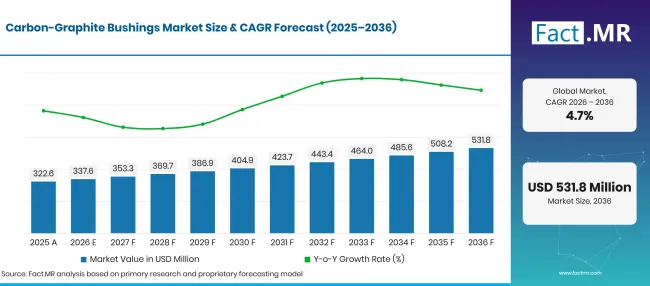
Factmr Carbon Graphite Bushings Market Forecast Global | Source: Fact.MR
| Year | Basis | Market Value (USD million) |
|---|---|---|
| 2025 | Historical estimate | 322.6 |
| 2026 | Estimate | 337.6 |
| 2036 | Forecast | 531.8 |
| CAGR 2026 to 2036 | Forecast period | 4.7% |
Source: Fact.MR analysis. Updated Oct 21, 2026
What are the defining numbers behind Carbon-Graphite Bushings Market growth?
The market is set to add USD 194.25 million in annual sales over the forecast. OEMs account for 67.2% of 2026 demand and Automotive makes up 36.0% by application. This is a business in which winning a design approval often matters more than attracting a one-time maintenance order.
- Demand Drivers in the Market
- Water-lubricated machinery creates demand for bushings that can support a shaft without a conventional oil circuit. A 2025 Japanese study tested resin-containing carbon-graphite bearings against stainless-steel sleeves and examined the influence of grooves on fluid-film pressure. [2] The research reinforces the importance of the complete sliding pair. Within the broader carbon and graphite market these finished components earn value through machining and application performance. Their commercial prospects cannot be read directly from demand for graphite electrodes or battery materials.
- Leak-control requirements influence the pump designs available to plant engineers. EPA's Texas implementation-plan provisions recognise submerged and sealless pumps among the configurations that can satisfy specified seal-system requirements. [8] This gives a clear reason to assess machinery without an external rotating shaft seal. The connection to the pumps market is design-specific. Carbon-graphite vendors benefit where their bushing is selected for that equipment. The rule itself does not require a carbon material or establish a procurement preference over ceramics.
- Automotive thermal-management pumps offer a repeat manufacturing route for compact sliding components. Schunk describes graphite bearings and seals for water and coolant pumps with components that can be integrated into overmoulding processes. [6] That product capability matters because the bearing must fit both the fluid system and the assembly method. Suppliers can secure recurring orders by resolving the interface with the pump manufacturer early. Growth depends on approved pump designs and production volumes rather than the broad assumption that every additional electric vehicle consumes the same carbon-graphite parts.
- Replacement demand gives specialist machinists a route into accounts with ageing equipment. Helwig's mechanical-carbon portfolio includes custom-engineered bushings and bearings alongside other machined carbon components. [1] A service customer needs the correct replacement geometry and material for an existing shaft. The commercial advantage can therefore come from identifying the part accurately and supplying it within a workable maintenance window. A low-priced substitute loses value if it requires further machining or performs poorly after the equipment returns to service.
- Key Segments Analyzed
- Resin Impregnated bushings hold 42.5% of Product Type revenue in 2026. Grade selection links pore structure and impregnation to the intended lubrication conditions.
- Automotive accounts for 36.0% of Application revenue in 2026. Pump and related sliding-component designs create a route to repeat purchases after OEM validation.
- OEMs contribute 67.2% of End-User revenue in 2026. A bushing specified during equipment development can remain part of the approved assembly through recurring production runs.
- Analyst Opinion at Fact.MR
- Shambhu Nath Jha, Lead Consultant, Fact.MR
- Start with the machine, not the graphite grade. Fluid chemistry, shaft material and the number of dry starts all affect how a bushing wears. A supplier that understands those conditions can recommend a tested material and keep the part specified across production runs. The phrase 'self-lubricating' is too broad to answer an engineer's questions. Focused work with pump and coolant-system manufacturers offers a stronger basis for repeat orders than trying to sell one standard bushing into every industry.
- Strategic Implications
- Test the bushing during start-up as well as steady operation. A shaft may run with a protective fluid film after reaching speed but make damaging contact on repeated starts. Mersen's guidance distinguishes lubrication conditions and cautions against relying on one load-speed figure. [3] A supplier should agree the duty cycle with the equipment builder before promising performance.
- Do not treat a bearing bushing and a pump seal as the same sale. One guides a shaft; the other limits leakage. Mersen makes carbon components for both functions, and the wider gaskets and seals market serves some of the same equipment buyers. [3] Shared customer access can help a supplier, but the parts have different tolerances and qualification tests.
- Use surface texturing where a test justifies it. A 2025 water-lubrication study found that one dimple spacing gave the lowest friction and wear among the specimens tested. [10] It offers a design lead, not a standard texture for every machine. Machining more elaborate surfaces makes sense only when the customer's duty conditions show a meaningful gain.
- Specify an operating range instead of promising unlimited dry running. Research on polymer-impregnated graphite bearings considered vibration and elevated temperature, both of which change contact behaviour. [9] Buyers replacing a failed metal or polymer component need to know why the proposed graphite grade should perform differently with their shaft and fluid.
Germany leads the five-country forecast at 5.98%. Brazil offers a visible replacement route through water-equipment procurement. The USA combines local specialist supply with process-industry demand. UK opportunities centre on established materials capabilities. Japan's lower forecast growth still supports technically demanding pump programmes with long qualification relationships.
How does the Carbon-Graphite Bushings Market break down by segment?
Product Type identifies how the carbon-graphite material is impregnated. Application identifies the equipment sector and End-User separates original equipment supply from replacement purchasing. The same cylindrical geometry can serve very different operating conditions. A market segment therefore does not substitute for a material grade or a tested duty specification.
Why does Resin Impregnated lead the product mix?
Resin Impregnated bushings account for 42.5% of Product Type revenue in 2026.
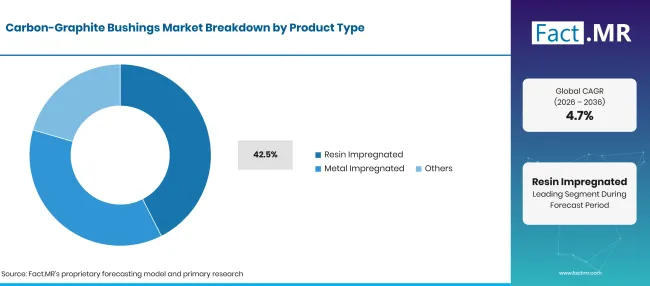
Factmr Carbon Graphite Bushings Market Breakdown Product Type | Source: Fact.MR
| Product Type | Share (2026) |
|---|---|
| Resin Impregnated | 42.5% |
| Other segments combined | 57.5% |
| Total | 100.0% |
Source: Fact.MR analysis. Updated Oct 21, 2026
Impregnation changes the material that the customer installs rather than simply adding a marketing designation. The choice affects pores and the interaction with the operating medium. Mersen's technical guidance identifies filling porosity as a key purpose of impregnation in its bearing grades. [3] Buyers should therefore compare the actual impregnated material with the shaft and fluid combination they intend to use. The resin label by itself gives an incomplete basis for substitution between suppliers or across two different machines. Metal Impregnated and other grades retain opportunities where their specific properties fit the application better. That choice needs to account for temperature and chemical compatibility. A supplier with several material options can avoid forcing one grade into unsuitable service. Commercial discipline means making the selection before negotiating a long production agreement and preserving the approved material identity in later replacement orders.
How does Automotive turn component development into repeat demand?
Automotive contributes 36.0% of Application revenue in 2026.
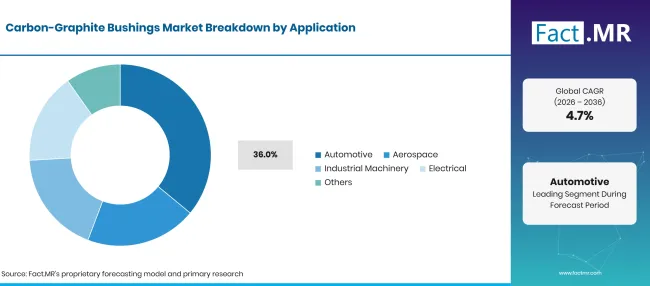
Factmr Carbon Graphite Bushings Market Breakdown Application | Source: Fact.MR
| Application | Share (2026) |
|---|---|
| Automotive | 36.0% |
| Other segments combined | 64.0% |
| Total | 100.0% |
Source: Fact.MR analysis. Updated Oct 21, 2026
Automotive purchasers need a bushing that can be manufactured repeatedly and fitted into the pump assembly without introducing avoidable variation. Schunk's water- and coolant-pump offering includes components designed for use as inserts in overmoulding. [6] This makes process compatibility part of the buying decision. A grade that performs well in a stand-alone test can still require changes before it fits the customer's assembly method. Vendors that contribute early to that work have a better chance of remaining within the released design. The application also brings concentration risk. A large vehicle or pump programme can account for a substantial portion of a supplier's dedicated tooling and inventory. Contracts should deal clearly with engineering changes and schedule reductions. The commercial objective is to retain stable recurring volume without accepting open-ended obligations for unused components when the customer's production plan changes.
Why do OEMs control most bushing purchases?
OEMs represent 67.2% of End-User revenue in 2026.
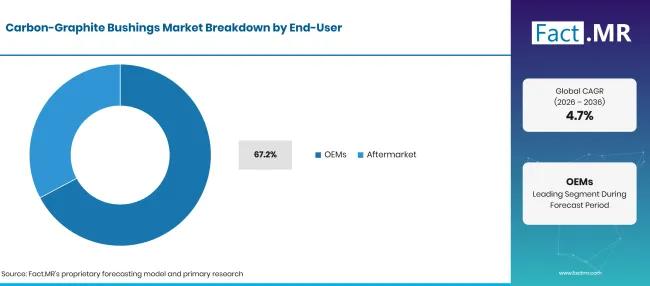
Factmr Carbon Graphite Bushings Market Breakdown End User | Source: Fact.MR
| End-User | Share (2026) |
|---|---|
| OEMs | 67.2% |
| Aftermarket | 32.8% |
| Total | 100.0% |
Source: Fact.MR analysis. Updated Oct 21, 2026
Equipment development establishes the required bore and shaft clearance along with the selected material. That specification limits later purchasing freedom because the bushing must remain compatible with the surrounding assembly. This is a distinct part of the broader bearing market. Morgan's 2025 annual report identifies direct sales to OEMs and assembly suppliers as routes for its Performance Carbon business. [4] For component vendors the useful commercial milestone is release into recurring manufacture rather than completion of an initial material trial. The Aftermarket offers a different form of value. Order quantities may be smaller but delivery time can matter greatly when equipment is unavailable. A vendor needs enough information to reproduce the approved part and identify the cause of premature wear. Stocking the wrong grade simply because the dimensions match can undermine the benefit of a rapid shipment. Segment shares are Fact.MR estimates. Other segments combined represent the balance of each category.
What is accelerating Carbon-Graphite Bushings Market adoption, and what is holding it back?
Most suppliers face two businesses at once. Original equipment makers want approved material, stable machining and long production runs. Maintenance buyers want an exact replacement quickly, often for an older machine. Mixing their stock and pricing policies can erode margin. Companies with disciplined grade records and flexible machining can serve both without making unqualified substitutions.
Drivers Impact Analysis
| DRIVER | (~) % IMPACT ON CAGR | GEOGRAPHIC RELEVANCE | IMPACT TIMELINE |
|---|---|---|---|
| Qualified components in automotive coolant-pump programmes | +1.0% | Germany; Japan; USA | Medium term (2 to 4 years) |
| Water-lubricated shaft support in industrial pumps | +0.8% | Global pump manufacturing | Medium term (2 to 4 years) |
| Replacement of worn parts in installed pumping equipment | +0.6% | Brazil; USA; industrial markets | Short term (up to 2 years) |
| Sealless machinery selected for demanding process fluids | +0.7% | USA; Europe; Japan | Medium term (2 to 4 years) |
| Recurring call-offs under approved OEM material specifications | +0.4% | Global | Short term (up to 2 years) |
Source: Fact.MR analysis. Updated Oct 21, 2026
Opportunity Impact Analysis
| OPPORTUNITY | (~) % IMPACT ON CAGR | GEOGRAPHIC RELEVANCE | IMPACT TIMELINE |
|---|---|---|---|
| Application-specific grooves and inspected surface features | +0.5% | Specialist pump and bearing programmes | Medium term (2 to 4 years) |
| Bushing inserts designed for automated overmoulding | +0.8% | Germany; Japan; automotive supply chains | Medium term (2 to 4 years) |
| Rapid replacement supply with verified material identity | +0.3% | Brazil; UK; USA | Short term (up to 2 years) |
| Grades validated for intermittent lubrication and thermal cycling | +0.6% | Industrial; aerospace; energy equipment | Long term (4 years or more) |
Source: Fact.MR analysis. Updated Oct 21, 2026
Restraints Impact Analysis
| RESTRAINT | (~) % IMPACT ON CAGR | GEOGRAPHIC RELEVANCE | IMPACT TIMELINE |
|---|---|---|---|
| Incorrect grade selection for fluid and start-up conditions | -0.8% | Global | Short term (up to 2 years) |
| Ceramic and engineered-polymer alternatives | -0.6% | Pump and automotive programmes | Long term (4 years or more) |
| OEM qualification and design-change costs | -0.5% | Germany; Japan; USA | Medium term (2 to 4 years) |
| Small production lots and machining rejection losses | -0.4% | Specialist replacement suppliers | Short term (up to 2 years) |
Source: Fact.MR analysis. Updated Oct 21, 2026
Which countries are scaling the Carbon-Graphite Bushings Market through 2036?
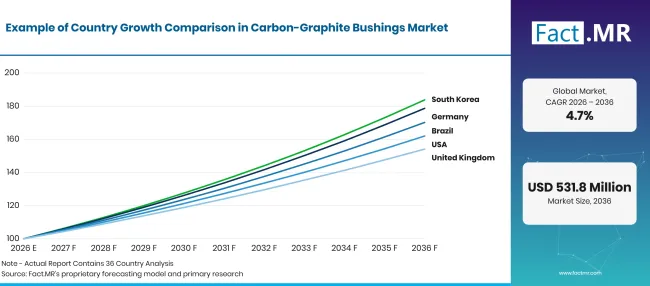
Factmr Carbon Graphite Bushings Market Growth Index | Source: Fact.MR
| Country | CAGR (2026 to 2036) |
|---|---|
| Germany | 5.98% |
| Brazil | 5.46% |
| United States | 4.9% |
| United Kingdom | 4.42% |
| Japan | 3.90% |
Source: Fact.MR analysis. Updated Oct 21, 2026
How can Germany's component suppliers defend an approved material position?
5.98% CAGR. Material selection and assembly integration support technically differentiated sales.
Schunk supplies graphite components for coolant and water pumps and describes ways to integrate them through overmoulding. [6] It also offers silicon-carbide alternatives. [7] German buyers can therefore compare materials within the same engineering discussion instead of assuming that a carbon bushing is the default choice.
Germany's forecast CAGR is 5.98%. Suppliers win when they help resolve a real pump-design problem early and then deliver the same approved material in production. Altering impregnation or machining after approval can be as disruptive as changing a major assembly component.
Where do Brazil's maintenance contracts create visible replacement demand?
5.46% CAGR. Water-equipment service channels offer a direct route to bushing purchases.
Cordilheira Alta's May 2025 maintenance procurement included 75 graphite bushings. [5] The number is small but instructive: Brazilian demand can arise from routine water-equipment repairs, not only from large new factory programmes. It describes one tender, not nationwide sales volume.
Brazil's 5.46% growth outlook makes distributors and repair contractors important customers. They often need a dimensionally accurate part for equipment installed years earlier. Correct identification, a dependable grade and a delivery date that fits the service outage can matter more than the lowest catalogue price.
How does process-equipment selection support the USA opportunity?
4.9% CAGR. Local specialist supply can serve demanding pump and replacement applications.
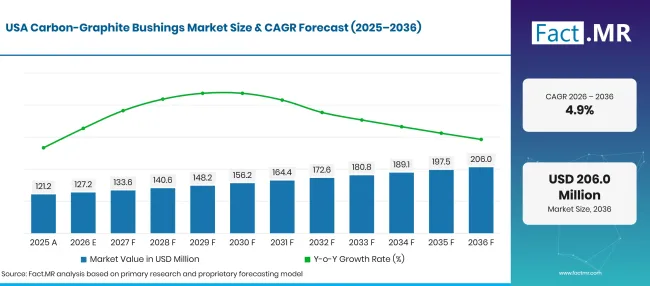
Factmr Carbon Graphite Bushings Market Forecast Usa | Source: Fact.MR
Texas EPA provisions recognise certain sealless and submerged pump arrangements when addressing leakage at shaft seals. [8] For U.S. plant engineers, this widens the equipment options under consideration. Where a design uses an internal bushing, the grade must still be qualified for its actual process fluid; the rule does not prescribe carbon graphite.
The United States is forecast to grow 4.94% annually. Firms such as Helwig offer custom mechanical-carbon bushings for demanding applications. [1] Local machining can be valuable when a repair window is short, provided the replacement material is properly identified. Quick delivery cannot compensate for a mismatch in bore, shaft or operating medium.
Why should UK suppliers separate bushing demand from wider carbon cycles?
4.42% CAGR. A broad materials portfolio offers market access but requires selective account planning.
Morgan lists sliding bearings within its Performance Carbon business in its 2025 annual report. [4] The wider division serves other carbon-product markets as well, so its performance is not a direct measure of UK bushing sales. What matters to a purchaser is access to the approved part for production and maintenance.
The UK forecast is 4.42%. Established carbon suppliers can combine new-equipment contracts with aftermarket work, but the two require different stocks and response times. Margin is more likely to come from accurate specifications and recurring accounts than from indiscriminately adding more grades to the catalogue.
What does Japan's bearing research imply for commercial qualification?
3.90% CAGR. Detailed knowledge of the sliding pair supports demanding pump programmes.
A 2025 Japanese study involving Miyazaki University and Nikkiso investigated resin-containing carbon-graphite bearings running against stainless-steel sleeves in water. Spiral grooves changed the calculated fluid-film pressure distribution. [2] This is useful design evidence, although it does not prove that the same groove pattern will work in every pump.
Japan's projected 3.90% growth is tied to demanding qualification work. Buyers will want tests of the actual shaft, bushing and fluid combination before releasing a component for production. For a supplier, that can mean a long development phase followed by steady repeat orders if the design is adopted.
Who leads the Carbon-Graphite Bushings Market?
Morgan reported GBP 306.8 million of Performance Carbon revenue in 2025. That division includes sliding bearings alongside other products and its revenue is not a bushing-market total. [4] The broader portfolio gives access to multiple equipment sectors. Commercial advantage within this market still depends on the relevant grade and machining capability for the particular shaft-support task.
Schunk and Mersen both document component ranges for demanding sliding and fluid-handling applications. Schunk also offers alternative tribological materials while Mersen differentiates bearing grades by operating conditions. [7] [3] This creates competition at the specification stage as well as after the customer requests a quotation. A vendor able to explain why carbon-graphite is appropriate can influence the design. Once the material is approved the contest shifts toward consistent production and the ability to supply replacements.
Helwig and St. Marys Carbon are included among the specialist suppliers assessed. Helwig explicitly identifies custom-engineered bushings within its mechanical-carbon portfolio. [1] Smaller orders can reward responsive machining and accurate part identification. They can also absorb a disproportionate amount of engineering time. Suppliers need to price that work clearly and distinguish one-off support from services already included in a recurring production agreement.
Which companies are the key providers?
- Morgan Advanced Materials
- Schunk Carbon Technology
- Helwig Carbon Products
- St. Marys Carbon Company
- Mersen Group
Bibliography
- [1] Helwig Carbon Products. (n.d.). Carbon graphite components.
- [2] Koike, H., Kanamaru, M., Nishikawa, T., Ejiri, S., Ohira, K., & Hattori, M. (2025). Tribology evaluation of resin carbon graphite bearings in water environments. The Proceedings of Mechanical Engineering Congress, Japan, 2025, J111-07.
- [3] Mersen. (2024). Carbon and graphite solutions for mechanical applications [Technical brochure].
- [4] Morgan Advanced Materials plc. (2026). Annual report 2025.
- [5] Prefeitura Municipal de Cordilheira Alta. (2025, May 21). Ata pregão 7/2025: Processo licitatório 50/2025 [Procurement proceedings].
- [6] Schunk Carbon Technology. (n.d.). Bearings and seals for water and coolant pumps.
- [7] Schunk Carbon Technology. (n.d.). Seal rings, bearings and vanes for tribological applications.
- [8] U.S. Environmental Protection Agency. (2023, September 14). Texas SIP: 30 TAC 115.352-115.359, fugitive emission control in petroleum refining, natural gas/gasoline processing, and petrochemical processes in ozone nonattainment areas.
- [9] Zaïdi, H., Tournis, S., Deville, L., Richard, C., Aissa, M., & Bouguerra, K. (2024). Friction evolution of graphite bearing impregnated with polymer subjected to vibration fretting at high temperature. Coatings, 14(2), 207.
- [10] Zheng, C., Yang, Y., Cheng, S., Wang, W., Liu, K., & Xu, J. (2025). Friction reduction and anti-wear mechanisms of surface-textured graphite under water lubrication. Wear, 562-563, 205665.
This Report Answers
- Which operating conditions support carbon-graphite bushing selection?
- Why does impregnation matter to a finished bearing component?
- How do automotive assembly methods affect OEM material approval?
- Where do local maintenance contracts create replacement demand?
- What distinguishes a bushing from adjacent graphite seals and other carbon products?
- How should suppliers compete against ceramic and engineered-polymer alternatives?
What does the Carbon-Graphite Bushings Market cover?
The report covers finished carbon-graphite bushings sold to OEMs and the aftermarket through 2036. Product Type and Application provide separate views of the same component revenue. Five country forecasts assess the commercial routes into automotive and industrial equipment. The competitive review distinguishes bushing activity from the wider portfolios of diversified carbon-material suppliers.
What is included in the scope?
Included products comprise resin-impregnated and metal-impregnated carbon-graphite bushings and other covered grades supplied for sliding support. Automotive and aerospace applications are assessed alongside industrial machinery and electrical equipment. Finished replacement bushings are included when sold through manufacturers or service channels. Integrated impregnation and machining form part of the finished component value.
What is excluded from the scope?
The market excludes graphite powders and electrodes. Carbon brushes and mechanical seal faces are also outside scope. Complete pumps and motors are excluded. Metallic bushings that only use discrete graphite plugs are outside the carbon-graphite material boundary unless explicitly classified within a covered composite grade. Separately billed repair labour and unrelated bearing components are excluded.
How Was the Analysis Built?
The analysis draws on 120+ sources, 35+ company portfolios, 25+ countries, and more than 20 industry interviews.
- Primary Research: Primary research includes discussions with manufacturers, service providers, technology developers, distributors, end users, and subject-matter experts. These conversations examine purchasing priorities, product adoption, operational challenges, approval requirements, competitive positioning, and the factors that influence wider market acceptance.
- Desk Research: Desk research covers government statistics, regulatory publications, company filings, trade data, technical studies, industry associations, standards, public policy, and other authoritative sources. Every source used in the analysis is documented in the bibliography.
- Market Sizing and Forecasting: Market estimates combine historical performance, demand indicators, pricing and volume trends, segment shares, company participation, country-level growth, adoption patterns, investment activity, and barriers to market expansion.
- Data Validation and Update Cycle: Findings are validated by comparing primary interviews with public data, company activity, regulatory changes, trade patterns, and industry developments. Regular updates review new product launches, capacity changes, partnerships, approvals, and shifts in commercial adoption.
Segmentation
What is the report’s scope and coverage?
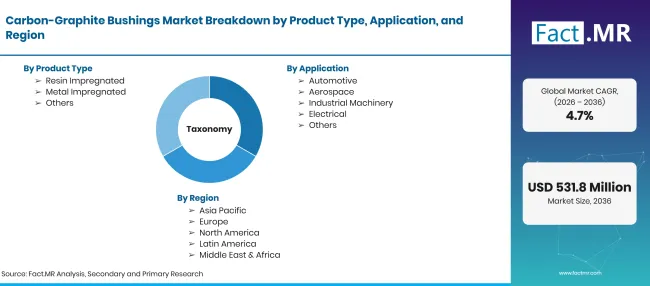
Factmr Carbon Graphite Bushings Market Taxonomy | Source: Fact.MR
| Attribute | Details |
|---|---|
| Quantitative Units | USD million in 2025, 2026 and 2036; CAGR for 2026 to 2036 |
| Market Definition | Carbon-graphite bushings are finished sleeve or related plain-bearing components made from carbon-graphite material for shaft guidance and sliding support. The market includes resin-impregnated and metal-impregnated grades alongside other covered formulations. Revenue is assigned to the bushing component rather than the complete pump or surrounding bearing assembly. |
| Product Type | Resin Impregnated; Metal Impregnated; Others |
| Application | Automotive; Aerospace; Industrial Machinery; Electrical; Others |
| End-User | OEMs; Aftermarket |
| Regions Covered | North America; Latin America; Western Europe; Eastern Europe; East Asia; South Asia & Pacific; Middle East & Africa |
| Countries Covered | Germany; Brazil; United States; United Kingdom; Japan |
| Companies Profiled | Morgan Advanced Materials; Schunk Carbon Technology; Helwig Carbon Products; St. Marys Carbon Company; Mersen Group |
| Forecast Period | 2026 to 2036 |
| Approach | Assessment of finished bushing demand across equipment production and replacement channels. Product comparisons consider impregnation and shaft pairing alongside fluid conditions and machining requirements. Country analysis focuses on accessible equipment programmes and service procurement. |
Source: Fact.MR analysis. Updated Oct 21, 2026
How is the market segmented?
-
By Product Type
- Resin Impregnated
- Metal Impregnated
- Others
-
By Application
- Automotive
- Aerospace
- Industrial Machinery
- Electrical
- Others
-
By End-User
- OEMs
- Aftermarket
-
By Region
- North America
- Latin America
- Western Europe
- Eastern Europe
- East Asia
- South Asia & Pacific
- Middle East & Africa
Frequently Asked Questions
How large is the Carbon-Graphite Bushings Market in 2026?
What is the expected value by 2036?
Which product type leads revenue?
Which application and customer groups lead?
What makes a carbon-graphite bushing supplier competitive?
Who worked on this report


Preview the report firsthand - request a free sample
Free SampleGet the brochure for pricing and purchase details
Download PDF