- Market Value (2025): USD 1.36 Bn
- Estimated Value (2026): USD 1.53 Bn
- Forecast Value (2036): USD 5.14 Bn
- CAGR (2026-2036): 12.9%
What is the Cemiplimab-rwlc Market forecast to be worth by 2036?
USD 1.5 billion in 2026 to USD 5.1 billion by 2036, at a 12.9% CAGR.
- The cemiplimab-rwlc market reached USD 1.36 billion in 2025.
- Sales are projected to rise from USD 1.53 billion in 2026 to USD 5.14 billion by 2036.
- As per Fact.MR analysis, the market carries a 12.9% CAGR outlook during 2026 to 2036 as eligible oncology patients receive PD-1 treatment.
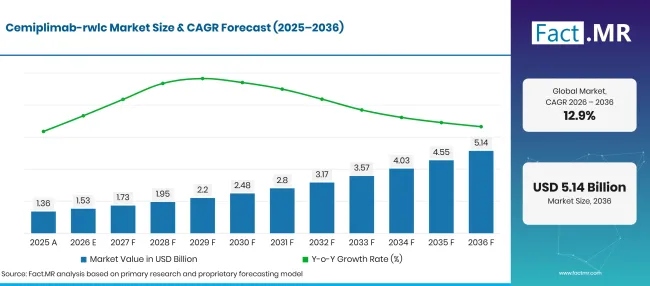
Cemiplimab Rwlc Market Forecast Global | Source: Fact.MR
| Year | Basis | Market Value (USD billion) |
|---|---|---|
| 2025 | Actual | 1.36 |
| 2026 | Estimate | 1.53 |
| 2036 | Forecast | 5.14 |
| CAGR 2026 to 2036 | Forecast period | 12.9% |
Source: Fact.MR analysis. Updated Oct 22, 2026
What are the defining numbers behind Cemiplimab-rwlc Market growth?
USD 3.6 billion absolute opportunity from 2026 to 2036, with 350 mg injection and hospital use forming the main treatment base.
- Demand Drivers in the Market
- Clinicians consider cemiplimab-rwlc for advanced cutaneous squamous cell carcinoma when a patient meets the approved treatment criteria. The choice also depends on whether surgery or radiation can still provide curative treatment.
- Pulmonary oncologists consider cemiplimab as a single medicine for selected non-small cell lung cancer with high PD-L1 expression.
- Hospital pharmacies prepare cemiplimab infusions according to the prescribed schedule and coordinate the required supplies with oncology teams. Standard vial presentations make ordering more predictable, but each patient still needs an individual safety review.
- Key Segments Analyzed
- By Type: 350 mg Injection is projected to hold 70.0% share in 2026 as hospital pharmacies manage fixed-dose infusion orders.
- By Application: Metastatic Cutaneous Squamous Cell Carcinoma is estimated to account for 48.2% share in 2026, reflecting its established treatment indication.
- By Distribution Channel: Hospital Pharmacies are forecast to represent 52.8% share in 2026 because infusion services manage medicine supply.
- By End-use: Hospitals are anticipated to capture 58.3% share in 2026 as oncology teams provide supervised intravenous treatment.
- Analyst Opinion at Fact.MR
- Shambhu Nath Jha, Principal Consultant at Fact.MR, states, “Cemiplimab-rwlc purchasing follows clinical eligibility and treatment-center readiness more closely than routine retail medicine sales. A working market hypothesis is that wider adjuvant use expands the number of treatment discussions, while safety monitoring and patient selection continue to shape prescribing decisions.”
- Strategic Implications
- As per Fact.MR analysis, oncology hospitals should align pharmacy supply with the approved infusion schedule and their own infusion capacity.
- Clinical teams should document prior cancer treatment and relevant immune-related risks before starting each eligible patient.
- Hospital pharmacies should plan for routine vial handling and dose preparation under the product prescribing information.
- Market researchers should separate actual Libtayo sales from sales of other PD-1 medicines when measuring brand competition.
Germany is forecast at 15.5% CAGR, while Brazil is projected at 14.2%. The United States records a 12.8% outlook, followed by the United Kingdom at 11.5% and Japan at 10.1%. Each country’s outlook depends on the product’s local authorization and practical access to oncology services.
How does the Cemiplimab-rwlc Market break down by segment?
350 mg Injection 70.0%; Metastatic Cutaneous Squamous Cell Carcinoma 48.2%; Hospital Pharmacies 52.8%; Hospitals 58.3% in 2026.
Which Type accounts for the larger share?
350 mg Injection holds 70.0% share in 2026.
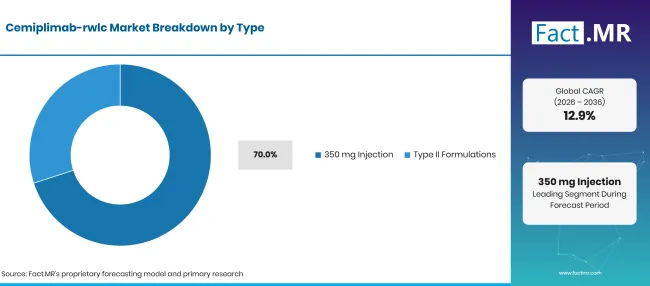
Cemiplimab Rwlc Market Breakdown Type | Source: Fact.MR
| Type | Share (2026) |
|---|---|
| 350 mg Injection (Leading segment) | 70.0% |
| Other segments combined | 30.0% |
| Total | 100.0% |
Source: Fact.MR analysis. Updated Oct 22, 2026
The 350 mg intravenous presentation is used in several approved treatment settings. For adjuvant treatment of high-risk cutaneous squamous cell carcinoma, the FDA also describes an option beginning with 350 mg every three weeks for 12 weeks and continuing with 700 mg every six weeks. Pharmacists dilute the medicine before infusion, and trained clinicians supervise each administration. The supplied Type II Formulations category requires product-level definition before it can be treated as a separate approved formulation.
What leads the Application segment?
Metastatic Cutaneous Squamous Cell Carcinoma leads with 48.2% share in 2026.
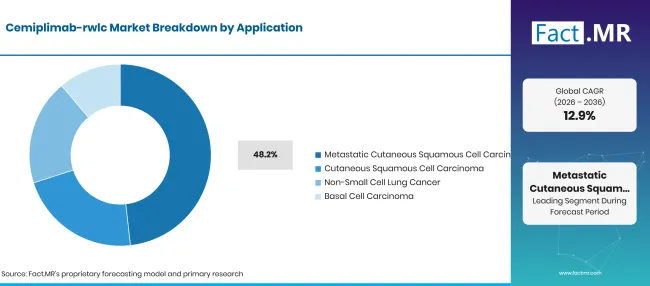
Cemiplimab Rwlc Market Breakdown Application | Source: Fact.MR
| Application | Share (2026) |
|---|---|
| Metastatic Cutaneous Squamous Cell Carcinoma (Leading segment) | 48.2% |
| Other segments combined | 51.8% |
| Total | 100.0% |
Source: Fact.MR analysis. Updated Oct 22, 2026
As per Fact.MR analysis, metastatic cutaneous squamous cell carcinoma remains an established clinical use for cemiplimab-rwlc. Locally advanced disease and selected high-risk adjuvant treatment create separate care pathways. For non-small cell lung cancer, treatment selection depends on tumor features and the intended combination regimen. Basal cell carcinoma is covered under different treatment-history criteria. The European Medicines Agency sets out these distinct authorized uses in its product overview [2].
How do Distribution Channels affect sales?
Hospital Pharmacies represent 52.8% share in 2026.
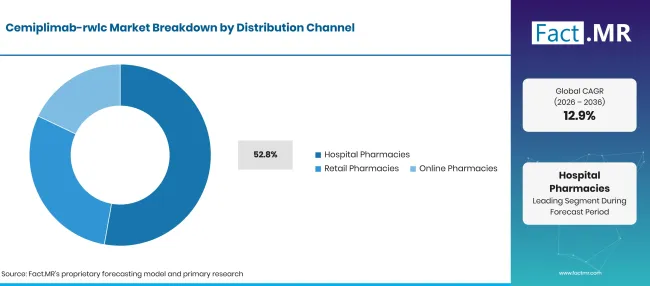
Cemiplimab Rwlc Market Breakdown Distribution Channel | Source: Fact.MR
| Distribution Channel | Share (2026) |
|---|---|
| Hospital Pharmacies (Leading segment) | 52.8% |
| Other segments combined | 47.2% |
| Total | 100.0% |
Source: Fact.MR analysis. Updated Oct 22, 2026
As per Fact.MR analysis, hospital pharmacies arrange the stock used by oncology infusion units and reconcile medicine use with scheduled visits. Specialty pharmacies can be involved in distribution arrangements, but the product still requires intravenous administration by trained staff. The role of retail or online pharmacies varies with the healthcare system and medicine-distribution rules. The prescribing information instructs a 30-minute intravenous infusion after dilution.
Which End-use accounts for the main purchasing base?
Hospitals capture 58.3% share in 2026.
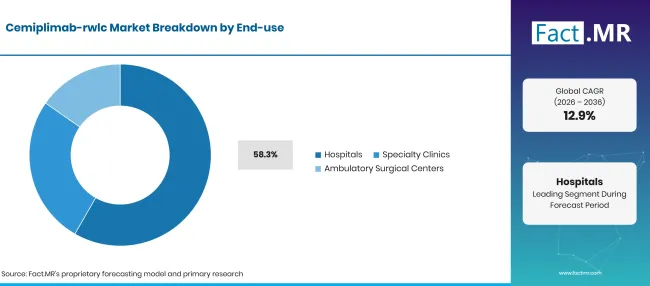
Cemiplimab Rwlc Market Breakdown End Use | Source: Fact.MR
| End-use | Share (2026) |
|---|---|
| Hospitals (Leading segment) | 58.3% |
| Other segments combined | 41.7% |
| Total | 100.0% |
Source: Fact.MR analysis. Updated Oct 22, 2026
As per Fact.MR analysis, hospitals combine oncology prescribing and infusion supervision with access to emergency care if treatment reactions occur. Specialty clinics can also deliver suitable infusions when they have qualified staff and monitoring processes. Ambulatory care centers serve a narrower role depending on local authorization and patient needs.
What is accelerating Cemiplimab-rwlc Market adoption, and what is holding it back?
New adjuvant eligibility supports use; clinical screening and treatment safety place limits on access.
Drivers Impact Analysis
| DRIVER | (~) % IMPACT ON CAGR | GEOGRAPHIC RELEVANCE | IMPACT TIMELINE |
|---|---|---|---|
| Adjuvant CSCC approval | +1.0% | United States, Europe | Medium term (2–4 years) |
| Established advanced CSCC use | +0.8% | Approved markets | Short term (<= 2 years) |
| Eligible lung-cancer regimens | +0.7% | Approved markets | Medium term (2–4 years) |
| Hospital infusion readiness | +0.5% | Global | Medium term (2–4 years) |
| Specialist prescribing pathways | +0.4% | Global | Long term (>= 4 years) |
Source: Fact.MR analysis. Updated Oct 22, 2026
Opportunity Impact Analysis
| OPPORTUNITY | (~) % IMPACT ON CAGR | GEOGRAPHIC RELEVANCE | IMPACT TIMELINE |
|---|---|---|---|
| Adjuvant care planning | +0.8% | United States, Europe | Medium term (2–4 years) |
| Oncology clinic coordination | +0.6% | Global | Medium term (2–4 years) |
| Dosing schedule planning | +0.5% | Approved markets | Short term (<= 2 years) |
| Evidence-based access reviews | +0.4% | Country specific | Long term (>= 4 years) |
Source: Fact.MR analysis. Updated Oct 22, 2026
Restraints Impact Analysis
| RESTRAINT | (~) % IMPACT ON CAGR | GEOGRAPHIC RELEVANCE | IMPACT TIMELINE |
|---|---|---|---|
| Immune-related safety | -0.8% | All markets | Short term (<= 2 years) |
| Patient eligibility | -0.6% | All markets | Medium term (2–4 years) |
| Infusion resource needs | -0.5% | Global | Medium term (2–4 years) |
| Reimbursement differences | -0.4% | Country specific | Long term (>= 4 years) |
Source: Fact.MR analysis. Updated Oct 22, 2026
Which countries are scaling the Cemiplimab-rwlc Market through 2036?
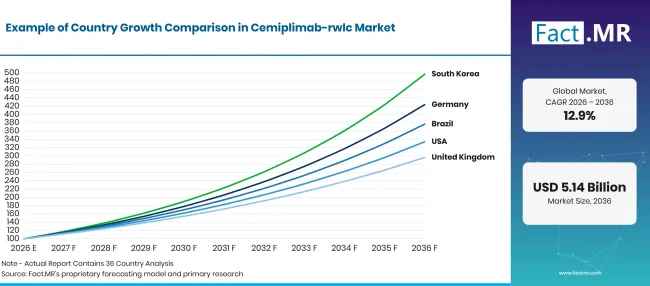
Cemiplimab Rwlc Market Growth Index | Source: Fact.MR
| Country | CAGR (2026–2036) |
|---|---|
| Germany | 15.5% |
| Brazil | 14.2% |
| United States | 12.8% |
| United Kingdom | 11.5% |
| Japan | 10.1% |
Source: Fact.MR analysis. Updated Oct 22, 2026
What shapes the Germany outlook?
15.5% CAGR, supported by wider oncology treatment access and expanded Libtayo authorization.
German oncology hospitals are integrating cemiplimab into approved treatment pathways for eligible patients. The European Commission expanded the Libtayo indication in November 2025 for selected high-risk cutaneous squamous cell carcinoma after surgery and radiation [4]. Hospital pharmacies coordinate infusion preparation, while oncology and dermatology teams assess tumor stage, treatment history, and clinical monitoring needs before therapy begins.
What shapes the Brazil outlook?
14.2% CAGR, influenced by specialist oncology access and locally authorized treatment pathways.
Brazilian oncology services assess cemiplimab within ANVISA authorization and the applicable public or private care pathway. Large cancer hospitals provide the specialist teams needed for intravenous PD-1 treatment, while pharmacy coordination links medicine supply with scheduled infusions. Treatment decisions remain closely tied to the approved indication, patient history, and available financing arrangements.
What shapes the United States outlook?
12.8% CAGR, supported by the expanded adjuvant treatment setting for high-risk CSCC.
The U.S. FDA approved adjuvant Libtayo on October 8, 2025 for high-risk cutaneous squamous cell carcinoma following surgery and radiation [1]. The FDA reviewed the C-POST study involving 415 patients as part of the approval. Oncology practices can now assess this postoperative treatment option alongside established use in advanced disease, with hospital pharmacists managing infusion preparation and scheduled dosing.
What shapes the United Kingdom outlook?
11.5% CAGR, shaped by medicine authorization, funding pathways, and specialist cancer services.
United Kingdom cancer services assess cemiplimab through national medicine authorization and health-technology review processes. NHS treatment teams consider the approved indication together with funding arrangements for each patient group. Specialist cancer units coordinate medicine supply, supervised infusions, repeat dosing, and clinical review, while access depends on the applicable commissioning and treatment pathway.
What shapes the Japan outlook?
10.1% CAGR, supported by locally approved lung cancer treatment use and specialist oncology care.
Japan’s cemiplimab outlook is closely linked to national medicine approvals. Regeneron reported that Japan’s Ministry of Health, Labour and Welfare approved an additional Libtayo indication in September 2025 for unresectable advanced or relapsed non-small cell lung cancer [3]. Oncology hospitals assess eligible patients, while pharmacy teams coordinate medicine supply, infusion schedules, and follow-up monitoring.
Who leads the Cemiplimab-rwlc Market?
Regeneron Pharmaceuticals holds the central position in the cemiplimab-rwlc market through Libtayo, with commercial activity tied directly to the medicine’s approved oncology indications and treatment access. Bristol Myers Squibb and Merck & Co./MSD compete through established checkpoint-inhibitor therapies used across overlapping cancer settings, giving oncologists alternative immunotherapy choices depending on tumor type, biomarker status, and treatment history.
Roche and AstraZeneca also participate in the broader immuno-oncology space through therapies used in selected solid tumors. Their role is competitive rather than as suppliers of cemiplimab-rwlc itself. Market competition therefore revolves around approved indications, clinical positioning, safety management, hospital access, and physician familiarity with competing PD-1 or PD-L1 treatment options rather than a common product portfolio.
Which companies are the key providers?
Key companies include Regeneron Pharmaceuticals; Bristol Myers Squibb; Roche; Merck & Co., Inc. / MSD; and AstraZeneca.
- Regeneron Pharmaceuticals
- Bristol Myers Squibb
- Roche
- Merck & Co., Inc. / MSD
- AstraZeneca
Bibliography
- [1] U.S. Food and Drug Administration. (2025, October). Libtayo (cemiplimab-rwlc) prescribing information.
- [2]European Medicines Agency. (2026, January 20). Libtayo: European public assessment report.
- [3] Regeneron Pharmaceuticals, Inc. (2025, October 28). Regeneron reports third quarter 2025 financial and operating results.
- [4] Regeneron Pharmaceuticals, Inc. (2025, November 19). Libtayo® (cemiplimab) approved in the European Union as first and only immunotherapy for adjuvant treatment of cutaneous squamous cell carcinoma (CSCC) with high risk of recurrence after surgery and radiation
- [5] Regeneron Pharmaceuticals, Inc. (2026, July 30). Regeneron reports second quarter 2026 financial and operating results.
- [6] Sanofi. (2025, October). Annual report on Form 20-F 2025.
This Report Answers
- How the established 350 mg presentation fits oncology pharmacy workflows.
- How the selected skin and lung cancer indications differ by treatment eligibility.
- Why hospital pharmacies account for the principal distribution channel.
- How regulatory approval and infusion capacity influence the five-country comparison.
- How Libtayo differs from other checkpoint-inhibitor products in competitive analysis.
What does the Cemiplimab-rwlc Market cover?
According to Fact.MR analysis, the market covers the specific cemiplimab-rwlc antibody product and its approved oncologic uses. It separates drug sales from the wider group of PD-1 and PD-L1 medicines.
What is included in the scope?
Included sales concern the Libtayo medicine used under local approvals for suitable adult patients.
\Application analysis reviews cutaneous squamous cell carcinoma and qualifying lung or basal cell cancers. Healthcare delivery is assessed across hospital and specialty infusion services, while distribution concerns medicine supply rather than independent online self-treatment.
What is excluded from the scope?
Other checkpoint inhibitors are excluded from product-specific cemiplimab-rwlc valuations.
Cancer screening and surgery are separate services rather than sales of the antibody. Oncology infusion fees and non-drug hospital charges are also treated outside the medicine-only product boundary.
How Was the Analysis Built?
The analysis draws on 120+ sources, 35+ company portfolios, 25+ countries, and more than 20 industry interviews.
- Primary Research: Primary research includes discussions with manufacturers, service providers, technology developers, distributors, end users, and subject-matter experts. These conversations examine purchasing priorities, product adoption, operational challenges, approval requirements, competitive positioning, and the factors that influence wider market acceptance.
- Desk Research: Desk research covers government statistics, regulatory publications, company filings, trade data, technical studies, industry associations, standards, public policy, and other authoritative sources. Every source used in the analysis is documented in the bibliography.
- Market Sizing and Forecasting: Market estimates combine historical performance, demand indicators, pricing and volume trends, segment shares, company participation, country-level growth, adoption patterns, investment activity, and barriers to market expansion.
- Data Validation and Update Cycle: Findings are validated by comparing primary interviews with public data, company activity, regulatory changes, trade patterns, and industry developments. Regular updates review new product launches, capacity changes, partnerships, approvals, and shifts in commercial adoption.
Segmentation
What is the report’s scope and coverage?
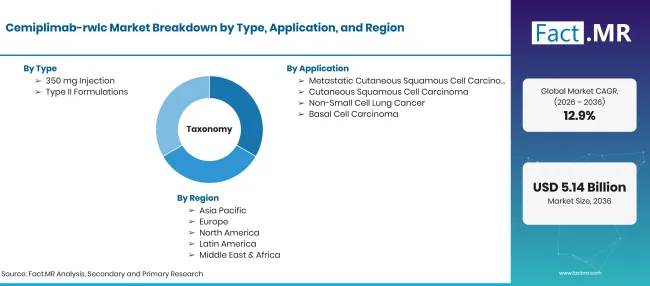
Cemiplimab Rwlc Market Taxonomy | Source: Fact.MR
| Attribute | Details |
|---|---|
| Quantitative Units | USD billion |
| Market Definition | Sales of the cemiplimab-rwlc antibody marketed as Libtayo |
| Type | 350 mg Injection; Type II Formulations (classification subject to product definition) |
| Application | Metastatic CSCC; CSCC; NSCLC; BCC |
| Distribution Channel | Hospital Pharmacies; Retail Pharmacies; Online Pharmacies |
| End-use | Hospitals; Specialty Clinics; Ambulatory Surgical Centers |
| Regions Covered | North America; Latin America; Western Europe; Eastern Europe; East Asia; South Asia & Pacific; Middle East & Africa |
| Countries Covered | Germany; Brazil; United States; United Kingdom; Japan |
| Companies Profiled | Regeneron Pharmaceuticals; Bristol Myers Squibb; Roche; Merck & Co., Inc. / MSD; and AstraZeneca |
| Forecast Period | 2026 to 2036 |
| Approach | Product-specific treatment scope and official clinical and company evidence |
Source: Fact.MR analysis. Updated Oct 22, 2026
How is the market segmented?
-
By Type
- 350 mg Injection
- Type II Formulations
-
By Application
- Metastatic Cutaneous Squamous Cell Carcinoma
- Cutaneous Squamous Cell Carcinoma
- Non-Small Cell Lung Cancer
- Basal Cell Carcinoma
-
By Distribution Channel
- Hospital Pharmacies
- Retail Pharmacies
- Online Pharmacies
-
By End-use
- Hospitals
- Specialty Clinics
- Ambulatory Surgical Centers
-
By Region
- North America
- Latin America
- Western Europe
- Eastern Europe
- East Asia
- South Asia & Pacific
- Middle East & Africa
Frequently Asked Questions
How big is the cemiplimab-rwlc market in 2026?
What is the CAGR from 2026 to 2036?
Which Type has the leading 2026 share?
Which application holds the leading share?
Who are the main companies in cemiplimab-rwlc market?
Who worked on this report


Preview the report firsthand - request a free sample
Free SampleGet the brochure for pricing and purchase details
Download PDF