- Market Value (2025): USD 4.8 Bn
- Estimated Value (2026): USD 5.13 Bn
- Forecast Value (2036): USD 9.9 Bn
- CAGR (2026-2036): 6.8%
What is the Cerebral Malaria Therapeutics Market forecast to be worth by 2036?
USD 5.1 billion in 2026 to USD 9.9 billion by 2036, registering a CAGR of 6.8%.
- As per Fact.MR analysis, the cerebral malaria therapeutics market was valued at USD 4.8 billion in 2025.
- Demand is projected to increase from USD 5.13 billion in 2026 to USD 9.9 billion by 2036.
- The market is forecast to expand at a 6.8% CAGR from 2026 to 2036 as healthcare systems strengthen access to severe malaria treatment.
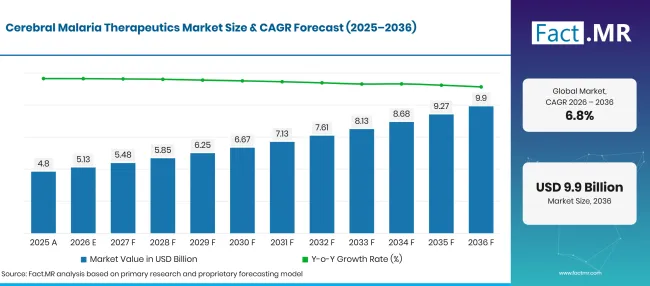
Cerebral Malaria Therapeutics Market Forecast Global | Source: Fact.MR
| Year | Basis | Market Value (USD billion) |
|---|---|---|
| 2025 | Actual | 4.8 |
| 2026 | Estimate | 5.13 |
| 2036 | Forecast | 9.9 |
| CAGR 2026 to 2036 | Forecast period | 6.8% |
Source: Fact.MR analysis. Updated Nov 10, 2026
What are the defining numbers behind Cerebral Malaria Therapeutics Market growth?
The market is expected to create an absolute opportunity of USD 4.8 billion between 2026 and 2036.
- Demand Drivers in the Market
- Need for rapid treatment of severe malaria has raised the demand for the cerebral malaria therapeutics. Severe P. falciparum malaria can progress quickly and requires immediate treatment. The WHO recommends intravenous or intramuscular artesunate for severe malaria. Treatment should continue until the patient can tolerate oral medication [1] [2].
- High malaria burden in endemic regions has driven the growth of the market. The WHO estimated 282 million malaria cases and 610,000 deaths worldwide in 2024. The African Region accounted for approximately 94% of cases and 95% of malaria deaths. This disease burden sustains the need for accessible antimalarial medicines and hospital treatment capacity [3].
- Availability of injectable antimalarial products supports the market growth. WHO records confirm prequalified 120 mg artesunate powder for injection products from Ipca Laboratories (MA186) and Macleods Pharmaceuticals (MA194), supporting access to parenteral antimalarial medicines [4] [9]. Product availability and distribution are important considerations for hospitals managing severe malaria [4].[4]
- Greater focus on treatment readiness creates lucrative opportunity for the growth of the market. Hospitals need reliable stocks of injectable medicines and the capacity to provide follow-on oral treatment. Timely diagnosis and supportive management also influence treatment outcomes.
- Key Segments Analyzed
- By Drug Type: Antimalarial Drugs are estimated to account for 48.3% of the market in 2026. These medicines form the central treatment component for severe malaria.
- By Route of Administration: Injectable products are projected to hold a 72.4% share in 2026, reflecting the need for rapid parenteral treatment in severe cases.
- By End User: Hospitals are expected to represent for 60.0% of the market in 2026 because cerebral malaria requires urgent clinical assessment and intensive patient management.
- Analyst Opinion at Fact.MR
- Shambhu Nath Jha, Principal Consultant at Fact.MR, states, “The market's development depends on timely access to effective antimalarial medicines and the ability of healthcare facilities to manage severe cases. Injectable artesunate remains central to treatment. Manufacturers and distributors need to support consistent product availability while healthcare providers need to ensure that patients receive the recommended oral follow-on regimen after initial parenteral treatment.”
- Strategic Implications
- Manufacturers should maintain consistent production and reliable supplies of injectable artesunate and other essential antimalarial medicines to support timely treatment of severe malaria.
- Healthcare providers should strengthen severe malaria treatment protocols and ensure that patients receiving injectable artesunate transition to a complete oral antimalarial regimen once clinically appropriate.
- Distributors should prioritize dependable medicine availability in malaria-endemic areas where access to emergency treatment can be limited by supply chain constraints and inadequate healthcare infrastructure.
- Public health agencies should strengthen early diagnosis programs and referral pathways to reduce treatment delays and improve access to appropriate care for patients with suspected severe malaria.
- Research organizations should assess adjunctive treatment strategies through appropriate clinical studies. These interventions should complement established antimalarial therapy rather than replace effective parasite-directed treatment.
Germany is projected to record a 7.8% CAGR through 2036. Brazil is forecast to expand at 7.1%, followed by the USA at 6.5%. The UK is expected to register a 5.8% CAGR, while Japan is projected to grow at 5.1%.
How does the Cerebral Malaria Therapeutics Market break down by segment?
Fact.MR identifies Antimalarial Drugs as the leading Drug Type category with a 48.3% share in 2026. Injectable products lead Route of Administration with 72.4%, while Hospitals account for 60.0% of End User demand.
Which Drug Type dominates?
Antimalarial Drugs are projected to account for 48.3% of the market in 2026.
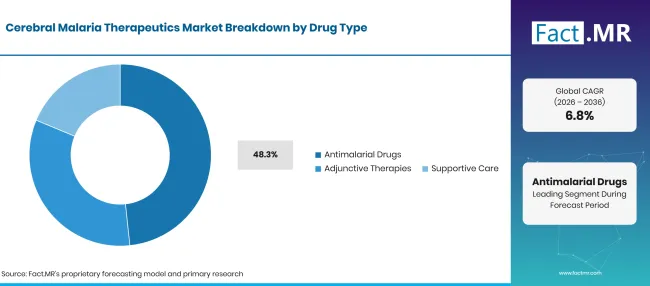
Cerebral Malaria Therapeutics Market Breakdown Drug Type | Source: Fact.MR
| Drug Type | Share (2026) |
|---|---|
| Antimalarial Drugs (Leading segment) | 48.3% |
| Other segments combined* | 51.7% |
| Total | 100.0% |
Source: Fact.MR analysis. Updated Nov 10, 2026
Antimalarial drugs form the primary therapeutic component of cerebral malaria management. Injectable artesunate is recommended for severe malaria and is administered promptly to reduce the risk of disease progression. Oral antimalarial combination therapy is required after the initial injectable treatment when the patient can tolerate oral medication. Adjunctive therapies may be investigated or used for specific clinical needs, but they should not be presented as established substitutes for antimalarial treatment.
What leads the Route of Administration segment?
Injectable products are expected to represent 72.4% of the market in 2026.
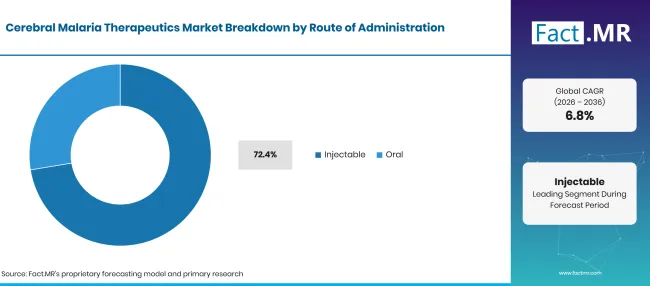
Cerebral Malaria Therapeutics Market Breakdown Route Of Administration | Source: Fact.MR
| Route of Administration | Share (2026) |
|---|---|
| Injectable (Leading segment) | 72.4% |
| Other segments combined* | 27.6% |
| Total | 100.0% |
Source: Fact.MR analysis. Updated Nov 10, 2026
Injectable treatment is central to severe malaria management because patients with cerebral malaria may be unconscious or unable to swallow medicines. WHO guidance recommends intravenous or intramuscular artesunate for severe malaria. After initial parenteral treatment, patients should receive a complete oral antimalarial regimen when they meet the applicable clinical criteria. The follow-on medicine and duration depend on WHO or national treatment guidance [1] [5].
How does End User shape demand?
Hospitals are likely to account for 60.0% of the market in 2026.
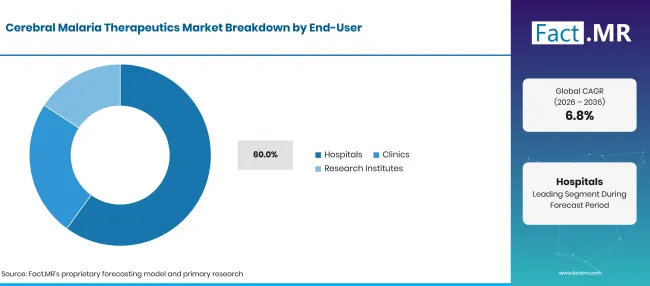
Cerebral Malaria Therapeutics Market Breakdown End User | Source: Fact.MR
| End User | Share (2026) |
|---|---|
| Hospitals (Leading segment) | 60.0% |
| Other segments combined* | 40.0% |
| Total | 100.0% |
Source: Fact.MR analysis. Updated Nov 10, 2026
Hospitals play a central role in cerebral malaria treatment because patients may require urgent diagnosis and parenteral medication. They also need the capacity to monitor neurological status and manage complications such as seizures and hypoglycaemia. Clinics can contribute through early diagnosis and referral of patients with severe symptoms.
What is accelerating Cerebral Malaria Therapeutics Market adoption, and what is holding it back?
The need for prompt severe malaria treatment supports demand, while medicine access challenges and the limited evidence for adjunctive therapies can constrain market development.
Drivers Impact Analysis
| DRIVER | (~) % IMPACT ON CAGR | GEOGRAPHIC RELEVANCE | IMPACT TIMELINE |
|---|---|---|---|
| Greater need for rapid severe malaria treatment | +1.0% | Africa, Asia | Short term (≤ 2 years) |
| Wider availability of injectable artesunate | +0.9% | Global | Medium term (2–4 years) |
| Strengthening hospital emergency care | +0.7% | Africa, Asia | Medium term (2–4 years) |
| Improved diagnosis and referral pathways | +0.5% | Global | Short term (≤ 2 years) |
| Development of antimalarial treatment options | +0.4% | Global | Long term (≥ 4 years) |
Source: Fact.MR analysis. Updated Nov 10, 2026
Opportunity Impact Analysis
| OPPORTUNITY | (~) % IMPACT ON CAGR | GEOGRAPHIC RELEVANCE | IMPACT TIMELINE |
|---|---|---|---|
| Expanded access to WHO-prequalified injectable artesunate | +0.8% | Africa, Asia | Medium term (2–4 years) |
| Improved medicine distribution in endemic regions | +0.6% | Africa, Asia | Medium term (2–4 years) |
| Stronger hospital treatment readiness | +0.5% | Global | Short term (≤ 2 years) |
| Research into evidence-based adjunctive treatments | +0.4% | Global | Long term (≥ 4 years) |
Source: Fact.MR analysis. Updated Nov 10, 2026
Restraints Impact Analysis
| RESTRAINT | (~) % IMPACT ON CAGR | GEOGRAPHIC RELEVANCE | IMPACT TIMELINE |
|---|---|---|---|
| Delayed diagnosis and referral | -0.8% | Africa, Asia | Short term (≤ 2 years) |
| Limited access to injectable medicines | -0.7% | Low-resource regions | Short term (≤ 2 years) |
| Weak healthcare infrastructure | -0.6% | Africa, Asia | Medium term (2–4 years) |
| Antimalarial drug resistance concerns | -0.5% | Global | Long term (≥ 4 years) |
Source: Fact.MR analysis. Updated Nov 10, 2026
Which countries are scaling the Cerebral Malaria Therapeutics Market through 2036?
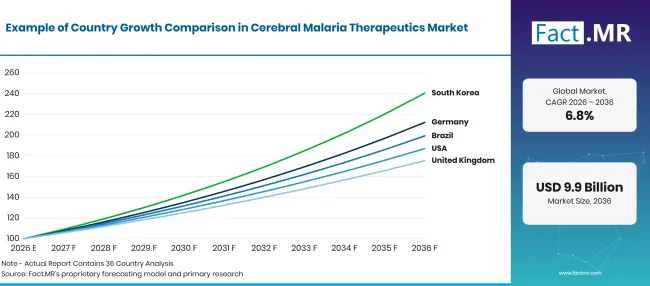
Cerebral Malaria Therapeutics Market Growth Index | Source: Fact.MR
| Country | CAGR (2026–2036) |
|---|---|
| Germany | 7.8% |
| Brazil | 7.1% |
| USA | 6.5% |
| UK | 5.8% |
| Japan | 5.1% |
Source: Fact.MR analysis. Updated Nov 10, 2026
What is shaping demand in Germany?
7.8% CAGR, supported by hospital preparedness and the need to maintain access to antimalarial medicines for imported malaria cases.
Germany's market is influenced by demand from hospitals and specialized treatment centers managing imported malaria cases. Although malaria is not endemic in the country, patients returning from malaria-endemic regions may require urgent access to appropriate antimalarial medicines. Hospital preparedness and dependable medicine availability remain important factors supporting market demand.
How is Brazil's malaria burden influencing market growth?
7.1% CAGR, driven by the need for timely treatment and improved medicine distribution across malaria-affected regions.
Brazil's malaria burden is concentrated in the Amazon region, where remote communities can face challenges accessing timely diagnosis and treatment. Severe malaria requires urgent medical intervention and hospital-based monitoring. Improvements in referral systems and the distribution of injectable antimalarial medicines can support treatment access and market development. Manufacturers can contribute by maintaining reliable supply channels for essential therapies.
What supports United States adoption?
6.5% CAGR, led by emergency treatment requirements and established clinical protocols for severe malaria.
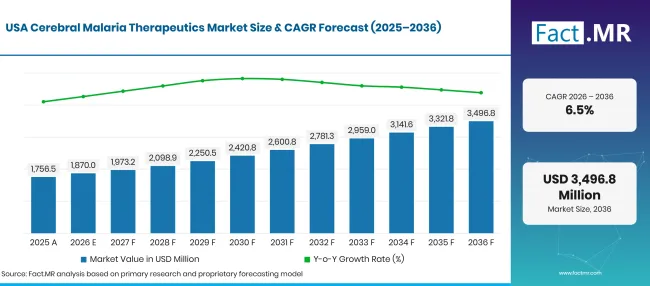
Cerebral Malaria Therapeutics Market Forecast Usa | Source: Fact.MR
The U.S. market is primarily influenced by the need to manage imported malaria cases. Although case volumes are relatively low compared with malaria-endemic countries, severe infections require prompt access to effective treatment. The CDC identifies intravenous artesunate as the recommended initial treatment for severe malaria. Amivas' Artesunate for Injection is FDA-approved and commercially available in the United States [5].
How is the United Kingdom building adoption?
5.8% CAGR, backed by specialist treatment requirements and preparedness for imported malaria cases.
The UK market is shaped by the need to diagnose and manage malaria cases acquired during international travel. Hospitals and specialist infectious disease centers require access to injectable antimalarial medicines for patients who develop severe complications. Treatment readiness and dependable medicine supply remain important considerations for healthcare providers. These requirements support demand for cerebral malaria therapeutics within specialist care settings.
What is shaping Japan's market outlook?
5.1% CAGR, driven by hospital preparedness and the need for specialized treatment of imported malaria cases.
Japan's market is influenced by the need to manage malaria cases associated with international travel. Hospitals and infectious disease specialists require access to appropriate antimalarial medicines to treat severe infections promptly. Maintaining reliable medicine supplies and strengthening clinical awareness can support emergency treatment preparedness and contribute to market development.
Who leads the Cerebral Malaria Therapeutics Market?
Fact.MR profiles Guilin Pharmaceutical, Macleods Pharmaceuticals, Ipca Laboratories, Amivas LLC, Cipla and Strides Pharma Science across the antimalarial and severe malaria treatment value chain.
Guilin Pharmaceutical has a direct position in severe malaria treatment through its Artesun injectable product, which the company identifies for cerebral malaria and critical malaria [6]. Macleods Pharmaceuticals and Ipca Laboratories have WHO-prequalified artesunate injection products, supporting their relevance to the injectable antimalarial segment.
Amivas is a direct participant in the severe malaria treatment market in the United States. Its Artesunate for Injection is FDA-approved for the initial treatment of severe malaria in adults and children [7]. Strides Pharma has disclosed its participation in malaria products, including artesunate suppositories and artemether-lumefantrine. Its disclosed product range supports broader antimalarial market relevance, although it should not be equated with a supplier of injectable artesunate without additional product evidence [8].
Which companies are the key providers?
Key companies profiled in the Cerebral Malaria Therapeutics Market include:
- Guilin Pharmaceutical Co., Ltd. (Fosun Pharma)
- Macleods Pharmaceuticals Ltd.
- Ipca Laboratories Ltd.
- Amivas LLC
- Cipla Ltd.
- Strides Pharma Science Limited
Bibliography
- [1] World Health Organization. (2026, September 10). WHO guidelines for malaria.
- [2] World Health Organization. (2024, November 30). WHO guidelines for malaria: Recommendation on treatment of severe malaria with intravenous or intramuscular artesunate.
- [3] World Health Organization. (2025, December 4). World malaria report 2025: Addressing the threat of antimalarial drug resistance.
- [4] World Health Organization. (2024, May 29). Macleods Pharmaceuticals Ltd.: Artesunate powder for solution for injection 120 mg (MA194). WHO Prequalification of Medical Products.
- [5] Centers for Disease Control and Prevention. (2026, August 17). Treatment of severe malaria.
- [6] Guilin Pharmaceutical Co., Ltd. (n.d.). Artesun®.
- [7] Amivas LLC. (n.d.). Artesunate product information.
- [8] Strides Pharma Science Limited. (2024, October 8). Corporate presentation.
- [9] World Health Organization. (2023, September 5). MA186: Artesunate powder for solution for injection 120 mg (Ipca Laboratories Ltd.). WHO Prequalification of Medical Products.
This Report Answers
- The report examines medicines and treatment approaches used in the management of cerebral malaria.
- Segment analysis compares antimalarial drugs, adjunctive therapies and supportive care.
- Route analysis distinguishes injectable treatment from oral medication used to complete treatment.
- End-user analysis examines hospitals, clinics and research institutes.
- Country analysis covers Germany, Brazil, the USA, the UK and Japan.
- The competitive overview profiles the eight companies listed in the market scope.
What does the Cerebral Malaria Therapeutics Market cover?
The market covers antimalarial medicines and related therapeutic products used in the treatment of cerebral malaria. It includes injectable medicines used during the emergency phase and oral antimalarial regimens used to complete treatment. The analysis also considers supportive care and adjunctive treatment categories where they fall within the defined market boundary.
What is included in the scope?
Included products comprise antimalarial medicines used for severe malaria and cerebral malaria treatment.
Injectable artesunate is a central product category because it is recommended for severe malaria. Oral antimalarial combination therapies are included where they form part of the complete treatment course following parenteral therapy. Supportive care and adjunctive therapies are considered where the market methodology explicitly assigns them a commercial value.
What is excluded from the scope?
The analysis excludes malaria prevention products such as insecticide-treated nets and vector-control chemicals.
Malaria vaccines and diagnostic products are outside the therapeutic product boundary. General hospital equipment and unrelated intensive care medicines are also excluded unless specifically included in the market's defined treatment categories. Medicines used only for uncomplicated malaria should not automatically be counted as cerebral malaria therapeutics.
How Was the Analysis Built?
The analysis draws on 120+ sources, 35+ company portfolios, 25+ countries, and more than 20 industry interviews.
- Primary Research: Primary research includes discussions with manufacturers, service providers, technology developers, distributors, end users, and subject-matter experts. These conversations examine purchasing priorities, product adoption, operational challenges, approval requirements, competitive positioning, and the factors that influence wider market acceptance.
- Desk Research: Desk research covers government statistics, regulatory publications, company filings, trade data, technical studies, industry associations, standards, public policy, and other authoritative sources. Every source used in the analysis is documented in the bibliography.
- Market Sizing and Forecasting: Market estimates combine historical performance, demand indicators, pricing and volume trends, segment shares, company participation, country-level growth, adoption patterns, investment activity, and barriers to market expansion.
- Data Validation and Update Cycle: Findings are validated by comparing primary interviews with public data, company activity, regulatory changes, trade patterns, and industry developments. Regular updates review new product launches, capacity changes, partnerships, approvals, and shifts in commercial adoption.
Segmentation
What is the report’s scope and coverage?
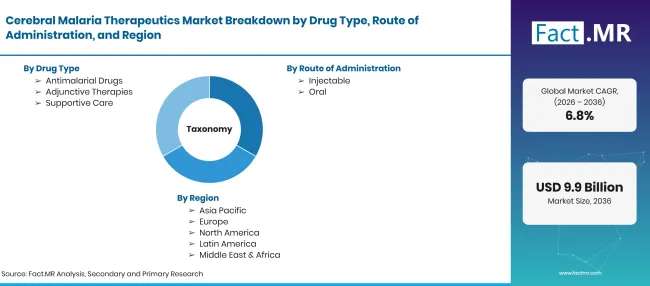
Cerebral Malaria Therapeutics Market Taxonomy | Source: Fact.MR
| Attribute | Details |
|---|---|
| Quantitative Units | USD billion |
| Market Definition | The cerebral malaria therapeutics market comprises medicines used to treat and manage cerebral malaria, a severe neurological complication of Plasmodium falciparum infection. It includes injectable antimalarial drugs such as artesunate and other medicines used in the treatment of severe malaria. These therapies support rapid parasite clearance and are administered under hospital supervision. The market also covers oral antimalarial medicines used to complete treatment after initial parenteral therapy, in accordance with clinical guidelines. |
| Drug Type | Antimalarial Drugs; Adjunctive Therapies; Supportive Care |
| Route of Administration | Injectable; Oral |
| End User | Hospitals; Clinics; Research Institutes |
| Regions Covered | North America; Latin America; Western Europe; Eastern Europe; East Asia; South Asia & Pacific; Middle East & Africa |
| Countries Covered | Germany; Brazil; USA; UK; Japan |
| Companies Profiled | Guilin Pharmaceutical; Macleods Pharmaceuticals; Ipca Laboratories; Amivas LLC; Cipla; Strides Pharma Science |
| Forecast Period | 2026 to 2036 |
| Approach | Market segmentation and forecast analysis supported by clinical guidelines, product information and public company disclosures |
Source: Fact.MR analysis. Updated Nov 10, 2026
How is the market segmented?
-
By Drug Type
- Antimalarial Drugs
- Adjunctive Therapies
- Supportive Care
-
By Route of Administration
- Injectable
- Oral
-
By End User
- Hospitals
- Clinics
- Research Institutes
-
By Region
- North America
- Latin America
- Western Europe
- Eastern Europe
- East Asia
- South Asia & Pacific
- Middle East & Africa
Frequently Asked Questions
How big is the Cerebral Malaria Therapeutics Market in 2026?
What is the CAGR from 2026 to 2036?
Which Drug Type has the largest share?
Which Route of Administration leads the market?
Which End User has the largest share?
Which companies are covered?
Who worked on this report


Preview the report firsthand - request a free sample
Free SampleGet the brochure for pricing and purchase details
Download PDF