- Market Value (2025): USD 16.8 Bn
- Estimated Value (2026): USD 17.8 Bn
- Forecast Value (2036): USD 31.9 Bn
- CAGR (2026-2036): 6.0%
What is the Antidepressants Market forecast to be worth by 2036?
USD 17.8 billion in 2026 to USD 31.9 billion by 2036, at a CAGR of 6.0%.
- As per Fact.MR analysis, the antidepressants market crossed a valuation of USD 16.8 billion in 2025.
- Demand will grow from USD 17.8 billion in 2026 to USD 31.9 billion by 2036.
- The forecast records a 6.0% CAGR from 2026 to 2036 due to growing diagnosis rates and improved access to psychiatric care are encouraging more patients to seek pharmacological treatment.
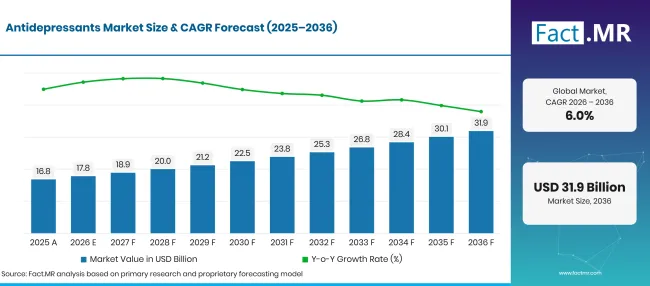
Antidepressants Market Forecast Global | Source: Fact.MR
| Year | Basis | Market Value (USD billion) |
|---|---|---|
| 2025 | Actual | 16.8 |
| 2026 | Estimate | 17.8 |
| 2036 | Forecast | 31.9 |
| CAGR 2026 to 2036 | Forecast period | 6.0% |
Source: Fact.MR analysis. Updated Nov 9, 2026
What are the defining numbers behind Antidepressants Market growth?
USD 14.1 billion absolute opportunity is expected between 2026 and 2036.
- Demand Drivers in the Market
- Increasing recognition and treatment of depressive disorders has driven the growth of the market. The World Health Organization estimated that 5.2% of adults globally experienced depression in 2023. Wider recognition of symptoms and access to mental healthcare can support demand for appropriate pharmacological treatment [1].
- Continued use of established antidepressant classes have raised the demand for the antidepressants. SSRIs and SNRIs remain important treatment options for major depressive disorder.
- Higher pharmaceutical consumption has created lucrative opportunity for the growth of the market. OECD data show that antidepressant consumption across member countries increased by more than 40% between 2013 and 2023. This trend reflects changes in mental health needs, recognition, prescribing practices and treatment duration [2].
- Key Segments Analyzed
- By Drug Class: SSRIs are projected to account for 38.5% of the market in 2026, supported by their established role in the treatment of major depressive disorder and selected anxiety disorders.
- By Indication: Major Depressive Disorder is expected to lead with a 54.2% share in 2026, reflecting the central role of antidepressants in pharmacological management of moderate and severe depression.
- By Distribution Channel: Retail Pharmacies are projected to hold 47.8% of the market in 2026, shaped by prescription fulfilment for patients receiving outpatient treatment.
- Analyst Opinion at Fact.MR
- Shambhu Nath Jha, Principal Consultant at Fact.MR, states, “Antidepressant demand is supported by greater recognition of depressive disorders and continued use of established medicines across outpatient care. SSRIs remain important because of their clinical familiarity and broad use. Manufacturers should focus on treatment tolerability, consistent supply and evidence that supports appropriate use across different patient groups.”
- Strategic Implications
- Pharmaceutical manufacturers should maintain consistent supplies of established generic antidepressants to support treatment continuity. They can also invest in differentiated formulations that address tolerability concerns and offer alternative treatment options for patients who experience inadequate symptom improvement with existing medications.
- Healthcare providers should select antidepressants based on the patient's diagnosis and medical history. Previous treatment response and individual preferences should also guide prescribing decisions. Careful consideration of potential adverse effects can improve treatment suitability and support better medication adherence.
- Retail and online pharmacies should strengthen prescription verification procedures to ensure appropriate dispensing of antidepressant medicines. Pharmacists can support patients through clear medication instructions and guidance on potential adverse effects while following applicable prescription regulations and monitoring requirements.
- Drug developers should increase investment in clinical research focused on patients who experience limited benefits from conventional antidepressants. Investigating alternative mechanisms of action and combination treatment approaches can help identify new therapeutic options while addressing unmet needs in depression management.
Germany is projected to record a 6.9% CAGR through 2036. Brazil is set to grow at 6.3%, followed by the USA at 5.7%. The UK is estimated to advance at 5.1%, while Japan is forecast at 4.5%.
How does the Antidepressants Market break down by segment?
Fact.MR identifies SSRIs as the leading Drug Class at 38.5%, Major Depressive Disorder as the leading Indication at 54.2%, and Retail Pharmacies as the leading Distribution Channel at 47.8%.
Which Drug Class dominates?
Selective Serotonin Reuptake Inhibitors (SSRIs) are set to hold 38.5% share in 2026.
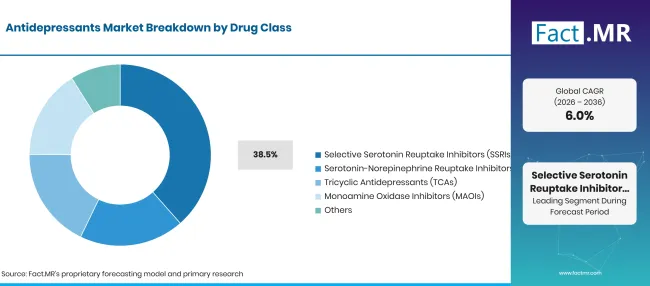
Antidepressants Market Breakdown Drug Class | Source: Fact.MR
| Drug Class | Share (2026) |
|---|---|
| SSRIs (Leading segment) | 38.5% |
| Other segments combined | 61.5%* |
| Total | 100.0% |
Source: Fact.MR analysis. Updated Nov 9, 2026
SSRIs account for the largest drug-class share because they are widely used in the pharmacological management of depression. Medicines such as sertraline, fluoxetine, escitalopram and citalopram are established options across several markets. NICE identifies SSRIs as a suitable first-choice antidepressant class for most adults when medication is appropriate. SNRIs provide another treatment option, particularly for patients whose clinical history or response supports their use. TCAs and MAOIs remain available for selected patients, often in more specialized treatment settings because of their safety profiles, interactions and monitoring requirements. Other antidepressant classes include medicines with different mechanisms of action and treatment considerations.
What leads the Indication segment?
Major Depressive Disorder is projected to account for 54.2% share in 2026.
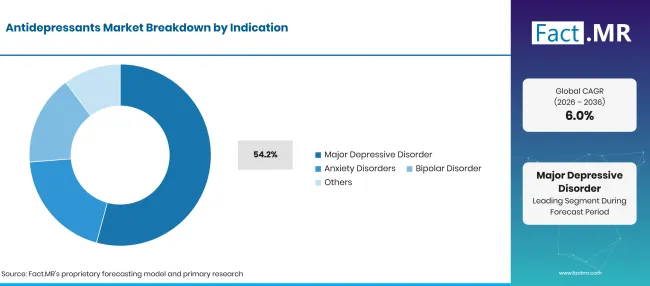
Antidepressants Market Breakdown Indication | Source: Fact.MR
| Indication | Share (2026) |
|---|---|
| Major Depressive Disorder (Leading segment) | 54.2% |
| Other segments combined | 45.8%* |
| Total | 100.0% |
Source: Fact.MR analysis. Updated Nov 9, 2026
Major depressive disorder is the central indication for the antidepressants market. Treatment may involve medication, psychological interventions or a combination, depending on symptom severity and individual clinical needs. Indian Psychiatric Society guidance notes that antidepressants can be combined with psychological treatment in moderate and severe depression, while medication is generally used in lesser amount for mild depression [3].
Which Distribution Channel accounts for the largest share?
Retail Pharmacies are expected to capture 47.8% share in 2026.
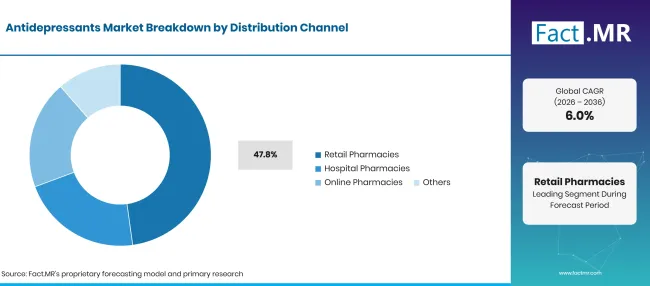
Antidepressants Market Breakdown Distribution Channel | Source: Fact.MR
| Distribution Channel | Share (2026) |
|---|---|
| Retail Pharmacies (Leading segment) | 47.8% |
| Other segments combined | 52.2%* |
| Total | 100.0% |
Source: Fact.MR analysis. Updated Nov 9, 2026
Retail pharmacies are a major distribution channel because many antidepressants are prescribed for ongoing outpatient treatment. Patients often require repeat prescriptions and regular clinical reviews to evaluate treatment response and monitor potential side effects. Hospital pharmacies supply medicines during inpatient care and specialist treatment. Online pharmacies offer an additional fulfilment option where permitted under local prescription and dispensing regulations.
What is accelerating Antidepressants Market adoption, and what is holding it back?
Greater recognition of depression and sustained use of prescription treatment support market growth, while adverse effects, discontinuation challenges and gaps in mental healthcare access can limit treatment continuity.
Drivers Impact Analysis
| DRIVER | (~) % IMPACT ON CAGR | GEOGRAPHIC RELEVANCE | IMPACT TIMELINE |
|---|---|---|---|
| Greater diagnosis and treatment of depressive disorders | +1.0% | Global | Short term (≤ 2 years) |
| Continued prescription of SSRIs and SNRIs | +0.8% | Global | Short term (≤ 2 years) |
| Antidepressant use in selected anxiety disorders | +0.7% | North America, Europe | Medium term (2–4 years) |
| Expansion of outpatient mental healthcare | +0.6% | Global | Medium term (2–4 years) |
| Longer-term maintenance treatment where clinically indicated | +0.4% | Global | Medium term (2–4 years) |
Source: Fact.MR analysis. Updated Nov 9, 2026
Opportunity Impact Analysis
| OPPORTUNITY | (~) % IMPACT ON CAGR | GEOGRAPHIC RELEVANCE | IMPACT TIMELINE |
|---|---|---|---|
| New treatment options for treatment-resistant depression | +0.8% | North America, Europe | Medium term (2–4 years) |
| Improved tolerability and patient adherence | +0.7% | Global | Medium term (2–4 years) |
| Development of medicines with differentiated mechanisms | +0.6% | Global | Long term (≥ 4 years) |
| Wider access to mental healthcare and diagnosis | +0.5% | Asia, Latin America | Medium term (2–4 years) |
| Improved treatment monitoring and follow-up | +0.4% | Global | Short term (≤ 2 years) |
Source: Fact.MR analysis. Updated Nov 9, 2026
Restraints Impact Analysis
| RESTRAINT | (~) % IMPACT ON CAGR | GEOGRAPHIC RELEVANCE | IMPACT TIMELINE |
|---|---|---|---|
| Adverse effects and individual differences in tolerability | -0.8% | Global | Short term (≤ 2 years) |
| Withdrawal symptoms and challenges with discontinuation | -0.6% | Global | Short term (≤ 2 years) |
| Delayed or incomplete treatment response | -0.5% | Global | Medium term (2–4 years) |
| Stigma and limited access to mental healthcare | -0.5% | Emerging markets | Long term (≥ 4 years) |
| Generic competition and pricing pressure | -0.4% | North America, Europe, Asia | Medium term (2–4 years) |
Source: Fact.MR analysis. Updated Nov 9, 2026
Which countries are scaling the Antidepressants Market through 2036?
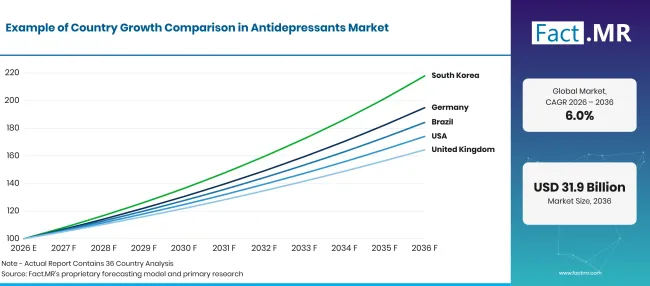
Antidepressants Market Growth Index | Source: Fact.MR
| Country | CAGR (2026–2036) |
|---|---|
| Germany | 6.9% |
| Brazil | 6.3% |
| USA | 5.7% |
| UK | 5.1% |
| Japan | 4.5% |
Source: Fact.MR analysis. Updated Nov 9, 2026
What supports Germany adoption?
6.9% CAGR, supported by established prescription practices and sustained use of antidepressant medicines.
Germany has an established market for prescription mental health medicines. OECD data reported antidepressant consumption of approximately 69.1 defined daily doses per 1,000 inhabitants per day in 2023, up from 53.1 in 2013 [4]. This increase reflects changing treatment patterns and greater pharmaceutical consumption. Continued outpatient prescribing and access to primary care and specialist mental health services can support demand for established antidepressant classes.
What supports market development in the Brazil?
6.3% CAGR, shaped by a substantial depressive disorder burden and opportunities to expand access to treatment.
IHME Global Burden of Disease estimates indicate that Brazil had an age-standardized depressive disorder prevalence of 3.89% in 2023 [5]. Wider access to mental health assessment and appropriate treatment can support demand for antidepressants. Public healthcare access, affordability and the availability of mental health professionals remain important factors influencing treatment uptake.
What supports United States adoption?
5.7% CAGR, led by established pharmaceutical treatment pathways and demand for options in treatment-resistant depression.
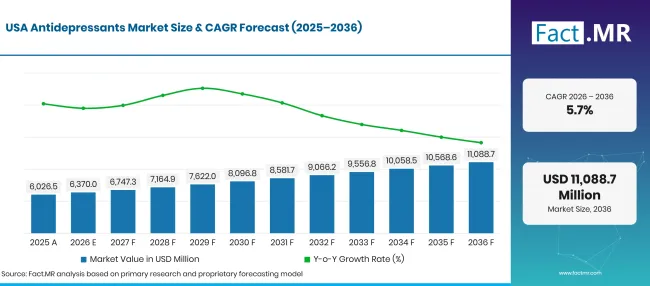
Antidepressants Market Forecast Usa | Source: Fact.MR
The U.S. antidepressants market is supported by established prescription practices and access to specialized psychiatric treatment. Treatment-resistant depression creates opportunities for differentiated therapies. Johnson & Johnson's SPRAVATO (esketamine), for example, received U.S. FDA approval in January 2025 as monotherapy for adults with treatment-resistant depression [6]. Access to newer therapies remains subject to eligibility requirements, monitoring and reimbursement.
How is the United Kingdom advancing in the market?
5.1% CAGR, driven by established primary care prescribing and demand for ongoing depression management.
The UK antidepressants market is driven by established clinical guidelines for the diagnosis and management of depressive disorders. The National Institute for Health and Care Excellence recommends selecting antidepressants according to clinical requirements and patient preferences. Treatment response and adverse effects are reviewed regularly after therapy begins. These prescribing practices support the use of antidepressants in routine depression management, with psychological therapies and other interventions forming part of the overall treatment approach.
What supports Japan adoption in the market?
4.5% CAGR, backed by continued use of prescription medicines and opportunities to improve mental health treatment access.
Japan's market is shaped by established pharmaceutical distribution and the availability of several antidepressant classes. Continued efforts to improve recognition of depression and access to appropriate mental health services can support treatment demand. The growth forecast should be viewed separately from the prevalence estimate because diagnosis rates, treatment duration and prescribing practices also influence pharmaceutical sales.
Who leads the Antidepressants Market?
Fact.MR profiles Pfizer, GlaxoSmithKline, Johnson & Johnson, AbbVie and H. Lundbeck across the antidepressant and broader mental health pharmaceutical landscape. Their participation differs by product type and treatment role. Some companies supply conventional antidepressants, while others participate through newer treatments for resistant depression or adjunctive therapies.
Pfizer Inc. markets PRISTIQ (desvenlafaxine), an SNRI indicated for major depressive disorder in adults. Pfizer's current product information and prescribing documentation confirm its role in the antidepressant market [7]. GlaxoSmithKline plc (GSK) has a historical presence in antidepressants, including products such as paroxetine.
Johnson & Johnson participates in the market through SPRAVATO (esketamine), a treatment for adults with treatment-resistant depression. In January 2025, the U.S. FDA approved SPRAVATO as monotherapy for eligible adults with treatment-resistant depression, expanding its role beyond its earlier use alongside an oral antidepressant. AbbVie Inc. participates through VRAYLAR (cariprazine), which is approved in the United States as an adjunctive treatment for major depressive disorder in adults. It is an atypical antipsychotic used alongside an antidepressant rather than a conventional antidepressant drug class [8].
H. Lundbeck A/S has a strong focus on brain diseases and a portfolio of medicines for depression and anxiety. Its listed products include vortioxetine (Brintellix/Trintellix), escitalopram (Cipralex/Lexapro) and citalopram (Cipramil/Celexa), alongside other psychiatric medicines [9].
Commercial competition depends on clinical evidence, product differentiation, regulatory approvals and access to prescription channels. Generic SSRIs and SNRIs compete on price and availability, while newer therapies seek to address patients with inadequate response to established treatments. Companies also need to support appropriate prescribing and treatment monitoring because response and tolerability vary between patients.
Which companies are the key providers?
Key companies participating in adjacent or specialized depression treatment are mentioned below:
- Pfizer Inc.
- GlaxoSmithKline plc
- Johnson & Johnson
- AbbVie Inc.
- H. Lundbeck A/S
Bibliography
- [1] World Health Organization. (2026, September 11). Depressive disorder (depression).
- WHO official source
- [2] Organisation for Economic Co-operation and Development. (2025, November 13). Health at a Glance 2025: Pharmaceutical consumption.
- [3] Press Information Bureau, Ministry of Health and Family Welfare, Government of India. (2025, February 7). Advancing mental healthcare in India.
- [4] Robert Koch Institute. (2025, December 5). Depressive and anxiety symptoms among adults in Germany: Results from the RKI Panel “Health in Germany” 2024.
- [5] World Health Organization. (2025, September 2). World mental health today: Latest data.
- https://www.who.int/news-room/fact-sheets/detail/depression World Health Organization. (2025, September 2). World mental health today: Latest data.
- [6] Johnson & Johnson. (2025, January 21). SPRAVATO® (esketamine) approved in the U.S. as the first and only monotherapy for adults with treatment-resistant depression.
- [7] Pfizer Inc. (2025, June). PRISTIQ® (desvenlafaxine succinate): Prescribing information.
- [8] AbbVie Inc. (2025, December). VRAYLAR® (cariprazine): Prescribing information.
- [9] H. Lundbeck A/S. (2025, February 5). Lundbeck reached record revenue of DKK 22 billion in 2024 with accelerated growth for strategic brands.
- [10] NHS Business Services Authority. (2026, July 23). Medicines used in mental health – England – 2016/17 to 2025/26.
- [11] Department of Pharmaceuticals, Ministry of Chemicals and Fertilizers. (2026, March 27). Production Linked Incentive Scheme for Pharmaceuticals. Press Information Bureau, Government of India.
This Report Answers
- The report describes how antidepressant medicines are used in the management of depressive disorders and selected other mental health conditions.
- Drug class analysis compares SSRIs, SNRIs, TCAs, MAOIs and other antidepressant classes.
- Indication analysis examines major depressive disorder, anxiety disorders and the bipolar disorder category.
- Country analysis discusses Germany, Brazil, the USA, the UK and Japan alongside available depression prevalence and pharmaceutical consumption data.
- The competitive overview profiles Pfizer, GSK, Johnson & Johnson, AbbVie and H. Lundbeck.
- Distribution analysis compares retail pharmacies, hospital pharmacies and online pharmacies.
What does the Antidepressants Market cover?
The market covers prescription medicines used to treat depressive disorders and selected other mental health conditions. It includes SSRIs, SNRIs, TCAs, MAOIs and other antidepressant classes. It also covers selected newer therapies used in treatment-resistant depression and medicines used as adjunctive treatment where these fall within the report's defined pharmaceutical revenue boundary.
What is included in the scope?
Included products are prescription antidepressant medicines sold for the management of major depressive disorder and other specified indications.
The scope includes branded and generic formulations across the drug classes. It also includes newer treatment options for resistant depression where the products are classified within the defined antidepressant market.
What is excluded from the scope?
The analysis excludes psychotherapy, counselling and other non-pharmaceutical interventions.
Mood stabilizers and antipsychotics used solely for conditions outside the market boundary are excluded. Medicines used for anxiety or bipolar disorder should only be counted where their use falls within the specified indication and revenue methodology. Hospital services, diagnostic tools and mental health care infrastructure are also outside the pharmaceutical revenue boundary.
How Was the Analysis Built?
The analysis draws on 120+ sources, 35+ company portfolios, 25+ countries and more than 20 industry interviews.
- Primary Research: Primary research includes discussions with pharmaceutical manufacturers, psychiatrists, healthcare providers, pharmacists, distributors and subject-matter experts. These discussions examine prescribing patterns, treatment preferences, product availability, pricing, adherence challenges and competitive positioning.
- Desk Research: Desk research covers government health statistics, clinical practice guidelines, regulatory publications, pharmaceutical consumption data, company filings, product information, clinical studies and industry publications. Sources are documented in the bibliography.
- Market Sizing and Forecasting: Market estimates combine historical performance, prescription trends, medicine pricing, treatment duration, segment shares, company participation, country-level growth and barriers to treatment access.
- Data Validation and Update Cycle: Findings are reviewed against clinical guidelines, regulatory approvals, company portfolio updates, new product introductions and changes in prescribing practices. Regular updates assess generic competition, treatment-resistant depression therapies and changes in pharmaceutical distribution.
Segmentation
What is the report’s scope and coverage?
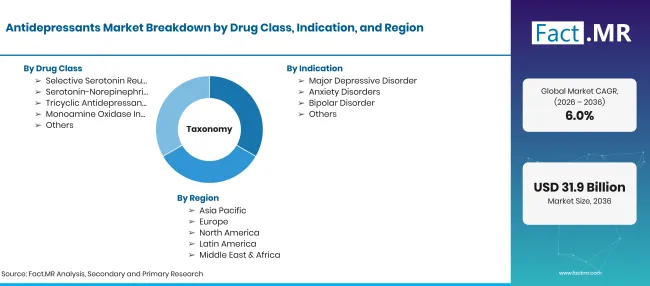
Antidepressants Market Taxonomy | Source: Fact.MR
| Attribute | Details |
|---|---|
| Quantitative Units | USD billion in 2026 to USD billion by 2036, at CAGR |
| Market Definition | The antidepressants market comprises prescription medications used to treat depressive disorders and selected psychiatric conditions. It includes selective serotonin reuptake inhibitors (SSRIs) and serotonin-norepinephrine reuptake inhibitors (SNRIs) alongside tricyclic antidepressants and monoamine oxidase inhibitors. |
| Drug Class | SSRIs; SNRIs; TCAs; MAOIs; Others |
| Indication | Major Depressive Disorder; Anxiety Disorders; Bipolar Disorder; Others |
| Distribution Channel | Retail Pharmacies; Hospital Pharmacies; Online Pharmacies; Others |
| Regions Covered | North America; Latin America; Western Europe; Eastern Europe; East Asia; South Asia & Pacific; Middle East & Africa |
| Countries Covered | Germany; Brazil; USA; UK; Japan |
| Companies Profiled | Pfizer; GlaxoSmithKline; Johnson & Johnson; AbbVie; H. Lundbeck |
| Forecast Period | 2026 to 2036 |
| Approach | Market segmentation and scenario-based analysis supported by clinical guidelines, pharmaceutical consumption data and company product information |
Source: Fact.MR analysis. Updated Nov 9, 2026
How is the market segmented?
-
By Drug Class
- Selective Serotonin Reuptake Inhibitors (SSRIs)
- Serotonin-Norepinephrine Reuptake Inhibitors (SNRIs)
- Tricyclic Antidepressants (TCAs)
- Monoamine Oxidase Inhibitors (MAOIs)
- Others
-
By Indication
- Major Depressive Disorder
- Anxiety Disorders
- Bipolar Disorder
- Others
-
By Distribution Channel
- Retail Pharmacies
- Hospital Pharmacies
- Online Pharmacies
- Others
-
By Region
- North America
- Latin America
- Western Europe
- Eastern Europe
- East Asia
- South Asia & Pacific
- Middle East & Africa
Frequently Asked Questions
How big is the Antidepressants Market in 2026?
What is the CAGR from 2026 to 2036?
Which drug class has the largest share?
Which indication has the largest share?
Which distribution channel leads?
Which country is projected to grow fastest?
Which companies are covered?
Who worked on this report


Preview the report firsthand - request a free sample
Free SampleGet the brochure for pricing and purchase details
Download PDF