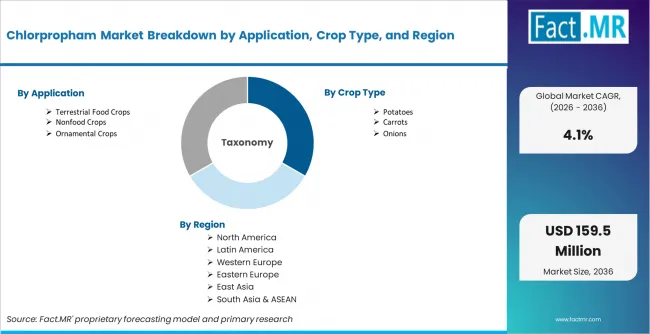
Chlorpropham Market Size, Share, Growth and Forecast (2026 - 2036)
The Chlorpropham Market is segmented by Form (Concentrate; Liquid); Application (Terrestrial Food Crops; Nonfood Crops; Ornamental Crops); Crop Type (Potatoes; Carrots; Onions; Other Tubers; Ornamentals); Treatment Method (Fogging; Aerosol; Dip Treatment; Spray Treatment); End User (Storage Operators; Potato Processors; Growers; Agrochemical Distributors); Sales Channel (Direct Supply; Distributor Supply; Retail Supply; Online Supply), and Region. Forecast for 2026 to 2036.
Fact.MR opinion that chlorpropham demand will rely on stored crop quality and residue control. Storage operators and potato processors use sprout control programs to protect shelf life and pass residue checks.
Chlorpropham Market Size, Market Forecast and Outlook by Fact.MR
- The chlorpropham market surpassed a value of USD 102.5 million in 2025.
- Demand is estimated to reach USD 106.7 million in 2026.
- The market is projected to record 4.1% CAGR from 2026 to 2036. Stored crop programs and post harvest loss control are forecast to lift the market to USD 159.5 million by 2036.
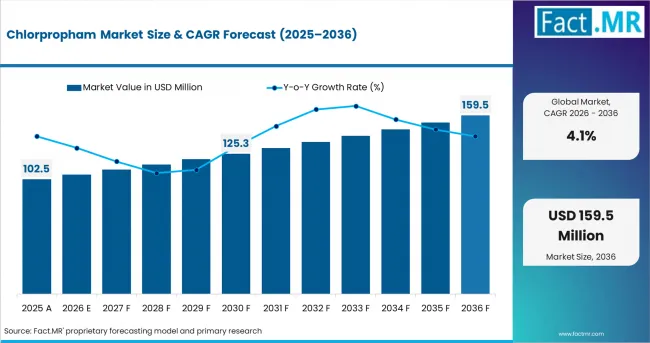
| Metric | Details |
|---|---|
| Industry Size (2026) | USD 106.7 million |
| Industry Value (2036) | USD 159.5 million |
| CAGR (2026 to 2036) | 4.1% |
Summary of Chlorpropham Market
- Demand Drivers in the Market
- Stored Crop Quality: Storage operators use chlorpropham to slow sprouting during long potato storage. Treatment helps keep more potatoes usable and reduces rejection risk.
- Residue Control: Stricter residue limits make dose control more important. Suppliers with clear label guidance and residue records can protect repeat orders.
- Processing Potatoes: Fry and chip processors need potatoes with steady quality. Chlorpropham demand follows long storage needs in processing supply chains.
- Key Segments Analyzed
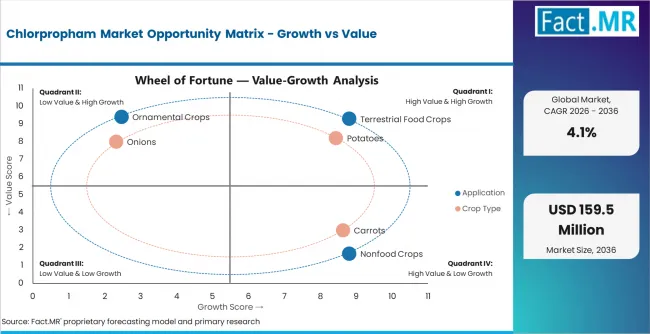
- By Application: Terrestrial food crops are likely to hold 74.7% share in 2026 as potato and tuber storage forms the main treatment base.
- By Crop Type: Potatoes are estimated to account for 68.0% share in 2026 since sprout suppression is most established in stored potato systems.
- By Form: Liquid is forecast to hold 58.0% share in 2026 as fogging and storage treatment systems need easy dosing.
- By Treatment Method: Fogging is likely to hold 46.0% share in 2026 as storage rooms need even product contact across stacked potatoes.
- By End User: Storage operators are estimated to hold 39.0% share in 2026 because treatment decisions are made at warehouse level.
- By Sales Channel: Direct supply is forecast to account for 44.0% share in 2026 as large storage accounts need scheduled deliveries and technical support.
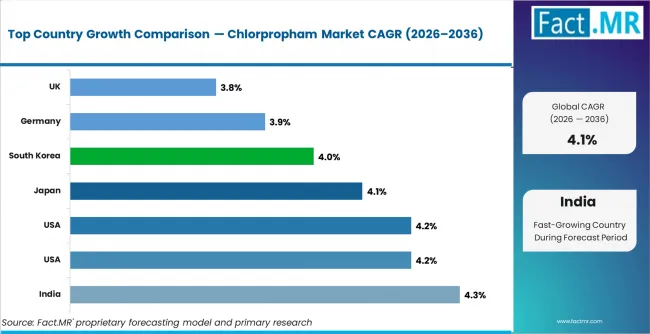
- By Geography: India chlorpropham demand is forecast to grow at 4.3% CAGR through 2036 as potato output and cold storage planning support treatment demand.
- Analyst Opinion at Fact.MR
- Shambhu Nath Jha as Senior Analyst at Fact.MR notes, “Chlorpropham is now more than a sprout control product. Demand depends on residue limits and storage cost control. Suppliers need to show safe dosing and clear records. Storage operators will prefer partners that offer application training and inspection support.”
- Strategic Implications
- Residue Readiness: Suppliers need to provide clear use rates and residue records. Weak documentation can slow acceptance in food crop channels.
- Storage Service: Application support will help suppliers stand out from generic active material sellers. Field support builds confidence during long storage periods.
- Crop Focus: Potato processors will stay the main demand base. Suppliers can protect volumes by offering products suited for fogging and storage rooms.
Chlorpropham use is tied to stored crop quality and residue control. Fact.MR identifies terrestrial food crops as the leading application. Potatoes form the main crop base because long storage periods need sprout control before processing or sale.
Storage operators are using more residue-aware treatment plans. Potato processors need steady tuber quality for fries and chips. Farmers need clear application rates before treated potatoes enter supply chains. Supplier service is important because label clarity and residue documents support repeat demand.
India is forecast to lead with 4.3% CAGR through 2036 as potato output and cold storage planning support treatment demand. United States demand may rise at 4.2% CAGR as processing potatoes remain linked to long storage. China is set to record 4.2% CAGR as tuber output and food processing sustain stored crop quality needs. Japan follows at 4.1% CAGR through quality checks and approved channel use. South Korea may record 4.0% CAGR as highland potato supply needs controlled storage after harvest. Germany may grow at 3.9% CAGR under tighter residue limits. United Kingdom demand is forecast to rise at 3.8% CAGR as storage operators manage residue checks and processor quality needs.
Segmental Analysis
Chlorpropham Market Analysis by Application
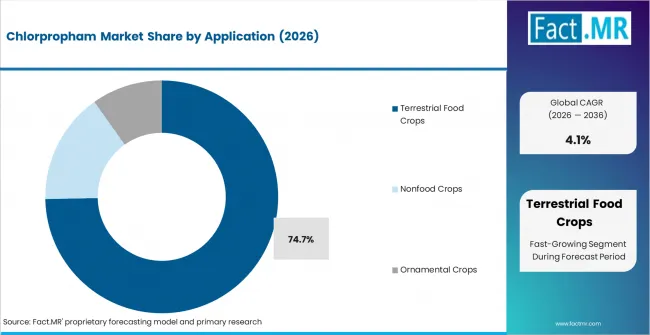
Terrestrial food crops are projected to hold 74.7% share in 2026 because potatoes and tubers form the main base for chlorpropham use. Nonfood crops use smaller volumes due to label limits. Ornamental crop use stays low because sprout control is less important in handling. Food crop storage gives chlorpropham its main demand base.
- Food Crop Use: Terrestrial food crops need sprout control during storage. Processors use treatment plans to protect tuber quality.
- Nonfood Crops: Nonfood crop use is smaller because residue rules and label limits restrict wider use. Demand depends on approved local applications.
- Ornamental Crops: Ornamental crop use stays limited. Treatment need is much lower than food crop storage demand.
Chlorpropham Market Analysis by Crop Type
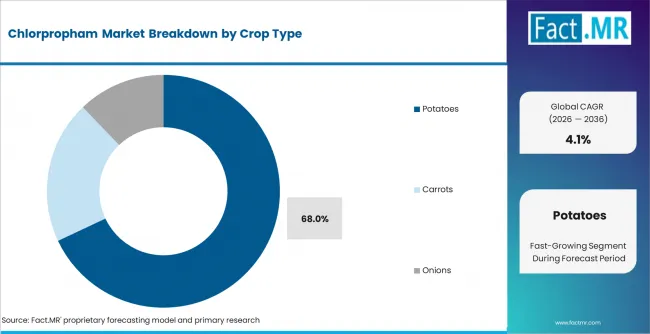
Potatoes are projected to account for 68.0% share in 2026 as chlorpropham use is most common in stored potato systems. Carrots and onions use smaller volumes because treatment rules and handling needs differ. Other tubers create limited demand in regions with long storage cycles. Potato processors need steady quality after months of storage, which supports the leading share.
- • Potato Storage: Potatoes stay the main treated crop. Long storage periods make sprout control part of warehouse planning.
- Carrot Use: Carrot applications are smaller and need careful label review. Demand comes from storage programs with residue checks.
- Onion Use: Onion treatment is selective and local. Use depends on specific crop handling practices.
Chlorpropham Market Analysis by Form
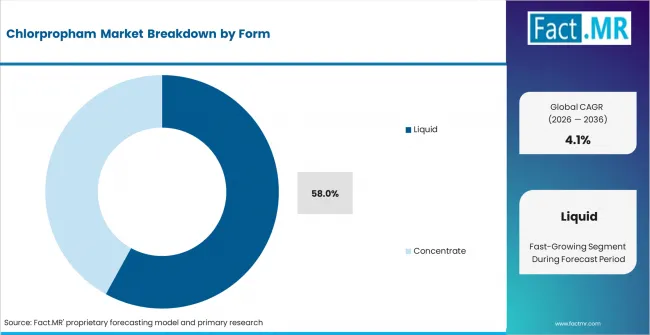
Liquid is estimated to hold 58.0% share in 2026 as storage treatment systems need products that work well with fogging equipment. Concentrates serve formulators and service providers that prepare final mixtures. Liquid products support ready dosing and reduce mixing steps. Steady distribution inside potato stores supports the leading share.
- Liquid Handling: Liquid products support storage room treatment. Operators can dose them through existing equipment.
- Concentrate Use: Concentrates serve formulators and local distributors. This format helps suppliers control active strength before dilution.
- Service Needs: Service providers prefer formats with clear instructions. Lower handling error helps protect repeat treatment work.
Chlorpropham Market Analysis by Treatment Method
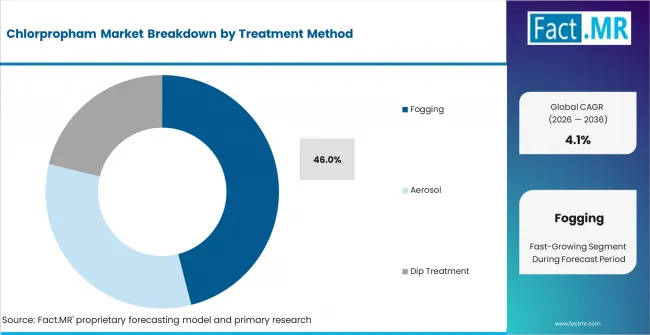
Fogging is projected to hold 46.0% share in 2026 as potato stores need even product spread across stacked crop piles. Aerosol treatment works in smaller rooms and controlled spaces. Dip and spray treatments are used for selected crops and smaller lots. Fogging leads because it can reach potatoes across large warehouse storage areas.
- Fogging Systems: Fogging supports even treatment across storage rooms. Large potato stores can treat crop piles without heavy movement.
- • Aerosol Use: Aerosol treatment works in controlled storage spaces. It supports smaller rooms and limited treatment plans.
- Dip Treatment: Dip treatment is used for selected crop lots. Use is limited by water handling and residue control needs.
Chlorpropham Market Analysis by End User
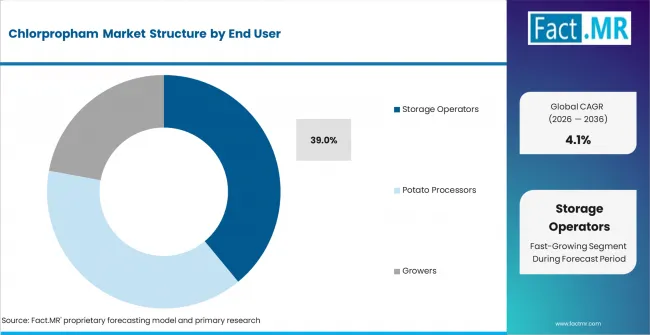
Storage operators are estimated to hold 39.0% share in 2026 as treatment decisions are made in crop storage facilities. Potato processors also need steady quality for fries and chips. Growers and distributors affect product choice through local access and service. Warehouse level decisions on timing and treatment method support the leading share.
- Storage Operators: Storage operators manage treatment timing and room conditions. Their decisions support repeat product orders.
- Potato Processors: Potato processors need steady raw material quality. Long storage periods increase treatment planning needs.
- Grower Demand: Growers use chlorpropham if crops are stored before sale. Product choice often follows local distributor advice.
Chlorpropham Market Analysis by Sales Channel
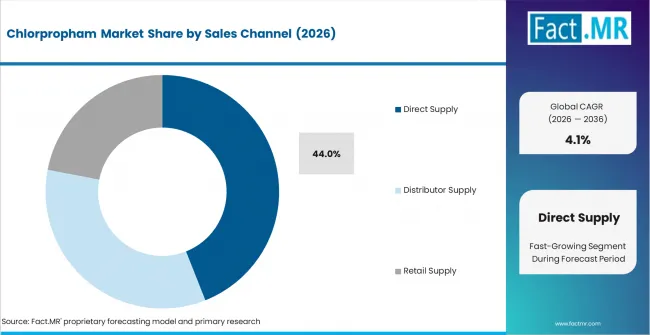
Direct supply is projected to account for 44.0% share in 2026 as large storage accounts need planned deliveries and technical support. Distributor supply serves local growers and smaller stores. Retail and online supply stay limited because chlorpropham needs label checks and careful handling. Large accounts prefer direct supplier contact for regulated crop treatment.
- Direct Supply: Direct supply supports large potato storage accounts. Regular delivery schedules reduce treatment delays.
- Distributor Supply: Distributor supply serves local farming clusters. Local access helps smaller storage sites get approved products.
- Retail Supply: Retail supply stays limited for professional treatment products. Handling rules reduce casual channel use.
Chlorpropham Market Drivers Restraints and Opportunities
Stored potato quality is the main driver for chlorpropham demand. The United States had 57.9 million cwt of potatoes in storage on June 1, 2025. [2] This storage volume shows why sprout control stays important during long holding periods. Storage operators need treatments that protect saleable potatoes and reduce waste.
Regulatory pressure is the main restraint for suppliers. The European Union lowered the potato chlorpropham maximum residue level from 0.35 mg per kg to 0.2 mg per kg in 2025. [3] This change makes residue control and clean application records more important. Suppliers without clear residue support may face weaker access in food crop channels.
Opportunities in the Chlorpropham Market
- Application Training: Storage operators need support on dose and timing. Suppliers can win repeat orders through training and clear product records.
- Potato Processing: Processors need stable raw material for frozen fries and chips. Treated storage helps keep potatoes usable after harvest.
- Alternative Planning: Producers can pair chlorpropham guidance with safener knowledge. This helps agrochemical companies manage residue and crop safety discussions.
Regional Analysis
Based on regional analysis, the chlorpropham market is segmented into North America and Latin America. It also covers Europe; East Asia; South Asia and Pacific; Middle East and Africa.
.webp)
| Country | CAGR |
|---|---|
| India | 4.3% |
| United States | 4.2% |
| China | 4.2% |
| Japan | 4.1% |
| South Korea | 4.0% |
| Germany | 3.9% |
| United Kingdom | 3.8% |
Source: adjusted forecast model based on pasted market data and primary research.
South Asia and Pacific Chlorpropham Market Analysis
South Asia and Pacific demand reflects potato production and cold storage expansion. India is the main market as potato output creates steady need for storage treatment and quality control.
- India: India is projected to record a 4.3% CAGR through 2036 as potato output reached 585.71 lakh tonnes in 2024 to 2025 and storage operators need sprout control for delayed sales. [4] Uttar Pradesh and West Bengal support large potato supply and cold storage use. Snack and frozen food processors need stable tuber quality. India benefits from high output and storage heavy supply chains.
- Japan: Japan is expected to advance at 4.1% CAGR by 2036 as food distributors need steady quality under strict inspection rules. Domestic storage programs are smaller than in India. Imported potato products still influence treatment standards. Japan demand grows through approved channels and strict quality checks.
North America Chlorpropham Market Analysis
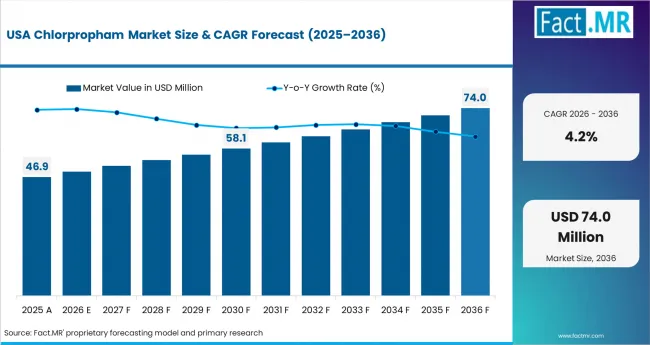
North America demand comes from large potato processing and professional storage systems. The United States leads the region because processors and storage operators need potatoes to stay usable for long periods.
- United States: The United States is set to expand at 4.2% CAGR from 2026 to 2036 as potato production totaled 421 million cwt in 2024 and processors need stored potatoes for year-round output. [1] Idaho and Washington support large processing volumes. Storage operators need treatment plans that control residues. Demand grows through established storage facilities and processing needs.
East Asia Chlorpropham Market Analysis
East Asia demand differs by crop scale and storage practice. China has a larger crop base. South Korea has smaller potato storage demand with higher quality control needs.
- China: China is set to record a 4.2% CAGR by 2036 as total grain production reached 706.50 million tons in 2024 and tuber output supports post-harvest storage needs. [5] Inner Mongolia and Gansu support major potato supply. Food processors need stable raw material for potato-based products. China demand benefits from crop scale and better storage systems.
- South Korea: South Korea is set to post a 4.0% CAGR through 2036 as highland potato production reached 126,399 tons in 2024 and storage quality stays important after harvest. [6] Gangwon supply needs controlled handling after seasonal production. Processors and distributors prefer treated crop lots with clear residue records. South Korea demand is supported by quality control and disciplined crop storage.
Europe Chlorpropham Market Analysis
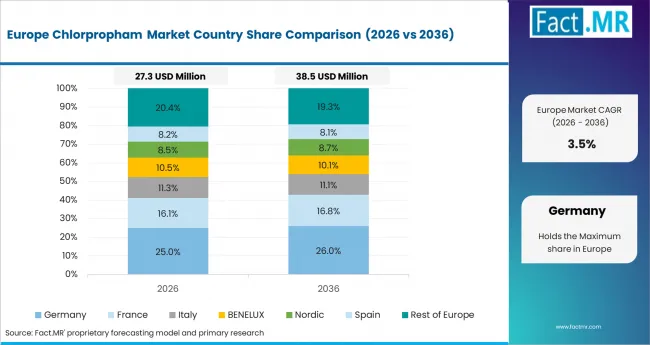
Europe demand is more sensitive to regulation than other regions. Germany and the United Kingdom still need chlorpropham through potato storage expertise and processing links, but residue rules limit wider use.
- Germany: Germany is set to record 3.9% CAGR by 2036 as potato stores and processors adjust to tighter residue limits. Lower residue tolerance keeps suppliers focused on clear documentation. Processors need clean potato lots for chips and frozen products. Germany demand depends on controlled use and reliable treatment support.
- United Kingdom: The United Kingdom is set to rise at 3.8% CAGR from 2026 to 2036 as storage operators manage residue limits and retail quality checks. Long holding cycles still support sprout control demand. Suppliers need proof of dose control and application support. United Kingdom demand is supported by regulated storage practice and processor quality needs.
Competitive Aligners for Market Players
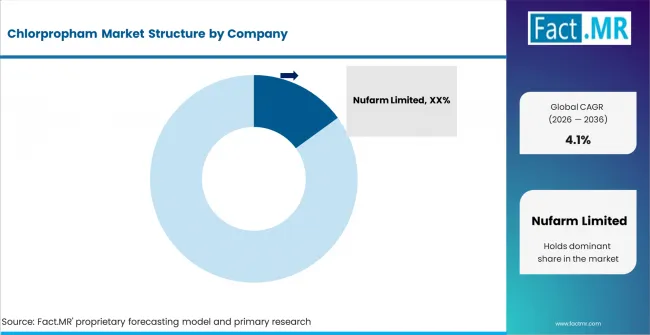
The chlorpropham market includes crop protection producers and agrochemical distributors with storage crop knowledge. Nufarm Limited, ADAMA Ltd., UPL Limited, Certis USA L.L.C., Limin Chemical Co., Ltd., and compete through active ingredient access and field support. Price is important, but residue support and clear label guidance influence repeat orders.
Large suppliers benefit from registration experience and distributor networks. Regional suppliers can protect accounts through service visits and potato storage knowledge. Companies with crop advisory support and wider agrochemical portfolios will have a better position.
Supplier performance will depend on residue records and reliable application support. Crop protection portfolios that include glyphosate can support service links across farms and distributors. Product managers that explain dose control in simple language can reduce storage operator risk. Firms that connect potato storage programs with potato starch and processing demand will have a clearer path to repeat sales.
Key Players in Chlorpropham Market
- Nufarm Limited
- ADAMA Ltd.
- UPL Limited
- Certis USA L.L.C.
- Limin Chemical Co., Ltd.
Bibliography
- [1] U.S. Department of Agriculture, National Agricultural Statistics Service. (2025, September 26). Potatoes 2024 summary.
- [2] U.S. Department of Agriculture, National Agricultural Statistics Service. (2025, June 18). Potato stocks.
- [3] European Commission. (2025, June 16). Commission Regulation (EU) 2025/1163 of 13 June 2025 amending Annexes II, III and V to Regulation (EC) No 396/2005 as regards maximum residue levels for chlorpropham, fuberidazole, ipconazole, methoxyfenozide, S-metolachlor and triflusulfuron in or on certain products. Official Journal of the European Union.
- [4] Ministry of Agriculture & Farmers Welfare. (2026, March 17). Union Minister Shri Shivraj Singh Chouhan releases Final Estimates of 2024-25 and First Advance Estimates of 2025-26 of area and production of horticulture crops. Press Information Bureau.
- [5] National Bureau of Statistics of China. (2024, December 13). Bulletin on the national grain production in 2024.
- [6] Ministry of Data and Statistics. (2024, November 22). Production of chili pepper, sesame and highland potatoes in 2024.
This Report Addresses
- Strategic intelligence on chlorpropham demand across stored crop quality, residue control, and potato processing needs.
- Opportunity mapping across India and the United States, with China and Japan covered through storage demand trends.
- Segment analysis by form, application, crop type, treatment method, end user, and sales channel.
- Regional outlook covering potato output, cold storage planning, and residue discipline.
- Competitive analysis of Nufarm Limited, ADAMA Ltd., UPL Limited, Certis USA L.L.C., and Limin Chemical Co., Ltd.
- Product assessment covering concentrate and liquid chlorpropham formats for fogging and storage room use.
- Report delivered through PDF files with Excel datasets and presentation decks.
- Primary interviews, supplier checks, and stored crop demand review support validation.
Chlorpropham Market Definition
The chlorpropham market covers technical and formulated chlorpropham used as a plant growth regulator and sprout suppressant. The scope includes concentrate and liquid products used on terrestrial food crops and selected nonfood crops. The market excludes finished potatoes and non chlorpropham sprout inhibitors.
Chlorpropham Market Inclusions
The scope includes chlorpropham concentrates and liquid formulations for potatoes and other stored crops across direct supply and distributor supply channels.
Chlorpropham Market Exclusions
The scope excludes fertilizers and fresh produce sales as well as ethylene treatment products and biological sprout suppressants sold without chlorpropham active content.
Chlorpropham Market Research Methodology
- Primary Research
- Primary research covered crop storage operators and potato processors that manage long storage cycles. Analysts reviewed product handling needs with agrochemical distributors and application service providers.
- Desk Research
- Desk research reviewed pesticide residue rules and crop production statistics from official agencies. Company product portfolios and crop protection chemicals pages were reviewed only for market structure and interlink mapping.
- Market-Sizing and Forecasting
- Forecasting used the pasted 2024 to 2034 chlorpropham baseline and shifted the window to 2026 to 2036. The model applied the same growth rate and recalculated values for 2025 and 2036.
- Data Validation and Update Cycle
- Forecasts were checked against potato production and storage indicators from official sources. Segment shares were checked against application use and crop storage intensity before final values were used.
Scope of the Report

| Attribute | Details |
|---|---|
| Quantitative Units | USD 106.7 million in 2026 to USD 159.5 million by 2036 at 4.1% CAGR |
| Market Definition | Chlorpropham formulations used as sprout suppressants and plant growth regulators in stored crops. |
| Form | Concentrate; Liquid |
| Application | Terrestrial Food Crops; Nonfood Crops; Ornamental Crops |
| Crop Type | Potatoes; Carrots; Onions; Other Tubers; Ornamentals |
| Treatment Method | Fogging; Aerosol; Dip Treatment; Spray Treatment |
| End User | Storage Operators; Potato Processors; Growers; Agrochemical Distributors |
| Sales Channel | Direct Supply; Distributor Supply; Retail Supply; Online Supply |
| Regions Covered | North America; Latin America; Europe; East Asia; South Asia and Pacific; Middle East and Africa |
| Countries Covered | India; United States; China; Japan; South Korea; Germany; United Kingdom |
| Key Companies Profiled | Nufarm Limited; ADAMA Ltd.; UPL Limited; Certis USA L.L.C.; Limin Chemical Co., Ltd.; |
| Forecast Period | 2026 to 2036 |
| Approach | Hybrid top-down and bottom-up model using chlorpropham demand by form and application, crop type use, treatment method adoption, end-user demand, sales channel movement, and supplier validation. |
Market Analysis by Segments
-
By Form:
- Concentrate
- Liquid
-
By Application:
- Terrestrial Food Crops
- Nonfood Crops
- Ornamental Crops
-
By Crop Type:
- Potatoes
- Carrots
- Onions
- Other Tubers
- Ornamental Plants
-
By Treatment Method:
- Fogging
- Aerosol
- Dip Treatment
- Spray Treatment
-
By End User:
- Storage Operators
- Potato Processors
- Growers
- Agrochemical Distributors
-
By Sales Channel:
- Direct Supply
- Distributor Supply
- Retail Supply
-
Region:
- North America
- United States
- Canada
- Europe
- Germany
- United Kingdom
- France
- Italy
- Spain
- Asia Pacific
- China
- Japan
- South Korea
- Taiwan
- Singapore
- Latin America
- Brazil
- Mexico
- Argentina
- Middle East & Africa
- GCC Countries
- South Africa
- Israel
- North America
- Frequently Asked Questions -
What is the value of the Chlorpropham Market in 2026?
The chlorpropham market is estimated at USD 106.7 million in 2026 under the adjusted forecast window.
What is the projected value of the Chlorpropham Market by 2036?
The chlorpropham market is projected to reach USD 159.5 million by 2036 through steady stored crop treatment use.
What is the CAGR for the Chlorpropham Market from 2026 to 2036?
The chlorpropham market is projected to record 4.1% CAGR from 2026 to 2036 under the adjusted model.
Which application leads the Chlorpropham Market?
Terrestrial food crops are projected to lead the chlorpropham market with 74.7% share in 2026 through potato storage use.
Which country is forecast to grow fastest in the Chlorpropham Market?
India is projected to grow fastest in the chlorpropham market at 4.3% CAGR through 2036 as potato output supports storage demand.
Table of Content
- Executive Summary
- Global Market Outlook
- Demand to side Trends
- Supply to side Trends
- Technology Roadmap Analysis
- Analysis and Recommendations
- Market Overview
- Market Coverage / Taxonomy
- Market Definition / Scope / Limitations
- Research Methodology
- Chapter Orientation
- Analytical Lens and Working Hypotheses
- Market Structure, Signals, and Trend Drivers
- Benchmarking and Cross-market Comparability
- Market Sizing, Forecasting, and Opportunity Mapping
- Research Design and Evidence Framework
- Desk Research Programme (Secondary Evidence)
- Company Annual and Sustainability Reports
- Peer-reviewed Journals and Academic Literature
- Corporate Websites, Product Literature, and Technical Notes
- Earnings Decks and Investor Briefings
- Statutory Filings and Regulatory Disclosures
- Technical White Papers and Standards Notes
- Trade Journals, Industry Magazines, and Analyst Briefs
- Conference Proceedings, Webinars, and Seminar Materials
- Government Statistics Portals and Public Data Releases
- Press Releases and Reputable Media Coverage
- Specialist Newsletters and Curated Briefings
- Sector Databases and Reference Repositories
- Fact.MR Internal Proprietary Databases and Historical Market Datasets
- Subscription Datasets and Paid Sources
- Social Channels, Communities, and Digital Listening Inputs
- Additional Desk Sources
- Expert Input and Fieldwork (Primary Evidence)
- Primary Modes
- Qualitative Interviews and Expert Elicitation
- Quantitative Surveys and Structured Data Capture
- Blended Approach
- Why Primary Evidence is Used
- Field Techniques
- Interviews
- Surveys
- Focus Groups
- Observational and In-context Research
- Social and Community Interactions
- Stakeholder Universe Engaged
- C-suite Leaders
- Board Members
- Presidents and Vice Presidents
- R&D and Innovation Heads
- Technical Specialists
- Domain Subject-matter Experts
- Scientists
- Physicians and Other Healthcare Professionals
- Governance, Ethics, and Data Stewardship
- Research Ethics
- Data Integrity and Handling
- Primary Modes
- Tooling, Models, and Reference Databases
- Desk Research Programme (Secondary Evidence)
- Data Engineering and Model Build
- Data Acquisition and Ingestion
- Cleaning, Normalisation, and Verification
- Synthesis, Triangulation, and Analysis
- Quality Assurance and Audit Trail
- Market Background
- Market Dynamics
- Drivers
- Restraints
- Opportunity
- Trends
- Scenario Forecast
- Demand in Optimistic Scenario
- Demand in Likely Scenario
- Demand in Conservative Scenario
- Opportunity Map Analysis
- Product Life Cycle Analysis
- Supply Chain Analysis
- Investment Feasibility Matrix
- Value Chain Analysis
- PESTLE and Porter’s Analysis
- Regulatory Landscape
- Regional Parent Market Outlook
- Production and Consumption Statistics
- Import and Export Statistics
- Market Dynamics
- Global Market Analysis 2021 to 2025 and Forecast, 2026 to 2036
- Historical Market Size Value (USD Million) Analysis, 2021 to 2025
- Current and Future Market Size Value (USD Million) Projections, 2026 to 2036
- Y to o to Y Growth Trend Analysis
- Absolute $ Opportunity Analysis
- Global Market Pricing Analysis 2021 to 2025 and Forecast 2026 to 2036
- Global Market Analysis 2021 to 2025 and Forecast 2026 to 2036, By Application
- Introduction / Key Findings
- Historical Market Size Value (USD Million) Analysis By Application , 2021 to 2025
- Current and Future Market Size Value (USD Million) Analysis and Forecast By Application , 2026 to 2036
- Terrestrial Food Crops
- Nonfood Crops
- Ornamental Crops
- Terrestrial Food Crops
- Y to o to Y Growth Trend Analysis By Application , 2021 to 2025
- Absolute $ Opportunity Analysis By Application , 2026 to 2036
- Global Market Analysis 2021 to 2025 and Forecast 2026 to 2036, By Crop Type
- Introduction / Key Findings
- Historical Market Size Value (USD Million) Analysis By Crop Type, 2021 to 2025
- Current and Future Market Size Value (USD Million) Analysis and Forecast By Crop Type, 2026 to 2036
- Potatoes
- Carrots
- Onions
- Other Tubers
- Potatoes
- Y to o to Y Growth Trend Analysis By Crop Type, 2021 to 2025
- Absolute $ Opportunity Analysis By Crop Type, 2026 to 2036
- Global Market Analysis 2021 to 2025 and Forecast 2026 to 2036, By Form
- Introduction / Key Findings
- Historical Market Size Value (USD Million) Analysis By Form, 2021 to 2025
- Current and Future Market Size Value (USD Million) Analysis and Forecast By Form, 2026 to 2036
- Liquid
- Concentrate
- Liquid
- Y to o to Y Growth Trend Analysis By Form, 2021 to 2025
- Absolute $ Opportunity Analysis By Form, 2026 to 2036
- Global Market Analysis 2021 to 2025 and Forecast 2026 to 2036, By Treatment Method
- Introduction / Key Findings
- Historical Market Size Value (USD Million) Analysis By Treatment Method, 2021 to 2025
- Current and Future Market Size Value (USD Million) Analysis and Forecast By Treatment Method, 2026 to 2036
- Fogging
- Aerosol
- Dip Treatment
- Spray Treatment
- Fogging
- Y to o to Y Growth Trend Analysis By Treatment Method, 2021 to 2025
- Absolute $ Opportunity Analysis By Treatment Method, 2026 to 2036
- Global Market Analysis 2021 to 2025 and Forecast 2026 to 2036, By End User
- Introduction / Key Findings
- Historical Market Size Value (USD Million) Analysis By End User, 2021 to 2025
- Current and Future Market Size Value (USD Million) Analysis and Forecast By End User, 2026 to 2036
- Storage Operators
- Potato Processors
- Growers
- Agrochemical Distributors
- Storage Operators
- Y to o to Y Growth Trend Analysis By End User, 2021 to 2025
- Absolute $ Opportunity Analysis By End User, 2026 to 2036
- Global Market Analysis 2021 to 2025 and Forecast 2026 to 2036, By Sales Channel
- Introduction / Key Findings
- Historical Market Size Value (USD Million) Analysis By Sales Channel, 2021 to 2025
- Current and Future Market Size Value (USD Million) Analysis and Forecast By Sales Channel, 2026 to 2036
- Direct Supply
- Distributor Supply
- Retail Supply
- Direct Supply
- Y to o to Y Growth Trend Analysis By Sales Channel, 2021 to 2025
- Absolute $ Opportunity Analysis By Sales Channel, 2026 to 2036
- Global Market Analysis 2021 to 2025 and Forecast 2026 to 2036, By Region
- Introduction
- Historical Market Size Value (USD Million) Analysis By Region, 2021 to 2025
- Current Market Size Value (USD Million) Analysis and Forecast By Region, 2026 to 2036
- North America
- Latin America
- Western Europe
- Eastern Europe
- East Asia
- South Asia and Pacific
- Middle East & Africa
- Market Attractiveness Analysis By Region
- North America Market Analysis 2021 to 2025 and Forecast 2026 to 2036, By Country
- Historical Market Size Value (USD Million) Trend Analysis By Market Taxonomy, 2021 to 2025
- Market Size Value (USD Million) Forecast By Market Taxonomy, 2026 to 2036
- By Country
- USA
- Canada
- Mexico
- By Application
- By Crop Type
- By Form
- By Treatment Method
- By End User
- By Sales Channel
- By Country
- Market Attractiveness Analysis
- By Country
- By Application
- By Crop Type
- By Form
- By Treatment Method
- By End User
- By Sales Channel
- Key Takeaways
- Latin America Market Analysis 2021 to 2025 and Forecast 2026 to 2036, By Country
- Historical Market Size Value (USD Million) Trend Analysis By Market Taxonomy, 2021 to 2025
- Market Size Value (USD Million) Forecast By Market Taxonomy, 2026 to 2036
- By Country
- Brazil
- Chile
- Rest of Latin America
- By Application
- By Crop Type
- By Form
- By Treatment Method
- By End User
- By Sales Channel
- By Country
- Market Attractiveness Analysis
- By Country
- By Application
- By Crop Type
- By Form
- By Treatment Method
- By End User
- By Sales Channel
- Key Takeaways
- Western Europe Market Analysis 2021 to 2025 and Forecast 2026 to 2036, By Country
- Historical Market Size Value (USD Million) Trend Analysis By Market Taxonomy, 2021 to 2025
- Market Size Value (USD Million) Forecast By Market Taxonomy, 2026 to 2036
- By Country
- Germany
- UK
- Italy
- Spain
- France
- Nordic
- BENELUX
- Rest of Western Europe
- By Application
- By Crop Type
- By Form
- By Treatment Method
- By End User
- By Sales Channel
- By Country
- Market Attractiveness Analysis
- By Country
- By Application
- By Crop Type
- By Form
- By Treatment Method
- By End User
- By Sales Channel
- Key Takeaways
- Eastern Europe Market Analysis 2021 to 2025 and Forecast 2026 to 2036, By Country
- Historical Market Size Value (USD Million) Trend Analysis By Market Taxonomy, 2021 to 2025
- Market Size Value (USD Million) Forecast By Market Taxonomy, 2026 to 2036
- By Country
- Russia
- Poland
- Hungary
- Balkan & Baltic
- Rest of Eastern Europe
- By Application
- By Crop Type
- By Form
- By Treatment Method
- By End User
- By Sales Channel
- By Country
- Market Attractiveness Analysis
- By Country
- By Application
- By Crop Type
- By Form
- By Treatment Method
- By End User
- By Sales Channel
- Key Takeaways
- East Asia Market Analysis 2021 to 2025 and Forecast 2026 to 2036, By Country
- Historical Market Size Value (USD Million) Trend Analysis By Market Taxonomy, 2021 to 2025
- Market Size Value (USD Million) Forecast By Market Taxonomy, 2026 to 2036
- By Country
- China
- Japan
- South Korea
- By Application
- By Crop Type
- By Form
- By Treatment Method
- By End User
- By Sales Channel
- By Country
- Market Attractiveness Analysis
- By Country
- By Application
- By Crop Type
- By Form
- By Treatment Method
- By End User
- By Sales Channel
- Key Takeaways
- South Asia and Pacific Market Analysis 2021 to 2025 and Forecast 2026 to 2036, By Country
- Historical Market Size Value (USD Million) Trend Analysis By Market Taxonomy, 2021 to 2025
- Market Size Value (USD Million) Forecast By Market Taxonomy, 2026 to 2036
- By Country
- India
- ASEAN
- Australia & New Zealand
- Rest of South Asia and Pacific
- By Application
- By Crop Type
- By Form
- By Treatment Method
- By End User
- By Sales Channel
- By Country
- Market Attractiveness Analysis
- By Country
- By Application
- By Crop Type
- By Form
- By Treatment Method
- By End User
- By Sales Channel
- Key Takeaways
- Middle East & Africa Market Analysis 2021 to 2025 and Forecast 2026 to 2036, By Country
- Historical Market Size Value (USD Million) Trend Analysis By Market Taxonomy, 2021 to 2025
- Market Size Value (USD Million) Forecast By Market Taxonomy, 2026 to 2036
- By Country
- Kingdom of Saudi Arabia
- Other GCC Countries
- Turkiye
- South Africa
- Other African Union
- Rest of Middle East & Africa
- By Application
- By Crop Type
- By Form
- By Treatment Method
- By End User
- By Sales Channel
- By Country
- Market Attractiveness Analysis
- By Country
- By Application
- By Crop Type
- By Form
- By Treatment Method
- By End User
- By Sales Channel
- Key Takeaways
- Key Countries Market Analysis
- USA
- Pricing Analysis
- Market Share Analysis, 2025
- By Application
- By Crop Type
- By Form
- By Treatment Method
- By End User
- By Sales Channel
- Canada
- Pricing Analysis
- Market Share Analysis, 2025
- By Application
- By Crop Type
- By Form
- By Treatment Method
- By End User
- By Sales Channel
- Mexico
- Pricing Analysis
- Market Share Analysis, 2025
- By Application
- By Crop Type
- By Form
- By Treatment Method
- By End User
- By Sales Channel
- Brazil
- Pricing Analysis
- Market Share Analysis, 2025
- By Application
- By Crop Type
- By Form
- By Treatment Method
- By End User
- By Sales Channel
- Chile
- Pricing Analysis
- Market Share Analysis, 2025
- By Application
- By Crop Type
- By Form
- By Treatment Method
- By End User
- By Sales Channel
- Germany
- Pricing Analysis
- Market Share Analysis, 2025
- By Application
- By Crop Type
- By Form
- By Treatment Method
- By End User
- By Sales Channel
- UK
- Pricing Analysis
- Market Share Analysis, 2025
- By Application
- By Crop Type
- By Form
- By Treatment Method
- By End User
- By Sales Channel
- Italy
- Pricing Analysis
- Market Share Analysis, 2025
- By Application
- By Crop Type
- By Form
- By Treatment Method
- By End User
- By Sales Channel
- Spain
- Pricing Analysis
- Market Share Analysis, 2025
- By Application
- By Crop Type
- By Form
- By Treatment Method
- By End User
- By Sales Channel
- France
- Pricing Analysis
- Market Share Analysis, 2025
- By Application
- By Crop Type
- By Form
- By Treatment Method
- By End User
- By Sales Channel
- India
- Pricing Analysis
- Market Share Analysis, 2025
- By Application
- By Crop Type
- By Form
- By Treatment Method
- By End User
- By Sales Channel
- ASEAN
- Pricing Analysis
- Market Share Analysis, 2025
- By Application
- By Crop Type
- By Form
- By Treatment Method
- By End User
- By Sales Channel
- Australia & New Zealand
- Pricing Analysis
- Market Share Analysis, 2025
- By Application
- By Crop Type
- By Form
- By Treatment Method
- By End User
- By Sales Channel
- China
- Pricing Analysis
- Market Share Analysis, 2025
- By Application
- By Crop Type
- By Form
- By Treatment Method
- By End User
- By Sales Channel
- Japan
- Pricing Analysis
- Market Share Analysis, 2025
- By Application
- By Crop Type
- By Form
- By Treatment Method
- By End User
- By Sales Channel
- South Korea
- Pricing Analysis
- Market Share Analysis, 2025
- By Application
- By Crop Type
- By Form
- By Treatment Method
- By End User
- By Sales Channel
- Russia
- Pricing Analysis
- Market Share Analysis, 2025
- By Application
- By Crop Type
- By Form
- By Treatment Method
- By End User
- By Sales Channel
- Poland
- Pricing Analysis
- Market Share Analysis, 2025
- By Application
- By Crop Type
- By Form
- By Treatment Method
- By End User
- By Sales Channel
- Hungary
- Pricing Analysis
- Market Share Analysis, 2025
- By Application
- By Crop Type
- By Form
- By Treatment Method
- By End User
- By Sales Channel
- Kingdom of Saudi Arabia
- Pricing Analysis
- Market Share Analysis, 2025
- By Application
- By Crop Type
- By Form
- By Treatment Method
- By End User
- By Sales Channel
- Turkiye
- Pricing Analysis
- Market Share Analysis, 2025
- By Application
- By Crop Type
- By Form
- By Treatment Method
- By End User
- By Sales Channel
- South Africa
- Pricing Analysis
- Market Share Analysis, 2025
- By Application
- By Crop Type
- By Form
- By Treatment Method
- By End User
- By Sales Channel
- USA
- Market Structure Analysis
- Competition Dashboard
- Competition Benchmarking
- Market Share Analysis of Top Players
- By Regional
- By Application
- By Crop Type
- By Form
- By Treatment Method
- By End User
- By Sales Channel
- Competition Analysis
- Competition Deep Dive
- Nufarm Limited
- Overview
- Product Portfolio
- Profitability by Market Segments (Product/Age /Sales Channel/Region)
- Sales Footprint
- Strategy Overview
- Marketing Strategy
- Product Strategy
- Channel Strategy
- ADAMA Ltd.
- UPL Limited
- Certis USA L.L.C.
- Limin Chemical Co., Ltd.
- Nufarm Limited
- Competition Deep Dive
- Assumptions & Acronyms Used
List Of Table
- Table 1: Global Market Value (USD Million) Forecast by Region, 2021 to 2036
- Table 2: Global Market Value (USD Million) Forecast by Application, 2021 to 2036
- Table 3: Global Market Value (USD Million) Forecast by Crop Type, 2021 to 2036
- Table 4: Global Market Value (USD Million) Forecast by Form, 2021 to 2036
- Table 5: Global Market Value (USD Million) Forecast by Treatment Method, 2021 to 2036
- Table 6: Global Market Value (USD Million) Forecast by End User, 2021 to 2036
- Table 7: Global Market Value (USD Million) Forecast by Sales Channel, 2021 to 2036
- Table 8: North America Market Value (USD Million) Forecast by Country, 2021 to 2036
- Table 9: North America Market Value (USD Million) Forecast by Application, 2021 to 2036
- Table 10: North America Market Value (USD Million) Forecast by Crop Type, 2021 to 2036
- Table 11: North America Market Value (USD Million) Forecast by Form, 2021 to 2036
- Table 12: North America Market Value (USD Million) Forecast by Treatment Method, 2021 to 2036
- Table 13: North America Market Value (USD Million) Forecast by End User, 2021 to 2036
- Table 14: North America Market Value (USD Million) Forecast by Sales Channel, 2021 to 2036
- Table 15: Latin America Market Value (USD Million) Forecast by Country, 2021 to 2036
- Table 16: Latin America Market Value (USD Million) Forecast by Application, 2021 to 2036
- Table 17: Latin America Market Value (USD Million) Forecast by Crop Type, 2021 to 2036
- Table 18: Latin America Market Value (USD Million) Forecast by Form, 2021 to 2036
- Table 19: Latin America Market Value (USD Million) Forecast by Treatment Method, 2021 to 2036
- Table 20: Latin America Market Value (USD Million) Forecast by End User, 2021 to 2036
- Table 21: Latin America Market Value (USD Million) Forecast by Sales Channel, 2021 to 2036
- Table 22: Western Europe Market Value (USD Million) Forecast by Country, 2021 to 2036
- Table 23: Western Europe Market Value (USD Million) Forecast by Application, 2021 to 2036
- Table 24: Western Europe Market Value (USD Million) Forecast by Crop Type, 2021 to 2036
- Table 25: Western Europe Market Value (USD Million) Forecast by Form, 2021 to 2036
- Table 26: Western Europe Market Value (USD Million) Forecast by Treatment Method, 2021 to 2036
- Table 27: Western Europe Market Value (USD Million) Forecast by End User, 2021 to 2036
- Table 28: Western Europe Market Value (USD Million) Forecast by Sales Channel, 2021 to 2036
- Table 29: Eastern Europe Market Value (USD Million) Forecast by Country, 2021 to 2036
- Table 30: Eastern Europe Market Value (USD Million) Forecast by Application, 2021 to 2036
- Table 31: Eastern Europe Market Value (USD Million) Forecast by Crop Type, 2021 to 2036
- Table 32: Eastern Europe Market Value (USD Million) Forecast by Form, 2021 to 2036
- Table 33: Eastern Europe Market Value (USD Million) Forecast by Treatment Method, 2021 to 2036
- Table 34: Eastern Europe Market Value (USD Million) Forecast by End User, 2021 to 2036
- Table 35: Eastern Europe Market Value (USD Million) Forecast by Sales Channel, 2021 to 2036
- Table 36: East Asia Market Value (USD Million) Forecast by Country, 2021 to 2036
- Table 37: East Asia Market Value (USD Million) Forecast by Application, 2021 to 2036
- Table 38: East Asia Market Value (USD Million) Forecast by Crop Type, 2021 to 2036
- Table 39: East Asia Market Value (USD Million) Forecast by Form, 2021 to 2036
- Table 40: East Asia Market Value (USD Million) Forecast by Treatment Method, 2021 to 2036
- Table 41: East Asia Market Value (USD Million) Forecast by End User, 2021 to 2036
- Table 42: East Asia Market Value (USD Million) Forecast by Sales Channel, 2021 to 2036
- Table 43: South Asia and Pacific Market Value (USD Million) Forecast by Country, 2021 to 2036
- Table 44: South Asia and Pacific Market Value (USD Million) Forecast by Application, 2021 to 2036
- Table 45: South Asia and Pacific Market Value (USD Million) Forecast by Crop Type, 2021 to 2036
- Table 46: South Asia and Pacific Market Value (USD Million) Forecast by Form, 2021 to 2036
- Table 47: South Asia and Pacific Market Value (USD Million) Forecast by Treatment Method, 2021 to 2036
- Table 48: South Asia and Pacific Market Value (USD Million) Forecast by End User, 2021 to 2036
- Table 49: South Asia and Pacific Market Value (USD Million) Forecast by Sales Channel, 2021 to 2036
- Table 50: Middle East & Africa Market Value (USD Million) Forecast by Country, 2021 to 2036
- Table 51: Middle East & Africa Market Value (USD Million) Forecast by Application, 2021 to 2036
- Table 52: Middle East & Africa Market Value (USD Million) Forecast by Crop Type, 2021 to 2036
- Table 53: Middle East & Africa Market Value (USD Million) Forecast by Form, 2021 to 2036
- Table 54: Middle East & Africa Market Value (USD Million) Forecast by Treatment Method, 2021 to 2036
- Table 55: Middle East & Africa Market Value (USD Million) Forecast by End User, 2021 to 2036
- Table 56: Middle East & Africa Market Value (USD Million) Forecast by Sales Channel, 2021 to 2036
List Of Figures
- Figure 1: Global Market Pricing Analysis
- Figure 2: Global Market Value (USD Million) Forecast 2021-2036
- Figure 3: Global Market Value Share and BPS Analysis by Application, 2026 and 2036
- Figure 4: Global Market Y-o-Y Growth Comparison by Application, 2026 to 2036
- Figure 5: Global Market Attractiveness Analysis by Application
- Figure 6: Global Market Value Share and BPS Analysis by Crop Type, 2026 and 2036
- Figure 7: Global Market Y-o-Y Growth Comparison by Crop Type, 2026 to 2036
- Figure 8: Global Market Attractiveness Analysis by Crop Type
- Figure 9: Global Market Value Share and BPS Analysis by Form, 2026 and 2036
- Figure 10: Global Market Y-o-Y Growth Comparison by Form, 2026 to 2036
- Figure 11: Global Market Attractiveness Analysis by Form
- Figure 12: Global Market Value Share and BPS Analysis by Treatment Method, 2026 and 2036
- Figure 13: Global Market Y-o-Y Growth Comparison by Treatment Method, 2026 to 2036
- Figure 14: Global Market Attractiveness Analysis by Treatment Method
- Figure 15: Global Market Value Share and BPS Analysis by End User, 2026 and 2036
- Figure 16: Global Market Y-o-Y Growth Comparison by End User, 2026 to 2036
- Figure 17: Global Market Attractiveness Analysis by End User
- Figure 18: Global Market Value Share and BPS Analysis by Sales Channel, 2026 and 2036
- Figure 19: Global Market Y-o-Y Growth Comparison by Sales Channel, 2026 to 2036
- Figure 20: Global Market Attractiveness Analysis by Sales Channel
- Figure 21: Global Market Value (USD Million) Share and BPS Analysis by Region, 2026 and 2036
- Figure 22: Global Market Y-o-Y Growth Comparison by Region, 2026 to 2036
- Figure 23: Global Market Attractiveness Analysis by Region
- Figure 24: North America Market Incremental Dollar Opportunity, 2026 to 2036
- Figure 25: Latin America Market Incremental Dollar Opportunity, 2026 to 2036
- Figure 26: Western Europe Market Incremental Dollar Opportunity, 2026 to 2036
- Figure 27: Eastern Europe Market Incremental Dollar Opportunity, 2026 to 2036
- Figure 28: East Asia Market Incremental Dollar Opportunity, 2026 to 2036
- Figure 29: South Asia and Pacific Market Incremental Dollar Opportunity, 2026 to 2036
- Figure 30: Middle East & Africa Market Incremental Dollar Opportunity, 2026 to 2036
- Figure 31: North America Market Value Share and BPS Analysis by Country, 2026 and 2036
- Figure 32: North America Market Value Share and BPS Analysis by Application, 2026 and 2036
- Figure 33: North America Market Y-o-Y Growth Comparison by Application, 2026 to 2036
- Figure 34: North America Market Attractiveness Analysis by Application
- Figure 35: North America Market Value Share and BPS Analysis by Crop Type, 2026 and 2036
- Figure 36: North America Market Y-o-Y Growth Comparison by Crop Type, 2026 to 2036
- Figure 37: North America Market Attractiveness Analysis by Crop Type
- Figure 38: North America Market Value Share and BPS Analysis by Form, 2026 and 2036
- Figure 39: North America Market Y-o-Y Growth Comparison by Form, 2026 to 2036
- Figure 40: North America Market Attractiveness Analysis by Form
- Figure 41: North America Market Value Share and BPS Analysis by Treatment Method, 2026 and 2036
- Figure 42: North America Market Y-o-Y Growth Comparison by Treatment Method, 2026 to 2036
- Figure 43: North America Market Attractiveness Analysis by Treatment Method
- Figure 44: North America Market Value Share and BPS Analysis by End User, 2026 and 2036
- Figure 45: North America Market Y-o-Y Growth Comparison by End User, 2026 to 2036
- Figure 46: North America Market Attractiveness Analysis by End User
- Figure 47: North America Market Value Share and BPS Analysis by Sales Channel, 2026 and 2036
- Figure 48: North America Market Y-o-Y Growth Comparison by Sales Channel, 2026 to 2036
- Figure 49: North America Market Attractiveness Analysis by Sales Channel
- Figure 50: Latin America Market Value Share and BPS Analysis by Country, 2026 and 2036
- Figure 51: Latin America Market Value Share and BPS Analysis by Application, 2026 and 2036
- Figure 52: Latin America Market Y-o-Y Growth Comparison by Application, 2026 to 2036
- Figure 53: Latin America Market Attractiveness Analysis by Application
- Figure 54: Latin America Market Value Share and BPS Analysis by Crop Type, 2026 and 2036
- Figure 55: Latin America Market Y-o-Y Growth Comparison by Crop Type, 2026 to 2036
- Figure 56: Latin America Market Attractiveness Analysis by Crop Type
- Figure 57: Latin America Market Value Share and BPS Analysis by Form, 2026 and 2036
- Figure 58: Latin America Market Y-o-Y Growth Comparison by Form, 2026 to 2036
- Figure 59: Latin America Market Attractiveness Analysis by Form
- Figure 60: Latin America Market Value Share and BPS Analysis by Treatment Method, 2026 and 2036
- Figure 61: Latin America Market Y-o-Y Growth Comparison by Treatment Method, 2026 to 2036
- Figure 62: Latin America Market Attractiveness Analysis by Treatment Method
- Figure 63: Latin America Market Value Share and BPS Analysis by End User, 2026 and 2036
- Figure 64: Latin America Market Y-o-Y Growth Comparison by End User, 2026 to 2036
- Figure 65: Latin America Market Attractiveness Analysis by End User
- Figure 66: Latin America Market Value Share and BPS Analysis by Sales Channel, 2026 and 2036
- Figure 67: Latin America Market Y-o-Y Growth Comparison by Sales Channel, 2026 to 2036
- Figure 68: Latin America Market Attractiveness Analysis by Sales Channel
- Figure 69: Western Europe Market Value Share and BPS Analysis by Country, 2026 and 2036
- Figure 70: Western Europe Market Value Share and BPS Analysis by Application, 2026 and 2036
- Figure 71: Western Europe Market Y-o-Y Growth Comparison by Application, 2026 to 2036
- Figure 72: Western Europe Market Attractiveness Analysis by Application
- Figure 73: Western Europe Market Value Share and BPS Analysis by Crop Type, 2026 and 2036
- Figure 74: Western Europe Market Y-o-Y Growth Comparison by Crop Type, 2026 to 2036
- Figure 75: Western Europe Market Attractiveness Analysis by Crop Type
- Figure 76: Western Europe Market Value Share and BPS Analysis by Form, 2026 and 2036
- Figure 77: Western Europe Market Y-o-Y Growth Comparison by Form, 2026 to 2036
- Figure 78: Western Europe Market Attractiveness Analysis by Form
- Figure 79: Western Europe Market Value Share and BPS Analysis by Treatment Method, 2026 and 2036
- Figure 80: Western Europe Market Y-o-Y Growth Comparison by Treatment Method, 2026 to 2036
- Figure 81: Western Europe Market Attractiveness Analysis by Treatment Method
- Figure 82: Western Europe Market Value Share and BPS Analysis by End User, 2026 and 2036
- Figure 83: Western Europe Market Y-o-Y Growth Comparison by End User, 2026 to 2036
- Figure 84: Western Europe Market Attractiveness Analysis by End User
- Figure 85: Western Europe Market Value Share and BPS Analysis by Sales Channel, 2026 and 2036
- Figure 86: Western Europe Market Y-o-Y Growth Comparison by Sales Channel, 2026 to 2036
- Figure 87: Western Europe Market Attractiveness Analysis by Sales Channel
- Figure 88: Eastern Europe Market Value Share and BPS Analysis by Country, 2026 and 2036
- Figure 89: Eastern Europe Market Value Share and BPS Analysis by Application, 2026 and 2036
- Figure 90: Eastern Europe Market Y-o-Y Growth Comparison by Application, 2026 to 2036
- Figure 91: Eastern Europe Market Attractiveness Analysis by Application
- Figure 92: Eastern Europe Market Value Share and BPS Analysis by Crop Type, 2026 and 2036
- Figure 93: Eastern Europe Market Y-o-Y Growth Comparison by Crop Type, 2026 to 2036
- Figure 94: Eastern Europe Market Attractiveness Analysis by Crop Type
- Figure 95: Eastern Europe Market Value Share and BPS Analysis by Form, 2026 and 2036
- Figure 96: Eastern Europe Market Y-o-Y Growth Comparison by Form, 2026 to 2036
- Figure 97: Eastern Europe Market Attractiveness Analysis by Form
- Figure 98: Eastern Europe Market Value Share and BPS Analysis by Treatment Method, 2026 and 2036
- Figure 99: Eastern Europe Market Y-o-Y Growth Comparison by Treatment Method, 2026 to 2036
- Figure 100: Eastern Europe Market Attractiveness Analysis by Treatment Method
- Figure 101: Eastern Europe Market Value Share and BPS Analysis by End User, 2026 and 2036
- Figure 102: Eastern Europe Market Y-o-Y Growth Comparison by End User, 2026 to 2036
- Figure 103: Eastern Europe Market Attractiveness Analysis by End User
- Figure 104: Eastern Europe Market Value Share and BPS Analysis by Sales Channel, 2026 and 2036
- Figure 105: Eastern Europe Market Y-o-Y Growth Comparison by Sales Channel, 2026 to 2036
- Figure 106: Eastern Europe Market Attractiveness Analysis by Sales Channel
- Figure 107: East Asia Market Value Share and BPS Analysis by Country, 2026 and 2036
- Figure 108: East Asia Market Value Share and BPS Analysis by Application, 2026 and 2036
- Figure 109: East Asia Market Y-o-Y Growth Comparison by Application, 2026 to 2036
- Figure 110: East Asia Market Attractiveness Analysis by Application
- Figure 111: East Asia Market Value Share and BPS Analysis by Crop Type, 2026 and 2036
- Figure 112: East Asia Market Y-o-Y Growth Comparison by Crop Type, 2026 to 2036
- Figure 113: East Asia Market Attractiveness Analysis by Crop Type
- Figure 114: East Asia Market Value Share and BPS Analysis by Form, 2026 and 2036
- Figure 115: East Asia Market Y-o-Y Growth Comparison by Form, 2026 to 2036
- Figure 116: East Asia Market Attractiveness Analysis by Form
- Figure 117: East Asia Market Value Share and BPS Analysis by Treatment Method, 2026 and 2036
- Figure 118: East Asia Market Y-o-Y Growth Comparison by Treatment Method, 2026 to 2036
- Figure 119: East Asia Market Attractiveness Analysis by Treatment Method
- Figure 120: East Asia Market Value Share and BPS Analysis by End User, 2026 and 2036
- Figure 121: East Asia Market Y-o-Y Growth Comparison by End User, 2026 to 2036
- Figure 122: East Asia Market Attractiveness Analysis by End User
- Figure 123: East Asia Market Value Share and BPS Analysis by Sales Channel, 2026 and 2036
- Figure 124: East Asia Market Y-o-Y Growth Comparison by Sales Channel, 2026 to 2036
- Figure 125: East Asia Market Attractiveness Analysis by Sales Channel
- Figure 126: South Asia and Pacific Market Value Share and BPS Analysis by Country, 2026 and 2036
- Figure 127: South Asia and Pacific Market Value Share and BPS Analysis by Application, 2026 and 2036
- Figure 128: South Asia and Pacific Market Y-o-Y Growth Comparison by Application, 2026 to 2036
- Figure 129: South Asia and Pacific Market Attractiveness Analysis by Application
- Figure 130: South Asia and Pacific Market Value Share and BPS Analysis by Crop Type, 2026 and 2036
- Figure 131: South Asia and Pacific Market Y-o-Y Growth Comparison by Crop Type, 2026 to 2036
- Figure 132: South Asia and Pacific Market Attractiveness Analysis by Crop Type
- Figure 133: South Asia and Pacific Market Value Share and BPS Analysis by Form, 2026 and 2036
- Figure 134: South Asia and Pacific Market Y-o-Y Growth Comparison by Form, 2026 to 2036
- Figure 135: South Asia and Pacific Market Attractiveness Analysis by Form
- Figure 136: South Asia and Pacific Market Value Share and BPS Analysis by Treatment Method, 2026 and 2036
- Figure 137: South Asia and Pacific Market Y-o-Y Growth Comparison by Treatment Method, 2026 to 2036
- Figure 138: South Asia and Pacific Market Attractiveness Analysis by Treatment Method
- Figure 139: South Asia and Pacific Market Value Share and BPS Analysis by End User, 2026 and 2036
- Figure 140: South Asia and Pacific Market Y-o-Y Growth Comparison by End User, 2026 to 2036
- Figure 141: South Asia and Pacific Market Attractiveness Analysis by End User
- Figure 142: South Asia and Pacific Market Value Share and BPS Analysis by Sales Channel, 2026 and 2036
- Figure 143: South Asia and Pacific Market Y-o-Y Growth Comparison by Sales Channel, 2026 to 2036
- Figure 144: South Asia and Pacific Market Attractiveness Analysis by Sales Channel
- Figure 145: Middle East & Africa Market Value Share and BPS Analysis by Country, 2026 and 2036
- Figure 146: Middle East & Africa Market Value Share and BPS Analysis by Application, 2026 and 2036
- Figure 147: Middle East & Africa Market Y-o-Y Growth Comparison by Application, 2026 to 2036
- Figure 148: Middle East & Africa Market Attractiveness Analysis by Application
- Figure 149: Middle East & Africa Market Value Share and BPS Analysis by Crop Type, 2026 and 2036
- Figure 150: Middle East & Africa Market Y-o-Y Growth Comparison by Crop Type, 2026 to 2036
- Figure 151: Middle East & Africa Market Attractiveness Analysis by Crop Type
- Figure 152: Middle East & Africa Market Value Share and BPS Analysis by Form, 2026 and 2036
- Figure 153: Middle East & Africa Market Y-o-Y Growth Comparison by Form, 2026 to 2036
- Figure 154: Middle East & Africa Market Attractiveness Analysis by Form
- Figure 155: Middle East & Africa Market Value Share and BPS Analysis by Treatment Method, 2026 and 2036
- Figure 156: Middle East & Africa Market Y-o-Y Growth Comparison by Treatment Method, 2026 to 2036
- Figure 157: Middle East & Africa Market Attractiveness Analysis by Treatment Method
- Figure 158: Middle East & Africa Market Value Share and BPS Analysis by End User, 2026 and 2036
- Figure 159: Middle East & Africa Market Y-o-Y Growth Comparison by End User, 2026 to 2036
- Figure 160: Middle East & Africa Market Attractiveness Analysis by End User
- Figure 161: Middle East & Africa Market Value Share and BPS Analysis by Sales Channel, 2026 and 2036
- Figure 162: Middle East & Africa Market Y-o-Y Growth Comparison by Sales Channel, 2026 to 2036
- Figure 163: Middle East & Africa Market Attractiveness Analysis by Sales Channel
- Figure 164: Global Market - Tier Structure Analysis
- Figure 165: Global Market - Company Share Analysis