White Pigment Market (2026 - 2036)

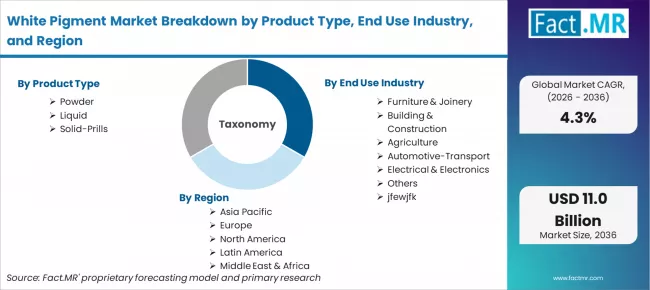
White Pigment Market is segmented by Product Type (Inorganic Pigment, Organic Pigment, Specialty Pigment), End Use Industry (Paints & Coatings, Plastics, Printing Inks, Construction Materials, Automotive, Others), and Region. Forecast for 2026 to 2036.

Core Findings

    White Pigment Market Size, Market Forecast and Outlook By Fact.MR

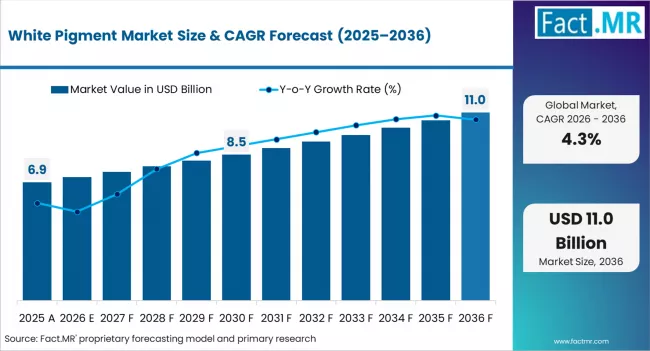
    The white pigment market was valued at USD 6.90 billion in 2025, projected to reach USD 7.20 billion in 2026, and is forecast to expand to USD 10.96 billion by 2036 at a 4.3% CAGR. is entering a phase of structural cost realignment as titanium dioxide feedstock consolidation in China and anti-dumping duties in the European Union reshape global pricing corridors, compelling coatings formulators to reassess pigment loading strategies across architectural and industrial product lines.

    The absolute dollar expansion between 2026 and 2036 amounts to approximately USD 3.76 billion. Growth reflects sustained consumption in architectural coatings, plastics masterbatch, and construction materials. Titanium dioxide (TiO2) accounts for over 80% of white pigment volume globally, and its price trajectory, governed by ilmenite ore availability and chloride-route processing capacity, acts as the primary cost variable for downstream formulators.

    Coatings procurement directors across major paint manufacturers are restructuring their TiO2 supplier portfolios to reduce single-source concentration risk. The consolidation of Cristal into Tronox in 2019 reduced the number of major chloride-route TiO2 producers to five globally, and buyers are now mandating dual-sourcing clauses in annual supply agreements to protect against allocation cuts during seasonal demand peaks.

    All major regional markets reflect differentiated growth parameters. China sets the pace at 7.5% CAGR. India registers at 6.8% CAGR. USA registers at 4.9% CAGR. Germany registers at 4.9% CAGR. Japan registers at 4.7% CAGR.
    White Pigment Market Market Value Analysis

    White Pigment Market Key Takeaways

    Metric Details
    Industry Size (2026) USD 7.20 billion
    Industry Value (2036) USD 10.96 billion
    CAGR (2026 to 2036) 4.3%

    White Pigment Market Definition

    White pigments are inorganic or organic compounds used to impart opacity, brightness, and whiteness to coatings, plastics, inks, paper, and construction materials. Titanium dioxide (TiO2) is the dominant white pigment by volume and performance, manufactured via chloride or sulphate process routes from ilmenite, rutile, or slag feedstocks. Zinc oxide, lithopone, and barium sulphate serve niche applications where full TiO2 opacity is not required or where cost constraints favor blended formulations.

    White Pigment Market Inclusions

    Market scope covers global and regional revenue for white pigments across inorganic pigment (primarily TiO2, zinc oxide, lithopone), organic pigment, and specialty pigment categories. End-use segments include paints and coatings, plastics, printing inks, construction materials, automotive, and others. The forecast spans 2026 to 2036.

    White Pigment Market Exclusions

    The scope excludes coloured pigments, carbon black, and functional pigments used exclusively for magnetic, conductive, or anti-corrosive purposes. Finished paint and coating products are excluded unless the valuation pertains to pigment content. TiO2 used in non-pigmentary applications such as photocatalysis and UV filtration in sunscreens falls outside the boundary.

    White Pigment Market Research Methodology

    • Primary Research: Analysts engaged with procurement specialists, process engineers, and supply chain directors across producing and consuming regions to map the specific decision criteria triggering purchasing and specification changes.
    • Desk Research: Data collection aggregated regulatory filings, trade body publications, standards body documentation, and company disclosures relevant to the product category.
    • Market-Sizing and Forecasting: Baseline values derive from a bottom-up aggregation of production volumes and trade flows, applying region-specific demand curves to project adoption velocity through 2036.
    • Data Validation and Update Cycle: Projections are tested against publicly reported industry expenditure guidance and cross-referenced with primary interview data to ensure internal consistency.

    Summary of White Pigment Market

    • White Pigment Market Definition
      • White pigments are inorganic or organic compounds used to impart opacity, brightness, and whiteness to coatings, plastics, inks, paper, and construction materials. Titanium dioxide (TiO2) is the dominant white pigment by volume and performance, manufactured via chloride or sulphate process routes from ilmenite, rutile, or slag feedstocks.
    • Demand Drivers in the Market
      • Architectural coatings demand in urbanizing economies: India's Ministry of Housing and Urban Affairs reported 11.4 million housing units sanctioned under the Pradhan Mantri Awas Yojana (PMAY) programme through December 2024.
      • Anti-dumping duties restructuring trade flows: The European Commission imposed definitive anti-dumping duties of 30.6% to 39.7% on TiO2 imports from China in 2022, redirecting Chinese export volumes toward Southeast Asia, the Middle East, and Latin America.
      • Plastics masterbatch growth: Global plastic packaging production exceeding 150 million tonnes annually requires white masterbatch for opacity in food packaging films, rigid containers, and consumer goods.
    • Key Segments Analyzed in the Fact.MR Report
      • Inorganic Pigment product type: 85.0% share in 2026.
      • Paints & Coatings end use industry: 55.0% share in 2026.
      • China: 7.5% compound growth through 2036.
    • Analyst Opinion at Fact.MR
      • The central tension is feedstock economics. Ilmenite ore prices fluctuated between USD 280 and USD 380 per tonne through 2023 to 2025, driven by supply tightness in key producing regions including Mozambique, South Africa, and Australia. Chinese sulphate-route producers face environmental compliance costs that are progressively closing the historical price gap with Western chloride-route output. Coatings formulators respond by optimizing pigment dispersion technology to reduce TiO2 loading per litre of paint by 5% to 10% without sacrificing opacity, effectively stretching pigment budgets while maintaining product performance specifications..
    • Strategic Implications / Executive Takeaways
      • Procurement teams must establish multi-year supply agreements with qualified producers to secure allocation ahead of anticipated demand increases.
      • Product development resources should prioritize formulations that meet tightening regulatory specifications in key import markets.
      • Regional expansion strategies must account for divergent growth rates and regulatory environments across major consuming nations.

    Segmental Analysis

    White Pigment Market Analysis by Product Type
    White Pigment Market Analysis By Product Type

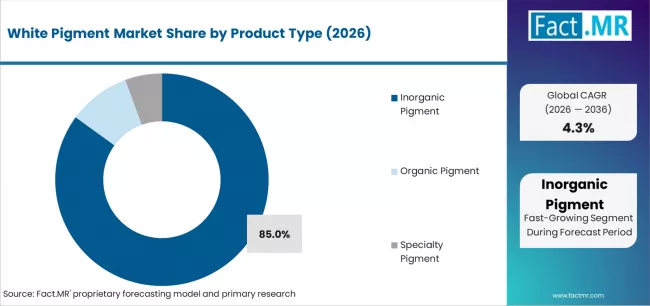
    Based on Fact.MR's white pigment market report, consumption of Inorganic Pigment is estimated to hold 85.0% share in 2026. Inorganic pigments, overwhelmingly titanium dioxide, dominate because no organic or specialty alternative delivers equivalent hiding power per unit cost across the broad range of application environments that coatings, plastics, and construction materials demand.

    • TiO2 performance monopoly: Titanium dioxide's refractive index of 2.73 (rutile form) is the highest among commercially available white pigments, enabling full opacity at lower loading levels than zinc oxide (refractive index 2.02) or lithopone (1.84). This optical physics advantage sustains TiO2's specification as the default white pigment in premium architectural and automotive coatings [1].
    • Chloride process capacity expansion: Tronox Limited commissioned new chloride-route TiO2 capacity at its Jazan facility in Saudi Arabia in 2024, adding approximately 150,000 tonnes per annum to global supply. Chloride-process TiO2 commands a 10% to 15% price premium over sulphate-process material due to higher purity and narrower particle size distribution [2].
    • Regulatory preference for inorganic stability: European Coatings Directive and U.S. EPA VOC regulations favor pigment systems with high chemical inertness. TiO2's resistance to UV degradation, acid and alkali exposure, and thermal decomposition ensures long-term colour retention in exterior coatings, reducing lifecycle recoating costs for building owners [3].

    White Pigment Market Analysis by End Use Industry
    White Pigment Market Analysis By End Use Industry

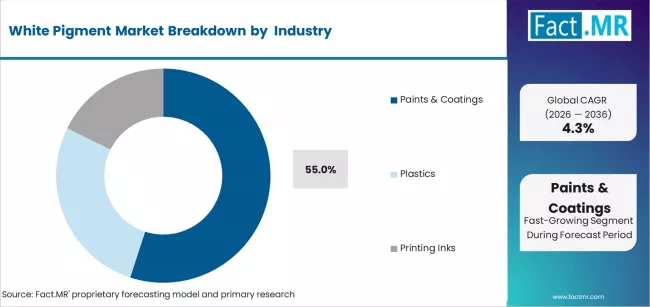
    As per Fact.MR's analysis, the Paints and Coatings segment accounts for 55.0% of white pigment consumption in 2026. This dominance reflects the coatings industry's position as the single largest consumer of TiO2 globally, with architectural, industrial, and automotive coatings collectively consuming over 3.5 million tonnes of titanium dioxide annually.

    • Architectural coatings volume: AkzoNobel, PPG Industries, and Sherwin-Williams collectively procure over 800,000 tonnes of TiO2 annually for decorative paint production. Their supplier qualification programmes set the technical benchmarks (particle size, crystal form, surface treatment) that shape TiO2 product development at major producers [4].
    • Automotive OEM coatings: White and pearl-white remain the most popular automotive exterior colours globally, accounting for approximately 35% of new vehicle production according to BASF's annual Automotive Color Trends report. Each vehicle requires 0.8 to 1.2 kg of TiO2 in its multilayer coating system, tying automotive production volumes directly to pigment demand [5].
    • Industrial protective coatings: Infrastructure maintenance programmes for bridges, pipelines, and marine vessels specify white and light-coloured protective coatings to reduce solar heat absorption. The U.S. Department of Transportation's Federal Highway Administration allocates annual budgets for bridge coating maintenance that sustain industrial TiO2 consumption at predictable procurement cycles [6].

    White Pigment Market Drivers, Restraints, and Opportunities
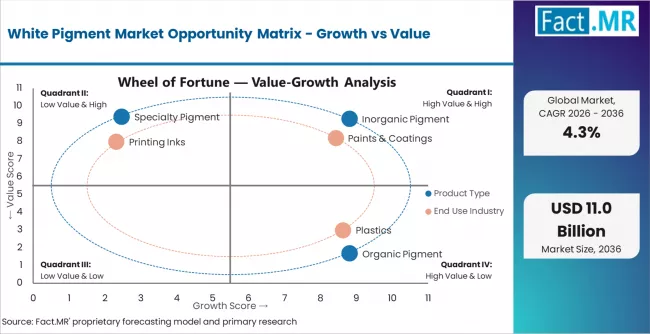
    White Pigment Market Opportunity Matrix Growth Vs Value

    Fact.MR analysis indicates the white pigment market's current valuation reflects the structural dependence of the coatings, plastics, and paper industries on titanium dioxide as the only commercially viable high-refractive-index white pigment. No alternative material matches TiO2's combination of opacity, brightness, durability, and chemical inertness at comparable cost per unit of hiding power.

    The central tension is feedstock economics. Ilmenite ore prices fluctuated between USD 280 and USD 380 per tonne through 2023 to 2025, driven by supply tightness in key producing regions including Mozambique, South Africa, and Australia. Chinese sulphate-route producers face environmental compliance costs that are progressively closing the historical price gap with Western chloride-route output. Coatings formulators respond by optimizing pigment dispersion technology to reduce TiO2 loading per litre of paint by 5% to 10% without sacrificing opacity, effectively stretching pigment budgets while maintaining product performance specifications.

    Opportunities in the White Pigment Market

    • Architectural coatings demand in urbanizing economies: India's Ministry of Housing and Urban Affairs reported 11.4 million housing units sanctioned under the Pradhan Mantri Awas Yojana (PMAY) programme through December 2024. Each new housing unit requires approximately 3 to 5 kg of TiO2 equivalent in architectural coatings, creating a direct procurement pipeline from public housing construction to white pigment consumption.
    • Anti-dumping duties restructuring trade flows: The European Commission imposed definitive anti-dumping duties of 30.6% to 39.7% on TiO2 imports from China in 2022, redirecting Chinese export volumes toward Southeast Asia, the Middle East, and Latin America. European coatings manufacturers now source primarily from Tronox, Chemours, and KRONOS Worldwide at higher landed costs, compressing formulation margins.
    • Plastics masterbatch growth: Global plastic packaging production exceeding 150 million tonnes annually requires white masterbatch for opacity in food packaging films, rigid containers, and consumer goods. BASF SE and Clariant International AG supply TiO2-based masterbatch concentrates to injection moulding and extrusion operations across Asia Pacific and Europe.

    Increasing Demand for White Pigment in the Plastic Industry

    Plastic accounts for a significant share in the overall white pigment market in terms of end-use industries. Manufacturers of consumer products are progressively looking for white plastic materials as the productions costs for these are lower. Advancements in technology have led to the growing use of white pigment in plastic industries, thereby escalating the growth of the global white pigment market.

    Construction Industry to Contribute to the Growth of the White Pigment Market

    The rising growth of the construction industry is expected to fuel growth opportunities for coatings, which leads to escalating demand for the white pigment in the near future. The increasing awareness about coating materials for long-lasting protection is on the rise across the globe, which leads to an increase in demand for white pigment across the world.

    Due to increasing environmental pollution and the rising level of VOCs in the environment, governments in many countries have set regulations for emission levels and the use of VOCs in standard architectural coatings.

    In the forthcoming years, the use of organic pigment is expected to be more popular within the construction industry, which may further benefit the global white pigment market during the forecast period.

    Expensive Raw Materials a Major Growth Deterrent for the Market

    The volatile prices of oils affect petrochemical products across the globe, which indirectly affect the costs of coating solvents. In countries with high regulations over emissions levels of HAPs and VOCs due to paints and coatings, the price for the production of solvents is higher.

    Moreover, increased production cost per volume (Tons) of coating solvents is also restricting manufacturers from increasing their capacities. These factors will hamper the growth of the white pigment market.

    White Pigment Market Regional Outlook

    Top Country Growth Comparison White Pigment Market Cagr (2026 2036)

    Geographically, the white pigment market has been categorized into seven prominent regions, including North America, Latin America, Europe, East Asia, South Asia, Oceania, and the Middle East and Africa. East Asia is expected to be the second-largest region in the white pigment market.

    Growth in disposable incomes and consumer spending, coupled with the increasing middle-class segment, particularly in developing economies, mainly China and India, fuels the demand for automotive vehicles, which further escalates the growth of the white pigment market across the region.

    Europe is expected to be the largest market in the global white pigment market. The Middle East & Africa and Latin America regions are expected to register a promising growth rate during the forecast period.

    White Pigment Market Key Players

    The key players in the white pigment market are mentioned below.

    • The Chemours Chemical Company
    • CRISTAL
    • Tronox Limited
    • Sudarshan Chemical Industries Limited
    • BASF SE
    • LANXESS
    • Clariant International AG
    • Ferro Corporation
    • KRONOS Worldwide Inc.
    • Sun Chemical Corporation
    • Cathay Industries Group
    • Heubach GmbH
    • Gharda Chemicals Limited
    • Altana AG

    The research report presents a comprehensive assessment of the white pigment market and contains thoughtful insights, facts, and historical data, as well as statistically supported and industry-validated market data. It also contains projections using a suitable set of assumptions and methodologies. The research report provides analysis and information according to white pigment market segments such as geography, product type, and end-use industry.

    The white pigment market report covers exhaustive analysis on

    • White Pigment Market Segments
    • White Pigment Market Dynamics
    • White Pigment Market Size
    • Supply & Demand
    • Current Trends/Issues/Challenges
    • Competition & Companies involved
    • Technology
    • Value Chain

    Scope of the Report

    White Pigment Market Breakdown By Product Type, End Use Industry, And Region

    Metric Value
    Quantitative Units USD 7.20 billion to USD 10.96 billion, at a CAGR of 4.3%
    Market Definition White pigments are inorganic or organic compounds used to impart opacity, brightness, and whiteness to coatings, plastics, inks, paper, and construction materials. Titanium dioxide (TiO2) is the dominant white pigment by volume and performance, manufactured via chloride or sulphate process routes from ilmenite, rutile, or slag feedstocks.
    Product Type Segmentation Inorganic Pigment, Organic Pigment, Specialty Pigment
    End Use Industry Segmentation Paints & Coatings, Plastics, Printing Inks, Construction Materials, Automotive, Others
    Regions Covered North America, Latin America, Europe, East Asia, South Asia, Oceania, Middle East & Africa
    Countries Covered China, India, USA, Germany, Japan, and 40 plus countries
    Key Companies Profiled Tronox Limited, CRISTAL (now part of Tronox), The Chemours Company, BASF SE, KRONOS Worldwide Inc., LANXESS, Clariant International AG, Ferro Corporation, Sun Chemical Corporation, Cathay Industries Group, Heubach GmbH, Sudarshan Chemical Industries Limited, Gharda Chemicals Limited, Altana AG
    Forecast Period 2026 to 2036
    Approach Hybrid top-down and bottom-up methodology reconciling production, trade, and consumption data with primary research validation.

    White Pigment Market Report Highlights

    • Detailed overview of parent market
    • Changing market dynamics in the industry
    • In-depth market segmentation
    • Historical, current and projected market size in terms of volume and value
    • Recent industry trends and developments
    • Competitive landscape
    • Strategies of key players and Products offered
    • Potential and niche segments, geographical regions exhibiting promising growth
    • A neutral perspective on market performance
    • Must-have information for market players to sustain and enhance their market footprint

    Bibliography

    • International Warehouse Logistics Association (IWLA). (2024). Chemical storage benchmarking: Pigment handling and distribution costs. IWLA.
    • Tronox Limited. (2024). Annual report 2024: Titanium dioxide production and capacity expansion. Tronox.
    • European Coatings Association (CEPE). (2024). Regulatory compliance guide: Pigment specifications in architectural coatings. CEPE.
    • OECD-FAO. (2024). Agricultural Outlook: Implications for commodity chemicals demand. OECD Publishing.
    • BASF SE. (2024). Automotive colour trends report 2024. BASF Coatings.
    • U.S. Department of Transportation, Federal Highway Administration. (2024). Bridge maintenance coatings programme: Annual budget report. FHWA.

    This bibliography is provided for reader reference. The full Fact.MR report contains the complete reference list with primary research documentation.

    This Report Addresses

    • Market sizing and quantitative forecast metrics detailing the precise expenditure dedicated to white pigment across major industrial sectors through 2036.
    • Segmentation analysis mapping the adoption patterns of specific product type categories and evaluating the technical and economic factors driving segment share distribution.
    • Regional deployment intelligence comparing growth trajectories across Asia Pacific, North America, Europe, Latin America, and Middle East and Africa.
    • Regulatory compliance assessment analyzing how evolving standards and policies affect product specifications and market access in key consuming regions.
    • Competitive posture evaluation tracking the positioning of leading producers and the structural factors determining competitive advantage.
    • Capital investment strategic guidance defining the procurement and capacity planning considerations for industry participants.
    • Supply chain risk analysis identifying the specific feedstock, logistics, and regulatory variables that constrain market expansion.
    • Custom data delivery formats encompassing interactive dashboards, raw Excel datasets, and PDF narrative reports.

    Table of Content

    1. Global Market Outlook
    2. Demand to side Trends
    3. Supply to side Trends
    4. Technology Roadmap Analysis
    5. Analysis and Recommendations
    6. Market Overview
      • Market Coverage / Taxonomy
      • Market Definition / Scope / Limitations
    7. Research Methodology
      • Chapter Orientation
      • Analytical Lens and Working Hypotheses
        • Market Structure, Signals, and Trend Drivers
        • Company Annual and Sustainability Reports
        • Peer-reviewed Journals and Academic Literature
        • Corporate Websites, Product Literature, and Technical Notes
        • Earnings Decks and Investor Briefings
        • Statutory Filings and Regulatory Disclosures
        • Technical White Papers and Standards Notes
        • Trade Journals, Industry Magazines, and Analyst Briefs
        • Conference Proceedings, Webinars, and Seminar Materials
        • Government Statistics Portals and Public Data Releases
        • Press Releases and Reputable Media Coverage
        • Specialist Newsletters and Curated Briefings
        • Sector Databases and Reference Repositories
        • Fact.MR Internal Proprietary Databases and Historical Market Datasets
        • Subscription Datasets and Paid Sources
        • Social Channels, Communities, and Digital Listening Inputs
        • Additional Desk Sources
      • Expert Input and Fieldwork (Primary Evidence)
        • Primary Modes
          • Qualitative Interviews and Expert Elicitation
          • Quantitative Surveys and Structured Data Capture
          • Blended Approach
        • Why Primary Evidence is Used
        • Field Techniques
          • Interviews
          • Surveys
          • Focus Groups
          • Observational and In-context Research
          • Social and Community Interactions
        • Stakeholder Universe Engaged
          • C-suite Leaders
          • Board Members
          • Presidents and Vice Presidents
          • R&D and Innovation Heads
          • Technical Specialists
          • Domain Subject-matter Experts
          • Scientists
          • Physicians and Other Healthcare Professionals
        • Governance, Ethics, and Data Stewardship
          • Research Ethics
          • Data Integrity and Handling
      • Tooling, Models, and Reference Databases
    8. Data Engineering and Model Build
      • Data Acquisition and Ingestion
      • Cleaning, Normalisation, and Verification
      • Synthesis, Triangulation, and Analysis
    9. Quality Assurance and Audit Trail
    10. Market Background
      • Market Dynamics
        • Drivers
        • Restraints
        • Opportunity
        • Trends
      • Scenario Forecast
        • Demand in Optimistic Scenario
        • Demand in Likely Scenario
        • Demand in Conservative Scenario
      • Opportunity Map Analysis
      • Product Life Cycle Analysis
      • Supply Chain Analysis
      • Investment Feasibility Matrix
      • Value Chain Analysis
      • PESTLE and Porter’s Analysis
      • Regulatory Landscape
      • Regional Parent Market Outlook
      • Production and Consumption Statistics
      • Import and Export Statistics
    11. Global Market Analysis 2021 to 2025 and Forecast, 2026 to 2036
      • Historical Market Size Value (USD Million) Analysis, 2021 to 2025
      • Current and Future Market Size Value (USD Million) Projections, 2026 to 2036
        • Y to o to Y Growth Trend Analysis
        • Absolute $ Opportunity Analysis
    12. Global Market Pricing Analysis 2021 to 2025 and Forecast 2026 to 2036
    13. Global Market Analysis 2021 to 2025 and Forecast 2026 to 2036, By Product Type
      • Introduction / Key Findings
      • Historical Market Size Value (USD Million) Analysis By Product Type, 2021 to 2025
      • Current and Future Market Size Value (USD Million) Analysis and Forecast By Product Type, 2026 to 2036
        • Inorganic Pigment
        • Organic Pigment
        • Specialty Pigment
      • Y to o to Y Growth Trend Analysis By Product Type, 2021 to 2025
      • Absolute $ Opportunity Analysis By Product Type, 2026 to 2036
    14. Global Market Analysis 2021 to 2025 and Forecast 2026 to 2036, By End Use Industry
      • Introduction / Key Findings
      • Historical Market Size Value (USD Million) Analysis By End Use Industry, 2021 to 2025
      • Current and Future Market Size Value (USD Million) Analysis and Forecast By End Use Industry, 2026 to 2036
        • Paints & Coatings
        • Plastics
        • Printing Inks
        • Construction Materials
        • Automotive
        • Others
      • Y to o to Y Growth Trend Analysis By End Use Industry, 2021 to 2025
      • Absolute $ Opportunity Analysis By End Use Industry, 2026 to 2036
    15. Global Market Analysis 2021 to 2025 and Forecast 2026 to 2036, By Region
      • Introduction
      • Historical Market Size Value (USD Million) Analysis By Region, 2021 to 2025
      • Current Market Size Value (USD Million) Analysis and Forecast By Region, 2026 to 2036
        • North America
        • Latin America
        • Western Europe
        • Eastern Europe
        • East Asia
        • South Asia and Pacific
        • Middle East & Africa
      • Market Attractiveness Analysis By Region
    16. North America Market Analysis 2021 to 2025 and Forecast 2026 to 2036, By Country
      • Historical Market Size Value (USD Million) Trend Analysis By Market Taxonomy, 2021 to 2025
      • Market Size Value (USD Million) Forecast By Market Taxonomy, 2026 to 2036
        • By Country
          • USA
          • Canada
          • Mexico
        • By Product Type
        • By End Use Industry
      • Market Attractiveness Analysis
        • By Country
        • By Product Type
        • By End Use Industry
      • Key Takeaways
    17. Latin America Market Analysis 2021 to 2025 and Forecast 2026 to 2036, By Country
      • Historical Market Size Value (USD Million) Trend Analysis By Market Taxonomy, 2021 to 2025
      • Market Size Value (USD Million) Forecast By Market Taxonomy, 2026 to 2036
        • By Country
          • Brazil
          • Chile
          • Rest of Latin America
        • By Product Type
        • By End Use Industry
      • Market Attractiveness Analysis
        • By Country
        • By Product Type
        • By End Use Industry
      • Key Takeaways
    18. Western Europe Market Analysis 2021 to 2025 and Forecast 2026 to 2036, By Country
      • Historical Market Size Value (USD Million) Trend Analysis By Market Taxonomy, 2021 to 2025
      • Market Size Value (USD Million) Forecast By Market Taxonomy, 2026 to 2036
        • By Country
          • Germany
          • UK
          • Italy
          • Spain
          • France
          • Nordic
          • BENELUX
          • Rest of Western Europe
        • By Product Type
        • By End Use Industry
      • Market Attractiveness Analysis
        • By Country
        • By Product Type
        • By End Use Industry
      • Key Takeaways
    19. Eastern Europe Market Analysis 2021 to 2025 and Forecast 2026 to 2036, By Country
      • Historical Market Size Value (USD Million) Trend Analysis By Market Taxonomy, 2021 to 2025
      • Market Size Value (USD Million) Forecast By Market Taxonomy, 2026 to 2036
        • By Country
          • Russia
          • Poland
          • Hungary
          • Balkan & Baltic
          • Rest of Eastern Europe
        • By Product Type
        • By End Use Industry
      • Market Attractiveness Analysis
        • By Country
        • By Product Type
        • By End Use Industry
      • Key Takeaways
    20. East Asia Market Analysis 2021 to 2025 and Forecast 2026 to 2036, By Country
      • Historical Market Size Value (USD Million) Trend Analysis By Market Taxonomy, 2021 to 2025
      • Market Size Value (USD Million) Forecast By Market Taxonomy, 2026 to 2036
        • By Country
          • China
          • Japan
          • South Korea
        • By Product Type
        • By End Use Industry
      • Market Attractiveness Analysis
        • By Country
        • By Product Type
        • By End Use Industry
      • Key Takeaways
    21. South Asia and Pacific Market Analysis 2021 to 2025 and Forecast 2026 to 2036, By Country
      • Historical Market Size Value (USD Million) Trend Analysis By Market Taxonomy, 2021 to 2025
      • Market Size Value (USD Million) Forecast By Market Taxonomy, 2026 to 2036
        • By Country
          • India
          • ASEAN
          • Australia & New Zealand
          • Rest of South Asia and Pacific
        • By Product Type
        • By End Use Industry
      • Market Attractiveness Analysis
        • By Country
        • By Product Type
        • By End Use Industry
      • Key Takeaways
    22. Middle East & Africa Market Analysis 2021 to 2025 and Forecast 2026 to 2036, By Country
      • Historical Market Size Value (USD Million) Trend Analysis By Market Taxonomy, 2021 to 2025
      • Market Size Value (USD Million) Forecast By Market Taxonomy, 2026 to 2036
        • By Country
          • Kingdom of Saudi Arabia
          • Other GCC Countries
          • Turkiye
          • South Africa
          • Other African Union
          • Rest of Middle East & Africa
        • By Product Type
        • By End Use Industry
      • Market Attractiveness Analysis
        • By Country
        • By Product Type
        • By End Use Industry
      • Key Takeaways
    23. Key Countries Market Analysis
      • USA
        • Pricing Analysis
        • Market Share Analysis, 2025
          • By Product Type
          • By End Use Industry
      • Canada
        • Pricing Analysis
        • Market Share Analysis, 2025
          • By Product Type
          • By End Use Industry
      • Mexico
        • Pricing Analysis
        • Market Share Analysis, 2025
          • By Product Type
          • By End Use Industry
      • Brazil
        • Pricing Analysis
        • Market Share Analysis, 2025
          • By Product Type
          • By End Use Industry
      • Chile
        • Pricing Analysis
        • Market Share Analysis, 2025
          • By Product Type
          • By End Use Industry
      • Germany
        • Pricing Analysis
        • Market Share Analysis, 2025
          • By Product Type
          • By End Use Industry
      • UK
        • Pricing Analysis
        • Market Share Analysis, 2025
          • By Product Type
          • By End Use Industry
      • Italy
        • Pricing Analysis
        • Market Share Analysis, 2025
          • By Product Type
          • By End Use Industry
      • Spain
        • Pricing Analysis
        • Market Share Analysis, 2025
          • By Product Type
          • By End Use Industry
      • France
        • Pricing Analysis
        • Market Share Analysis, 2025
          • By Product Type
          • By End Use Industry
      • India
        • Pricing Analysis
        • Market Share Analysis, 2025
          • By Product Type
          • By End Use Industry
      • ASEAN
        • Pricing Analysis
        • Market Share Analysis, 2025
          • By Product Type
          • By End Use Industry
      • Australia & New Zealand
        • Pricing Analysis
        • Market Share Analysis, 2025
          • By Product Type
          • By End Use Industry
      • China
        • Pricing Analysis
        • Market Share Analysis, 2025
          • By Product Type
          • By End Use Industry
      • Japan
        • Pricing Analysis
        • Market Share Analysis, 2025
          • By Product Type
          • By End Use Industry
      • South Korea
        • Pricing Analysis
        • Market Share Analysis, 2025
          • By Product Type
          • By End Use Industry
      • Russia
        • Pricing Analysis
        • Market Share Analysis, 2025
          • By Product Type
          • By End Use Industry
      • Poland
        • Pricing Analysis
        • Market Share Analysis, 2025
          • By Product Type
          • By End Use Industry
      • Hungary
        • Pricing Analysis
        • Market Share Analysis, 2025
          • By Product Type
          • By End Use Industry
      • Kingdom of Saudi Arabia
        • Pricing Analysis
        • Market Share Analysis, 2025
          • By Product Type
          • By End Use Industry
      • Turkiye
        • Pricing Analysis
        • Market Share Analysis, 2025
          • By Product Type
          • By End Use Industry
      • South Africa
        • Pricing Analysis
        • Market Share Analysis, 2025
          • By Product Type
          • By End Use Industry
    24. Market Structure Analysis
      • Competition Dashboard
      • Competition Benchmarking
      • Market Share Analysis of Top Players
        • By Regional
        • By Product Type
        • By End Use Industry
    25. Competition Analysis
      • Competition Deep Dive
        • Tronox Limited
          • Overview
          • Product Portfolio
          • Profitability by Market Segments (Product/Age /Sales Channel/Region)
          • Sales Footprint
          • Strategy Overview
            • Marketing Strategy
            • Product Strategy
            • Channel Strategy
        • CRISTAL (now part of Tronox)
        • The Chemours Company
        • BASF SE
        • KRONOS Worldwide Inc.
        • LANXESS
        • Clariant International AG
        • Ferro Corporation
        • Sun Chemical Corporation
        • Cathay Industries Group
        • Heubach GmbH
        • Sudarshan Chemical Industries Limited
        • Gharda Chemicals Limited
        • Altana AG
    26. Assumptions & Acronyms Used

    List Of Table

    • Table 1: Global Market Value (USD Million) Forecast by Region, 2021 to 2036
    • Table 2: Global Market Value (USD Million) Forecast by Product Type, 2021 to 2036
    • Table 3: Global Market Value (USD Million) Forecast by End Use Industry, 2021 to 2036
    • Table 4: North America Market Value (USD Million) Forecast by Country, 2021 to 2036
    • Table 5: North America Market Value (USD Million) Forecast by Product Type, 2021 to 2036
    • Table 6: North America Market Value (USD Million) Forecast by End Use Industry, 2021 to 2036
    • Table 7: Latin America Market Value (USD Million) Forecast by Country, 2021 to 2036
    • Table 8: Latin America Market Value (USD Million) Forecast by Product Type, 2021 to 2036
    • Table 9: Latin America Market Value (USD Million) Forecast by End Use Industry, 2021 to 2036
    • Table 10: Western Europe Market Value (USD Million) Forecast by Country, 2021 to 2036
    • Table 11: Western Europe Market Value (USD Million) Forecast by Product Type, 2021 to 2036
    • Table 12: Western Europe Market Value (USD Million) Forecast by End Use Industry, 2021 to 2036
    • Table 13: Eastern Europe Market Value (USD Million) Forecast by Country, 2021 to 2036
    • Table 14: Eastern Europe Market Value (USD Million) Forecast by Product Type, 2021 to 2036
    • Table 15: Eastern Europe Market Value (USD Million) Forecast by End Use Industry, 2021 to 2036
    • Table 16: East Asia Market Value (USD Million) Forecast by Country, 2021 to 2036
    • Table 17: East Asia Market Value (USD Million) Forecast by Product Type, 2021 to 2036
    • Table 18: East Asia Market Value (USD Million) Forecast by End Use Industry, 2021 to 2036
    • Table 19: South Asia and Pacific Market Value (USD Million) Forecast by Country, 2021 to 2036
    • Table 20: South Asia and Pacific Market Value (USD Million) Forecast by Product Type, 2021 to 2036
    • Table 21: South Asia and Pacific Market Value (USD Million) Forecast by End Use Industry, 2021 to 2036
    • Table 22: Middle East & Africa Market Value (USD Million) Forecast by Country, 2021 to 2036
    • Table 23: Middle East & Africa Market Value (USD Million) Forecast by Product Type, 2021 to 2036
    • Table 24: Middle East & Africa Market Value (USD Million) Forecast by End Use Industry, 2021 to 2036

    List Of Figures

    • Figure 1: Global Market Pricing Analysis
    • Figure 2: Global Market Value (USD Million) Forecast 2021 to 2036
    • Figure 3: Global Market Value Share and BPS Analysis by Product Type, 2026 and 2036
    • Figure 4: Global Market Y-o-Y Growth Comparison by Product Type, 2026 to 2036
    • Figure 5: Global Market Attractiveness Analysis by Product Type
    • Figure 6: Global Market Value Share and BPS Analysis by End Use Industry, 2026 and 2036
    • Figure 7: Global Market Y-o-Y Growth Comparison by End Use Industry, 2026 to 2036
    • Figure 8: Global Market Attractiveness Analysis by End Use Industry
    • Figure 9: Global Market Value (USD Million) Share and BPS Analysis by Region, 2026 and 2036
    • Figure 10: Global Market Y-o-Y Growth Comparison by Region, 2026 to 2036
    • Figure 11: Global Market Attractiveness Analysis by Region
    • Figure 12: North America Market Incremental Dollar Opportunity, 2026 to 2036
    • Figure 13: Latin America Market Incremental Dollar Opportunity, 2026 to 2036
    • Figure 14: Western Europe Market Incremental Dollar Opportunity, 2026 to 2036
    • Figure 15: Eastern Europe Market Incremental Dollar Opportunity, 2026 to 2036
    • Figure 16: East Asia Market Incremental Dollar Opportunity, 2026 to 2036
    • Figure 17: South Asia and Pacific Market Incremental Dollar Opportunity, 2026 to 2036
    • Figure 18: Middle East & Africa Market Incremental Dollar Opportunity, 2026 to 2036
    • Figure 19: North America Market Value Share and BPS Analysis by Country, 2026 and 2036
    • Figure 20: North America Market Value Share and BPS Analysis by Product Type, 2026 and 2036
    • Figure 21: North America Market Y-o-Y Growth Comparison by Product Type, 2026 to 2036
    • Figure 22: North America Market Attractiveness Analysis by Product Type
    • Figure 23: North America Market Value Share and BPS Analysis by End Use Industry, 2026 and 2036
    • Figure 24: North America Market Y-o-Y Growth Comparison by End Use Industry, 2026 to 2036
    • Figure 25: North America Market Attractiveness Analysis by End Use Industry
    • Figure 26: Latin America Market Value Share and BPS Analysis by Country, 2026 and 2036
    • Figure 27: Latin America Market Value Share and BPS Analysis by Product Type, 2026 and 2036
    • Figure 28: Latin America Market Y-o-Y Growth Comparison by Product Type, 2026 to 2036
    • Figure 29: Latin America Market Attractiveness Analysis by Product Type
    • Figure 30: Latin America Market Value Share and BPS Analysis by End Use Industry, 2026 and 2036
    • Figure 31: Latin America Market Y-o-Y Growth Comparison by End Use Industry, 2026 to 2036
    • Figure 32: Latin America Market Attractiveness Analysis by End Use Industry
    • Figure 33: Western Europe Market Value Share and BPS Analysis by Country, 2026 and 2036
    • Figure 34: Western Europe Market Value Share and BPS Analysis by Product Type, 2026 and 2036
    • Figure 35: Western Europe Market Y-o-Y Growth Comparison by Product Type, 2026 to 2036
    • Figure 36: Western Europe Market Attractiveness Analysis by Product Type
    • Figure 37: Western Europe Market Value Share and BPS Analysis by End Use Industry, 2026 and 2036
    • Figure 38: Western Europe Market Y-o-Y Growth Comparison by End Use Industry, 2026 to 2036
    • Figure 39: Western Europe Market Attractiveness Analysis by End Use Industry
    • Figure 40: Eastern Europe Market Value Share and BPS Analysis by Country, 2026 and 2036
    • Figure 41: Eastern Europe Market Value Share and BPS Analysis by Product Type, 2026 and 2036
    • Figure 42: Eastern Europe Market Y-o-Y Growth Comparison by Product Type, 2026 to 2036
    • Figure 43: Eastern Europe Market Attractiveness Analysis by Product Type
    • Figure 44: Eastern Europe Market Value Share and BPS Analysis by End Use Industry, 2026 and 2036
    • Figure 45: Eastern Europe Market Y-o-Y Growth Comparison by End Use Industry, 2026 to 2036
    • Figure 46: Eastern Europe Market Attractiveness Analysis by End Use Industry
    • Figure 47: East Asia Market Value Share and BPS Analysis by Country, 2026 and 2036
    • Figure 48: East Asia Market Value Share and BPS Analysis by Product Type, 2026 and 2036
    • Figure 49: East Asia Market Y-o-Y Growth Comparison by Product Type, 2026 to 2036
    • Figure 50: East Asia Market Attractiveness Analysis by Product Type
    • Figure 51: East Asia Market Value Share and BPS Analysis by End Use Industry, 2026 and 2036
    • Figure 52: East Asia Market Y-o-Y Growth Comparison by End Use Industry, 2026 to 2036
    • Figure 53: East Asia Market Attractiveness Analysis by End Use Industry
    • Figure 54: South Asia and Pacific Market Value Share and BPS Analysis by Country, 2026 and 2036
    • Figure 55: South Asia and Pacific Market Value Share and BPS Analysis by Product Type, 2026 and 2036
    • Figure 56: South Asia and Pacific Market Y-o-Y Growth Comparison by Product Type, 2026 to 2036
    • Figure 57: South Asia and Pacific Market Attractiveness Analysis by Product Type
    • Figure 58: South Asia and Pacific Market Value Share and BPS Analysis by End Use Industry, 2026 and 2036
    • Figure 59: South Asia and Pacific Market Y-o-Y Growth Comparison by End Use Industry, 2026 to 2036
    • Figure 60: South Asia and Pacific Market Attractiveness Analysis by End Use Industry
    • Figure 61: Middle East & Africa Market Value Share and BPS Analysis by Country, 2026 and 2036
    • Figure 62: Middle East & Africa Market Value Share and BPS Analysis by Product Type, 2026 and 2036
    • Figure 63: Middle East & Africa Market Y-o-Y Growth Comparison by Product Type, 2026 to 2036
    • Figure 64: Middle East & Africa Market Attractiveness Analysis by Product Type
    • Figure 65: Middle East & Africa Market Value Share and BPS Analysis by End Use Industry, 2026 and 2036
    • Figure 66: Middle East & Africa Market Y-o-Y Growth Comparison by End Use Industry, 2026 to 2036
    • Figure 67: Middle East & Africa Market Attractiveness Analysis by End Use Industry
    • Figure 68: Global Market - Tier Structure Analysis
    • Figure 69: Global Market - Company Share Analysis

    - Frequently Asked Questions -

    How large is the demand for White Pigment in the global market in 2026?

    Demand for White Pigment in the global market is estimated to be valued at USD 7.20 billion in 2026.

    What will be the market size of White Pigment in the global market by 2036?

    Market size for White Pigment is projected to reach USD 10.96 billion by 2036.

    What is the expected demand growth for White Pigment in the global market between 2026 and 2036?

    Demand for White Pigment is expected to grow at a CAGR of 4.3% between 2026 and 2036.

    Which Product Type is poised to lead global sales by 2026?

    Inorganic Pigment accounts for 85.0% share in 2026.

    How is the End Use Industry segment structured in this report?

    Paints & Coatings holds a 55.0% share in 2026 within the End Use Industry segment.

    What is the growth outlook for China in this report?

    China is projected to grow at a CAGR of 7.5% during 2026 to 2036.

    What is White Pigment and what is it mainly used for?

    White pigments are inorganic or organic compounds used to impart opacity, brightness, and whiteness to coatings, plastics, inks, paper, and construction materials. Titanium dioxide (TiO2) is the dominant white pigment by volume and performance, manufactured via chloride or sulphate process routes from ilmenite, rutile, or slag feedstocks.

    How does Fact.MR build and validate the White Pigment forecast?

    Forecasting models apply a hybrid top-down and bottom-up methodology starting with production and trade data, and cross-validate projections against primary research findings and quarterly industry data releases.

    White Pigment Market