- Market Value (2025): USD 847.3 Mn
- Estimated Value (2026): USD 899.8 Mn
- Forecast Value (2036): USD 1643.3 Mn
- CAGR (2026-2036): 6.2%
What is the Chrysin Extract Market forecast to be worth by 2036?
USD 899.8 Million in 2026 to USD 1643.3 Million by 2036, at a 6.2% CAGR.
- As per Fact.MR analysis, the chrysin extract market reached USD 847.3 Million in 2025.
- Sales are projected to increase from USD 899.8 Million in 2026 to USD 1643.3 Million by 2036.
- The market is forecast to record a 6.2% CAGR from 2026 to 2036 as supplement brands and ingredient processors develop specialist flavonoid formulations.
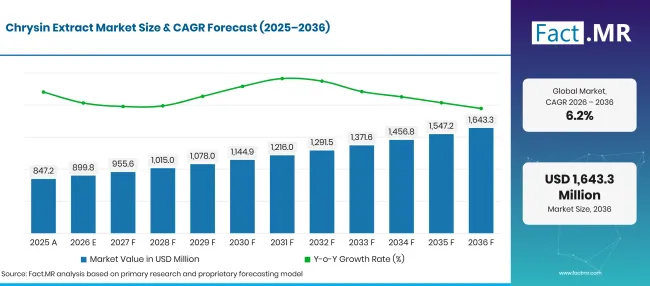
Factmr Chrysin Extract Market Forecast Global | Source: Fact.MR
| Year | Basis | Market value (USD million) |
|---|---|---|
| 2025 | Actual | 847.3 |
| 2026 | Estimate | 899.8 |
| 2036 | Forecast | 1,643.3 |
| CAGR 2026 to 2036 | Forecast period | 6.2% |
Source: Fact.MR analysis. Updated Oct 14, 2026
What are the defining numbers behind Chrysin Extract Market growth?
USD 743.5 Million in additional market value between 2026 and 2036.
- Demand Drivers in the Market
- Supplement manufacturers check the source of chrysin before using it in botanical products. Chrysin can be obtained from plants such as passionflower and Oroxylum indicum.
- Chrysin does not dissolve easily in water, which can make product development more challenging. Manufacturers often consider this when developing different formulations.
- Research teams continue to study chrysin in experimental applications. Its rapid breakdown in the body is one of the factors considered during product development and evaluation.
- Key Segments Analyzed
- By Source: Passiflora incarnata represents 42.1% share in 2026 as botanical ingredient buyers seek an identifiable passionflower source.
- By Form: Powder holds 45.2% share in 2026 because dry extracts suit bulk handling and controlled blending.
- By Application: Dietary Supplements account for 42.3% share in 2026, reflecting the main commercial route for chrysin-containing finished products.
- By Distribution Channel: Online Retail lead with 38.4% share in 2026 as specialist products become accessible to dispersed buyers.
- Analyst Opinion at Fact.MR
- Shambhu Nath Jha, Principal Consultant at Fact.MR, states, “Customers often look for clear information on an ingredient's source and consistent product quality. Suppliers that provide reliable sourcing details and maintain the same quality across batches make it easier for buyers to evaluate the ingredient before considering any product claims.”
- Strategic Implications
- Extract manufacturers can record the source plant and maintain consistent chrysin levels across batches. This helps supplement brands compare ingredients more easily.
- Supplement brands often test how chrysin performs in their own formulations before making packaging and sales decisions.
- Distributors can keep certificates of analysis on hand and clearly explain the difference between pure chrysin and botanical extract blends.
- Research buyers often review laboratory-grade specifications separately from the requirements for ingredients intended for consumer use.
Germany is projected to grow at 7.8% CAGR through 2036, supported by strong product documentation and record-keeping practices. Brazil follows at 7.1% as botanical ingredient processors manage product registrations. The United States reaches 6.5%, with buyers placing importance on ingredient identity and quality records. The United Kingdom records 5.8%, where product classification remains an important consideration. Japan stands at 5.1% as formulation companies evaluate the use of specialized flavonoid ingredients.
How does the Chrysin Extract Market break down by segment?
Passiflora incarnata accounts for 42.1% of Source; Powder 45.2% of Form; Dietary Supplements 42.3% of Application; Online Retail 38.4% of Distribution Channel.
Which source accounts for the largest share?
Passiflora incarnata is projected to hold 42.1% share in 2026.
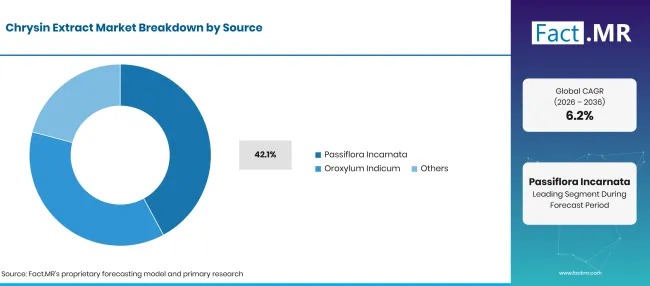
Factmr Chrysin Extract Market Breakdown Source | Source: Fact.MR
| Source | Share (2026) |
|---|---|
| Passiflora incarnata (Leading segment) | 42.1% |
| Other segments combined | 57.9%* |
| Total | 100.0% |
Source: Fact.MR analysis. Updated Oct 14, 2026
Passiflora incarnata is a well-known plant source of chrysin and is commonly used in ingredient sourcing. However, chrysin levels can vary, so laboratory testing is important to confirm the actual content. Oroxylum indicum is another source of chrysin and follows a different supply chain. It also contains a broader range of flavonoids alongside chrysin.
Which form leads supplier sales?
Powder is projected to account for 45.2% share in 2026.
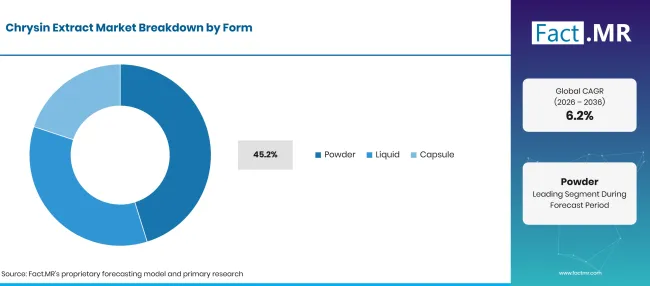
Factmr Chrysin Extract Market Breakdown Form | Source: Fact.MR
| Form | Share (2026) |
|---|---|
| Powder (Leading segment) | 45.2% |
| Other segments combined | 54.8%* |
| Total | 100.0% |
Source: Fact.MR analysis. Updated Oct 14, 2026
Powder forms are commonly used because they are easy to blend with other dry ingredients. Manufacturers can measure the extract accurately and adjust the rest of the formula as needed. Liquid forms offer a different option, especially when the liquid base is an important part of the final product.
What leads the application mix?
Dietary Supplements are projected to represent 42.3% share in 2026.
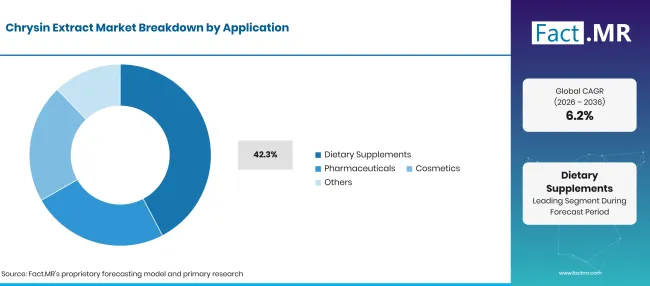
Factmr Chrysin Extract Market Breakdown Application | Source: Fact.MR
| Application | Share (2026) |
|---|---|
| Dietary Supplements (Leading segment) | 42.3% |
| Other segments combined | 57.7%* |
| Total | 100.0% |
Source: Fact.MR analysis. Updated Oct 14, 2026
Dietary supplements are the main segment for chrysin because it is used as a plant-based flavonoid in finished products. Brands usually review ingredient quality and product requirements before launch. Pharmaceutical use is mainly linked to research, where purity standards and testing needs differ from those of consumer supplements.
How does distribution channel shape purchases?
Online Retail is projected to account for 38.4% share in 2026.
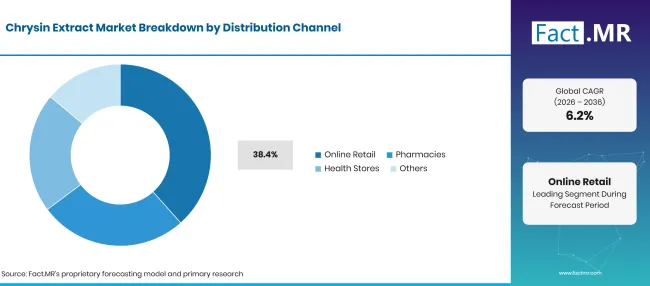
Factmr Chrysin Extract Market Breakdown Distribution Channel | Source: Fact.MR
| Distribution Channel | Share (2026) |
|---|---|
| Online Retail (Leading segment) | 38.4% |
| Other segments combined | 61.6%* |
| Total | 100.0% |
Source: Fact.MR analysis. Updated Oct 14, 2026
Online stores help brands reach customers looking for specific supplements. Product pages can show key ingredient details and product information. Pharmacies attract customers who prefer clear labels and trusted advice. Health stores sell botanical products alongside other popular supplements.
What is accelerating Chrysin Extract Market adoption, and what is holding it back?
Specialist botanical products and reliable quality testing support demand for chrysin extract. Limited absorption in the body and restrictions on product claims can slow wider use.
Drivers Impact Analysis
| Driver | (~) % Impact on CAGR | Geographic Relevance | Impact Timeline |
|---|---|---|---|
| Dietary supplement formulation interest | +0.9% | North America; Europe | Medium term |
| Botanical traceability and assay quality | +0.7% | Global | Short term |
| Formulation research for limited solubility | +0.6% | North America; East Asia | Long term |
| Online specialist product access | +0.5% | Global | Medium term |
| Laboratory and ingredient research activity | +0.4% | Global | Long term |
Source: Fact.MR analysis. Updated Oct 14, 2026
Opportunity Impact Analysis
| Opportunity | (~) % Impact on CAGR | Geographic Relevance | Impact Timeline |
|---|---|---|---|
| Assay-supported standardized extracts | +0.7% | Global | Medium term |
| Improved dispersibility formulations | +0.6% | North America; East Asia | Long term |
| Traceable source partnerships | +0.5% | Europe; Latin America | Medium term |
| Specialist ingredient distribution | +0.3% | Global | Short term |
Source: Fact.MR analysis. Updated Oct 14, 2026
Restraints Impact Analysis
| Restraint | (~) % Impact on CAGR | Geographic Relevance | Impact Timeline |
|---|---|---|---|
| Poor solubility and oral bioavailability | -0.8% | Global | Long term |
| Safety and labeling requirements | -0.6% | North America; Europe | Medium term |
| Variable botanical composition | -0.4% | Global | Medium term |
| Limited clinical support for claims | -0.3% | Global | Long term |
Source: Fact.MR analysis. Updated Oct 14, 2026
Which countries are scaling the Chrysin Extract Market through 2036?
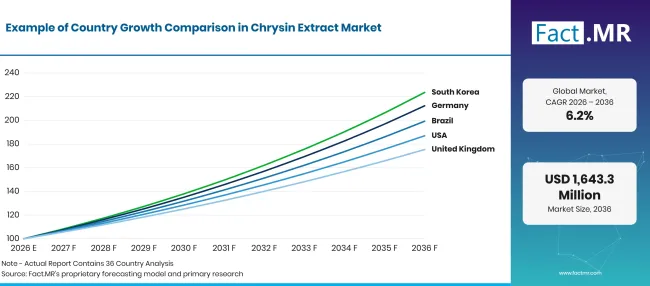
Factmr Chrysin Extract Market Growth Index | Source: Fact.MR
| Country | CAGR (2026–2036) |
|---|---|
| Germany | 7.8% |
| Brazil | 7.1% |
| United States | 6.5% |
| United Kingdom | 5.8% |
| Japan | 5.1% |
Source: Fact.MR analysis. Updated Oct 14, 2026
What supports Germany’s chrysin extract outlook?
7.8% CAGR, shaped by botanical identity and ingredient quality requirements.
German companies often check the plant source and chrysin content before using an extract in supplements. The European Union also has rules for certain food ingredients under Regulation (EU) 2017/2470 [4]. Brands review ingredient requirements before launching new products.
How is Brazil developing its chrysin extract market?
7.1% CAGR, supported by botanical ingredient processing and supplement formulation.
Brazilian extract producers compare different plant sources before supplying capsule and powder manufacturers. In January 2025, Anvisa updated its guidance for food supplements and ingredient requirements [5]. Brands use this guidance when reviewing products and labels. Differences between plant batches also make quality checks important when choosing ingredients.
What shapes the United States chrysin extract outlook?
6.5% CAGR, shaped by specialist supplement formulation and ingredient testing.
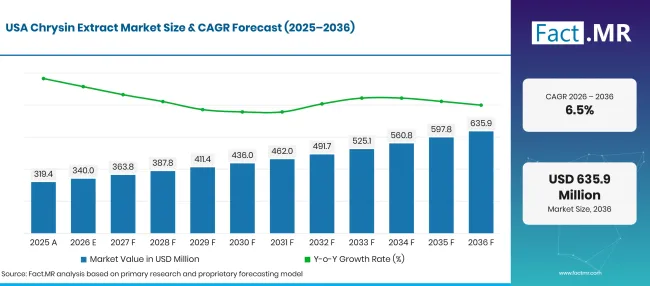
Factmr Chrysin Extract Market Forecast Usa | Source: Fact.MR
American supplement companies review ingredient identity and purity before choosing chrysin ingredients. In June 2025, the U.S. Food and Drug Administration released educational materials on the new dietary ingredient notification process [2]. The FDA also provided guidance on supplement disclaimers in December 2025 [3]. Research labs look for chrysin ingredients with consistent quality for testing.
How is the United Kingdom approaching chrysin extract?
5.8% CAGR, influenced by ingredient classification and formulation requirements.
UK distributors often check where plant ingredients come from before supplying specialist flavonoid products. An August 2025 review reported that chrysin has low water solubility and is quickly processed by the body [1]. These factors are important when developing different product formats. Brands also review product categories and label details before launching new products.
What supports Japan’s chrysin extract opportunities?
5.1% CAGR, reflecting selective research use and product-quality assessment.
Japanese research groups often compare chrysin purity and quality when selecting materials for flavonoid studies. A September 2025 scientific paper examined chrysin-based compounds [6]. Companies also review the intended product format and available research before product development. Low water solubility remains an important factor when considering liquid products.
Who leads the Chrysin Extract Market?
Competition in the chrysin extract market includes botanical extract producers, ingredient suppliers, and nutraceutical companies. Purecium Limited and Botanical Cube Inc. focus on plant-based ingredients, where ingredient source and product quality are important. Sabinsa Corporation offers chrysin as part of a broader range of supplement ingredients.
Chengdu Biopurify supplies plant extracts and purified natural compounds for supplement and research use. Xi’an Kintai Biotech Inc. and Shaanxi Greenyo Biotech Co., Ltd. also provide botanical ingredients for these markets. Buyers often compare suppliers based on ingredient purity, batch consistency, supporting documents, and suitability for capsules, powders, or liquid products.
Which companies are the key providers?
Key companies include Purecium Limited; Botanical Cube Inc.; Sabinsa Corporation; Chengdu Biopurify; Xi’an Kintai Biotech Inc.; and Shaanxi Greenyo Biotech Co., Ltd.
- Purecium Limited
- Botanical Cube Inc.
- Sabinsa Corporation
- Chengdu Biopurify
- Xi’an Kintai Biotech Inc.
- Shaanxi Greenyo Biotech Co., Ltd.
Bibliography
- [1] Kurkiewicz, M., Moździerz, A., Rzepecka-Stojko, A., & Stojko, J. (2025, August 5). Chrysin: A comprehensive review of its pharmacological properties and therapeutic potential. Pharmaceuticals, 18(8), 1162.
- [2] U.S. Food and Drug Administration. (2025, June 11). FDA releases educational materials on the new dietary ingredient notification process for dietary supplements.
- [3] U.S. Food and Drug Administration. (2025, December 11). FDA issues letter to industry on the DSHEA disclaimer.
- [4] European Commission. (2017, December 20). Commission Implementing Regulation (EU) 2017/2470 establishing the Union list of novel foods in accordance with Regulation (EU) 2015/2283 of the European Parliament and of the Council on novel foods. EUR-Lex.
- [5] Agência Nacional de Vigilância Sanitária. (2025, January 16). Anvisa atualiza perguntas e respostas sobre suplementos alimentares.
- [6] Jeong, C. Y., Kim, C.-E., Byun, E.-B., & Jeon, J. (2025, September 27). Chrysin as a bioactive scaffold: Advances in synthesis and pharmacological evaluation. International Journal of Molecular Sciences, 26(19), 9467.
This Report Addresses
- The report assesses how source identity and chrysin concentration influence ingredient selection across botanical extracts.
- Form analysis explains why powder holds the larger specified share across chrysin extract products.
- Application analysis examines how dietary supplements form the main commercial route for chrysin-based ingredients.
- Distribution analysis shows how online retail supports access to specialist chrysin products for dispersed buyers.
- Country analysis compares how ingredient quality, product classification, formulation needs, and regulatory requirements shape adoption across Germany, Brazil, the United States, the United Kingdom, and Japan.
- Competitive analysis compares botanical extract suppliers based on ingredient purity, batch consistency, supporting documentation, and suitability for powder, liquid, or capsule formats.
What does the Chrysin Extract Market cover?
The market covers chrysin-bearing botanical extracts and preparations sold for defined ingredient or research uses. It follows commercial routes from extract processing into finished supplement formats and other appropriate uses. Source identity and chrysin concentration are central product descriptors. Adjacent product development overlaps with nutraceutical ingredients.
What is included in the scope?
Fact.MR estimates that the scope includes Passiflora incarnata and Oroxylum indicum sources, alongside other chrysin-bearing materials. It covers powder, liquid and capsule formats sold through the four distribution channels. Ingredient suppliers and finished-product sellers enter the analysis where the sale relates directly to chrysin extract.
What is excluded from the scope?
Unrelated botanical extracts sold without a chrysin identity or content claim fall outside the market boundary. The scope also excludes claims of approved clinical treatment and research outcomes that have not been established in human use.
How Was the Analysis Built?
The analysis draws on 120+ sources, 35+ company portfolios, 25+ countries, and more than 20 industry interviews.
- Primary Research: Primary research includes discussions with manufacturers, service providers, technology developers, distributors, end users, and subject-matter experts. These conversations examine purchasing priorities, product adoption, operational challenges, approval requirements, competitive positioning, and the factors that influence wider market acceptance.
- Desk Research: Desk research covers government statistics, regulatory publications, company filings, trade data, technical studies, industry associations, standards, public policy, and other authoritative sources. Every source used in the analysis is documented in the bibliography.
- Market Sizing and Forecasting: Market estimates combine historical performance, demand indicators, pricing and volume trends, segment shares, company participation, country-level growth, adoption patterns, investment activity, and barriers to market expansion.
- Data Validation and Update Cycle: Findings are validated by comparing primary interviews with public data, company activity, regulatory changes, trade patterns, and industry developments. Regular updates review new product launches, capacity changes, partnerships, approvals, and shifts in commercial adoption.
Segmentation
What is the report’s scope and coverage?
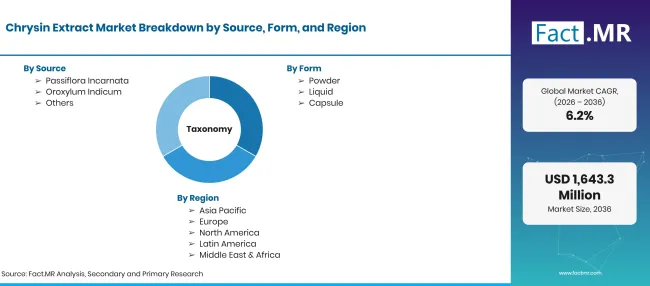
Factmr Chrysin Extract Market Taxonomy | Source: Fact.MR
| Attribute | Details |
|---|---|
| Quantitative Units | USD Million |
| Market Definition | Extracts and preparations marketed as sources of the flavonoid chrysin for supplement, pharmaceutical research and cosmetic applications. |
| Source | Passiflora Incarnata; Oroxylum Indicum; Others |
| Form | Powder; Liquid; Capsule |
| Application | Dietary Supplements; Pharmaceuticals; Cosmetics; Others |
| Distribution Channel | Online Retail; Pharmacies; Health Stores; Others |
| Regions Covered | North America; Latin America; Western Europe; Eastern Europe; East Asia; South Asia & Pacific; Middle East & Africa |
| Countries Covered | Germany; Brazil; United States; United Kingdom; Japan |
| Key Companies Profiled | Purecium Limited; Botanical Cube Inc.; Sabinsa Corporation; Chengdu Biopurify; Xi’an Kintai Biotech Inc.; Shaanxi Greenyo Biotech Co., Ltd. |
| Forecast Period | 2026 to 2036 |
| Approach | Bottom-up ingredient application review alongside source, form and country demand analysis |
Source: Fact.MR analysis. Updated Oct 14, 2026
How is the market segmented?
-
By Source:
- Passiflora incarnata
- Oroxylum indicum
- Others
-
By Form:
- Powder
- Liquid
- Capsule
-
By Application:
- Dietary Supplements
- Pharmaceuticals
- Cosmetics
- Others
-
By Distribution Channel:
- Online Retail
- Pharmacies
- Health Stores
- Others
-
By Region:
- North America
- Latin America
- Western Europe
- Eastern Europe
- East Asia
- South Asia & Pacific
- Middle East & Africa
Frequently Asked Questions
How big is the chrysin extract market in 2026?
What is the CAGR of the chrysin extract market from 2026 to 2036?
Which source leads the chrysin extract market?
Which product form leads the market?
Who are the main companies in the chrysin extract market?
Who worked on this report


Preview the report firsthand - request a free sample
Free SampleGet the brochure for pricing and purchase details
Download PDF