- Market Value (2025): USD 2.89 Bn
- Estimated Value (2026): USD 3.03 Bn
- Forecast Value (2036): USD 4.88 Bn
- CAGR (2026-2036): 4.9%
What is the Extreme Pressure Additives Market forecast to be worth by 2036?
USD 3.03 billion in 2026 to USD 4.9 billion by 2036 at a 4.9% CAGR.
- As per Fact.MR analysis, the extreme pressure additives market reached USD 2.89 billion in 2025.
- Demand will increase from USD 4.88 billion by 2036 as lubricant formulators serve demanding industrial and vehicle applications.
- The market is forecast to record a 4.9% CAGR from 2026 to 2036.
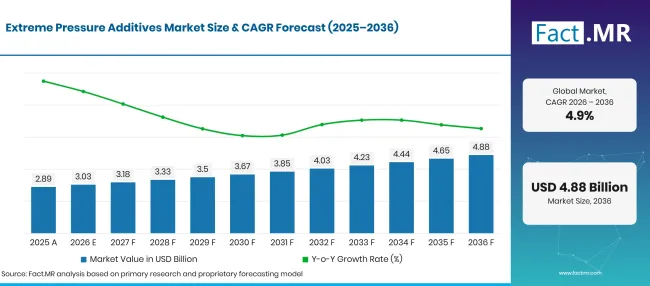
Factmr Extreme Pressure Additives Market Forecast Global | Source: Fact.MR
| Year | Basis | Market Value (USD billion) |
|---|---|---|
| 2025 | Actual | 2.89 |
| 2026 | Estimate | 3.00 |
| 2036 | Forecast | 4.88 |
| CAGR 2026 to 2036 | Forecast period | 4.9% |
Source: Fact.MR analysis. Updated Oct 13, 2026
What are the defining numbers behind Extreme Pressure Additives Market growth?
The forecast represents USD 1.9 billion in more market value between 2026 and 2036, led by sulfurized chemistry and industrial production applications.
Demand Drivers in the Market
- Metalworking fluid makers look for additives that protect cutting tools when pressure becomes very high during machining.
- Industrial lubricant manufacturers focus on dependable protection for gears operating under heavy loads. LANXESS highlights the use of extreme pressure additives in gear oils and greases, where lubricant choice depends on operating conditions [1].
- Equipment maintenance teams work with lubricant blends that perform well across different metal types. The choice of sulfur-based additives can affect staining and corrosion, especially when copper-containing metals are involved.
- Automotive transmission formulators evaluate lubricants for load-carrying performance at higher temperatures. Compatibility with base oils and smooth interaction with other additive ingredients remains important when developing finished lubricant products.
Key Segments Analyzed
- By Type: Sulfurized Additives account for 38.5% share in 2026 because they offer film protection for heavily loaded metal contacts.
- By Application: Automotive holds 35.2% share in 2026 as vehicle driveline fluids require pressure protection.
- By End-User Industry: Manufacturing represents 42.8% share in 2026 owing to gear equipment and metalworking operations.
Analyst Opinion at Fact.MR
Shambhu Nath Jha, Principal Consultant at Fact.MR, states, “Buyers compare extreme pressure additives by how well they protect gear teeth and cutting tools during heavy operation. Lubricant manufacturers check performance across different metals before using a product in regular production. Suppliers with clear test data and practical blending support can compete on product performance as well as price.”
Strategic Implications
- Additive manufacturers can provide application-specific test results for gear systems and metalworking fluids, helping formulators compare performance under actual operating conditions.
- Lubricant blenders often compare additive performance across the metal types used by their customers before selecting a final formulation.
- Industrial distributors play an important role by keeping clear technical guidance for replacement lubricants, since equipment and metal composition can vary from one site to another.
- Plant engineers review the complete lubricant formulation during service checks because extreme-pressure performance depends on how all lubricant components work together.
Germany will post a 5.4% CAGR through 2036, supported by machining work. Brazil follows at 4.9% because maintenance and transport equipment require load-bearing fluids. The USA is forecast at 4.5%, the UK at 4.0% and Japan at 3.5%.
How does the Extreme Pressure Additives Market break down by segment?
Sulfurized Additives lead Type at 38.5%; Automotive leads Application at 35.2%; Manufacturing leads End-User Industry at 42.8%.
Which Type dominates?
Sulfurized Additives are forecast to hold a 38.5% share in 2026.
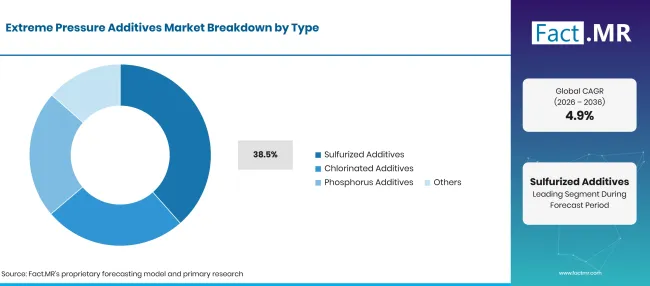
Factmr Extreme Pressure Additives Market Breakdown Type | Source: Fact.MR
| Type | Share (2026) |
|---|---|
| Sulfurized Additives (Leading segment) | 38.5% |
| Other segments combined | 61.5%* |
| Total | 100.0% |
Source: Fact.MR analysis. Updated Oct 13, 2026
Sulfurized additives are used when moving metal parts operate under heavy pressure and need extra protection from wear. Their performance depends on the sulfur content and the type of metal involved in the application. The additive also needs to work well with the finished lubricant and avoid unwanted effects on sensitive metal alloys. LANXESS describes sulfur-based Additin products for metal forming operations and industrial gear oils [2]. Phosphorus-based additives provide another option for load protection, while chlorinated additives are assessed according to application requirements and handling considerations. Other additive types are used for more specific lubricant formulations.
What leads the Application segment?
Automotive is estimated to account for a 35.2% share in 2026.
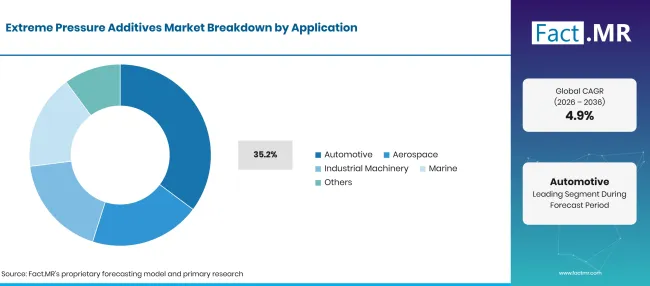
Factmr Extreme Pressure Additives Market Breakdown Application | Source: Fact.MR
| Application | Share (2026) |
|---|---|
| Automotive (Leading segment) | 35.2% |
| Other segments combined | 64.8%* |
| Total | 100.0% |
Source: Fact.MR analysis. Updated Oct 13, 2026
Automotive fluids must balance load protection with smooth performance across the full lubricant blend. Extreme pressure additives are commonly used in selected gear and transmission applications, where metal surfaces operate under very high pressure. Industrial machinery is another key area of use because equipment runs for long hours and repeated work cycles. Marine and transport operators choose lubricants based on service life and the materials used in components. Aerospace applications follow stricter approval requirements, so additives used successfully in factory equipment may not be suitable for aircraft systems.
How does End-User Industry shape sales?
Manufacturing is forecast to represent a 42.8% share in 2026.
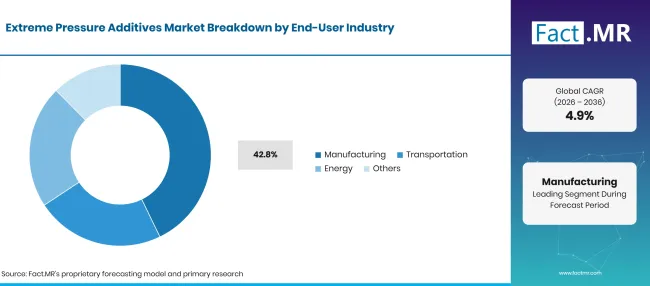
Factmr Extreme Pressure Additives Market Breakdown End User Industry | Source: Fact.MR
| End-User Industry | Share (2026) |
|---|---|
| Manufacturing (Leading segment) | 42.8% |
| Other segments combined | 57.2%* |
| Total | 100.0% |
Source: Fact.MR analysis. Updated Oct 13, 2026
Manufacturing companies purchase metal-cutting fluids and lubricants for use across machine tools and production equipment. Operations managers look for reliable protection because surface damage can disrupt production and affect product quality. Automotive component manufacturers and other industrial users buy through lubricant suppliers that tailor formulations to specific operations. As a result, lubricant formulators compete through application testing, technical support, and product performance as well as price.
What is accelerating Extreme Pressure Additives Market adoption, and what is holding it back?
Strong protection under heavy loads supports demand for extreme pressure additives. Compatibility with different metals and the overall cost of the lubricant blend can influence purchasing decisions and product adoption.
Drivers Impact Analysis
| DRIVER | (~) % IMPACT ON CAGR | GEOGRAPHIC RELEVANCE | IMPACT TIMELINE |
|---|---|---|---|
| Heavy-load gear protection | +1.0% | Global | Medium term (2–4 years) |
| Metalworking surface quality | +0.8% | Europe, East Asia | Short term (<= 2 years) |
| Automotive driveline formulation | +0.7% | North America, Europe | Medium term (2–4 years) |
| Industrial equipment service life | +0.5% | Global | Long term (>= 4 years) |
| Specialized fluid development | +0.4% | Global | Medium term (2–4 years) |
Source: Fact.MR analysis. Updated Oct 13, 2026
Opportunity Impact Analysis
| OPPORTUNITY | (~) % IMPACT ON CAGR | GEOGRAPHIC RELEVANCE | IMPACT TIMELINE |
|---|---|---|---|
| Alloy-specific metalworking fluids | +0.8% | Global | Medium term (2–4 years) |
| Tailored industrial gear packages | +0.6% | Europe, North America | Medium term (2–4 years) |
| Lower-staining sulfur formulations | +0.5% | Global | Long term (>= 4 years) |
| Distributor technical service | +0.4% | Latin America, Asia | Short term (<= 2 years) |
Source: Fact.MR analysis. Updated Oct 13, 2026
Restraints Impact Analysis
| RESTRAINT | (~) % IMPACT ON CAGR | GEOGRAPHIC RELEVANCE | IMPACT TIMELINE |
|---|---|---|---|
| Metal compatibility limitations | -0.8% | Global | Short term (<= 2 years) |
| Formulation approval time | -0.6% | Global | Medium term (2–4 years) |
| Additive input cost exposure | -0.5% | Global | Medium term (2–4 years) |
| Changing equipment and fluid specifications | -0.4% | Europe, East Asia | Long term (>= 4 years) |
Source: Fact.MR analysis. Updated Oct 13, 2026
Which countries are scaling the Extreme Pressure Additives Market through 2036?
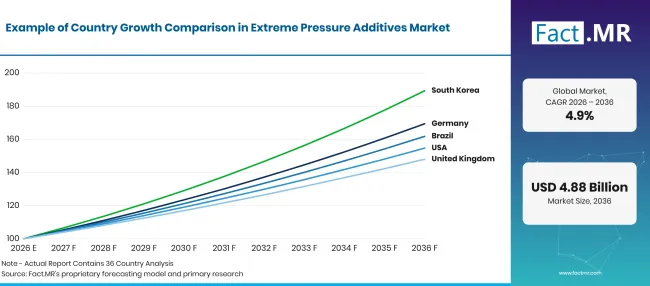
Factmr Extreme Pressure Additives Market Growth Index | Source: Fact.MR
| Country | CAGR (2026–2036) |
|---|---|
| Germany | 5.4% |
| Brazil | 4.9% |
| USA | 4.5% |
| UK | 4.0% |
| Japan | 3.5% |
Source: Fact.MR analysis. Updated Oct 13, 2026
Why is Germany leading extreme pressure additive adoption?
5.4% CAGR, linked to precision machinery and metalworking fluid requirements.
German lubricant blenders supply machine shops that require reliable protection during cutting, forming, and gear operations. The German Association of the Automotive Industry reported 4.15 million passenger cars produced in 2025 [6], providing a large market for transmission-fluid suppliers. Buyers also compare metal compatibility and surface performance before approving new lubricant formulations.
How is Brazil expanding additive consumption?
4.9% CAGR, shaped by equipment servicing and automotive manufacturing.
Brazilian factories use gear oils and metalworking fluids in equipment that operates under heavy loads and high pressure. IBGE reported that industrial production increased 1.8% in January 2026 from December 2025 [7]. This level of industrial activity supports regular lubricant use and maintenance across manufacturing plants. Smaller workshops also work with distributors when comparing sulfur- and phosphorus-based additives.
What is driving United States adoption?
4.5% CAGR, associated with industrial lubricant formulation and machinery upkeep.
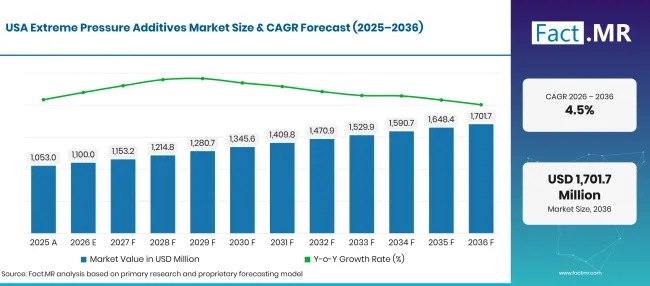
Factmr Extreme Pressure Additives Market Forecast Usa | Source: Fact.MR
U.S. industrial facilities use extreme pressure additives in gear oils and metalworking fluids for equipment that operates under repeated heavy loads. The Bureau of Labor Statistics reported 1,101.0 thousand people employed in machinery production in 2026 [3], highlighting the large industrial base served by lubricant suppliers. Manufacturers also carry out product testing to compare additive types, equipment compatibility, and overall lubricant performance before approving products for broader use.
How is the United Kingdom developing pressure-protection demand?
4.0% CAGR, tied to machinery operations and formulation efficiency.
UK manufacturers use gear and metalworking oils to protect equipment operating under heavy loads. The Office for National Statistics reported that machinery and equipment output rose 4.6% in the fourth quarter of 2025 [4]. Buyers often compare equipment protection, maintenance costs, and waste management requirements before changing lubricant formulations.
Why is Japan maintaining steady formulation demand?
3.5% CAGR, associated with precise metalworking and controlled lubricant selection.
Japanese precision manufacturers look for consistent lubricant performance during repeated machining and gear operations. METI released its 2025 Current Survey of Production yearbook in June 2026 [5], covering machinery and fabricated-metal activity relevant to lubricant suppliers. Formulators compare alloy compatibility, surface quality, and overall lubricant performance before selecting additives.
Who leads the Extreme Pressure Additives Market?
LANXESS and Lubrizol are active suppliers of extreme-pressure additives used in metalworking fluids, gear oils, and related lubricant products. Afton Chemical also provides extreme-pressure and anti-wear additives, while Infineum and Chevron Oronite participate in the broader lubricant-additive market. According to Fact.MR analysis, buyers often compare load-carrying performance, material compatibility, and suitability for the final lubricant application when selecting products.
BASF supplies anti-wear and extreme-pressure additives alongside other ingredients used in metalworking fluids. Evonik and Croda take part in the wider lubricant-chemical market, while ExxonMobil and TotalEnergies are involved across lubricants, synthetic fluids, and base oils. Competition varies by application requirements, product performance, and compatibility with the finished lubricant rather than by additive chemistry alone.
Which companies are the key providers?
Key companies include Infineum International Limited; BASF SE; Chevron Oronite Company LLC; Afton Chemical Corporation; Lubrizol Corporation; Evonik Industries AG; and LANXESS AG.
- Infineum International Limited
- BASF SE
- Chevron Oronite Company LLC
- Afton Chemical Corporation
- Lubrizol Corporation
- Evonik Industries AG
- LANXESS AG
How is the market segmented?
-
By Type
- Sulfurized Additives
- Chlorinated Additives
- Phosphorus Additives
- Others
-
By Application
- Automotive
- Aerospace
- Transportation
- Energy
- Marine
- Others
-
By End-User Industry
- Manufacturing
- Others
-
By Region
- North America
- Latin America
- Western Europe
- Eastern Europe
- East Asia
- South Asia & Pacific
- Middle East & Africa
Bibliography
- [1] LANXESS. (n.d.). Additin® Extreme-Pressure.
- [2] LANXESS. (n.d.). ADDITIN® RC 2515.
- [3] U.S. Bureau of Labor Statistics. (2026, October 2). Table B-1. Employees on nonfarm payrolls by industry sector and selected industry detail. In The Employment Situation — September 2026.
- [4] Office for National Statistics. (2026, February 12). Index of Production, UK: December 2025.
- [5] Ministry of Economy, Trade and Industry. (2026, June 30). Current Survey of Production: Yearbook 2025.
- [6] German Association of the Automotive Industry. (2026, January 5). Passenger car production in 2025 slightly above previous year's level.
- [7] Instituto Brasileiro de Geografia e Estatística. (2026, March 6). Produção industrial avança 1,8% em janeiro [Industrial production advances 1.8% in January].
This Report Answers
- The report explains how extreme pressure additives are purchased by chemistry type and lubricant application.
- Segment analysis identifies the 2026 leaders in sulfurized chemistry and automotive formulations.
- Country coverage compares industrial production conditions in Germany, Brazil, the USA, the UK and Japan.
- Competitive discussion separatees additive chemistry portfolios from broader chemical supply activities.
- Application analysis assesses alloy compatibility and the role of load protection in production fluids.
The Extreme Pressure Additives Market covers?
The market covers additives blended into lubricants to protect moving metal surfaces when contact pressure becomes severe. Included product families are sulfurized additives and selected phosphorus or chlorinated materials used for similar pressure protection. The analysis addresses automotive and industrial applications where performance depends on the finished lubricant and equipment conditions.
What is included in the scope?
Included uses cover extreme pressure ingredients sold for metalworking fluids and gear lubricants. Grease applications fall within the functional market boundary when additives provide load protection. the broader lubricant value chain includes the related category of lubricants assessed by Fact.MR, while specialized mining lubricants provide an adjacent industrial example. Finished lubricant prices are outside the additive revenue boundary. Regional analysis tracks purchases by lubricant formulators and distributors supplying machine operators.
What is excluded from the scope?
Base oils sold without extreme pressure functionality fall outside this market. Finished automotive oils and industrial fluids are also excluded from additive-only revenue to prevent double counting. General corrosion inhibitors and viscosity modifiers are excluded unless they form part of an identifiable extreme pressure additive package. Machine tools and mechanical parts themselves are not included in chemical additive sales.
How Was the Analysis Built?
The analysis draws on 120+ sources, 35+ company portfolios, 25+ countries, and more than 20 industry interviews.
- Primary Research: Primary research includes discussions with manufacturers, service providers, technology developers, distributors, end users, and subject-matter experts. These conversations examine purchasing priorities, product adoption, operational challenges, approval requirements, competitive positioning, and the factors that influence wider market acceptance.
- Desk Research: Desk research covers government statistics, regulatory publications, company filings, trade data, technical studies, industry associations, standards, public policy, and other authoritative sources. Every source used in the analysis is documented in the bibliography.
- Market Sizing and Forecasting: Market estimates combine historical performance, demand indicators, pricing and volume trends, segment shares, company participation, country-level growth, adoption patterns, investment activity, and barriers to market expansion.
- Data Validation and Update Cycle: Findings are validated by comparing primary interviews with public data, company activity, regulatory changes, trade patterns, and industry developments. Regular updates review new product launches, capacity changes, partnerships, approvals, and shifts in commercial adoption.
Segmentation
What is the report’s scope and coverage?
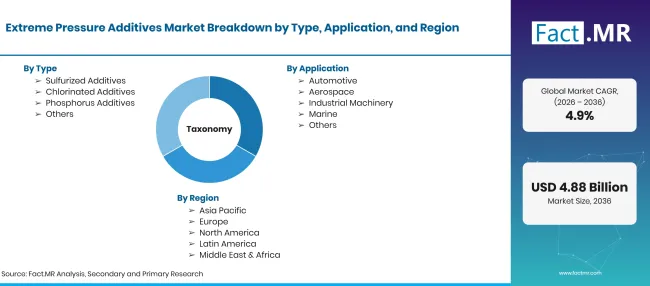
Factmr Extreme Pressure Additives Market Taxonomy | Source: Fact.MR
| Attribute | Details |
|---|---|
| Quantitative Units | USD Billion; 2026 to 2036; CAGR |
| Market Definition | Extreme pressure chemical additives used to protect lubricated metal contacts under heavy loads. |
| Type | Sulfurized Additives; Chlorinated Additives; Phosphorus Additives; Others |
| Application | Automotive; Aerospace; Transportation; Energy; Marine; Others |
| End-User Industry | Manufacturing; Others |
| Regions Covered | North America; Latin America; Western Europe; Eastern Europe; East Asia; South Asia & Pacific; Middle East & Africa |
| Countries Covered | Germany; Brazil; USA; UK; Japan |
| Companies Profiled | Infineum International Limited; BASF SE; Chevron Oronite Company LLC; Afton Chemical Corporation; Lubrizol Corporation; Evonik Industries AG; LANXESS AG |
| Forecast Period | 2026 to 2036 |
| Approach | Application-based review of additive chemistry, industrial lubricant use, official manufacturing indicators and product information |
Source: Fact.MR analysis. Updated Oct 13, 2026
Frequently Asked Questions
How big is the extreme pressure additives market in 2026?
What is the forecast CAGR through 2036?
Which additive type leads the market?
Which end-user industry leads?
Who are the main companies in the extreme pressure additives market?
Who worked on this report


Preview the report firsthand - request a free sample
Free SampleGet the brochure for pricing and purchase details
Download PDF