Circular Industrial By-Products Market (2026 - 2036)

Circular Industrial By-Products Market is segmented by Product Type (Fly Ash, Blast Furnace Slag, Steel Slag, Red Mud, and Others), Source Industry (Power Generation, Iron & Steel, Aluminum, Mining & Metals, and Others), Application (Cement & Concrete, Road Construction, Soil Stabilization & Agriculture, Metallurgical Recovery, Ceramics & Bricks, and Others), Processing Type (Untreated, Processed, Beneficiated), and Region. Forecast for 2026 to 2036.

Core Findings

    Circular Industrial By-Products Market Forecast 2026 to 2036

    In 2025, the circular industrial by-products market was valued at USD 284 billion. Based on Fact.MR’s analysis, demand for these materials is estimated to grow to USD 296 billion in 2026 and USD 487 billion by 2036. FMR projects a CAGR of 5.1% during the forecast period. This represents an absolute dollar growth of USD 191 billion, reflecting steady structural expansion as industries substitute virgin minerals with industrial residues.

    Growth remains stable due to cement decarbonization and infrastructure demand, yet transport economics limit long-distance trade because most materials remain bulk-density sensitive.
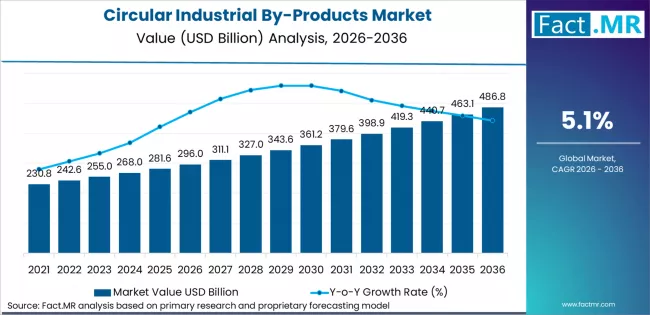
    Circular Industrial By Products Market Market Value Analysis

    Material exchange increasingly links heavy industries. Power plants, steel mills, and metal refineries indirectly influence construction material availability, as residue consistency determines clinker substitution capacity and aggregate replacement rates.

    Regionally, India leads with 7.4% CAGR, followed by China (6.6%), Indonesia (6.1%), and Brazil (5.9%). Mature markets such as Germany (3.8%), Japan (3.6%), and the United States (3.4%) rely mainly on replacement demand due to strict environmental classification standards.

    Circular Industrial By-Products Market Definition

    The circular industrial by-products market involves the recovery, processing, and commercial utilization of mineral residues generated during industrial operations. These materials, including ash, slag, and metal-processing residues, are reused to replace natural raw materials such as limestone, clay, and aggregates. Their primary function is material substitution and landfill diversion while supporting resource efficiency. Key end uses include cement and concrete manufacturing, road construction, soil stabilization, metallurgical recovery processes, and ceramic production where consistent mineral inputs are required.

    Market Inclusions

    This report covers global and regional market sizes for circular industrial by-products across the defined forecast period. It includes segment breakdowns by product type (fly ash, blast furnace slag, steel slag, red mud, others), source industry (power generation, iron & steel, aluminum, mining & metals, others), application (cement & concrete, road construction, soil stabilization & agriculture, metallurgical recovery, ceramics & bricks, others), and processing type (untreated, processed, beneficiated). Utilization ratios, substitution economics, and regional material flow patterns are also analyzed to reflect industry dynamics.

    Market Exclusions

    The scope excludes municipal recycling streams such as plastics, paper, and household waste materials. It omits finished construction products including ready-mix concrete, precast blocks, and bricks. Hazardous waste treatment services and general waste disposal operations are not covered, focusing exclusively on industrial mineral residues reused as alternative raw material inputs.

    Research Methodology

    Primary Research
    Interviews were conducted with cement manufacturers, steel producers, residue processing companies, and construction material suppliers to understand utilization practices and procurement patterns.

    Desk Research
    Data was gathered from environmental regulations, industrial production statistics, and emissions disclosures related to power generation, metals, and mineral processing industries.

    Market Sizing and Forecasting
    A hybrid model was applied, combining top-down industrial output estimates with bottom-up material substitution ratios across applications.

    Data Validation and Update Cycle
    Findings were validated against production volumes, landfill diversion records, and utilization trends, with periodic updates based on industrial activity changes.

    Market Definition
    The circular industrial by-products market focuses on the reuse of mineral residues generated during industrial processes to replace virgin raw materials. These materials, including ash and slag, support resource efficiency and reduce landfill dependence while maintaining performance requirements in construction and industrial applications.

    Demand Drivers

    • Industrial Decarbonization: Cement and metal industries increasingly substitute primary minerals with secondary materials to reduce emissions intensity.
    • Landfill Restrictions: Environmental regulations encourage diversion of industrial residues toward productive reuse pathways.
    • Resource Availability: Constraints on natural aggregate extraction increase reliance on alternative mineral inputs across infrastructure sectors.

    Key Segments

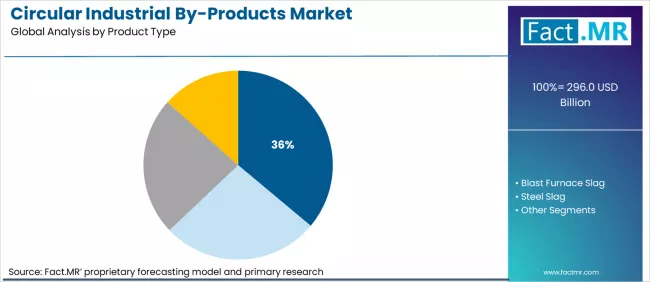
    • By Product Type: Fly ash dominates utilization due to continuous generation and compatibility with cement systems.
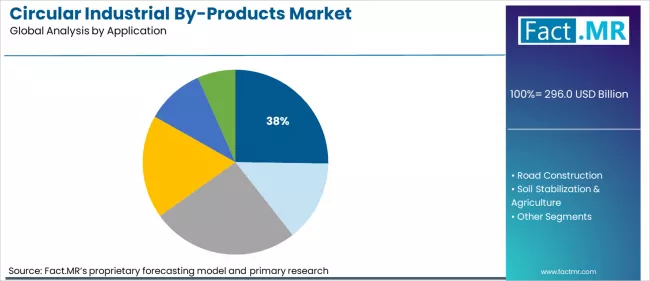
    • By Application: Cement & concrete accounts for the largest share because it absorbs high material volumes with minimal processing.
    • By Processing Type: Processed materials gain adoption as industries require consistent specification-grade inputs.

    Regional Outlook

    • India: Expected to grow at 7.4% CAGR, supported by infrastructure expansion and utilization mandates.
    • China: Expanding at 6.6% CAGR due to integrated steel and construction supply chains.
    • USA: Growth at 3.4% CAGR reflecting stable replacement demand in a mature market.

    Analyst Opinion

    The circular industrial by-products market is moving toward steady expansion, supported by decarbonization targets and material substitution requirements. Demand is strongest in infrastructure and cement production, where residue availability directly influences raw material sourcing decisions and landfill reduction strategies.

    Strategic Insights

    • Specification Requirements: Industries increasingly prefer processed and beneficiated residues that meet consistent quality standards for large-scale construction applications.
    • Regional Dynamics: Asia Pacific drives volume consumption due to infrastructure growth, while North America and Europe emphasize compliance-grade reuse under environmental regulations.

    Methodology

    The analysis combines primary interviews with cement producers, metal processors, and material handlers with secondary research covering industrial output statistics, environmental policies, and utilization trends.

    Segmental Analysis

    Circular Industrial By-Products Market Analysis by Product Type
    Circular Industrial By Products Market Analysis By Product Type

    Market Overview: Fly ash is expected to capture the largest share of the market by 2026. It is widely utilized in construction materials due to its consistent generation from power plants and its compatibility with cementitious systems. The material allows large-volume substitution of clinker and aggregates without major processing requirements, making it a preferred residue across infrastructure projects.

    Demand Drivers:

    • Continuous Availability: Baseload power generation produces stable fly ash volumes, enabling reliable long-term supply agreements for construction material producers.
    • Cost Efficiency: Minimal processing requirements reduce handling and treatment costs compared to other residues, supporting large-scale adoption.
    • Construction Material Compatibility: Its physical and chemical properties allow direct integration into blended cement and concrete formulations, supporting widespread use.

    Circular Industrial By-Products Market Analysis by Application
    Circular Industrial By Products Market Analysis By Application

    Market Overview: Cement & concrete applications are projected to account for the largest share of consumption by 2026. These applications absorb high material volumes while maintaining performance requirements, making them the primary utilization channel for industrial residues across infrastructure projects.

    Demand Drivers:

    • Clinker Substitution Needs: Cement producers replace a portion of clinker with industrial residues to reduce emissions intensity and raw material usage.
    • Infrastructure Demand: Road, housing, and public works projects create continuous demand for blended construction materials.
    • Material Performance: Residue-based cement improves durability and thermal stability in large concrete structures.

    Key Dynamics

    Circular Industrial By-Products Market Drivers, Restraints, and Opportunities

    FMR analysts observe that the circular industrial by-products market represents a structurally stable yet transforming segment within heavy industry and construction materials supply. Historically, residues from power generation and metal production were managed as disposal liabilities. Increasing landfill restrictions and rising raw material extraction costs shifted utilization toward organized reuse channels. The 2026 valuation reflects baseline demand linked to cement production, infrastructure construction, and material substitution requirements that define acceptable replacement ratios in many markets.

    While untreated residues account for the majority of volume, higher-quality processed and beneficiated materials are gaining share. These upgraded materials command higher per-ton value because consistent chemical composition allows use in performance-critical construction and metallurgical processes. The market exists at its current size because residue utilization is increasingly integrated into industrial procurement planning rather than post-production waste handling.

    • Material Specification Trend: As construction standards tighten, demand grows for processed residues with predictable composition suitable for large infrastructure and structural applications.
    • Environmental Compliance Standards: Landfill diversion rules and industrial emission reduction targets encourage industries to channel residues into productive reuse pathways, increasing commercial utilization.

    Regional Industrial Dynamics: In Asia Pacific, large infrastructure programs support high-volume residue consumption, while North America and Europe emphasize compliance-grade processing and controlled application usage.

    Regional Analysis

    The market analysis covers key global regions, including South Asia & Pacific, Middle East & Africa, North America, Latin America, Western Europe, and Eastern Europe. It is segmented geographically with distinct industrial utilization patterns in each region. The full report provides detailed market attractiveness analysis.
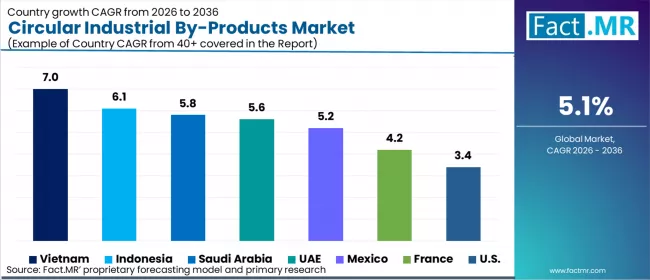
    Circular Industrial By Products Market Cagr Analysis By Country

    Country CAGR (%)
    India 7.4%
    Vietnam 7.0%
    Indonesia 6.1%
    Saudi Arabia 5.8%
    UAE 5.6%
    Mexico 5.2%
    USA 3.4%
    Germany 3.8%

    Source: Fact MR (FMR) analysis, based on proprietary forecasting model and primary research.

    South Asia & Pacific

    South Asia & Pacific acts as a high-volume utilization region where infrastructure growth and industrial output generate continuous demand for secondary mineral inputs.

    • India: Demand for circular industrial by-products in India is projected to rise at 7.4% CAGR through 2036. Large infrastructure projects and utilization mandates support adoption across cement and road construction sectors.
    • Vietnam: Demand in Vietnam is projected to rise at 7.0% CAGR through 2036. Industrial expansion and urban development increase consumption of alternative construction materials.
    • Indonesia: Demand in Indonesia is projected to rise at 6.1% CAGR through 2036. Expanding transportation infrastructure and restrictions on natural aggregate extraction support steady utilization growth.

    Middle East & Africa

    Middle East & Africa functions as a construction expansion region where material substitution supports large-scale infrastructure and urban development.

    • Saudi Arabia: Demand is projected to rise at 5.8% CAGR through 2036. Major construction initiatives and material supply diversification increase use of processed residues.
    • UAE: Demand is projected to rise at 5.6% CAGR through 2036. Large commercial and residential developments support adoption of blended construction materials.

    North America

    North America represents a mature replacement market where usage is tied to sustainability standards and infrastructure rehabilitation.

    • USA: Demand is projected to rise at 3.4% CAGR through 2036. Adoption is driven by blended cement specifications and landfill diversion requirements.

    Latin America

    Latin America is an emerging utilization region supported by construction expansion and industrial development.

    • Mexico: Demand is projected to rise at 5.2% CAGR through 2036. Infrastructure growth and cost-efficient material sourcing drive increasing use of secondary mineral inputs.

    Western Europe

    Western Europe functions as a compliance-driven market where environmental standards govern residue reuse.

    • Germany: Demand is projected to rise at 3.8% CAGR through 2036. Strict circular economy regulations and construction material standards maintain stable consumption.

    Fact MR's analysis of the Circular Industrial By-Products Market in South Asia & Pacific, Middle East & Africa, North America, Latin America, and Western Europe consists of country-wise assessments that include India, Vietnam, Indonesia, Saudi Arabia, UAE, Mexico, the United States, and Germany. Readers can find detailed utilization trends, regulatory frameworks, and industrial adoption patterns shaping growth in these countries.

    Competitive Landscape

    How Are Key Players Competing in the Circular Industrial By-Products Market?

    The circular industrial by-products market is shaped by material producers and processors such as Holcim Group, Heidelberg Materials, and CEMEX S.A.B. de C.V., who integrate industrial residues into blended cement and construction materials. ArcelorMittal, China Baowu Steel Group, Tata Steel Limited, and JSW Steel Ltd leverage captive slag generation to secure downstream utilization channels. Eco Material Technologies and Boral Limited focus on processing and beneficiation to improve residue consistency and meet construction performance specifications.

    Companies differentiate primarily through supply reliability, processing capability, and logistics proximity. Vertically integrated producers benefit from direct access to residue streams, while independent processors compete by upgrading untreated materials into specification-grade inputs suitable for large infrastructure projects.

    Recent Industry Developments

    Acquisition – CRH to acquire Eco Material Technologies (Announced Jul 29, 2025):
    CRH agreed to acquire Eco Material Technologies, a supplier of supplementary cementitious materials such as fly ash and synthetic gypsum, to secure long-term access to alternative mineral inputs for low-carbon construction.
    https://www.crh.com/media/press-releases/2025/crh-to-acquire-eco-material-technologies-for-2-1b/

    Project – Coal ash recycling collaboration with Alabama Power (Jan 25, 2024):
    Eco Material Technologies partnered with Alabama Power to harvest and reuse millions of tons of coal ash for concrete production, expanding industrial residue utilization in construction materials.
    https://www.nasdaq.com/press-release/eco-material-technologies-and-alabama-power-to-repurpose-coal-ash-at-plant-barry-2024

    Investment – Holcim circular construction expansion (Dec 2, 2025):
    Holcim acquired recycling companies across Europe to increase recycled material capacity and support circular construction supply chains, reinforcing industrial by-product integration into building materials.
    https://www.reuters.com/business/holcim-steps-up-recycled-building-materials-push-with-three-deals-2025-12-02/

    Key Players of the Circular Industrial By-Products Market

    • Holcim Group
    • Heidelberg Materials
    • CEMEX S.A.B. de C.V.
    • China Baowu Steel Group
    • ArcelorMittal
    • Tata Steel Limited
    • JSW Steel Ltd
    • Nippon Steel Corporation
    • Boral Limited
    • Eco Material Technologies

    Report Scope

    Metric Value
    Quantitative Units USD 296 billion (2026) to USD 487 billion (2036), at a CAGR of 5.1%
    Market Definition The Circular Industrial By-Products Market includes mineral residues generated from industrial processes that are reused as alternative raw materials in construction, agriculture, and metallurgical applications.
    By Product Type Fly Ash, Blast Furnace Slag, Steel Slag, Red Mud, Others
    By Source Industry Power Generation, Iron & Steel, Aluminum, Mining & Metals, Others
    By Application Cement & Concrete, Road Construction, Soil Stabilization & Agriculture, Metallurgical Recovery, Ceramics & Bricks, Others
    By Processing Type Untreated, Processed, Beneficiated
    Regions Covered North America, Latin America, Europe, East Asia, South Asia, Oceania, Middle East & Africa
    Countries Covered United States, Canada, Mexico, Brazil, Argentina, Germany, France, United Kingdom, Italy, Spain, China, India, Japan, South Korea, Indonesia, Australia, and 40+ countries
    Key Companies Profiled Holcim Group, Heidelberg Materials, CEMEX S.A.B. de C.V., China Baowu Steel Group, ArcelorMittal, Tata Steel Limited, JSW Steel Ltd, Nippon Steel Corporation, Boral Limited, Eco Material Technologies
    Forecast Period 2026 to 2036
    Approach Hybrid top-down industrial output modeling and bottom-up substitution ratio analysis validated through primary interviews and trade flow benchmarking

    Circular Industrial By-Products Market Key Segments

    • By Product Type :

      • Fly Ash
      • Blast Furnace Slag
      • Steel Slag
      • Red Mud
      • Others
    • By Source Industry :

      • Power Generation
      • Iron & Steel
      • Aluminum
      • Mining & Metals
      • Others
    • By Application :

      • Cement & Concrete
      • Road Construction
      • Soil Stabilization & Agriculture
      • Metallurgical Recovery
      • Ceramics & Bricks
      • Others
    • By Processing Type :

      • Untreated
      • Processed
      • Beneficiated
    • Region :

      • North America
        • USA
        • Canada
        • Mexico
      • Europe
        • Germany
        • UK
        • France
        • Italy
        • Spain
        • Nordic Countries
        • BENELUX
        • Rest of Europe
      • Asia Pacific
        • China
        • Japan
        • South Korea
        • India
        • Australia
        • Rest of Asia Pacific
      • Latin America
        • Brazil
        • Argentina
        • Rest of Latin America
      • Middle East & Africa
        • Kingdom of Saudi Arabia
        • United Arab Emirates
        • South Africa
        • Rest of Middle East & Africa
      • Other Regions
        • Oceania
        • Central Asia
        • Other Markets

    Bibliographies

    Acquisition – CRH to Acquire Eco Material Technologies:
    CRH plc. (2025, July 29). CRH to acquire Eco Material Technologies to expand supplementary cementitious materials portfolio. CRH Press Release. [1]

    Project – Coal Ash Recycling Collaboration with Alabama Power:
    Eco Material Technologies. (2024, January 25). Eco Material Technologies and Alabama Power to repurpose coal ash for concrete production. Nasdaq Press Release. [2]

    Investment – Holcim Circular Construction Expansion:
    Holcim Group. (2025, December 2). Holcim expands recycled construction materials capacity through acquisitions. Reuters Business News. [3]

    Table of Content

    1. Executive Summary
      • Global Market Outlook
      • Demand to side Trends
      • Supply to side Trends
      • Technology Roadmap Analysis
      • Analysis and Recommendations
    2. Market Overview
      • Market Coverage / Taxonomy
      • Market Definition / Scope / Limitations
    3. Market Background
      • Market Dynamics
        • Drivers
        • Restraints
        • Opportunity
        • Trends
      • Scenario Forecast
        • Demand in Optimistic Scenario
        • Demand in Likely Scenario
        • Demand in Conservative Scenario
      • Opportunity Map Analysis
      • Product Life Cycle Analysis
      • Supply Chain Analysis
      • Investment Feasibility Matrix
      • Value Chain Analysis
      • PESTLE and Porter’s Analysis
      • Regulatory Landscape
      • Regional Parent Market Outlook
      • Production and Consumption Statistics
      • Import and Export Statistics
    4. Global Market Analysis 2021 to 2025 and Forecast, 2026 to 2036
      • Historical Market Size Value (USD Billion) & Volume (KT) Analysis, 2021 to 2025
      • Current and Future Market Size Value (USD Billion) & Volume (KT) Projections, 2026 to 2036
        • Y to o to Y Growth Trend Analysis
        • Absolute $ Opportunity Analysis
    5. Global Market Pricing Analysis 2021 to 2025 and Forecast 2026 to 2036
    6. Global Market Analysis 2021 to 2025 and Forecast 2026 to 2036, By Product Type
      • Introduction / Key Findings
      • Historical Market Size Value (USD Billion) & Volume (KT) Analysis By Product Type , 2021 to 2025
      • Current and Future Market Size Value (USD Billion) & Volume (KT) Analysis and Forecast By Product Type , 2026 to 2036
      • Fly Ash
      • Blast Furnace Slag
      • Steel Slag
      • Red Mud
      • Others
    7. Y to o to Y Growth Trend Analysis By Product Type , 2021 to 2025
    8. Absolute $ Opportunity Analysis By Product Type , 2026 to 2036
    9. Global Market Analysis 2021 to 2025 and Forecast 2026 to 2036, By Source Industryy
      • Introduction / Key Findings
      • Historical Market Size Value (USD Billion) & Volume (KT) Analysis By Source Industryy, 2021 to 2025
      • Current and Future Market Size Value (USD Billion) & Volume (KT) Analysis and Forecast By Source Industryy, 2026 to 2036
      • Power Generation
      • Iron & Steel
      • Aluminum
      • Mining & Metals
      • Others
    10. Y to o to Y Growth Trend Analysis By Source Industryy, 2021 to 2025
    11. Absolute $ Opportunity Analysis By Source Industryy, 2026 to 2036
    12. Global Market Analysis 2021 to 2025 and Forecast 2026 to 2036, By Application
      • Introduction / Key Findings
      • Historical Market Size Value (USD Billion) & Volume (KT) Analysis By Application, 2021 to 2025
      • Current and Future Market Size Value (USD Billion) & Volume (KT) Analysis and Forecast By Application, 2026 to 2036
      • Cement & Concrete
      • Road Construction
      • Soil Stabilization & Agriculture
      • Metallurgical Recovery
      • Ceramics & Bricks
      • Others
    13. Y to o to Y Growth Trend Analysis By Application, 2021 to 2025
    14. Absolute $ Opportunity Analysis By Application, 2026 to 2036
    15. Global Market Analysis 2021 to 2025 and Forecast 2026 to 2036, By Processing Type
      • Introduction / Key Findings
      • Historical Market Size Value (USD Billion) & Volume (KT) Analysis By Processing Type, 2021 to 2025
      • Current and Future Market Size Value (USD Billion) & Volume (KT) Analysis and Forecast By Processing Type, 2026 to 2036
      • Untreated
      • Processed
      • Beneficiated
    16. Y to o to Y Growth Trend Analysis By Processing Type, 2021 to 2025
    17. Absolute $ Opportunity Analysis By Processing Type, 2026 to 2036
    18. Global Market Analysis 2021 to 2025 and Forecast 2026 to 2036, By Region
      • Introduction
      • Historical Market Size Value (USD Billion) & Volume (KT) Analysis By Region, 2021 to 2025
      • Current Market Size Value (USD Billion) & Volume (KT) Analysis and Forecast By Region, 2026 to 2036
        • North America
        • Latin America
        • Western Europe
        • Eastern Europe
        • East Asia
        • South Asia and Pacific
        • Middle East & Africa
      • Market Attractiveness Analysis By Region
    19. North America Market Analysis 2021 to 2025 and Forecast 2026 to 2036, By Country
      • Historical Market Size Value (USD Billion) & Volume (KT) Trend Analysis By Market Taxonomy, 2021 to 2025
      • Market Size Value (USD Billion) & Volume (KT) Forecast By Market Taxonomy, 2026 to 2036
        • By Country
          • USA
          • Canada
          • Mexico
        • By Product Type
        • By Source Industryy
        • By Application
        • By Processing Type
      • Market Attractiveness Analysis
        • By Country
        • By Product Type
        • By Source Industryy
        • By Application
        • By Processing Type
      • Key Takeaways
    20. Latin America Market Analysis 2021 to 2025 and Forecast 2026 to 2036, By Country
      • Historical Market Size Value (USD Billion) & Volume (KT) Trend Analysis By Market Taxonomy, 2021 to 2025
      • Market Size Value (USD Billion) & Volume (KT) Forecast By Market Taxonomy, 2026 to 2036
        • By Country
          • Brazil
          • Chile
          • Rest of Latin America
        • By Product Type
        • By Source Industryy
        • By Application
        • By Processing Type
      • Market Attractiveness Analysis
        • By Country
        • By Product Type
        • By Source Industryy
        • By Application
        • By Processing Type
      • Key Takeaways
    21. Western Europe Market Analysis 2021 to 2025 and Forecast 2026 to 2036, By Country
      • Historical Market Size Value (USD Billion) & Volume (KT) Trend Analysis By Market Taxonomy, 2021 to 2025
      • Market Size Value (USD Billion) & Volume (KT) Forecast By Market Taxonomy, 2026 to 2036
        • By Country
          • Germany
          • UK
          • Italy
          • Spain
          • France
          • Nordic
          • BENELUX
          • Rest of Western Europe
        • By Product Type
        • By Source Industryy
        • By Application
        • By Processing Type
      • Market Attractiveness Analysis
        • By Country
        • By Product Type
        • By Source Industryy
        • By Application
        • By Processing Type
      • Key Takeaways
    22. Eastern Europe Market Analysis 2021 to 2025 and Forecast 2026 to 2036, By Country
      • Historical Market Size Value (USD Billion) & Volume (KT) Trend Analysis By Market Taxonomy, 2021 to 2025
      • Market Size Value (USD Billion) & Volume (KT) Forecast By Market Taxonomy, 2026 to 2036
        • By Country
          • Russia
          • Poland
          • Hungary
          • Balkan & Baltic
          • Rest of Eastern Europe
        • By Product Type
        • By Source Industryy
        • By Application
        • By Processing Type
      • Market Attractiveness Analysis
        • By Country
        • By Product Type
        • By Source Industryy
        • By Application
        • By Processing Type
      • Key Takeaways
    23. East Asia Market Analysis 2021 to 2025 and Forecast 2026 to 2036, By Country
      • Historical Market Size Value (USD Billion) & Volume (KT) Trend Analysis By Market Taxonomy, 2021 to 2025
      • Market Size Value (USD Billion) & Volume (KT) Forecast By Market Taxonomy, 2026 to 2036
        • By Country
          • China
          • Japan
          • South Korea
        • By Product Type
        • By Source Industryy
        • By Application
        • By Processing Type
      • Market Attractiveness Analysis
        • By Country
        • By Product Type
        • By Source Industryy
        • By Application
        • By Processing Type
      • Key Takeaways
    24. South Asia and Pacific Market Analysis 2021 to 2025 and Forecast 2026 to 2036, By Country
      • Historical Market Size Value (USD Billion) & Volume (KT) Trend Analysis By Market Taxonomy, 2021 to 2025
      • Market Size Value (USD Billion) & Volume (KT) Forecast By Market Taxonomy, 2026 to 2036
        • By Country
          • India
          • ASEAN
          • Australia & New Zealand
          • Rest of South Asia and Pacific
        • By Product Type
        • By Source Industryy
        • By Application
        • By Processing Type
      • Market Attractiveness Analysis
        • By Country
        • By Product Type
        • By Source Industryy
        • By Application
        • By Processing Type
      • Key Takeaways
    25. Middle East & Africa Market Analysis 2021 to 2025 and Forecast 2026 to 2036, By Country
      • Historical Market Size Value (USD Billion) & Volume (KT) Trend Analysis By Market Taxonomy, 2021 to 2025
      • Market Size Value (USD Billion) & Volume (KT) Forecast By Market Taxonomy, 2026 to 2036
        • By Country
          • Kingdom of Saudi Arabia
          • Other GCC Countries
          • Turkiye
          • South Africa
          • Other African Union
          • Rest of Middle East & Africa
        • By Product Type
        • By Source Industryy
        • By Application
        • By Processing Type
      • Market Attractiveness Analysis
        • By Country
        • By Product Type
        • By Source Industryy
        • By Application
        • By Processing Type
      • Key Takeaways
    26. Key Countries Market Analysis
      • USA
        • Pricing Analysis
        • Market Share Analysis, 2025
          • By Product Type
          • By Source Industryy
          • By Application
          • By Processing Type
      • Canada
        • Pricing Analysis
        • Market Share Analysis, 2025
          • By Product Type
          • By Source Industryy
          • By Application
          • By Processing Type
      • Mexico
        • Pricing Analysis
        • Market Share Analysis, 2025
          • By Product Type
          • By Source Industryy
          • By Application
          • By Processing Type
      • Brazil
        • Pricing Analysis
        • Market Share Analysis, 2025
          • By Product Type
          • By Source Industryy
          • By Application
          • By Processing Type
      • Chile
        • Pricing Analysis
        • Market Share Analysis, 2025
          • By Product Type
          • By Source Industryy
          • By Application
          • By Processing Type
      • Germany
        • Pricing Analysis
        • Market Share Analysis, 2025
          • By Product Type
          • By Source Industryy
          • By Application
          • By Processing Type
      • UK
        • Pricing Analysis
        • Market Share Analysis, 2025
          • By Product Type
          • By Source Industryy
          • By Application
          • By Processing Type
      • Italy
        • Pricing Analysis
        • Market Share Analysis, 2025
          • By Product Type
          • By Source Industryy
          • By Application
          • By Processing Type
      • Spain
        • Pricing Analysis
        • Market Share Analysis, 2025
          • By Product Type
          • By Source Industryy
          • By Application
          • By Processing Type
      • France
        • Pricing Analysis
        • Market Share Analysis, 2025
          • By Product Type
          • By Source Industryy
          • By Application
          • By Processing Type
      • India
        • Pricing Analysis
        • Market Share Analysis, 2025
          • By Product Type
          • By Source Industryy
          • By Application
          • By Processing Type
      • ASEAN
        • Pricing Analysis
        • Market Share Analysis, 2025
          • By Product Type
          • By Source Industryy
          • By Application
          • By Processing Type
      • Australia & New Zealand
        • Pricing Analysis
        • Market Share Analysis, 2025
          • By Product Type
          • By Source Industryy
          • By Application
          • By Processing Type
      • China
        • Pricing Analysis
        • Market Share Analysis, 2025
          • By Product Type
          • By Source Industryy
          • By Application
          • By Processing Type
      • Japan
        • Pricing Analysis
        • Market Share Analysis, 2025
          • By Product Type
          • By Source Industryy
          • By Application
          • By Processing Type
      • South Korea
        • Pricing Analysis
        • Market Share Analysis, 2025
          • By Product Type
          • By Source Industryy
          • By Application
          • By Processing Type
      • Russia
        • Pricing Analysis
        • Market Share Analysis, 2025
          • By Product Type
          • By Source Industryy
          • By Application
          • By Processing Type
      • Poland
        • Pricing Analysis
        • Market Share Analysis, 2025
          • By Product Type
          • By Source Industryy
          • By Application
          • By Processing Type
      • Hungary
        • Pricing Analysis
        • Market Share Analysis, 2025
          • By Product Type
          • By Source Industryy
          • By Application
          • By Processing Type
      • Kingdom of Saudi Arabia
        • Pricing Analysis
        • Market Share Analysis, 2025
          • By Product Type
          • By Source Industryy
          • By Application
          • By Processing Type
      • Turkiye
        • Pricing Analysis
        • Market Share Analysis, 2025
          • By Product Type
          • By Source Industryy
          • By Application
          • By Processing Type
      • South Africa
        • Pricing Analysis
        • Market Share Analysis, 2025
          • By Product Type
          • By Source Industryy
          • By Application
          • By Processing Type
    27. Market Structure Analysis
      • Competition Dashboard
      • Competition Benchmarking
      • Market Share Analysis of Top Players
        • By Regional
        • By Product Type
        • By Source Industryy
        • By Application
        • By Processing Type
    28. Competition Analysis
      • Competition Deep Dive
        • Holcim Group
          • Overview
          • Product Portfolio
          • Profitability by Market Segments (Product/Age /Sales Channel/Region)
          • Sales Footprint
          • Strategy Overview
            • Marketing Strategy
            • Product Strategy
            • Channel Strategy
        • Heidelberg Materials
        • CEMEX S.A.B. de C.V.
        • China Baowu Steel Group
        • ArcelorMittal
        • Tata Steel Limited
        • JSW Steel Ltd
        • Nippon Steel Corporation
        • Boral Limited
        • Eco Material Technologies
    29. Assumptions & Acronyms Used
    30. Research Methodology

    List Of Table

    • Table 1: Global Market Value (USD Mn) Forecast by Region, 2021 to 2036
    • Table 2: Global Market Volume (KT) Forecast by Region, 2021 to 2036
    • Table 3: Global Market Value (USD Mn) Forecast by Product Type, 2021 to 2036
    • Table 4: Global Market Volume (KT) Forecast by Product Type, 2021 to 2036
    • Table 5: Global Market Value (USD Mn) Forecast by Source Industry, 2021 to 2036
    • Table 6: Global Market Volume (KT) Forecast by Source Industry, 2021 to 2036
    • Table 7: Global Market Value (USD Mn) Forecast by Application, 2021 to 2036
    • Table 8: Global Market Volume (KT) Forecast by Application, 2021 to 2036
    • Table 9: Global Market Value (USD Mn) Forecast by Processing Type, 2021 to 2036
    • Table 10: Global Market Volume (KT) Forecast by Processing Type, 2021 to 2036
    • Table 11: North America Market Value (USD Mn) Forecast by Country, 2021 to 2036
    • Table 12: North America Market Volume (KT) Forecast by Country, 2021 to 2036
    • Table 13: North America Market Value (USD Mn) Forecast by Product Type, 2021 to 2036
    • Table 14: North America Market Volume (KT) Forecast by Product Type, 2021 to 2036
    • Table 15: North America Market Value (USD Mn) Forecast by Source Industry, 2021 to 2036
    • Table 16: North America Market Volume (KT) Forecast by Source Industry, 2021 to 2036
    • Table 17: North America Market Value (USD Mn) Forecast by Application, 2021 to 2036
    • Table 18: North America Market Volume (KT) Forecast by Application, 2021 to 2036
    • Table 19: North America Market Value (USD Mn) Forecast by Processing Type, 2021 to 2036
    • Table 20: North America Market Volume (KT) Forecast by Processing Type, 2021 to 2036
    • Table 21: Latin America Market Value (USD Mn) Forecast by Country, 2021 to 2036
    • Table 22: Latin America Market Volume (KT) Forecast by Country, 2021 to 2036
    • Table 23: Latin America Market Value (USD Mn) Forecast by Product Type, 2021 to 2036
    • Table 24: Latin America Market Volume (KT) Forecast by Product Type, 2021 to 2036
    • Table 25: Latin America Market Value (USD Mn) Forecast by Source Industry, 2021 to 2036
    • Table 26: Latin America Market Volume (KT) Forecast by Source Industry, 2021 to 2036
    • Table 27: Latin America Market Value (USD Mn) Forecast by Application, 2021 to 2036
    • Table 28: Latin America Market Volume (KT) Forecast by Application, 2021 to 2036
    • Table 29: Latin America Market Value (USD Mn) Forecast by Processing Type, 2021 to 2036
    • Table 30: Latin America Market Volume (KT) Forecast by Processing Type, 2021 to 2036
    • Table 31: Western Europe Market Value (USD Mn) Forecast by Country, 2021 to 2036
    • Table 32: Western Europe Market Volume (KT) Forecast by Country, 2021 to 2036
    • Table 33: Western Europe Market Value (USD Mn) Forecast by Product Type, 2021 to 2036
    • Table 34: Western Europe Market Volume (KT) Forecast by Product Type, 2021 to 2036
    • Table 35: Western Europe Market Value (USD Mn) Forecast by Source Industry, 2021 to 2036
    • Table 36: Western Europe Market Volume (KT) Forecast by Source Industry, 2021 to 2036
    • Table 37: Western Europe Market Value (USD Mn) Forecast by Application, 2021 to 2036
    • Table 38: Western Europe Market Volume (KT) Forecast by Application, 2021 to 2036
    • Table 39: Western Europe Market Value (USD Mn) Forecast by Processing Type, 2021 to 2036
    • Table 40: Western Europe Market Volume (KT) Forecast by Processing Type, 2021 to 2036
    • Table 41: East Asia Market Value (USD Mn) Forecast by Country, 2021 to 2036
    • Table 42: East Asia Market Volume (KT) Forecast by Country, 2021 to 2036
    • Table 43: East Asia Market Value (USD Mn) Forecast by Product Type, 2021 to 2036
    • Table 44: East Asia Market Volume (KT) Forecast by Product Type, 2021 to 2036
    • Table 45: East Asia Market Value (USD Mn) Forecast by Source Industry, 2021 to 2036
    • Table 46: East Asia Market Volume (KT) Forecast by Source Industry, 2021 to 2036
    • Table 47: East Asia Market Value (USD Mn) Forecast by Application, 2021 to 2036
    • Table 48: East Asia Market Volume (KT) Forecast by Application, 2021 to 2036
    • Table 49: East Asia Market Value (USD Mn) Forecast by Processing Type, 2021 to 2036
    • Table 50: East Asia Market Volume (KT) Forecast by Processing Type, 2021 to 2036
    • Table 51: South Asia Pacific Market Value (USD Mn) Forecast by Country, 2021 to 2036
    • Table 52: South Asia Pacific Market Volume (KT) Forecast by Country, 2021 to 2036
    • Table 53: South Asia Pacific Market Value (USD Mn) Forecast by Product Type, 2021 to 2036
    • Table 54: South Asia Pacific Market Volume (KT) Forecast by Product Type, 2021 to 2036
    • Table 55: South Asia Pacific Market Value (USD Mn) Forecast by Source Industry, 2021 to 2036
    • Table 56: South Asia Pacific Market Volume (KT) Forecast by Source Industry, 2021 to 2036
    • Table 57: South Asia Pacific Market Value (USD Mn) Forecast by Application, 2021 to 2036
    • Table 58: South Asia Pacific Market Volume (KT) Forecast by Application, 2021 to 2036
    • Table 59: South Asia Pacific Market Value (USD Mn) Forecast by Processing Type, 2021 to 2036
    • Table 60: South Asia Pacific Market Volume (KT) Forecast by Processing Type, 2021 to 2036
    • Table 61: Eastern Europe Market Value (USD Mn) Forecast by Country, 2021 to 2036
    • Table 62: Eastern Europe Market Volume (KT) Forecast by Country, 2021 to 2036
    • Table 63: Eastern Europe Market Value (USD Mn) Forecast by Product Type, 2021 to 2036
    • Table 64: Eastern Europe Market Volume (KT) Forecast by Product Type, 2021 to 2036
    • Table 65: Eastern Europe Market Value (USD Mn) Forecast by Source Industry, 2021 to 2036
    • Table 66: Eastern Europe Market Volume (KT) Forecast by Source Industry, 2021 to 2036
    • Table 67: Eastern Europe Market Value (USD Mn) Forecast by Application, 2021 to 2036
    • Table 68: Eastern Europe Market Volume (KT) Forecast by Application, 2021 to 2036
    • Table 69: Eastern Europe Market Value (USD Mn) Forecast by Processing Type, 2021 to 2036
    • Table 70: Eastern Europe Market Volume (KT) Forecast by Processing Type, 2021 to 2036
    • Table 71: Middle East & Africa Market Value (USD Mn) Forecast by Country, 2021 to 2036
    • Table 72: Middle East & Africa Market Volume (KT) Forecast by Country, 2021 to 2036
    • Table 73: Middle East & Africa Market Value (USD Mn) Forecast by Product Type, 2021 to 2036
    • Table 74: Middle East & Africa Market Volume (KT) Forecast by Product Type, 2021 to 2036
    • Table 75: Middle East & Africa Market Value (USD Mn) Forecast by Source Industry, 2021 to 2036
    • Table 76: Middle East & Africa Market Volume (KT) Forecast by Source Industry, 2021 to 2036
    • Table 77: Middle East & Africa Market Value (USD Mn) Forecast by Application, 2021 to 2036
    • Table 78: Middle East & Africa Market Volume (KT) Forecast by Application, 2021 to 2036
    • Table 79: Middle East & Africa Market Value (USD Mn) Forecast by Processing Type, 2021 to 2036
    • Table 80: Middle East & Africa Market Volume (KT) Forecast by Processing Type, 2021 to 2036

    List Of Figures

    • Figure 1: Global Market Volume (KT) Forecast 2020 to 2035
    • Figure 2: Global Market Pricing Analysis
    • Figure 3: Global Market Value (USD Mn) Forecast 2020 to 2035
    • Figure 4: Global Market Value Share and BPS Analysis by Product Type, 2026 and 2036
    • Figure 5: Global Market Y-o-Y Growth Comparison by Product Type, 2026 to 2036
    • Figure 6: Global Market Attractiveness Analysis by Product Type
    • Figure 7: Global Market Value Share and BPS Analysis by Source Industry, 2026 and 2036
    • Figure 8: Global Market Y-o-Y Growth Comparison by Source Industry, 2026 to 2036
    • Figure 9: Global Market Attractiveness Analysis by Source Industry
    • Figure 10: Global Market Value Share and BPS Analysis by Application, 2026 and 2036
    • Figure 11: Global Market Y-o-Y Growth Comparison by Application, 2026 to 2036
    • Figure 12: Global Market Attractiveness Analysis by Application
    • Figure 13: Global Market Value Share and BPS Analysis by Processing Type, 2026 and 2036
    • Figure 14: Global Market Y-o-Y Growth Comparison by Processing Type, 2026 to 2036
    • Figure 15: Global Market Attractiveness Analysis by Processing Type
    • Figure 16: Global Market Value (USD Mn) Share and BPS Analysis by Region, 2026 and 2036
    • Figure 17: Global Market Y-o-Y Growth Comparison by Region, 2026 to 2036
    • Figure 18: Global Market Attractiveness Analysis by Region
    • Figure 19: North America Market Incremental $ Opportunity, 2026 to 2036
    • Figure 20: Latin America Market Incremental $ Opportunity, 2026 to 2036
    • Figure 21: Western Europe Market Incremental $ Opportunity, 2026 to 2036
    • Figure 22: East Asia Market Incremental $ Opportunity, 2026 to 2036
    • Figure 23: South Asia Pacific Market Incremental $ Opportunity, 2026 to 2036
    • Figure 24: Eastern Europe Market Incremental $ Opportunity, 2026 to 2036
    • Figure 25: Middle East & Africa Market Incremental $ Opportunity, 2026 to 2036
    • Figure 26: North America Market Value Share and BPS Analysis by Country, 2026 and 2036
    • Figure 27: North America Market Value Share and BPS Analysis by Product Type, 2026 and 2036
    • Figure 28: North America Market Y-o-Y Growth Comparison by Product Type, 2026 to 2036
    • Figure 29: North America Market Attractiveness Analysis by Product Type
    • Figure 30: North America Market Value Share and BPS Analysis by Source Industry, 2026 and 2036
    • Figure 31: North America Market Y-o-Y Growth Comparison by Source Industry, 2026 to 2036
    • Figure 32: North America Market Attractiveness Analysis by Source Industry
    • Figure 33: North America Market Value Share and BPS Analysis by Application, 2026 and 2036
    • Figure 34: North America Market Y-o-Y Growth Comparison by Application, 2026 to 2036
    • Figure 35: North America Market Attractiveness Analysis by Application
    • Figure 36: North America Market Value Share and BPS Analysis by Processing Type, 2026 and 2036
    • Figure 37: North America Market Y-o-Y Growth Comparison by Processing Type, 2026 to 2036
    • Figure 38: North America Market Attractiveness Analysis by Processing Type
    • Figure 39: Latin America Market Value Share and BPS Analysis by Country, 2026 and 2036
    • Figure 40: Latin America Market Value Share and BPS Analysis by Product Type, 2026 and 2036
    • Figure 41: Latin America Market Y-o-Y Growth Comparison by Product Type, 2026 to 2036
    • Figure 42: Latin America Market Attractiveness Analysis by Product Type
    • Figure 43: Latin America Market Value Share and BPS Analysis by Source Industry, 2026 and 2036
    • Figure 44: Latin America Market Y-o-Y Growth Comparison by Source Industry, 2026 to 2036
    • Figure 45: Latin America Market Attractiveness Analysis by Source Industry
    • Figure 46: Latin America Market Value Share and BPS Analysis by Application, 2026 and 2036
    • Figure 47: Latin America Market Y-o-Y Growth Comparison by Application, 2026 to 2036
    • Figure 48: Latin America Market Attractiveness Analysis by Application
    • Figure 49: Latin America Market Value Share and BPS Analysis by Processing Type, 2026 and 2036
    • Figure 50: Latin America Market Y-o-Y Growth Comparison by Processing Type, 2026 to 2036
    • Figure 51: Latin America Market Attractiveness Analysis by Processing Type
    • Figure 52: Western Europe Market Value Share and BPS Analysis by Country, 2026 and 2036
    • Figure 53: Western Europe Market Value Share and BPS Analysis by Product Type, 2026 and 2036
    • Figure 54: Western Europe Market Y-o-Y Growth Comparison by Product Type, 2026 to 2036
    • Figure 55: Western Europe Market Attractiveness Analysis by Product Type
    • Figure 56: Western Europe Market Value Share and BPS Analysis by Source Industry, 2026 and 2036
    • Figure 57: Western Europe Market Y-o-Y Growth Comparison by Source Industry, 2026 to 2036
    • Figure 58: Western Europe Market Attractiveness Analysis by Source Industry
    • Figure 59: Western Europe Market Value Share and BPS Analysis by Application, 2026 and 2036
    • Figure 60: Western Europe Market Y-o-Y Growth Comparison by Application, 2026 to 2036
    • Figure 61: Western Europe Market Attractiveness Analysis by Application
    • Figure 62: Western Europe Market Value Share and BPS Analysis by Processing Type, 2026 and 2036
    • Figure 63: Western Europe Market Y-o-Y Growth Comparison by Processing Type, 2026 to 2036
    • Figure 64: Western Europe Market Attractiveness Analysis by Processing Type
    • Figure 65: East Asia Market Value Share and BPS Analysis by Country, 2026 and 2036
    • Figure 66: East Asia Market Value Share and BPS Analysis by Product Type, 2026 and 2036
    • Figure 67: East Asia Market Y-o-Y Growth Comparison by Product Type, 2026 to 2036
    • Figure 68: East Asia Market Attractiveness Analysis by Product Type
    • Figure 69: East Asia Market Value Share and BPS Analysis by Source Industry, 2026 and 2036
    • Figure 70: East Asia Market Y-o-Y Growth Comparison by Source Industry, 2026 to 2036
    • Figure 71: East Asia Market Attractiveness Analysis by Source Industry
    • Figure 72: East Asia Market Value Share and BPS Analysis by Application, 2026 and 2036
    • Figure 73: East Asia Market Y-o-Y Growth Comparison by Application, 2026 to 2036
    • Figure 74: East Asia Market Attractiveness Analysis by Application
    • Figure 75: East Asia Market Value Share and BPS Analysis by Processing Type, 2026 and 2036
    • Figure 76: East Asia Market Y-o-Y Growth Comparison by Processing Type, 2026 to 2036
    • Figure 77: East Asia Market Attractiveness Analysis by Processing Type
    • Figure 78: South Asia Pacific Market Value Share and BPS Analysis by Country, 2026 and 2036
    • Figure 79: South Asia Pacific Market Value Share and BPS Analysis by Product Type, 2026 and 2036
    • Figure 80: South Asia Pacific Market Y-o-Y Growth Comparison by Product Type, 2026 to 2036
    • Figure 81: South Asia Pacific Market Attractiveness Analysis by Product Type
    • Figure 82: South Asia Pacific Market Value Share and BPS Analysis by Source Industry, 2026 and 2036
    • Figure 83: South Asia Pacific Market Y-o-Y Growth Comparison by Source Industry, 2026 to 2036
    • Figure 84: South Asia Pacific Market Attractiveness Analysis by Source Industry
    • Figure 85: South Asia Pacific Market Value Share and BPS Analysis by Application, 2026 and 2036
    • Figure 86: South Asia Pacific Market Y-o-Y Growth Comparison by Application, 2026 to 2036
    • Figure 87: South Asia Pacific Market Attractiveness Analysis by Application
    • Figure 88: South Asia Pacific Market Value Share and BPS Analysis by Processing Type, 2026 and 2036
    • Figure 89: South Asia Pacific Market Y-o-Y Growth Comparison by Processing Type, 2026 to 2036
    • Figure 90: South Asia Pacific Market Attractiveness Analysis by Processing Type
    • Figure 91: Eastern Europe Market Value Share and BPS Analysis by Country, 2026 and 2036
    • Figure 92: Eastern Europe Market Value Share and BPS Analysis by Product Type, 2026 and 2036
    • Figure 93: Eastern Europe Market Y-o-Y Growth Comparison by Product Type, 2026 to 2036
    • Figure 94: Eastern Europe Market Attractiveness Analysis by Product Type
    • Figure 95: Eastern Europe Market Value Share and BPS Analysis by Source Industry, 2026 and 2036
    • Figure 96: Eastern Europe Market Y-o-Y Growth Comparison by Source Industry, 2026 to 2036
    • Figure 97: Eastern Europe Market Attractiveness Analysis by Source Industry
    • Figure 98: Eastern Europe Market Value Share and BPS Analysis by Application, 2026 and 2036
    • Figure 99: Eastern Europe Market Y-o-Y Growth Comparison by Application, 2026 to 2036
    • Figure 100: Global Market – Tier Structure Analysis
    • Figure 101: Global Market – Company Share Analysis

    - FAQs -

    How large is the demand for Circular Industrial By-Products in the global market in 2026?

    Demand for circular industrial by-products in the global market is estimated to be valued at USD 296 billion in 2026.

    What will be the market size by 2036?

    The market size for circular industrial by-products is projected to reach USD 487 billion by 2036.

    What is the expected demand growth between 2026 and 2036?

    Demand is expected to grow at a CAGR of 5.1?tween 2026 and 2036.

    Which product type is expected to dominate the market?

    Fly ash is expected to dominate the market due to continuous availability and compatibility with cement manufacturing.

    Which region is expected to show the highest growth rate?

    India is projected to show the highest regional CAGR at 7.4% during the forecast period, supported by infrastructure development and utilization mandates.

    How significant is the growth outlook for Vietnam?

    Vietnam is expected to grow at a 7.0?GR, reflecting industrial expansion and rising demand for alternative construction materials.

    What is the growth outlook for the United States?

    The United States is anticipated to grow at a 3.4?GR from 2026 to 2036, supported by sustainability standards and blended cement adoption.

    What is the growth forecast for Saudi Arabia?

    Saudi Arabia is expected to grow at a 5.8?GR, driven by infrastructure development and material supply diversification

    Which European market is highlighted in this analysis?

    Germany is a key European market, projected to grow at a 3.8?GR due to circular economy regulations and construction material standards.

    Which company is identified as a leading player in the market?

    Holcim Group is recognized as a leading player providing circular construction material solutions utilizing industrial residues.

    What are circular industrial by-products used for?

    They are used as alternative raw materials in cement production, road construction, soil stabilization, metallurgical recovery, and ceramic manufacturing.

    What does the market include in this report?

    The market scope includes industrial mineral residues reused as substitute inputs across construction and industrial processes.

    How is the market forecast developed in this report?

    The forecast is developed using industrial output projections, substitution ratios, and primary industry interviews.

    What is meant by the circular industrial by-products market in this report?

    The market refers to global production, trade, and utilization of industrial mineral residues repurposed as raw material substitutes across industries.

    Circular Industrial By-Products Market