- Market Value (2025): USD 1346.2 Mn
- Estimated Value (2026): USD 1435.0 Mn
- Forecast Value (2036): USD 2719.1 Mn
- CAGR (2026-2036): 6.6%
What is the Industrial Microwave Heating Equipment Market forecast to be worth by 2036?
USD 1,435.0 million in 2026 to USD 2,719.1 million by 2036, at 6.6% CAGR.
- The industrial microwave heating equipment market crossed a valuation of USD 1,346.2 million in 2025.
- Demand is projected to increase from USD 1,435.0 million in 2026 to USD 2,719.1 million by 2036 across the forecast horizon.
- The market is forecast to record a 6.6% CAGR from 2026 to 2036 as plant engineering teams and process owners replace long residence-time heating steps across qualified production lines.
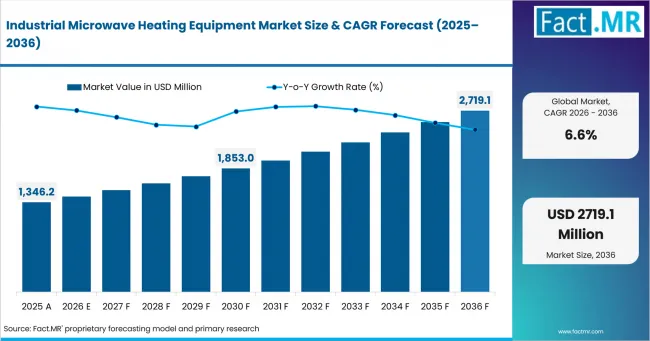
Industrial Microwave Heating Equipment Market Market Value Analysis | Source: Fact.MR
What are the defining numbers behind Industrial Microwave Heating Equipment Market growth?
USD 1,284.1 million absolute opportunity by 2036, led by demand for continuous microwave heating equipment and food processing applications.
- Demand Drivers in the Market
- Food processors need rapid tempering and moisture control because frozen blocks and packaged foods lose throughput under long conductive heating steps.
- Chemical process engineers need controllable volumetric energy supported by reaction or drying stages that respond poorly to slow wall-to-core heat transfer.
- Paper and wood processors need moisture removal with lower thermal exposure owing to quality losses that appear under uneven long-duration heating.
- Laboratory and pharmaceutical teams need scalable microwave platforms shaped by pilot-to-production transfer requirements and strict process repeatability during formulation or drying work.
- Key Segments Analyzed
- By Equipment: Magnetron Systems are expected to hold 60% share in 2026 supported by established tube availability and high power density across industrial generator platforms.
- By Type: Continuous Microwave Heating Equipment is projected to account for 58% share in 2026 owing to line integration and steady material flow across production heating steps.
- By Application: Food Processing is anticipated to capture 31% share in 2026 driven by tempering and drying duties that benefit from shorter heating response.
- By Power / Frequency Architecture: 915 MHz High-power Systems are estimated to represent 34% share in 2026 attributable to penetration depth and high-throughput industrial loads.
- By System Configuration: Integrated Processing Lines are forecast to capture 44% share in 2026 shaped by engineering teams specifying material handling and microwave delivery as one production package.
- Analyst Opinion at Fact.MR
- Shambhu Nath Jha is a Senior Analyst at Fact.MR and states: “Industrial microwave projects are won or lost during process qualification because power generation alone does not prove plant performance. Adoption is expected to favor providers that support material trials and field tuning before full production acceptance. Suppliers should combine generator choice with applicator engineering and reliable service access for long qualification cycles.”
- Strategic Implications
- Plant engineering teams should test material load and residence time before approving industrial generator power or applicator geometry for production use.
- Food processors should validate tempering uniformity under production throughput before moving a laboratory recipe onto a continuous conveyor line.
- Chemical producers should define dielectric behavior across moisture and temperature ranges before locking frequency architecture for a production unit.
- Equipment integrators should document shielding performance and service access before commissioning microwave systems inside existing plant layouts and utilities.
The industrial microwave suppliers are shifting closer to customer process development. For instance, in September 2025, MUEGGE Group created a Director Application Scouting & Access role during a strategic business-development realignment. The role was assigned to identify and validate new business opportunities across a portfolio that includes industrial microwave components and systems. The move fits a market where application discovery and process validation often come before pilot equipment or production-line orders.
India is expected to record a 7.3% CAGR through 2036 due to machinery investment and expanding food processing capacity. Saudi Arabia is anticipated to post a 7.0% CAGR through 2036 supported by industrial diversification and new process plant commissioning. China is projected to advance at a 6.8% CAGR through 2036 attributable to high-output manufacturing and chemicals production. Brazil is estimated to post a 6.4% CAGR through 2036 shaped by food processing and industrial modernization programs. Germany is forecast to record a 5.9% CAGR through 2036 reinforced by process efficiency investment and established engineering depth.
How does the Industrial Microwave Heating Equipment Market break down by segment?
Magnetron Systems lead at 60%, Continuous Microwave Heating Equipment leads at 58%.
Which equipment architecture dominates?
Magnetron Systems hold 60% share in 2026.
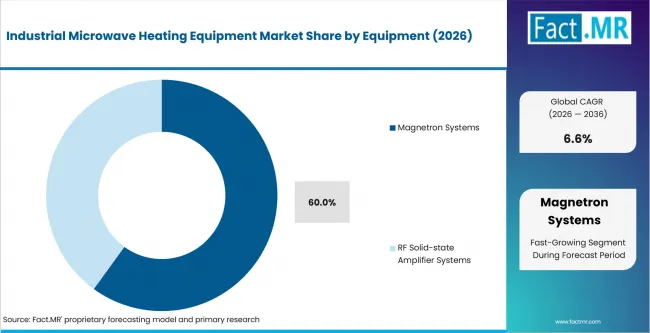
Industrial Microwave Heating Equipment Market Analysis By Equipment | Source: Fact.MR
Magnetron Systems are expected to hold 60% share in 2026 supported by proven high-power output across established industrial frequencies. RF Solid-state Amplifier Systems serve projects that value electronic control and modular power scaling during recipe development or tighter closed-loop processing. CoberMuegge supplies industrial microwave generator platforms while Richardson Electronics supports continuous-wave magnetron ranges suited to industrial heating equipment. Selection remains tied to required power density and service economics instead of one architecture fitting every process.
What leads the Type segment?
Continuous Microwave Heating Equipment holds 58% share in 2026.
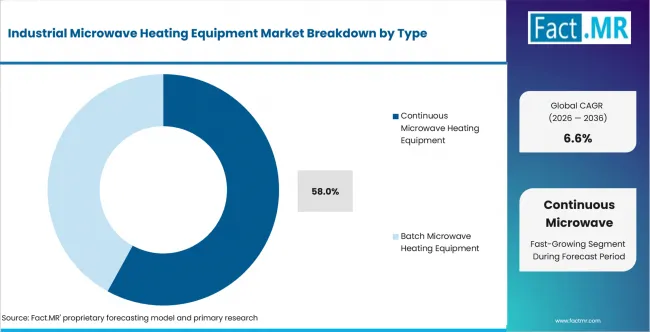
Industrial Microwave Heating Equipment Market Analysis By Type | Source: Fact.MR
Continuous Microwave Heating Equipment is projected to account for 58% share in 2026 owing to production lines that need steady material flow and repeatable residence time. Batch Microwave Heating Equipment remains relevant for specialty chemical lots and laboratory-scale work where product changeovers affect operating schedules. Industrial Microwave Systems supplies commercial processing platforms alongside smaller laboratory and research equipment for process development. Continuous installations gain value when conveyors and process controls are qualified as part of the plant line.
How does Application shape equipment demand?
Food Processing holds 31% share in 2026.
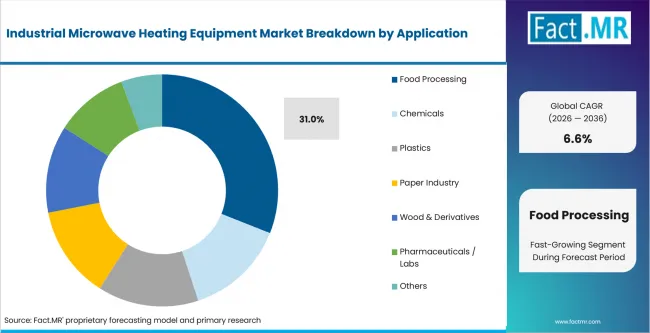
Industrial Microwave Heating Equipment Market Analysis By Application | Source: Fact.MR
Food Processing is anticipated to represent 31% share in 2026 driven by tempering and drying duties where faster heating supports throughput planning. Chemical processing follows for reaction support or drying steps that need direct energy deposition inside the material. Plastics and paper applications depend on resin behavior or moisture profiles while engineers tune applicators around product geometry. In May 2026, Eurostat reported that the combined food beverage and tobacco group represented 13.8% of EU industrial energy use during 2024. That energy base keeps process efficiency central to equipment evaluation across large food production sites.
What supports 915 MHz High-power Systems within frequency architecture?
915 MHz High-power Systems hold 34% share in 2026.
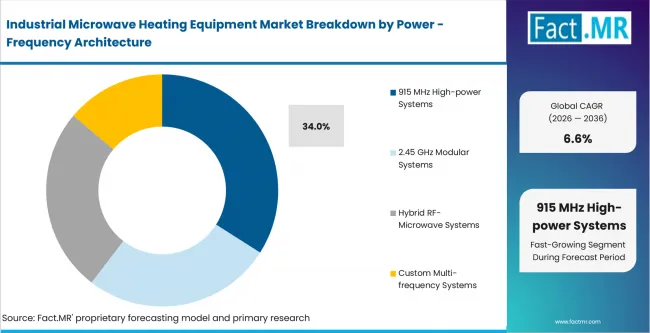
Industrial Microwave Heating Equipment Market Analysis By Power Frequency Architecture | Source: Fact.MR
915 MHz High-power Systems are estimated to capture 34% share in 2026 attributable to deeper energy penetration and high-throughput processing of thicker material loads. 2.45 GHz Modular Systems support lower-power units and product development settings where compact generator packages are easier to deploy. Hybrid RF-Microwave Systems serve processes that combine field behavior across stages while Custom Multi-frequency Systems remain specialized project work. Microwave Techniques supplies commercial processing equipment alongside smaller laboratory and research platforms used during process development. Frequency choice ultimately follows load geometry and dielectric behavior after process trials establish the usable operating window.
How does System Configuration shape procurement?
Integrated Processing Lines hold 44% share in 2026.
Integrated Processing Lines are forecast to hold 44% share in 2026 shaped by plant teams seeking one qualified package around generators and applicators. Standalone Units remain suitable for localized heating steps where existing production routing already provides material handling and operator access. Retrofit Modules address brownfield lines where floor space limits new layouts while Laboratory and Pilot Systems support recipe development before production commitment. In November 2025 UNIDO reported that global manufacturing output expanded by 2.9% during 2024 across its industrial statistics framework. Continued factory investment favors systems that fit existing production flow and prove measurable process gains during qualification.
What is accelerating Industrial Microwave Heating Equipment Market adoption, and what is holding it back?
Cycle-time reduction drives it, process qualification cost restrains it.
Drivers Impact Analysis
| DRIVER | (~) % IMPACT ON CAGR | GEOGRAPHIC RELEVANCE | IMPACT TIMELINE |
|---|---|---|---|
| Shorter cycle time from volumetric heating | +0.9% | Global processing plants | Medium term (2-4 years) |
| Electrification of industrial process heat | +0.7% | Europe and Asia Pacific | Medium term (2-4 years) |
| Food tempering and drying throughput needs | +0.5% | Asia Pacific and North America | Medium term (2-4 years) |
| Continuous production-line integration | +0.4% | China, India and Germany | Long term (>= 4 years) |
| Moisture-control quality gains | +0.3% | Paper and wood processing regions | Long term (>= 4 years) |
Source: Fact.MR analysis. Updated Jul 7, 2026
- Cycle-time compression: Conventional conduction heating moves energy from the surface inward and often extends residence time for thick product loads. In November 2025, the International Energy Agency reported that industry used nearly 40% of global final energy during 2024. Microwave projects are expected to receive closer review where faster heating lowers queue time without requiring additional floor space.
- Process-heat electrification: Industrial facilities are examining electric heat options where process temperature and product geometry fit direct electricity use. In October 2025, the International Energy Agency projected industrial heat demand to increase 14% between 2025 and 2030. Microwave equipment is projected to gain attention in processes that need targeted energy delivery and controllable start-stop operation.
- Food throughput pressure: Frozen tempering and drying lines need repeatable heat profiles when volume increases create bottlenecks before cutting or mixing steps. In January 2026, China’s National Bureau of Statistics reported 5.3% growth in food manufacturing value added during 2025. Equipment demand is anticipated to expand where processors validate higher throughput without sacrificing moisture uniformity.
- Continuous line integration: Production managers increasingly evaluate microwave equipment as part of a complete flow path instead of a standalone energy source. In January 2026, China’s National Bureau of Statistics reported 4.3% growth in special-purpose machinery manufacturing during 2025. Integration work is estimated to favor providers that coordinate applicators and control logic with upstream or downstream handling equipment.
- Moisture-control quality: Paper and wood processors lose value when uneven heating causes local overdrying or leaves moisture gradients inside thick materials. In May 2026, Eurostat reported that paper pulp and printing activities represented 12.1% of EU industrial energy use during 2024. Adoption is forecast to remain selective where microwave tuning produces measurable quality gains against established drying systems.
Opportunity Impact Analysis
| OPPORTUNITY | (~) % IMPACT ON CAGR | GEOGRAPHIC RELEVANCE | IMPACT TIMELINE |
|---|---|---|---|
| Solid-state generator control | +0.5% | Europe, Japan and North America | Medium term (2-4 years) |
| Brownfield retrofit modules | +0.4% | Europe and North America | Medium term (2-4 years) |
| Hybrid microwave process packages | +0.3% | Chemicals hubs in Asia Pacific | Long term (>= 4 years) |
| Pilot-to-production scale-up services | +0.3% | Global food and pharmaceutical sites | Long term (>= 4 years) |
Source: Fact.MR analysis. Updated Jul 7, 2026
- Solid-state control: Electronically controlled RF power provides modular output adjustment and recipe-based power management for selected industrial loads. In May 2026, Eurostat reported that electricity 33.3% of EU industrial final energy consumption during 2024. Opportunity is expected to expand where process teams value controllability enough to justify higher equipment cost or architecture change.
- Brownfield retrofit modules: Existing plants often need microwave heating inserted into a constrained line without rebuilding every upstream or downstream machine. Eurostat reported in May 2026 that EU industry used 8 835 petajoules of final energy during 2024. Retrofit opportunity is projected to favor compact applicators and service models that reduce installation disruption across operating facilities.
- Hybrid process packages: Chemical plants often combine microwave energy with mixing or drying and conventional heat during different stages of one process. In May 2026, Eurostat reported that chemicals and petrochemicals represented 22.9% of EU industrial energy consumption during 2024. Hybrid packages are anticipated to progress where pilot evidence confirms better residence-time control under the customer feed chemistry.
- Pilot-to-production scale-up: Laboratory microwave results do not transfer automatically when material depth and flow patterns change during industrial scale-up. In January 2026, China’s National Bureau of Statistics reported 2.4% growth in medicine manufacturing value added during 2025. Service opportunity is estimated to increase where providers offer pilot equipment and application trials before commercial system design.
Restraints Impact Analysis
| RESTRAINT | (~) % IMPACT ON CAGR | GEOGRAPHIC RELEVANCE | IMPACT TIMELINE |
|---|---|---|---|
| Process qualification and shielding validation | -0.6% | Global industrial sites | Short term (<= 2 years) |
| Magnetron replacement and lifecycle planning | -0.4% | Global installed base | Medium term (2-4 years) |
| Material-specific dielectric variability | -0.3% | Food, chemicals and materials processing | Medium term (2-4 years) |
| Integration downtime and engineering cost | -0.2% | Brownfield plants worldwide | Short term (<= 2 years) |
Source: Fact.MR analysis. Updated Jul 7, 2026
- Process qualification cost: Industrial microwave projects require load tests and shielding review before plant acceptance proceeds under the project acceptance plan. Product recipes also need validation across material temperature and moisture conditions that change absorption behavior. Near-term adoption is expected to slow when process owners lack pilot access or clear acceptance criteria before capital approval.
- Lifecycle planning: Magnetron systems need replacement planning around tube availability and power-supply service support across long equipment lives. A generator purchase becomes harder to justify when the plant cannot map critical spares and local field support. Procurement is projected to favor platforms with documented consumable routes and practical maintenance access across long operating lives.
- Dielectric variability: Microwave absorption changes as moisture and temperature shift during processing which complicates one-time recipe transfer across product lots. Uneven load geometry also creates field behavior that laboratory tests rarely reveal under full commercial production conditions. Adoption is anticipated to remain selective until trials establish a repeatable operating window for the actual product.
- Integration downtime: Brownfield projects need electrical work and shielding installation without creating long production stoppages around existing line schedules. Engineering cost rises when conveyors or utilities need substantial modification before commissioning inside an operating brownfield production line. Retrofit use is estimated to improve where modular equipment and planned installation windows reduce plant disruption.
Which countries are scaling Industrial Microwave Heating Equipment Market fastest?
India 7.3%, Saudi Arabia 7.0%, China 6.8%, Brazil 6.4%, Germany 5.9% through 2036.
Industrial Microwave Heating Equipment is segmented into Asia Pacific, North America, Europe, Central & South America, and the Middle East & Africa.
| COUNTRY | CAGR |
|---|---|
| India | 7.3% |
| Saudi Arabia | 7.0% |
| China | 6.8% |
| Brazil | 6.4% |
| Germany | 5.9% |
Source: Fact.MR analysis. Updated Jul 7, 2026
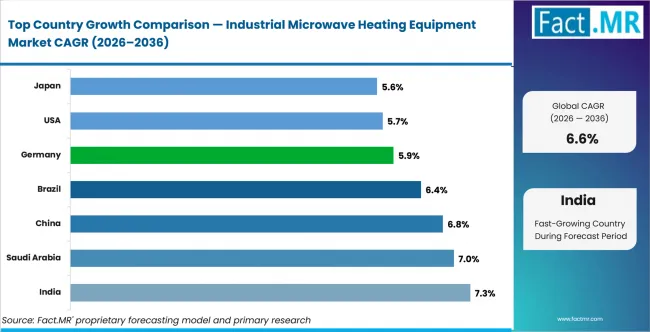
Industrial Microwave Heating Equipment Market Cagr Analysis By Country | Source: Fact.MR
What is powering India’s growth through 2036?
7.3% CAGR through 2036, driven by machinery investment and expansion across food processing capacity.
India’s industrial base is creating a wider application pool for microwave heating across machinery-intensive production and food processing facilities. In June 2025, India’s Ministry of Statistics and Programme Implementation reported 11.8% year-on-year growth in machinery and equipment manufacturing during May 2025. The market is expected to expand at a 7.3% CAGR through 2036 as manufacturers modernize plants and increase processing capacity. Suppliers can strengthen adoption by combining application trials with local technical support that lowers qualification risk for production teams.
How is Saudi Arabia scaling industrial microwave heating demand?
7.0% CAGR through 2036, supported by industrial diversification and investment across new processing facilities.
Industrial diversification is widening the addressable base for microwave heating systems across Saudi Arabia’s expanding manufacturing and processing sectors. In August 2025, the General Authority for Statistics reported that the Industrial Production Index increased 7.9% year on year during June 2025. Demand is anticipated to advance at a 7.0% CAGR through 2036 as new facilities require efficient thermal processing technologies. Suppliers with regional service capabilities can gain stronger project access by supporting commissioning and maintenance near major production clusters.
What supports the China outlook?
6.8% CAGR through 2036, attributable to manufacturing scale and continued investment across chemical processing operations.
China’s extensive manufacturing network supports industrial microwave heating adoption across chemical processing and other energy-intensive production applications. The National Bureau of Statistics reported in January 2026 that industrial value added increased 5.9% during 2025. Market demand is projected to rise at a 6.8% CAGR through 2036 as producers replace aging equipment and expand processing capacity. Vendors can improve conversion rates by shortening application trials and providing technical teams near major industrial clusters.
What underpins Brazil’s growth?
6.4% CAGR through 2036, shaped by food processing investment and gradual modernization across industrial facilities.
Brazil offers targeted opportunities for microwave heating systems as food processors modernize thermal operations without replacing complete production lines. In February 2026, the Brazilian Institute of Geography and Statistics reported that industrial production increased 0.6% during 2025. Equipment demand is estimated to grow at a 6.4% CAGR through 2036 as processors pursue selective upgrades across established facilities.
How is Germany developing industrial microwave heating demand?
5.9% CAGR through 2036, reinforced by process efficiency investment and specialized equipment engineering capabilities.
German manufacturers are evaluating industrial microwave systems through lifecycle economics and their ability to improve existing thermal processing operations. In June 2026, the Federal Statistical Office reported that industrial producer prices increased 2.2% year on year in May 2026. The market is forecast to expand at a 5.9% CAGR through 2036 as manufacturers invest in efficiency improvements and specialized process equipment. Purchasing decisions is likely to continue to emphasize service availability and maintenance planning for installations across brownfield production lines.
Who leads the Industrial Microwave Heating Equipment Market?
CoberMuegge LLC and Microwave Techniques cover industrial generator and system integration needs, while Richardson Electronics and Hitachi Power Solutions strengthen magnetron and power-source access.
CoberMuegge LLC competes through industrial microwave generators and waveguide components while supporting application engineering for production heating projects. Microwave Techniques brings Industrial Microwave Systems into a broader engineering portfolio that covers cooking or tempering and drying across continuous equipment. Richardson Electronics supports generator and continuous-wave magnetron sourcing for production heating equipment and replacement programs. These firms compete around field tuning and replacement access because heating performance depends on the complete power-delivery chain.
Hitachi Power Solutions supplies industrial magnetrons for heating equipment while Teledyne e2v maintains magnetron coverage for industrial applications. Toshiba Hokuto Electronics also provides continuous-wave magnetrons for dielectric heating equipment and plasma-processing uses across industrial equipment portfolios. Stellant Systems carries L3Harris Electron Devices heritage into current magnetron coverage for industrial heating and related high-power applications. Competition through 2036 is expected to favor providers that combine process trials with dependable tube supply and field service.
Which companies are the key providers?
CoberMuegge LLC and Microwave Techniques are key providers. Richardson Electronics and Hitachi Power Solutions are also profiled. Teledyne e2v, Toshiba Hokuto Electronics and Stellant Systems complete the company set.
- CoberMuegge LLC
- Microwave Techniques
- Richardson Electronics
- Hitachi Power Solutions Co. Ltd.
- Teledyne e2v Limited
- Toshiba Hokuto Electronics Corporation
- Stellant Systems
Bibliography
- Brazilian Institute of Geography and Statistics. (2026, February 3). National industry retreats 1.2% in December, closes 2025 rising 0.6%. IBGE News Agency.
- CoberMuegge LLC. (2026). Industrial microwave generators and systems. CoberMuegge LLC.
- Eurostat. (2026, May 29). Final energy consumption in industry - detailed statistics. European Commission.
- Federal Statistical Office of Germany. (2026, June 19). Producer prices in May 2026: +2.2% on May 2025. Destatis.
- General Authority for Statistics. (2025, August 10). GASTAT IPI increases by 7.9% in June 2025. General Authority for Statistics.
- Hitachi Power Solutions Co., Ltd. (2026). Microwave heating systems. Hitachi Power Solutions Co., Ltd.
- International Energy Agency. (2025, October 7). Renewable heat. Renewables 2025. International Energy Agency.
- International Energy Agency. (2025, November 20). Industry. Energy Efficiency 2025. International Energy Agency.
- Microwave Techniques. (2026). Industrial microwave systems and components. Microwave Techniques.
- Ministry of Statistics and Programme Implementation. (2025, June 30). Quick estimate of Index of Industrial Production and use-based index for the month of May 2025. Government of India.
- MUEGGE Group. (2025, September 4). MUEGGE prepares for the future: Executive transition and strategic realignment. MUEGGE Group.
- National Bureau of Statistics of China. (2026, January 20). Industrial production operation in December 2025. National Bureau of Statistics of China.
- Richardson Electronics, Ltd. (2026). Continuous-wave magnetrons. Richardson Electronics, Ltd.
- Stellant Systems. (2026). Magnetrons and microwave power products. Stellant Systems.
- Teledyne e2v. (2026). RF power and microwave products. Teledyne Technologies Incorporated.
- Toshiba Hokuto Electronics Corporation. (2026). Industrial magnetrons and microwave products. Toshiba Hokuto Electronics Corporation.
- United Nations Industrial Development Organization. (2025, November 21). UNIDO’s 2025 Yearbook charts the future of industrial statistics. United Nations Industrial Development Organization.
This Report Addresses
- The report provides strategic intelligence on Industrial Microwave Heating Equipment across Equipment and Type choices that shape production-line qualification programs.
- Segment analysis identifies Magnetron Systems and Continuous Microwave Heating Equipment as the leading segments within the 2026 structure.
- Regional outlook evaluates India and Saudi Arabia alongside China while Brazil and Germany complete the country growth comparison through 2036.
- Competitive analysis profiles CoberMuegge and Microwave Techniques alongside Richardson Electronics or Hitachi Power Solutions while Teledyne e2v and two additional active magnetron providers complete the company review.
- Equipment assessment covers Magnetron Systems and RF Solid-state Amplifier Systems across industrial processes that require different control and lifecycle logic.
- Application assessment covers Food Processing and Chemicals alongside Plastics or Paper Industry while wood products and pharmaceutical or laboratory work remain included where microwave heating performs the purchased process function.
What does the Industrial Microwave Heating Equipment Market cover?
Magnetron Systems, RF Solid-state Amplifier Systems, Continuous Equipment and Batch Equipment used for industrial heating and material processing.
The Industrial Microwave Heating Equipment Market covers microwave generators and process equipment designed to deliver controlled electromagnetic energy for industrial material heating. Coverage includes continuous and batch architectures used for tempering or drying and reaction support across qualified production environments.
The market differs from consumer microwave appliances because commercial value comes from industrial power delivery and applicator engineering alongside process control. Conventional thermal ovens and radio-frequency dielectric heaters outside the defined microwave architecture remain outside the boundary unless sold as part of a hybrid microwave process package.
What is included in the scope?
Industrial microwave heating systems used on production lines and pilot equipment across thermal processing applications.
Coverage includes Magnetron Systems and RF Solid-state Amplifier Systems used in continuous or batch microwave heating equipment. The equipment scope spans food processing and chemical production while plastics or paper and wood products remain included where microwave energy performs the purchased heating function. Pharmaceutical and laboratory units are included when they support material heating or drying instead of analytical microwave sensing. Product mapping also reviews microwave magnetron systems where tube supply and replacement economics shape generator selection decisions. Adjacent RF power amplifier technologies inform the solid-state architecture assessment for electronically controlled power delivery. Related industrial dryer equipment provides context for moisture-removal applications without widening the boundary to every conventional dryer.
What is excluded from the scope?
Consumer microwave ovens and non-microwave thermal equipment are outside the scope.
The scope excludes household microwave ovens and conventional convection or infrared equipment sold without an industrial microwave heating function. Standalone microwave plasma sources are also excluded when the purchased function is plasma generation instead of controlled material heating. Analytical microwave sensors and communication transmitters remain outside the boundary because they do not deliver industrial thermal processing.
How was the analysis built?
100+ sources, 35+ company portfolios, 20+ countries, 15+ interviews.
- Primary Research
- Primary research includes interviews with industrial microwave equipment manufacturers, system integrators, food processing companies and process engineers. It also includes input from plant managers, maintenance specialists, industrial automation providers and distributors involved in equipment selection, installation and operational optimization.
- Desk Research
- Desk research reviews official industrial production statistics, manufacturing reports, energy-efficiency initiatives, industrial heating technology publications and supplier product catalogs. Company product portfolios, technical documentation and industrial electrification developments are also assessed to evaluate market trends and competitive positioning.
- Market-Sizing and Forecasting
- Forecasting uses industrial production activity, equipment replacement cycles, process-heating modernization trends, microwave system adoption rates and average equipment pricing across key applications. Analysis also considers food processing expansion, materials-processing requirements, industrial automation investments and energy-efficiency objectives influencing equipment demand.
- Data Validation and Update Cycle
- Forecasts are validated through manufacturer checks and industry interviews that test assumptions on equipment demand, application adoption and procurement trends. Product portfolio mapping, end-use industry assessment and distributor feedback help confirm market direction, while ongoing reviews of technology developments and industrial investment activity support forecast updates.
Segmentation
What is the report’s scope and coverage?
| Attribute | Details |
|---|---|
| Quantitative Units | USD Million in 2026 to USD Million by 2036/td> |
| Market Definition | Microwave generators and process equipment that deliver controlled electromagnetic energy for industrial heating; tempering; drying and process-reaction applications |
| Equipment | Magnetron Systems; RF Solid-state Amplifier Systems |
| Type | Continuous Microwave Heating Equipment; Batch Microwave Heating Equipment |
| Application | Food Processing; Chemical Processing; Plastics; Paper Industry; Wood Products; Pharmaceutical and Laboratory |
| Power / Frequency Architecture | 915 MHz High-power Systems; 2.45 GHz Modular Systems; Hybrid RF-Microwave Systems; Custom Multi-frequency Systems |
| System Configuration | Integrated Processing Lines; Standalone Units; Retrofit Modules; Laboratory and Pilot Systems |
| Regions Covered | North America; Europe; Asia Pacific; Latin America; Middle East and Africa |
| Countries Covered | India; Saudi Arabia; China; Brazil; Germany |
| Key Companies Profiled | CoberMuegge LLC; Microwave Techniques; Richardson Electronics; Hitachi Power Solutions Co. Ltd.; Teledyne e2v Limited; Toshiba Hokuto Electronics Corporation; Stellant Systems |
| Forecast Period | 2026 to 2036 |
| Approach | Hybrid top-down and bottom-up approach using industrial production activity; equipment replacement cycles; process-heating modernization; microwave adoption rates; equipment pricing; application qualification and provider validation |
Source: Fact.MR analysis. Updated Jul 7, 2026
How is the market segmented?
-
By Equipment
- Magnetron Systems
- RF Solid-state Amplifier Systems
-
By Type
- Continuous Microwave Heating Equipment
- Batch Microwave Heating Equipment
-
By Application
- Food Processing
- Chemical Processing
- Plastics Processing
- Paper Processing
- Wood Products Processing
- Pharmaceutical and Laboratory Processing
- Other Industrial Applications
-
By Power / Frequency Architecture
- 915 MHz High-power Systems
- 2.45 GHz Modular Systems
- Hybrid RF-Microwave Systems
- Custom Multi-frequency Systems
-
By System Configuration
- Integrated Processing Lines
- Standalone Units
- Retrofit Modules
- Laboratory and Pilot Systems
-
Region
- North America
- United States
- Canada
- Europe
- Germany
- United Kingdom
- France
- Italy
- Netherlands
- Asia Pacific
- India
- China
- Japan
- South Korea
- Australia
- Central & South America
- Brazil
- Mexico
- Argentina
- Chile
- Middle East & Africa
- Saudi Arabia
- UAE
- South Africa
- North America
Frequently Asked Questions
Which Equipment leads the Industrial Microwave Heating Equipment Market?
Which Type leads the Industrial Microwave Heating Equipment Market?
Which Application leads the Industrial Microwave Heating Equipment Market?
Which Power / Frequency Architecture leads the Industrial Microwave Heating Equipment Market?
Which System Configuration leads the Industrial Microwave Heating Equipment Market?
Which country records the highest CAGR in the Industrial Microwave Heating Equipment Market?
How does Saudi Arabia perform in the Industrial Microwave Heating Equipment Market?
How does China perform in the Industrial Microwave Heating Equipment Market?
How does Brazil perform in the Industrial Microwave Heating Equipment Market?
How does Germany perform in the Industrial Microwave Heating Equipment Market?
What is the primary driver in the Industrial Microwave Heating Equipment Market?
What is the main restraint in the Industrial Microwave Heating Equipment Market?
Why are Magnetron Systems important?
Why do plant engineering teams dominate demand?
Who worked on this report


Preview the report firsthand - request a free sample
Free SampleGet the brochure for pricing and purchase details
Download PDF