- Base Value(2025): 4.7 Bn
- Estimated Value(2026): 5.0 Bn
- Forecast Value (2036): 8.6 Bn
- CAGR (2026 - 2036): 5.7%
Citrus Extract Market Analysis and Forecast by Fact.MR
The global market for citrus extract is estimated to be around USD 5.0 billion in 2026 and has been forecast to expand at a CAGR of 5.7% to end up at USD 8.6 billion by 2036. The Citrus Extract segment is led by Orange Extract, which is anticipated to account for 45.0% of the product segment in 2026, while Food And Beverage is expected to remain the leading application with around 60.0% share. The market was valued at USD 4.7 billion in 2025 and is poised for steady growth driven by evolving industry dynamics and regional demand patterns.
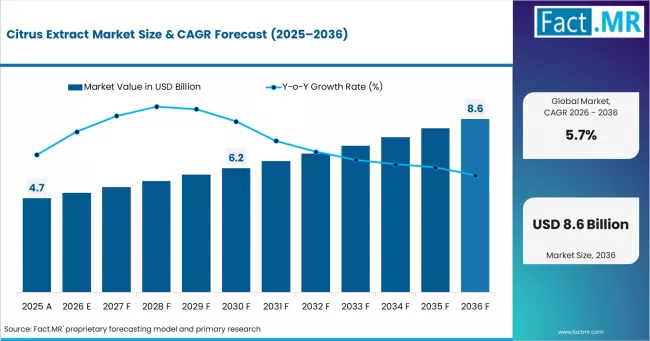
Citrus Extract Market Value Analysis | Source: Fact.MR
Summary of Citrus Extract Market
- Market Snapshot
- In 2025, the global Citrus Extract Market was valued at approximately USD 4.7 billion.
- The market is estimated to reach USD 5.0 billion in 2026 and is projected to attain USD 8.6 billion by 2036
- The citrus extract market is likely to expand at a CAGR of 5.7% during the forecast period.
- The market is anticipated to create an absolute dollar opportunity of USD 3.6 billion between 2026 and 2036.
- Orange Extract account for 45.0% of market share in 2026.
- China (6.8%) and India (6.4%) are the key growth markets during the forecast period
- Demand and Growth Drivers
- Rising consumer preference for natural flavoring and fragrance ingredients is shifting procurement away from synthetic alternatives toward citrus-derived extracts across food, beverage, and personal care applications.
- Expansion of functional food and dietary supplement categories is creating new demand channels for citrus extracts with bioactive properties including antioxidants and essential oils.
- Growth in cosmetics and personal care formulations using plant-based ingredients is increasing adoption of citrus extracts for fragrance, skin care, and cleaning product applications.
- Product and Segment View
- Orange extract accounts for 45% of the product segment in 2026, led by its broad application base across beverages, confectionery, dairy, and personal care products.
- Food and beverage applications represent 60% of the application segment in 2026, reflecting the dominant role of citrus flavoring in processed food and drink manufacturing.
- Direct sales hold 60% of the distribution channel in 2026, with ingredient manufacturers maintaining supply contracts directly with food and cosmetic producers.
- Geography and Competitive Outlook
- China leads country-level growth at 6.8% CAGR, supported by expanding food processing capacity and growing demand for natural flavoring agents.
- Europe maintains steady demand anchored by clean-label food trends and regulatory preference for natural ingredients in personal care.
- Givaudan SA holds 15% market share, with competition shaped by flavor and fragrance houses, specialty ingredient suppliers, and regional extractors.
- Analyst Opinion
- Demand growth in the citrus extract market is shifting from commodity citrus oil supply toward standardized, application-specific extract formulations that command higher margins. Clean-label regulation in Europe and North America is structurally favoring natural citrus extracts over synthetic flavor alternatives, creating sustained procurement tailwinds. Supply chain concentration in citrus-growing regions creates procurement risk, particularly during crop shortfall years affecting orange and lemon yields. Companies investing in extraction technology and bioactive compound isolation are positioned to capture premium pricing in nutraceutical and cosmetic channels.
Why is the Citrus Extract Market Growing?
- Clean-label and natural ingredient mandates in food processing are redirecting formulation budgets toward citrus-derived alternatives across beverages, confectionery, and dairy.
- Functional food and nutraceutical expansion is creating demand for citrus extracts with documented bioactive properties, including hesperidin and limonene compounds.
- Personal care industry growth in Asia Pacific and Latin America is absorbing larger volumes of citrus essential oils and extracts for fragrance and skin care formulations.
The structural shift toward natural ingredients is not cyclical. Regulatory frameworks in Europe, North America, and parts of Asia Pacific are tightening restrictions on synthetic flavoring and fragrance compounds, creating a sustained pull toward plant-derived alternatives. Citrus extracts benefit directly from this shift due to their broad application compatibility and established safety profiles.
Extraction technology is advancing the category from bulk essential oil supply toward fractionated, standardized extracts with specific bioactive concentrations. This enables citrus extract suppliers to serve nutraceutical and pharmaceutical applications that require consistent compound potency, opening higher-margin product tiers beyond commodity flavoring.
Segment-wise Analysis of the Citrus Extract Market
- Orange extract leads the product segment at 45% share in 2026, anchored by its versatility across food, beverage, cosmetic, and supplement applications.
- Food and beverage applications account for 60% in 2026, reflecting the dominant role of citrus flavoring in processed food manufacturing.
- Food manufacturers hold 55% of the end-use segment in 2026, with direct procurement contracts from flavor houses and extract suppliers.
The citrus extract market is segmented by product type (orange, lemon, lime, grapefruit extract), application (food and beverage, dietary supplements, cosmetics and personal care, pharmaceuticals), end use (food manufacturers, nutraceutical companies, cosmetic manufacturers, pharmaceutical companies), distribution channel (direct sales, distributors, online retail), and form (liquid, powder, essential oil).
Which Product Segment Leads the Citrus Extract Market?
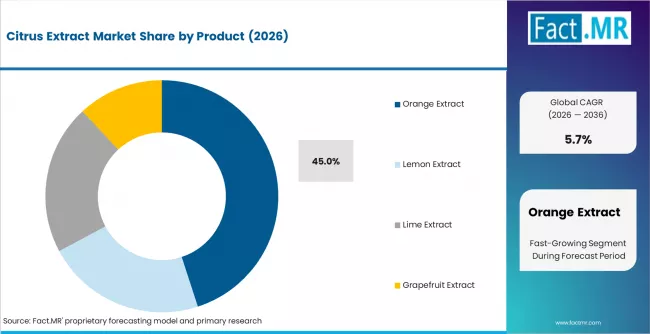
Citrus Extract Market Analysis By Product | Source: Fact.MR
Orange extract holds 45% of the product segment in 2026, supported by the scale of global orange production and the established role of orange flavoring across beverages, confectionery, dairy, and bakery products. The segment benefits from consistent raw material availability, broad consumer familiarity, and well-developed extraction infrastructure in major citrus-producing regions.
Which Application Drives the Largest Demand?
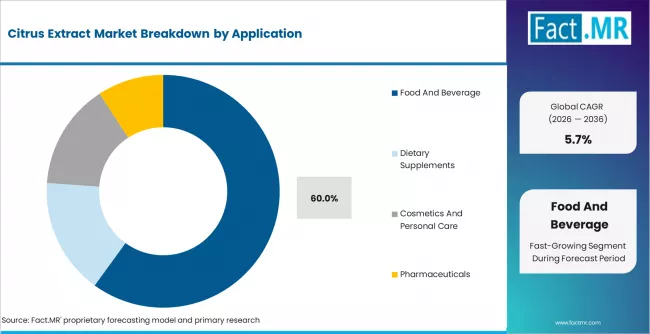
Citrus Extract Market Analysis By Application | Source: Fact.MR
Food and beverage accounts for 60% of the application segment in 2026. Citrus extracts serve as primary flavoring agents in soft drinks, confectionery, dairy products, and bakery items. The shift toward natural flavor labeling is reinforcing demand from food processors replacing synthetic alternatives with citrus-derived options.
Key Growth Drivers, Constraints, and Market Scope
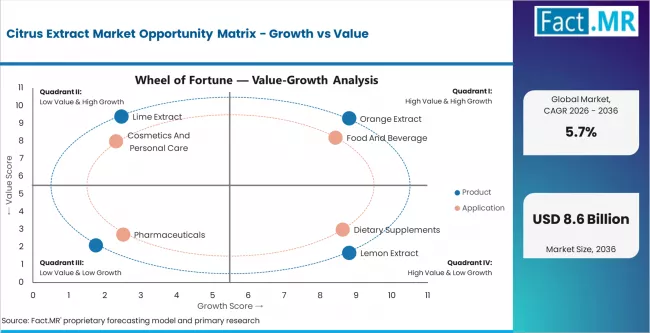
Citrus Extract Market Opportunity Matrix Growth Vs Value | Source: Fact.MR
- Natural ingredient preference and clean-label regulation are structurally favoring citrus extracts over synthetic alternatives.
- Functional ingredient demand in nutraceuticals is creating higher-margin application channels for bioactive citrus compounds.
- Citrus crop yield variability creates supply-side pricing volatility that affects extract manufacturer margins.
The citrus extract market is shaped by the convergence of natural ingredient demand, regulatory frameworks favoring plant-derived compounds, and expanding application coverage across food, personal care, and health product categories.
Growth Drivers
Demand is shaped by clean-label trends in food processing that favor natural citrus flavoring over synthetic compounds. Nutraceutical industry growth is absorbing citrus extracts with standardized bioactive concentrations. Personal care formulation trends in Asia Pacific are expanding the addressable market for citrus essential oils and fragrance extracts.
Constraints
Citrus crop yield fluctuations due to disease pressure, climate variability, and regional production concentration create supply-side pricing volatility. Regulatory complexity across markets increases compliance costs for extract suppliers serving multiple geographies. Competition from other natural flavor sources limits citrus extract pricing power in commodity segments.
Opportunities
Standardized bioactive citrus extracts for pharmaceutical and nutraceutical applications represent a high-margin growth channel. E-commerce distribution of consumer-facing citrus extract products is creating direct-to-consumer pathways. Cold-pressed and supercritical extraction technologies are enabling premium product differentiation.
Regional Outlook Across Key Markets
.webp "Top Country Growth Comparison Citrus Extract Market Cagr (2026 2036)")
Top Country Growth Comparison Citrus Extract Market Cagr (2026 2036) | Source: Fact.MR
- China leads at 6.8% CAGR, supported by food processing expansion and growing demand for natural flavoring agents.
- India follows at 6.4% CAGR, driven by beverage industry growth and increasing nutraceutical adoption.
- South Korea records 6.2% CAGR, reflecting cosmetic industry demand for citrus-derived ingredients.
- Brazil grows at 6.1% CAGR, benefiting from domestic citrus production scale and extract processing capacity.
Country CAGR Table
| Country | CAGR (%) |
|---|---|
| China | 6.8% |
| India | 6.4% |
| South Korea | 6.2% |
| Brazil | 6.1% |
| USA | 5.5% |
| Germany | 5.2% |
| UK | 4.9% |
Source: Fact.MR analysis. Updated Apr 24, 2026
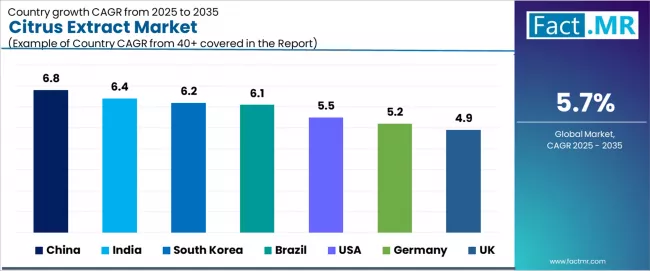
Citrus Extract Market Cagr Analysis By Country | Source: Fact.MR
Regional demand reflects variations in food processing scale, clean-label regulatory maturity, cosmetic industry development, and citrus crop production infrastructure. Asia Pacific is the fastest-growing region driven by food and personal care industry expansion.
Market Outlook for Citrus Extract in China
The China citrus extract market is projected to grow at a CAGR of 6.8% through 2036. Demand is driven by rapid food processing industry expansion, growing consumer preference for natural flavoring, and increasing domestic citrus production supporting local extraction capacity.
- Food processing expansion is creating large-volume demand for natural citrus flavoring agents.
- Domestic citrus production supports local extraction and reduces import dependency.
- Personal care industry growth is broadening the application base for citrus essential oils.
Citrus Extract Demand Trends in India
The India citrus extract market is projected to grow at a CAGR of 6.4% through 2036. Growth reflects expanding beverage industry demand, increasing nutraceutical adoption, and growing food processing capacity in urban industrial clusters.
- Beverage industry growth is absorbing larger volumes of natural citrus flavoring inputs.
- Nutraceutical market expansion creates demand for bioactive citrus extract compounds.
- Food processing capacity development supports volume growth in flavoring ingredient procurement.
South Korea Citrus Extract Market Growth
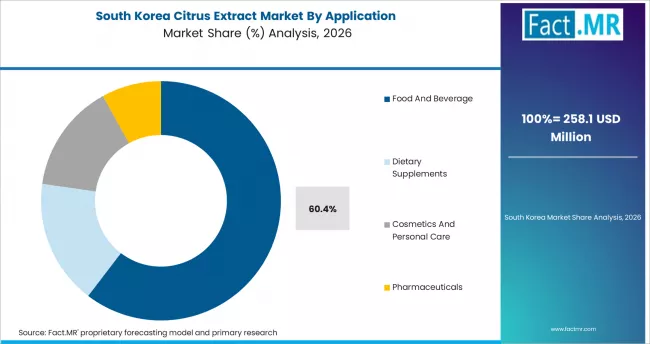
Citrus Extract Market South Korea Market Share Analysis By Application | Source: Fact.MR
The South Korea citrus extract market is projected to grow at a CAGR of 6.2% through 2036. Demand is shaped by the cosmetic industry's preference for citrus-derived fragrance and skin care ingredients, alongside clean-label food trends.
- Cosmetic industry demand for natural citrus ingredients supports premium extract procurement.
- Clean-label food trends are shifting flavoring sourcing toward natural citrus alternatives.
- Functional beverage growth creates additional demand for citrus bioactive compounds.
Brazil Citrus Extract Market Assessment
The Brazil citrus extract market is projected to grow at a CAGR of 6.1% through 2036. Growth is supported by the country's position as the largest global orange producer, providing cost-competitive raw material access for domestic extraction operations.
- Dominant orange production provides cost-competitive raw material for extract manufacturing.
- Export-oriented extraction capacity positions Brazil as a key global supplier.
- Domestic food and beverage industry growth sustains local demand for citrus flavoring.
USA Citrus Extract Market Outlook
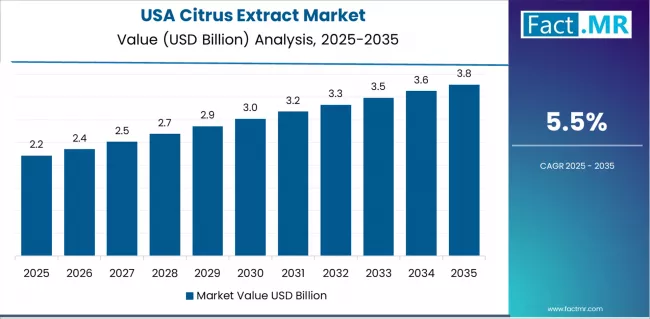
Citrus Extract Market Country Value Analysis | Source: Fact.MR
The USA citrus extract market is projected to grow at a CAGR of 5.5% through 2036. Demand is anchored in clean-label food formulation trends, functional beverage growth, and dietary supplement adoption of citrus bioactive compounds.
- Clean-label regulation supports natural citrus extract adoption across food processing.
- Functional beverage and supplement categories create premium demand channels.
- Established extraction infrastructure in Florida and California supports domestic supply.
Germany Citrus Extract Market Analysis
The Germany citrus extract market is projected to grow at a CAGR of 5.2% through 2036. Demand reflects strong clean-label regulatory compliance in food manufacturing and growing natural ingredient preference in personal care.
- Clean-label food regulation drives sustained demand for natural citrus flavoring.
- Personal care formulation trends support citrus essential oil procurement.
- Pharmaceutical-grade extract demand creates a specialized high-value channel.
Competitive Benchmarking and Company Positioning
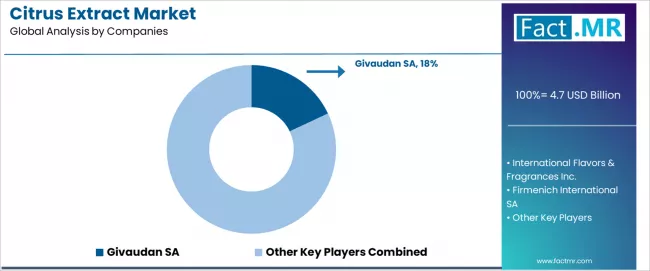
Citrus Extract Market Analysis By Company | Source: Fact.MR
- Givaudan SA holds 15% market share, competing on flavor creation expertise, global supply chain, and application development capabilities.
- IFF, Firmenich, and Symrise compete through integrated flavor and fragrance portfolios that combine citrus extracts with broader ingredient platforms.
- Competition is shaped by extraction technology, application expertise, supply chain reliability, and the ability to serve regulated end-use markets.
The competitive landscape is moderately consolidated among global flavor and fragrance houses. Givaudan holds the largest individual share at 15%, with IFF, Firmenich, Symrise, and Takasago forming the next tier. Regional extractors and specialty ingredient suppliers compete on pricing, proximity to citrus-growing regions, and niche application expertise.
Strategic priorities include investing in advanced extraction technologies, expanding bioactive compound isolation capabilities, building clean-label certification portfolios, and developing application-specific formulations for nutraceutical and cosmetic channels.
Competitive Benchmarking
| Company | Extraction Scale | Application Breadth | Geographic Reach | R&D Capability |
|---|---|---|---|---|
| Givaudan SA | Global | Full spectrum | Multi-continent | Advanced |
| IFF | Global | Full spectrum | Multi-continent | Advanced |
| Symrise AG | Global | Broad | Multi-continent | Strong |
| Kerry Group | Regional | Food focused | Europe/Americas | Moderate |
| Treatt plc | Mid-scale | Specialty | Export-oriented | Focused |
Source: Fact.MR analysis. Updated Apr 24, 2026
Recent Industry Developments
- Givaudan SA expanded its natural citrus extraction facility in 2025, adding cold-pressed processing capacity to serve growing clean-label food and beverage demand.
- Symrise AG announced a partnership with citrus growers in Brazil in early 2026 to secure sustainable sourcing for its natural flavoring ingredient portfolio.
- Treatt plc invested in supercritical CO2 extraction technology in 2025, targeting premium citrus bioactive compounds for nutraceutical and pharmaceutical applications.
Leading Companies Shaping the Citrus Extract Market
-
Major Players
- Givaudan SA
- International Flavors & Fragrances Inc.
- Firmenich International SA
- Symrise AG
- Takasago International Corporation
-
Emerging Players
- Kerry Group plc
- Sensient Technologies Corporation
- Archer Daniels Midland Company
- Robertet SA
- Citrus and Allied Essences Ltd.
- Dohler GmbH
- Bell Flavors & Fragrances Inc.
- Treatt plc
- Bordas SA
- Ultra International BV
Sources and Research References
- Food and Agriculture Organization of the United Nations (FAO). Citrus fruit production and trade statistics.
- European Food Safety Authority (EFSA). Natural flavoring substance regulatory guidance.
- Givaudan SA. Annual reports and ingredient portfolio disclosures.
- United States Department of Agriculture (USDA). Citrus crop production data and market reports.
- International Federation of Essential Oils and Aroma Trades (IFEAT). Industry publications and market analysis.
- Primary interviews with extract manufacturers, flavor houses, food processors, and cosmetic formulators.
This bibliography is provided for reader reference. The full report contains the complete reference list.
Key Questions This Report Addresses
- What is the current and projected size of the citrus extract market through 2036?
- What CAGR is expected for the citrus extract market between 2026 and 2036?
- Which product type holds the largest market share in 2026?
- Which application segment accounts for the highest demand in 2026?
- What factors are shaping demand for citrus extracts globally?
- Which countries are projected to show the fastest growth through 2036?
- How is the competitive landscape structured and who are the leading companies?
- How does Fact.MR validate the market forecast?
Citrus Extract Market Definition
The citrus extract market covers concentrated flavoring, fragrance, and bioactive ingredients derived from citrus fruits including oranges, lemons, limes, and grapefruits. The market spans extraction, processing, and supply of liquid extracts, powdered extracts, and essential oils used across food and beverage, dietary supplements, cosmetics, and pharmaceutical applications.
Citrus Extract Market Inclusions
The scope covers global and regional market size and forecasts for 2026 to 2036 across product type, application, end use, distribution channel, form, and region. It includes demand analysis based on food processing volumes, clean-label adoption rates, cosmetic ingredient trends, and nutraceutical market development.
Citrus Extract Market Exclusions
The scope excludes fresh citrus fruit sales, citrus juice concentrates sold as finished beverages, synthetic citrus flavoring compounds, and citrus-derived industrial chemicals not intended for food, cosmetic, or pharmaceutical end use.
Citrus Extract Market Research Methodology
- Primary research includes interviews with extract manufacturers, flavor houses, food processors, cosmetic formulators, and procurement managers.
- Desk research draws on citrus crop production data, trade statistics, ingredient regulatory filings, and company financial disclosures.
- Market sizing uses a demand-side model validated through cross-checks against extraction volumes, pricing benchmarks, and end-use consumption patterns.
- Data validation involves reconciliation with industry association data, sensitivity testing, and expert panel review.
Segmentation
Scope of Analysis
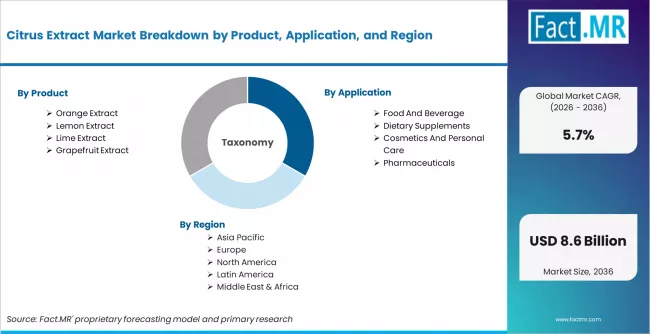
Citrus Extract Market Breakdown By Product, Application, And Region | Source: Fact.MR
| Parameter | Details |
|---|---|
| Quantitative Units | USD 5.0 billion to USD 8.6 billion, at a CAGR of 5.7% |
| Market Definition | The citrus extract market covers concentrated flavoring, fragrance, and bioactive ingredients derived from citrus fruits for food, supplement, cosmetic, and pharmaceutical use. |
| Regions Covered | North America, Latin America, Europe, East Asia, South Asia and Pacific, Middle East and Africa |
| Countries Covered | USA, China, India, Brazil, Germany, UK, South Korea, and 30+ countries |
| Key Companies | Givaudan SA, IFF, Firmenich, Symrise AG, Takasago, Kerry Group, Sensient Technologies, ADM, Robertet SA, Citrus and Allied Essences |
| Forecast Period | 2026 to 2036 |
| Approach | Hybrid demand-side methodology built on citrus production data, extraction volume benchmarks, end-use consumption analysis, and primary interviews across manufacturers and formulators. |
Source: Fact.MR analysis. Updated Apr 24, 2026
Analysis by Product Type, Application, End Use, Distribution Channel, Form, and Region
-
Citrus Extract Market Market Segmented by Product:
- Orange Extract
- Juice Concentrates
- Cold Press Orange Extract
- Clarified Orange Concentrate
- Peel Extract
- Essential Oil Extract
- Pectin Rich Extract
- Juice Concentrates
- Lemon Extract
- Juice Concentrates
- Lemon Juice Concentrate
- Dehydrated Lemon Extract
- Peel Extract
- Limonene Rich Oil
- Natural Acid Extract
- Juice Concentrates
- Lime Extract
- Juice Concentrates
- Lime Juice Concentrate
- Cold Process Lime Extract
- Peel Extract
- Citrus Oil Extract
- Flavoring Extract
- Juice Concentrates
- Grapefruit Extract
- Juice Concentrates
- Bitter Orange Style Extract
- Nutrient Rich Concentrate
- Peel Extract
- Flavonoid Rich Extract
- Essential Oil Fraction
- Juice Concentrates
- Orange Extract
-
Citrus Extract Market Market Segmented by Application:
- Food And Beverage
- Beverages
- Soft Drinks
- Functional Drinks
- Bakery And Confectionery
- Cakes And Pastries
- Candies And Gummies
- Beverages
- Dietary Supplements
- Nutraceuticals
- Vitamin Formulations
- Antioxidant Supplements
- Nutraceuticals
- Cosmetics And Personal Care
- Skincare Products
- Cleansers
- Brightening Creams
- Skincare Products
- Pharmaceuticals
- Herbal Medicines
- Digestive Health Products
- Immunity Formulations
- Herbal Medicines
- Food And Beverage
-
Citrus Extract Market Market Segmented by End Use:
- Food Manufacturers
- Beverage Companies
- Soft Drink Producers
- Juice Manufacturers
- Bakery Manufacturers
- Industrial Bakeries
- Artisan Bakeries
- Beverage Companies
- Nutraceutical Companies
- Supplement Brands
- Functional Nutrition Brands
- Supplement Brands
- Cosmetic Manufacturers
- Personal Care Brands
- Natural Cosmetic Brands
- Personal Care Brands
- Pharmaceutical Companies
- Herbal Drug Manufacturers
- OTC Product Makers
- Herbal Drug Manufacturers
- Food Manufacturers
-
Citrus Extract Market Market Segmented by Distribution Channel:
- Direct Sales
- B2B Ingredient Supply
- Bulk Industrial Supply
- Contract Manufacturing Supply
- B2B Ingredient Supply
- Distributors
- Food Ingredient Distributors
- Regional Distributors
- Global Trading Houses
- Food Ingredient Distributors
- Online Retail
- B2B Platforms
- Digital Ingredient Marketplaces
- E Procurement Platforms
- B2B Platforms
- Direct Sales
-
Citrus Extract Market Market Segmented by Form:
- Liquid Extract
- Concentrates
- High Brix Concentrates
- Standardized Extracts
- Concentrates
- Juice Based Extracts
- Filtered Juice Extract
- Pasteurized Extract
- Powder Extract
- Spray Dried Powder
- Instant Soluble Powder
- Encapsulated Powder
- Spray Dried Powder
- Essential Oil Extract
- Cold Press Oil
- Food Grade Oil
- Aroma Oil Fraction
- Cold Press Oil
- Liquid Extract
-
Citrus Extract Market Market by Region:
- North America
- USA
- Canada
- Mexico
- Latin America
- Brazil
- Chile
- Rest of Latin America
- Western Europe
- Germany
- UK
- Italy
- Spain
- France
- Nordic
- BENELUX
- Rest of Western Europe
- Eastern Europe
- Russia
- Poland
- Hungary
- Balkan & Baltic
- Rest of Eastern Europe
- East Asia
- China
- Japan
- South Korea
- South Asia and Pacific
- India
- ASEAN
- Australia & New Zealand
- Rest of South Asia and Pacific
- Middle East & Africa
- Kingdom of Saudi Arabia
- Other GCC Countries
- Turkiye
- South Africa
- Other African Union
- Rest of Middle East & Africa
- North America
Frequently Asked Questions
What is the size of the citrus extract market in 2026?
What will be the size of the citrus extract market in 2036?
What is the expected CAGR of the citrus extract market?
Which product type leads the citrus extract market?
Which application accounts for the highest demand?
Which country is the fastest growing market?
What does the citrus extract market cover?
How does Fact.MR validate its forecast?
Who worked on this report


Preview the report firsthand - request a free sample
Free SampleGet the brochure for pricing and purchase details
Download PDF