- Base Value(2025): 1.8 Bn
- Estimated Value(2026): 1.9 Bn
- Forecast Value (2036): 2.8 Bn
- CAGR (2026 - 2036): 4.1%
Concrete Crusher Rental Market Analysis and Forecast by Fact.MR
- The global concrete crusher rental market is estimated at USD 1.87 billion in 2026 and is forecast to expand at a CAGR of 4.1% to reach USD 2.8 billion by 2036.
- Concrete crusher rental covers the provision of mobile and semi-mobile crushing equipment used to process concrete, masonry, asphalt, and mixed construction debris into reusable aggregate, base material, and recycled fill.
- The rental fleet includes jaw crushers, impact crushers, cone crushers, and specialty models offered for construction and demolition waste recycling, quarry production, road base preparation, and site clearance operations.
- Electrification of crusher platforms and integration of telematics-enabled fleet management are shaping the next phase of rental fleet composition and operating economics.
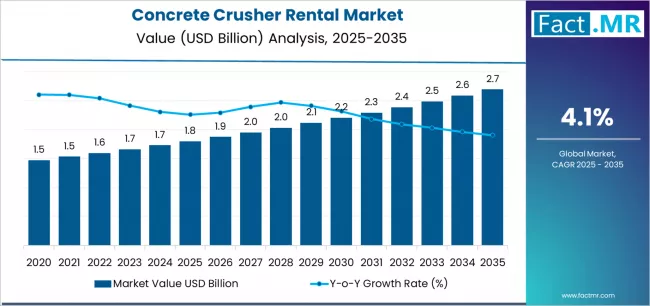
Concrete Crusher Rental Market Market Value Analysis | Source: Fact.MR
Summary of Concrete Crusher Rental Market
- Market Snapshot
- In 2025, the global Concrete Crusher Rental Market was valued at approximately USD 1.8 billion.
- The market is estimated to reach USD 1.87 billion in 2026 and is projected to attain USD 2.8 billion by 2036.
- The concrete crusher rental market is likely to expand at a CAGR of 4.1% during the forecast period.
- The market is anticipated to create an absolute dollar opportunity of USD 0.93 billion between 2026 and 2036.
- Long-term rental accounts for 58.4% of rental duration segment share in 2026.
- India (5.0%) and China (4.5%) are the key growth markets during the forecast period.
- Demand and Growth Drivers
- Landfill diversion mandates and construction waste recycling regulations in the EU, North America, and select Asia Pacific jurisdictions are increasing contractor adoption of on-site crushing as a compliance-driven alternative to debris haulage and disposal.
- Rising transportation costs for hauling demolition waste to off-site disposal facilities are improving the cost-competitiveness of on-site crusher rental for generating reusable aggregate directly at the project location.
- Infrastructure demolition and replacement cycles across aging road networks, bridges, and commercial buildings are generating concentrated volumes of concrete debris requiring mobile crushing capacity on tight project timelines.
- Urban redevelopment programs that require clearing existing structures before new construction are creating demand for crusher rental as a project-phase-specific requirement bundled with demolition and site preparation services.
- Electrification of mobile crusher platforms is creating a premium rental tier that meets zero-emission site requirements while reducing fuel costs and maintenance intervals compared to diesel-only fleet configurations.
- Product and Segment View
- Jaw concrete crusher rental accounts for 29.7% of the product segment in 2026, supported by high throughput capacity, suitability for primary crushing of large concrete sections, and broad applicability across demolition and recycling applications.
- Construction and demolition waste recycling represents 34.5% of the application segment in 2026, with on-site concrete processing, aggregate recovery, and landfill diversion as the primary demand channels.
- Mechanical crushing technology accounts for 37.6% of the technology segment in 2026, reflecting the continued dominance of mechanical jaw and impact systems in mobile crusher rental fleets.
- Key segmentation includes:
- Product Type: Jaw Concrete Crusher Rental, Impact Concrete Crusher Rental, Cone Concrete Crusher Rental, Specialty Concrete Crusher Rental
- Application: Construction and Demolition Waste Recycling, Quarry and Mining Operations, Road and Infrastructure Construction, Site Clearance and Land Preparation
- Technology: Mechanical Crushing Technology, Hydraulic Crushing Technology, Electric Crushing Systems
- These systems enable:
- On-site processing of concrete, masonry, and asphalt debris into reusable aggregate and base material
- Primary, secondary, and tertiary crushing of construction demolition waste for recycled fill, road base, and landscape material production
- Mobile deployment at demolition, infrastructure, and quarry sites with rapid setup and relocation capability
- Geography and Competitive Outlook
- North America maintains strong rental demand, supported by construction waste recycling mandates, high on-site crushing adoption among demolition contractors, and established mobile crusher fleet availability across major rental platforms.
- Asia Pacific is the fastest-growing region, with India and China driving demand through large-scale infrastructure demolition, urbanization-led site clearance, and increasing regulatory attention to construction waste management.
- Europe sustains demand through EU Waste Framework Directive compliance, circular economy material recovery targets, and contractor adoption of electric crusher rental to meet zero-emission zone requirements.
- India (5.0%), China (4.5%), and the USA (3.8%) are the fastest-growing markets, while South Korea (3.6%) and Germany (3.5%) maintain demand through infrastructure maintenance and recycling mandate compliance.
- Key players include Komatsu, Sandvik, Metso, Keestrack, Terex, Kleemann, McCloskey, Powerscreen, United Rentals, Sunbelt, Loxam, Boels, Kubota, Wirtgen, and Rubble Master.
- Analyst Opinion
- Shambhu Nath Jha, Principal Consultant at Fact.MR, says 'The concrete crusher rental market is benefiting from a convergence of regulatory pressure, cost economics, and sustainability procurement requirements that are shifting demolition contractors from debris haulage to on-site aggregate recycling. Long-term rental agreements tied to multi-phase demolition and infrastructure replacement projects now account for 58% of rental duration share, reflecting the integration of crusher rental into project-level cost planning rather than spot equipment access. OEM competition is increasingly shaped by electric and hybrid platform availability, with Sandvik and Metso leading the introduction of electric cone and jaw crushers that reduce operating costs and meet zero-emission site specifications.'
Key Growth Drivers, Constraints, and Opportunities
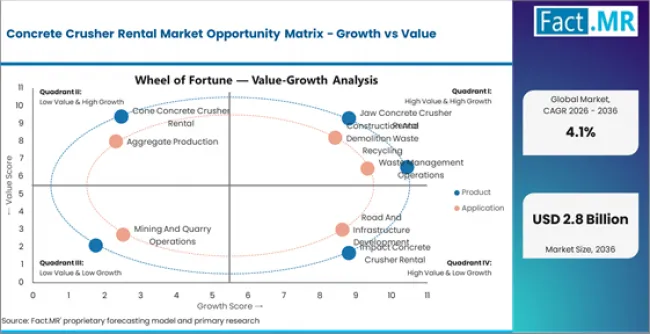
Concrete Crusher Rental Market Opportunity Matrix Growth Vs Value | Source: Fact.MR
Key Factors Driving Growth
- EU Waste Framework Directive targets and North American municipal landfill diversion mandates are converting construction waste disposal from a haulage operation into an on-site recycling requirement, directly increasing crusher rental specification frequency in demolition project planning.
- Rising landfill tipping fees and debris transportation costs are improving the breakeven economics of on-site crushing, making rental access cost-competitive for mid-size demolition projects that previously relied on off-site disposal.
- Aging infrastructure replacement programs across highway networks, commercial buildings, and public facilities are generating high-volume concrete debris requiring mobile crushing capacity on constrained project timelines.
Key Market Constraints
- High per-unit rental rates for mobile crushers, ranging from USD 500,000 to USD 1.5 million for mid-capacity platforms, create a financial threshold that limits rental adoption among smaller demolition and earthmoving contractors.
- Permitting requirements for on-site crushing operations, including dust, noise, and air quality compliance, add project setup complexity and cost that can reduce the time-savings advantage of on-site processing.
- Equipment availability constraints during peak demolition seasons create rental shortages at regional platforms, forcing contractors to schedule crushing around fleet availability rather than project timelines.
Key Opportunity Areas
- Electric and hybrid mobile crushers are entering rental fleets to meet zero-emission zone requirements, with Sandvik's QH443E electric cone crusher demonstrating 25% lower energy consumption and up to 91% reduction in lubricant use compared to diesel equivalents.
- Telematics integration across rental crusher fleets is enabling predictive maintenance, fuel consumption optimization, and remote performance monitoring, allowing rental operators to improve fleet uptime and margin performance.
- Bundled rental packages combining crushers with screeners, conveyors, and dust suppression systems are increasing per-project rental revenue and improving contractor adoption through turnkey on-site recycling solutions.
Segment-wise Analysis of the Concrete Crusher Rental Market
- Jaw concrete crusher rental holds 29.7% of the product segment in 2026, supported by high primary crushing capacity, versatile feed acceptance, and established contractor familiarity across demolition waste recycling and quarry applications.
- Construction and demolition waste recycling represents 34.5% of the application segment in 2026, with on-site concrete processing, aggregate recovery, and landfill diversion mandates generating the largest rental demand concentration.
- Long-term rental accounts for 58.4% of the rental duration segment in 2026, reflecting the multi-month deployment requirements of demolition projects and the capital-intensive nature of crusher equipment.
The concrete crusher rental market is segmented by product type, application, end use, technology, rental duration, and region. By product type, the market covers jaw crushers (primary crushing), impact crushers (secondary processing and recycling), cone crushers (precision aggregate production), and specialty models for confined-space and urban applications. Jaw crushers lead by rental volume due to their primary-stage versatility, while cone and impact crushers generate premium rental rates for specialized aggregate grading and recycled material production.
Which Product Segment Dominates the Concrete Crusher Rental Market?
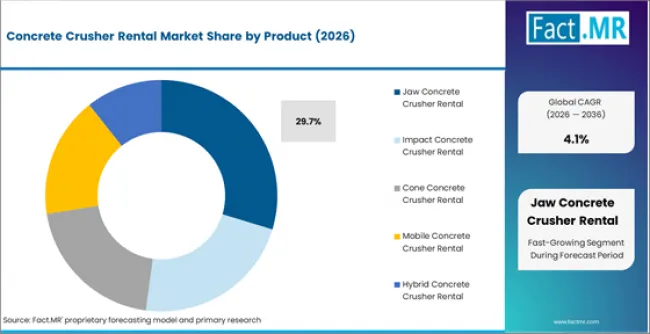
Concrete Crusher Rental Market Analysis By Product | Source: Fact.MR
Jaw concrete crusher rental is estimated to account for 29.7% of product segment value in 2026. Jaw crushers serve as the primary-stage crushing platform for demolition waste, accepting large concrete sections, reinforced slabs, and mixed masonry debris for initial size reduction before screening or secondary processing. Their broad feed acceptance, mechanical simplicity, and established contractor familiarity make them the default first specification for most demolition and recycling rental assignments.
Jaw crushers also benefit from the widest rental fleet availability across major platforms, as their versatile application profile supports deployment across demolition recycling, quarry production, road base preparation, and site clearance without significant reconfiguration between assignments.
Which Application Segment Dominates the Concrete Crusher Rental Market?
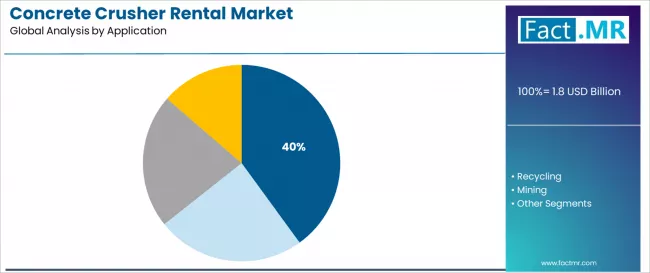
Concrete Crusher Rental Market Analysis By Application | Source: Fact.MR
Construction and demolition waste recycling is expected to lead the application segment with 34.5% share of global rental demand in 2026. Demand is driven by landfill diversion mandates, on-site aggregate recovery requirements, and the cost advantage of processing debris at the demolition location rather than hauling to off-site disposal facilities. Contractors increasingly specify crusher rental as a line item in demolition project planning to meet recycling rate requirements and reduce material haulage expenditure.
Quarry and mining operations follow as the second-largest application, generating demand for cone and impact crushers used in aggregate grading and production. Road and infrastructure construction sustains a parallel demand stream for base material production from recycled concrete sources.
Which Product Trend is Shaping the Next Phase of Growth in the Concrete Crusher Rental Market?
Electric and hybrid mobile crushers are emerging as the defining product trend in the rental market, driven by zero-emission zone regulations, operational cost reduction, and sustainability procurement criteria. Sandvik introduced the QH443E electric cone crusher with a 300-kW motor and regenerative braking, consuming 25% less energy than diesel equivalents. Metso launched the Nordberg HPe Series cone crushers with 15% more capacity and 35% higher crushing force, featuring advanced automation for real-time performance optimization.
The electrification trend is reshaping rental fleet economics by reducing fuel expenditure, lowering maintenance intervals, and enabling operation in noise- and emission-restricted urban demolition zones where diesel-only machines face permit constraints. Rental operators adding electric models to their fleet are capturing premium daily rates while also improving fleet utilization by accessing project sites that were previously off-limits to diesel equipment. At ConExpo 2026, Sandvik unveiled the CH442 and CH662 cone crushers, while Komatsu showcased autonomous quarry solutions, signaling continued investment in electrification and digital integration across the crushing equipment supply chain.
Regional Outlook Across Key Markets
- India leads growth at 5.0%, driven by large-scale urban redevelopment, highway infrastructure demolition and replacement, and increasing regulatory attention to construction waste management in metropolitan areas.
- China at 4.5% sustains demand through expressway rehabilitation, urban renewal demolition volumes, and state-directed investment in construction waste recycling infrastructure across provincial and municipal authorities.
- North America shows mature rental adoption, with the U.S. at 3.8% supported by landfill diversion mandates, on-site recycling adoption by demolition contractors, and established mobile crusher fleet availability.
- Europe maintains steady demand with Germany at 3.5% driven by EU Waste Framework Directive recycling targets, circular economy material recovery mandates, and electric crusher fleet adoption in zero-emission construction zones.
.webp "Top Country Growth Comparison Concrete Crusher Rental Market Cagr (2026 2036)")
Top Country Growth Comparison Concrete Crusher Rental Market Cagr (2026 2036) | Source: Fact.MR
| Country | CAGR (%) |
|---|---|
| India | 5.0% |
| China | 4.5% |
| USA | 3.8% |
| South Korea | 3.6% |
| Germany | 3.5% |
| UK | 3.4% |
| Japan | 3.0% |
Source: Fact.MR analysis. Updated Jun 3, 2026
Source: Fact MR (FMR) analysis, based on proprietary forecasting model and primary research.
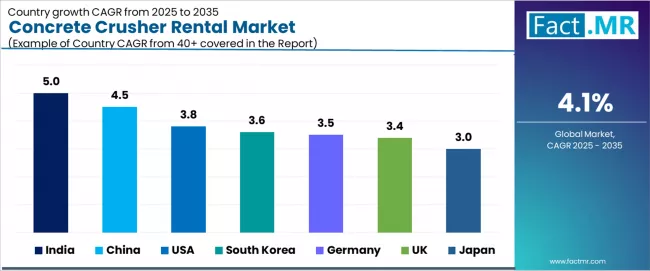
Concrete Crusher Rental Market Cagr Analysis By Country | Source: Fact.MR
Concrete Crusher Rental Demand Trends in India
Large-scale urban redevelopment projects in Mumbai, Delhi, and Bangalore are generating high demolition debris volumes that require on-site mobile crushing capacity for aggregate recovery and site clearance. National Infrastructure Pipeline highway replacement programs add a parallel demand channel, as aging road sections are demolished and processed through rental jaw and impact crushers to produce recycled base material for new construction. PLI scheme incentives for manufacturing facility construction are also generating demolition and site preparation activity that supports crusher rental demand.
- Metropolitan urban redevelopment programs generate concentrated demolition debris volumes requiring on-site jaw and impact crusher rental for aggregate recovery.
- National Highway Authority demolition and replacement cycles create recurring rental demand for mobile crushing at highway rehabilitation project sites.
China Concrete Crusher Rental Market Growth Assessment
State-directed investment in construction waste recycling infrastructure is the primary growth mechanism, with provincial and municipal authorities establishing processing requirements for demolition debris. Domestic OEM cost advantages in crusher manufacturing, led by companies such as Shanghai Shibang and Zoomlion, support competitive rental rate structures that accelerate adoption among mid-tier demolition and earthmoving contractors.
- Provincial construction waste recycling mandates create structured demand for mobile crusher rental at urban demolition and redevelopment sites.
- Domestic OEM pricing competitiveness enables fleet expansion by regional rental operators serving state-tendered infrastructure projects.
Market Outlook for Concrete Crusher Rental in the United States
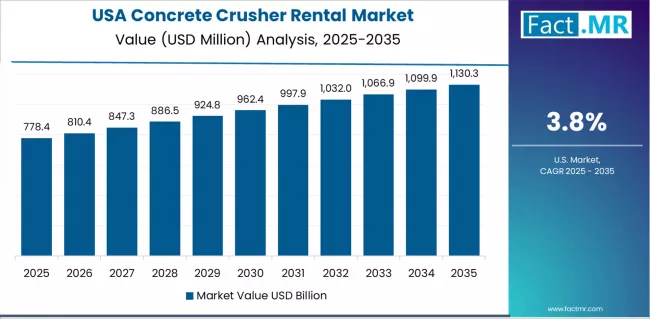
Concrete Crusher Rental Market Country Value Analysis | Source: Fact.MR
Established on-site crushing adoption among demolition contractors, supported by municipal landfill diversion mandates and rising tipping fees, sustains the primary demand base. United Rentals and Sunbelt provide broad geographic fleet coverage, while specialty demolition rental providers offer project-specific crusher and screener packages. IRA and infrastructure bill allocations for highway and bridge replacement create additional demand for mobile crushing at demolition and reconstruction project sites.
- Municipal landfill diversion mandates and rising tipping fees improve the cost-competitiveness of on-site crusher rental for demolition contractors.
- Infrastructure bill highway and bridge replacement allocations generate project-phase-specific crusher rental demand at demolition and reconstruction sites.
Germany Concrete Crusher Rental Market Demand Analysis
EU Waste Framework Directive compliance and circular economy targets are the primary regulatory drivers of crusher rental demand. German demolition contractors face specific recycling rate requirements for construction waste, creating a compliance-driven specification pathway for on-site mobile crushing. Electric and hybrid crusher availability from Sandvik, Metso, and Kleemann enables operation in zero-emission zones, meeting both regulatory and sustainability procurement criteria on government-tendered projects.
- EU Waste Framework Directive recycling rate targets create compliance-driven demand for on-site crusher rental at demolition sites.
- Zero-emission zone regulations and sustainability procurement criteria favor electric and hybrid crusher models from European OEMs.
South Korea Concrete Crusher Rental Demand Trends
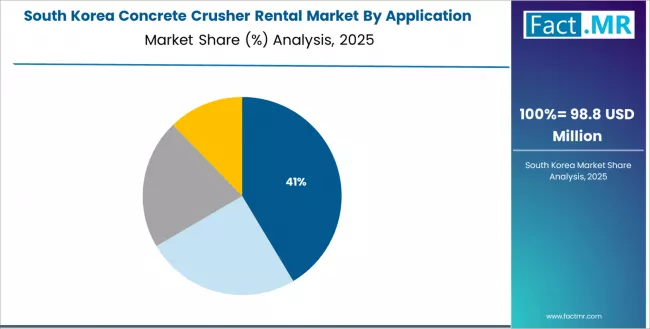
Concrete Crusher Rental Market South Korea Market Share Analysis By Application | Source: Fact.MR
High-density urban redevelopment in Seoul and Incheon generates concentrated demolition waste volumes requiring on-site mobile crushing for aggregate recovery. Government-funded infrastructure modernization and semiconductor facility construction create parallel demand streams for site clearance crushing equipment. Quality and after-sales support expectations favor established OEM brands in rental fleet composition.
- Seoul metropolitan redevelopment projects create concentrated rental demand for jaw and impact crushers for demolition waste processing.
- Government infrastructure modernization and industrial facility construction sustain parallel rental demand for mobile crushing capacity.
Competitive Benchmarking and Company Positioning
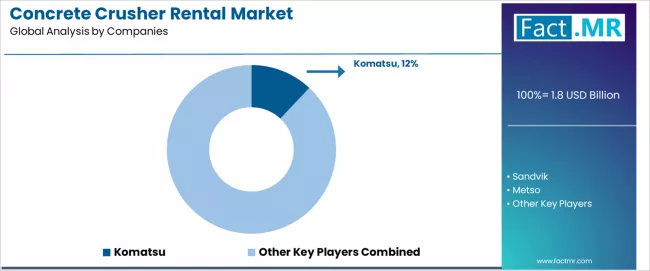
Concrete Crusher Rental Market Analysis By Company | Source: Fact.MR
Concrete Crusher Rental Market Analysis By Company
- Sandvik and Metso hold the strongest OEM positions in mobile crushing equipment, competing through electric and hybrid platform availability, digital fleet management integration, and broad product lines spanning jaw, cone, and impact crusher configurations.
- Komatsu, Terex (Powerscreen), and Kleemann (Wirtgen Group) maintain established positions across demolition, quarry, and recycling applications, with competition shaped by crusher throughput, material handling versatility, and dealer service network depth.
- Rental platform competition is concentrated at United Rentals, Sunbelt, Loxam, and Boels, where fleet scale, geographic branch density, and bundled equipment packages combining crushers with screeners and conveyors determine market access.
The competitive landscape is defined by the intersection of OEM equipment capability and rental platform fleet availability. Sandvik and Metso lead the electrification transition with electric cone and jaw crusher platforms that command premium rental rates while reducing fuel and maintenance costs. Komatsu holds approximately 12% market share in crusher manufacturing, with a strong position in Asia Pacific and North American quarry and demolition applications.
Rental platform competition is shaped by fleet depth, bundling capability, and geographic reach. United Rentals completed the USD 4.8 billion acquisition of H&E Equipment Services in January 2025, integrating nearly 64,000 rental assets and significantly expanding its branch network for heavy equipment rental including mobile crushers.
Strategic priorities include expanding electric and hybrid crusher fleet availability, deepening telematics-enabled fleet monitoring and predictive maintenance capabilities, and securing long-term rental agreements tied to multi-year infrastructure demolition and replacement programs. Companies that combine crushing performance with digital fleet services and sustainability credentials are best positioned to capture premium rental demand from regulated demolition contractors.
Key Companies in the Concrete Crusher Rental Market
- Komatsu, Sandvik, and Metso lead the mobile crushing equipment supply side, supported by broad product portfolios, electrification leadership, and established dealer and rental fleet distribution channels across global markets.
- Keestrack, Terex (Powerscreen), Kleemann (Wirtgen Group), and McCloskey maintain strong positions in mid-range and specialty crusher applications, competing through throughput performance, material handling versatility, and regional dealer network coverage.
- United Rentals, Sunbelt, Loxam, Boels, and Rubble Master serve the rental access layer, with competition driven by fleet scale, equipment mix, bundled package capability, and branch proximity to active demolition and construction zones.
Recent Industry Developments
- Sandvik, QH443E Electric Cone Crusher Introduction (March 2025): Sandvik introduced the QH443E electric cone crusher with a 300-kW motor and regenerative braking system, delivering 25% lower energy consumption and up to 91% reduction in lubricant use. The launch positions Sandvik as a leader in electric mobile crushing for rental fleets targeting zero-emission construction zones.
- Metso, Nordberg HPe Series Cone Crusher Launch (March 2025): Metso launched the Nordberg HP600e, HP800e, and HP900e cone crushers, offering 15% more capacity and 35% higher crushing force compared to predecessor models. The HPe series features an advanced automation platform for real-time performance optimization, supporting premium rental positioning in aggregate and recycling applications.
- Sandvik, CH442 and CH662 Cone Crushers Unveiled at ConExpo 2026 (March 2026): Sandvik Crushing Solutions unveiled the CH442 and CH662 cone crushers at ConExpo 2026, representing the next evolution of the CH400 and CH600 series with enhanced performance and digital integration for infrastructure and aggregate production applications.
- United Rentals, H&E Equipment Services Acquisition (January 2025): United Rentals completed the acquisition of H&E Equipment Services for approximately USD 4.8 billion, integrating nearly 64,000 rental assets including mobile crushing and screening equipment, and significantly expanding branch network density for heavy equipment rental.
- Sunbelt Rentals, NYSE Listing and Fleet Expansion (March 2026): Sunbelt Rentals completed its New York Stock Exchange listing, bringing a USD 19 billion fleet to the public market. The company continues advancing telematics-enabled fleet tracking and utilization optimization across its North American operations.
Leading Companies Shaping the Concrete Crusher Rental Market
- Komatsu
- Sandvik
- Metso
- Keestrack
- Terex (Powerscreen)
- Kleemann (Wirtgen Group)
- McCloskey
- United Rentals
- Sunbelt Rentals
- Rubble Master
Sources and Research References
- Sandvik AB. Electric crusher platform specifications, ConExpo 2026 product announcements, and fleet management updates.
- Metso Corporation. Nordberg HPe Series launch data and digital services portfolio updates.
- Komatsu Ltd. Mobile crusher portfolio and autonomous quarry solution announcements.
- European Commission. Waste Framework Directive construction waste recycling target data.
- U.S. Environmental Protection Agency (EPA). Construction and demolition waste generation and recycling statistics.
- Primary interviews with crusher OEMs, rental platforms, demolition contractors, recycling operators, and environmental compliance consultants.
This bibliography is provided for reader reference and is not exhaustive. The full report contains the complete reference list and detailed citations.
Key Questions This Report Addresses
- What is the current and projected size of the Concrete Crusher Rental Market through 2036?
- How fast is the concrete crusher rental market expected to grow between 2026 and 2036?
- Which product type generates the highest rental demand by value in 2026?
- Which application segment accounts for the largest share of crusher rental demand?
- What regulatory and cost factors are driving on-site crusher rental adoption?
- How is electrification of mobile crusher platforms influencing the rental market?
- Which countries are projected to show the fastest growth through 2036?
- How are landfill diversion mandates shaping crusher rental specification patterns?
- Who are the key OEMs and rental platforms in the Concrete Crusher Rental Market?
- What recent product launches and acquisitions are reshaping competitive positioning?
- How does Fact.MR estimate and validate the concrete crusher rental market forecast?
Concrete Crusher Rental Market Definition
The concrete crusher rental market covers the provision of mobile and semi-mobile crushing equipment on rental or lease agreements for processing concrete, masonry, asphalt, and mixed construction debris into reusable aggregate, base material, and recycled fill. It includes jaw crushers, impact crushers, cone crushers, and specialty models offered for demolition waste recycling, quarry production, road base preparation, and site clearance operations.
Concrete Crusher Rental Market Inclusions
- The scope covers global and regional market size and forecasts for 2026 to 2036 across product type, application, end use, technology, rental duration, and region.
- It includes rental demand analysis based on demolition activity, construction waste regulation compliance, quarry production cycles, road construction programs, and rental penetration rates across major geographies.
- The report includes rental rate analysis across jaw, impact, and cone crusher platforms for daily, weekly, monthly, and project-based rental durations.
Concrete Crusher Rental Market Exclusions
- The scope excludes crushers sold outright for permanent ownership, mine-site fixed crushing plants, and internally operated fleet equipment not rented commercially.
- It excludes screening-only equipment, concrete recycling wash plants, and material conveyance systems sold independently of crushing equipment rental.
- The report excludes aggregate production from virgin quarry sources where crushing is performed by quarry operators rather than through rental equipment access.
Concrete Crusher Rental Market Research Methodology
- The methodology combines secondary research, primary interviews, and forecast modelling aligned with demolition and construction waste management cycles.
- It draws on 110+ secondary sources including environmental regulation databases, demolition industry surveys, and equipment manufacturer filings.
- Market sizing covers 30+ countries through a demand-side model supported by top-down validation against demolition permit data and construction waste generation estimates.
- Key inputs include demolition project volumes, construction waste recycling rates, landfill tipping fees, aggregate pricing, and mobile crusher utilization benchmarks.
- Primary validation includes 25+ interviews across crusher OEMs, rental platforms, demolition contractors, recycling operators, and waste management agencies.
Segmentation
Scope of Analysis
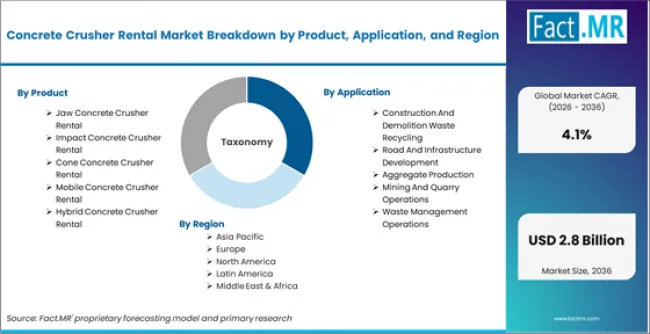
Concrete Crusher Rental Market Breakdown By Product, Application, And Region | Source: Fact.MR
| Parameter | Details |
|---|---|
| Quantitative Units | USD 1.87 billion to USD 2.8 billion, at a CAGR of 4.1% |
| Market Definition | The Concrete Crusher Rental Market covers the provision of mobile and semi-mobile crushing equipment on rental agreements for processing concrete, masonry, asphalt, and mixed construction debris into reusable aggregate, base material, and recycled fill. |
| Regions Covered | North America, Latin America, Europe, East Asia, South Asia and Pacific, Middle East and Africa |
| Countries Covered | India, China, USA, South Korea, Germany, UK, Japan, 30 plus countries |
| Key Companies | Komatsu, Sandvik, Metso, Keestrack, Terex, Kleemann, McCloskey, Powerscreen, United Rentals, Sunbelt, Loxam, Boels, Kubota, Wirtgen, Rubble Master |
| Forecast Period | 2026 to 2036 |
| Approach | Hybrid demand-side and top-down methodology built on demolition activity analysis, construction waste recycling rates, landfill diversion regulation tracking, rental utilization data, and primary interviews across OEMs, rental platforms, demolition contractors, and waste management agencies. |
Source: Fact.MR analysis. Updated Jun 3, 2026
Concrete Crusher Rental Market Segmentation
-
Concrete Crusher Rental Market Segmented by Product:
- Jaw Concrete Crusher Rental
- Compact Jaw Concrete Crusher Rental
- Residential Demolition Concrete Crushing Rental
- Small Construction Waste Processing Rental
- Heavy Duty Jaw Concrete Crusher Rental
- Infrastructure Demolition Concrete Crushing Rental
- Large Scale Aggregate Recycling Rental
- Compact Jaw Concrete Crusher Rental
- Impact Concrete Crusher Rental
- Horizontal Shaft Impact Concrete Crusher Rental
- Recycled Concrete Aggregate Production Rental
- Road Demolition Material Processing Rental
- Vertical Shaft Impact Concrete Crusher Rental
- Precision Aggregate Shaping Rental
- Fine Concrete Material Processing Rental
- Horizontal Shaft Impact Concrete Crusher Rental
- Cone Concrete Crusher Rental
- Portable Cone Concrete Crusher Rental
- Secondary Aggregate Crushing Rental
- Commercial Construction Waste Recycling Rental
- Heavy Capacity Cone Concrete Crusher Rental
- Industrial Concrete Recycling Rental
- High Volume Aggregate Production Rental
- Portable Cone Concrete Crusher Rental
- Mobile Concrete Crusher Rental
- Track Mounted Mobile Concrete Crusher Rental
- Remote Demolition Site Crushing Rental
- Infrastructure Redevelopment Material Processing Rental
- Wheel Mounted Mobile Concrete Crusher Rental
- Urban Construction Waste Recycling Rental
- Temporary Crushing Site Operations Rental
- Track Mounted Mobile Concrete Crusher Rental
- Hybrid Concrete Crusher Rental
- Diesel Electric Concrete Crusher Rental
- Fuel Efficient Aggregate Crushing Rental
- Low Emission Demolition Material Processing Rental
- Electric Powered Concrete Crusher Rental
- Indoor Recycling Facility Crushing Rental
- Noise Sensitive Area Concrete Crushing Rental
- Diesel Electric Concrete Crusher Rental
- Jaw Concrete Crusher Rental
-
Concrete Crusher Rental Market Segmented by Application:
- Construction And Demolition Waste Recycling
- Residential Construction Waste Recycling
- Housing Demolition Material Processing Rental
- Residential Renovation Waste Crushing Rental
- Commercial Construction Waste Recycling
- Commercial Building Demolition Processing Rental
- Industrial Site Redevelopment Crushing Rental
- Residential Construction Waste Recycling
- Road And Infrastructure Development
- Road Construction Material Processing
- Road Base Aggregate Production Rental
- Highway Demolition Material Recycling Rental
- Bridge And Infrastructure Redevelopment
- Bridge Deck Concrete Crushing Rental
- Infrastructure Rehabilitation Material Processing Rental
- Road Construction Material Processing
- Aggregate Production
- Recycled Aggregate Production
- Concrete Aggregate Supply Rental
- Sustainable Construction Material Processing Rental
- Industrial Aggregate Processing
- Large Scale Crushing Operations Rental
- Commercial Aggregate Production Rental
- Recycled Aggregate Production
- Mining And Quarry Operations
- Quarry Material Processing
- Stone And Concrete Crushing Rental
- Secondary Aggregate Production Rental
- Mining Infrastructure Operations
- Mining Site Demolition Crushing Rental
- Heavy Excavation Material Processing Rental
- Quarry Material Processing
- Waste Management Operations
- Municipal Waste Processing
- Construction Debris Recycling Rental
- Urban Waste Material Crushing Rental
- Industrial Waste Processing
- Industrial Concrete Waste Recycling Rental
- Factory Redevelopment Material Processing Rental
- Municipal Waste Processing
- Construction And Demolition Waste Recycling
-
Concrete Crusher Rental Market Segmented by End Use:
- Construction Companies
- Commercial Construction Companies
- Infrastructure Development Contractors
- Urban Redevelopment Contractors
- Residential Construction Companies
- Housing Demolition Contractors
- Residential Waste Recycling Contractors
- Commercial Construction Companies
- Demolition Contractors
- Building Demolition Contractors
- Commercial Structure Demolition Contractors
- Industrial Demolition Service Providers
- Infrastructure Demolition Contractors
- Bridge Removal Contractors
- Road Redevelopment Contractors
- Building Demolition Contractors
- Recycling And Waste Management Companies
- Construction Waste Recycling Companies
- Concrete Recycling Operators
- Aggregate Recovery Service Providers
- Industrial Waste Management Companies
- Industrial Material Recovery Contractors
- Sustainable Waste Processing Operators
- Construction Waste Recycling Companies
- Mining And Quarry Companies
- Quarry Operators
- Aggregate Production Contractors
- Stone Processing Operators
- Mining Companies
- Mining Infrastructure Service Providers
- Excavation Material Processing Contractors
- Quarry Operators
- Municipal Authorities
- Public Works Departments
- Urban Waste Recycling Departments
- Infrastructure Redevelopment Authorities
- Environmental Management Agencies
- Construction Waste Regulation Authorities
- Sustainable Material Recovery Departments
- Public Works Departments
- Construction Companies
-
Concrete Crusher Rental Market Segmented by Technology:
- Mechanical Crushing Technology
- Single Stage Crushing Systems
- Primary Concrete Crushing Rental
- Bulk Material Reduction Rental
- Multi Stage Crushing Systems
- High Efficiency Aggregate Processing Rental
- Precision Material Sizing Rental
- Single Stage Crushing Systems
- Hydraulic Crushing Technology
- Standard Hydraulic Crushing Systems
- Heavy Reinforced Concrete Crushing Rental
- Industrial Demolition Material Processing Rental
- Advanced Hydraulic Crushing Systems
- High Capacity Aggregate Recycling Rental
- Continuous Crushing Operations Rental
- Standard Hydraulic Crushing Systems
- Power Source
- Diesel Powered Concrete Crusher Rental
- Heavy Duty Demolition Crushing Rental
- Remote Site Material Processing Rental
- Electric Powered Concrete Crusher Rental
- Low Emission Aggregate Crushing Rental
- Indoor Recycling Facility Crushing Rental
- Diesel Powered Concrete Crusher Rental
- Mobility Configuration
- Stationary Concrete Crusher Rental
- Fixed Site Aggregate Processing Rental
- Long Duration Recycling Operations Rental
- Mobile Concrete Crusher Rental
- Portable Demolition Crushing Rental
- Temporary Infrastructure Redevelopment Rental
- Stationary Concrete Crusher Rental
- Mechanical Crushing Technology
-
Concrete Crusher Rental Market Segmented by Rental Duration:
- Long Term Rental
- Monthly Rental
- Extended Aggregate Processing Rental
- Industrial Recycling Facility Rental
- Project Based Rental
- Infrastructure Redevelopment Crushing Rental
- Large Scale Demolition Processing Rental
- Monthly Rental
- Short Term Rental
- Daily Rental
- Emergency Demolition Crushing Rental
- Short Duration Material Processing Rental
- Weekly Rental
- Temporary Construction Recycling Rental
- Seasonal Redevelopment Crushing Rental
- Daily Rental
- Long Term Rental
-
Concrete Crusher Rental Market by Region:
- North America
- USA
- Canada
- Mexico
- Latin America
- Brazil
- Chile
- Rest of Latin America
- Western Europe
- Germany
- UK
- Italy
- Spain
- France
- Nordic
- BENELUX
- Rest of Western Europe
- Eastern Europe
- Russia
- Poland
- Hungary
- Balkan & Baltic
- Rest of Eastern Europe
- East Asia
- China
- Japan
- South Korea
- South Asia and Pacific
- India
- ASEAN
- Australia & New Zealand
- Rest of South Asia and Pacific
- Middle East & Africa
- Kingdom of Saudi Arabia
- Other GCC Countries
- Turkiye
- South Africa
- Other African Union
- Rest of Middle East & Africa
- North America
Frequently Asked Questions
How big is the concrete crusher rental market in 2026?
What will be the size of concrete crusher rental market in 2036?
How much will be the concrete crusher rental market growth between 2026 and 2036?
What are the key product types in the concrete crusher rental market?
Which application segment is expected to contribute significant share in the concrete crusher rental market in 2026?
Who worked on this report


Preview the report firsthand - request a free sample
Free SampleGet the brochure for pricing and purchase details
Download PDF