- Market Value (2025): USD 362.6 Mn
- Estimated Value (2026): USD 392 Mn
- Forecast Value (2036): USD 855 Mn
- CAGR (2026-2036): 8.1%
What is the Continuous L-L Extractors Market forecast to be worth by 2036?
USD 392 million in 2026 to USD 855 million by 2036, at 8.1% CAGR.
- The market stood at roughly USD 362.6 million in 2025 as hydrometallurgy, pharmaceutical purification and petrochemical extraction maintained a broad installed and project base.
- Revenue is projected to grow from USD 392 million in 2026 to USD 855 million by 2036 as critical minerals processing, battery recycling and rare earth separation build new extraction capacity.
- An 8.1% CAGR from 2026 to 2036 reflects government-backed processing investment and replacement of aging mixer-settler batteries with modern column and centrifugal designs.
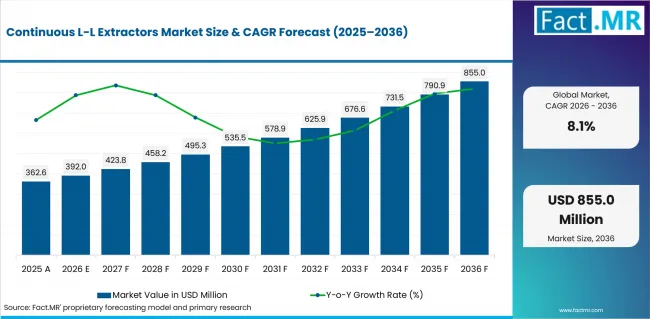
Continuous L L Extractors Market Value Analysis | Source: Fact.MR
What are the defining numbers behind Continuous L-L Extractors Market growth?
USD 463 million absolute opportunity by 2036, led by Pulsed/packed columns and Hydrometallurgy/metal recovery within their respective segments.
- Demand Drivers in the Market
- Critical-mineral and battery-material projects create equipment demand once their flowsheets require continuous solvent extraction. That moves extractor selection into early plant design.
- Rare earth separation relies on repeated liquid-liquid extraction stages because closely related elements need selective separation. New domestic processing projects therefore translate into demand for extraction equipment.
- Recycling projects need systems that can manage variable leach solutions at commercial scale. Buyers look for piloting support before committing to a full circuit.
- Pharmaceutical manufacturers consider continuous extraction when batch work limits throughput or extends product residence time. Containment and validation requirements shape the equipment choice.
- Chemical and metals processors replace legacy mixer-settler batteries when solvent inventory, footprint, or process control becomes a constraint. This supports demand for modern column and centrifugal designs.
- Key Segments Analyzed
- By Extractor Type: Pulsed/packed columns lead at 35.2% of 2026 demand because they deliver many theoretical stages in a compact continuous footprint with no moving parts in contact with the phases, which makes them the workhorse of hydrometallurgical and petrochemical circuits where reliability over years of continuous duty decides economics.
- By Driving Mechanism: Gravity-based columns hold 42.0% of demand because density-driven countercurrent contact needs no mechanical energy input and scales predictably from pilot to production, while centrifugal force at 20.0% grows fastest where short residence time and low solvent inventory matter, as in pharmaceutical and nuclear-related service.
- By Application: Hydrometallurgy and metal recovery account for 39.0% of application demand because copper, nickel, cobalt, uranium and rare earth flowsheets all center on solvent extraction, and the critical minerals buildout is adding circuits faster than any other sector.
- By Capacity: Lab and pilot units support solvent screening and scale-up work. Mid-scale systems validate continuous operation before a full plant commitment, while large and small production units serve different throughput requirements.
- By End User: Chemical producers hold 42.0% of end user demand as the broadest continuous extraction user base, while metals and mining at 17.0% and pharmaceutical manufacturers at 17.0% represent the highest-specification and fastest-growing buying groups.
- Analyst Opinion at Fact.MR
- Shambhu Nath Jha, Sr. Consultant at Fact.MR, states, “A continuous extractor is chosen around the chemistry of the feed. Buyers need to establish phase behavior first, then test the contactor at the throughput their plant requires. That sequence matters because a design that works with a clean test solution can behave differently with an actual leach liquor or process stream.”
- Strategic Implications
- Project developers should budget for pilot extraction trials on actual leach liquor before freezing flowsheets, since phase behavior on real feeds routinely differs from synthetic test work.
- Suppliers can differentiate on stage efficiency documentation and scale-up guarantees, which de-risk the financing of new extraction circuits.
- Pharmaceutical users should evaluate centrifugal contactors where solvent inventory and residence time affect product stability and safety cases.
- Recyclers benefit from modular extraction skids that scale by numbering up, matching the staged capacity growth of battery recycling plants.
Sulzer provides extraction technology for hydrometallurgical metal recovery, with its OptimEXT system based on a Kühni column and supported by pilot testing. This gives buyers a direct example of the scale-up support required before a new extraction circuit is specified.
The United States is positioned for 8.8% annual growth from 2026 to 2036 on federal processing investment. Australia is projected to grow at 8.5% on rare earth and battery mineral projects. China follows at 8.2% on its dominant separation capacity, Germany advances at 7.9% on pharmaceutical and specialty chemical purification, and India records 7.4% as its processing ambitions build from a small base.
How does the Continuous L-L Extractors Market break down by segment?
The leading shares are Pulsed/packed columns at 35.2% by Extractor Type and Hydrometallurgy/metal recovery at 39.0% by Application.
Why do pulsed/packed columns lead the extractor mix?
At 35.0% share in 2026, pulsed/packed columns lead because they combine high stage counts, no wetted moving parts, and proven scale-up from pilot to plant.
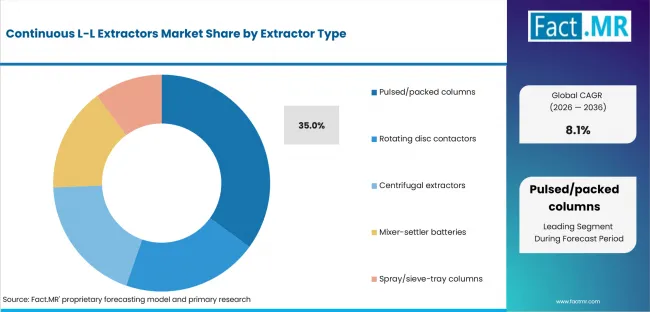
Continuous L L Extractors Market Analysis By Extractor Type | Source: Fact.MR
Pulsed/packed columns account for 35.0% of demand because hydrometallurgical and petrochemical circuits run continuously for years, and a column with pulsed or packed internals delivers many stages with minimal mechanical risk. Rotating disc contactors suit duties where agitation improves mass transfer. Centrifugal extractors fit pharmaceutical and high-value service, mixer-settler batteries remain relevant in legacy and uranium circuits, and spray and sieve-tray columns serve simpler duties.
Why do gravity-based columns dominate driving mechanisms?
A 42.0% share puts gravity-based columns first in 2026 because density-driven countercurrent flow is the cheapest, most reliable way to run extraction continuously.
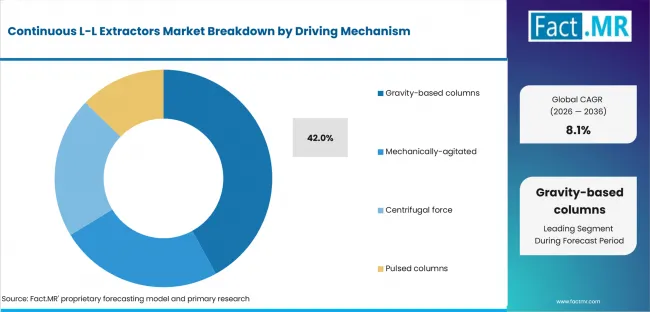
Continuous L L Extractors Market Analysis By Driving Mechanism | Source: Fact.MR
Gravity-based columns represent 42.0% of demand because the phases move by density difference alone, eliminating mechanical complexity in contact with corrosive and solvent-laden streams. Mechanically agitated systems are used where interfacial area needs boosting. Centrifugal force suits duties where hold-up and residence time must shrink, while pulsed columns intensify contact without internal moving parts.
Why does hydrometallurgy lead the application group?
The 2026 leader is hydrometallurgy and metal recovery at 39.0% share because every major critical mineral flowsheet centers on solvent extraction cascades.
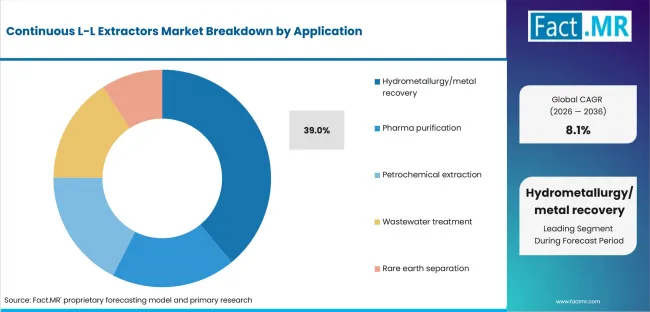
Continuous L L Extractors Market Analysis By Application | Source: Fact.MR
Hydrometallurgy and metal recovery account for 39.0% of application demand because copper, nickel, cobalt, zinc, uranium and rare earth production routes converge on solvent extraction as the purification step, and the critical minerals investment wave is adding circuits globally. Pharmaceutical purification supports antibiotic, peptide and API production. Petrochemical extraction, wastewater treatment, and specialized rare-earth circuits each depend on duty-specific separation requirements.
How does capacity shape extractor selection?
Capacity selection follows the required throughput. It also depends on solvent inventory and validation needs.
Lab and pilot systems let buyers test phase behavior before equipment is sized for a plant. Mid-scale units prove continuous operation under representative conditions. Large production extractors suit established flowsheets where throughput drives equipment selection. Small production systems fit specialty chemical and pharmaceutical duties that need continuous separation at lower volumes.
Why do chemical producers lead the end user group?
The leading 2026 share is 42.0% for chemical producers because extraction is a routine unit operation across their purification and recovery processes.
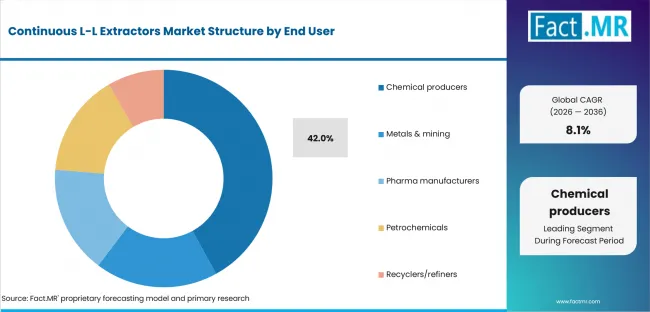
Continuous L L Extractors Market Analysis By End User | Source: Fact.MR
Chemical producers represent 42.0% of demand because continuous extraction runs across their product slate, from solvent recovery to product purification, giving them the largest installed base and steady renewal demand. Metals and mining companies buy circuit equipment for hydrometallurgy, pharmaceutical manufacturers use high-specification systems for purification, petrochemical operators require process-specific extraction equipment, and recyclers and refiners add modular capacity as battery recycling scales.
What is accelerating Continuous L-L Extractors Market adoption, and what is holding it back?
The principal accelerator is the critical minerals and battery recycling buildout, whose flowsheets cannot avoid solvent extraction. Adoption is slowed by the long engineering timelines of extraction circuits, solvent management and fire safety requirements, and competition from alternative separation technologies in some duties.
Drivers Impact Analysis
| DRIVER | (~) % IMPACT ON CAGR | GEOGRAPHIC RELEVANCE | IMPACT TIMELINE |
|---|---|---|---|
| Critical minerals processing buildout | +1.4% | United States, Australia, China | Medium term (2-4 years) |
| Battery recycling plants | +1.2% | North America, Europe | Medium term (2-4 years) |
| Rare earth separation investment | +1.0% | United States, Australia, Europe | Long term (>= 4 years) |
| Pharma purification intensification | +0.8% | Global pharma hubs | Medium term (2-4 years) |
| Mixer-settler modernization | +0.6% | Legacy circuits globally | Long term (>= 4 years) |
- Critical minerals processing buildout: DOE issued a March 2026 funding opportunity of up to USD 500 million for critical-material processing and battery recycling. Eligible projects may require solvent-extraction equipment when their process design uses that route.
- Battery recycling plants: Many battery-recycling flowsheets use solvent extraction to separate nickel, cobalt, manganese, and lithium from leach solutions. Equipment demand depends on the selected flowsheet.
- Rare earth separation investment: The USGS identifies several rare earth elements as high-risk supply chains. That supports interest in domestic separation capacity, where solvent extraction remains an established approach.
Opportunity Impact Analysis
| OPPORTUNITY | (~) % IMPACT ON CAGR | GEOGRAPHIC RELEVANCE | IMPACT TIMELINE |
|---|---|---|---|
| Pilot testing services | +0.5% | Project developers globally | Short term (<= 2 years) |
| Modular extraction skids | +0.4% | Recyclers and small processors | Medium term (2-4 years) |
| Centrifugal contactor retrofits | +0.4% | Pharmaceutical plants | Medium term (2-4 years) |
| Solvent recovery integration | +0.3% | Large circuits | Long term (>= 4 years) |
- Pilot testing services: Project developers need stage efficiency and phase behavior data on real feeds. Suppliers operating test centers convert pilot work into equipment orders with embedded scale-up confidence.
- Modular extraction skids: Battery recyclers grow capacity in stages. Skid-mounted extraction modules that number up let plants match investment to feedstock availability.
- Centrifugal contactor retrofits: Pharmaceutical plants replacing batch separations with continuous centrifugal contactors cut solvent inventory and cycle time, a retrofit opportunity across the antibiotic and API installed base.
Restraints Impact Analysis
| RESTRAINT | (~) % IMPACT ON CAGR | GEOGRAPHIC RELEVANCE | IMPACT TIMELINE |
|---|---|---|---|
| Long circuit engineering timelines | -0.5% | New min\erals projects | Medium term (2-4 years) |
| Solvent fire and safety burden | -0.4% | All installations | Long term (>= 4 years) |
| Alternative separation technologies | -0.3% | Membrane and adsorption niches | Medium term (2-4 years) |
| Reagent supply constraints | -0.2% | Specialized extractants | Short term (<= 2 years) |
- Long engineering timelines: Extraction circuits require test work, pilot validation and staged engineering before equipment orders, stretching the conversion of project announcements into equipment revenue.
- Solvent fire and safety burden: Large hydrocarbon solvent inventories impose fire protection, ventilation and regulatory costs that some projects use to justify alternative separation routes.
- Alternative separation technologies: Membranes, adsorption and ion exchange compete for some separation duties, particularly where solvent use is politically or environmentally sensitive.
How do the leading continuous L-L extractor markets compare?
United States 8.8% CAGR. Australia 8.5%. China 8.2%. Germany 7.9%. India 7.4%.
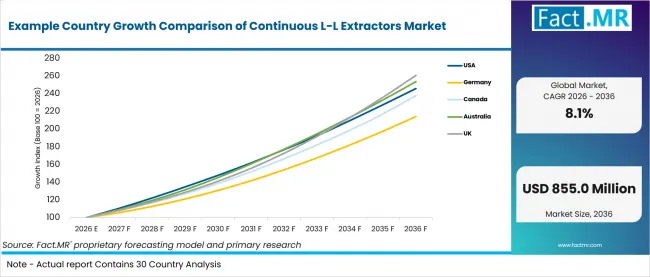
Example Country Growth Comparison Of Continuous L L Extractors Market | Source: Fact.MR
| COUNTRY | CAGR |
|---|---|
| United States | 8.8% |
| Australia | 8.5% |
| Germany | 7.9% |
Why Is US Federal Funding Building a New Extraction Circuit Pipeline?
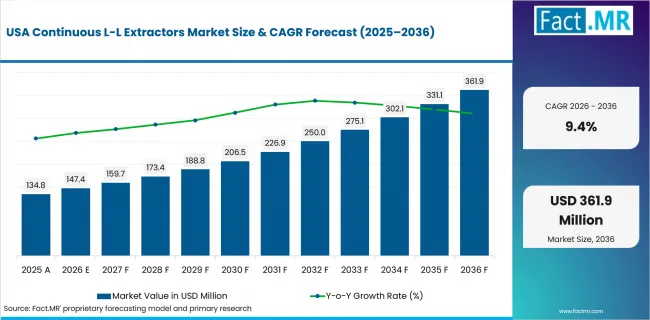
Continuous L L Extractors Market Country Value Analysis | Source: Fact.MR
The United States is financing separation capacity directly. DOE’s Office of Critical Minerals and Energy Innovation announced up to USD 500 million in March 2026 for critical mineral processing and battery recycling demonstration and commercial plants, the third funding round under the infrastructure law’s battery materials programs. In August 2025, the department had already outlined nearly USD 1 billion across four opportunities, including up to USD 135 million for rare earth recovery from mine tailings with a required academic partner.
Every funded hydrometallurgical plant contains extraction circuits, and the USGS critical minerals list, finalized in November 2025 with 60 commodities and rare earths flagged as highest-risk, keeps the policy momentum behind domestic separation. For continuous L-L extractors, United States demand is projected to grow at an 8.8% CAGR from 2026 to 2036.
Why Do Australia’s Rare Earth and Battery Mineral Projects Specify Extraction?
Australia hosts some of the most advanced non-Chinese rare earth and lithium processing projects in the world, and solvent extraction sits at the heart of their flowsheets. Australian research institutions bring decades of hydrometallurgical expertise to pilot validation, and government critical minerals strategy backing keeps the project pipeline full.
As projects move from demonstration to commercial scale, extraction columns and contactors follow. Australia’s demand grows at an 8.5% CAGR from 2026 to 2036.
Why Is Germany a Pharmaceutical and Specialty Chemical Extraction Market?
Germany’s pharmaceutical and specialty chemical sectors use continuous extraction for purification and solvent recovery, and German process engineering favors documented, well-instrumented equipment. The country’s pharmaceutical manufacturers are steady buyers of centrifugal contactors and columns for API purification.
European battery recycling projects sited in Germany add hydrometallurgical demand. Germany’s demand grows at a 7.9% CAGR from 2026 to 2036.
Who leads the Continuous L-L Extractors Market?
Sulzer Chemtech, Koch Modular, Rousselet Robatel, De Dietrich Process Systems, CINC Industries, and B&P Littleford compete through stage efficiency, scale-up validation, and application references.
Competition turns on stage efficiency, real-feed pilot validation, and scale-up support. Sulzer Chemtech’s documented column engineering and pilot-testing services illustrate the technical proof points buyers use; Koch Modular, Rousselet Robatel, De Dietrich Process Systems, CINC Industries, and B&P Littleford broaden the competitive set for recycling skids, centrifugal retrofits, and rare-earth circuit packages.
Buyers differentiate suppliers by the fit of their equipment and support with the process duty.
Which companies are the key providers?
The company set includes Sulzer Chemtech, Koch Modular, Rousselet Robatel, De Dietrich Process Systems, CINC Industries, and B&P Littleford.
- Sulzer Chemtech
- Koch Modular
- Rousselet Robatel
- De Dietrich Process Systems
- CINC Industries
- B&P Littleford
Bibliography
- U.S. Department of Energy, Office of Critical Minerals and Energy Innovation. (2026). Notice of Funding Opportunity: up to USD 500 million for critical materials processing and battery recycling.
- U.S. Geological Survey. (2025). Final 2025 List of Critical Minerals and associated supply chain risk assessment.
- U.S. Congressional Research Service. (2026). Critical Mineral Resources: National Policy and Critical Minerals List, R47982.
- Sulzer Chemtech. (n.d.). Liquid-Liquid Extraction Columns and Services.
This Report Addresses
- The report quantifies the 2025 baseline and forecasts revenue from 2026 through 2036.
- It compares the United States, Australia, China, Germany, and India, drawing on country coverage of 30+ markets.
- It evaluates Sulzer Chemtech, Koch Modular, Rousselet Robatel, De Dietrich Process Systems, CINC Industries, and B&P Littleford.
- It examines extractor type, driving mechanism, application, capacity, and end user choices.
- It separates hydrometallurgical, pharmaceutical, petrochemical, rare earth, and wastewater extraction demand.
- It tests the forecast against critical minerals investment, recycling plant construction, and purification modernization.
What does the Continuous L-L Extractors Market cover?
The study follows extraction equipment from flowsheet development and pilot testing through plant installation and circuit optimization.
Revenue includes the extractor column or contactor, internals, agitation or pulsing systems, controls, and pilot testing services billed by the equipment supplier. Complete solvent extraction plants as turnkey contracts are excluded.
Demand is segmented by extractor type, driving mechanism, application, capacity, and end user. Country estimates reflect processing investment, project pipelines, installed circuit age, and supplier test center access.
What is included in the scope?
Included systems perform continuous countercurrent liquid-liquid contact for separation and purification.
Pulsed/packed columns, rotating disc contactors, centrifugal extractors, mixer-settler batteries and spray and sieve-tray columns are counted across all covered applications and capacities. Pilot and test work billed by the equipment supplier is covered.
What is excluded from the scope?
Batch extraction equipment, membranes, adsorption systems, and complete turnkey plants are not included.
The study excludes separatory funnels and batch extraction tanks, membrane and ion exchange separation systems, distillation equipment, and full solvent extraction plant contracts covering civil works and balance of plant.
How was the analysis built?
Project pipelines, circuit counts, operator interviews, and forecast cross-checks referencing more than 30 countries.
- Primary Research: Primary research targets process engineers in minerals and chemicals, pharmaceutical purification managers, extraction equipment suppliers, and engineering firms. Interviews test stage requirements, phase behavior experience, equipment selection, solvent management, and modernization timing.
- Desk Research: Desk research reviews government critical minerals funding and policy documents, geological survey publications, project feasibility disclosures, and manufacturer literature. Named programs are used only when supported by the government sources listed in the bibliography.
- Market-Sizing and Forecasting: Sizing is developed from circuit counts, extractors per circuit, type and capacity mixes, realized pricing, pilot service revenue, and replacement cycles. The result is reconciled to USD 392 million in 2026 and USD 855 million in 2036.
- Data Validation and Update Cycle: Validation compares segment shares, supplier positions, and country growth with funded project lists and commissioning reports. Update signals include DOE award announcements, recycling plant permits, rare earth project milestones, and product launches.
What is the report’s scope and coverage?
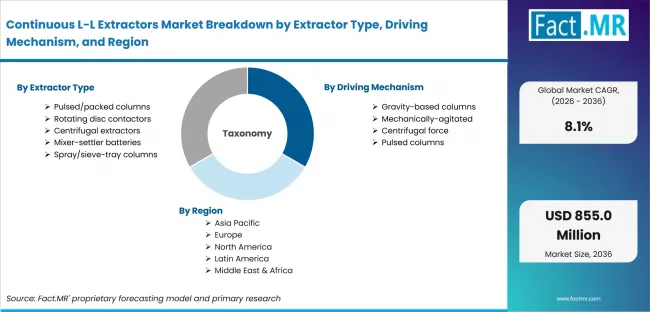
Continuous L L Extractors Market Breakdown By Extractor Type, Driving Mechanism, And Region | Source: Fact.MR
| ATTRIBUTE | DETAILS |
|---|---|
| Quantitative Units | USD 392 Million in 2026 to USD Mllion by 2036 at CAGR |
| Market Definition | The market covers continuous liquid-liquid extraction columns and centrifugal contactors for solvent extraction, purification and metal recovery in chemical, pharmaceutical, petrochemical and hydrometallurgical processes. |
| Extractor Type | Pulsed/packed columns; Rotating disc contactors; Centrifugal extractors; Mixer-settler batteries; Spray/sieve-tray columns |
| Driving Mechanism | Gravity-based columns; Mechanically-agitated; Centrifugal force; Pulsed columns |
| Application | Hydrometallurgy/metal recovery; Pharma purification; Petrochemical extraction; Rare earth separation; Wastewater treatment |
| Capacity | Lab/pilot; Small production; Mid-scale; Large production |
| End User | Chemical producers; Metals & mining; Pharma manufacturers; Petrochemicals; Recyclers/refiners |
| Regions Covered | North America; Asia Pacific; Europe |
| Countries Covered | United States; Australia; China; Germany; India (full report analyzes 30+ countries) |
| Key Companies Profiled | Sulzer Chemtech; Koch Modular; Rousselet Robatel; De Dietrich Process Systems; CINC Industries; B&P Littleford |
| Forecast Period | 2026 to 2036 |
| Approach | Sizing combines circuit counts by application, extractor prices by type and capacity, project pipelines in minerals and recycling, and separately billed pilot testing and service. |
How is the market segmented?
-
By Extractor Type:
- Pulsed/packed columns
- Rotating disc contactors
- Centrifugal extractors
- Mixer-settler batteries
- Spray/sieve-tray columns
-
By Driving Mechanism:
- Gravity-based columns
- Mechanically-agitated
- Centrifugal force
- Pulsed columns
-
By Application:
- Hydrometallurgy/metal recovery
- Pharma purification
- Petrochemical extraction
- Rare earth separation
- Wastewater treatment
-
By Capacity:
- Lab/pilot
- Small production
- Mid-scale
- Large production
-
By End User:
- Chemical producers
- Metals & mining
- Pharma manufacturers
- Petrochemicals
- Recyclers/refiners
-
By Region:
- North America
- Asia Pacific
- Europe