- Base Value(2026): 3.9 Bn
- Estimated Value(2026): 3.9 Bn
- Forecast Value (2036): 5.8 Bn
- CAGR (2026 - 2036): 4.0%
Continuous Casting Auxiliary Equipment Market Forecast Outlook 2026 to 2036
The continuous casting auxiliary equipment market is expected to reach USD 3.9 billion in 2026, growing to USD 5.8 billion by 2036, with a CAGR of 4%.
Key Takeaways from Continuous Casting Auxiliary Equipment Market
- Continuous Casting Auxiliary Equipment Market Value (2026): USD 3.9 billion
- Continuous Casting Auxiliary Equipment Market Forecast Value (2036): USD 5.8 billion
- Continuous Casting Auxiliary Equipment Market Forecast CAGR 2026 to 2036: 4%
- Leading Segment in Continuous Casting Auxiliary Equipment Market: Integrated (BF-BOF) Plant Type (62%)
- Key Growth Region in Continuous Casting Auxiliary Equipment Market: Asia Pacific
- Key Players in Continuous Casting Auxiliary Equipment Market: Primetals Technologies Limited, SMS group GmbH, Danieli & C. Officine Meccaniche S.p.A., Tenova S.p.A., Toshiba Mitsubishi-Electric Industrial Systems Corporation (TMEIC), Mitsubishi Heavy Industries, Ltd., IHI Corporation, Nippon Steel Engineering Co., Ltd., ABB Ltd., Siemens AG
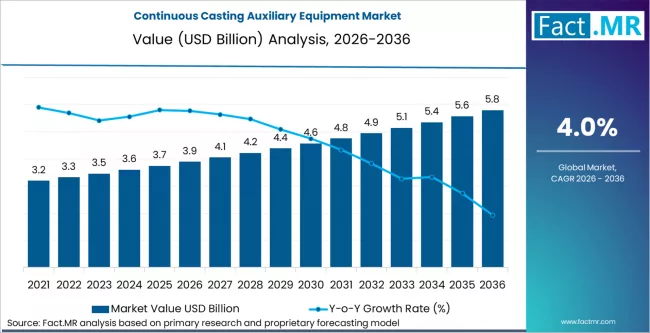
Continuous Casting Auxiliary Equipment Market Market Value Analysis | Source: Fact.MR
Decision-makers must understand that while this market presents steady growth, it remains sensitive to fluctuations in global steel production and raw material costs. Economic exposure is particularly tied to the cyclical nature of the manufacturing sector, which can impact equipment demand during periods of industry contraction.
Prioritization of investments should focus on ensuring operational efficiency and minimizing downtime, as reliability and uptime are key in this space. Timing of procurement and upgrades will be crucial, as market shifts toward more advanced automation technologies could offer competitive advantages. With growing demand for energy-efficient solutions, companies must stay aligned with sustainability initiatives while managing capital expenditures carefully. Decisions made today will set the foundation for long-term operational resilience and alignment with broader industry trends.
Continuous Casting Auxiliary Equipment Market
| Metric | Value |
|---|---|
| Estimated Value in (2026E) | USD 3.9 billion |
| Forecast Value in (2036F) | USD 5.8 billion |
| Forecast CAGR 2026 to 2036 | 4% |
Source: Fact.MR analysis. Updated Jan 29, 2026
Category
| Category | Segments |
|---|---|
| Equipment Type | Mold Level Control and Oscillation; Secondary Cooling and Spray Systems; Tundish Heating and Flow Control Auxiliaries; Roller Aprons and Strand Support Auxiliaries |
| Casting Product | Slab Casters; Bloom Casters; Billet Casters; Other |
| Plant Type | Integrated (BF-BOF); Mini Mills (EAF); Other |
| Region | North America; Europe; Asia Pacific; Latin America; Middle East & Africa |
Source: Fact.MR analysis. Updated Jan 29, 2026
Segmental Analysis
What Is the Impact of Casting Product on the Continuous Casting Auxiliary Equipment Market?
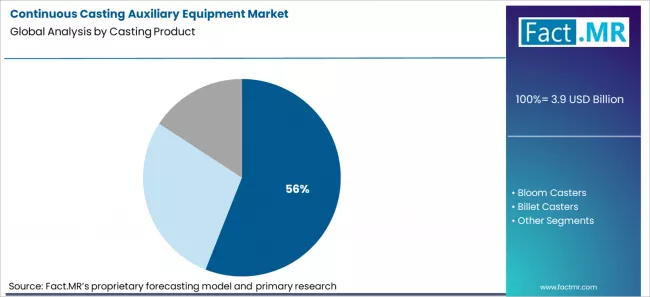
Continuous Casting Auxiliary Equipment Market Analysis By Casting Product | Source: Fact.MR
In the continuous casting auxiliary equipment market, casting product is a critical factor in determining the demand for specific equipment. Slab casters lead the market with a 56% share, as they are essential in producing wide, thick steel sections for industries such as construction, automotive, and heavy machinery. Slab casting is highly preferred for producing high-quality products with minimal defects, making it a key driver in the market. As the demand for steel continues to grow in construction and infrastructure projects, the need for slab casters and their auxiliary equipment will remain strong, with billet and bloom casters supporting niche requirements.
What Is the Impact of Plant Type on the Continuous Casting Auxiliary Equipment Market?
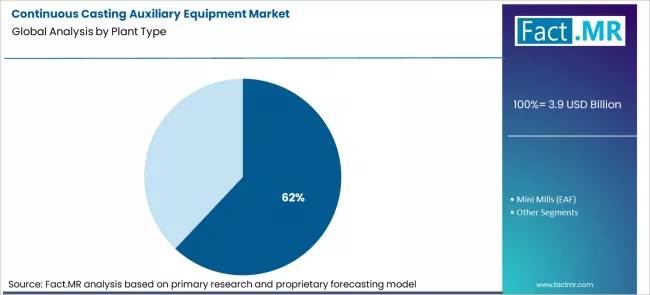
Continuous Casting Auxiliary Equipment Market Analysis By Plant Type | Source: Fact.MR
Plant type plays a significant role in shaping the demand for continuous casting auxiliary equipment, with integrated (BF-BOF) plants holding a 62% share. Integrated plants, which combine blast furnaces (BF) and basic oxygen furnaces (BOF), require advanced continuous casting systems to maximize efficiency and produce high-quality steel products in large volumes. These plants are critical for meeting the increasing global demand for steel in construction, automotive, and manufacturing sectors. As steel production moves toward greater automation and efficiency, the demand for advanced auxiliary equipment in integrated plants will continue to drive the growth of the continuous casting market. Mini mills (EAF) also contribute to the market, focusing on smaller-scale, electric arc furnace operations.
What are the Drivers, Restraints, and Key Trends in the Continuous Casting Auxiliary Equipment Market?
Demand for continuous casting auxiliary equipment is driven by steelmakers’ need to improve yield, surface quality, and throughput in continuous casting operations across flat and long steel production. Plant engineers specify equipment such as mold level controllers, electromagnetic stirrers, and strand support systems to stabilize solidification, reduce defects, and support consistent metallurgical properties. Procurement teams prioritize solutions that integrate with existing caster lines, deliver repeatable performance, and support data capture for process control. High upfront and integration costs can constrain adoption in smaller mills with limited capital budgets. Variability in slab, billet, and bloom formats also affects equipment specification and setup time. Key trends include development of advanced control systems that optimize casting parameters in real time and modular auxiliary units that support scalable implementation across varied caster configurations.
Analysis of the Continuous Casting Auxiliary Equipment Market by Key Country
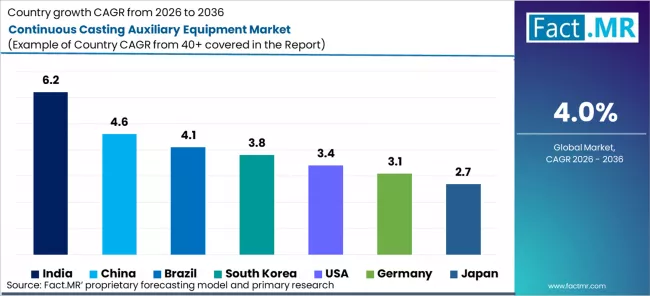
Continuous Casting Auxiliary Equipment Market Cagr Analysis By Country | Source: Fact.MR
| Country | CAGR (2026-2036) |
|---|---|
| USA | 3.4% |
| China | 4.6% |
| India | 6.2% |
| Germany | 3.1% |
| Japan | 2.7% |
| South Korea | 3.8% |
| Brazil | 4.1% |
Source: Fact.MR analysis. Updated Jan 29, 2026
The report covers an in-depth analysis of 40+ countries; top-performing countries are highlighted below.
What is the Outlook on the Continuous Casting Auxiliary Equipment Market in the USA?
USA market in continuous casting auxiliary equipment is projected to grow at a CAGR of 3.4% from 2026 to 2036. The demand for continuous casting auxiliary equipment is driven by industries such as steel manufacturing, automotive, and construction, where efficiency in metal casting is critical. With ongoing investments in infrastructure and manufacturing technologies, there is a growing need for advanced equipment that improves production efficiency and product quality. Companies in the USA should focus on providing high-performance, durable auxiliary equipment that meets the industry's evolving demands for energy efficiency and process optimization.
What is the Demand for Continuous Casting Auxiliary Equipment in China?
Sales of continuous casting auxiliary equipment in China are expected to grow at a CAGR of 4.6% from 2026 to 2036. As China continues to expand its steel manufacturing and automotive industries, the demand for continuous casting equipment is rising. The country's focus on upgrading its industrial processes and improving efficiency in metal production will continue to drive demand for high-performance auxiliary equipment. Suppliers and manufacturers should focus on providing cost-effective, technologically advanced solutions that cater to China’s rapidly growing industrial base and support its drive toward modernization.
What is the Sales Outlook on Continuous Casting Auxiliary Equipment in India?
The demand for continuous casting auxiliary equipment in India is projected to grow at a CAGR of 6.2% from 2026 to 2036. With India’s expanding manufacturing and steel production sectors, the need for efficient and reliable casting equipment is increasing. The country’s focus on industrial growth, infrastructure development, and improving product quality standards in sectors like steel and automotive is contributing to the rising demand for auxiliary equipment. Manufacturers should target India’s growing demand by offering advanced, energy-efficient solutions that help industries meet quality and production goals while improving overall operational performance.
What is the Demand for Continuous Casting Auxiliary Equipment in Germany?
Germany market in continuous casting auxiliary equipment is forecast to grow at a CAGR of 3.1% from 2026 to 2036. As Germany continues to lead in advanced manufacturing and industrial technologies, the demand for efficient casting equipment in sectors such as steel production, automotive, and construction remains strong. The country’s focus on maintaining high manufacturing standards and improving energy efficiency in industrial processes will continue to support steady growth in the market for continuous casting auxiliary equipment. Companies in Germany should focus on delivering high-tech, sustainable solutions that comply with the country’s stringent environmental regulations.
What is the Sales Outlook on Continuous Casting Auxiliary Equipment in Japan?
Japan demand for continuous casting auxiliary equipment is set to grow at a CAGR of 2.7% from 2026 to 2036. Japan's strong manufacturing base, particularly in steel and automotive production, is driving the need for reliable casting equipment that ensures high-quality outputs and operational efficiency. While the market is mature, Japan's continued investments in industrial upgrades and focus on sustainability in manufacturing processes will support moderate growth in the continuous casting auxiliary equipment market. Companies should focus on offering advanced solutions that improve process optimization and reduce resource consumption.
What is the Market Expansion Outlook for Continuous Casting Auxiliary Equipment in South Korea?
The demand for continuous casting auxiliary equipment in South Korea is projected to grow at a CAGR of 3.8% from 2026 to 2036. South Korea's advanced manufacturing sectors, particularly in steel and automotive production, are increasing the need for high-quality casting equipment. With ongoing investments in industrial upgrades and a growing focus on improving efficiency and sustainability in production processes, the market for continuous casting auxiliary equipment is expected to experience steady growth. Manufacturers should provide innovative solutions that help improve production capacity, energy efficiency, and overall cost-effectiveness.
What is the Market Expansion Outlook for Continuous Casting Auxiliary Equipment in Brazil?
Sales of continuous casting auxiliary equipment in Brazil are expected to grow at a CAGR of 4.1% from 2026 to 2036. As Brazil continues to expand its manufacturing and steel industries, the demand for efficient and reliable casting equipment is rising. The country’s focus on improving industrial processes and meeting international production standards is driving this growth. Suppliers and manufacturers should focus on offering advanced casting equipment solutions that meet the country’s increasing demand for high-quality, energy-efficient production systems, particularly in the steel and automotive sectors.
What is Driving Change in Continuous Casting Auxiliary Equipment Market?
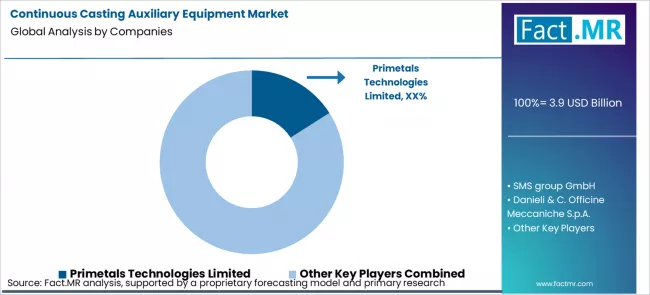
Continuous Casting Auxiliary Equipment Market Analysis By Company | Source: Fact.MR
From 2024, continuous casting auxiliary equipment market has been evolving due to advancements in automation, digitalization, and decarbonization. Companies like Primetals Technologies and SMS Group are integrating AI-driven systems and predictive maintenance into their equipment to improve efficiency and reduce downtime. Digitalization efforts, such as Primetals' automation contracts, are enhancing operational reliability by providing real-time monitoring and improving process control. Decarbonization initiatives, like hydrogen injection systems, are gaining momentum in steel industry, aligning with global environmental goals. Companies expanding in Asia and other emerging markets are responding to growing demand for steel and aluminum, ensuring long-term competitiveness. This shift reflects broader industry trends towards flexible, modular, and sustainable solutions in production.
Key Players of the Continuous Casting Auxiliary Equipment Market
- Primetals Technologies Limited
- SMS group GmbH
- Danieli & C. Officine Meccaniche S.p.A.
- Tenova S.p.A.
- Toshiba Mitsubishi-Electric Industrial Systems Corporation (TMEIC)
- Mitsubishi Heavy Industries, Ltd.
- IHI Corporation
- Nippon Steel Engineering Co., Ltd.
- ABB Ltd.
- Siemens AG
Bibliographies
- International Organization for Standardization. (2024). ISO 14284: Steel continuous casting - Mold oscillation parameters and control. ISO.
- European Committee for Standardization. (2023). EN 746-2: Industrial thermoprocessing equipment - Safety requirements for combustion and fuel handling systems. CEN.
- American Society of Mechanical Engineers. (2023). ASME Boiler and Pressure Vessel Code, Section VIII - Pressure components. ASME.
- World Steel Association. (2024). Steel statistical yearbook - Production technologies and process efficiency benchmarks. World Steel Association.
- Association for Iron & Steel Technology. (2024). Continuous casting fundamentals and auxiliary system integration. AIST.
Segmentation
Scope of the Report
| Items | Values |
|---|---|
| Quantitative Units (2026) | USD Billion |
| Equipment Type | Mold Level Control and Oscillation, Secondary Cooling and Spray Systems, Tundish Heating and Flow Control Auxiliaries, Roller Aprons and Strand Support Auxiliaries |
| Casting Product | Slab Casters, Bloom Casters, Billet Casters |
| Plant Type | Integrated (BF-BOF), Mini Mills (EAF) |
| Regions Covered | North America, Europe, Asia Pacific, Latin America, Middle East & Africa |
| Countries Covered | United States, Canada, Mexico, Germany, United Kingdom, France, Japan, South Korea, China, India, Brazil, and other countries |
| Key Companies Profiled | Primetals Technologies Limited, SMS group GmbH, Danieli & C. Officine Meccaniche S.p.A., Tenova S.p.A., Toshiba Mitsubishi-Electric Industrial Systems Corporation (TMEIC), Mitsubishi Heavy Industries, Ltd., IHI Corporation, Nippon Steel Engineering Co., Ltd., ABB Ltd., Siemens AG |
| Additional Attributes | Dollar revenue by equipment type, casting product, plant type, and region; regional demand trends, competitive landscape, technological advancements in continuous casting auxiliary equipment, operational performance optimization initiatives, and product development strategies |
Source: Fact.MR analysis. Updated Jan 29, 2026
Continuous Casting Auxiliary Equipment Market Key Segments
-
Equipment Type :
- Mold Level Control and Oscillation
- Secondary Cooling and Spray Systems
- Tundish Heating and Flow Control Auxiliaries
- Roller Aprons and Strand Support Auxiliaries
-
Casting Product :
- Slab Casters
- Bloom Casters
- Billet Casters
- Other
-
Plant Type :
- Integrated (BF-BOF)
- Mini Mills (EAF)
- Other
-
Region :
- North America
- USA
- Canada
- Mexico
- Europe
- Germany
- UK
- France
- Italy
- Spain
- Rest of Europe
- Asia Pacific
- China
- Japan
- South Korea
- India
- Australia
- Rest of Asia Pacific
- Latin America
- Brazil
- Argentina
- Rest of Latin America
- Middle East and Africa
- Kingdom of Saudi Arabia
- United Arab Emirates
- South Africa
- Rest of Middle East and Africa
- Other Regions
- Oceania
- Central Asia
- Other Markets
- North America
Frequently Asked Questions
How big is the continuous casting auxiliary equipment market in 2026?
What will be the size of continuous casting auxiliary equipment market in 2036?
How much will be the continuous casting auxiliary equipment market growth between 2026 and 2036?
What are the key product types in the continuous casting auxiliary equipment market?
Which casting product segment to contribute significant share in the continuous casting auxiliary equipment market in 2026?
Who worked on this report


Preview the report firsthand - request a free sample
Free SampleGet the brochure for pricing and purchase details
Download PDF