- Market Value (2025): USD 64.80 Bn
- Estimated Value (2026): USD 68.2 Bn
- Forecast Value (2036): USD 113.2 Bn
- CAGR (2026-2036): 5.2%
What is the Copper Cable Market forecast to be worth by 2036?
USD 68.2 billion in 2026 to USD 113.2 billion by 2036 at a 5.2% CAGR.
- In 2025, the copper cable market was worth USD 64.8 billion, with structured cabling, power distribution and plant wiring providing most of that base.
- Revenue will move from USD 68.2 billion in 2026 to USD 113.2 billion by 2036 as grid reinforcement, factory electrification and enterprise network upgrades widen the order book.
- A 5.2% CAGR reflects steady replacement work on aging networks, combined with new circuits for data centres, charging points and automated production lines.
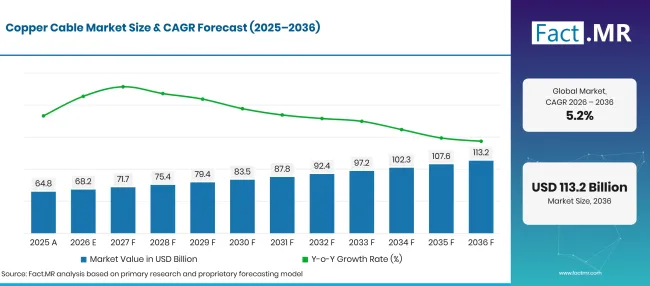
Copper Cable Market Forecast Global | Source: Fact.MR
| Year | Basis | Market Value (USD billion) |
|---|---|---|
| 2025 | Actual | 64.8 |
| 2026 | Estimate | 68.2 |
| 2036 | Forecast | 113.2 |
| CAGR 2026 to 2036 | Forecast period | 5.2% |
Source: Fact.MR analysis. Updated Nov 6, 2026
What are the defining numbers behind Copper Cable Market growth?
The 2026 to 2036 period will add USD 45.0 billion in new value, with twisted pair and telecommunications cabling carrying the biggest single blocks.
- Demand Drivers in the Market
- Network access keeps widening. About 6 billion people were online in 2025, while 2.2 billion remained offline, according to ITU [1]. Each new office floor, campus and access node still needs copper patch and horizontal cabling between the fibre backbone and the end device.
- Data centres are pulling heavy power and signal cabling into new sites. The U.S. Department of Energy notes that data centres used about 4.4% of U.S. electricity in 2023 and could reach up to 12% by 2028 [2]. Every rack row adds copper feeders, busway connections and short-reach links.
- Buildings remain the base load for copper conductors. USGS reports that building construction accounted for 42% of U.S. copper use in 2025 and electrical and electronic products for another 23% [3]. Wiring codes that call for more circuits per dwelling keep this volume steady.
- Plant automation is adding control, instrumentation and motor cables. Robots, drives and sensor networks each need shielded multi-conductor runs, and retrofits of older lines often replace whole cable trays at once. Plant owners prefer cable with oil, heat and flex ratings that match the machine, which shortens downtime during changeovers.
- Key Segments Analyzed
- By Product Type: Twisted Pair Cable will hold 38.4% share in 2026, since structured cabling in offices, campuses and server rooms still runs over copper pairs between switches and end devices.
- By Application: Telecommunications will account for 28.6% of 2026 value, as operators and enterprises keep copper in access, in-building and equipment links where short distances favour it.
- Analyst Opinion at Fact.MR
- Shambhu Nath Jha, Principal Consultant at Fact.MR, states, “Copper will keep its role wherever power and data must travel short distances to many endpoints, and that describes most buildings, plants and server halls. Grid operators and data centre builders will set the pace of orders, while metal price swings will decide who protects margin. Suppliers with secure rod supply, recycling routes and broad catalogues of low voltage and data cables will win the long contracts.”
- Strategic Implications
- Cable manufacturers should lock in long-term copper rod supply and expand scrap recovery so that quotes stay stable when metal prices move.
- Electrical distributors should hold deeper stock of Category 6A and shielded industrial cable, because contractors on data centre and factory jobs order on short notice.
- Utilities and building owners should plan cable replacement in batches tied to grid and refurbishment programmes, which improves pricing and delivery slots.
- Investors should favour producers with low and medium voltage capacity close to demand centres, since freight and lead times weigh heavily on copper cable bids.
Germany will lead the five-country group at 6.0%, driven by a grid build-out that has moved from planning into construction. Brazil follows at 5.5% as transmission auctions turn into line and substation work. The United States, at 4.9%, benefits from data centre load but grows from a very large installed base. The United Kingdom will post 4.4%, with broadband work shifting toward fibre while building wiring stays steady. Japan closes the group at 3.9%, where flat energy use limits new circuits and demand leans on factory upgrades.
How does the Copper Cable Market break down by segment?
Twisted Pair Cable will lead Product Type at 38.4%; Telecommunications will head Application at 28.6% in 2026.
Which Product Type leads?
Twisted Pair Cable represents 38.4% of 2026 sales.
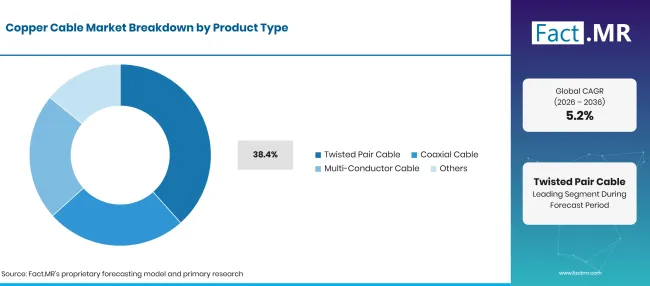
Copper Cable Market Breakdown Product Type | Source: Fact.MR
| Product Type | Share (2026) |
|---|---|
| Twisted Pair Cable (Leading segment) | 38.4% |
| Other segments combined | 61.6%* |
| Total | 100.0% |
Source: Fact.MR analysis. Updated Nov 6, 2026
Office fit-outs, hospitals, schools and server rooms all wire their horizontal runs with copper pairs, and that is where this product earns its volume. Twisting the conductors cuts crosstalk and outside interference, so a single cable can carry Ethernet data and, through Power over Ethernet, run cameras, access points and lighting. Demand for gigabit ethernet equipment keeps Category 6 and 6A cable on most specification sheets. Coaxial cable serves broadcast, cable television and radio frequency links, while multi-conductor cable carries power and control signals inside machines and panels. Other products include flat, ribbon and specialty cables for appliances and instruments. Buyers in all three groups choose by conductor size, shielding and jacket rating, and the wider wire and cable industry sets the copper and compound prices they pay.
What supports Telecommunications within Application?
Telecommunications takes 28.6% of 2026 revenue.
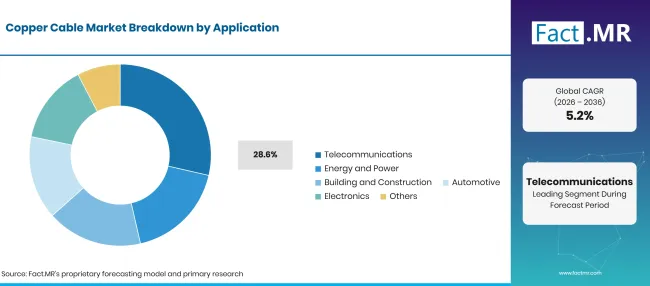
Copper Cable Market Breakdown Application | Source: Fact.MR
| Application | Share (2026) |
|---|---|
| Telecommunications (Leading segment) | 28.6% |
| Other segments combined | 71.4%* |
| Total | 100.0% |
Source: Fact.MR analysis. Updated Nov 6, 2026
Network operators and enterprises still rely on copper for the final link to the desk, the radio unit and the customer premises device. Fibre now reaches most cabinets and buildings, yet copper patch cords, backplane links and in-building runs remain cheaper to terminate and power. Growth in ethernet network cards and switch ports adds a copper connection at every endpoint. Energy and power applications use copper in low and medium voltage feeders, earthing and substation wiring. Building and construction absorbs general purpose wiring, while automotive and electronics buy fine wires and harness cable. Rising sales of the electric vehicle fleet lift demand for high voltage copper cable inside each car and at each charger.
What is accelerating Copper Cable Market adoption, and what is holding it back?
More electricity use, new data centres, factory automation and building work are adding copper circuits across all five countries. Copper’s conductivity and the skills of existing installers favour it for short runs. Volatile metal prices squeeze margins, aluminium is taking some power cable work, and optical fibre keeps replacing copper in longer communication links.
Drivers Impact Analysis
| DRIVER | (~) % IMPACT ON CAGR | GEOGRAPHIC RELEVANCE | IMPACT TIMELINE |
|---|---|---|---|
| Grid reinforcement and wider distribution networks | +1.1% | Global | Long term (>=4 years) |
| Building and construction wiring requirements | +1.0% | Asia Pacific, North America, Latin America | Medium term (2-4 years) |
| Factory automation and connected machinery | +0.9% | North America, Western Europe, East Asia | Medium term (2-4 years) |
| Enterprise and telecom network growth | +0.7% | Global | Medium term (2-4 years) |
Source: Fact.MR analysis. Updated Nov 6, 2026
Opportunity Impact Analysis
| OPPORTUNITY | (~) % IMPACT ON CAGR | GEOGRAPHIC RELEVANCE | IMPACT TIMELINE |
|---|---|---|---|
| Power and signal cabling for data centres | +0.7% | North America, Western Europe, East Asia | Medium term (2-4 years) |
| Transmission and distribution line extensions | +0.7% | Europe, Latin America, North America | Long term (>=4 years) |
| Purpose-built cables for industrial automation | +0.6% | Global | Medium term (2-4 years) |
| Replacement of aging electrical and communication cable | +0.5% | Europe, North America, Japan | Long term (>=4 years) |
Source: Fact.MR analysis. Updated Nov 6, 2026
Restraints Impact Analysis
| RESTRAINT | (~) % IMPACT ON CAGR | GEOGRAPHIC RELEVANCE | IMPACT TIMELINE |
|---|---|---|---|
| Copper price swings raising production and purchase costs | -0.8% | Global | Short term (<=2 years) |
| Optical fibre replacing copper in communication links | -0.5% | North America, Western Europe, East Asia | Long term (>=4 years) |
| Aluminium conductors in selected power cable uses | -0.5% | Global | Medium term (2-4 years) |
| Price competition pressing manufacturer margins | -0.4% | Global | Short term (<=2 years) |
Source: Fact.MR analysis. Updated Nov 6, 2026
Which countries are scaling the Copper Cable Market through 2036?
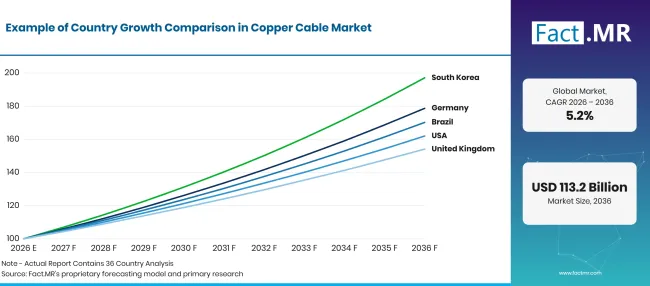
Copper Cable Market Growth Index | Source: Fact.MR
| Country | CAGR (2026 to 2036) |
|---|---|
| Germany | 6.0% |
| Brazil | 5.5% |
| United States | 4.9% |
| United Kingdom | 4.4% |
| Japan | 3.9% |
Source: Fact.MR analysis. Updated Nov 6, 2026
What supports copper cable adoption in Germany?
6.0% CAGR, driven by grid expansion that has moved into construction.
Germany’s grid regulator approved about 2,000 km of power lines in 2025, around 45% more than in 2024, and granted planning permission for the A-Nord, Ultranet, SuedLink and SuedOstLink direct current links [4]. These corridors need converter stations and connecting substations, each wired with copper control, earthing and low voltage cable. The country’s machinery and automotive plants add steady orders for shielded industrial cable as they automate older lines.
How is Brazil developing demand?
5.5% CAGR, backed by transmission auctions and new industrial load.
Brazil’s Ministry of Mines and Energy reported that its first transmission auction of 2025 covered 1,081 km of new lines and 2,000 MVA of capacity across 12 states, with R$ 5.53 billion in planned investment [5]. Substations and distribution feeders built around these lines draw on copper conductors. Wind and solar parks in the northeast also need collector and control cable, while commercial building work in the southeast keeps building wire moving.
What is supporting United States adoption?
4.9% CAGR, helped by data centre construction and grid upgrades.
U.S. electricity generation reached a record of about 4,430 billion kWh in 2025, up 2.8% from 2024, according to EIA [6]. Refined copper consumption reached 1,700 thousand metric tons in 2025, USGS data show [3]. Data centres, new factories and utility hardening programmes keep feeder and building wire orders high. Product safety rules, including demand for electrical safety products, also shape which cable ratings contractors buy.
How is the United Kingdom developing demand?
4.4% CAGR, reflecting steady building work and a shift to fibre in access networks.
Gigabit-capable broadband reached 88% of UK premises in January 2026, up from 84% a year earlier, the government reports [7]. Ofcom found full fibre available to 79% of premises in England in 2025 [8]. Fibre now carries the access link, yet each new home and office still needs copper for internal data points and power circuits. Housing, hospital and school refurbishment keeps building wire and structured cabling in demand.
What supports Japan’s adoption?
3.9% CAGR, as factory upgrades offset flat energy use.
Japan’s final energy consumption fell 2.0% in FY2024, while electricity use rose 0.6%, METI reports [9]. That pattern points to more electrified processes in homes and businesses even as total energy use falls. Electronics, semiconductor and car plants buy fine-gauge, high-flex copper cable for robots and test equipment. Rail and utility operators replace aging cable on fixed cycles, which gives local makers a stable base. Earthquake design rules also push building owners toward flexible conductors and tested fire ratings, adding value per metre installed.
Who leads the Copper Cable Market?
Three groups shape competition. Global multi-segment producers, led by Prysmian and Nexans, compete on scale, metal sourcing and range from building wire to grid cable. Prysmian signed a long-term copper wire rod agreement with Aurubis in September 2026 to secure supply for electrification and digital networks [10], and Nexans partnered with Vesto in October 2026 to scale electrical cable reuse through its CableLoop service [11].
Regional specialists such as Southwire and LS Cable & System win on delivery speed and local codes. Southwire opened a new industrial plant in Bremen, Indiana in September 2025 serving industrial, telecom, data centre and factory automation customers [12], and in November 2025 announced an expansion of medium voltage cable output at Heflin, Alabama [13]. Japanese and Chinese groups, including Sumitomo Electric, Furukawa Electric, Proterial and Hengtong, compete through conductor metallurgy and combined copper and fibre portfolios. Through 2036, secure copper supply, recycling capacity and fast delivery to data centre and grid projects will separate winners from the rest.
Which companies are the key providers?
Key companies in the Copper Cable Market include Prysmian, Nexans, Southwire, LS Cable & System, Sumitomo Electric, Furukawa Electric, Proterial and Hengtong.
- Prysmian
- Nexans
- Southwire
- LS Cable & System
- Sumitomo Electric
- Furukawa Electric
- Proterial
- Hengtong
Bibliography
- [1] International Telecommunication Union. (2025, November 17). Global number of Internet users increases, but disparities deepen key digital divides.
- [2] U.S. Department of Energy. (2025, November 13). Smart Transmission Tools Modernize America’s Power Grid.
- [3] U.S. Geological Survey. (2026, February). Mineral Commodity Summaries 2026: Copper.
- [4] Bundesnetzagentur. (2026, January 2). Energy transition clears crucial hurdle: significant progress in electricity grid expansion in 2025.
- [5] Ministério de Minas e Energia. (2025, December 12). MME consolida expansão sustentável da infraestrutura elétrica para atender ao crescimento da demanda de energia.
- [6] U.S. Energy Information Administration. (2026, March 5). U.S. electricity generation in 2025 hit a record, again.
- [7] GOV.UK. (2026, July 13). Levelling Up Missions annual report 2025 to 2026 (accessible version).
- [8] Ofcom. (2025, November 19). Nations report 2025.
- [9] Ministry of Economy, Trade and Industry. (2026, April 14). FY2024 Energy Supply and Demand Report (Revised Report).
- [10] Prysmian. (2026, September 23). Prysmian and Aurubis deepen strategic partnership with landmark long-term copper agreement.
- [11] Nexans. (2026, October 15). Nexans and Vesto partner to scale electrical cable reuse.
- [12] Southwire. (2025, September 12). Southwire Celebrates Ribbon Cutting at New Industrial Plant in Bremen, Ind..
- [13] Southwire. (2025, November 12). Southwire To Expand Operations in Heflin Ala..
This Report Answers
- How is copper cable revenue split between twisted pair, coaxial, multi-conductor and other cables?
- Why do copper pairs keep their place in office, campus and server room cabling?
- Which applications buy the most copper cable, and how much comes from telecommunications networks?
- What do industrial, residential and commercial buyers look for in conductor size, shielding and jacket ratings?
- How do copper prices, aluminium conductors and optical fibre change supplier margins and product choices?
- Which of the five countries will grow quickest, and which grid, building and network projects explain the gaps?
What does the Copper Cable Market cover?
This study tracks finished cables built around copper conductors that carry power or signals. Twisted pair, coaxial and multi-conductor designs form the main product groups, with flat, ribbon and specialty cables grouped as others.
Hybrid access designs also count when copper carries the final drop, and wireless options such as 5G fixed wireless access compete with copper for some rural and suburban connections. Cable sold for these links is valued only when it reaches the buyer as a finished product.
Revenue is measured at manufacturer selling prices across telecommunications, energy and power, building and construction, automotive, electronics and other applications. The end-user view covers industrial, residential and commercial buyers.
What is included in the scope?
Copper conductor cables for power distribution, telecommunications, building wiring and equipment connections.
Shielded, armoured and insulated copper cable designs sold as complete cable products.Copper cable used in vehicles, chargers, appliances and electronic equipment.Data and control cable for factories, plants and server rooms.
What is excluded from the scope?
Optical fibre cables, which carry signals as light.
Aluminium-only cables and conductors without copper content.Copper rod, cathode and bare wire sold as raw material.Connectors, switchgear, installation services and complete infrastructure projects.
How Was the Analysis Built?
The analysis draws on 120+ sources, 35+ company portfolios, 25+ countries, and more than 20 industry interviews.
- Primary Research: Primary research includes discussions with manufacturers, service providers, technology developers, distributors, end users, and subject-matter experts. These conversations examine purchasing priorities, product adoption, operational challenges, approval requirements, competitive positioning, and the factors that influence wider market acceptance.
- Desk Research: Desk research covers government statistics, regulatory publications, company filings, trade data, technical studies, industry associations, standards, public policy, and other authoritative sources. Every source used in the analysis is documented in the bibliography.
- Market Sizing and Forecasting: Market estimates combine historical performance, demand indicators, pricing and volume trends, segment shares, company participation, country-level growth, adoption patterns, investment activity, and barriers to market expansion.
- Data Validation and Update Cycle: Findings are validated by comparing primary interviews with public data, company activity, regulatory changes, trade patterns, and industry developments. Regular updates review new product launches, capacity changes, partnerships, approvals, and shifts in commercial adoption.
Segmentation
What is the report’s scope and coverage?
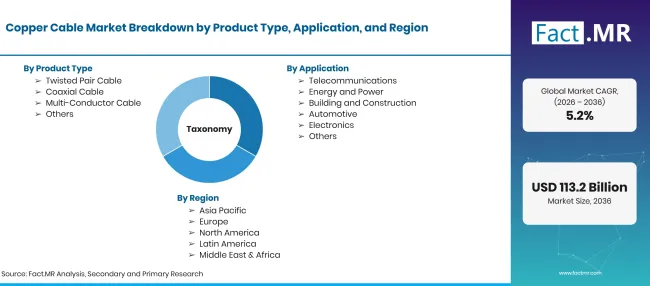
Copper Cable Market Taxonomy | Source: Fact.MR
| Attribute | Details |
|---|---|
| Quantitative Units | USD billion |
| Market Definition | Cables that use copper conductors to carry electrical power or communication signals, sold as finished cable products. |
| Product Type | Twisted Pair Cable; Coaxial Cable; Multi-Conductor Cable; Others |
| Application | Telecommunications; Energy and Power; Building and Construction; Automotive; Electronics; Others |
| End-User | Industrial; Residential; Commercial |
| Regions Covered | North America; Latin America; Western Europe; Eastern Europe; East Asia; South Asia & Pacific; Middle East & Africa |
| Countries Covered | Germany; Brazil; United States; United Kingdom; Japan |
| Companies Profiled | Prysmian; Nexans; Southwire; LS Cable & System; Sumitomo Electric; Furukawa Electric; Proterial; Hengtong |
| Forecast Period | 2026 to 2036 |
| Approach | Copper cable consumption by application and end-user, checked against producer output and country electricity, construction and network data. |
Source: Fact.MR analysis. Updated Nov 6, 2026
How is the market segmented?
-
By Product Type
- Twisted Pair Cable
- Coaxial Cable
- Multi-Conductor Cable
- Others
-
By Application
- Telecommunications
- Energy and Power
- Building and Construction
- Automotive
- Electronics
- Others
-
By End-User
- Industrial
- Residential
- Commercial
-
By Region
- North America
- Latin America
- Western Europe
- Eastern Europe
- East Asia
- South Asia & Pacific
- Middle East & Africa
Frequently Asked Questions
How large is the copper cable market in 2026?
What growth rate will the copper cable market record?
Which product type leads?
Which application leads?
Which country will grow quickest?
Who are the main companies?
What holds the market back?
Who worked on this report


Preview the report firsthand - request a free sample
Free SampleGet the brochure for pricing and purchase details
Download PDF