- Base Value(2025): 0.8 Bn
- Estimated Value(2026): 0.9 Bn
- Forecast Value (2036): 1.7 Bn
- CAGR (2026 - 2036): 6.6%
Corneal Topographers Market Forecast and Outlook (2026 to 2036)
- In 2025, the corneal topographers market was valued at USD 0.8 billion.
- Based on Fact.MR analysis, demand for corneal topographers is estimated to grow to USD 0.9 billion in 2026 and USD 1.7 billion by 2036.
- FACT.MR projects a CAGR of 6.6% during the forecast period.
- The market is expected to generate USD 0.8 billion in incremental revenue during the forecast period.
- Growth is steady and procedure-volume driven rather than transformational.
- Rising global LASIK and cataract surgery volumes underpin demand.
- Affordability of entry-level Placido systems limits pricing power for premium multi-modal platforms in cost-sensitive markets.
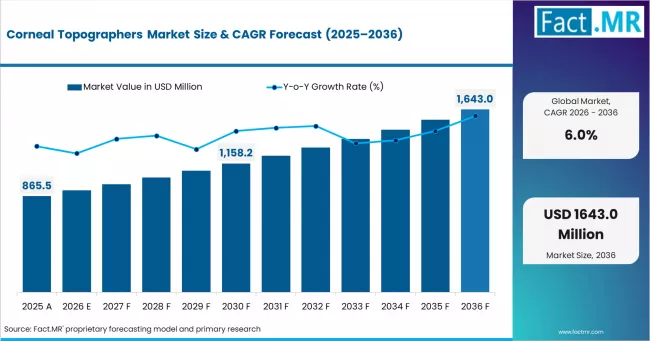
Corneal Topographers Market Market Value Analysis | Source: Fact.MR
Summary of Corneal Topographers Market
- Market Definition
- The market covers Placido disc, Scheimpflug, and scanning slit systems for corneal surface measurement. Used in refractive surgery planning, cataract evaluation, corneal disorder diagnosis, and contact lens fitting across ophthalmic clinics, hospitals, and surgical centres globally.
- Demand Drivers
- Global LASIK and lens-based refractive surgery volumes are rising. Pre-operative topography is a mandatory clinical step. Procedure growth directly drives device utilisation and replacement cycles in surgical clinics.
- Keratoconus detection and corneal ectasia monitoring require longitudinal mapping capability. Clinical adoption of Scheimpflug tomography is expanding as screening protocols are formalised across hospital ophthalmology programmes.
- Multi-modal platform demand is rising in high-volume surgical centres. Standalone topographers are being replaced by integrated systems that combine topography, tomography, and wavefront analysis in a single workstation.
- Key Segments Analyzed
- By Technology: Placido disc systems lead at approximately 50% share in 2026. Dominant in routine diagnostics due to lower cost and widespread installation across independent ophthalmic clinics.
- By Application: Refractive surgery evaluation leads at approximately 35% share in 2026. Driven by growing LASIK, SMILE, and lens-based refractive procedure volumes across North America, Europe, and Asia Pacific.
- By End User: Ophthalmic clinics lead at approximately 45% share in 2026. High patient throughput, specialisation in anterior segment care, and replacement cycle depth make clinics the primary demand channel.
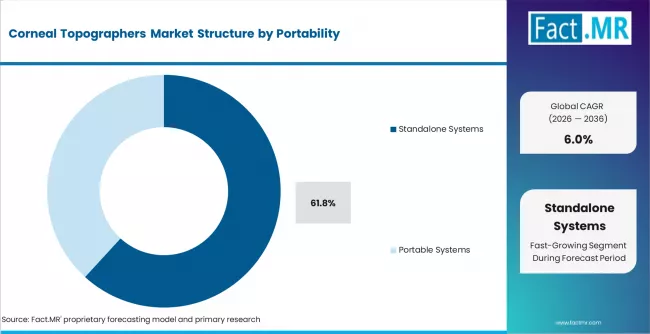
- By Portability: Tabletop systems lead at approximately 71% share in 2026. Higher measurement accuracy and established integration with surgical planning software anchor their dominant position in clinical settings.
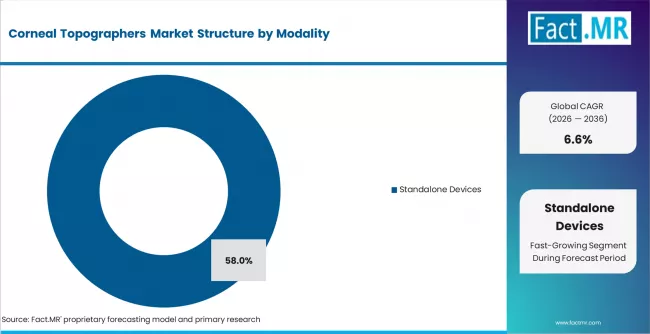
- By Modality: Standalone devices lead at approximately 58% share in 2026. Combined multi-modal systems are growing faster but remain a premium-tier segment concentrated in high-volume surgical hospitals.
- Analyst Opinion at FACT.MR
- Shambhu Nath Jha, Principal Consultant at Fact.MR, opines, CXOs will observe a clear split forming in the market. Routine clinics continue to rely on Placido-based systems. These are driven by replacement cycles and cost sensitivity. At the same time, surgical centers are upgrading to multi-modal platforms. These systems support higher precision and advanced procedures.
- Strategic Implications
- Develop integrated multi-modal platforms targeting high-volume refractive and cataract surgery centres where pre-operative documentation requirements are tightening.
- Invest in software-linked topography outputs compatible with surgical planning systems. Compatibility with femtosecond laser and IOL calculation platforms is becoming a procurement criterion.
- Segment the product portfolio between entry-level Placido systems for independent clinics and premium Scheimpflug or combined-modality devices for hospital procurement channels.
- Methodology
- Market sizing based on device shipment volumes and average selling prices by technology and end user. Validated with 2024–2025 financial disclosures and procurement benchmarks.
- Supported by ophthalmic procedure volume data, reimbursement coverage records, and device approval data from FDA, CE, and PMDA regulatory databases.
- Forecasts incorporate refractive surgery volume growth, multi-modal system adoption curves, and expert inputs from surgical centre procurement directors.
| Metric | Value |
|---|---|
| Estimated Value in 2026 | USD 0.9 billion |
| Forecast Value in 2036 | USD 1.7 billion |
| Forecast CAGR (2026 to 2036) | 6.6% |
Source: Fact.MR analysis. Updated May 15, 2026
Procurement in ophthalmic clinics is shifting toward integrated systems that combine corneal topography with tomography and aberrometry. Hospitals are upgrading pre-operative workstations to meet insurance and accreditation documentation requirements. Suppliers without validated software-linked outputs for surgical planning are losing placement in high-volume surgical centres.
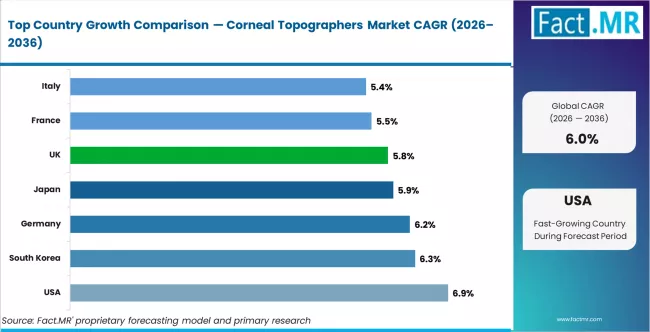
The United States leads at 7.5% CAGR through 2036, driven by rising refractive and cataract surgery volumes and private payer documentation requirements. South Korea follows at 7.0%, reflecting rapid medical device adoption and government-supported vision care infrastructure. Germany records 6.8%, supported by high procedural standards and GKV reimbursement coverage for corneal diagnostics. The UK grows at 6.3%, tied to NHS diagnostic equipment upgrade cycles. France records 6.0%, reflecting steady clinic-level adoption. Italy trails at 5.9%, where reimbursement constraints limit volume replacement cycles.
Segmental Analysis
Corneal Topographers Market Analysis by Technology
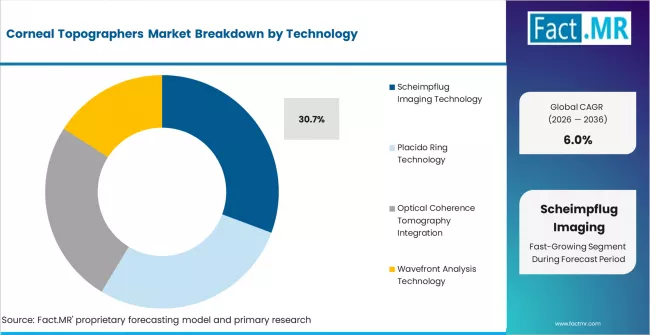
Corneal Topographers Market Analysis By Technology | Source: Fact.MR
Based on FACT.MR analysis, Placido disc systems hold approximately 50% share in 2026. This technology remains the clinical standard for routine corneal curvature measurement. Lower device cost and established procurement pathways sustain volume leadership across independent ophthalmic clinics.
- Carl Zeiss Portfolio: Carl Zeiss AG expanded its ATLAS and CIRRUS anterior segment product portfolio in 2024. Zeiss integrated corneal topography outputs with its CALISTO surgical planning platform targeting cataract and refractive surgery centres [4].
- OCULUS System Launch: OCULUS Optikgeräte GmbH launched an updated Pentacam AXL Wave in late 2024 combining Scheimpflug tomography with biometry and wavefront analysis. The system targets pre-operative documentation requirements at surgical hospitals [5].
- Scheimpflug Adoption Trend: Scheimpflug-based tomography adoption in refractive surgery centres grew measurably through 2024 as ectasia screening protocols tightened. Multiple ophthalmology societies updated pre-operative evaluation guidelines to include full corneal tomography in 2024–2025 [2].
Corneal Topographers Market Analysis by Application
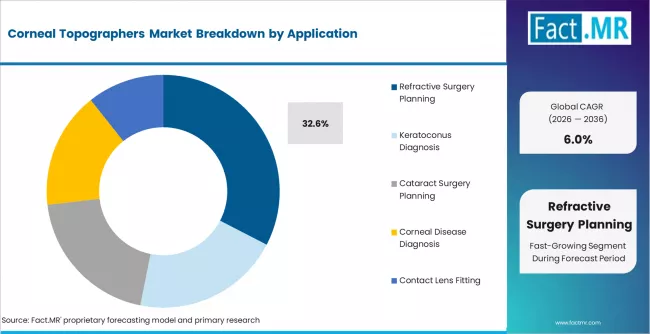
Corneal Topographers Market Analysis By Application | Source: Fact.MR
Based on FACT.MR analysis, refractive surgery evaluation holds approximately 35% share in 2026. LASIK, SMILE, and lens-based refractive procedures require pre-operative topography for patient selection and surgical planning.
- Topcon Partnership: Topcon Corporation signed ophthalmic clinic integration agreements in Japan and South Korea in 2024, linking topography outputs with its electronic medical record platform. Deals targeted surgical workflow efficiency at high-volume facilities [6].
- Nidek Development: Nidek Co., Ltd. launched the OPD-Scan III upgrade in early 2025, expanding refractive map outputs compatible with LASIK and SMILE planning consoles at certified refractive surgery centres across Asia Pacific and Europe [7].
- Cataract Evaluation Growth: Premium IOL implantation rates increased in the U.S. and Germany through 2024, raising demand for pre-operative corneal mapping in cataract surgery planning. Industry data indicates consistent growth in premium IOL penetration among cataract surgery volumes [8].
Corneal Topographers Market Analysis by End User
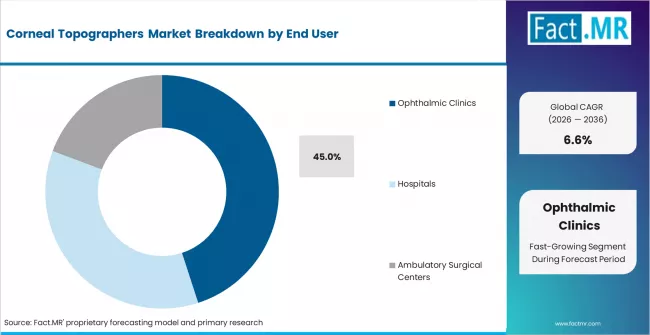
Corneal Topographers Market Analysis By End User | Source: Fact.MR
Based on FACT.MR analysis, ophthalmic clinics hold approximately 45% share in 2026. High patient throughput, specialisation in anterior segment care, and direct device ownership drive clinic-level demand. Hospitals represent the second-largest segment, supported by procurement of multi-modal integrated platforms for surgical departments.
- Topcon Corporation: Reported increased installations of corneal topography systems in standalone ophthalmic clinics across Asia and Europe. Growth was driven by rising outpatient refractive consultations and clinic-level device ownership expansion.
- Carl Zeiss Meditec AG: Expanded integrated diagnostic platform deployments in hospital ophthalmology departments. Demand was linked to surgical workflow integration for cataract and refractive procedures.
- American Academy of Ophthalmology: Highlighted that most anterior segment diagnostics are performed in specialized clinics due to higher patient throughput and procedural efficiency.
Corneal Topographers Market Analysis by Portability
Corneal Topographers Market Analysis By Portability | Source: Fact.MR
Based on FACT.MR analysis, tabletop systems hold approximately 71% share in 2026. Tabletop devices dominate due to superior measurement accuracy, established surgical planning software integration, and clinic infrastructure compatibility.
- OCULUS Optikgeräte GmbH: In Jan 2025 confirmed continued demand for tabletop Pentacam systems in surgical planning. Clinics prioritized accuracy and software integration over portability.
- International Agency for the Prevention of Blindness: Noted increased use of portable diagnostic tools in community eye screening programs, especially in low-resource settings.
Corneal Topographers Market Analysis by Modality
Corneal Topographers Market Analysis By Modality | Source: Fact.MR
Based on FACT.MR analysis, standalone devices hold approximately 58% share in 2026. Standalone topographers remain the primary procurement choice in independent ophthalmic clinics where single-function diagnostic instruments are preferred for cost and simplicity.
- Ziemer Ophthalmic Systems AG (Feb 2026): Expanded multi-modal diagnostic offerings targeting high-volume surgical clinics requiring comprehensive pre-operative assessment.
- European Society of Cataract and Refractive Surgeons (2025): Emphasized the increasing clinical preference for multi-modal imaging systems for surgical planning and patient outcomes optimization.
Drivers, Restraints, and Opportunities
Corneal Topographers Market Opportunity Matrix Growth Vs Value | Source: Fact.MR
-
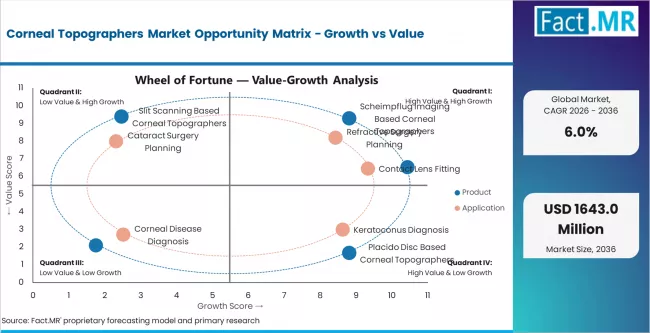
FACT.MR analysts observe the corneal topographers market has expanded steadily on the back of refractive surgery volume growth. Procedure-driven replacement cycles in ophthalmic clinics have maintained consistent device demand.
Standalone Placido systems face volume saturation in mature clinic markets. Growth is concentrating in Scheimpflug-based tomography and integrated multi-modal platforms where software analytics add clinical differentiation.
- Refractive Surgery Volume Growth: Global LASIK and SMILE procedure volumes continued to rise through 2024 and into 2025, particularly across Asia Pacific and North America. The American Refractive Surgery Council reported procedural growth in the U.S. refractive sector in 2024 [1]. Each surgical case requires pre-operative corneal topography, sustaining direct device utilisation.
- Keratoconus Screening Formalisation: The Global Consensus on Keratoconus published updated screening recommendations in 2024 that formalise corneal tomography as a mandatory diagnostic step for ectasia risk assessment before refractive surgery [2]. This is expanding Scheimpflug system adoption in markets where Placido-only protocols were previously standard.
- Multi-Modal Platform Demand in Asia Pacific: South Korea and Japan are driving combined topography-tomography system adoption as hospitals upgrade anterior segment workstations. Nidek and Topcon both reported Asia Pacific device revenue growth in their 2024 annual disclosures, with demand concentrated in high-specification integrated platforms [3].
Regional Analysis
.webp "Top Country Growth Comparison Corneal Topographers Market Cagr (2026 2036)")
Top Country Growth Comparison Corneal Topographers Market Cagr (2026 2036) | Source: Fact.MR
The corneal topographers market is assessed across North America, Europe, Asia Pacific, Latin America, and Middle East and Africa, covering 40+ countries with distinct demand profiles shaped by refractive surgery volumes, reimbursement structures, device regulatory approvals, and ophthalmic clinic infrastructure development. The full report offers market attractiveness analysis by region and country.
| Country | CAGR (2026 to 2036) |
|---|---|
| United States | 7.5% |
| Germany | 6.8% |
| South Korea | 7.0% |
| United Kingdom | 6.3% |
| France | 6.0% |
| Italy | 5.9% |
Source: Fact.MR analysis. Updated May 15, 2026
Source: Fact.MR (FACT.MR) analysis, based on proprietary forecasting model and primary research
Corneal Topographers Market Cagr Analysis By Country | Source: Fact.MR
Europe Corneal Topographers Market Analysis
Europe acts as a clinical reference point for corneal topography standards. Regulations and surgical protocols strongly influence device specifications. Multi-modal systems are widely preferred in advanced clinical settings. Procurement is structured through hospital networks and insurance-backed frameworks.
- Germany: Clinical precision drives adoption in Germany, with growth projected at 6.8% CAGR through 2036. Statutory insurance supports consistent diagnostic usage in ophthalmology. Updated keratoconus screening guidelines have increased reliance on tomography systems. Demand is strongest in urban surgical centres. Procurement remains stable through hospital-linked channels. Premium systems are gaining traction in refractive surgery hubs.
- United Kingdom: The UK market is expected to grow at 6.3% CAGR through 2036. Public funding supports equipment upgrades in NHS eye units. Private clinics act as the main channel for high-end systems. Updated clinical guidelines have reinforced pre-surgical diagnostics. Demand is split between replacement cycles and premium upgrades. Growth is balanced across public and private sectors.
- France: France is forecast to expand at 6.0% CAGR through 2036. Reimbursement systems ensure steady diagnostic adoption. Clinical recommendations now emphasize tomography in surgical workflows. Hospitals maintain structured procurement cycles. Independent clinics are upgrading to integrated platforms. Demand remains stable with gradual technology transition.
- Italy: Italy is projected to grow at 5.9% CAGR through 2036. Regional healthcare structures create uneven procurement patterns. Northern regions show stronger adoption of advanced systems. Private clinics are investing in refractive surgery capabilities. Demand is mixed between replacement and upgrade cycles. Growth is slower compared to other European markets.
FACT.MR covers Germany, France, the UK, Italy, Spain, Nordic Countries, and BENELUX. Readers can find regulatory benchmarks, procurement trends, and adoption insights.
North America Corneal Topographers Market Analysis
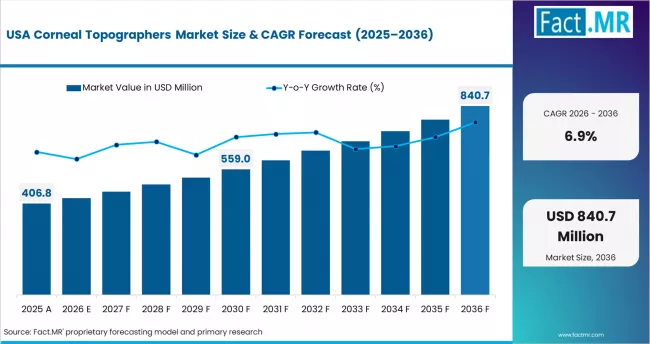
Corneal Topographers Market Country Value Analysis | Source: Fact.MR
North America leads global demand. Growth is supported by high surgical volumes and strong insurance coverage. Advanced diagnostic systems are widely adopted in surgical centres. The market favors premium and integrated platforms.
- United States: The U.S. is projected to grow at 7.5% CAGR through 2036. Refractive surgery volumes continue to expand. Clinical guidelines require detailed pre-operative diagnostics. Insurance and accreditation bodies support structured usage. Surgical centres are the primary buyers of advanced systems. Mid-tier clinics are upgrading gradually. Growth is driven by procedure volume and technology adoption.
FACT.MR covers the United States, Canada, and Mexico. Readers can access reimbursement data, surgical trends, and procurement insights.
Asia Pacific Corneal Topographers Market Analysis
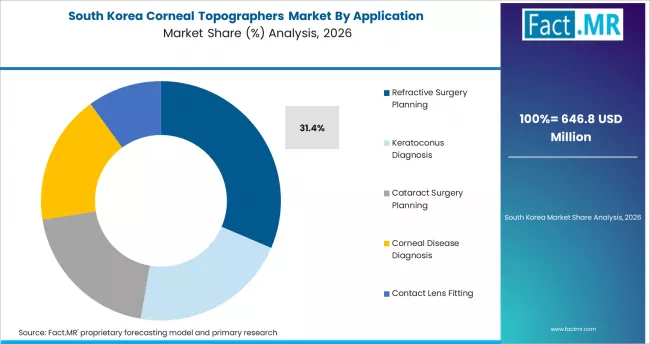
Corneal Topographers Market South Korea Market Share Analysis By Application | Source: Fact.MR
Asia Pacific is the fastest-growing region. Expansion is driven by rising surgical demand and clinic network growth. Adoption is shifting toward advanced diagnostic systems. Hospital modernization is a key driver.
- South Korea: South Korea is expected to grow at 7.0% CAGR through 2036. High LASIK volumes support strong device demand. Specialized clinics dominate the market landscape. Updated clinical standards are increasing tomography usage. Procurement is focused on high-end multi-modal systems. Demand is concentrated in premium surgical centres.
FACT.MR covers China, Japan, South Korea, India, ASEAN, and ANZ. Readers can find procedure data, regulatory trends, and adoption benchmarks.
Competitive Aligners for Market Players
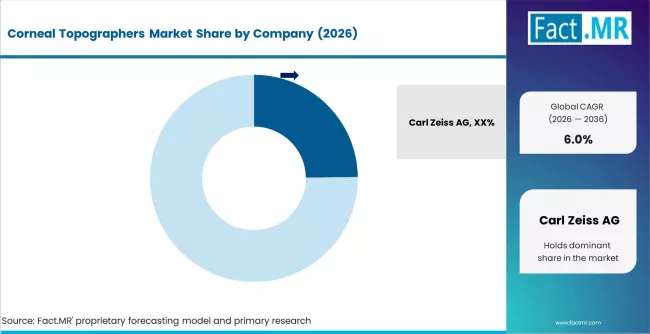
Corneal Topographers Market Analysis By Company | Source: Fact.MR
The corneal topographers market shows moderate concentration with clear tiered competition, rather than dominance by a single player. A small group of global manufacturers leads, but multiple regional and niche players remain active. The market structure is shaped by technology depth, clinical validation, and distribution reach.
At the top tier, companies such as Carl Zeiss Meditec AG, OCULUS Optikgeräte GmbH, NIDEK Co., Ltd., and Topcon Corporation dominate through advanced product portfolios. These firms compete on multi-modal integration, imaging accuracy, and surgical workflow compatibility. Their systems increasingly combine Placido, Scheimpflug, and OCT technologies, reflecting a shift toward comprehensive anterior segment diagnostics.
Mid-tier and specialized players such as Tomey Corporation, Ziemer Ophthalmic Systems AG, and Cassini Technologies compete through niche innovation. They focus on specific clinical applications such as keratoconus detection, refractive planning, or high-resolution imaging. This segment differentiates through precision features and targeted clinical use cases rather than scale. Competition is increasingly shifting from hardware to software, analytics, and integration capabilities. Vendors are investing in AI-enabled diagnostics, cloud connectivity, and surgical planning tools. Product launches and R&D investments remain key strategies. Partnerships and distribution alliances are also expanding global reach.
Regionally, strong distribution networks and regulatory compliance create barriers to entry. Established players maintain long-term hospital and clinic relationships. Procurement cycles favor vendors with proven clinical performance and service support.
Key Players
- Carl Zeiss AG
- OCULUS Optikgeräte GmbH
- Nidek Co., Ltd.
- Topcon Corporation
- Tomey Corporation
Scope of Report
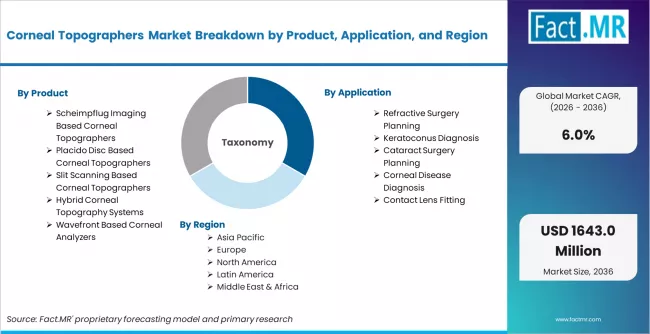
Corneal Topographers Market Breakdown By Product, Application, And Region | Source: Fact.MR
| Attribute | Details |
|---|---|
| Quantitative Units | USD 0.9 billion (2026) to USD 1.7 billion (2036), at a CAGR of 6.6% |
| Market Definition | Diagnostic instruments used to measure and map corneal curvature and surface irregularities, supplied to ophthalmic clinics, hospitals, and ambulatory surgical centres for refractive surgery evaluation, cataract planning, and corneal disorder diagnosis globally. |
| Technology Segmentation | Placido Disc Systems, Scheimpflug Systems, Scanning Slit Systems |
| Application Segmentation | Refractive Surgery Evaluation, Cataract Surgery Evaluation, Corneal Disorder Diagnosis, Contact Lens Fitting |
| End User Segmentation | Ophthalmic Clinics, Hospitals, Ambulatory Surgical Centers |
| Portability Segmentation | Tabletop Systems, Portable / Handheld Systems |
| Modality Segmentation | Standalone Devices, Combined / Multi-modal Systems |
| Application Coverage | Pre-operative refractive surgery mapping, post-surgical corneal monitoring, keratoconus detection and progression tracking, irregular astigmatism assessment, and contact lens fitting evaluation. |
| Regions Covered | North America, Europe, Asia Pacific, Latin America, Middle East and Africa |
| Countries Covered | USA, Canada, Mexico, Germany, UK, France, Italy, Spain, Nordic, BENELUX, China, Japan, South Korea, India, ASEAN, Australia and New Zealand, Brazil, Argentina, Chile, Saudi Arabia, GCC, Turkey, South Africa, Rest of MEA |
| Key Companies Profiled | Carl Zeiss AG, OCULUS Optikgeräte GmbH, Nidek Co. Ltd., Topcon Corporation, Tomey Corporation |
| Forecast Period | 2026 to 2036 |
| Approach | Hybrid top-down and bottom-up model using device shipment volumes by technology type, average selling prices by end user and application, reimbursement coverage benchmarks, procedure volume data, and primary interviews with ophthalmologists and procurement managers. |
Source: Fact.MR analysis. Updated May 15, 2026
This Report Addresses
- Strategic intelligence on corneal topographer demand across Placido disc, Scheimpflug, and scanning slit platforms for refractive surgery evaluation, cataract planning, and corneal disorder diagnosis globally.
- Market forecast from USD 0.9 billion in 2026 to USD 1.7 billion by 2036, at a CAGR of 6.6%.
- Growth opportunity mapping across U.S. refractive surgery volume expansion, Germany regulatory-driven Scheimpflug adoption, South Korea clinic modernisation, UK NHS upgrade cycles, France accreditation-led procurement, and Italy private clinic investment.
- Segment analysis by technology (Placido disc, Scheimpflug, scanning slit), application (refractive surgery, cataract evaluation, corneal disorder, contact lens fitting), end user (ophthalmic clinics, hospitals, ambulatory surgical centres), portability, and modality.
- Regional outlook covering Asia Pacific refractive volume-led growth, North America procedure-driven premium adoption, and Europe guideline-led multi-modal system demand.
- Competitive analysis of Carl Zeiss, OCULUS, Nidek, Topcon, and Tomey. Focus on multi-modal platform depth, surgical planning software integration, and hospital procurement contract positioning.
- Regulatory analysis covering FDA 510(k) device clearances, CE marking requirements, Japanese PMDA approvals, South Korea MFDS standards, and reimbursement frameworks governing ophthalmic diagnostic device procurement across covered markets.
- Report delivered in PDF, Excel, and presentation formats. Supported by primary interviews, procedure volume data, regulatory records, and ophthalmic clinic procurement benchmarks.
Key Questions This Report Addresses
- What is the current and future size of the corneal topographers market?
- How fast is the market expected to grow between 2026 and 2036?
- Which product type is likely to lead the market by 2026?
- Which application drives the highest demand?
- What factors are driving demand globally?
- How is AI integration reshaping corneal diagnostics?
- Why are China and the USA the fastest-growing markets?
- How does premium IOL adoption influence topographer demand?
- Which countries are projected to show the fastest growth?
- Who are the key companies?
- What role does keratoconus screening play?
- How does Fact.MR estimate and validate the forecast?
Corneal Topographers Market Definition
The corneal topographers market covers ophthalmic diagnostic devices used to map the shape, curvature, and elevation of the corneal surface for refractive surgery planning, keratoconus detection, cataract IOL selection, contact lens fitting, and corneal disease diagnosis, used across hospitals, ophthalmic clinics, diagnostic centers, and research institutions.
Corneal Topographers Market Inclusions
- The scope covers global and regional market size and forecasts for 2026 to 2036 across product type, application, end use, technology, portability, distribution channel, and region.
- It includes regional demand analysis based on refractive surgery volumes, cataract procedure rates, ophthalmic clinic density, and diagnostic equipment adoption.
- The report includes pricing and cost analysis across Scheimpflug, Placido, hybrid, and wavefront systems, including hardware and software licensing costs.
- It covers technology trends, market drivers and constraints, and the competitive landscape of leading players.
Corneal Topographers Market Exclusions
- The scope excludes general-purpose ophthalmic imaging devices such as OCT scanners, fundus cameras, and visual field analyzers not designed specifically for corneal surface mapping.
- It excludes refractive surgery lasers, cataract phacoemulsification equipment, and surgical instruments.
- The report excludes autorefractors and keratometers that provide basic curvature measurements without topographic mapping capability.
- It also excludes software-only corneal analysis platforms sold without dedicated imaging hardware.
Corneal Topographers Market Research Methodology
- The methodology combines secondary research, primary interviews, and forecast modelling.
- It draws on 100+ secondary sources and benchmarks 45+ company product portfolios.
- Market sizing covers 30+ countries through a demand-side model, supported by top-down validation.
- Key inputs include refractive surgery volumes, cataract procedure rates, ophthalmic clinic density, and keratoconus screening adoption.
- The model cross-checks demand with equipment shipments, pricing trends, and product launch data.
- Primary validation includes 20+ interviews across ophthalmic equipment manufacturers, refractive surgeons, and clinic operators.
- Final estimates go through procedure-volume checks, equipment-flow review, and sensitivity testing.
Segmentation
Corneal Topographers Market by Segments
By Technology:
- Placido Disc Systems
- Scheimpflug Systems
- Scanning Slit Systems
By Application:
- Refractive Surgery Evaluation
- Cataract Surgery Evaluation
- Corneal Disorder Diagnosis
- Contact Lens Fitting
By End User:
- Ophthalmic Clinics
- Hospitals
- Ambulatory Surgical Centers
By Portability:
- Tabletop Systems
- Portable / Handheld Systems
By Modality:
- Standalone Devices
- Combined / Multi-modal Systems (topography + tomography)
By Region:
- North America
- United States
- Canada
- Mexico
- Latin America
- Brazil
- Mexico
- Argentina
- Chile
- Rest of Latin America
- Western Europe
- Germany
- United Kingdom
- France
- Italy
- Spain
- Nordic Countries
- BENELUX
- Rest of Western Europe
- Eastern Europe
- Russia
- Poland
- Hungary
- Balkan and Baltic
- Rest of Eastern Europe
- East Asia
- China
- Japan
- South Korea
- South Asia and Pacific
- India
- ASEAN
- Australia and New Zealand
- Rest of South Asia and Pacific
- Middle East and Africa
- Kingdom of Saudi Arabia
- Other GCC Countries
- Turkey
- South Africa
- Rest of Middle East and Africa
Bibliography
- [1] American Refractive Surgery Council. (2024). Refractive Surgery Procedure Volume Trends: LASIK and SMILE Growth in the United States. americanrefractivesurgerycouncil.org/trends
- [2] Global Consensus on Keratoconus. (2024). Updated Screening and Diagnostic Recommendations: Corneal Tomography Requirements for Ectasia Risk Assessment Before Refractive Surgery. cornealconsensus.org/guidelines
- [3] Nidek Co., Ltd. (2024). Annual Report: Asia Pacific Ophthalmic Device Revenue Growth Including Corneal Topography and Multi-Modal Anterior Segment System Sales. nidek.com/investor-relations
- [4] Carl Zeiss AG. (2024). Product Integration Announcement: ATLAS 9000 Corneal Topography System Integration with CALISTO Surgical Planning Platform for Refractive and Cataract Surgery Centres. zeiss.com/meditec/news
- [5] OCULUS Optikgeräte GmbH. (Late 2024). Product Launch: Pentacam AXL Wave Scheimpflug Tomography System Combining Corneal Tomography, Biometry, and Wavefront Analysis for Pre-Operative Surgical Documentation. oculus.de/news
- [6] Topcon Corporation. (2024). Partnership Announcement: Ophthalmic Clinic Integration Agreements in Japan and South Korea Linking Topography Outputs with Electronic Medical Record Platform. topcon.co.jp/en/news
- [7] Nidek Co., Ltd. (Early 2025). Product Launch: OPD-Scan III System Upgrade Expanding Refractive Map Compatibility with LASIK and SMILE Surgical Planning Consoles at Certified Refractive Surgery Centres in Asia Pacific and Europe. nidek.com/news
- [8] Market Scope. (2024). Premium IOL Penetration Report: Toric and Multifocal Intraocular Lens Implantation Rates Among Cataract Surgery Volumes in the United States and Germany. market-scope.com/reports
Frequently Asked Questions
How large is the corneal topographers market in 2025?
What will the market size be in 2026?
What is the projected market size by 2036?
What is the expected CAGR of the corneal topographers market?
What is the absolute dollar opportunity in this market?
Which technology segment leads the market?
Which application segment is poised to lead?
Which country shows the fastest growth?
Who worked on this report


Preview the report firsthand - request a free sample
Free SampleGet the brochure for pricing and purchase details
Download PDF