Deburring Machine Market

Deburring Machine Market Size and Share Forecast Outlook 2025 to 2035

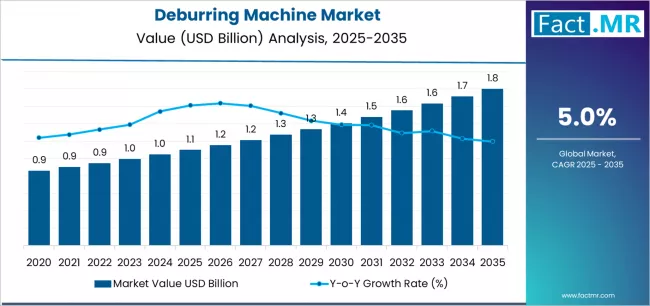
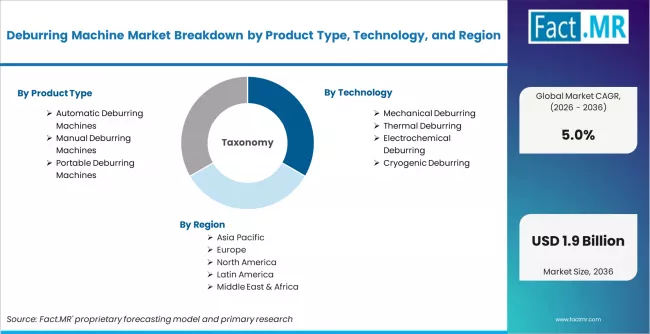
Deburring machine market is projected to grow from USD 1.1 billion in 2025 to USD 1.8 billion by 2035, at a CAGR of 5.0%. Vibratory Deburring will dominate with a 26.8% market share, while automatic will lead the operation mode segment with a 54.8% share.

Deburring Machine Market Forecast and Outlook 2025 to 2035

The global deburring machine market is projected to reach USD 1.8 billion by 2035, recording an absolute increase of USD 0.7 billion over the forecast period. The market is valued at USD 1.1 billion in 2025 and is set to rise at a CAGR of 5.0% during the assessment period.

The market is expected to grow by 1.6 times during the same period, supported by expanding automated manufacturing operations and increasing demand for precision finishing solutions across both automotive and aerospace production environments. Additionally, growing emphasis on surface quality requirements, expanding adoption of robotic deburring systems, and rising integration of Industry 4.0 technologies creates expanding opportunities for advanced deburring equipment innovations and intelligent finishing process automation.

Quick Stats for Deburring Machine Market

  • Deburring Machine Market Value (2025): USD 1.1 billion
  • Deburring Machine Market Forecast Value (2035): USD 1.8 billion
  • Deburring Machine Market Forecast CAGR: 5.0%
  • Leading Type in Deburring Machine Market: Vibratory Deburring (26.8%)
  • Key Growth Regions in Deburring Machine Market: Asia Pacific, North America, and Europe
  • Top Players in Deburring Machine Market: ATI Industrial Automation, BENSELER, Sugino Corp., Kadia Production, Georg Kesel GmbH & Co. KG, EMAG Systems GmbH, PROCECO, Maschinenbau Silberhorn, SBS Ecoclean Group, Loeser GmbH, SEMA Technology Group, AXIOME, RSA Cutting Technologies Ltd., Bertsche Engineering Corporation, Abtex LLC

Deburring Machine Market Market Value Analysis

Rising precision manufacturing requirements globally, coupled with expanding metalworking capacity through modern production facilities and integrated finishing operations, further accelerate market penetration across diverse industrial segments. The growing manufacturing sector demand for consistent edge finishing, particularly in automotive component production and aerospace parts manufacturing, generates requirements for automated deburring systems and high-throughput finishing equipment.

Technical advancements in deburring technologies demonstrating measurable improvements in process consistency, cycle time reduction, and surface quality optimization reinforce manufacturer confidence in deburring equipment economics, while quality control trends toward zero-defect manufacturing expand addressable market opportunities beyond manual finishing operations into automated deburring cells and integrated production line solutions.

Automotive manufacturers and precision engineering facilities increasingly incorporate automated deburring machines into production workflows, quality assurance programs, and lean manufacturing initiatives, creating mainstream adoption channels that extend beyond specialty finishing applications into conventional component manufacturing environments.

However, high capital investment requirements for automated deburring systems and technical complexity in application-specific configuration may pose challenges to market expansion. Skilled operator requirements for equipment setup and maintenance in certain production environments also influence total cost of ownership, requiring manufacturers to develop comprehensive training strategies catering to specific operational requirements across different geographical markets.

Technology selection complexity during equipment procurement and the engineering requirements for process optimization and media management may limit adoption among smaller manufacturing facilities in developing regions with limited infrastructure for advanced finishing systems and technical support capabilities.

Deburring Machine Market Year-over-Year Forecast 2025 to 2035

Between 2025 and 2030, the deburring machine market is projected to expand from USD 1.1 billion to USD 1.4 billion, resulting in a value increase of USD 0.3 billion, which represents 42.9% of the total forecast growth for the decade. This phase of development will be shaped by rising demand for automated finishing systems and precision component manufacturing, product innovation in robotic deburring cells and high-pressure water jet technologies, as well as expanding integration with automotive lightweighting initiatives and aerospace quality requirements. Companies are establishing competitive positions through investment in automation technology development, process optimization capabilities, and strategic market expansion across automotive component finishing, aerospace parts processing, and electronics manufacturing applications.

From 2030 to 2035, the market is forecast to grow from USD 1.4 billion to USD 1.8 billion, adding another USD 0.4 billion, which constitutes 57.1% of the overall ten-year expansion. This period is expected to be characterized by the expansion of specialized deburring solutions, including adaptive robotic systems and intelligent process control technologies tailored for specific manufacturing applications, strategic collaborations between equipment manufacturers and end-user industries, and an enhanced focus on sustainability initiatives and media recycling capabilities. The growing emphasis on manufacturing digitalization and quality assurance automation will drive demand for advanced deburring machine solutions across diverse industrial applications.

Deburring Machine Market Key Takeaways

Metric Value
Market Value (2025) USD 1.1 billion
Market Forecast Value (2035) USD 1.8 billion
Forecast CAGR (2025-2035) 5.0%

Why is the Deburring Machine Market Experiencing Steady Growth?

The deburring machine market grows by enabling manufacturing engineers, production managers, and quality control professionals to access efficient edge finishing systems that support component quality while meeting industry demand for consistent surface preparation and burr removal.

Process engineers and operations managers face mounting pressure to specify reliable finishing equipment with proven performance and operational characteristics, with deburring machine systems typically providing 90-95% burr removal efficiency and consistent results across production runs, making these systems essential for competitive positioning in automotive manufacturing, aerospace component production, and precision metalworking categories.

The manufacturing industry's need for automated finishing and quality consistency creates demand for diverse deburring technologies that can provide superior edge quality, maintain predictable performance across different component geometries, and ensure process reliability without compromising production economics or throughput requirements.

Quality standards promoting surface integrity and component performance drive adoption in automotive production facilities, aerospace manufacturing operations, and medical device fabrication centers, where finishing process selection has a direct impact on product quality outcomes and regulatory compliance.

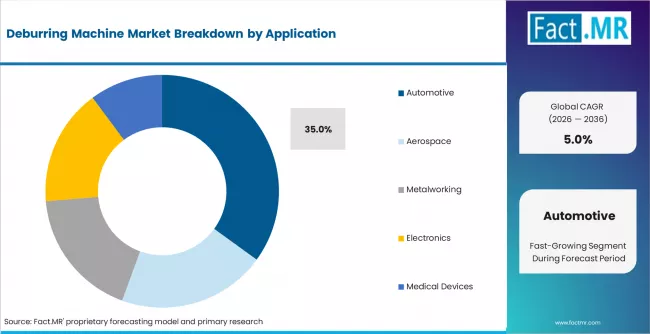
The automotive industry's growing focus on lightweight materials and complex geometries further expands market opportunities, with engineering analysis demonstrating measurable advantages from automated deburring systems, including enhanced process consistency and reduced manual labor requirements.

However, application complexity during equipment configuration and the technical requirements for media selection and process parameter optimization may limit adoption among smaller manufacturers and developing regions with limited infrastructure for advanced finishing system implementation and process validation capabilities.

Segmental Analysis

The market is segmented by type, operation mode, deburring media, end use, and region. By type, the market is divided into vibratory deburring and high-pressure water jet deburring. By operation mode, the market is divided into automatic and semi-automatic. By deburring media, the market is divided into ceramic and steel. By end use, the market is divided into automotive and aerospace & defense. Regionally, the market is divided into Asia Pacific, North America, Europe, Latin America, and Middle East & Africa.

What Makes Vibratory Deburring the Dominant Type Segment in the Deburring Machine Market?

Deburring Machine Market Analysis By Type

The vibratory deburring segment represents the dominant force in the deburring machine market, capturing approximately 26.8% of total market share in 2025. This established type category encompasses solutions featuring oscillating motion for mass finishing, ceramic or steel media for edge finishing, and versatile processing capabilities, including bowl vibrators and tub vibrators that enable batch processing, consistent surface quality, and proven reliability across all deburring applications. The vibratory deburring segment's market leadership stems from its essential role in high-volume manufacturing, with these systems capable of meeting diverse finishing requirements while maintaining cost-effective operation and process flexibility across all production environments. Within the vibratory deburring segment, automotive component finishing accounts for substantial utilization share, driven by high production volumes and consistent quality requirements across global manufacturing operations.

High-pressure water jet deburring represents the fastest-growing segment with a CAGR of 6.8%, serving applications requiring precision edge finishing, complex geometry access, and environmentally friendly processing for aerospace components and medical device manufacturing. These applications offer advanced product solutions for difficult-to-reach areas, delicate component handling, and chemical-free finishing while providing sufficient processing capabilities to meet quality demands and surface integrity requirements. Additional types include barrel tumbling, brush deburring, thermal deburring, electrochemical deburring, and others serving specialized finishing operations and material-specific applications.

Key advantages driving the vibratory deburring segment include:

  • Established process maturity infrastructure with proven performance reliability that reduces implementation risk and ensures consistent finishing results
  • Critical throughput functionality allowing batch processing across different component types without significant setup complexity
  • Proven cost-effectiveness, delivering reliable edge finishing while maintaining competitiveness against alternative deburring methods
  • Broad industry acceptance enabling straightforward process specification and quality standards across multiple manufacturing sectors

How does Automatic Operation Mode Lead Process Automation?

Deburring Machine Market Analysis By Operation Mode

The automatic operation mode segment demonstrates commanding market leadership with approximately 54.8% share in 2025, driven by manufacturing automation trends and labor cost reduction initiatives. This operation category encompasses fully automated deburring systems with programmable controls, robotic material handling, and integrated quality inspection that support unmanned operation, consistent process execution, and high-volume production requirements. The automatic segment's market dominance reflects manufacturing industry transition toward automated finishing operations, with production managers selecting automatic systems to ensure process consistency, reduce labor dependency, and achieve higher throughput rates across diverse deburring applications.

The semi-automatic segment serves applications requiring operator interaction for loading/unloading, process monitoring, and quality verification while maintaining automated finishing cycles for flexible production environments. The manual segment addresses applications with low production volumes, specialized finishing requirements, and budget-constrained operations.

Key factors supporting automatic operation mode dominance include:

  • Labor cost reduction advantages achieving operational savings through minimized operator requirements and continuous processing capability
  • Process consistency benefits enabling repeatable finishing quality through programmed cycle parameters and automated controls
  • Productivity enhancement supporting higher throughput through reduced cycle times and continuous operation capabilities
  • Quality assurance advantages maintaining competitive positioning through consistent processing and reduced human error variables

Why does Ceramic Media Maintain Strong Market Position?

Deburring Machine Market Analysis By Deburring Media

The ceramic deburring media segment captures approximately 37.9% of deburring machine market share in 2025, reflecting the segment's versatile finishing characteristics and widespread application compatibility across diverse component materials. This media category encompasses shaped ceramic compounds providing controlled abrasive action, dimensional stability, and reusable processing media that support consistent edge finishing, surface preparation, and burr removal across ferrous and non-ferrous materials.

The ceramic media segment's strong market position stems from optimal finishing characteristics and cost-effective performance enabling widespread adoption across automotive, aerospace, and general metalworking applications. The steel media segment serves applications requiring aggressive material removal, ferrous component finishing, and high-density processing media for heavy-duty deburring operations. Additional media types include plastic for delicate components and organic compounds for specialized finishing applications.

What are the Drivers, Restraints, and Key Trends of the Deburring Machine Market?

The market is driven by three concrete demand factors tied to manufacturing quality requirements and automation adoption. First, increasing quality standards and surface finish specifications creates growing demand for consistent deburring processes, with global manufacturing quality requirements tightening across automotive, aerospace, and medical device sectors worldwide, requiring comprehensive finishing infrastructure. Second, expanding manufacturing automation and Industry 4.0 integration drives increased adoption of automated deburring systems, with many manufacturers implementing robotic finishing cells and intelligent process monitoring programs by 2030. Third, technological advancements in robotic deburring and adaptive process control enable more effective finishing operations that reduce cycle times while improving edge quality and process repeatability.

Market restraints include high capital costs for automated deburring systems that can deter manufacturers from comprehensive finishing automation implementation, particularly in cost-sensitive production environments where deburring equipment faces budget constraints from manual finishing alternatives. Process development complexity and application-specific configuration requirements pose another significant challenge, as deburring system optimization demands extensive testing, media selection trials, and parameter development, potentially causing extended implementation timelines and engineering resource requirements. Media disposal requirements and environmental regulations create additional operational challenges for process sustainability, demanding ongoing investment in media recycling programs and waste management capabilities.

Key trends indicate accelerated adoption of robotic deburring systems with vision-guided capabilities and adaptive force control that enable flexible finishing operations across varying component geometries. Technology integration trends toward digital twin simulation for process optimization, predictive maintenance capabilities, and real-time quality monitoring enable advanced manufacturing approaches that maximize equipment utilization while ensuring consistent finishing quality. However, the market thesis could face disruption if significant advances in additive manufacturing reduce machining-related burrs or major shifts in manufacturing processes eliminate traditional deburring requirements.

Analysis of the Deburring Machine Market by Key Countries

Deburring Machine Market Cagr Analysis By Country

Country CAGR (2025 to 2035)
China 7.0%
India 6.6%
Mexico 6.2%
Germany 5.9%
USA 5.6%
Brazil 5.3%
UK 4.8%

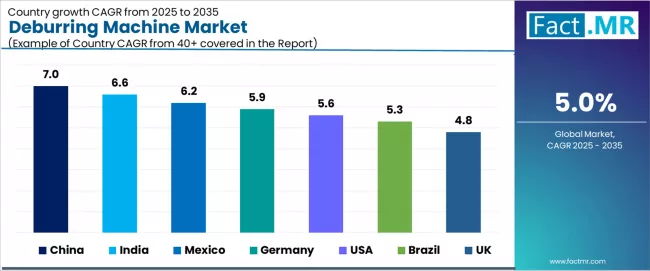
The deburring machine market is expanding steadily, with China leading at a 7.0% CAGR through 2035, driven by rapid industrialization momentum, substantial robotics adoption, and expanding manufacturing automation programs. India follows at 6.6%, supported by Make in India manufacturing surge, growing automotive component production, and integrated quality assurance requirements.

Mexico records 6.2%, reflecting automotive manufacturing relocation alongside expanding electronics assembly operations. Germany posts 5.9%, anchored by high precision engineering demand and advanced manufacturing technology adoption. USA grows at 5.6%, with substantial industrial automation investments and aerospace manufacturing requirements. Brazil advances at 5.3%, emphasizing industrial modernization programs and manufacturing capacity expansion, while UK grows steadily at 4.8%, focusing on aerospace component manufacturing and medical device production growth.

China Leads Global Market Expansion

China demonstrates the strongest growth potential in the deburring machine market with a CAGR of 7.0% through 2035. The country's leadership position stems from massive manufacturing capacity expansion, rapid industrial robotics adoption, and increasing quality standards enabling mainstream deburring equipment deployment.

Growth is concentrated in major manufacturing regions, including Guangdong, Jiangsu, Zhejiang, and Shanghai, where automotive production clusters and expanding metalworking infrastructure are implementing automated deburring systems for enhanced component quality and production efficiency.

Distribution channels through integrated equipment suppliers, manufacturing solution providers, and automation integrators expand deployment across automotive component manufacturers, electronics producers, and general metalworking facilities. The country's growing manufacturing sector provides policy support for automation development, including investment incentives for intelligent manufacturing facilities and quality improvement programs.

Key market factors:

  • Manufacturing demand concentrated in automotive and electronics sectors with comprehensive automation programs
  • Infrastructure development through industrial park expansion and smart manufacturing zone establishment
  • Comprehensive automation ecosystem, including established robotic integration with proven implementation capabilities
  • Technology adoption featuring automated finishing cells, robotic deburring systems, and quality inspection integration

India Emerges as Manufacturing Hub

In major industrial states including Maharashtra, Gujarat, Tamil Nadu, and Haryana, the adoption and operation of deburring machines is accelerating across automotive component manufacturing and precision engineering segments, driven by Make in India initiatives and expanding manufacturing capabilities.

The market demonstrates strong growth momentum with a CAGR of 6.6% through 2035, linked to government manufacturing promotion policies, integrated automotive supply chains, and sustained component production growth. Indian manufacturers are implementing modern deburring equipment and quality assurance systems to enhance product competitiveness while meeting growing quality requirements in expanding automotive sectors and export-oriented manufacturing industries. The country's manufacturing expansion initiatives create persistent demand for finishing equipment, while increasing emphasis on quality standards drives adoption of automated deburring production systems.

Key development areas:

  • Automotive component and precision engineering segments leading deburring equipment adoption with comprehensive quality programs
  • Manufacturing localization initiatives providing domestic production growth with government policy support
  • Technology partnerships between Indian manufacturers and international equipment suppliers are expanding market reach
  • Integration of quality management systems and comprehensive process control protocols

Mexico Shows Nearshoring Advantages

The Mexico market expansion is driven by automotive manufacturing relocation, including component production operations in Guanajuato and Nuevo León, and expanding electronics assembly operations across northern manufacturing states. The country demonstrates promising growth potential with a CAGR of 6.2% through 2035, supported by nearshoring advantages for North American supply chains, growing automotive component production, and increasing integration with USA manufacturing networks.

Mexican manufacturers face implementation considerations related to skilled workforce development and technology adoption, requiring investment in training programs and support from international equipment providers. However, growing manufacturing volumes and proximity to major consumer markets create compelling business cases for deburring equipment deployment, particularly in automotive regions where component quality has a direct impact on supply chain qualification and customer specifications.

Key market characteristics:

  • Automotive and electronics segments showing fastest growth with substantial increase in finishing equipment requirements
  • Regional expansion trends focused on automotive manufacturing clusters and electronics assembly zones
  • Future projections indicate continued nearshoring momentum and manufacturing capacity development programs
  • Growing emphasis on quality compliance and competitive positioning in North American markets

Germany Demonstrates Precision Engineering Leadership

The German market leads in high-precision deburring applications based on integration with advanced manufacturing engineering and sophisticated quality requirements for premium component production. The country shows steady potential with a CAGR of 5.9% through 2035, driven by world-class precision engineering capabilities, strong automotive manufacturing presence, and the expansion of specialized finishing technologies in major industrial centers, including Baden-Württemberg, Bavaria, North Rhine-Westphalia, and Lower Saxony.

German manufacturers are adopting advanced deburring technologies for aerospace component finishing and automotive quality optimization, particularly in regions with sophisticated surface quality requirements and specialized applications demanding comprehensive process validation. Technology deployment channels through established equipment manufacturers and engineering solution providers expand coverage across automotive suppliers and aerospace component producers.

Leading market segments:

  • Automotive component and aerospace parts manufacturing operations in major production centers implementing comprehensive finishing automation
  • Strategic partnerships with technology suppliers, achieving stringent quality specifications and process capability requirements
  • Collaborative research between technical institutes and commercial operations are expanding innovation capabilities
  • Focus on Industry 4.0 integration initiatives and intelligent manufacturing methodologies

USA Emphasizes Automation Investment

Deburring Machine Market Country Value Analysis

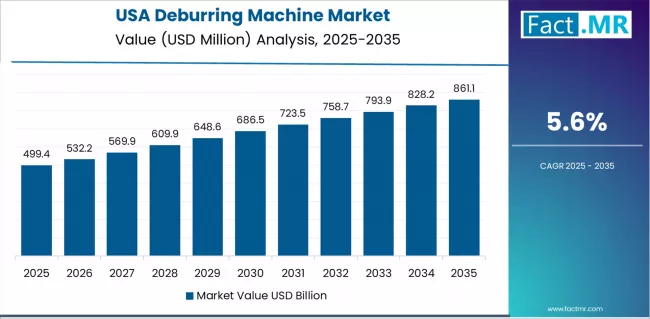
In major manufacturing regions including Michigan, Ohio, Indiana, and California, automotive manufacturers and aerospace component producers are implementing automated deburring solutions to optimize production efficiency and improve quality consistency, with documented installations showing significant productivity improvements through robotic finishing systems and integrated quality control. The market shows steady growth potential with a CAGR of 5.6% through 2035, linked to established manufacturing infrastructure, substantial automation investment trends, and ongoing aerospace production requirements.

American manufacturers are adopting advanced deburring technologies and robotic integration solutions to enhance operational performance while maintaining quality standards demanded by automotive engineering specifications and aerospace certification requirements. The country's advanced manufacturing initiatives create persistent demand for automation solutions and finishing technology innovations that integrate with existing production systems.

Market development factors:

  • Automotive and aerospace manufacturers leading deburring equipment consumption across USA
  • Automation investment trends and productivity improvement programs providing growth pathways for advanced finishing systems
  • Strategic relationships between American manufacturers and equipment suppliers are expanding technology capabilities
  • Emphasis on quality consistency and operational efficiency across manufacturing applications

Brazil Shows Industrial Modernization Focus

Brazil's deburring machine market demonstrates growth positioning focused on industrial modernization and manufacturing capacity enhancement, with documented equipment adoption in automotive component production, achieving improved quality outcomes through automated finishing systems in São Paulo and Minas Gerais manufacturing regions.

The country maintains steady growth momentum with a CAGR of 5.3% through 2035, driven by industrial renewal programs, growing automotive component manufacturing, and strategic positioning for South American production development. Major manufacturing facilities, including operations in southeastern industrial states, showcase deployment of modern deburring equipment where quality improvement applications support competitiveness enhancement and comprehensive production optimization programs.

Key market characteristics:

  • Manufacturing modernization and quality improvement programs driving deburring equipment adoption with emphasis on automation and consistency
  • Industrial development partnerships enabling technology adoption approaches with equipment financing programs
  • Technology collaboration between Brazilian manufacturers and international suppliers is expanding market capabilities
  • Emphasis on production efficiency and quality enhancement methodologies

UK Emphasizes Aerospace and Medical Applications

The UK deburring machine market demonstrates specialized landscape, characterized by aerospace component manufacturing and medical device production growth across precision engineering sectors. The country shows steady growth momentum with a CAGR of 4.8% through 2035, driven by established aerospace industry presence, expanding medical device manufacturing, and strategic emphasis on high-value precision component production.

The UK's focus on stringent quality requirements and regulatory compliance creates requirements for advanced deburring technologies that support comprehensive surface finish specifications and validation protocols. The market benefits from strong engineering capabilities between equipment suppliers and precision manufacturers, creating supply relationships that prioritize quality assurance and technical support services.

Key market characteristics:

  • Aerospace and medical device sectors driving deburring equipment demand with emphasis on precision finishing and quality validation
  • Regulatory compliance partnerships enabling comprehensive quality programs with certification requirements
  • Technology collaboration between UK manufacturers and international equipment suppliers is expanding capabilities
  • Emphasis on precision engineering and quality assurance methodologies

Europe Market Split by Country

Deburring Machine Market Europe Country Market Share Analysis, 2025 & 2035

The deburring machine market in Europe is projected to grow from USD 312.4 million in 2025 to USD 518.2 million by 2035, registering a CAGR of 5.2% over the forecast period. Germany is expected to maintain its leadership position with a 34.6% market share in 2025, supported by its advanced precision engineering infrastructure, comprehensive automotive manufacturing capabilities, and strong metalworking industry presence across major industrial centers.

Italy follows with a 22.8% share in 2025, driven by established metalworking operations and integrated automotive component manufacturing sectors. France holds a 18.4% share in 2025 through its aerospace manufacturing facilities and automotive supplier networks. United Kingdom commands a 14.7% share, while Rest of Europe accounts for 9.5% in 2025.

By 2035, Germany is projected to hold 34.3% share, Italy 22.9%, France 18.5%, United Kingdom 14.8%, and Rest of Europe 9.5%, reflecting sustained growth momentum across all major European markets and increasing deburring machine adoption in diversified manufacturing applications implementing advanced finishing automation programs.

Competitive Landscape of the Deburring Machine Market

Deburring Machine Market Analysis By Company

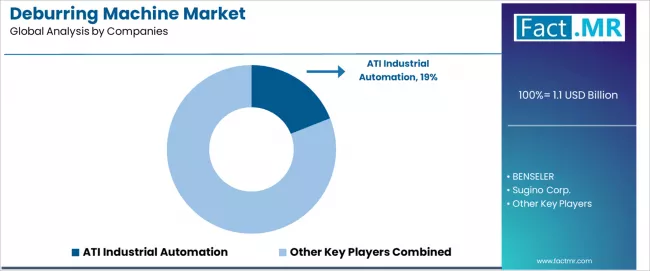
The deburring machine market features approximately 30-40 meaningful players with moderate concentration, where the top three companies control roughly 20-25% of global production capacity through established manufacturing operations and extensive customer relationships across automotive, aerospace, and metalworking sectors.

Market leaders include ATI Industrial Automation, Sugino Corp., and EMAG Systems GmbH, which maintain competitive advantages through comprehensive deburring equipment product portfolios, global manufacturing networks, and deep expertise in the finishing technology and automation integration sectors, creating strong customer relationships among automotive manufacturers, aerospace suppliers, and precision engineering facilities.

These companies leverage established production facilities and ongoing technology development initiatives to defend market positions while expanding into adjacent robotic finishing applications and intelligent process control markets. ATI Industrial Automation commands approximately 8.3% market share through diversified finishing equipment operations and strategic positioning in automated deburring markets.

Challengers encompass Kadia Production, Georg Kesel GmbH & Co. KG, and SBS Ecoclean Group, which compete through specialized finishing technologies and strong regional presence in key manufacturing markets. Specialty producers, including BENSELER, Maschinenbau Silberhorn, and PROCECO, focus on specific deburring technologies or application segments, offering differentiated capabilities in vibratory systems, precision finishing equipment, and turnkey solution integration.

Regional players and emerging manufacturers create competitive pressure through application-specific innovations and strategic partnerships, particularly in high-growth markets including China and India, where local presence provides advantages in customer support and application engineering.

Market dynamics favor companies that combine advanced finishing technology expertise with comprehensive process engineering capabilities that address the complete value chain from equipment design through installation commissioning and process optimization support. Strategic investments in robotic integration capabilities and digital process monitoring enable competitive differentiation and market positioning across deburring machine operations.

Global Deburring Machine Market - Stakeholder Contribution Framework

Deburring machine products represent critical finishing equipment that enables manufacturing engineers, production managers, and quality professionals to achieve consistent edge quality and surface preparation without manual finishing variability, typically providing 90-95% burr removal efficiency and repeatable processing cycles while supporting diverse manufacturing applications.

With the market projected to grow from USD 1.1 billion in 2025 to USD 1.8 billion by 2035 at a 5.0% CAGR, these products offer compelling advantages - proven process consistency, comprehensive automation capabilities, and established reliability - making them essential for automotive component manufacturing (largest segment), aerospace parts production (expanding applications), and diverse precision manufacturing applications seeking reliable finishing solutions. Scaling production capacity and market development requires coordinated action across manufacturing policy, industry standards, equipment manufacturers, end-user industries, and research institutions.

How Governments Could Spur Local Production and Adoption?

  • Manufacturing Development Programs: Include deburring equipment capabilities in national manufacturing strategies, providing targeted funding for automation technology facilities in regions with manufacturing clusters and supporting local equipment manufacturers through investment incentives and development support.
  • Quality Standards & Training Infrastructure: Implement comprehensive manufacturing quality requirements that encourage consistent finishing processes, provide vocational training programs for equipment operation, and establish technical education initiatives that support skilled workforce development.
  • Trade Policy & Technology Access: Create balanced import-export frameworks across manufacturing equipment and finishing technologies, establish equipment financing programs for small and medium manufacturers, and develop technology transfer protocols that facilitate manufacturing capability enhancement.
  • Skills Development & Education: Fund technical education programs for manufacturing engineers, process technicians, and automation specialists. Invest in workforce development initiatives that bridge educational institutions with commercial equipment operation and process optimization sectors.

How Industry Bodies Could Support Market Development?

  • Process Standards & Quality Protocols: Define standardized finishing specifications for deburring operations across automotive, aerospace, and medical device applications, establish universal testing methodologies for edge quality and surface integrity, and create certification programs for process validation that manufacturers can implement.
  • Technology Education & Best Practices: Lead communication initiatives that demonstrate deburring technologies, emphasizing automation benefits, quality improvements, and productivity advantages compared to manual finishing methods and conventional deburring approaches.
  • Application Guidelines: Develop technical standards for equipment selection, comprehensive process development methodologies, and media selection criteria, ensuring optimal implementation across different component geometries and material types.

How Manufacturers and Technology Players Could Strengthen the Ecosystem?

  • Equipment Technology Development: Develop next-generation deburring systems with enhanced automation capabilities, improved process control, and application-specific features that enhance finishing quality while reducing cycle times and operational costs.
  • Technical Support Platforms: Provide comprehensive engineering support that integrates equipment selection assistance, process development services, operator training programs, and performance optimization consulting, enabling manufacturers to maximize finishing quality and production efficiency.
  • Process Development Services: Offer flexible application engineering arrangements for manufacturing customers, including process trials, media optimization services, quality validation support, and preventive maintenance programs that keep deburring equipment performance consistent with production requirements.

Key Players in the Deburring Machine Market

  • ATI Industrial Automation
  • BENSELER
  • Sugino Corp.
  • Kadia Production
  • Georg Kesel GmbH & Co. KG
  • EMAG Systems GmbH
  • PROCECO
  • Maschinenbau Silberhorn
  • SBS Ecoclean Group
  • Loeser GmbH
  • SEMA Technology Group
  • AXIOME
  • RSA Cutting Technologies Ltd.
  • Bertsche Engineering Corporation
  • Abtex LLC

Scope of the Report

Items Values
Quantitative Units USD 1.1 Billion
Type Vibratory Deburring, Barrel Tumbling, Brush Deburring, Thermal Deburring, Electrochemical Deburring, High-Pressure Water Jet Deburring, Others
Operation Mode Automatic, Semi-automatic, Manual
Deburring Media Ceramic, Steel, Plastic, Organic Compounds
End Use Automotive, Aerospace & Defense, Electronics, Medical Devices, Metalworking, Others
Regions Covered Asia Pacific, North America, Europe, Latin America, Middle East & Africa
Country Covered China, India, Mexico, Germany, USA, Brazil, UK, and 40+ countries
Key Companies Profiled ATI Industrial Automation, BENSELER, Sugino Corp., Kadia Production, Georg Kesel GmbH & Co. KG, EMAG Systems GmbH, PROCECO, Maschinenbau Silberhorn, SBS Ecoclean Group, Loeser GmbH, SEMA Technology Group, AXIOME, RSA Cutting Technologies Ltd., Bertsche Engineering Corporation, Abtex LLC
Additional Attributes Dollar sales by type categories, operation mode analysis across automatic and semi-automatic configurations, deburring media segmentation trends across ceramic and steel applications, end use developments across automotive and aerospace sectors, regional manufacturing trends across Asia Pacific, North America, and Europe, competitive landscape with equipment manufacturers and finishing technology suppliers, process specifications and quality requirements, integration with manufacturing facilities and production line operations.

Deburring Machine Market by Segments

  • Type :

    • Vibratory Deburring
    • Barrel Tumbling
    • Brush Deburring
    • Thermal Deburring
    • Electrochemical Deburring
    • High-Pressure Water Jet Deburring
    • Others
  • Operation Mode :

    • Automatic
    • Semi-automatic
    • Manual
  • Deburring Media :

    • Ceramic
    • Steel
    • Plastic
    • Organic Compounds
  • End Use :

    • Automotive
    • Aerospace & Defense
    • Electronics
    • Medical Devices
    • Metalworking
    • Others
  • Region :

    • Asia Pacific
      • China
      • Japan
      • South Korea
      • India
      • Australia & New Zealand
      • ASEAN
      • Rest of Asia Pacific
    • North America
      • USA
      • Canada
      • Mexico
    • Europe
      • Germany
      • France
      • United Kingdom
      • Italy
      • Rest of Europe
    • Latin America
      • Brazil
      • Rest of Latin America
    • Middle East & Africa
      • Kingdom of Saudi Arabia
      • Other GCC Countries
      • Turkey
      • South Africa
      • Rest of Middle East & Africa

Table of Content

  1. Executive Summary
    • Global Market Outlook
    • Demand to side Trends
    • Supply to side Trends
    • Technology Roadmap Analysis
    • Analysis and Recommendations
  2. Market Overview
    • Market Coverage / Taxonomy
    • Market Definition / Scope / Limitations
  3. Market Background
    • Market Dynamics
      • Drivers
      • Restraints
      • Opportunity
      • Trends
    • Scenario Forecast
      • Demand in Optimistic Scenario
      • Demand in Likely Scenario
      • Demand in Conservative Scenario
    • Opportunity Map Analysis
    • Product Life Cycle Analysis
    • Supply Chain Analysis
    • Investment Feasibility Matrix
    • Value Chain Analysis
    • PESTLE and Porter’s Analysis
    • Regulatory Landscape
    • Regional Parent Market Outlook
    • Production and Consumption Statistics
    • Import and Export Statistics
  4. Global Market Analysis 2020 to 2024 and Forecast, 2025 to 2035
    • Historical Market Size Value (USD Million) Analysis, 2020 to 2024
    • Current and Future Market Size Value (USD Million) Projections, 2025 to 2035
      • Y to o to Y Growth Trend Analysis
      • Absolute $ Opportunity Analysis
  5. Global Market Pricing Analysis 2020 to 2024 and Forecast 2025 to 2035
  6. Global Market Analysis 2020 to 2024 and Forecast 2025 to 2035, By Type
    • Introduction / Key Findings
    • Historical Market Size Value (USD Million) Analysis By Type, 2020 to 2024
    • Current and Future Market Size Value (USD Million) Analysis and Forecast By Type, 2025 to 2035
      • Vibratory Deburring
      • Barrel Tumbling
      • Brush Deburring
      • Thermal Deburring
      • Electrochemical Deburring
      • High-Pressure Water Jet Deburring
      • Others
    • Y to o to Y Growth Trend Analysis By Type, 2020 to 2024
    • Absolute $ Opportunity Analysis By Type, 2025 to 2035
  7. Global Market Analysis 2020 to 2024 and Forecast 2025 to 2035, By Operation Mode
    • Introduction / Key Findings
    • Historical Market Size Value (USD Million) Analysis By Operation Mode, 2020 to 2024
    • Current and Future Market Size Value (USD Million) Analysis and Forecast By Operation Mode, 2025 to 2035
      • Automatic
      • Semi-automatic
      • Manual
    • Y to o to Y Growth Trend Analysis By Operation Mode, 2020 to 2024
    • Absolute $ Opportunity Analysis By Operation Mode, 2025 to 2035
  8. Global Market Analysis 2020 to 2024 and Forecast 2025 to 2035, By Deburring Media
    • Introduction / Key Findings
    • Historical Market Size Value (USD Million) Analysis By Deburring Media, 2020 to 2024
    • Current and Future Market Size Value (USD Million) Analysis and Forecast By Deburring Media, 2025 to 2035
      • Ceramic
      • Steel
      • Plastic
      • Organic Compounds
    • Y to o to Y Growth Trend Analysis By Deburring Media, 2020 to 2024
    • Absolute $ Opportunity Analysis By Deburring Media, 2025 to 2035
  9. Global Market Analysis 2020 to 2024 and Forecast 2025 to 2035, By Region
    • Introduction
    • Historical Market Size Value (USD Million) Analysis By Region, 2020 to 2024
    • Current Market Size Value (USD Million) Analysis and Forecast By Region, 2025 to 2035
      • North America
      • Latin America
      • Western Europe
      • Eastern Europe
      • East Asia
      • South Asia and Pacific
      • Middle East & Africa
    • Market Attractiveness Analysis By Region
  10. North America Market Analysis 2020 to 2024 and Forecast 2025 to 2035, By Country
    • Historical Market Size Value (USD Million) Trend Analysis By Market Taxonomy, 2020 to 2024
    • Market Size Value (USD Million) Forecast By Market Taxonomy, 2025 to 2035
      • By Country
        • USA
        • Canada
        • Mexico
      • By Type
      • By Operation Mode
      • By Deburring Media
    • Market Attractiveness Analysis
      • By Country
      • By Type
      • By Operation Mode
      • By Deburring Media
    • Key Takeaways
  11. Latin America Market Analysis 2020 to 2024 and Forecast 2025 to 2035, By Country
    • Historical Market Size Value (USD Million) Trend Analysis By Market Taxonomy, 2020 to 2024
    • Market Size Value (USD Million) Forecast By Market Taxonomy, 2025 to 2035
      • By Country
        • Brazil
        • Chile
        • Rest of Latin America
      • By Type
      • By Operation Mode
      • By Deburring Media
    • Market Attractiveness Analysis
      • By Country
      • By Type
      • By Operation Mode
      • By Deburring Media
    • Key Takeaways
  12. Western Europe Market Analysis 2020 to 2024 and Forecast 2025 to 2035, By Country
    • Historical Market Size Value (USD Million) Trend Analysis By Market Taxonomy, 2020 to 2024
    • Market Size Value (USD Million) Forecast By Market Taxonomy, 2025 to 2035
      • By Country
        • Germany
        • UK
        • Italy
        • Spain
        • France
        • Nordic
        • BENELUX
        • Rest of Western Europe
      • By Type
      • By Operation Mode
      • By Deburring Media
    • Market Attractiveness Analysis
      • By Country
      • By Type
      • By Operation Mode
      • By Deburring Media
    • Key Takeaways
  13. Eastern Europe Market Analysis 2020 to 2024 and Forecast 2025 to 2035, By Country
    • Historical Market Size Value (USD Million) Trend Analysis By Market Taxonomy, 2020 to 2024
    • Market Size Value (USD Million) Forecast By Market Taxonomy, 2025 to 2035
      • By Country
        • Russia
        • Poland
        • Hungary
        • Balkan & Baltic
        • Rest of Eastern Europe
      • By Type
      • By Operation Mode
      • By Deburring Media
    • Market Attractiveness Analysis
      • By Country
      • By Type
      • By Operation Mode
      • By Deburring Media
    • Key Takeaways
  14. East Asia Market Analysis 2020 to 2024 and Forecast 2025 to 2035, By Country
    • Historical Market Size Value (USD Million) Trend Analysis By Market Taxonomy, 2020 to 2024
    • Market Size Value (USD Million) Forecast By Market Taxonomy, 2025 to 2035
      • By Country
        • China
        • Japan
        • South Korea
      • By Type
      • By Operation Mode
      • By Deburring Media
    • Market Attractiveness Analysis
      • By Country
      • By Type
      • By Operation Mode
      • By Deburring Media
    • Key Takeaways
  15. South Asia and Pacific Market Analysis 2020 to 2024 and Forecast 2025 to 2035, By Country
    • Historical Market Size Value (USD Million) Trend Analysis By Market Taxonomy, 2020 to 2024
    • Market Size Value (USD Million) Forecast By Market Taxonomy, 2025 to 2035
      • By Country
        • India
        • ASEAN
        • Australia & New Zealand
        • Rest of South Asia and Pacific
      • By Type
      • By Operation Mode
      • By Deburring Media
    • Market Attractiveness Analysis
      • By Country
      • By Type
      • By Operation Mode
      • By Deburring Media
    • Key Takeaways
  16. Middle East & Africa Market Analysis 2020 to 2024 and Forecast 2025 to 2035, By Country
    • Historical Market Size Value (USD Million) Trend Analysis By Market Taxonomy, 2020 to 2024
    • Market Size Value (USD Million) Forecast By Market Taxonomy, 2025 to 2035
      • By Country
        • Kingdom of Saudi Arabia
        • Other GCC Countries
        • Turkiye
        • South Africa
        • Other African Union
        • Rest of Middle East & Africa
      • By Type
      • By Operation Mode
      • By Deburring Media
    • Market Attractiveness Analysis
      • By Country
      • By Type
      • By Operation Mode
      • By Deburring Media
    • Key Takeaways
  17. Key Countries Market Analysis
    • USA
      • Pricing Analysis
      • Market Share Analysis, 2024
        • By Type
        • By Operation Mode
        • By Deburring Media
    • Canada
      • Pricing Analysis
      • Market Share Analysis, 2024
        • By Type
        • By Operation Mode
        • By Deburring Media
    • Mexico
      • Pricing Analysis
      • Market Share Analysis, 2024
        • By Type
        • By Operation Mode
        • By Deburring Media
    • Brazil
      • Pricing Analysis
      • Market Share Analysis, 2024
        • By Type
        • By Operation Mode
        • By Deburring Media
    • Chile
      • Pricing Analysis
      • Market Share Analysis, 2024
        • By Type
        • By Operation Mode
        • By Deburring Media
    • Germany
      • Pricing Analysis
      • Market Share Analysis, 2024
        • By Type
        • By Operation Mode
        • By Deburring Media
    • UK
      • Pricing Analysis
      • Market Share Analysis, 2024
        • By Type
        • By Operation Mode
        • By Deburring Media
    • Italy
      • Pricing Analysis
      • Market Share Analysis, 2024
        • By Type
        • By Operation Mode
        • By Deburring Media
    • Spain
      • Pricing Analysis
      • Market Share Analysis, 2024
        • By Type
        • By Operation Mode
        • By Deburring Media
    • France
      • Pricing Analysis
      • Market Share Analysis, 2024
        • By Type
        • By Operation Mode
        • By Deburring Media
    • India
      • Pricing Analysis
      • Market Share Analysis, 2024
        • By Type
        • By Operation Mode
        • By Deburring Media
    • ASEAN
      • Pricing Analysis
      • Market Share Analysis, 2024
        • By Type
        • By Operation Mode
        • By Deburring Media
    • Australia & New Zealand
      • Pricing Analysis
      • Market Share Analysis, 2024
        • By Type
        • By Operation Mode
        • By Deburring Media
    • China
      • Pricing Analysis
      • Market Share Analysis, 2024
        • By Type
        • By Operation Mode
        • By Deburring Media
    • Japan
      • Pricing Analysis
      • Market Share Analysis, 2024
        • By Type
        • By Operation Mode
        • By Deburring Media
    • South Korea
      • Pricing Analysis
      • Market Share Analysis, 2024
        • By Type
        • By Operation Mode
        • By Deburring Media
    • Russia
      • Pricing Analysis
      • Market Share Analysis, 2024
        • By Type
        • By Operation Mode
        • By Deburring Media
    • Poland
      • Pricing Analysis
      • Market Share Analysis, 2024
        • By Type
        • By Operation Mode
        • By Deburring Media
    • Hungary
      • Pricing Analysis
      • Market Share Analysis, 2024
        • By Type
        • By Operation Mode
        • By Deburring Media
    • Kingdom of Saudi Arabia
      • Pricing Analysis
      • Market Share Analysis, 2024
        • By Type
        • By Operation Mode
        • By Deburring Media
    • Turkiye
      • Pricing Analysis
      • Market Share Analysis, 2024
        • By Type
        • By Operation Mode
        • By Deburring Media
    • South Africa
      • Pricing Analysis
      • Market Share Analysis, 2024
        • By Type
        • By Operation Mode
        • By Deburring Media
  18. Market Structure Analysis
    • Competition Dashboard
    • Competition Benchmarking
    • Market Share Analysis of Top Players
      • By Regional
      • By Type
      • By Operation Mode
      • By Deburring Media
  19. Competition Analysis
    • Competition Deep Dive
      • ATI Industrial Automation
        • Overview
        • Product Portfolio
        • Profitability by Market Segments (Product/Age /Sales Channel/Region)
        • Sales Footprint
        • Strategy Overview
          • Marketing Strategy
          • Product Strategy
          • Channel Strategy
      • BENSELER
      • Sugino Corp.
      • Kadia Production
      • Georg Kesel GmbH & Co. KG
      • EMAG Systems GmbH
      • PROCECO
      • Maschinenbau Silberhorn
      • SBS Ecoclean Group
      • Loeser GmbH
      • SEMA Technology Group
      • AXIOME
      • RSA Cutting Technologies Ltd.
      • Bertsche Engineering Corporation
      • Abtex LLC
  20. Assumptions & Acronyms Used
  21. Research Methodology

List Of Table

  • Table 1: Global Market Value (USD Million) Forecast by Region, 2020 to 2035
  • Table 2: Global Market Value (USD Million) Forecast by Type, 2020 to 2035
  • Table 3: Global Market Value (USD Million) Forecast by Operation Mode, 2020 to 2035
  • Table 4: Global Market Value (USD Million) Forecast by Deburring Media, 2020 to 2035
  • Table 5: North America Market Value (USD Million) Forecast by Country, 2020 to 2035
  • Table 6: North America Market Value (USD Million) Forecast by Type, 2020 to 2035
  • Table 7: North America Market Value (USD Million) Forecast by Operation Mode, 2020 to 2035
  • Table 8: North America Market Value (USD Million) Forecast by Deburring Media, 2020 to 2035
  • Table 9: Latin America Market Value (USD Million) Forecast by Country, 2020 to 2035
  • Table 10: Latin America Market Value (USD Million) Forecast by Type, 2020 to 2035
  • Table 11: Latin America Market Value (USD Million) Forecast by Operation Mode, 2020 to 2035
  • Table 12: Latin America Market Value (USD Million) Forecast by Deburring Media, 2020 to 2035
  • Table 13: Western Europe Market Value (USD Million) Forecast by Country, 2020 to 2035
  • Table 14: Western Europe Market Value (USD Million) Forecast by Type, 2020 to 2035
  • Table 15: Western Europe Market Value (USD Million) Forecast by Operation Mode, 2020 to 2035
  • Table 16: Western Europe Market Value (USD Million) Forecast by Deburring Media, 2020 to 2035
  • Table 17: Eastern Europe Market Value (USD Million) Forecast by Country, 2020 to 2035
  • Table 18: Eastern Europe Market Value (USD Million) Forecast by Type, 2020 to 2035
  • Table 19: Eastern Europe Market Value (USD Million) Forecast by Operation Mode, 2020 to 2035
  • Table 20: Eastern Europe Market Value (USD Million) Forecast by Deburring Media, 2020 to 2035
  • Table 21: East Asia Market Value (USD Million) Forecast by Country, 2020 to 2035
  • Table 22: East Asia Market Value (USD Million) Forecast by Type, 2020 to 2035
  • Table 23: East Asia Market Value (USD Million) Forecast by Operation Mode, 2020 to 2035
  • Table 24: East Asia Market Value (USD Million) Forecast by Deburring Media, 2020 to 2035
  • Table 25: South Asia and Pacific Market Value (USD Million) Forecast by Country, 2020 to 2035
  • Table 26: South Asia and Pacific Market Value (USD Million) Forecast by Type, 2020 to 2035
  • Table 27: South Asia and Pacific Market Value (USD Million) Forecast by Operation Mode, 2020 to 2035
  • Table 28: South Asia and Pacific Market Value (USD Million) Forecast by Deburring Media, 2020 to 2035
  • Table 29: Middle East & Africa Market Value (USD Million) Forecast by Country, 2020 to 2035
  • Table 30: Middle East & Africa Market Value (USD Million) Forecast by Type, 2020 to 2035
  • Table 31: Middle East & Africa Market Value (USD Million) Forecast by Operation Mode, 2020 to 2035
  • Table 32: Middle East & Africa Market Value (USD Million) Forecast by Deburring Media, 2020 to 2035

List Of Figures

  • Figure 1: Global Market Pricing Analysis
  • Figure 2: Global Market Value (USD Million) Forecast 2020 to 2035
  • Figure 3: Global Market Value Share and BPS Analysis by Type, 2025 and 2035
  • Figure 4: Global Market Y to o to Y Growth Comparison by Type, 2025 to 2035
  • Figure 5: Global Market Attractiveness Analysis by Type
  • Figure 6: Global Market Value Share and BPS Analysis by Operation Mode, 2025 and 2035
  • Figure 7: Global Market Y to o to Y Growth Comparison by Operation Mode, 2025 to 2035
  • Figure 8: Global Market Attractiveness Analysis by Operation Mode
  • Figure 9: Global Market Value Share and BPS Analysis by Deburring Media, 2025 and 2035
  • Figure 10: Global Market Y to o to Y Growth Comparison by Deburring Media, 2025 to 2035
  • Figure 11: Global Market Attractiveness Analysis by Deburring Media
  • Figure 12: Global Market Value (USD Million) Share and BPS Analysis by Region, 2025 and 2035
  • Figure 13: Global Market Y to o to Y Growth Comparison by Region, 2025 to 2035
  • Figure 14: Global Market Attractiveness Analysis by Region
  • Figure 15: North America Market Incremental Dollar Opportunity, 2025 to 2035
  • Figure 16: Latin America Market Incremental Dollar Opportunity, 2025 to 2035
  • Figure 17: Western Europe Market Incremental Dollar Opportunity, 2025 to 2035
  • Figure 18: Eastern Europe Market Incremental Dollar Opportunity, 2025 to 2035
  • Figure 19: East Asia Market Incremental Dollar Opportunity, 2025 to 2035
  • Figure 20: South Asia and Pacific Market Incremental Dollar Opportunity, 2025 to 2035
  • Figure 21: Middle East & Africa Market Incremental Dollar Opportunity, 2025 to 2035
  • Figure 22: North America Market Value Share and BPS Analysis by Country, 2025 and 2035
  • Figure 23: North America Market Value Share and BPS Analysis by Type, 2025 and 2035
  • Figure 24: North America Market Y to o to Y Growth Comparison by Type, 2025 to 2035
  • Figure 25: North America Market Attractiveness Analysis by Type
  • Figure 26: North America Market Value Share and BPS Analysis by Operation Mode, 2025 and 2035
  • Figure 27: North America Market Y to o to Y Growth Comparison by Operation Mode, 2025 to 2035
  • Figure 28: North America Market Attractiveness Analysis by Operation Mode
  • Figure 29: North America Market Value Share and BPS Analysis by Deburring Media, 2025 and 2035
  • Figure 30: North America Market Y to o to Y Growth Comparison by Deburring Media, 2025 to 2035
  • Figure 31: North America Market Attractiveness Analysis by Deburring Media
  • Figure 32: Latin America Market Value Share and BPS Analysis by Country, 2025 and 2035
  • Figure 33: Latin America Market Value Share and BPS Analysis by Type, 2025 and 2035
  • Figure 34: Latin America Market Y to o to Y Growth Comparison by Type, 2025 to 2035
  • Figure 35: Latin America Market Attractiveness Analysis by Type
  • Figure 36: Latin America Market Value Share and BPS Analysis by Operation Mode, 2025 and 2035
  • Figure 37: Latin America Market Y to o to Y Growth Comparison by Operation Mode, 2025 to 2035
  • Figure 38: Latin America Market Attractiveness Analysis by Operation Mode
  • Figure 39: Latin America Market Value Share and BPS Analysis by Deburring Media, 2025 and 2035
  • Figure 40: Latin America Market Y to o to Y Growth Comparison by Deburring Media, 2025 to 2035
  • Figure 41: Latin America Market Attractiveness Analysis by Deburring Media
  • Figure 42: Western Europe Market Value Share and BPS Analysis by Country, 2025 and 2035
  • Figure 43: Western Europe Market Value Share and BPS Analysis by Type, 2025 and 2035
  • Figure 44: Western Europe Market Y to o to Y Growth Comparison by Type, 2025 to 2035
  • Figure 45: Western Europe Market Attractiveness Analysis by Type
  • Figure 46: Western Europe Market Value Share and BPS Analysis by Operation Mode, 2025 and 2035
  • Figure 47: Western Europe Market Y to o to Y Growth Comparison by Operation Mode, 2025 to 2035
  • Figure 48: Western Europe Market Attractiveness Analysis by Operation Mode
  • Figure 49: Western Europe Market Value Share and BPS Analysis by Deburring Media, 2025 and 2035
  • Figure 50: Western Europe Market Y to o to Y Growth Comparison by Deburring Media, 2025 to 2035
  • Figure 51: Western Europe Market Attractiveness Analysis by Deburring Media
  • Figure 52: Eastern Europe Market Value Share and BPS Analysis by Country, 2025 and 2035
  • Figure 53: Eastern Europe Market Value Share and BPS Analysis by Type, 2025 and 2035
  • Figure 54: Eastern Europe Market Y to o to Y Growth Comparison by Type, 2025 to 2035
  • Figure 55: Eastern Europe Market Attractiveness Analysis by Type
  • Figure 56: Eastern Europe Market Value Share and BPS Analysis by Operation Mode, 2025 and 2035
  • Figure 57: Eastern Europe Market Y to o to Y Growth Comparison by Operation Mode, 2025 to 2035
  • Figure 58: Eastern Europe Market Attractiveness Analysis by Operation Mode
  • Figure 59: Eastern Europe Market Value Share and BPS Analysis by Deburring Media, 2025 and 2035
  • Figure 60: Eastern Europe Market Y to o to Y Growth Comparison by Deburring Media, 2025 to 2035
  • Figure 61: Eastern Europe Market Attractiveness Analysis by Deburring Media
  • Figure 62: East Asia Market Value Share and BPS Analysis by Country, 2025 and 2035
  • Figure 63: East Asia Market Value Share and BPS Analysis by Type, 2025 and 2035
  • Figure 64: East Asia Market Y to o to Y Growth Comparison by Type, 2025 to 2035
  • Figure 65: East Asia Market Attractiveness Analysis by Type
  • Figure 66: East Asia Market Value Share and BPS Analysis by Operation Mode, 2025 and 2035
  • Figure 67: East Asia Market Y to o to Y Growth Comparison by Operation Mode, 2025 to 2035
  • Figure 68: East Asia Market Attractiveness Analysis by Operation Mode
  • Figure 69: East Asia Market Value Share and BPS Analysis by Deburring Media, 2025 and 2035
  • Figure 70: East Asia Market Y to o to Y Growth Comparison by Deburring Media, 2025 to 2035
  • Figure 71: East Asia Market Attractiveness Analysis by Deburring Media
  • Figure 72: South Asia and Pacific Market Value Share and BPS Analysis by Country, 2025 and 2035
  • Figure 73: South Asia and Pacific Market Value Share and BPS Analysis by Type, 2025 and 2035
  • Figure 74: South Asia and Pacific Market Y to o to Y Growth Comparison by Type, 2025 to 2035
  • Figure 75: South Asia and Pacific Market Attractiveness Analysis by Type
  • Figure 76: South Asia and Pacific Market Value Share and BPS Analysis by Operation Mode, 2025 and 2035
  • Figure 77: South Asia and Pacific Market Y to o to Y Growth Comparison by Operation Mode, 2025 to 2035
  • Figure 78: South Asia and Pacific Market Attractiveness Analysis by Operation Mode
  • Figure 79: South Asia and Pacific Market Value Share and BPS Analysis by Deburring Media, 2025 and 2035
  • Figure 80: South Asia and Pacific Market Y to o to Y Growth Comparison by Deburring Media, 2025 to 2035
  • Figure 81: South Asia and Pacific Market Attractiveness Analysis by Deburring Media
  • Figure 82: Middle East & Africa Market Value Share and BPS Analysis by Country, 2025 and 2035
  • Figure 83: Middle East & Africa Market Value Share and BPS Analysis by Type, 2025 and 2035
  • Figure 84: Middle East & Africa Market Y to o to Y Growth Comparison by Type, 2025 to 2035
  • Figure 85: Middle East & Africa Market Attractiveness Analysis by Type
  • Figure 86: Middle East & Africa Market Value Share and BPS Analysis by Operation Mode, 2025 and 2035
  • Figure 87: Middle East & Africa Market Y to o to Y Growth Comparison by Operation Mode, 2025 to 2035
  • Figure 88: Middle East & Africa Market Attractiveness Analysis by Operation Mode
  • Figure 89: Middle East & Africa Market Value Share and BPS Analysis by Deburring Media, 2025 and 2035
  • Figure 90: Middle East & Africa Market Y to o to Y Growth Comparison by Deburring Media, 2025 to 2035
  • Figure 91: Middle East & Africa Market Attractiveness Analysis by Deburring Media
  • Figure 92: Global Market - Tier Structure Analysis
  • Figure 93: Global Market - Company Share Analysis

- FAQs -

How big is the deburring machine market in 2025?

The global deburring machine market is estimated to be valued at USD 1.1 billion in 2025.

What will be the size of deburring machine market in 2035?

The market size for the deburring machine market is projected to reach USD 1.8 billion by 2035.

How much will be the deburring machine market growth between 2025 and 2035?

The deburring machine market is expected to grow at a 5.0% CAGR between 2025 and 2035.

What are the key product types in the deburring machine market?

The key product types in deburring machine market are vibratory deburring, barrel tumbling, brush deburring, thermal deburring, electrochemical deburring, high-pressure water jet deburring and others.

Which operation mode segment to contribute significant share in the deburring machine market in 2025?

In terms of operation mode, automatic segment to command 54.8% share in the deburring machine market in 2025.

Deburring Machine Market