- Market Value (2025): USD 5.0 Bn
- Estimated Value (2026): USD 5.2 Bn
- Forecast Value (2036): USD 8.4 Bn
- CAGR (2026-2036): 4.9%
What is the Diagnostic Vials Market forecast to be worth by 2036?
USD 5.2 billion in 2026 to USD 8.4 billion by 2036 at a 4.9% CAGR.
- The diagnostic vials market reached USD 5.0 billion in 2025.
- Demand is projected to increase from USD 5.2 billion in 2026 to USD 8.4 billion by 2036.
- The market is projected to expand at a 4.9% CAGR from 2026 to 2036.
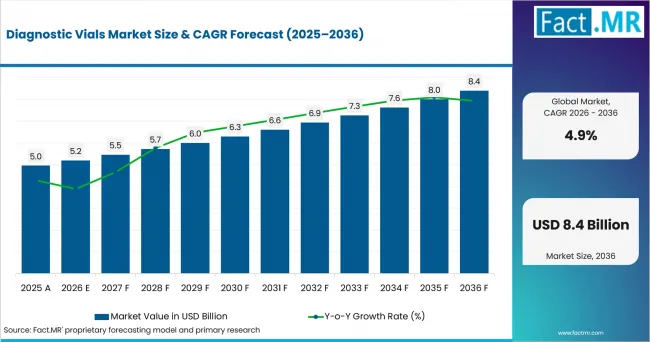
Diagnostic Vials Market Value Analysis | Source: Fact.MR
What are the defining numbers behind Diagnostic Vials Market growth?
An absolute opportunity of USD 3.2 billion is expected between 2026 and 2036.
- Demand Drivers in the Market
- Diagnostic testing is becoming a more persistent part of routine care, surveillance and disease management. The World Health Organization's 2023 Essential Diagnostics List added and updated laboratory tests across infectious disease, endocrine, maternal health and cardiovascular care, while encouraging countries to strengthen access to in vitro diagnostics. As the menu and frequency of IVD test kits expand, laboratories consume more primary containers for samples, controls and reagents, supporting recurring vial purchases.
- Biobanking and longitudinal research are increasing the number of specimens that must remain identifiable and stable for long periods. WHO laboratory biosecurity guidance covers collection, transport and storage across biomedical laboratories, repositories and biobanks. Large programs in Germany, the United States, the United Kingdom and Japan show how millions of biospecimens or aliquots are managed under controlled conditions, increasing demand for reliable sample containers, closures and formats compatible with cold storage.
- Regulation is raising the value of traceability, labeling and validated containment. The EU in vitro diagnostic framework treats specimen receptacles as IVDs when specifically intended for primary containment and preservation, and four EUDAMED modules became mandatory on 28 May 2026, including UDI/device registration. In the United States, FDA classifications separately cover blood-collection tubes and vials as well as sterile specimen transport and storage containers. These requirements favor suppliers that can provide consistent diagnostic packaging, documented materials and dependable lot control.
- Laboratory workflows increasingly reward container formats that reduce handling variability. FDA-recognized standards for specimen collection and storage, together with WHO biosafety principles, place emphasis on controlled handling from collection through laboratory processing. Ready-to-use, bar-coded and automation-compatible vial formats can reduce relabeling and manual transfer steps, which supports replacement of poorly standardized containers in high-throughput laboratories and repositories.
- Material performance remains a direct purchasing criterion because diagnostic accuracy can be affected by container interaction, evaporation, contamination or closure failure. First-party technical portfolios from Gerresheimer and DWK Life Sciences show continued use of Type I glass, molded glass and polymer formats for diagnostic, reagent and sample-management applications. Buyers therefore select vials according to chemical resistance, barrier performance, sterilization needs, temperature exposure and the sensitivity of the stored material.
- Key Segments Analyzed
- Glass Diagnostic Vials account for 52.6% of Product demand in 2026 because Type I, Type II and Type III glass options give diagnostic and laboratory buyers a broad choice of chemical-resistance and barrier properties within established glass-processing workflows.
- Medium Volume Vials represent 44.3% of Capacity demand in 2026 as routine diagnostic testing and general laboratory work need enough headspace and sample capacity for handling without the storage footprint associated with bulk containers.
- Clinical Diagnostics contributes 41.8% of Application demand in 2026 because blood testing and molecular diagnostics generate recurring sample-handling cycles across routine and specialist laboratories.
- Diagnostic Laboratories hold 38.7% of End Use demand in 2026 because centralized and independent laboratories purchase vials repeatedly for specimen preparation, reagent handling, retesting, quality control and archiving.
- Glass Based Vials account for 63.4% of Material demand in 2026 because glass combines dimensional stability, strong barrier characteristics and well-established hydrolytic-resistance grades for sensitive diagnostic and laboratory contents.
- Direct Sales represent 55.7% of Distribution Channel demand in 2026 as higher-volume laboratories, pharmaceutical users and diagnostic manufacturers benefit from specification control, lot documentation, negotiated supply programs and technical support directly from manufacturers.
- Analyst Opinion at Fact.MR
- Shambhu Nath Jha, Principal Consultant, Fact.MR, states, "Diagnostic vials sit at a small but consequential point in the testing chain. Buyers are increasingly evaluating the vial, closure, label and handling format as one controlled system because a poorly matched container can create avoidable loss, contamination or workflow friction. Growth through 2036 will therefore depend less on adding undifferentiated capacity and more on supplying stable glass and polymer formats that fit automated laboratories, biobanks and regulated diagnostic workflows."
- Strategic Implications
- Suppliers should treat dimensional consistency, closure integrity and lot documentation as commercial differentiators for diagnostic laboratories, where the cost of a rejected or compromised sample can exceed the cost of the container.
- Portfolio design should separate high-volume routine vials from higher-value specialty and cryogenic formats. Companies active in chromatography consumables and adjacent laboratory categories can use common distributor and quality-management capabilities, but diagnostic vial specifications still need application-specific validation.
- Manufacturing strategies should protect supply continuity across both glass and polymer inputs. Dual-format capability can help suppliers respond when customers shift between glass and plastic for weight, breakage, chemical compatibility, temperature or sterilization reasons.
- Diagnostic and pharmaceutical customers increasingly expect packaging suppliers to support filling, kitting, labeling and ready-to-use workflows. This creates room for closer coordination with contract packaging operations while keeping the diagnostic vial itself within validated specifications.
How does the Diagnostic Vials Market break down by segment?
The market is analyzed by Product, Capacity, Application, End Use, Material and Distribution Channel.
Why do Glass Diagnostic Vials lead Product?
Glass Diagnostic Vials account for 52.6% of Product demand in 2026.
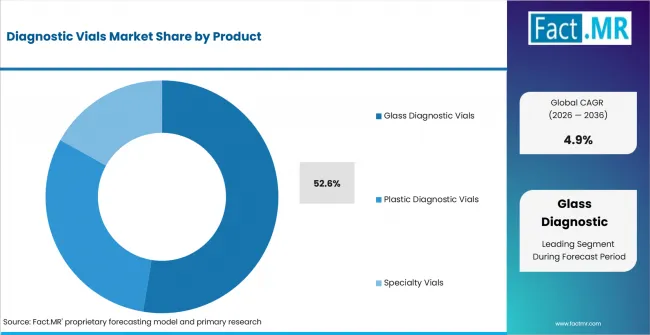
Diagnostic Vials Market Analysis By Product | Source: Fact.MR
Glass remains widely used where laboratories and diagnostic manufacturers need strong barrier performance, visual inspection and compatibility with sensitive reagents or stored samples. The category also spans Type I borosilicate, treated Type II and Type III soda lime formats, allowing buyers to match performance and cost to different diagnostic and laboratory requirements rather than moving every use case into one premium material.
DWK Life Sciences describes diagnostic packaging in glass and plastic for assay and sample-collection content, with Type I threaded glass vials used for diagnostic assays and reagents. Gerresheimer also markets Type I borosilicate vial platforms with tighter dimensional-tolerance options. These established manufacturing and qualification pathways reduce switching friction for users that already run glass-based filling, sealing, inspection or storage processes.
Why do Medium Volume Vials lead Capacity?
Medium Volume Vials account for 44.3% of Capacity demand in 2026.
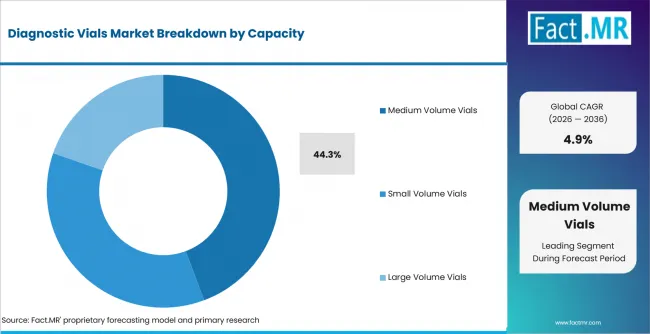
Diagnostic Vials Market Analysis By Capacity | Source: Fact.MR
The category aligns with the practical needs of Diagnostic Testing Vials and Laboratory Use Vials, where operators require enough working volume for sample preparation, controls or reagent handling while still preserving rack density and manageable storage space. This balance matters in laboratories that process repeated batches and need predictable compatibility with caps, racks, centrifugation or refrigerated storage.
Small Volume Vials are useful when sample conservation is the priority, while Large Volume Vials serve bulk sample and industrial testing tasks. Medium volume formats occupy the routine middle ground where testing frequency is high and handling is standardized, supporting repeat purchasing rather than one-time project demand.
Why does Clinical Diagnostics lead Application?
Clinical Diagnostics accounts for 41.8% of Application demand in 2026.
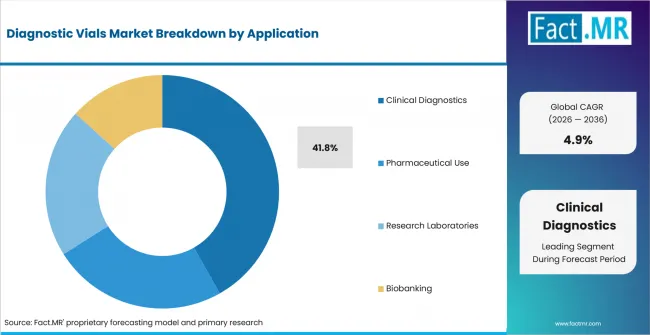
Diagnostic Vials Market Analysis By Application | Source: Fact.MR
Clinical testing creates a recurring chain of collection, preparation, analysis, quality control and short-term retention. Blood Testing and Molecular Diagnostics both require containers that preserve sample identity and minimize interaction with the material being tested. WHO continues to broaden and update essential diagnostic priorities, reinforcing laboratory testing as part of routine health-system capacity rather than an episodic activity.
The same demand mechanism supports adjacent diagnostic supplies: a broader installed base of assays generates more controlled handling of calibrators, reagents and patient specimens. Pharmaceutical Use, Research Laboratories and Biobanking remain important applications, but clinical diagnostics has a higher recurring cadence because patient testing volumes replenish container demand continuously.
Why do Diagnostic Laboratories lead End Use?
Diagnostic Laboratories account for 38.7% of End Use demand in 2026.
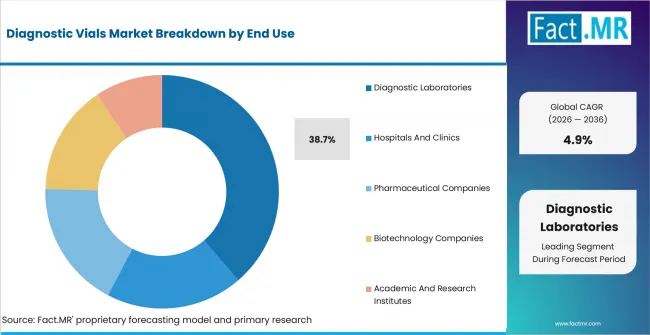
Diagnostic Vials Market Analysis By End Use | Source: Fact.MR
Diagnostic laboratories concentrate specimen throughput and standard operating procedures, making container consistency commercially important. CMS maintains CLIA laboratory-demographic and performance systems across the United States, reflecting a regulated testing infrastructure where laboratories must maintain quality practices and traceable processes. Similar quality expectations apply across other developed laboratory systems.
High-throughput laboratories also buy across adjacent sample-preparation categories, including chromatography consumables, but vials remain a recurring physical interface for small-volume storage, reagent handling and retained samples. Hospitals and Clinics often route complex testing to laboratories, while pharmaceutical, biotechnology and academic users buy around study or production schedules.
Why do Glass Based Vials lead Material?
Glass Based Vials account for 63.4% of Material demand in 2026.
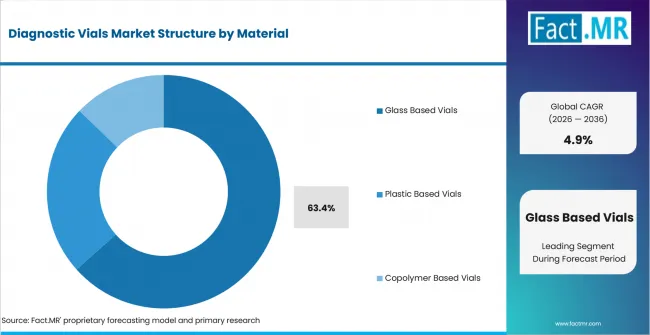
Diagnostic Vials Market Analysis By Material | Source: Fact.MR
Glass offers a strong combination of barrier performance, dimensional stability and established chemical-resistance classifications. DWK Life Sciences lists Type I glass for diagnostic assay and reagent packaging and uses glass formats for lyophilized and sensitive contents. This supports continued preference where long storage, low permeability or chemical compatibility is more important than container weight.
Plastic Based Vials and Copolymer Based Vials remain useful where break resistance, lower weight, squeezability or specific handling characteristics matter. As plastic packaging technology improves, polymer alternatives can gain in selected workflows, but glass retains a broad validated base across diagnostic and laboratory applications.
Why does Direct Sales lead Distribution Channel?
Direct Sales account for 55.7% of Distribution Channel demand in 2026.
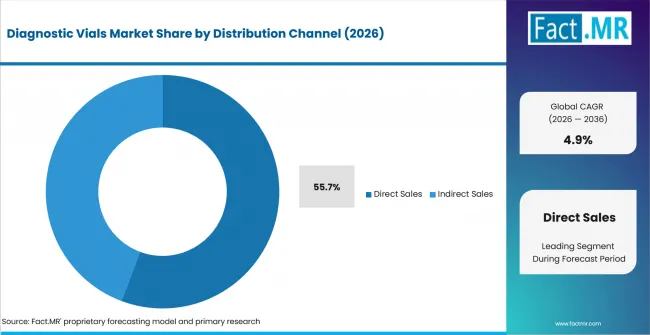
Diagnostic Vials Market Analysis By Distribution Channel | Source: Fact.MR
Large diagnostic laboratories, pharmaceutical companies and diagnostic-content manufacturers often need repeatable vial dimensions, defined material grades, closure compatibility, quality certificates and predictable replenishment. Direct manufacturer relationships simplify specification changes and provide clearer accountability when a vial must be qualified for a particular filling, storage or transport process.
Indirect Sales through Medical Distributors and Online Medical Stores remain important for smaller laboratories, fragmented purchasing and lower-volume replenishment. Direct supply gains share where order sizes, documentation requirements and technical coordination make the manufacturer relationship part of the purchasing decision.
What is accelerating Diagnostic Vials Market adoption, and what is holding it back?
Adoption is being accelerated by sustained diagnostic testing, expanding molecular workflows, greater biobank capacity, stricter traceability expectations and automation of sample handling. The commercial effect is a higher number of specimens and reagents moving through standardized containers, coupled with more frequent qualification of bar-coded, ready-to-use, specialty and cold-storage-compatible vial formats.
Growth is constrained by price pressure in routine vials, energy and material-cost volatility, breakage risk for glass, and the time required to qualify changes in containers or closures. Laboratories and diagnostic manufacturers are reluctant to switch a validated container solely for a small unit-price saving when the change can require stability checks, workflow adjustments or relabeling. Polymer alternatives reduce breakage in some uses but must still satisfy compatibility, permeability, sterilization and temperature requirements.
Drivers Impact Analysis
| Factor | (~) % Impact on CAGR | Geographic Relevance | Impact Timeline |
|---|---|---|---|
| Higher clinical and molecular diagnostic throughput | +0.8% | Global | Short term |
| Expansion of biobanking and longitudinal sample storage | +0.6% | Germany, USA, UK, Japan | Medium term |
| IVD traceability and container compliance requirements | +0.5% | Germany, UK, USA | Short term |
| Automation and bar-coded sample handling | +0.4% | USA, UK, Germany, Japan | Medium term |
| Pharmaceutical stability and laboratory research demand | +0.3% | Global | Medium term |
Source: Fact.MR analysis. Updated Aug 26, 2026
Opportunity Impact Analysis
| Factor | (~) % Impact on CAGR | Geographic Relevance | Impact Timeline |
|---|---|---|---|
| Cryogenic and specialty vials for biobanks | +0.4% | Germany, USA, UK, Japan | Medium term |
| Ready-to-use and bar-coded diagnostic vial formats | +0.3% | USA, Germany, UK | Medium term |
| Decentralized molecular testing in public laboratories | +0.3% | Brazil | Short to medium term |
| Higher-value Type I glass and advanced polymer formats | +0.2% | Global | Long term |
Source: Fact.MR analysis. Updated Aug 26, 2026
Restraints Impact Analysis
| Factor | (~) % Impact on CAGR | Geographic Relevance | Impact Timeline |
|---|---|---|---|
| Price pressure in routine high-volume vial formats | -0.4% | Global | Short term |
| Glass breakage and transport-handling losses | -0.3% | Global | Short term |
| Requalification burden for container or closure changes | -0.3% | Germany, UK, USA, Japan | Medium term |
| Glass, resin and energy input volatility | -0.2% | Global | Medium term |
Source: Fact.MR analysis. Updated Aug 26, 2026
Which countries are scaling the Diagnostic Vials Market through 2036?
- Germany is expanding demand through regulated IVD workflows and high-capacity biobanking. The Federal Ministry of Health notes that specimen containers can themselves qualify as IVDs, while the German National Cohort reported more than 26 million biospecimens in its central biorepository in 2025.
- Brazil is strengthening demand through a structured public-health laboratory network and updated IVD regulation. The Ministry of Health guides the hierarchical SISLAB network, while ANVISA has modernized risk classification, notification, registration and labeling rules for in vitro diagnostic medical devices.
- USA demand is supported by a broad CLIA-regulated laboratory base and large-scale research repositories. NIH reported more than 4.0 million primary biospecimens and 14.7 million stored aliquots in the All of Us biobank as of April 1, 2026, illustrating the scale of controlled specimen storage.
- UK demand is linked to high diagnostic activity and automated biobanking. NHS England reported an average of 2.4 million tests per month across key diagnostic activity in 2024/25, while UK Biobank holds around 17 million containers of blood, urine and saliva samples.
- Japan is supported by organized disease-oriented biobanking and genomics research. BioBank Japan reported 800,000 DNA tubes and 1.7 million serum tubes as of April 1, 2026, with storage systems operating under ISO-aligned quality and information-security controls.
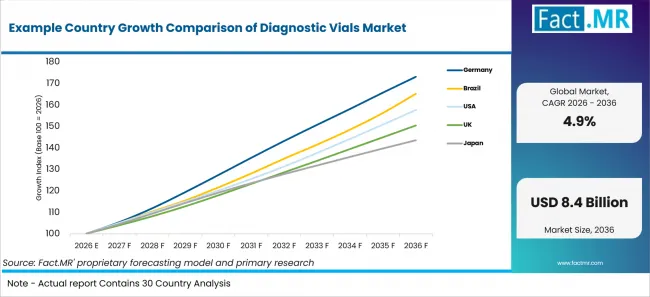
Example Country Growth Comparison Of Diagnostic Vials Market | Source: Fact.MR
Country CAGR (2026-2036)
| Country | CAGR (2026-2036) |
|---|---|
| Germany | 5.6% |
| Brazil | 5.2% |
| USA | 4.7% |
| UK | 4.2% |
| Japan | 3.7% |
Source: Fact.MR analysis. Updated Aug 26, 2026
What is driving Germany's growth through 2036?
Germany is projected to expand at a 5.6% CAGR from 2026 to 2036.
The regulatory environment gives specimen containers a formal place in IVD quality systems. Germany's Federal Ministry of Health states that sample containers can be IVDs, while the EU framework requires device registration and traceability through EUDAMED. Since four EUDAMED modules became mandatory on 28 May 2026, suppliers serving German diagnostic users face clearer expectations for device information, certificates and market-surveillance visibility.
Biobanking creates a second demand stream. The German National Cohort reported more than 26 million biospecimens stored at its central biorepository in 2025, supported by robotics and long-term storage at very low temperatures. That scale favors consistent cryogenic and ambient-storage vial formats, machine-readable identification and closures that tolerate repeated storage and retrieval cycles.
What is driving Brazil's growth through 2036?
Brazil is projected to expand at a 5.2% CAGR from 2026 to 2036.
Public-health laboratory decentralization increases the number of sites that need dependable specimen and reagent containers. Brazil's Ministry of Health describes SISLAB as a national system organized into disease- and program-specific subnetworks with a hierarchy based on complexity. As molecular and surveillance testing is distributed across this network, compliant vials are required at collection, preparation, referral and retention points.
ANVISA's RDC 830/2023 modernized the framework for IVD medical devices, aligning risk classification and market-entry requirements with international practice. For vial suppliers, stronger labeling, registration and quality expectations raise the value of consistent specifications and documentation, especially when products are supplied across public laboratories and diagnostic manufacturers.
What is driving USA's growth through 2036?
USA is projected to expand at a 4.7% CAGR from 2026 to 2036.
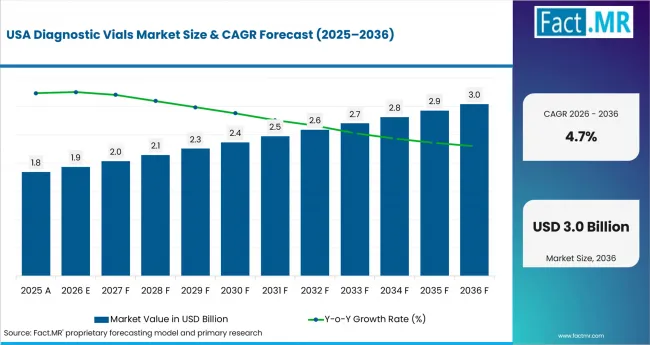
Diagnostic Vials Market Country Value Analysis | Source: Fact.MR
The United States combines a broad regulated laboratory base with explicit device classifications for specimen containers. CMS uses CLIA registries and performance systems to oversee laboratory quality, while FDA classifies blood specimen collection devices that include tubes and vials and separately recognizes sterile specimen transport and storage containers. This framework supports repeat demand for standardized containers that fit validated laboratory procedures.
What is driving UK's growth through 2036?
UK is projected to expand at a 4.2% CAGR from 2026 to 2036.
NHS England reported an average of 2.4 million diagnostic tests per month in 2024/25, an 8% increase from the prior year, with Community Diagnostic Centres delivering additional activity that included pathology tests. Not every diagnostic procedure consumes a vial, but sustained pathology and laboratory throughput increases the number of samples, controls and reagents that must move through standardized containers.
UK Biobank adds a separate long-term storage mechanism. It holds around 17 million containers of blood, urine and saliva samples, including about 10 million samples in an automated -80 C freezer. The scale of robotic retrieval favors uniform dimensions, durable identification and storage-compatible containers, supporting demand for vials used in biobanking and research workflows.
What is driving Japan's growth through 2036?
Japan is projected to expand at a 3.7% CAGR from 2026 to 2036.
BioBank Japan is a disease-oriented national research resource that stores biological samples and clinical information from participating patients. As of April 1, 2026, it reported 800,000 DNA tubes and 1.7 million serum tubes, alongside genomic and omics data resources. The scale demonstrates continuing demand for highly standardized sample-container systems within genetics and precision-medicine research.
BioBank Japan also states that samples are held under security controls that meet ISO standards and are provided to research projects aimed at new diagnostic and therapeutic methods. This places emphasis on reproducible labeling, sample identity, temperature performance and handling consistency, characteristics that support qualified diagnostic and specialty vial formats rather than low-control commodity containers.
Who Leads the Diagnostic Vials Market?
Key players in the Diagnostic Vials Market include Gerresheimer AG, DWK Life Sciences Ltd., Origin Pharma Packaging, SDG Pharma, Adelphi Healthcare Packaging, Airnov Healthcare Packaging, Rapid Labs Limited, Shanxi Hongjin Medical Glass Co.Ltd, Jinan Youlyy Industrial Co.Ltd, PGP Glass Private Limited and China Suncity Plastic Vials Factory.
Competition is shaped by material breadth, dimensional consistency, closure and finishing options, regulatory support, manufacturing scale and the ability to serve both standardized and customized orders. Diagnostic customers also value supply continuity because changing a vial or closure can require internal qualification, packaging-line adjustment or stability work before routine use.
Which companies are the key providers?
Key providers include Gerresheimer AG, DWK Life Sciences Ltd., Origin Pharma Packaging, SDG Pharma, Adelphi Healthcare Packaging, Airnov Healthcare Packaging, Rapid Labs Limited, Shanxi Hongjin Medical Glass Co.Ltd, Jinan Youlyy Industrial Co.Ltd, PGP Glass Private Limited and China Suncity Plastic Vials Factory.
- Gerresheimer AG
- DWK Life Sciences Ltd.
- Origin Pharma Packaging
- SDG Pharma
- Adelphi Healthcare Packaging
- Airnov Healthcare Packaging
- Rapid Labs Limited
- Shanxi Hongjin Medical Glass Co. Ltd.
- Jinan Youlyy Industrial Co. Ltd.
- PGP Glass Private Limited
- China Suncity Plastic Vials Factory
Bibliography
- World Health Organization. (2023). WHO releases new list of essential diagnostics; new recommendations for hepatitis E virus tests, personal use glucose meters. World Health Organization.
- World Health Organization. (2020). Laboratory biosafety manual, 4th edition. World Health Organization.
- World Health Organization. (2024). Laboratory biosecurity guidance. World Health Organization.
- European Parliament and Council of the European Union. (2017, consolidated 2025). Regulation (EU) 2017/746 on in vitro diagnostic medical devices. Official Journal of the European Union.
- European Commission. (2026). EUDAMED overview. European Commission.
- U.S. Food and Drug Administration. (2026). Product Classification: Tubes, Vials, Systems, Serum Separators, Blood Collection. U.S. Food and Drug Administration.
- U.S. Food and Drug Administration. (2026). Product Classification: Container, Specimen Mailer and Storage, Sterile. U.S. Food and Drug Administration.
- Centers for Medicare & Medicaid Services. (2026). Laboratory Performance. U.S. Department of Health and Human Services.
- National Institutes of Health. (2026). Advancing Cross-NIH Science Through Shared Genomic and Real-World Data Infrastructure. National Institutes of Health.
- Federal Ministry of Health, Germany. (2026). Was sind Medizinprodukte? Bundesministerium fuer Gesundheit.
- German National Cohort. (2025). Zukunft gestalten: Mitgliederversammlung in Muenchen. NAKO e.V.
- Brazilian Health Regulatory Agency. (2023). Anvisa atualiza regras sobre dispositivos medicos para diagnostico in vitro. ANVISA.
- Ministry of Health, Brazil. (2026). Guia para diagnostico laboratorial em saude publica: orientacoes para o Sistema Nacional de Laboratorios de Saude Publica. Ministerio da Saude.
- NHS England. (2025). Performance report 2024/25. NHS England.
- UK Biobank. (2026). Biological samples. UK Biobank.
- BioBank Japan. (2026). BioSamples and Data Collections of BBJ. Institute of Medical Science, The University of Tokyo.
- Gerresheimer. (2026). Vial platform. Gerresheimer AG.
- DWK Life Sciences. (2026). Diagnostic Packaging. DWK Life Sciences.
This Report Answers
- How will the diagnostic vials market move from USD 5.2 billion in 2026 to USD 8.4 billion by 2036?
- Which product, capacity, application, end-use, material and distribution categories account for the leading 2026 shares?
- How do clinical testing, biobanking, automation and IVD regulation translate into recurring vial demand?
- What country-specific mechanisms support growth in Germany, Brazil, USA, UK and Japan through 2036?
- How do material performance, traceability, supply reliability and channel structure shape competition among diagnostic vial providers?
What does the Diagnostic Vials Market cover?
The Diagnostic Vials Market covers revenue from vials sold for clinical diagnostics, pharmaceutical use, research laboratories and biobanking within the defined Product, Capacity, End Use, Material and Distribution Channel categories. Revenue is counted for the vial product at the point it is sold through direct or indirect channels, including glass, plastic, copolymer and specialty formats used for diagnostic samples, reagents, stability work and biological storage.
The analysis follows demand from Diagnostic Laboratories, Hospitals And Clinics, Pharmaceutical Companies, Biotechnology Companies and Academic And Research Institutes. It captures routine and specialty vials used in the listed applications without extending the market to unrelated laboratory hardware or complete diagnostic instruments.
What is included in the scope?
Included revenue covers Glass Diagnostic Vials, Plastic Diagnostic Vials and Specialty Vials, including the listed borosilicate, treated glass, soda lime, polypropylene, polyethylene, polycarbonate, cryogenic and ambient-storage variants. Small, Medium and Large Volume Vials are included where sold for the specified diagnostic, laboratory or bulk-testing uses.
Application coverage includes Clinical Diagnostics, Pharmaceutical Use, Research Laboratories and Biobanking. The commercial boundary includes vials supplied directly by manufacturers and vials sold through Medical Distributors or Online Medical Stores within the Indirect Sales channel.
What is excluded from the scope?
The scope excludes complete diagnostic analyzers, assay instruments, test kits sold without a separately valued vial component, general-purpose laboratory bottles outside the stated vial taxonomy, blood bags, syringes, culture plates, specimen tubes that are not marketed within the diagnostic vial category, and packaging components whose revenue cannot be attributed to the vial.
It also excludes diagnostic services, laboratory testing fees, biobank service revenue and pharmaceutical products stored inside the vials. Related packaging and laboratory-consumables markets are used only as context and are not added to Diagnostic Vials Market revenue.
How Was the Analysis Built?
The analysis combines market sizing with primary and desk research focused on diagnostic-vial manufacturing, diagnostic laboratories, healthcare providers, pharmaceutical and biotechnology users, distributors, research laboratories and biobanking operations. The market is examined by the exact Product, Capacity, Application, End Use, Material and Distribution Channel structure used throughout the report.
- Primary Research: respondent groups include vial and primary-packaging manufacturers, glass and polymer processors, diagnostic laboratory procurement teams, pharmaceutical packaging and quality personnel, biotechnology researchers, biobank operators, medical distributors and channel specialists. Discussion topics center on vial volumes, material selection, qualification cycles, closure compatibility, direct-versus-distributor procurement and changes in sample-handling workflows.
- Desk Research: the evidence base includes health-system and regulator material on IVDs, laboratory quality and specimen handling; public-health laboratory guidance; biobank and research-program information; and first-party technical material on glass, polymer, diagnostic and ready-to-use vial formats. Country evidence is selected for Germany, Brazil, USA, UK and Japan to explain different demand mechanisms rather than applying one global narrative to every market.
- Market Sizing and Forecasting: key variables include diagnostic and research sample throughput, recurring vial consumption, vial mix by product and material, capacity mix, direct and indirect channel behavior, pharmaceutical stability-testing needs, biobank storage expansion, material and energy costs, and the pace at which automation and bar-coding change container specifications.
- Data Validation and Update Cycle: market values and shares are checked for consistency across the segmentation, country analysis and forecast period. External developments are used to test the direction and strength of demand drivers, while regulation, laboratory infrastructure, supplier capabilities and biobank activity are refreshed when they materially change the outlook.
Segmentation
What is the report's scope and coverage?
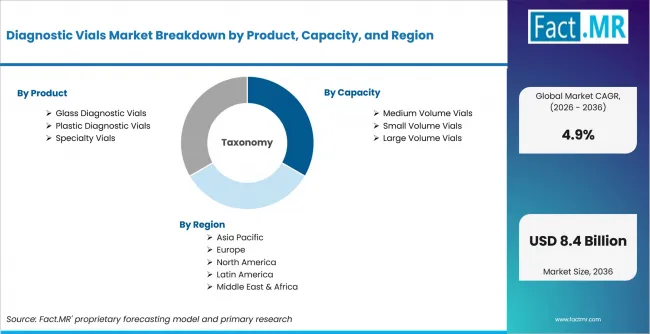
Diagnostic Vials Market Breakdown By Product, Capacity, And Region | Source: Fact.MR
| Scope Item | Coverage |
|---|---|
| Quantitative Units | USD billion for market value; percent for CAGR and market share |
| Market Definition | Commercial revenue from diagnostic vials used for sample, reagent, pharmaceutical, laboratory and biobanking applications within the specified taxonomy |
| Segments Covered | Product; Capacity; Application; End Use; Material; Distribution Channel |
| Regions Covered | Global market; detailed country analysis for Germany, Brazil, USA, UK and Japan |
| Countries Covered | Germany; Brazil; USA; UK; Japan |
| Key Companies Profiled | Gerresheimer AG; DWK Life Sciences Ltd.; Origin Pharma Packaging; SDG Pharma; Adelphi Healthcare Packaging; Airnov Healthcare Packaging; Rapid Labs Limited; Shanxi Hongjin Medical Glass Co.Ltd; Jinan Youlyy Industrial Co.Ltd; PGP Glass Private Limited; China Suncity Plastic Vials Factory |
| Forecast Period | 2026-2036 |
| Base Year | 2025 |
| Market Value, 2026 | USD 5.2 billion |
| Market Value, 2036 | USD 8.4 billion |
| CAGR, 2026-2036 | 4.9% |
| Absolute Opportunity | USD 3.2 billion |
| Approach | Market sizing by diagnostic and laboratory demand, vial product/material/capacity mix, end-use procurement, channel structure, supplier pricing and country-specific operating evidence |
Source: Fact.MR analysis. Updated Aug 26, 2026
How is the market segmented?
-
By Product
- Glass Diagnostic Vials
- Type I Borosilicate Glass Vials
- Type II Treated Glass Vials
- Type III Soda Lime Glass Vials
- Plastic Diagnostic Vials
- Polypropylene Vials
- Polyethylene Vials
- Polycarbonate Vials
- Specialty Vials
- Cryogenic Vials
- Ambient Storage Vials
- Glass Diagnostic Vials
-
By Capacity
- Medium Volume Vials
- Diagnostic Testing Vials
- Laboratory Use Vials
- Small Volume Vials
- Micro Sample Vials
- Standard Small Vials
- Large Volume Vials
- Bulk Sample Vials
- Industrial Testing Vials
- Medium Volume Vials
-
By Application
- Clinical Diagnostics
- Blood Testing
- Molecular Diagnostics
- Pharmaceutical Use
- Drug Storage
- Stability Testing
- Vaccine Storage
- Research Laboratories
- Academic Research
- Industrial Laboratories
- Biobanking
- Sample Preservation
- Biological Repositories
- Clinical Diagnostics
-
By End Use
- Diagnostic Laboratories
- Hospitals And Clinics
- Pharmaceutical Companies
- Biotechnology Companies
- Academic And Research Institutes
-
By Material
- Glass Based Vials
- Plastic Based Vials
- Copolymer Based Vials
-
By Distribution Channel
- Direct Sales
- Indirect Sales
- Medical Distributors
- Online Medical Stores
Frequently Asked Questions
What is the Diagnostic Vials Market value in 2026?
At what CAGR is the market projected to grow?
What is the projected market value by 2036?
Which Product category accounts for the leading share in 2026?
Which Capacity category accounts for the leading share in 2026?
Which Application category accounts for the leading share in 2026?
Which End Use category accounts for the leading share in 2026?
Which Material category accounts for the leading share in 2026?
Which Distribution Channel accounts for the leading share in 2026?
Which countries are analyzed in detail?
Which companies are included in the market analysis?
Who worked on this report


Preview the report firsthand - request a free sample
Free SampleGet the brochure for pricing and purchase details
Download PDF