- Market Value (2025): USD 1.1 Bn
- Estimated Value (2026): USD 1.2 Bn
- Forecast Value (2036): USD 2.6 Bn
- CAGR (2026-2036): 7.7%
What is the Dispensable Solder Pastes Market forecast to be worth by 2036?
USD 2.6 billion by 2036 at 7.7% CAGR.
- The Dispensable Solder Pastes Market reached USD 1.1 billion in 2025.
- Demand is projected to increase from USD 1.2 billion in 2026 to USD 2.6 billion by 2036.
- The market is forecast to record a 7.7% CAGR from 2026 to 2036.
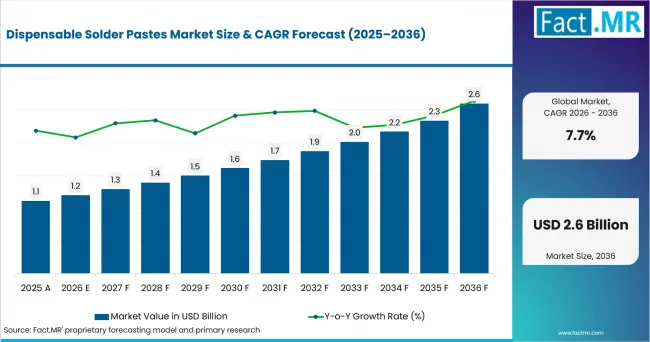
Dispensable Solder Pastes Market Value Analysis | Source: Fact.MR
What are the defining numbers behind Dispensable Solder Pastes Market growth?
An absolute opportunity of USD 1.3 billion is expected between 2026 and 2036.
- Demand Drivers in the Market
- SAC (SnAgCu) remains a core lead-free solder family for electronics assembly as manufacturers operate within RoHS-based material systems that restrict lead in electrical and electronic equipment. Its established use also allows paste suppliers to adapt flux chemistry and rheology for dispensing or jetting without requiring manufacturers to qualify an unfamiliar alloy family.
- Type 4 powder provides a workable balance between deposit size and paste handling. IPC classifies Type 4 powder at approximately 20-38 μm, allowing smaller deposits than coarser powders while avoiding some of the oxidation and process-control challenges associated with still finer particle distributions.
- Jet dispensing expands solder-paste use beyond geometries that can be served efficiently by a single stencil plane. Software-controlled jet systems can place different paste volumes at selected locations and accommodate challenging component topographies, making the method relevant to densely populated boards and semiconductor-package features.
- Advanced semiconductor packaging is increasing the number of fine-feature attach and interconnect processes requiring precisely controlled solder deposits. Taiwan is adding advanced packaging and testing capacity, while the U.S. CHIPS National Advanced Packaging Manufacturing Program finalized USD 1.4 billion in awards to move packaging technologies toward scaled domestic manufacturing.
- OSATs and semiconductor manufacturers qualify solder paste as part of a complete deposition and reflow process. Powder size and flux rheology must work with the selected nozzle or jetting system, while deposit volume and reflow conditions affect joint formation. Indium Corporation specifically formulates semiconductor solder pastes for dispensing and jetting across SiP, MEMS and other package applications.
- Key Segments Analyzed
- SAC (SnAgCu) accounts for 45.0% of Alloy Type in 2026, supported by its established role in lead-free electronics assembly and compatibility with mature soldering process controls.
- Type 4 holds 36.0% of Particle Size in 2026 because its 20-38 μm particle range supports relatively fine deposits without moving to the tighter handling requirements of finer solder powders.
- Jet dispensing represents 38.0% of Dispensing Method in 2026 as software-controlled deposition allows paste volume to be varied across package features without relying on direct stencil contact.
- Semiconductor packaging captures 44.0% of Application in 2026 because fine-feature packages require selective solder deposition for attach and interconnect steps that cannot always be handled through one conventional stencil process.
- OSAT/semiconductor users comprise 37.0% of End User in 2026 because they operate the packaging lines where alloy selection, paste rheology, deposition parameters and reflow conditions are qualified together.
- Analyst Opinion at Fact.MR
- Shambhu Nath Jha, Senior Consultant at Fact.MR, states, "Dispensable solder paste demand will increasingly be determined by where package geometry requires selective deposits rather than uniform stencil printing. Smaller features increase the importance of powder distribution and rheology, while jetting adds another layer of process qualification around deposit volume and reflow. Suppliers that can tune paste performance with dispensing equipment and package requirements are more likely to move from development trials into repeat production."
- Strategic Implications
- Suppliers should specify particle distribution and rheological behaviour alongside recommended nozzle, dispensing or jetting conditions rather than marketing alloy composition alone.
- Application trials should reproduce the intended package geometry because required deposit volume and accessibility can differ substantially across semiconductor and electronics assemblies.
- Technical support should be concentrated around semiconductor packaging clusters in China, Taiwan, South Korea, Japan and the USA, where new packaging capacity creates repeated qualification opportunities.
- Suppliers developing finer-particle products should demonstrate whether the reduction in achievable deposit size compensates for tighter oxidation, storage and handling requirements.
- Commercial positioning should distinguish formulations developed for contact dispensing from those specifically optimized for high-frequency jetting because the two processes impose different rheological requirements.
How does the Dispensable Solder Pastes Market break down by segment?
The market is segmented by Alloy Type, Particle Size, Dispensing Method, Application and End User.
Why does SAC (SnAgCu) lead Alloy Type?
SAC (SnAgCu) is projected to account for a 45.3% share in 2026.
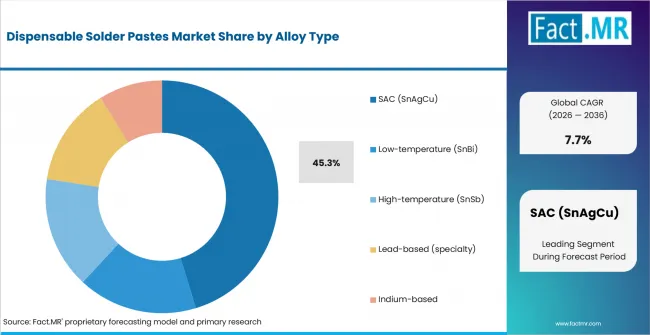
Dispensable Solder Pastes Market Analysis By Alloy Type | Source: Fact.MR
SAC benefits from an established position in lead-free electronics manufacturing. The EU RoHS Directive restricts lead in electrical and electronic equipment, while IPC J-STD-001 provides an industry-consensus framework for soldered electronic assemblies. This gives manufacturers a mature process environment in which SAC alloys are already familiar.
For dispensable paste, suppliers can retain the alloy family while altering flux chemistry and rheology for syringe or jet application. SAC305 is available commercially in semiconductor pastes developed specifically for jetting and fine-feature applications, showing how the alloy can be adapted to selective deposition.
Why does Type 4 lead Particle Size?
Type 4 is projected to account for a 36.0% share in 2026.
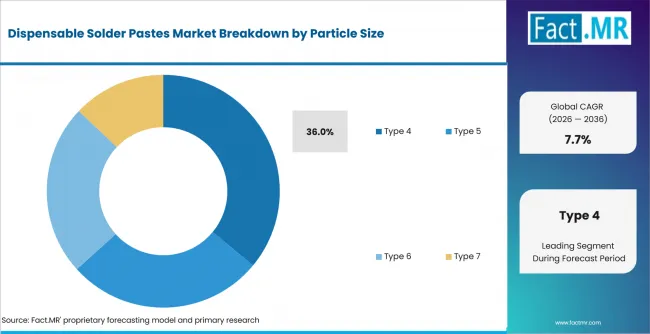
Dispensable Solder Pastes Market Analysis By Particle Size | Source: Fact.MR
Type 4 powder falls within an approximately 20-38 μm particle range under IPC classification. The smaller particles allow paste to pass through finer deposition features than coarser grades, making the format suitable for compact electronic and semiconductor assemblies.
Moving to Type 5 and finer powders can enable still smaller deposits, but it increases surface area relative to solder volume and places greater demands on oxidation control and paste formulation. Type 4 therefore occupies a practical middle ground for applications that require finer placement without the process sensitivity of the smallest available powders.
Why does Jet dispensing lead Dispensing Method?
Jet dispensing is projected to account for a 38.3% share in 2026.
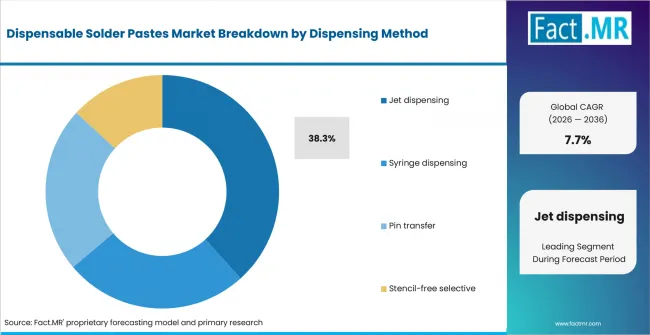
Dispensable Solder Pastes Market Analysis By Dispensing Method | Source: Fact.MR
Jetting allows solder paste to be deposited without physical contact between the dispensing head and the substrate. Deposit locations and volumes can be controlled through software, which is useful when package surfaces vary in height or when selected joints require different solder volumes.
Commercial systems illustrate the process advantage. Mycronic's jet platforms support software-driven solder-paste deposition and can combine jet printing with dispensing of other assembly materials. The company positions the technology for boards and components where conventional screen or stencil printing cannot address every required deposit.
Why does Semiconductor packaging lead Application?
Semiconductor packaging is projected to account for a 43.9% share in 2026.
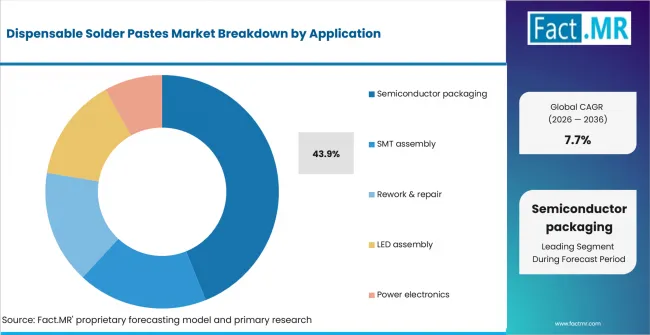
Dispensable Solder Pastes Market Analysis By Application | Source: Fact.MR
Semiconductor packages increasingly combine multiple dies, substrates and interconnect types within compact geometries. This creates solder-placement requirements that can vary across one package, increasing the value of selective dispensing or jetting instead of applying one uniform paste thickness.
Indium Corporation supplies semiconductor solder pastes for fine-feature printing, dispensing and jetting in SiP and MEMS packaging, as well as die-attach and clip-attach applications. Continued investment in advanced packaging in Taiwan and the USA expands the production base where these processes can be qualified.
Why do OSAT/semiconductor users lead End User?
OSAT/semiconductor users are projected to account for a 37.3% share in 2026.
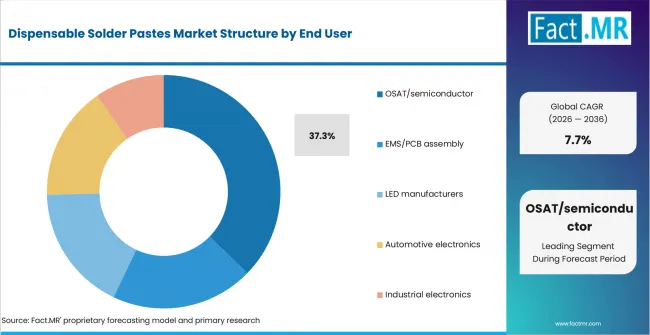
Dispensable Solder Pastes Market Analysis By End User | Source: Fact.MR
These users control the package-assembly process in which paste composition, deposit size and reflow profile must work together. A change in powder size or flux behaviour can affect dispensing stability and final joint formation, so material approval takes place against the actual equipment and package configuration.
High-value semiconductor devices also increase the cost of process variation. OSATs therefore require repeatable deposit volumes and traceable material lots before a solder paste is released into volume production, giving suppliers with application engineering and local qualification support an advantage.
What is accelerating Dispensable Solder Pastes Market adoption, and what is holding it back?
Drivers Impact Analysis
| Factor | (~) % Impact on CAGR | Geographic Relevance | Impact Timeline |
|---|---|---|---|
| Lead-free electronic assembly using SAC alloys | +2.1% | China, Taiwan, South Korea, Japan, USA and Europe | Short term (<= 2 years) |
| Fine-feature deposition using Type 4 solder powder | +1.7% | Taiwan, China, South Korea, Japan and USA | Medium term (2-4 years) |
| Selective solder placement through jet dispensing | +1.2% | Taiwan, Japan, China, South Korea and USA | Long term (>= 4 years) |
Opportunity Impact Analysis
| Factor | (~) % Impact on CAGR | Geographic Relevance | Impact Timeline |
|---|---|---|---|
| Low-temperature alloys for heat-sensitive packages | +1.1% | China, Taiwan, Japan, South Korea and USA | Short term (<= 2 years) |
| Finer-particle pastes for dense semiconductor packages | +0.9% | Taiwan, South Korea, China, Japan and USA | Medium term (2-4 years) |
| Rheology optimized specifically for high-speed jetting | +0.6% | Japan, Taiwan, China, South Korea and Europe | Long term (>= 4 years) |
Restraints Impact Analysis
| Factor | (~) % Impact on CAGR | Geographic Relevance | Impact Timeline |
|---|---|---|---|
| Oxidation and storage sensitivity as particle size decreases | -1.0% | Global | Short term (<= 2 years) |
| Nozzle instability or clogging during fine-paste dispensing | -0.8% | Global | Medium term (2-4 years) |
| Package-specific deposition and reflow qualification | -0.5% | Global | Long term (>= 4 years) |
Which countries are scaling the Dispensable Solder Pastes Market through 2036?
- Taiwan: Taiwan's concentration of semiconductor packaging and testing creates direct demand for selective solder-deposition materials. ASE and related companies are investing NT$17.8 billion in additional advanced packaging and testing infrastructure at Nanzih, adding packaging lines where paste and dispensing parameters can be qualified close to production.
- Japan: Japan is rebuilding advanced semiconductor production while maintaining a substantial electronics and automotive manufacturing base. METI plans to invest JPY 100 billion in Rapidus from the fiscal 2025 budget, creating additional domestic semiconductor process-development activity and associated materials qualification.
- South Korea: South Korea is expanding semiconductor manufacturing while strengthening its domestic materials and equipment ecosystem. Government support includes KRW 4.25 trillion of low-interest semiconductor financing in 2025 and further investment aimed at foundry capacity and supply-chain development.
- USA: The USA is extending semiconductor investment into advanced packaging. The CHIPS National Advanced Packaging Manufacturing Program finalized USD 1.4 billion in awards intended to validate packaging technologies and transition them toward high-volume domestic production, creating new qualification opportunities for solder pastes used in fine-feature interconnect processes.
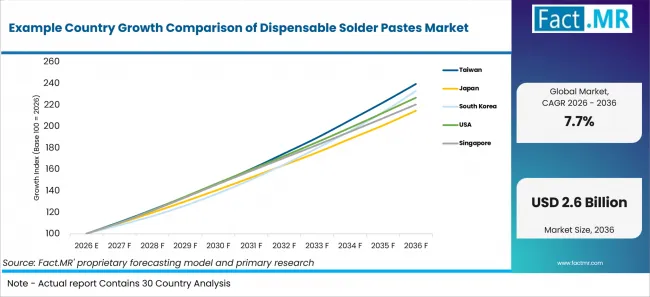
Example Country Growth Comparison Of Dispensable Solder Pastes Market | Source: Fact.MR
| Country | CAGR (2026-2036) |
|---|---|
| Taiwan | 8.8% |
| Japan | 8.3% |
| South Korea | 8.6% |
| USA | 8.6% |
What is driving Taiwan's growth through 2036?
Taiwan is forecast to expand at an 8.8% CAGR from 2026 to 2036.
Taiwan's growth is tied directly to semiconductor packaging and test capacity. ASE and its partners are investing NT$17.8 billion in advanced packaging and testing facilities at Nanzih, while a separate ASE K18B project involves another NT$17.6 billion of investment in advanced packaging and final testing.
These facilities increase the number of fine-feature package processes requiring tightly controlled solder volumes. Jettable and dispensable pastes are relevant where different interconnect locations require deposit sizes or geometries that cannot be produced efficiently through a single stencil.
What is driving Japan's growth through 2036?
Japan is forecast to expand at an 8.3% CAGR from 2026 to 2036.
Japan is adding next-generation semiconductor capability through Rapidus while retaining established production in automotive and precision electronics. METI intends to invest JPY 100 billion in Rapidus through the Information-technology Promotion Agency under the fiscal 2025 budget.
New semiconductor process development creates additional materials qualification around package assembly. Solder-paste suppliers can benefit where Japanese manufacturers require stable deposit volume and tightly controlled reflow performance for high-reliability electronic devices.
What is driving South Korea's growth through 2036?
South Korea is forecast to expand at an 8.6% CAGR from 2026 to 2036.
South Korea's semiconductor manufacturing base is being reinforced through financing and new capacity. The Korea Development Bank committed KRW 4.25 trillion of low-interest semiconductor loans for 2025, while a subsequent industry plan included KRW 4.5 trillion of public and private investment in a new foundry.
More domestic semiconductor production expands demand for packaging materials qualified alongside local equipment. Dispensable solder paste benefits where package layouts require selective deposition, while suppliers with local application support can adjust paste rheology and process parameters during qualification.
What is driving the USA's growth through 2036?
The USA is forecast to expand at an 8.6% CAGR from 2026 to 2036.
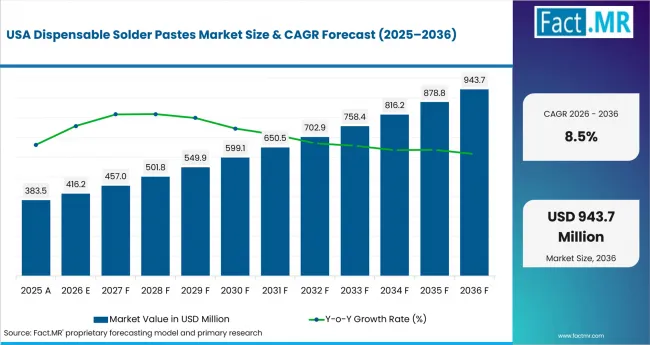
Dispensable Solder Pastes Market Country Value Analysis | Source: Fact.MR
U.S. semiconductor policy is adding advanced packaging capacity alongside wafer fabrication. The Department of Commerce finalized USD 1.4 billion in awards through the National Advanced Packaging Manufacturing Program to support technologies that can be validated and moved into scaled domestic manufacturing.
The programme also targets advanced packaging substrates and substrate materials, indicating a broader domestic packaging ecosystem rather than fabrication alone. More pilot and production lines create qualification opportunities for selective solder deposition in heterogeneous integration and other fine-feature package architectures.
Who leads the Dispensable Solder Pastes Market?
Indium Corporation is positioned through solder-material development and packaging support. Senju Metal and Alpha Assembly (MacDermid) compete through alloy formulation and fine-particle paste capability.
Competition depends on deposit repeatability, storage stability and reflow performance. Paste and dispensing hardware are qualified as one process.
Local application support near packaging clusters can shorten nozzle and reflow qualification.
Which companies are the key providers?
Key companies include Indium Corporation; Senju Metal; Alpha Assembly (MacDermid); Henkel; Koki Company; and Nihon Superior.
- Indium Corporation
- Senju Metal
- Alpha Assembly (MacDermid)
- Henkel
- Koki Company
- Nihon Superior
Bibliography
- IPC. (2024). J-STD-005B: Requirements for Soldering Pastes. IPC.
- European Parliament and Council of the European Union. (2011). Directive 2011/65/EU on the Restriction of Hazardous Substances. Official Journal of the European Union.
- U.S. Department of Commerce. (2025). CHIPS for America Advanced Packaging Manufacturing Program. U.S. Government.
- National Institute of Standards and Technology. (2024). Advanced Packaging, Power Delivery and Thermal Management Research. U.S. Department of Commerce.
- SEMI. (2025). Semiconductor Packaging Materials and Manufacturing Outlook. SEMI.
- Ministry of Industry and Information Technology, China. (2026). Development of the Electronic Information Manufacturing Industry in 2025. Government of China.
- Ministry of Economic Affairs, Taiwan. (2026). Advanced Semiconductor Research and Development and Packaging Support. Government of Taiwan.
- Ministry of Economy, Trade and Industry, Japan. (2025). Strategy for Semiconductor and Digital Industry Revitalization. Government of Japan.
- Ministry of Trade, Industry and Energy, Republic of Korea. (2025). High-Tech Strategic Industry and Materials Development Measures. Government of the Republic of Korea.
- Indium Corporation. (2026). Dispensing Solder Paste Materials and Process Guidance. Indium Corporation.
- Senju Metal Industry. (2026). Fine-Particle Solder Pastes for Semiconductor Packaging. Senju Metal Industry.
This Report Answers
- The report examines demand across Alloy Type, Particle Size, Dispensing Method, Application, End User.
- Segment analysis explains the operating reason behind each leading category.
- Country analysis evaluates the listed markets and adoption conditions through 2036.
- Competitive analysis reviews the listed companies and clarifies ownership or research roles where relevant.
- The analysis considers qualification, process control and application fit that influence purchasing decisions.
What does the Dispensable Solder Pastes Market cover?
Dispensable solder pastes engineered for jetting and syringe dispensing in semiconductor packaging, SMT rework and selective assembly with fine-pitch and low-void performance.
The assessment follows the stated segmentation by Alloy Type, Particle Size, Dispensing Method, Application, End User. Revenue is counted only where the stated product or equipment is sold for the listed applications.
What is included in the scope?
The scope includes SAC (SnAgCu), Low-temperature (SnBi), High-temperature (SnSb), Lead-based (specialty), Indium-based.
It also covers Type 4, Type 5, Type 6, Type 7.
Demand is assessed across Dispensing Method: Jet dispensing, Syringe dispensing, Pin transfer, Stencil-free selective; Application: Semiconductor packaging, SMT assembly, Rework & repair, LED assembly, Power electronics; End User: OSAT/semiconductor, EMS/PCB assembly, LED manufacturers, Automotive electronics, Industrial electronics.
What is excluded from the scope?
Stencil-print solder paste is excluded when it is not formulated or sold for dispensing.
Solder wire, preforms and liquid flux are adjacent products.
Jetting and dispensing equipment is excluded when sold separately.
How Was the Analysis Built?
The analysis combines product scope, segment demand, country outlook and supplier coverage.
- Primary Research: Interviews focus on solder-paste suppliers, OSAT companies, electronics manufacturers and dispensing-equipment specialists.
- Desk Research: The review covers IPC paste standards, RoHS requirements, packaging investment and supplier technical data.
- Market Sizing and Forecasting: Estimates combine packaging and assembly volume, paste consumption per deposit, alloy mix, particle size and realized pricing.
- Data Validation and Update Cycle: Findings are checked against public evidence and supplier portfolios. Updates review alloy changes, package geometry and advanced-packaging capacity.
What is the report's scope and coverage?
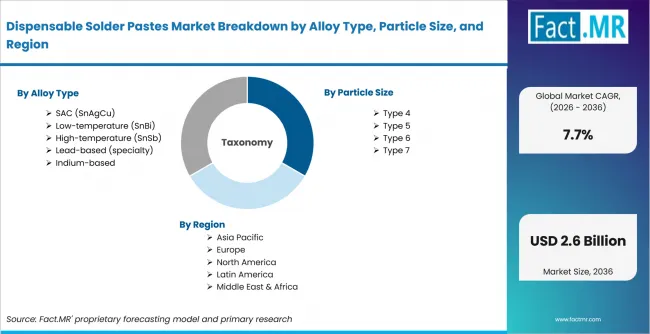
Dispensable Solder Pastes Market Breakdown By Alloy Type, Particle Size, And Region | Source: Fact.MR
| Attribute | Details |
|---|---|
| Quantitative Units | USD Billion |
| Market Definition | Dispensable solder pastes engineered for jetting and syringe dispensing in semiconductor packaging, SMT rework and selective assembly with fine-pitch and low-void performance. |
| Segments Covered | Alloy Type; Particle Size; Dispensing Method; Application; End User |
| Regions Covered | North America; Latin America; Europe; East Asia; South Asia and Oceania; Middle East and Africa |
| Countries Covered | China; Taiwan; Japan; South Korea; USA |
| Key Companies Profiled | Indium Corporation; Senju Metal; Alpha Assembly (MacDermid); Henkel; Koki Company; Nihon Superior |
| Forecast Period | 2026 to 2036 |
| Base Year | 2025 |
| Market Value, 2026 | USD 1.2 billion |
| Market Value, 2036 | USD 2.6 billion |
| CAGR, 2026-2036 | 7.7% |
| Absolute Opportunity | USD 1.3 billion |
| Approach | Combines packaging and assembly volume, paste consumption per deposit, alloy mix, particle size and realized pricing. |
How is the market segmented?
-
By Alloy Type
- SAC (SnAgCu)
- Low-temperature (SnBi)
- High-temperature (SnSb)
- Lead-based (specialty)
- Indium-based
-
By Particle Size
- Type 4
- Type 5
- Type 6
- Type 7
-
By Dispensing Method
- Jet dispensing
- Syringe dispensing
- Pin transfer
- Stencil-free selective
-
By Application
- Semiconductor packaging
- SMT assembly
- Rework & repair
- LED assembly
- Power electronics
-
By End User
- OSAT/semiconductor
- EMS/PCB assembly
- LED manufacturers
- Automotive electronics
- Industrial electronics