- Market Value (2025): USD 766.1 Mn
- Estimated Value (2026): USD 835.0 Mn
- Forecast Value (2036): USD 1976.7 Mn
- CAGR (2026-2036): 9.0%
What is the Dispensable Thermal Greases Market forecast to be worth by 2036?
USD 1976.7 million by 2036 at 9.0% CAGR.
- The Dispensable Thermal Greases Market reached USD 766.1 million in 2025.
- Demand is projected to increase from USD 835.0 million in 2026 to USD 1976.7 million by 2036.
- The market is forecast to record a 9.0% CAGR from 2026 to 2036.
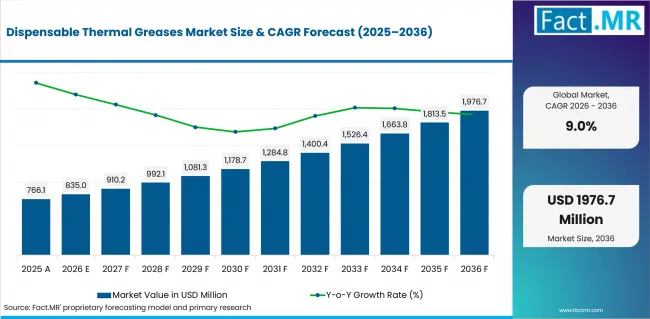
Dispensable Thermal Greases Market Value Analysis | Source: Fact.MR
What are the defining numbers behind Dispensable Thermal Greases Market growth?
An absolute opportunity of USD 1,145.0 million is expected between 2026 and 2036.
- Demand Drivers in the Market
- Metal-oxide filled creates a heat-transfer path while preserving the electrical or mechanical requirement of the finished interface.
- <3 W/mK leads because it balances thermal performance with viscosity or electrical insulation for a broad application base.
- Silicone-based supports automated placement or bonding in computing, automotive and industrial power electronics.
- DOE and NREL thermal-management programmes identify interface resistance as a reliability issue in high-power devices.
- Controlled dispensing and bond-line management reduce excess material and improve repeatability across production assemblies.
- Key Segments Analyzed
- Key Segments Analyzed
- Metal-oxide filled accounts for 35.0% of Filler Type in 2026 because ceramic fillers can improve thermal conduction while retaining electrical insulation between heat-generating components and cooling hardware.
- <3 W/mK holds 40.0% of Conductivity Range in 2026 as many mainstream electronics interfaces can meet thermal requirements without the high filler loading needed for more conductive formulations.
- Silicone-based represents 50.0% of Base Chemistry in 2026 because silicone greases remain conformable across temperature changes and can carry thermally conductive fillers while maintaining spreadability at the interface.
- CPU/GPU cooling captures 44.0% of Application in 2026 because processors require a compliant material between the package and heat sink to displace insulating air gaps and lower thermal resistance. Parker identifies thermal interface materials as a means of eliminating air gaps between electronic components and heat sinks, while 3M specifically lists processor and graphics chips as applications for thermal grease.
- Analyst Opinion at Fact.MR
- Shambhu Nath Jha, Senior Consultant at Fact.MR, states, "Demand in the Dispensable Thermal Greases Market will increasingly depend on thermal resistance at the assembled interface rather than conductivity values alone. Processor and power-electronics manufacturers must control bond-line thickness while limiting pump-out and material separation over repeated thermal cycles. Suppliers that demonstrate stable dispensing and interface performance on the customer's actual hardware are better positioned for repeat qualification."
- Strategic Implications
- Suppliers should report thermal impedance alongside bulk conductivity because interface performance depends on material thickness, contact resistance and assembly pressure. Parker identifies both thermal conductivity and thermal impedance as key thermal-interface properties.
- Application trials should reproduce the intended heat source, heat sink surface and assembly pressure because surface condition and bond-line thickness influence the thermal resistance of the complete interface.
- Technical support should extend across China, the USA, South Korea, Japan and Germany, reflecting demand from computing, semiconductor and automotive power-electronics manufacturing rather than concentrating commercial activity in one or two countries.
- Higher-conductivity formulations should be positioned where thermal load justifies increased filler loading. Mainstream electronics applications may continue to use lower-conductivity greases where thin bond lines provide adequate interface performance.
- Laird Performance Materials should be treated within DuPont rather than as a separate independent supplier.
How does the Dispensable Thermal Greases Market break down by segment?
The market is segmented by Filler Type, Conductivity Range, Base Chemistry and Application.
Why does Metal-oxide filled lead Filler Type?
Metal-oxide filled is projected to account for a 34.6% share in 2026.
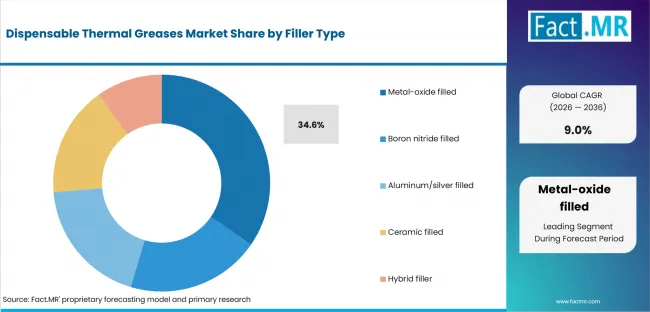
Dispensable Thermal Greases Market Analysis By Filler Type | Source: Fact.MR
Metal-oxide fillers improve heat transfer through grease while allowing the thermal interface to remain electrically insulating. This is important around processors and power electronics, where the material must conduct heat toward a heat sink without creating an unintended electrical path.
The filler platform can also be adjusted across different thermal-performance requirements. Manufacturers can increase filler loading where greater conductivity is needed or retain lower loading where ease of dispensing and thin bond-line formation carry more value.
Why does <3 W/mK lead Conductivity Range?
<3 W/mK is projected to account for a 39.6% share in 2026.
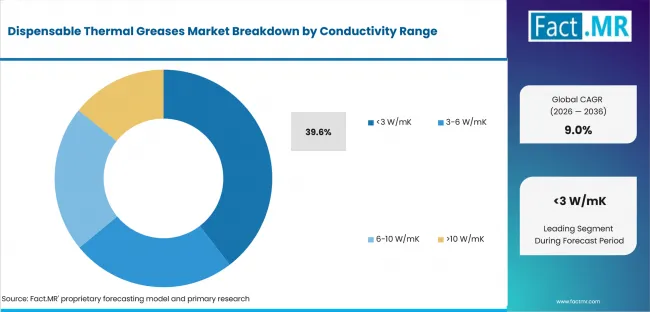
Dispensable Thermal Greases Market Analysis By Conductivity Range | Source: Fact.MR
Many electronic interfaces do not require the highest available bulk conductivity because total thermal performance also depends on bond-line thickness and contact resistance. Parker notes that thermally conductive materials reduce joint resistance by conforming to uneven mating surfaces and replacing low-conductivity air gaps.
Lower filler loading can also preserve flow behaviour, making the grease easier to dispense and spread under assembly pressure. Parker's microelectronics portfolio includes lower-conductivity silicone greases for applications where modest thermal conductivity is sufficient, alongside more conductive formulations for demanding interfaces.
Why does Silicone-based lead Base Chemistry?
Silicone-based is projected to account for a 49.9% share in 2026.
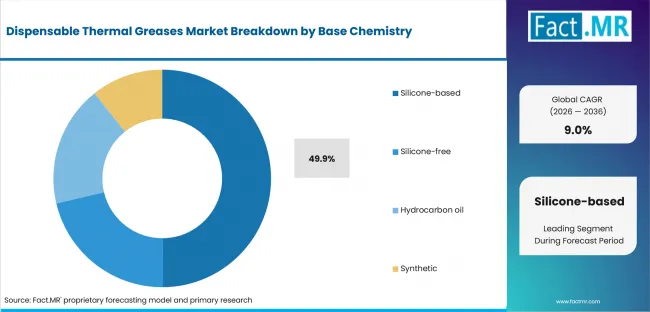
Dispensable Thermal Greases Market Analysis By Base Chemistry | Source: Fact.MR
Silicone provides a stable carrier for thermally conductive fillers while remaining soft enough to conform to microscopic surface irregularities between a component and heat sink. Parker's thermally conductive grease portfolio uses silicone-based, single-component materials specifically for heat transfer between hot electronic components and cooling surfaces.
The chemistry also supports reworkable interfaces because the grease does not need to become a rigid structural bond. This is useful in computing and electronics assemblies where heat sinks may need to be removed during maintenance or component replacement.
Why does CPU/GPU cooling lead Application?
CPU/GPU cooling is projected to account for a 43.9% share in 2026.
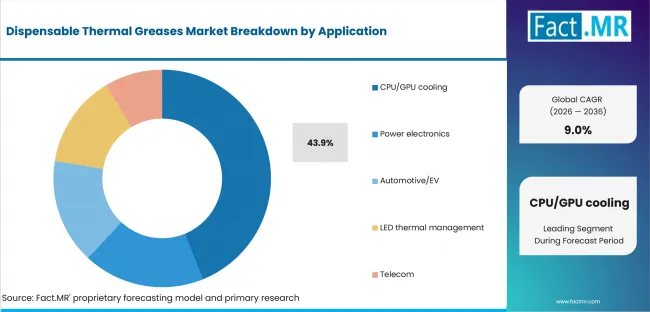
Dispensable Thermal Greases Market Analysis By Application | Source: Fact.MR
Processors generate concentrated heat over a relatively small package area, requiring an interface material between the package surface and heat sink. Even apparently flat surfaces contain microscopic irregularities that trap air, and replacing these gaps with a thermally conductive grease lowers resistance to heat flow.
The application also generates recurring demand because grease is applied during processor or cooling-module assembly. 3M identifies processor and graphics chips as heat sources served by thermally conductive grease, while Parker lists microprocessors and CPUs among typical uses for dispensable thermal-interface materials.
What is accelerating Dispensable Thermal Greases Market adoption, and what is holding it back?
Drivers Impact Analysis
| Factor | (~) % Impact on CAGR | Geographic Relevance | Impact Timeline |
|---|---|---|---|
| Increasing processor and accelerator heat density | +2.4% | China, USA, Taiwan, South Korea and Japan | Short term (<= 2 years) |
| Wider thermal-management requirements in power electronics | +2.0% | Germany, China, USA, Japan and South Korea | Medium term (2-4 years) |
| Automated dispensing of thermal-interface materials | +1.4% | China, Japan, South Korea, USA and Europe | Long term (>= 4 years) |
Source: Fact.MR analysis. Updated Aug 12, 2026
Opportunity Impact Analysis
| Factor | (~) % Impact on CAGR | Geographic Relevance | Impact Timeline |
|---|---|---|---|
| Pump-out-resistant formulations for repeated thermal cycling | +1.3% | Global | Short term (<= 2 years) |
| Higher-conductivity electrically insulating filler systems | +1.0% | USA, Germany, Japan, China and South Korea | Medium term (2-4 years) |
| Thermal interfaces for EV power electronics | +0.7% | China, Germany, USA, Japan and South Korea | Long term (>= 4 years) |
Source: Fact.MR analysis. Updated Aug 12, 2026
Restraints Impact Analysis
| Factor | (~) % Impact on CAGR | Geographic Relevance | Impact Timeline |
|---|---|---|---|
| Pump-out and dry-out during repeated temperature cycling | -1.2% | Global | Short term (<= 2 years) |
| Filler separation and changes in dispensing consistency | -0.9% | Global | Medium term (2-4 years) |
| Bond-line and interface-specific qualification requirements | -0.6% | Global | Long term (>= 4 years) |
Source: Fact.MR analysis. Updated Aug 12, 2026
Pump-out and separation are genuine material-selection issues rather than country-specific restraints. Parker's microelectronic materials documentation describes thermal-interface formulations designed specifically to inhibit bleeding, separation and pump-out.
Which countries are scaling the Dispensable Thermal Greases Market through 2036?
- Germany: Germany's automotive, electrical-equipment and industrial-electronics industries create applications for dispensable thermal interfaces in power modules and control electronics. In May 2026, new orders increased 5.7% in electrical equipment, while automotive production rose 3.6% from the previous month.
- Japan: Japan is expanding advanced semiconductor capability through Rapidus while retaining automotive and precision-electronics manufacturing. METI intends to invest JPY 100 billion in Rapidus through the fiscal 2025 budget, adding semiconductor development and production environments where thermal management is integral to package and system design.
- South Korea: South Korea's concentration in semiconductors and electronics creates demand for thermal management across memory devices, computing hardware and power electronics. Continued investment by semiconductor equipment and materials companies adds local qualification activity for thermal-interface products.
- USA: U.S. investment in semiconductor fabrication and advanced packaging is increasing domestic thermal-management requirements. The Department of Commerce finalized USD 1.4 billion in advanced-packaging awards and is also supporting integrated wafer manufacturing and packaging capability at GlobalFoundries in New York.
Country CAGR (2026-2036)
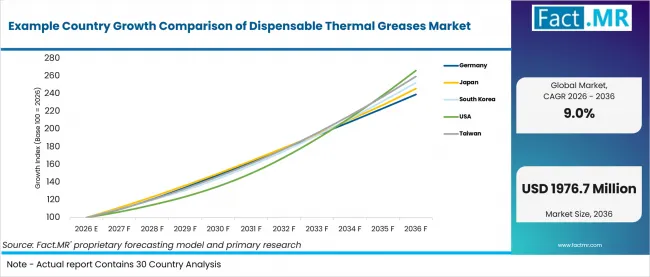
Example Country Growth Comparison Of Dispensable Thermal Greases Market | Source: Fact.MR
| Country | CAGR (2026-2036) |
|---|---|
| Germany | 9.4% |
| Japan | 9.4% |
| South Korea | 9.8% |
| USA | 10.0% |
Source: Fact.MR analysis. Updated Aug 12, 2026
What is driving China's growth through 2036?
China is forecast to expand at an 11.2% CAGR from 2026 to 2036.
China's electronics and electrical-equipment industries create a large production base for thermal-interface materials used around processors and power modules. In 2025, value added from computer, communication and other electronic-equipment manufacturing increased 10.6%, while electrical machinery and apparatus manufacturing rose 9.2%.
Automotive manufacturing increased 11.5% during the same year, widening the thermal-management opportunity into vehicle control systems and power electronics. These applications favour dispensable materials where bond-line thickness and conformability can be adjusted to different module geometries.
What is driving Germany's growth through 2036?
Germany is forecast to expand at a 9.4% CAGR from 2026 to 2036.
Germany's automotive and electrical-equipment manufacturing base creates direct demand for thermal interfaces used around power electronics and control modules. New orders for electrical equipment increased 21.5% month over month in March 2026, while computer, electronic and optical products increased 14.4%.
Automotive production also rose 3.6% in May 2026. As vehicle platforms incorporate more power electronics, thermal grease suppliers gain additional qualification opportunities where material must maintain interface contact despite temperature cycling and vibration.
What is driving Japan's growth through 2036?
Japan is forecast to expand at a 9.4% CAGR from 2026 to 2036.
Japan is building next-generation semiconductor manufacturing capacity while maintaining established automotive and precision-electronics production. METI selected Rapidus for its advanced-semiconductor programme and intends to invest JPY 100 billion through the fiscal 2025 budget.
AIST is also establishing an open semiconductor R&D centre in Chitose alongside the Rapidus cluster. More domestic device-development and pilot activity creates additional thermal-management qualification work around processors and high-density electronic packages.
What is driving South Korea's growth through 2036?
South Korea is forecast to expand at a 9.8% CAGR from 2026 to 2036.
South Korea's semiconductor and electronics manufacturing base creates recurring demand for materials that transfer heat from densely packed devices to cooling hardware. The country's semiconductor ecosystem continues to attract global production-equipment investment, including expansion by Tokyo Electron.
The same thermal-management requirement extends into automotive electronics and battery-related power modules. Dispensable grease is relevant where manufacturers need a compliant interface that can accommodate surface variation while maintaining low thermal resistance during temperature cycling.
What is driving the USA's growth through 2036?
The USA is forecast to expand at a 10.3% CAGR from 2026 to 2036.
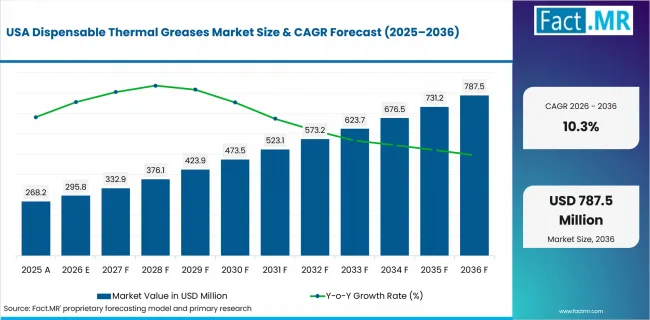
Dispensable Thermal Greases Market Country Value Analysis | Source: Fact.MR
The USA is adding semiconductor fabrication and packaging capability, increasing demand for thermal-management materials across high-performance computing and advanced electronic packages. The Department of Commerce finalized USD 1.4 billion in awards under the National Advanced Packaging Manufacturing Program to move new packaging technologies into scaled manufacturing.
Advanced packaging itself raises thermal-management requirements because multiple semiconductor components can be integrated within compact packages. NIST identifies reliable thermal management as a core requirement in advanced packaging, reinforcing the need for interface materials that control heat transfer between high-power devices and cooling structures.
Who leads the Dispensable Thermal Greases Market?
Henkel is positioned as a leading supplier through formulation breadth and technical support. Dow and Shin-Etsu Chemical compete through application-specific materials for electronics or industrial equipment.
Competition is determined by cured performance and process consistency. Buyers assess viscosity and cure profile together with thermal, dielectric or mechanical requirements.
Qualification history and lot control create switching costs, so suppliers with stable formulations and local process support retain stronger positions.
Laird Performance Materials operates within DuPont.
Which companies are the key providers?
Key companies include Henkel; Dow; Shin-Etsu Chemical; Momentive; Parker Chomerics; and Laird (DuPont).
- Henkel
- Dow
- Shin-Etsu Chemical
- Momentive
- Parker Chomerics
- Laird (DuPont)
Bibliography
- U.S. Department of Energy. (2025). Power Electronics Thermal Management Research and Development. U.S. Government.
- National Renewable Energy Laboratory. (2025). Thermal Management for Power Electronics and Electric Drive Systems. U.S. Department of Energy.
- National Institute of Standards and Technology. (2026). Thermal Property Measurements for Electronic Materials. U.S. Department of Commerce.
- U.S. Department of Commerce. (2025). CHIPS for America Advanced Packaging Manufacturing Program. U.S. Government.
- IPC. (2024). Electronics Assembly Process Control and Materials Standards. IPC.
- Ministry of Industry and Information Technology, China. (2026). Development of the Electronic Information Manufacturing Industry in 2025. Government of China.
- Federal Ministry for Economic Affairs and Climate Action, Germany. (2025). Industrial and Automotive Transformation Programmes. Government of Germany.
- Ministry of Economy, Trade and Industry, Japan. (2025). Strategy for Semiconductor and Digital Industry Revitalization. Government of Japan.
- Ministry of Trade, Industry and Energy, Republic of Korea. (2025). High-Tech Strategic Industry and Materials Development Measures. Government of the Republic of Korea.
- Parker Hannifin. (2026). Chomerics Thermal Interface Materials. Parker Hannifin.
- DuPont. (2026). Laird Performance Materials Thermal Interface Solutions. DuPont.
This Report Answers
- The report examines demand across Filler Type, Conductivity Range, Base Chemistry, Application.
- Segment analysis explains the operating reason behind each leading category.
- Country analysis evaluates the listed markets and adoption conditions through 2036.
- Competitive analysis reviews the listed companies and clarifies ownership or research roles where relevant.
- The analysis considers qualification, process control and application fit that influence purchasing decisions.
What does the Dispensable Thermal Greases Market cover?
Dispensable thermal greases and pastes providing thermal conduction between heat-generating components and heat sinks in electronics, automotive and power applications.
The assessment follows the stated segmentation by Filler Type, Conductivity Range, Base Chemistry, Application. Revenue is counted only where the stated product or equipment is sold for the listed applications.
What is included in the scope?
The scope includes Metal-oxide filled, Boron nitride filled, Aluminum/silver filled, Ceramic filled, Hybrid filler.
It also covers <3 W/mK, 3-6 W/mK, 6-10 W/mK, >10 W/mK.
Demand is assessed across Base Chemistry: Silicone-based, Silicone-free, Hydrocarbon oil, Synthetic; Application: CPU/GPU cooling, Power electronics, Automotive/EV, LED thermal management, Telecom.
What is excluded from the scope?
Cured thermal adhesives, phase-change pads and gap fillers are excluded when not sold as dispensable grease.
Heat sinks and cooling hardware are excluded as standalone products.
General lubricating grease is outside the market.
How Was the Analysis Built?
The analysis combines product scope, segment demand, country outlook and supplier coverage.
- Primary Research: Interviews focus on formulators, distributors, equipment suppliers and end users responsible for bonding, potting or thermal management.
- Desk Research: The review covers technical standards, government manufacturing programmes and company product literature.
- Market Sizing and Forecasting: Estimates combine application volume, material use per part, formulation mix, pack size and realized pricing.
- Data Validation and Update Cycle: Findings are checked against public evidence and supplier portfolios. Updates review formulation changes, ownership changes and manufacturing shifts.
Segmentation
What is the report's scope and coverage?
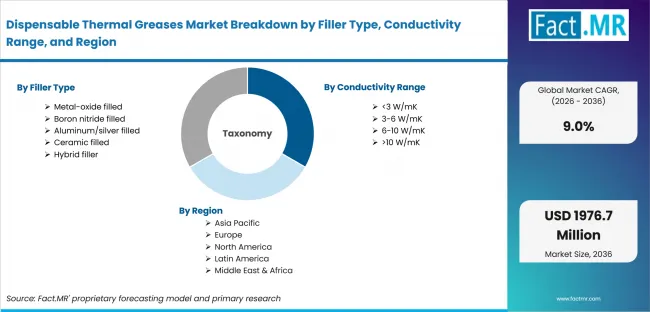
Dispensable Thermal Greases Market Breakdown By Filler Type, Conductivity Range, And Region | Source: Fact.MR
| Attribute | Details |
|---|---|
| Quantitative Units | USD 835.0 million in 2026 to USD 1,980.0 million by 2036 at a 9.0% CAGR |
| Market Definition | Dispensable thermal greases and pastes providing thermal conduction between heat-generating components and heat sinks in electronics, automotive and power applications. |
| Segments Covered | Filler Type; Conductivity Range; Base Chemistry; Application |
| Regions Covered | North America; Latin America; Europe; East Asia; South Asia and Oceania; Middle East and Africa |
| Countries Covered | China; Germany; Japan; South Korea; USA |
| Key Companies Profiled | Henkel; Dow; Shin-Etsu Chemical; Momentive; Parker Chomerics; Laird (DuPont) |
| Forecast Period | 2026 to 2036 |
| Base Year | 2025 |
| Market Value, 2026 | USD 835.0 million |
| Market Value, 2036 | USD 1,980.0 million |
| CAGR, 2026-2036 | 9.0% |
| Absolute Opportunity | USD 1,145.0 million |
| Approach | Combines application volume, material use per part, formulation mix, pack size and realized pricing. |
Source: Fact.MR analysis. Updated Aug 12, 2026
How is the market segmented?
-
By Filler Type
- Metal-oxide filled
- Boron nitride filled
- Aluminum/silver filled
- Ceramic filled
- Hybrid filler
-
By Conductivity Range
- <3 W/mK
- 3-6 W/mK
- 6-10 W/mK
- >10 W/mK
-
By Base Chemistry
- Silicone-based
- Silicone-free
- Hydrocarbon oil
- Synthetic
-
By Application
- CPU/GPU cooling
- Power electronics
- Automotive/EV
- LED thermal management
- Telecom
-
By Region
- North America
- Latin America
- Western Europe
- Eastern Europe
- East Asia
- South Asia and Pacific
- Middle East & Africa
Frequently Asked Questions
What is the Dispensable Thermal Greases Market value in 2026?
At what CAGR is the market projected to grow?
What is the projected market value by 2036?
Which Filler Type category leads the market?
Which Conductivity Range category leads the market?
Which Base Chemistry category leads the market?
Which Application category leads the market?
What is the listed CAGR for China?
What is the primary driver in this market?
What is the main restraint?
Which companies are assessed?
Who worked on this report


Preview the report firsthand - request a free sample
Free SampleGet the brochure for pricing and purchase details
Download PDF