- Market Value (2025): USD 459.1 Mn
- Estimated Value (2026): USD 555.0 Mn
- Forecast Value (2036): USD 3703.0 Mn
- CAGR (2026-2036): 20.9%
What is the Drop-In Graphene Battery Coatings Market forecast to be worth by 2036?
USD 555.0 million in 2026 to USD 3703.0 million by 2036, at 20.9% CAGR.
- The Drop-In Graphene Battery Coatings Market reached USD 459.1 million in 2025.
- Demand is projected to increase from USD 555.0 million in 2026 to USD 3703.0 million by 2036.
- The market is forecast to record a 20.9% CAGR from 2026 to 2036 as EV cell makers and storage integrators seek conductive protection at the cathode interface.
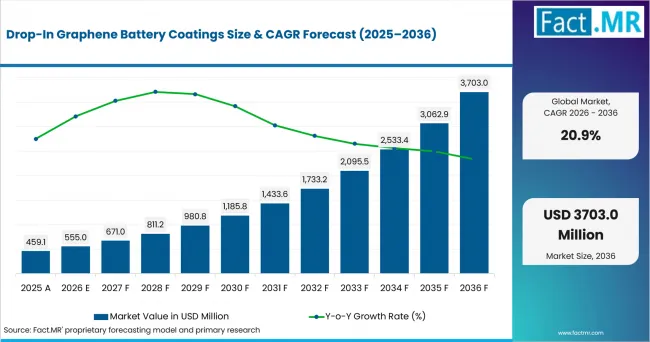
Drop In Graphene Battery Coatings Value Analysis | Source: Fact.MR
What are the defining numbers behind Drop-In Graphene Battery Coatings Market growth?
USD 3148.0 million absolute opportunity by 2036, led by graphene shells on cathode particles, NMC chemistry and EV cells.
- Demand Drivers in the Market
- Cathode teams need stable conductive interfaces. In May 2026, the International Energy Agency reported 1.2 TWh of EV battery deployment in 2025. Larger cathode volumes expand the addressable base for interface-focused coating qualification.
- EV cell developers seek lower interface resistance during fast charging. Thin graphene layers add conductivity while limiting inactive material loading.
- Grid-storage integrators prioritize cycle life. In May 2026, the International Energy Agency reported stationary storage represented one-third of U.S. battery deployment in 2025. That scale supports durability-focused cathode work.
- Battery manufacturers favor coatings that fit established powder and electrode workflows, reducing equipment changes across NMC, LFP, LMFP and related chemistries.
- Key Segments Analyzed
- By Coating Architecture: Graphene shell on cathode particles is expected to hold 38.0% share in 2026 owing to direct surface coverage.
- By Cathode Chemistry: NMC is projected to account for 32.0% share in 2026 due to surface-stability needs in nickel-bearing cathodes.
- By Performance Target: Fast charge is anticipated to capture 33.0% share in 2026 as cell developers seek lower interface resistance.
- By Application: EV cells are estimated to represent 44.0% share in 2026 supported by large traction-battery deployment.
- Analyst Opinion at Fact.MR
- Shambhu Nath Jha, Principal Consultant at Fact.MR, states, “Graphene coatings face a practical test: improve the cathode interface while keeping production workflows intact. Demand is expected to favor compatible powder or dispersion formats. Suppliers need repeatable material quality and chemistry-specific cell data.”
- Strategic Implications
- Cathode producers should match coating thickness and coverage to each chemistry’s failure mode.
- Cell manufacturers should compare coated and uncoated cathodes under identical fast-charge and cycle-life protocols.
- Graphene suppliers should control particle size and dispersion for repeatable electrode processing. In January 2025, the U.S. Department of Energy issued a Notice of Intent for up to USD 725 million to boost domestic production of battery critical materials, battery components, and advanced batteries, supporting expansion of the U.S. battery supply chain.
- Application developers should match coatings to the priority metric for EV, storage or specialty cells.
South Korea is projected to record 21.8% CAGR through 2036 supported by battery exports. The USA is anticipated to post 21.3% CAGR as storage expands. Italy is estimated at 19.6% CAGR with storage deployment. Japan is forecast at 19.0% CAGR on battery policy. Germany is expected at 17.8% CAGR supported by EV scale.
How does the Drop-In Graphene Battery Coatings Market break down by segment?
EV cells lead Application at 44.0%; graphene shell on cathode particles leads Coating Architecture at 38.0%.
Which Coating Architecture dominates?
Graphene shell on cathode particles holds 38.0% share in 2026.
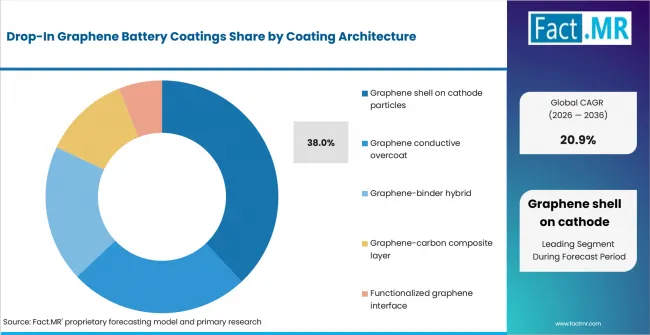
Drop In Graphene Battery Coatings Analysis By Coating Architecture | Source: Fact.MR
Graphene shell on cathode particles is expected to hold 38.0% because surface-level coverage combines conductivity with interface protection. Conductive overcoats and binder hybrids address electrode-level transport. Volexion describes conformal graphene encapsulation compatible with existing cathode manufacturing.
What leads the Cathode Chemistry segment?
NMC accounts for 32.0% share in 2026.
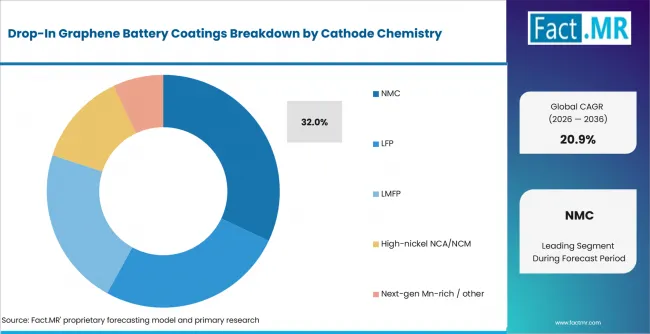
Drop In Graphene Battery Coatings Analysis By Cathode Chemistry | Source: Fact.MR
NMC is projected to account for 32.0% share because nickel-bearing cathodes benefit from controlled surface stability and conductivity. LFP and LMFP broaden the chemistry base. In May 2026, the International Energy Agency placed cathode active material at roughly 40-50% of NMC cell production cost.
How does Performance Target shape demand?
Fast charge leads with 33.0% share in 2026.
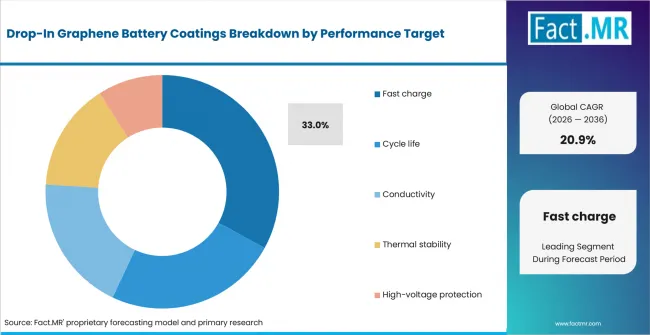
Drop In Graphene Battery Coatings Analysis By Performance Target | Source: Fact.MR
Fast charge is anticipated to hold 33.0% share because higher current increases interface resistance and thermal stress. Cycle-life and conductivity programs address related degradation. In February 2026, the International Energy Agency reported that average battery prices declined by 8% in 2025, reflecting manufacturing-efficiency gains, advances in battery technology and intensifying global competition.
What supports EV cells within Application?
EV cells represent 44.0% share in 2026.
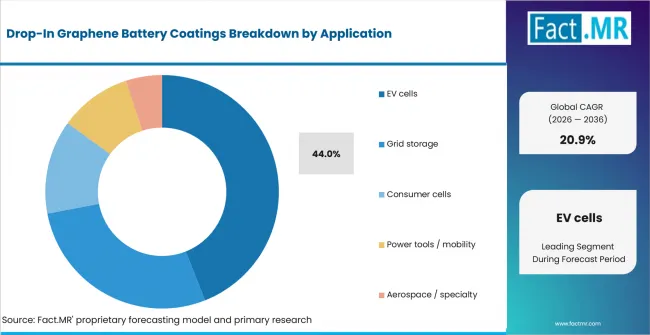
Drop In Graphene Battery Coatings Analysis By Application | Source: Fact.MR
EV cells are estimated to represent 44.0% share because automotive batteries combine scale with strict performance validation. Grid storage emphasizes long cycle life. In May 2026, the International Energy Agency reported EVs represented more than 70% of global battery deployment in 2025.
What is accelerating Drop-In Graphene Battery Coatings Market adoption, and what is holding it back?
Cathode-interface performance drives adoption; qualification time and material consistency restrain it.
Drivers Impact Analysis
| DRIVER | (~) % IMPACT ON CAGR | GEOGRAPHIC RELEVANCE | IMPACT TIMELINE |
|---|---|---|---|
| EV cell fast-charge and cycle-life requirements | +3.0% | Global | Short term (<= 2 years) |
| Battery storage cycle-life requirements | +2.1% | North America, Europe, East Asia | Medium term (2-4 years) |
| High-nickel cathode surface stability | +1.6% | USA, South Korea, Japan | Short term (<= 2 years) |
| Drop-in compatibility with existing cell lines | +1.2% | Global | Medium term (2-4 years) |
| Low-loading conductivity improvement | +0.9% | Global | Long term (>= 4 years) |
Opportunity Impact Analysis
| OPPORTUNITY | (~) % IMPACT ON CAGR | GEOGRAPHIC RELEVANCE | IMPACT TIMELINE |
|---|---|---|---|
| Manganese-rich and high-voltage cathode stabilization | +1.5% | USA, Japan, Europe | Long term (>= 4 years) |
| Fast-charge EV cell qualification | +1.2% | Global | Medium term (2-4 years) |
| Grid-storage cycle-life upgrades | +1.0% | USA, Italy, Germany | Medium term (2-4 years) |
| Aerospace and specialty high-power cells | +0.7% | North America, Europe | Short term (<= 2 years) |
Restraints Impact Analysis
| RESTRAINT | (~) % IMPACT ON CAGR | GEOGRAPHIC RELEVANCE | IMPACT TIMELINE |
|---|---|---|---|
| Long battery qualification cycles | -1.1% | Global | Short term (<= 2 years) |
| Graphene dispersion and coating consistency | -0.9% | Global | Short term (<= 2 years) |
| Low-cost LFP and carbon-additive pressure | -0.8% | Global | Medium term (2-4 years) |
| Graphite and battery-material supply concentration | -0.6% | USA, Europe | Medium term (2-4 years) |
Which countries are scaling the Drop-In Graphene Battery Coatings Market through 2036?
- The country comparison spans 4.0 percentage points across the forecast period.
- South Korea remains 0.5 percentage point above the USA as battery manufacturing and EV deployment support material qualification.
- The USA remains 1.7 percentage points above Italy as grid storage and domestic battery investment widen cathode-development activity.
- Italy remains 0.6 percentage point above Japan as stationary storage creates a visible cycle-life testing route for cathode interfaces.
- Japan remains 1.2 percentage points above Germany as national battery strategy supports next-generation cell and material development.
Comparable CAGRs create different entry conditions because cell-manufacturing scale, storage deployment and qualification depth vary by country. Full report coverage includes North America, Latin America, Western Europe, Eastern Europe, East Asia, South Asia & Pacific, and Middle East & Africa.
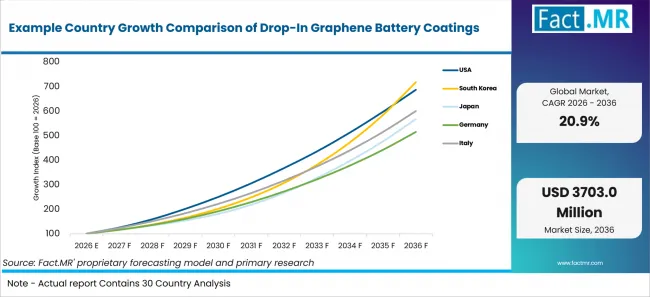
Example Country Growth Comparison Of Drop In Graphene Battery Coatings | Source: Fact.MR
| Country | CAGR (2026-2036) |
|---|---|
| South Korea | 21.8% |
| USA | 21.3% |
| Italy | 19.6% |
| Japan | 19.0% |
| Germany | 17.8% |
How is South Korea scaling Drop-In Graphene Battery Coatings demand?
21.8% CAGR through 2036, supported by battery manufacturing depth and expanding electric-vehicle deployment.
South Korea's cell-manufacturing base creates a direct route for cathode-interface materials that fit established electrode processing. In January 2026, South Korea’s Ministry of Climate, Energy and Environment published data showing that the country’s registered electric-vehicle stock reached 899,101 at the end of 2025, citing Ministry of Land, Infrastructure and Transport registration statistics. Cell engineering teams are expected to evaluate graphene coatings against fast-charge behavior and cycle retention before widening use across production programs. The 21.8% CAGR is expected to keep qualification focused on repeatable coating quality and chemistry-specific cell evidence. Suppliers that can reproduce dispersion quality across batches are anticipated to gain a clearer path into long-duration customer trials.
What supports the USA outlook?
21.3% CAGR through 2036, driven by utility-scale storage additions and domestic battery investment.
The USA combines EV cell development with a large stationary-storage testing environment. In February 2026, the U.S. Energy Information Administration reported that a record 15 GW of utility-scale battery storage capacity was added in 2025. Storage developers are expected to value cathode treatments that show measurable lifetime gains under repeated cycling. Automotive cell programs are anticipated to place equal weight on fast-charge performance and manufacturing compatibility. The 21.3% CAGR is projected to favor drop-in coatings that improve cycle life or charge transfer while fitting existing cathode workflows.
What underpins Italy's growth?
19.6% CAGR through 2036, supported by stationary storage deployment and electrified-mobility applications.
Italy offers a practical route for cathode-interface materials through storage projects and specialty mobility programs. In January 2026, Terna reported 17,920 MWh of installed storage capacity at the end of 2025. Storage-oriented cell programs are expected to judge graphene coatings against cycle stability and energy throughput. Specialty mobility projects create a separate path where conductivity and high-power discharge receive greater attention. The 19.6% CAGR is anticipated to keep commercial evaluation centered on cycle-life improvement and consistent coating integration.
How does Japan develop demand?
19.0% CAGR through 2036, supported by battery manufacturing policy and next-generation cell programs.
Japan's battery strategy gives material developers a structured path for high-value cell qualification. In June 2026, the Ministry of Economy, Trade and Industry set a target of 150 GWh per year of domestic battery manufacturing capacity from 2030 into the mid-2030s. Material teams are expected to prioritize reproducibility and electrochemical stability across long validation programs. Higher-voltage and next-generation cathode work creates a route for thin conductive interfaces that protect active surfaces. The 19.0% CAGR is forecast to support careful validation of conductive cathode-interface materials.
What is supporting Germany's adoption?
17.8% CAGR through 2036, supported by a large battery-electric vehicle base and battery-performance development.
Germany links automotive engineering with battery-material testing across premium vehicle programs. In January 2026, Destatis reported about 545,100 battery-electric passenger-car registrations during 2025. Cell developers are expected to compare graphene-coated cathodes against established carbon additives under realistic electrode loading. Grid-storage programs offer a second validation route where long service life carries more weight than peak power. The 17.8% CAGR is estimated to sustain demand for coatings that show measurable conductivity or lifetime gains under production-relevant validation.
Who leads the Drop-In Graphene Battery Coatings Market?
Volexion provides direct drop-in cathode encapsulation, while NanoXplore and other profiled graphene suppliers support adjacent battery-material pathways.
Volexion directly participates through conformal graphene encapsulation of lithium-ion cathode active materials and drop-in compatibility with existing and next-generation lithium-ion manufacturing. In December 2025, Argonne’s Chain Reaction Innovations reported that Volexion was shipping its first graphene-coated cathode active materials to tier-one manufacturers. NanoXplore lists graphene-enhanced conductive additives for anode and cathode slurries and participates in battery development and manufacturing through its wholly owned VoltaXplore platform. HydroGraph participates through its collaboration with NEI Corporation on NANOMYTE® FGA-1AD and FGA-1ND graphene dispersions, which are designed for integration into existing electrode slurries and can be used as conductive additives in lithium-ion battery anodes and cathodes.
Public company materials indicate differentiation across cathode encapsulation, conductive-additive integration, compatibility with existing slurry and manufacturing processes, and application-specific battery validation.
Which companies are the key providers?
Key companies include Volexion; NanoXplore; NEI Corporation; Graphene Manufacturing Group (GMG); First Graphene; and HydroGraph.
- Volexion
- NanoXplore
- NEI Corporation
- Graphene Manufacturing Group (GMG)
- First Graphene
- HydroGraph
Bibliography
- International Energy Agency. (2026, May 20). Electric vehicle batteries. In Global EV Outlook 2026.
- International Energy Agency. (2026, May 20). Trends in electric cars. In Global EV Outlook 2026.
- NanoXplore Inc. (2025, September 30). Volatus Aerospace and VoltaXplore sign LOI for Canadian-made battery supply to power next-gen drones [Press release].
- NanoXplore Inc. (2025, October 6). NanoXplore receives up to $2.75M contribution from the Government of Canada [Press release].
- HydroGraph Clean Power Inc. (2025, January 7). HydroGraph publishes 2025 CEO letter to shareholders.
- Beck, J. (2025, January 15). The Trienens Institute Store Pillar. Paula M. Trienens Institute for Sustainability and Energy, Northwestern University.
- U.S. Energy Information Administration. (2026, February 20). New U.S. electric generating capacity expected to reach a record high in 2026.
- U.S. Department of Energy. (2025, January 10). DOE issues notice of intent for funding in strengthening domestic critical materials processing and manufacturing to enhance national security.
- Statistisches Bundesamt (Destatis). (2026, January 22). E-Autos und Plug-in-Hybride: Ausstattung in Haushalten hängt stark vom Einkommen ab [Electric cars and plug-in hybrids: Household ownership depends strongly on income].
- Terna S.p.A. (2026, January 21). Electricity demand of 311.3 TWh in 2025 [Press release].
- Ministry of Economy, Trade and Industry. (2026, June 2). “Battery Industry Strategy” revised as the “Battery and Power Industry Strategy”.
- Directa Plus plc. (2026, January 7). Full year trading and operational update: Board change [Regulatory announcement].
- Lombardo, T., Paoli, L., Fernandez Pales, A., & Gül, T. (2026, February 13). Global battery markets are growing strongly – and so are the supply risks. International Energy Agency.
- Chain Reaction Innovations. (2025, December 12). 2025 startup milestones. Argonne National Laboratory.
- NanoXplore Inc. (2025, September 16). Annual information form.
- NEI Corporation. (2025, March 5). Collaboration yields new high-performance graphene dispersions [Press release].
- Directa Plus plc. (2026, April 27). Appointment of administrators [Regulatory announcement]. London Stock Exchange.
This Report Answers
- The assessment covers coating architecture and cathode chemistry while connecting the market boundary to adjacent graphene batteries and graphene energy storage applications.
- Segment analysis compares graphene shells, conductive overcoats and binder hybrids, with context from graphene electrodes and graphene nanoplatelets.
- Cathode analysis covers NMC, LFP, LMFP and high-nickel systems alongside lithium-ion battery cathodes and cathode active materials.
- Application analysis evaluates EV cells and grid storage together with lithium-ion batteries and solid-state battery materials.
- Interface analysis distinguishes cathode coatings from graphene battery anodes and other electrode-side material categories.
- The scope also separates graphene cathode interfaces from battery separator coatings, which address the separator layer instead of the cathode active material or electrode.
- Country analysis profiles South Korea, USA, Italy, Japan and Germany using official post-2024 battery, vehicle, charging and storage indicators.
What does the Drop-In Graphene Battery Coatings Market cover?
Graphene shells, conductive overcoats, binder hybrids and functionalized interfaces used on battery cathode materials or electrodes.
The market covers graphene layers applied to cathode particles or electrodes for conductivity, surface protection or performance stabilization. Included formats keep graphene at the active interface.
The boundary excludes anode-only graphene, free-standing graphene electrodes and separator-only coatings unless sold specifically for cathode-interface use.
What is included in the scope?
Drop-in graphene coating materials used in lithium-ion cathode production and related battery-cell qualification.
Included products cover particle shells, conductive overcoats, binder hybrids, composite layers and functionalized interfaces across the listed cathode chemistries and applications. The scope focuses on material formats that enter cathode preparation or electrode processing with limited equipment change. Performance assessment centers on conductivity, fast-charge behavior, cycle retention, thermal response and high-voltage stability under application-relevant cell testing.
What is excluded from the scope?
Anode-only graphene and separator-only coatings are outside the scope. Graphene products enter the assessment only when they have a defined battery cathode-interface use.
The assessment excludes anode-only graphene, current collectors, separator coatings and electrolyte additives. Finished cells sold as complete products also fall outside the cathode-coating boundary.
How Was the Analysis Built?
120+ sources, 35+ company portfolios, 25+ countries and more than 20 industry interviews.
- Primary Research: Interviews cover cathode producers, cell engineers, graphene suppliers and application specialists, focusing on qualification, process fit and performance evidence.
- Desk Research: Review covers official battery statistics, company portfolios, technical materials and policy sources, with first-hand evidence prioritized.
- Market-Sizing and Forecasting: The model combines the historical series with battery deployment, coating-addressable cathode volume, application mix and country growth.
- Data Validation and Update Cycle: Company checks and official indicators validate market fit; updates review coating qualifications, scale-up and cathode-chemistry changes.
What is the report’s scope and coverage?
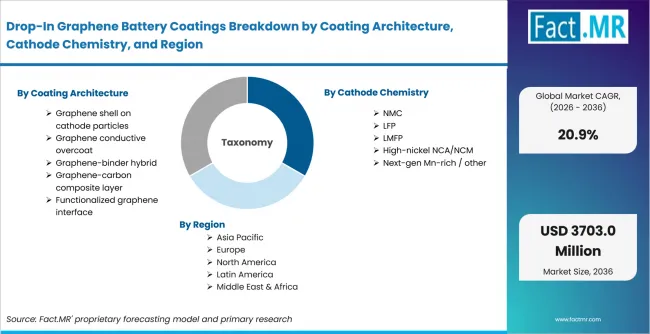
Drop In Graphene Battery Coatings Breakdown By Coating Architecture, Cathode Chemistry, And Region | Source: Fact.MR
| Attribute | Details |
|---|---|
| Quantitative Units | USD Million |
| Market Definition | Graphene-based coatings, shells, overcoats and interfaces designed for lithium-ion battery cathode materials or electrodes and intended to improve conductivity, cycle life, fast-charge performance, thermal stability or high-voltage protection while remaining compatible with established battery manufacturing workflows. |
| Coating Architecture | Graphene shell on cathode particles; Graphene conductive overcoat; Graphene-binder hybrid; Graphene-carbon composite layer; Functionalized graphene interface |
| Cathode Chemistry | NMC; LFP; LMFP; High-nickel NCA/NCM; Next-gen Mn-rich / other |
| Performance Target | Fast charge; Cycle life; Conductivity; Thermal stability; High-voltage protection |
| Application | EV cells; Grid storage; Consumer cells; Power tools / mobility; Aerospace / specialty |
| Regions Covered | North America; Latin America; Western Europe; Eastern Europe; East Asia; South Asia & Pacific; Middle East & Africa |
| Countries Profiled | USA; South Korea; Japan; Germany; Italy |
| Key Companies Profiled | Volexion; NanoXplore; NEI Corporation; Graphene Manufacturing Group (GMG); First Graphene; HydroGraph |
| Forecast Period | 2026 to 2036 |
| Approach | Hybrid top-down and bottom-up assessment using cathode-material applications, graphene supplier portfolios, EV and stationary battery deployment, country-level battery indicators and coating-qualification requirements. |
How is the market segmented?
-
By Coating Architecture
- Graphene shell on cathode particles
- Graphene conductive overcoat
- Graphene-binder hybrid
- Graphene-carbon composite layer
- Functionalized graphene interface
-
By Cathode Chemistry
- NMC
- LFP
- LMFP
- High-nickel NCA/NCM
- Next-gen Mn-rich / other
-
By Performance Target
- Fast charge
- Cycle life
- Conductivity
- Thermal stability
- High-voltage protection
-
By Application
- EV cells
- Grid storage
- Consumer cells
- Power tools / mobility
- Aerospace / specialty
-
By Region
- North America
- Latin America
- Western Europe
- Eastern Europe
- East Asia
- South Asia & Pacific
- Middle East & Africa