- Market Value (2025): USD 89.9 Mn
- Estimated Value (2026): USD 108 Mn
- Forecast Value (2036): USD 680 Mn
- CAGR (2026-2036): 20.2%
What is the Dry Resist Coaters Market forecast to be worth by 2036?
USD 108 million in 2026 to USD 680 million by 2036 at a 20.2% CAGR.
- The Dry Resist Coaters Market reached USD 89.9 million in 2025.
- Demand is projected to increase from USD 108 million in 2026 to USD 680 million by 2036.
- The market is forecast to record 20.2% CAGR from 2026 to 2036 as foundries and memory makers qualify dry resist for EUV-linked patterning.
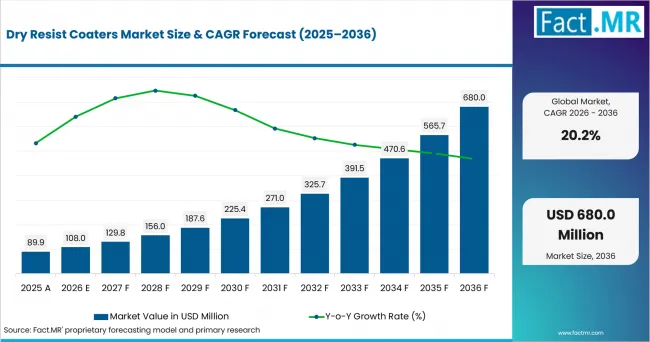
Dry Resist Coaters Market Value Analysis | Source: Fact.MR
What are the defining numbers behind Dry Resist CoaAters Market growth?
An absolute opportunity of USD 572 million is expected between 2026 and 2036.
- Demand Drivers in the Market
- Foundry engineers need lower-defect resist coating where EUV dose and pattern-transfer windows affect wafer cost.
- Memory makers require repeatable dry underlayers. Lam Research Corporation reported in January 2025 that Aether was selected for advanced DRAM production use.
- Track engineers need clean module handoff. TEL released CLEAN TRACK LITHIUS Pro DICE in December 2025 as a 300 mm coater/developer.
- Process teams compare dry routes with wet resist handling. Lam said in January 2025 that dry resist qualified for 28nm BEOL logic pitch at 2nm and below.
- Key Segments Analyzed
- By Deposition Method: CVD-type dry deposition is expected to hold 44.0% share in 2026 because vapor delivery fits uniform wafer films.
- By Resist Chemistry: Metal-oxide resist is projected to account for 47.0% share in 2026 due to EUV sensitivity needs.
- By Integration: Track-integrated systems are anticipated to capture 53.0% share in 2026 owing to cleaner coat-expose-develop handoff.
- By End User: Leading-edge foundries are estimated to represent 57.0% share in 2026 as logic fabs test dry resist economics.
- Analyst Opinion at Fact.MR
- Shambhu Nath Jha, Principal Consultant at Fact.MR, states, “Dry resist coating is drawing attention because qualification now depends on production evidence, not laboratory resolution alone. Toolmakers are expected to win accounts when they prove film control, automation fit and defect reduction on customer wafers. Suppliers need dry deposition skill, lithography-track support and local applications teams.”
- Strategic Implications
- Tool vendors should document defect and dose results against photoresist ancillary lithography chemicals so fabs are able to compare dry and wet routes.
- Track suppliers should connect coating hardware with photolithography platforms to reduce handoff errors during EUV recipe transfer.
- Chemical partners should align metal-oxide purity with semiconductor process chemicals qualification routines before customer audits begin.
- Process-control teams should map dry film behavior with semiconductor defect inspection equipment before production release.
Taiwan is expected to record 22.03% CAGR through 2036, supported by local foundry density. South Korea is projected to post 21.85% CAGR owing to memory and HBM-linked patterning. The USA is forecast to reach 21.77% CAGR due to funded fab projects. Japan is anticipated to register 21.68% CAGR because equipment makers support High NA EUV trials. China is estimated to record 21.55% CAGR as IC output expands. The Netherlands is forecast to post 21.53% CAGR due to lithography depth and export-control discipline.
How does the Dry Resist Coaters Market break down by segment?
CVD-type dry deposition leads at 44.0%; Track-integrated systems lead at 53.0%.
Which Deposition Method dominates?
CVD-type dry deposition is expected to hold 44.0% share in 2026.
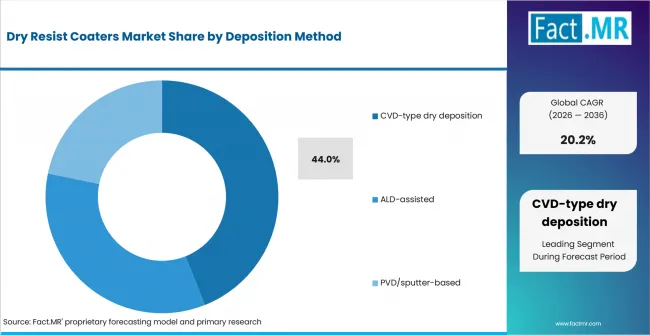
Dry Resist Coaters Market Analysis By Deposition Method | Source: Fact.MR
CVD-type dry deposition is expected to lead because it deposits resist as a controlled vapor film. ALD-assisted systems serve thinner and more conformal films where dose control is tighter. PVD or sputter-based routes remain smaller because chemistry choices are narrower.
What leads the Resist Chemistry segment?
Metal-oxide resist is projected to account for 47.0% share in 2026.
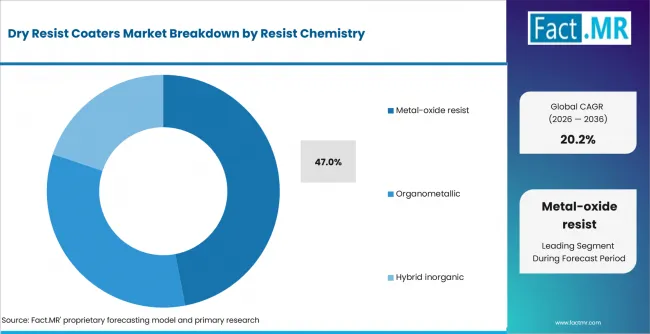
Dry Resist Coaters Market Analysis By Resist Chemistry | Source: Fact.MR
Metal-oxide resist is projected to lead due to EUV sensitivity and etch durability. Organometallic materials remain relevant where customers need tuned exposure behavior. Hybrid inorganic chemistries stay smaller until repeatability broadens. Dry coating pushes more value into deposition and underlayer control.
How does Integration shape demand?
Track-integrated systems are anticipated to hold 53.0% share in 2026.
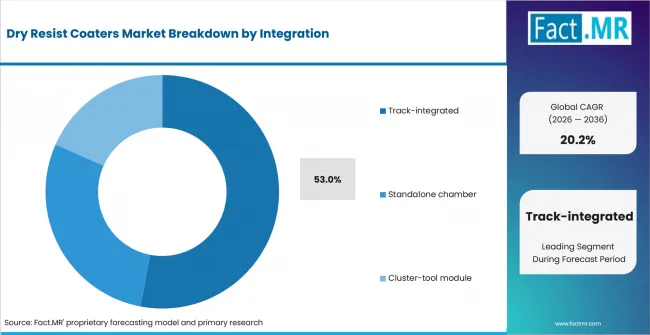
Dry Resist Coaters Market Analysis By Integration | Source: Fact.MR
Track-integrated systems are anticipated to lead because fabs prefer coat and develop steps within proven lithography flows. Standalone chambers serve pilot lines. Cluster-tool modules gain where fabs want dry coating closer to etch or deposition cells. Buyers compare dry resist with wet process equipment when chemical use changes.
What supports Leading-edge foundries within End User?
Leading-edge foundries are estimated to represent 57.0% share in 2026.
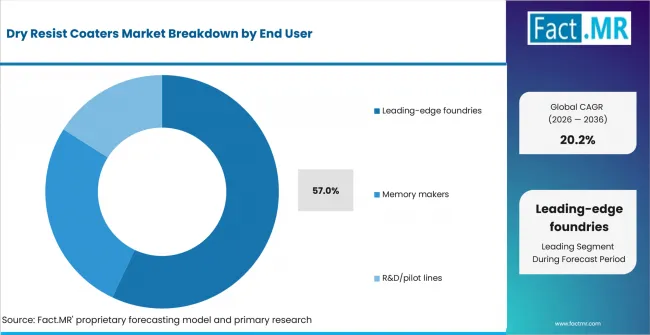
Dry Resist Coaters Market Analysis By End User | Source: Fact.MR
Leading-edge foundries are estimated to lead because EUV dose control and stochastic defects directly affect wafer cost and process qualification. Foundries use e-beam wafer inspection systems to identify defects and validate dry resist recipes before transferring qualified processes into high-volume manufacturing lines.
What is accelerating Dry Resist Coaters Market adoption, and what is holding it back?
EUV patterning economics drive it; production qualification risk restrains it.
Drivers Impact Analysis
| DRIVER | (~) % IMPACT ON CAGR | GEOGRAPHIC RELEVANCE | IMPACT TIMELINE |
|---|---|---|---|
| 2nm and sub-2nm EUV qualification | +2.1% | Taiwan, USA, Japan | Short term (<= 2 years) |
| Advanced DRAM and HBM patterning | +1.6% | South Korea, Taiwan | Medium term (2-4 years) |
| Reduced chemical use | +1.2% | Global | Medium term (2-4 years) |
| Track integration | +0.9% | Japan, Netherlands, USA | Long term (>= 4 years) |
Source: Fact.MR analysis. Updated Aug 21, 2026
- Advanced DRAM and HBM patterning: Memory customers are expected to test dry resist as dense DRAM pitch raises defect sensitivity.
- Reduced chemical use: Lam said its Aether dry-resist technology consumes five to ten times less chemicals than traditional wet-chemical resist processes. Site-level validation remains necessary.
Opportunity Impact Analysis
| OPPORTUNITY | (~) % IMPACT ON CAGR | GEOGRAPHIC RELEVANCE | IMPACT TIMELINE |
|---|---|---|---|
| High NA EUV process modules | +1.4% | Japan, Netherlands, Taiwan | Medium term (2-4 years) |
| Metal-oxide dry resist optimization | +1.1% | Global | Short term (<= 2 years) |
| Cluster-tool dry coating near etch cells | +0.8% | USA, South Korea | Long term (>= 4 years) |
Source: Fact.MR analysis. Updated Aug 21, 2026
- High NA EUV process modules: TEL said in April 2026 that LITHIUS Pro DICE can reduce wafer defects and associated costs from flawed resist coating by 50% or more versus previous models, based on TEL’s estimate.
- Metal-oxide dry resist optimization: Chemistry-qualified hardware is projected to create premium opportunities because resist sensitivity and film durability must move together.
- Cluster-tool dry coating: Cluster modules are anticipated to develop where fabs want dry coating near semiconductor dry etch systems and fewer wafer transfers.
Restraints Impact Analysis
| RESTRAINT | (~) % IMPACT ON CAGR | GEOGRAPHIC RELEVANCE | IMPACT TIMELINE |
|---|---|---|---|
| Production-wafer proof requirements | -0.8% | Global | Short term (<= 2 years) |
| Export-control review | -0.6% | China, Netherlands, USA | Medium term (2-4 years) |
| Tool integration with existing tracks | -0.5% | Japan, Taiwan | Medium term (2-4 years)\ |
Source: Fact.MR analysis. Updated Aug 21, 2026
- Production-wafer proof requirements: Customers are expected to delay orders until dry resist recipes show stable yield on production wafers.
- Export-control review: The Dutch government said in January 2025 that, from April 1, more types of advanced semiconductor-manufacturing equipment would require export authorization.
- Tool integration: Retrofitting dry coaters is anticipated to be slower where wafer-routing routines are fixed. Clean transfer needs bring wafer-transfer robots into equipment planning.
Which countries are scaling the Dry Resist Coaters Market through 2036?
- The country comparison spans 0.50 percentage point and forms a narrow high-growth band across the forecast period.
- Taiwan remains 0.18 percentage point above South Korea because foundry density keeps 2nm qualification close to production fabs.
- South Korea remains 0.08 percentage point above the USA as DRAM and HBM programs keep dry resist trials visible.
- The USA remains 0.09 percentage point above Japan because CHIPS-funded fabs widen leading-edge pilot-line demand.
- Japan remains 0.13 percentage point above China as local coater and lithography-track capability supports High NA EUV readiness.
- China remains 0.02 percentage point above the Netherlands owing to IC output growth despite tighter imported-tool access.
Comparable CAGRs create different entry conditions due to fab density, EUV readiness, export controls and applications support. Full report coverage includes North America, Latin America, Western Europe, Eastern Europe, East Asia, South Asia & Pacific, Middle East & Africa.
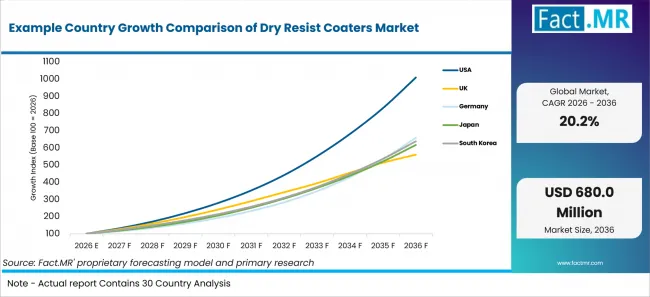
Example Country Growth Comparison Of Dry Resist Coaters Market | Source: Fact.MR
| Country | CAGR (2026-2036) |
|---|---|
| Taiwan | 22.03% |
| South Korea | 21.85% |
| USA | 21.77% |
| Japan | 21.68% |
| China | 21.55% |
| Netherlands | 21.53% |
Source: Fact.MR analysis. Updated Aug 21, 2026
What supports Taiwan adoption?
22.03% CAGR through 2036, supported by 2nm foundry qualification and local electronics production.
Taiwan’s growth reflects expanding semiconductor production, strong manufacturing output and continued qualification activity around advanced foundry nodes. Dry resist coaters can support EUV dose control and local recipe transfer, although fixed-asset softness, production-wafer validation and dense fab layouts may slow deployment.
How is South Korea scaling demand?
21.85% CAGR through 2036, driven by advanced memory and HBM-linked patterning needs.
South Korea’s growth is shaped by large semiconductor exports, advanced memory production and demand for tighter pattern control. South Korea’s semiconductor exports reached USD 173.4 billion in 2025, while total ICT exports reached USD 264.3 billion. DRAM and HBM manufacturers are expected to test dry resist for dense pitches, although yield validation, customer concentration and plant-specific qualification requirements may lengthen adoption cycles.
What supports USA adoption?
21.77% CAGR through 2036, backed by domestic fab projects and leading-edge logic capacity.
The USA’s growth reflects CHIPS-funded fab development and expanding leading-edge logic capacity. Commerce had awarded USD 30.9 billion in direct funding across 40 projects by July 2025, with nearly 40% of the projects intended to produce leading-edge logic chips. Pilot lines can support dry resist qualification before volume transfer, although long project milestones, export-control documentation and concentrated award activity may slow commercialization.
How does Japan perform?
21.68% CAGR through 2036, led by equipment capability and High NA EUV process support.
Japan’s growth reflects strong semiconductor equipment capability and active development of advanced lithography support systems. SEAJ forecast FY2025 sales of semiconductor manufacturing equipment made in Japan at JPY 4.86 trillion, while Tokyo Electron released CLEAN TRACK LITHIUS Pro DICE, a 300 mm wafer coater/developer, in December 2025. Domestic tool expertise supports dry resist qualification, although integration work, early service requirements and slower ramp schedules may constrain adoption.
What underpins China growth?
21.55% CAGR through 2036, supported by integrated-circuit output growth and local tool demand.
China’s growth reflects rising integrated-circuit output and a large electronic information manufacturing base. IC production reached 484.3 billion units in 2025, while major electronic information manufacturers generated RMB 17.4 trillion in operating revenue. Domestic fabs are expected to test dry coaters for greater local process control, although licensing restrictions, mixed tool availability and defect-performance requirements may complicate qualification.
How is the Netherlands developing demand?
21.53% CAGR through 2036, driven by lithography equipment leadership and export-control discipline.
The Netherlands’ growth reflects its leadership in lithography equipment and close links with advanced semiconductor manufacturing ecosystems. Lithography expertise can support EUV-linked resist-module development, although export controls, scanner roadmap dependencies and lengthy validation cycles may delay wider dry resist adoption.
Who leads the Dry Resist Coaters Market?
Lam Research Corporation has direct public evidence for Aether dry-photoresist technology. TEL, SUSS MicroTec and SCREEN Semiconductor Solutions are profiled for adjacent coater/developer, materials, lithography, coating or process-support capability.
Lam Research Corporation is an active provider through Aether dry photoresist and dry resist process modules. TEL is directly relevant through coater-developer platforms and imec-linked patterning work. Together, these companies define the near-term evidence base that fabs review before pilot lines move toward production.
SUSS MicroTec and SCREEN Semiconductor Solutions add coating, process and research-link capabilities. Competition is expected to depend on process evidence, chamber service and customer-specific qualification support.
Which companies are the key providers?
Key companies include Lam Research Corporation, TEL, SUSS MicroTec and SCREEN Semiconductor Solutions.
- Lam Research Corporation
- SUSS MicroTec
- SCREEN Semiconductor Solutions
- Tokyo Electron Limited
What is the report’s scope and coverage?
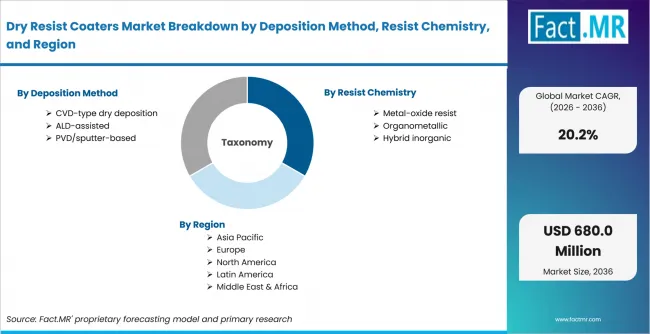
Dry Resist Coaters Market Breakdown By Deposition Method, Resist Chemistry, And Region | Source: Fact.MR
| Attribute | Details |
|---|---|
| Quantitative Units | USD million |
| Market Definition | Equipment used to deposit dry photoresist or dry resist underlayers on semiconductor wafers through vapor-phase or chamber-based coating routes. |
| Deposition Method | CVD-type dry deposition; ALD-assisted; PVD/sputter-based |
| Resist Chemistry | Metal-oxide resist; Organometallic; Hybrid inorganic |
| Integration | Track-integrated; Standalone chamber; Cluster-tool module |
| End User | Leading-edge foundries; Memory makers; R&D/pilot lines |
| Regions Covered | North America; Latin America; Western Europe; Eastern Europe; East Asia; South Asia & Pacific; Middle East & Africa |
| Countries Covered | Taiwan; South Korea; USA; Japan; China; Netherlands |
| Key Companies Profiled | Lam Research Corporation; TEL; SUSS MicroTec; SCREEN Semiconductor Solutions |
| Forecast Period | 2026 to 2036 |
| Approach | Hybrid top-down and bottom-up approach using fab investment, lithography needs, dry resist qualification, segment mix and provider portfolio review. |
Source: Fact.MR analysis. Updated Aug 21, 2026
Bibliography
- Statistics Netherlands. (2026, April 8). Exports to Taiwan up, exports to US and China down.
- U.S. Government Accountability Office. (2025, December 11). Semiconductors: Information on projects funded to strengthen U.S. supply chain (GAO-26-107882).
- Government of the Netherlands. (2025, January 15). Klever: Export controls on advanced semiconductor manufacturing equipment to be tightened.
- Lam Research Corporation. (2025, January 14). Lam Research establishes 28nm pitch in high-resolution patterning through dry photoresist technology.
- Lam Research Corporation. (2025, January 29). Breakthrough EUV dry photoresist technology from Lam Research adopted by leading memory manufacturer.
- Ministry of Economic Affairs, R.O.C. (2026, January 23). Industrial Production Index in December 2025.
- Ministry of Economy, Trade and Industry. (2025, November 21). Press conference by Minister Akazawa (Excerpt).
- Ministry of Trade, Industry and Resources. (2026, January 2). Korea’s annual exports reach new highs in 2025.
- Ministry of Trade, Industry and Resources, & Ministry of Science and ICT. (2026, January 15). ICT exports post record annual performance in 2025.
- Semiconductor Equipment Association of Japan. (2025, July 3). Market forecast report: Semiconductor and FPD manufacturing equipment (Fiscal years 2025–2027).
- Tokyo Electron Limited. (2025, December 15). Tokyo Electron releases CLEAN TRACK™ LITHIUS Pro DICE™, a 300mm wafer coater/developer.
- Tokyo Electron Limited. (2026, April 28). CLEAN TRACK™ LITHIUS Pro DICE™ world-class productivity and innovative defect control technology.
This Report Answers
- The report explains where dry resist coaters are used across deposition method and resist chemistry choices.
- Segment analysis identifies CVD-type dry deposition and track-integrated systems as the main 2026 demand anchors.
- Country analysis examines Taiwan, South Korea, the USA, Japan, China and the Netherlands.
- Competitive analysis reviews Lam Research Corporation, TEL, SUSS MicroTec and SCREEN Semiconductor Solutions.
- Application analysis compares foundry, memory and pilot-line needs for EUV-linked resist qualification.
What does the Dry Resist Coaters Market cover?
CVD-type, ALD-assisted and PVD/sputter-based systems used for dry resist coating.
The Dry Resist Coaters Market covers chamber-based tools that deposit dry photoresist or dry resist underlayers on semiconductor wafers. It includes vapor delivery, wafer handling and process-control elements used before lithography or pattern transfer. The market is linked to exposure tools but excludes standalone scanners.
What is included in the scope?
Dry resist coater systems used in leading-edge wafer fabrication and pilot-line qualification.
The scope includes dry resist coater tools by CVD-type dry deposition, ALD-assisted deposition and PVD/sputter-based systems. Track-integrated systems, standalone chambers and cluster-tool modules are included across foundry, memory and R&D users. Process adjacency is assessed where semiconductor robots affect clean wafer transfer.
What is excluded from the scope?
Wet-only photoresist tracks and standalone exposure scanners are outside the scope.
The scope excludes conventional spin coaters used only for wet photoresist, scanner hardware and metrology-only tools sold without a dry resist coater. EUV pellicle protection is treated as adjacent lithography infrastructure and is not counted as coater revenue.
How Was the Analysis Built?
120+ sources, 35+ company portfolios, 25+ countries, and more than 20 industry interviews.
- Primary Research: Interviews covered equipment suppliers, lithography engineers, process developers, procurement teams, fab operations managers and subject-matter experts.
- Desk Research: Desk research covered government statistics, company releases, equipment association forecasts, regulatory publications, product portfolios and technical disclosures.
- Market Sizing and Forecasting: Estimates combine equipment demand, wafer-fab investment, dry resist qualification, segment shares, country adoption and provider participation.
- Data Validation and Update Cycle: Findings are validated through provider checks, source triangulation, country evidence review and portfolio mapping.
Segmentation
How is the market segmented?
-
By Deposition Method:
- CVD-type dry deposition
- ALD-assisted
- PVD/sputter-based
-
By Resist Chemistry:
- Metal-oxide resist
- Organometallic
- Hybrid inorganic
-
By Integration:
- Track-integrated
- Standalone chamber
- Cluster-tool module
-
By End User:
- Leading-edge foundries
- Memory makers
- R&D/pilot lines
-
By Region:
- North America
- Latin America
- Western Europe
- Eastern Europe
- East Asia
- South Asia & Pacific
- Middle East & Africa
Frequently Asked Questions
How big is the dry resist coaters market in 2026?
What is the CAGR of the dry resist coaters market from 2026 to 2036?
Which deposition method leads the dry resist coaters market?
Which resist chemistry leads the dry resist coaters market?
Who are the leading companies in the dry resist coaters market?
Who worked on this report


Preview the report firsthand - request a free sample
Free SampleGet the brochure for pricing and purchase details
Download PDF