- Base Value(2025): 19.5 Bn
- Estimated Value(2026): 20.4 Bn
- Forecast Value (2036): 32.6 Bn
- CAGR (2026 - 2036): 4.8%
Semiconductor Process Chemicals Market Forecast and Outlook 2026 to 2036
In 2025, the semiconductor process chemicals market was valued at USD 19.5 billion. Based on Fact.MR analysis, demand for semiconductor process chemicals is estimated to grow to USD 20.4 billion in 2026 and USD 32.6 billion by 2036. FACT.MR projects a CAGR of 4.8% during the forecast period.
The absolute dollar growth from 2026 to 2036 represents an incremental gain of USD 12.2 billion. This expansion is transformational in composition, though measured in pace, driven by the semiconductor industry's accelerating transition to sub-10nm and gate-all-around transistor architectures that require entirely new generations of photoresist chemistries, atomic layer deposition precursors, and selective etch formulations at unit prices 3-5x above legacy equivalents. Growth is tempered by cyclical fab utilization fluctuations, customer-driven chemical consolidation programs among leading foundries, and geopolitical supply chain realignment that is redistributing capital expenditure across new regional manufacturing clusters.
As Bertrand Loy, President and CEO of Entegris, noted in the company's Q4 2024 earnings call regarding advanced node chemical demand, 'The transition to gate-all-around and high-NA EUV is creating a step-change in the complexity and purity requirements for process chemicals, and we are seeing customers qualify our next-generation formulations well ahead of expected node ramps that pull-forward dynamic gives us strong conviction in the multi-year demand trajectory for advanced materials.' [1]
China leads at 6.0% CAGR through 2036, driven by semiconductor self-sufficiency and domestic fab expansion. Brazil follows at 5.6% with state-backed semiconductor investment. Europe grows at 4.6% under the European Chips Act and new fab projects. The United States and United Kingdom each post 4.5% supported by CHIPS Act funding. Germany records 4.4% from IDM expansion, South Korea 4.0% on memory node transitions, and Japan 3.3% in a mature supplier market.
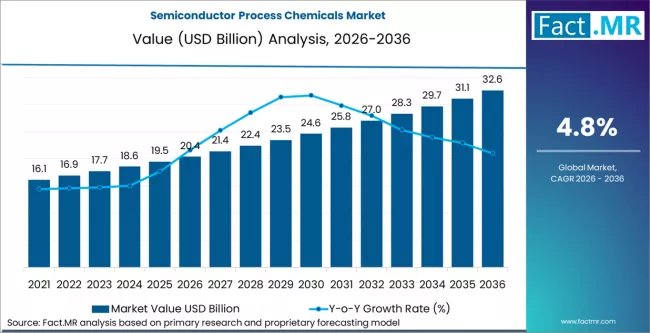
Semiconductor Process Chemicals Market Market Value Analysis | Source: Fact.MR
Market Definition
Semiconductor process chemicals are high-purity specialty materials used in the fabrication of integrated circuits and microelectronic devices. They are consumed across key wafer manufacturing steps including photolithography, wet cleaning and etching, chemical mechanical planarization, and vapor-phase deposition. Their core function is to enable precise, repeatable circuit patterning at nanometer-scale geometries. The primary end use is semiconductor wafer production at foundries, integrated device manufacturers, and outsourced assembly and test facilities worldwide.
Market Inclusions
The report covers global and regional semiconductor process chemicals market sizes from 2025 to 2036, with detailed segment breakdowns by chemical function (photoresists and ancillary, etchants and cleaners, CMP slurries, precursors and gases), node and application tier (<10nm, 10-28nm, >28nm), and end user (foundries, IDMs, OSATs). Analysis includes chemical pricing trends by purity grade, technology adoption timelines for EUV and gate-all-around process chemistries, regional supply chain concentration analysis, and capital expenditure correlation modeling between fab construction cycles and chemical procurement demand.
Market Exclusions
The scope excludes bulk commodity chemicals not manufactured to semiconductor-grade purity specifications, electronic-grade gases sold primarily for industrial rather than wafer-fab applications, and chemical mechanical planarization equipment such as polishing pads and conditioning discs. It also omits downstream packaging chemicals used in wire bonding, encapsulation, and printed circuit board fabrication, focusing strictly on front-end-of-line and back-end-of-line wafer process chemicals. Chemicals used exclusively in solar cell, MEMS, or LED device fabrication are excluded unless also qualified for IC production.
Research Methodology
- Primary Research: Primary research involved structured interviews with process integration engineers, procurement managers, and supply chain executives at leading foundries, IDMs, and OSATs across Taiwan, South Korea, Japan, the United States, and Germany, supplemented by interviews with chemical formulation scientists at specialty chemical manufacturers.
- Desk Research: Desk research synthesized data from semiconductor equipment and materials trade associations including SEMI and SEAJ, disclosed capital expenditure and materials procurement data from publicly listed fabricators, patent filing trend analysis for advanced photoresist and precursor chemistries, and government semiconductor investment program documentation.
- Market-Sizing and Forecasting: Market sizing employed a bottom-up approach, constructing demand forecasts from wafer starts by node tier, multiplied by chemical consumption coefficients per wafer start derived from process step counts and disclosed materials consumption data, then triangulated against top-down semiconductor materials spending ratios reported by SEMI and SEAJ.
Data Validation and Update Cycle
Outputs were cross-validated against disclosed materials revenue from Entegris, CMC Materials, JSR, and Merck KGaA semiconductor materials divisions and reconciled quarterly with major fab capacity announcements, chemical qualification news releases, and technology node transition timelines disclosed by TSMC, Samsung, and Intel.
Key Takeaways
Market Definition
- Semiconductor process chemicals comprise ultra-high-purity specialty materials including photoresists, etchants, CMP slurries, and deposition precursors consumed during wafer fabrication to enable precise, nanometer-scale circuit patterning and surface processing across every major front-end unit process step.
Demand Drivers
- Accelerating transition to sub-7nm and gate-all-around transistor architectures by TSMC, Samsung Foundry, and Intel Foundry is requiring entirely new photoresist and precursor chemistry platforms developed specifically for high-numerical-aperture EUV exposure and selective atomic layer processing, commanding significant unit price premiums over legacy formulations.
- CHIPS and Science Act commitments in the United States totaling USD 52.7 billion and European Chips Act allocations of EUR 43 billion are triggering a parallel wave of greenfield and brownfield fab construction that generates sustained, long-cycle chemical procurement demand extending through the early 2030s.
- Advanced DRAM and NAND memory manufacturers in South Korea and Japan are executing aggressive node shrink roadmaps requiring high-selectivity wet etch chemistries and planarization slurries formulated specifically for three-dimensional stacked memory architectures, creating new chemical qualification cycles independent of logic node transitions.
Key Segments Analyzed
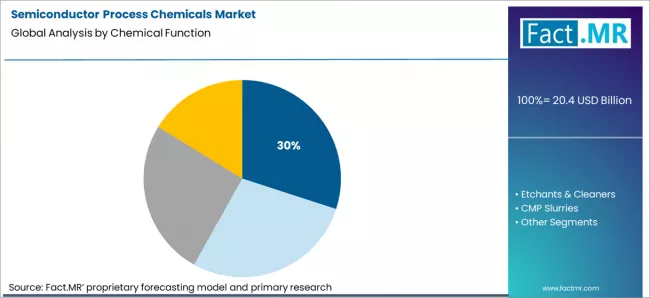
- By Chemical Function, Etchants & Cleaners command 30% share in 2025, reflecting their consumption across the highest number of process steps per wafer including pre-gate cleaning, post-etch residue removal, and surface preparation, making them the most volume-intensive chemical category across all node tiers and device types.
- By Node/Application, <10nm and 10-28nm tiers are equal co-leaders at 35% share each, with advanced sub-10nm processes driving premium-price chemistry adoption and the 10-28nm tier representing the highest current wafer start volume where specialty chemical specifications continue to tighten with each technology generation.
- By End User, Foundries hold the leading position with 50% share in 2025, reflecting the concentration of advanced node production at pure-play foundries, principally TSMC, Samsung Foundry, and GlobalFoundries, which collectively consume the majority of the most demanding and highest-unit-value process chemical formulations.
Analyst Opinion at FACT.MR
- Shambhu Nath Jha, Principal Consultant at Fact.MR, opines, 'CXOs will find in this report granular evidence that the chemical content per wafer at leading-edge nodes is expanding 40-60% relative to 28nm baseline, a structural demand multiplier that makes advanced-node chemical intensity, not wafer start volume, the primary revenue growth engine for specialty chemical suppliers through 2036, fundamentally rewiring competitive positioning priorities across the entire semiconductor materials value chain.'
Strategic Implications / Executive Takeaways
- Chemical suppliers must accelerate qualification programs at leading foundry customers for sub-10nm and gate-all-around compatible formulations, as the qualification-to-volume-purchase cycle at advanced nodes can span 18-36 months and early qualification incumbency confers near-irreplaceable switching cost advantages once mass production ramps.
- Procurement executives at foundries and IDMs should implement dual-source qualification strategies for critical photoresist and precursor chemistries used at nodes below 7nm, as geographic concentration of qualified specialty chemical production in Japan and Taiwan creates systemic supply chain vulnerability that CHIPS Act investments are only partially offsetting.
- Investors evaluating chemical supplier positioning should weight technical qualification pipeline at leading-edge nodes as the primary forward indicator of revenue quality, since unit price premiums for EUV-compatible and GAA-selective chemistries are 3-5x legacy equivalents and carry significantly higher gross margins.
Methodology
- Market sizing was constructed bottom-up from wafer start forecasts by node tier, multiplied by chemistry-specific consumption coefficients per wafer start, and triangulated against SEMI semiconductor materials spending data and disclosed chemical revenues from Entegris, JSR, and Merck KGaA.
- Advanced-node chemical adoption curves for EUV photoresists, metal-oxide hard masks, and selective ALD precursors were calibrated using disclosed qualification and volume production timelines from TSMC technology symposia, Samsung Foundry Day presentations, and Intel Technology Road Map disclosures covering 2022 through 2025.
- Country-level forecast assumptions were validated against national semiconductor investment commitments, approved fab construction permits, and disclosed CAPEX guidance from publicly listed fabricators including TSMC, Samsung Electronics, SK Hynix, Micron, Intel, and Infineon.
Segmental Analysis
Semiconductor Process Chemicals Market Analysis by Chemical Function
Semiconductor Process Chemicals Market Analysis By Chemical Function | Source: Fact.MR
Based on FACT.MR's semiconductor process chemicals market report, consumption of Etchants & Cleaners is estimated to hold 30% share in 2025. Etchants and cleaners dominate chemical function demand because they are consumed across the largest number of individual process steps per wafer including pre-diffusion surface preparation, post-photolithography develop, inter-layer cleaning, post-CMP cleaning, and selective wet etch for advanced device structures making their aggregate consumption volume the highest of any chemical category regardless of node tier or device type. The structural advantage of this segment is its throughput-driven demand model: volume scales directly with wafer starts, and specification upgrades at advanced nodes create incremental unit price uplift on top of stable volume demand.
- Entegris Surface Preparation Portfolio Expansion: Entegris disclosed in its 2024 Annual Report the commercial launch of its next-generation OPTIA semiconductor cleaning chemistry platform designed for sub-5nm gate-all-around transistor post-etch residue removal, with qualification completions disclosed at two leading-edge foundry customers and volume production revenue recognition beginning in Q3 2024, representing one of the first commercially qualified GAA-specific cleaning chemistries to enter volume production [2].
- Dow Electronic Materials Advanced Etch Development: Dow's Electronic & Industrial segment disclosed in its Q3 2024 earnings supplement the completion of a major R&D milestone for high-selectivity silicon nitride etch chemistry compatible with backside power delivery network fabrication processes targeting 2nm-class logic nodes, addressing a critical process integration challenge where conventional etch chemistries produce unacceptable damage to adjacent dielectric layers [3].
- Wafer Cleaning Equipment and Chemical Co-Optimization: SEMI's 2024 World Fab Forecast noted that advanced-node fab tool sets for sub-10nm production include 15-20% more wet clean steps per wafer compared to 28nm equivalent processes, structurally driving etchant and cleaner consumption per wafer upward even as wafer dimensions and process thermal budgets remain constant a step-function demand driver that is independent of wafer start volume growth [4].
Semiconductor Process Chemicals Market Analysis by Node/Application
Based on FACT.MR's semiconductor process chemicals market report, consumption for <10nm node applications is estimated to hold 35% share in 2025, equal to the 10-28nm tier. The sub-10nm segment commands co-leadership by value rather than volume because chemical content per wafer at advanced nodes is 40-60% higher than at 28nm equivalents, unit prices for EUV-compatible photoresists and selective ALD precursors are 3-5x legacy equivalents, and the concentration of production at a small number of highly capital-intensive fabs creates purchasing relationships where technical qualification confers durable sole-source or dual-source incumbent status for qualified chemical suppliers.
- TSMC EUV Chemistry Ramp at N2 Node: TSMC disclosed at its 2024 Technology Symposium that its N2 (2nm-class) gate-all-around process uses a novel photoresist chemistry platform co-developed with Japanese material suppliers, requiring new metal-oxide resist formulations with line-edge-roughness performance below 1.5nm 3σ specification that eliminates conventional chemically amplified resists and creates a captive market for co-developed advanced materials at volume production from 2025 [5].
- JSR Metal-Oxide Resist Commercialization: JSR Corporation disclosed in its fiscal 2024 financial results the successful scale-up of its inorganic metal-oxide photoresist platform targeting high-NA EUV applications, with initial volume supply agreements signed with two ASML high-NA EUV adopter customers and a USD 120 million capacity investment at its Tsu manufacturing facility announced in September 2024 to support anticipated demand growth through 2028 [6].
- DRAM Node Shrink Chemical Qualification Cycle: The JEDEC 2024 Solid-State Technology assessment noted that sub-10nm DRAM node transitions at Samsung and SK Hynix are requiring 23-27 new chemical qualifications per generation compared to 12-15 at prior 1z-class nodes, reflecting the multiplication of atomic layer deposition, selective etch, and advanced clean steps in three-dimensional storage cell architectures creating sustained chemical supplier qualification activity and new sole-source incumbent positions [7].
Semiconductor Process Chemicals Market Drivers, Restraints, And Opportunities
Fact.MR analysis indicates that the semiconductor process chemicals market is structurally anchored by the unbroken cadence of Moore's Law-driven node scaling, which demands continuous reformulation of every major chemical category at each successive technology generation. The USD 19.5 billion base valuation reflects a market that has expanded steadily in line with global wafer starts while simultaneously experiencing upward price migration as leading-edge formulations replace commodity predecessors.
FACT.MR analysts observe that the central market tension is between the advanced-node premium segment where EUV photoresists, metal-oxide resists, and next-generation ALD precursors command unit prices 300-500% above legacy equivalents but require massive upfront R&D and qualification investment and the >28nm commodity segment, where pricing compression from Chinese domestic chemical suppliers is eroding margins for incumbent international suppliers. This bifurcation is reshaping supplier portfolios: companies unable to fund advanced-node chemistry pipelines are retreating to commodity segments, while leaders are concentrating R&D on sub-7nm and gate-all-around compatible formulations that justify premium positioning.
- CHIPS Act and European Chips Act Capital Deployment: FACT.MR analysts observe that the U.S. CHIPS and Science Act's USD 52.7 billion allocation and the European Chips Act's EUR 43 billion package are creating an unprecedented wave of greenfield fab construction including TSMC Arizona, Samsung Taylor, Intel Ohio, and TSMC Dresden that will generate multi-decade regional chemical procurement demand from facilities that had not previously existed as chemical customers, structurally expanding total addressable market for qualified specialty chemical suppliers with Western supply chain credentials.
- High-NA EUV Transition and Chemistry Intensity Increase: The industry transition to high-numerical-aperture EUV lithography, initiated at ASML customers targeting sub-3nm nodes from 2025 onward, requires chemically amplified resist formulations with resolution and line-edge-roughness performance characteristics unachievable with existing EUV resist platforms, creating a mandatory qualification cycle for new chemical classes including metal-oxide photoresists and dry-developed resist systems that will command premium pricing throughout the decade and cannot be supplied by commodity chemical manufacturers.
- Chinese Domestic Chemical Development Pressure: Geopolitical export controls imposed under U.S. Commerce Department rules targeting advanced semiconductor manufacturing equipment and materials since October 2022 have accelerated China's government-funded domestic chemical supplier development programs, with state-backed entities including Capchem, Stella Chemifa, and Shanghai Sinyang expanding capacity for electronic-grade acids, CMP slurries, and photoresist ancillaries creating pricing pressure in legacy-node chemical segments while simultaneously restricting international supplier access to China's rapidly expanding legacy-node fab market.
Regional Analysis
Based on regional assessment, the semiconductor process chemicals market is analyzed across North America, Latin America, Europe, Asia Pacific, and Middle East & Africa spanning more than 40+ countries. Regional performance varies according to fab construction activity, technology node distribution, regulatory frameworks governing chemical handling, and geopolitical supply chain realignment dynamics. The report also presents a comparative market attractiveness evaluation grounded in region-specific demand trends.
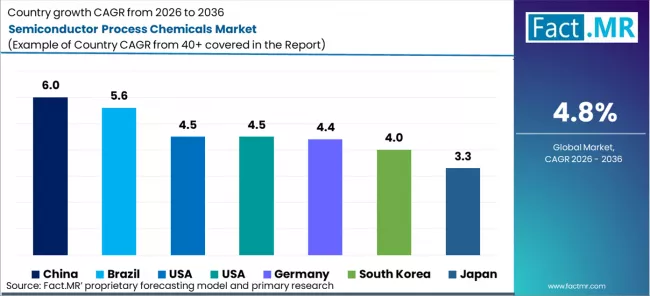
Semiconductor Process Chemicals Market Cagr Analysis By Country | Source: Fact.MR
| Country | CAGR% |
|---|---|
| China | 6.0% |
| Brazil | 5.6% |
| United States | 4.5% |
| United Kingdom | 4.5% |
| Germany | 4.4% |
| South Korea | 4.0% |
| Japan | 3.3% |
Source: Fact.MR analysis. Updated Feb 18, 2026
Source: Fact MR (FMR) analysis, based on proprietary forecasting model and primary research.
North America Semiconductor Process Chemicals Market Analysis
North America is undergoing the largest reshoring cycle in semiconductor history, transforming the region into a high-specification chemical demand center. CHIPS Act-supported fab construction including TSMC Arizona, Samsung Texas, Intel Ohio, and Micron Idaho is building entirely new long-term chemical procurement ecosystems. Domestic suppliers such as Entegris and Honeywell benefit from local manufacturing presence and supply chain security credentials increasingly required for government-backed projects.
- United States: Demand for semiconductor process chemicals in the United States is projected to rise at 4.5% CAGR through 2036. Growth is supported by USD 52.7 billion in CHIPS Act incentives and large-scale fab investments that are driving multi-year qualification and procurement programs for advanced photoresists, CMP slurries, and specialty gases, according to Fact.MR.
FACT.MR's analysis of semiconductor process chemicals market in North America includes the United States and Canada, detailing facility-level investment timelines and advanced-node chemical demand trends.
Asia-Pacific Semiconductor Process Chemicals Market Analysis
Asia-Pacific remains the global semiconductor fabrication hub, accounting for over 75% of wafer capacity. The region’s ecosystem is anchored by TSMC in Taiwan, Samsung and SK Hynix in South Korea, and Japan’s long-standing leadership in specialty chemicals. Supplier relationships are built on decades of co-development and process integration.
- China: Demand for semiconductor process chemicals in China is projected to rise at 6.0% CAGR through 2036, driven by state-backed fab expansion and domestic supplier development under national self-sufficiency programs, according to Fact.MR.
- Japan: Demand in Japan is projected to grow at 3.3% CAGR through 2036, supported by its role as a global specialty chemical supplier and renewed domestic fab investment.
- South Korea: Demand in South Korea is projected to rise at 4.0% CAGR through 2036, linked to large-scale memory and logic expansion programs requiring next-generation process chemistries, as per Fact.MR.
FACT.MR's analysis of semiconductor process chemicals market in Asia-Pacific covers China, Japan, South Korea, and regional supplier development trends.
Europe Semiconductor Process Chemicals Market Analysis
Europe is entering a renewed semiconductor investment cycle under the European Chips Act, creating new demand for advanced-node process chemicals. Germany is emerging as the central hub for this expansion, supported by large-scale public and private funding. Regional chemical leaders such as Merck KGaA and BASF are well positioned to support new fabrication projects.
- Germany: Demand for semiconductor process chemicals in Germany is projected to rise at 4.4% CAGR through 2036, supported by major fab construction including TSMC Dresden and Intel Magdeburg, according to Fact.MR.
- United Kingdom: Demand in the United Kingdom is projected to grow at 4.5% CAGR through 2036, supported by compound semiconductor strategy funding and domestic supply chain compliance requirements, as per Fact.MR.
FACT.MR’s analysis of the semiconductor process chemicals market in Europe includes Germany, United Kingdom, France, Netherlands, and other regional markets.
Latin America Semiconductor Process Chemicals Market Analysis
Latin America represents an emerging semiconductor chemicals market, where policy-backed manufacturing initiatives are beginning to generate structured demand. Brazil leads regional development efforts, supported by industrial policy and development bank financing mechanisms.
- Brazil: Demand for semiconductor process chemicals in Brazil is projected to rise at 5.6% CAGR through 2036, driven by national semiconductor investment programs and preferential financing for materials procurement, according to Fact.MR.
FACT.MR’s analysis of the semiconductor process chemicals market in Latin America includes Brazil and Mexico, outlining early-stage procurement development and compound semiconductor growth.
Competitive Aligners for Market Players
The semiconductor process chemicals market is moderately concentrated at the advanced-node tier and more fragmented across legacy-node commodity segments. Entegris, JSR, Shin-Etsu Chemical, and Merck KGaA collectively hold dominant positions in the highest-specification photoresist, CMP slurry, and precursor categories serving sub-10nm production, supported by decades of co-development programs with leading foundry customers and proprietary formulation databases that cannot be replicated on short timelines. Competitive intensity is significantly higher in the >28nm segment, where Chinese domestic chemical producers including Capchem, Stella Chemifa, and Shanghai Sinyang are mounting cost-competitive challenges that are compressing margins for international suppliers.
Structural competitive advantage at leading-edge nodes is cemented by the customer qualification process, which requires 18-36 months of joint development and process integration validation before a chemical can be approved for production use. Once qualified, switching a process chemical requires re-qualification of the entire affected process module, creating switching costs that effectively lock in qualified suppliers for the production lifetime of a given node. Companies with existing qualifications at TSMC N2, Samsung SF2, and Intel 18A have near-irreplaceable positions that will generate premium-priced revenue streams throughout the multi-year volume ramp cycles of these nodes.
Buyer behaviour among leading foundries and IDMs is characterized by a dual-source discipline that maintains two qualified suppliers for every critical chemical to manage supply chain risk, while simultaneously using the qualification pipeline as leverage to negotiate pricing and co-investment commitments from suppliers. Large customers typically co-fund advanced formulation development in exchange for preferential pricing on volume purchases, creating a captive R&D partnership model that ties chemical suppliers' innovation pipelines directly to customer roadmaps. SME foundries and OSATs have minimal pricing leverage and typically purchase through distributor channels at catalog pricing.
Recent Developments
- In November 2025, Sumitomo Chemical agreed to acquire Taiwanese semiconductor process chemicals maker Asia Union Electronic Chemical Corporation (AUECC), expanding its global footprint with new manufacturing bases in Taiwan and the U.S. to support broader supply and production capabilities.
- In September 2025, LCY launched next-generation advanced formulations tailored for semiconductor advanced packaging applications, including high-precision polymers and hydrocarbon chemistry solutions that address rising demand in AI and high-speed communications fabs.
Key Players
- Entegris
- TOK (Tokyo Ohka Kogyo Co., Ltd.)
- Dow Inc.
- Merck KGaA
- JSR Corporation
- Fujifilm Holdings Corporation
- BASF SE
- CMC Materials (now part of Entegris)
- Honeywell International Inc.
- Kanto Kagaku Co., Ltd.
This Report Addresses
- Market intelligence for strategic planning: comprehensive analysis of chemical adoption patterns by node tier, technology node transition timelines, and fab-type-specific procurement trends across global semiconductor manufacturing markets.
- Market size and forecast: global semiconductor process chemicals market valued at USD 19.5 billion in 2025, projected to reach USD 32.6 billion by 2036 at 4.8% CAGR, with segment-level sizing by chemical function, node/application tier, and end user type.
- Growth opportunity mapping: identification of high-value subsegments including EUV-compatible photoresists, metal-oxide resist platforms, high-NA EUV ancillary chemistries, and selective ALD precursors where unit price premiums and qualification barriers create durable competitive moats and above-market margin profiles.
- Segment and regional forecasts: country-level CAGR analysis for China, Brazil, United States, United Kingdom, Germany, South Korea, Japan, and 15+ additional markets, with chemical function and node-tier breakdowns revealing divergent technology adoption and procurement drivers.
- Competition strategy assessment: competitive positioning analysis of Entegris, JSR, Merck KGaA, TOK, and regional vendors, including qualification pipeline status at leading-edge nodes, capacity investment strategies, and co-development program structures with leading foundry customers.
- Product and compliance tracking: analysis of EUV and high-NA EUV process chemistry qualification timelines, CHIPS Act supply chain compliance requirements, and U.S. export control impacts on chemical trade flows between the United States, Japan, and China.
- Regulatory impact analysis: assessment of CHIPS and Science Act, European Chips Act, and national semiconductor investment program impacts on regional chemical procurement demand, domestic supplier development programs, and geopolitical supply chain realignment trajectories.
- Report delivery formats: Excel data tables with segment-level forecasts, PowerPoint summary slides for executive briefings, and PDF comprehensive report with verifiable citations for all market claims.
Bibliography
- [1] Loy, B. (2024, February). Q4 2024 Earnings Call Transcript: Advanced Node Chemical Demand Outlook. Entegris Inc. Retrieved from https://ir.entegris.com/events-and-presentations/
- [2] Entegris Inc. (2024). Annual Report 2024: OPTIA Semiconductor Cleaning Chemistry Platform Launch. Entegris Investor Relations. Retrieved from https://ir.entegris.com/financial-information/annual-reports/
- [3] Dow Inc. (2024, October). Q3 2024 Earnings Supplement: Electronic & Industrial Segment Advanced Etch Development Milestone. Dow Investor Relations. Retrieved from https://investors.dow.com/financials/quarterly-earnings/
- [4] SEMI. (2024). World Fab Forecast 2024: Advanced-Node Process Step Count Analysis. SEMI Market Intelligence. Retrieved from https://www.semi.org/en/products-services/market-data/world-fab-forecast
- [5] TSMC. (2024, June). 2024 Technology Symposium: N2 Process Technology and Materials Requirements. Taiwan Semiconductor Manufacturing Company Limited. Retrieved from https://ir.tsmc.com/english/
- [6] JSR Corporation. (2024, September). Fiscal 2024 Financial Results: Metal-Oxide Photoresist Scale-Up and Capacity Investment Announcement. JSR Investor Relations. Retrieved from https://www.jsr.co.jp/jsr_n/ir/
- [7] JEDEC Solid State Technology Association. (2024). 2024 DRAM Technology Roadmap: Sub-10nm Node Process Chemistry Requirements. JEDEC Publications. Retrieved from https://www.jedec.org/standards-documents/
Segmentation
Scope of the Report
| Metric | Value |
|---|---|
| Quantitative Units | USD 20.4 billion (2026) to USD 32.6 billion (2036), at a CAGR of 4.8% |
| Market Definition | Semiconductor process chemicals are high-purity specialty materials used in the fabrication of integrated circuits and microelectronic devices. They are consumed across key wafer manufacturing steps including photolithography, wet cleaning and etching, chemical mechanical planarization, and vapor-phase deposition. |
| Chemical Function | Photoresists & Ancillary, Etchants & Cleaners, CMP Slurries, Precursors & Gases |
| Node/Application | <10nm, 10-28nm, >28nm |
| End User | Foundries, IDMs, OSATs |
| Regions Covered | Asia Pacific, Europe, North America, Latin America, Middle East & Africa |
| Countries Covered | China, Japan, South Korea, Taiwan, India, Australia & New Zealand, ASEAN, Rest of Asia Pacific, Germany, United Kingdom, France, Netherlands, Italy, Nordics, Central & Eastern Europe, Rest of Europe, United States, Canada, Mexico, Brazil, Argentina, Rest of Latin America, Kingdom of Saudi Arabia, United Arab Emirates, Israel, South Africa, Rest of Middle East & Africa |
| Key Companies Profiled | Entegris, TOK, Dow, Merck KGaA, JSR, Fujifilm, BASF, CMC Materials, Honeywell, Kanto Kagaku |
| Forecast Period | 2025 to 2036 |
| Approach | Bottom-up market modeling from wafer start forecasts by node tier and chemical consumption coefficients per wafer start, triangulated against SEMI and SEAJ materials spending data, and validated through primary interviews with fab process engineers, procurement executives, and chemical supplier R&D leadership. |
Source: Fact.MR analysis. Updated Feb 18, 2026
Semiconductor Process Chemicals Market Analysis by Segments
-
By Chemical Function :
- Photoresists & Ancillary
- Etchants & Cleaners
- CMP Slurries
- Precursors & Gases
-
By Node/Application :
- <10nm
- 10-28nm
- >28nm
-
By End User :
- Foundries
- IDMs
- OSATs
-
Region :
- Asia Pacific
- China
- Japan
- South Korea
- Taiwan
- India
- Australia & New Zealand
- ASEAN
- Rest of Asia Pacific
- Europe
- Germany
- United Kingdom
- France
- Netherlands
- Italy
- Nordics
- Central & Eastern Europe
- Rest of Europe
- North America
- United States
- Canada
- Mexico
- Latin America
- Brazil
- Mexico
- Argentina
- Rest of Latin America
- Middle East & Africa
- Kingdom of Saudi Arabia
- United Arab Emirates
- Israel
- South Africa
- Rest of Middle East & Africa
- Asia Pacific
Frequently Asked Questions
How large is the semiconductor process chemicals market in 2025?
What will the market size be in 2026?
What will the market size be in 2036?
What is the expected CAGR for the forecast period?
Which chemical function segment is poised to lead the market?
Which node/application tier commands the highest chemical value?
Which end user segment dominates semiconductor process chemical procurement?
Which country is expected to record the fastest growth?
What is the absolute dollar growth expected between 2026 and 2036?
Which region leads the global semiconductor process chemicals market?
How does Germany's market growth compare to the broader European region?
How is geopolitical tension shaping the semiconductor process chemicals market?
Who worked on this report


Preview the report firsthand - request a free sample
Free SampleGet the brochure for pricing and purchase details
Download PDF