- Base Value(2025): 10.4 Bn
- Estimated Value(2026): 12.2 Bn
- Forecast Value (2036): 58.6 Bn
- CAGR (2026 - 2036): 17.0%
E-Axle Inverter and Control Unit Systems Market Forecast and Outlook By Fact.MR
- In 2025, the e-axle inverter and control unit systems market was valued at USD 10.4 billion.
- Based on Fact.MR analysis, demand for e-axle inverter and control unit systems is estimated to grow to USD 12.2 billion in 2026 and USD 58.6 billion by 2036. FACT.MR projects a CAGR of 17.0% during the forecast period.
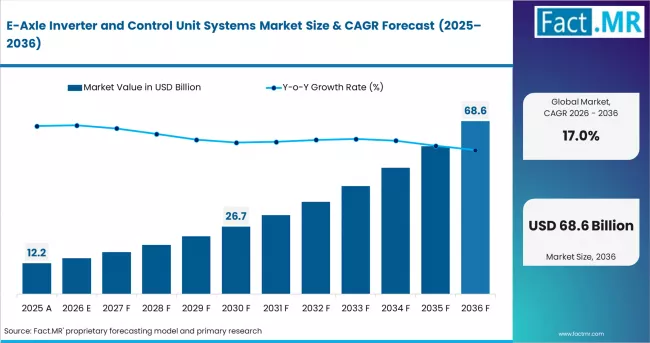
E Axle Inverter And Control Unit Systems Market Market Value Analysis | Source: Fact.MR
| Metric | Value |
|---|---|
| Estimated Value in 2026 | USD 12.2 billion |
| Forecast Value in 2036 | USD 58.6 billion |
| Forecast CAGR (2026 to 2036) | 17.0% |
Source: Fact.MR analysis. Updated May 9, 2026
Summary of E-Axle Inverter and Control Unit Systems Market
- Market Definition
- Market covers e-axle inverter and control unit systems used in battery and hybrid electric vehicles globally.
- Demand Drivers
- Global EV mandates are accelerating OEM procurement of integrated e-axle power electronics.
- SiC semiconductor adoption is driving higher inverter efficiency and reducing thermal management cost.
- Platform-based EV architectures are standardising inverter and ECU integration at the axle level.
- Key Segments Analyzed
- By System Type: Integrated inverter + control unit leads with 50% share in 2026 due to space and cost efficiency.
- By Semiconductor Type: Silicon-based IGBT leads with 55% in 2026; SiC gaining fastest share on efficiency grounds.
- By Vehicle Type: BEV segment leads in 2026 driven by global pure-electric platform rollouts.
- Analyst Opinion at FACT.MR
- Shambhu Nath Jha, Principal Consultant at Fact.MR, opines, 'CXOs will find that SiC integration speed and vertical control architecture depth define who wins e-axle inverter contracts in the next five years.'
- Strategic Implications
- Accelerate SiC-based inverter development to match OEM efficiency roadmaps.
- Form co-development agreements with EV platform OEMs to secure integrated e-axle supply positions.
- Invest in ECU software capabilities to differentiate beyond hardware commodity competition.
- Methodology
- Uses EV production volumes and inverter content-per-vehicle benchmarks.
- Includes company disclosures, semiconductor shipment data, and OEM platform filings.
- Forecasts consider electrification mandate timelines and SiC supply ramp trajectories.
The market is projected to generate USD 46.4 billion in absolute opportunity over the forecast period. Growth is transformational, underpinned by accelerating global EV adoption mandates and platformisation of e-axle architectures. Expansion is paced by semiconductor supply constraints and high capital intensity in SiC wafer manufacturing.
China leads with 18.6% CAGR, anchored by the world's largest EV production base and deep domestic e-axle integration. India follows at 17.9% as a cost-optimized EV ecosystem scales rapidly. South Korea records 17.4% driven by Hyundai-Kia E-GMP platform expansion. The United States grows at 16.8% on OEM-led vertical integration. Germany posts 16.5% supported by premium drivetrain electrification. Japan grows at 15.2%, reflecting a measured hybrid-to-EV transition. Mature European markets generate steady replacement demand, constrained by legacy powertrain engineering dependencies.
Segmental Analysis
E-Axle Inverter and Control Unit Systems Market Analysis by System Type
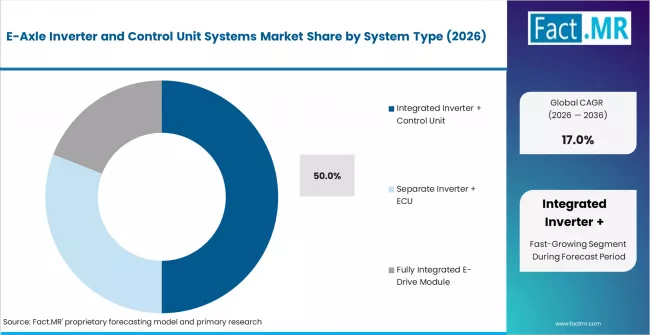
E Axle Inverter And Control Unit Systems Market Analysis By System Type | Source: Fact.MR
Based on FACT.MR's e-axle inverter and control unit systems market report, the integrated inverter + control unit segment is estimated to hold approximately 50% share in 2026. This segment leads due to space efficiency, reduced wiring complexity, and OEM preference for compact e-axle packaging in BEV platforms. Integrated systems reduce thermal management overhead and simplify assembly, making them the preferred architecture for high-volume EV production.
- BorgWarner Integration: BorgWarner expanded its integrated e-drive systems portfolio in 2024, securing supply agreements with multiple European OEMs for compact inverter-ECU modules designed for next-generation BEV platforms. [2]
- ZF Friedrichshafen Development: ZF Friedrichshafen launched its updated electric driveline platform in 2025, incorporating an integrated power electronics and control unit module targeting commercial and passenger EV applications with improved thermal performance. [3]
- OEM Integration Trend: Automotive OEMs are increasingly specifying integrated e-axle inverter systems to reduce Bill of Materials complexity and enable faster production ramp. This is compressing demand for separate inverter and ECU configurations across mid-segment BEV platforms. [4]
E-Axle Inverter and Control Unit Systems Market Analysis by Semiconductor Type
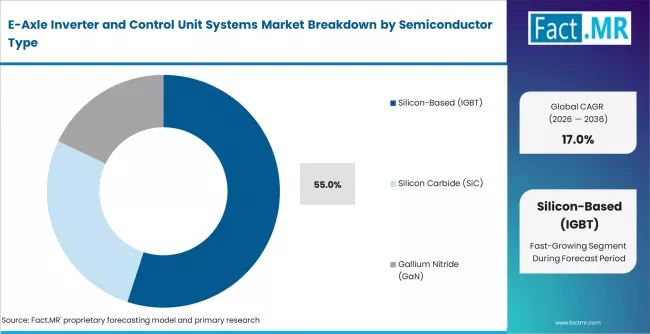
E Axle Inverter And Control Unit Systems Market Analysis By Semiconductor Type | Source: Fact.MR
Based on FACT.MR's report, silicon-based IGBT inverters are estimated to hold approximately 55% share in 2026. IGBTs maintain dominance due to established supply chains, lower per-unit cost, and suitability for PHEV and entry-level BEV applications. However, SiC is the fastest-growing sub-segment, with adoption accelerating in premium BEV and high-performance applications where switching efficiency and range extension justify higher component cost.
- Infineon SiC Expansion: Infineon Technologies commenced volume production at its new SiC wafer facility in Kulim, Malaysia in 2024, adding over 1 million SiC wafers annually to support growing e-axle inverter demand from European and Asian OEMs. [5]
- STMicroelectronics SiC Supply: STMicroelectronics secured long-term SiC substrate supply agreements in 2025 with Soitec to support automotive-grade SiC inverter production for Stellantis and Renault EV platforms. [6]
- GaN Emerging Opportunity: GaN-based power devices are entering the e-axle inverter market in 2025 trials, targeting 48V mild-hybrid and auxiliary inverter applications where size and switching frequency advantages outweigh current cost premiums. [7]
Drivers, Restraints, and Opportunities
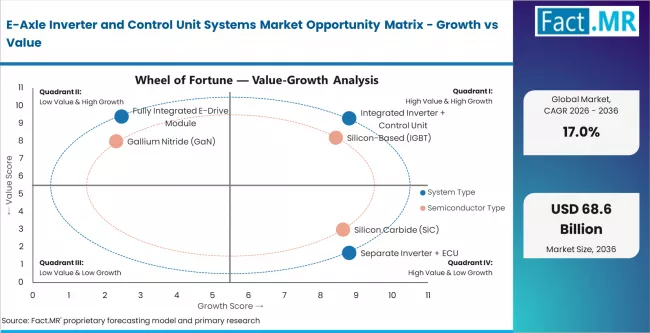
E Axle Inverter And Control Unit Systems Market Opportunity Matrix Growth Vs Value | Source: Fact.MR
FACT.MR analysts observe that the market is evolving as the critical power electronics layer of the global EV transition. Demand is anchored in EV platform proliferation, OEM electrification commitments, and rising inverter content-per-vehicle as integrated e-axle architectures replace discrete drivetrain components. The market exists at its current scale because inverter and control unit performance directly determines vehicle range, efficiency, and thermal safety.
The market is undergoing a material transition from silicon IGBT to silicon carbide semiconductors. IGBT-based inverters are losing design-in momentum in premium and performance EV segments due to lower switching efficiency and higher heat generation. SiC systems are replacing them at higher unit cost but with measurable range and cooling benefits that OEMs are willing to pay for. Revenue growth is increasingly value-driven rather than volume-driven.
- EV Platform Mandates: The European Union's 2035 ICE ban and China's NEV credit scheme are forcing OEM investment in dedicated EV platforms requiring high-performance inverter systems. Demand for integrated e-axle inverter and ECU modules is rising structurally across all passenger vehicle segments.
- SiC Semiconductor Adoption: Tesla's transition to SiC inverters in Model 3 (2023-2024) catalysed OEM-wide re-evaluation of power module architecture. Infineon Technologies and STMicroelectronics expanded SiC capacity in 2024-2025, supporting broader e-axle market adoption across European and Asian OEMs.
- Asia Pacific Supply Base: China's domestic e-axle integration ecosystem, anchored by CATL, BYD, and SAIC, is enabling cost-competitive inverter system development. This is compressing margins for global Tier-1 suppliers while accelerating overall market volume growth in the region.
Regional Analysis
The e-axle inverter and control unit systems market is assessed across Asia Pacific, North America, Europe, Latin America, and Middle East and Africa. Coverage spans 40+ countries across all EV-relevant manufacturing and adoption geographies. The full report provides market attractiveness analysis by region and country.
.webp "Top Country Growth Comparison E Axle Inverter And Control Unit Systems Market Cagr (2026 2036)")
Top Country Growth Comparison E Axle Inverter And Control Unit Systems Market Cagr (2026 2036) | Source: Fact.MR
| Country | CAGR (2026 to 2036) |
|---|---|
| China | 18.6% |
| India | 17.9% |
| South Korea | 17.4% |
| United States | 16.8% |
| Germany | 16.5% |
| Japan | 15.2% |
Source: Fact.MR analysis. Updated May 9, 2026
Source: Fact.MR (FACT.MR) analysis, based on proprietary forecasting model and primary research
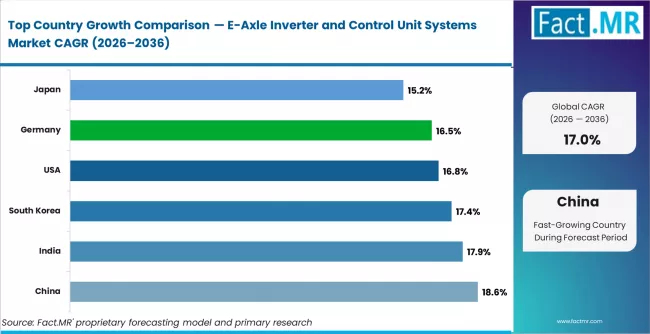
E Axle Inverter And Control Unit Systems Market Cagr Analysis By Country | Source: Fact.MR
Asia Pacific E-Axle Inverter and Control Unit Systems Market Analysis
Asia Pacific is the global production epicenter and fastest-growing region. China anchors manufacturing scale, while India and South Korea contribute high-growth demand. BYD Auto, CATL, Hyundai Mobis, and Nidec define regional competitive positioning. The region is rapidly transitioning toward domestic SiC and IGBT module ecosystems, reducing reliance on imports.
- China: Policy-driven scale and vertical integration support 18.6% CAGR through 2036. Over 9 million NEVs were sold in 2024, creating the largest inverter demand base globally. BYD Auto and SAIC Motor are internalizing inverter and ECU development, improving cost control and system efficiency. Ministry of Industry and Information Technology NEV mandates are ensuring stable demand pipelines. SICC and Sanan Optoelectronics are scaling SiC production, accelerating domestic semiconductor independence.
- India: Cost-optimised architecture expansion supports 17.9% CAGR through 2036. The PM E-DRIVE scheme is accelerating EV penetration across multiple vehicle classes. Tata AutoComp Systems and global Tier-1 partnerships are enabling local inverter assembly. The market is differentiated by two- and three-wheeler electrification, where low-cost inverter design and efficiency trade-offs define procurement strategy. Local manufacturing incentives are strengthening supply chain localisation.
- South Korea: Integrated ecosystem strength supports 17.4% CAGR through 2036. Hyundai Motor Group is scaling E-GMP platform globally, standardising inverter architectures. Hyundai Mobis delivers tightly integrated e-axle modules. Samsung SDI and SK On are reinforcing upstream power electronics supply. The ecosystem’s vertical integration reduces development timelines and enhances performance consistency.
- Japan: Engineering-led transition supports 15.2% CAGR through 2036. Toyota is accelerating BEV targets and next-generation inverter requirements. Denso Corporation is scaling SiC inverter production capacity. Ministry of Economy, Trade and Industry is funding electrification through the GI Fund. Hybrid dominance is moderating near-term growth, but long-term investment in high-efficiency inverter platforms is strengthening.
Fact.MR covers China, India, Japan, South Korea, ASEAN, and ANZ. It includes EV production, semiconductor adoption, and inverter system demand trends.
North America E-Axle Inverter and Control Unit Systems Market Analysis
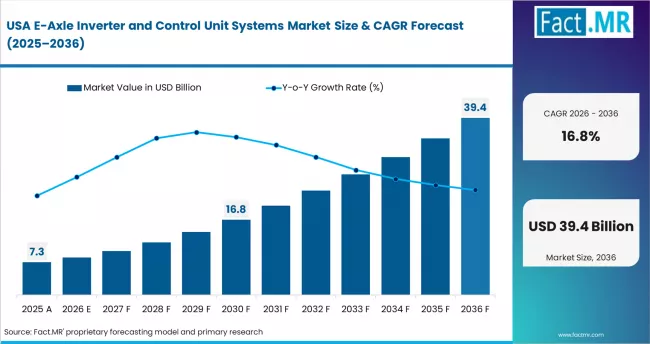
E Axle Inverter And Control Unit Systems Market Country Value Analysis | Source: Fact.MR
North America is characterised by innovation-led growth and OEM vertical integration. Tesla and General Motors are redefining inverter design and sourcing strategies. BorgWarner and Robert Bosch remain key Tier-1 suppliers. IRA incentives are accelerating domestic SiC and inverter manufacturing investments.
- United States: Technology-led adoption supports 16.8% CAGR through 2036. Tesla continues to iterate SiC inverter efficiency across multiple platforms, setting industry benchmarks. General Motors is scaling Ultium-based inverter deployments across its EV portfolio. Wolfspeed and onsemi are expanding domestic SiC production capacity. OEMs including Ford and Rivian are pursuing inverter insourcing strategies, reshaping Tier-1 supplier relationships and margin structures.
Fact.MR covers United States, Canada, and Mexico. It includes OEM electrification strategies, SiC adoption rates, and manufacturing investments.
Europe E-Axle Inverter and Control Unit Systems Market Analysis
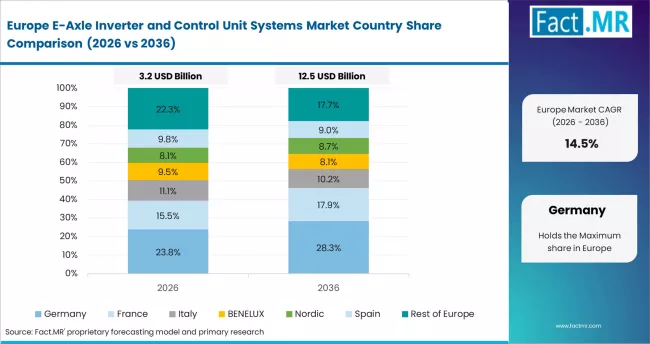
E Axle Inverter And Control Unit Systems Market Europe Country Market Share Analysis, 2026 & 2036 | Source: Fact.MR
Europe is a regulation-driven EV transition market with strong premium OEM influence. ICE phase-out policies are forcing accelerated electrification timelines. Continental AG, Robert Bosch, and ZF Friedrichshafen dominate Tier-1 supply. EU-backed semiconductor programmes are strengthening SiC ecosystem development.
- Germany: Premium OEM electrification supports 16.5% CAGR through 2036. BMW, Mercedes-Benz, and Volkswagen Group are committing to full EV platform transitions. Infineon Technologies is expanding SiC wafer and module production under IPCEI support. Vertical integration across batteries and power electronics is increasing, improving system efficiency and supply security.
Fact.MR covers Germany, France, United Kingdom, Italy, Spain, and Rest of Europe. It includes regulatory timelines, OEM electrification roadmaps, and semiconductor ecosystem development.
Competitive Aligners for Market Players
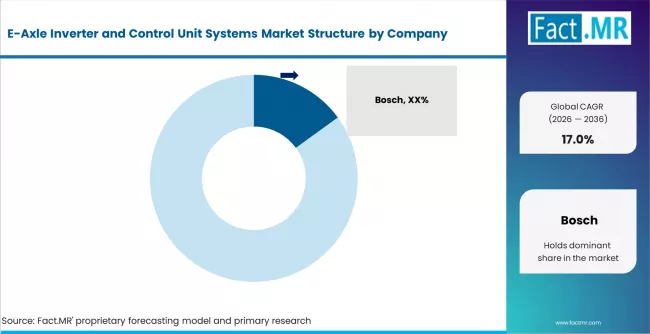
E Axle Inverter And Control Unit Systems Market Analysis By Company | Source: Fact.MR
Competitive positioning in the e-axle inverter and control unit systems market is increasingly shaped by who controls efficiency, integration, and semiconductor access. The shift from silicon IGBT to SiC is not just a technology upgrade. It is redefining who captures value across the drivetrain stack.
One clear advantage comes from vertical integration. OEMs like Tesla are designing in-house inverter systems to optimise performance and reduce supplier dependency. This puts pressure on traditional Tier-1 suppliers to move beyond component supply and offer fully integrated e-axle solutions. Players such as BorgWarner and Robert Bosch are responding by bundling motors, inverters, and control units into single packages.
Semiconductor partnerships are becoming a decisive differentiator. Access to SiC supply from companies like Infineon Technologies, Wolfspeed, and onsemi directly impacts performance, cost, and delivery timelines. Vendors that secure long-term wafer and module agreements are better positioned to win OEM contracts, especially as SiC shortages periodically constrain the market. Another key factor is system-level efficiency and software control. Inverter performance is no longer judged only on hardware specs. Algorithms for thermal management, switching efficiency, and energy optimisation are becoming central to differentiation. Suppliers that can demonstrate real-world range improvement and power density gains have a stronger case during OEM sourcing decisions. Regional strategy also matters. Companies investing in local manufacturing in China and India are gaining faster access to high-growth EV programmes.
Key Players
- Bosch
- Continental AG
- ZF Friedrichshafen AG
- BorgWarner Inc.
- Valeo SA
- Infineon Technologies AG
- NXP Semiconductors N.V.
- STMicroelectronics N.V.
- Denso Corporation
- Hitachi Astemo Ltd.
Bibliography
- [1] BorgWarner Inc., Product Announcement: Integrated E-Drive Systems, BorgWarner, 2024. Available at: https://www.borgwarner.com/newsroom
- [2] ZF Friedrichshafen AG, Electric Driveline Platform Launch, ZF, 2025. Available at: https://www.zf.com/mobile/en/press
- [3] Automotive News, OEM Integration Trends in E-Axle Procurement, 2024. Available at: https://www.autonews.com
- [4] Infineon Technologies AG, Kulim SiC Fab Volume Production Announcement, Infineon, 2024. Available at: https://www.infineon.com/cms/en/about-infineon/press/
- [5] STMicroelectronics, SiC Substrate Supply Agreement with Soitec, STMicroelectronics, 2025. Available at: https://www.st.com/content/st_com/en/about/media-center
- [6] Power Electronics International, GaN E-Axle Inverter Trials 2025, 2025. Available at: https://www.power-and-beyond.com
This Report Addresses
- Strategic insights on demand across China, India, South Korea, United States, Germany, and Japan. Covers EV platform electrification, semiconductor type adoption, OEM integration trends, and e-axle inverter demand forecasts.
- Market forecast from USD 12.2 billion in 2026 to USD 58.6 billion by 2036, at 17.0% CAGR.
- Opportunity mapping across SiC inverter adoption, integrated e-axle module demand, OEM vertical integration, and emerging market cost-optimized EV architectures.
- Segment analysis by system type, semiconductor type, and vehicle type. Covers integrated and discrete configurations, IGBT, SiC, and GaN power modules.
- Regional outlook covering Asia Pacific production leadership, North America OEM-driven innovation, and Europe regulatory-mandated EV investment.
- Competitive analysis of Bosch, Continental AG, ZF Friedrichshafen, BorgWarner, Infineon Technologies, and STMicroelectronics.
- Technology tracking on SiC power module capacity, GaN emerging adoption, ECU software integration, and inverter power density benchmarks.
- Report delivery in PDF, Excel, and presentation formats with validated data and industry inputs.
E-Axle Inverter and Control Unit Systems Market Definition
The e-axle inverter and control unit systems market covers power electronics and control hardware integrated into electric axle assemblies for battery and hybrid electric vehicles. These systems convert DC battery power to AC motor drive current and execute real-time torque, thermal, and diagnostics control.
E-Axle Inverter and Control Unit Systems Market Inclusions
Covers global and regional forecasts from 2026 to 2036 by system type, semiconductor type, and vehicle type. Includes integrated and discrete inverter-ECU configurations, SiC and IGBT power modules, and e-drive systems across passenger and commercial EV segments. Covers efficiency benchmarking and power density analysis.
E-Axle Inverter and Control Unit Systems Market Exclusions
Excludes on-board chargers, DC-DC converters, and battery management systems unless integrated into an e-axle module. Standalone traction motors and transmission hardware are not included. Finished EV platforms and branded drivetrain assemblies are excluded. Focus remains on inverter and control electronics within the e-axle.
E-Axle Inverter and Control Unit Systems Market Research Methodology
- Primary Research:Interviews with Tier-1 drivetrain suppliers, semiconductor manufacturers, OEM powertrain engineers, and EV platform procurement teams.
- Desk Research:Uses data from Bosch, Infineon Technologies, ZF Friedrichshafen, BorgWarner annual reports and 2024-2025 EV powertrain deployment data.
- Market-Sizing and Forecasting:Hybrid model combining EV production volume forecasts, inverter content-per-vehicle analysis, and semiconductor pricing benchmarks.
- Data Validation and Update Cycle:Validated using OEM production disclosures, semiconductor shipment data, and EV market deployment benchmarks.
Segmentation
Scope of Report
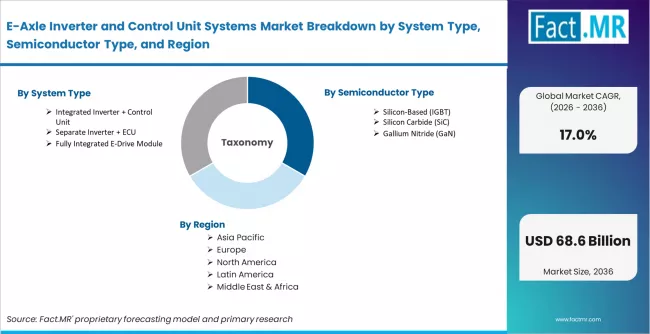
E Axle Inverter And Control Unit Systems Market Breakdown By System Type, Semiconductor Type, And Region | Source: Fact.MR
| Attribute | Details |
|---|---|
| Quantitative Units | USD 12.2 billion (2026) to USD 58.6 billion (2036), at a CAGR of 17.0% |
| Market Definition | E-axle inverter and control unit systems used in battery electric and hybrid electric vehicle drivetrains, including integrated and discrete power electronics and electronic control units that manage motor drive, torque, and thermal functions. |
| System Type Segmentation | Integrated Inverter + Control Unit, Separate Inverter + ECU, Fully Integrated E-Drive Module |
| Semiconductor Type Segmentation | Silicon-Based (IGBT), Silicon Carbide (SiC), Gallium Nitride (GaN) |
| Vehicle Type Segmentation | Battery Electric Vehicles (BEV), Plug-in Hybrid Electric Vehicles (PHEV), Commercial Electric Vehicles |
| Application Coverage | Passenger BEV drivetrains, PHEV hybrid modules, commercial EV axle systems, high-performance e-drive platforms, and cost-optimized emerging market EV configurations. |
| Regions Covered | North America, Europe, Asia Pacific, Latin America, Middle East and Africa |
| Countries Covered | USA, Canada, Mexico, Germany, UK, France, Italy, Spain, China, Japan, South Korea, India, ASEAN, Australia and New Zealand, Brazil, Argentina, Saudi Arabia, GCC, South Africa, Rest of MEA |
| Key Companies Profiled | Bosch, Continental AG, ZF Friedrichshafen AG, BorgWarner Inc., Valeo SA, Infineon Technologies AG, NXP Semiconductors N.V., STMicroelectronics N.V., Denso Corporation, Hitachi Astemo Ltd. |
| Forecast Period | 2026 to 2036 |
Source: Fact.MR analysis. Updated May 9, 2026
E-Axle Inverter and Control Unit Systems Market by Segments
-
By System Type:
- Integrated Inverter + Control Unit
- Separate Inverter + ECU
- Fully Integrated E-Drive Module
-
By Semiconductor Type:
- Silicon-Based (IGBT)
- Silicon Carbide (SiC)
- Gallium Nitride (GaN)
-
By Vehicle Type:
- Battery Electric Vehicles (BEV)
- Plug-in Hybrid Electric Vehicles (PHEV)
- Commercial Electric Vehicles
-
By Region:
- North America
- United States
- Canada
- Mexico
- Latin America
- Brazil
- Mexico
- Argentina
- Chile
- Rest of Latin America
- Western Europe
- Germany
- United Kingdom
- France
- Italy
- Spain
- Nordic Countries
- BENELUX
- Rest of Western Europe
- Eastern Europe
- Russia
- Poland
- Hungary
- Balkan and Baltic
- Rest of Eastern Europe
- East Asia
- China
- Japan
- South Korea
- South Asia and Pacific
- India
- ASEAN
- Australia and New Zealand
- Rest of South Asia and Pacific
- Middle East and Africa
- Kingdom of Saudi Arabia
- Other GCC Countries
- Turkey
- South Africa
- Rest of Middle East and Africa
- North America
Frequently Asked Questions
How large is the e-axle inverter and control unit systems market in 2025?
What will the market size be in 2026?
What is the projected market value by 2036?
What is the expected CAGR for the market?
Which system type segment leads the market?
Which semiconductor type dominates the market?
Which region is growing the fastest?
What is driving demand for e-axle inverter and control unit systems?
What is the key challenge in this market?
Who are the major players in the market?
Which vehicle type segment holds the largest share?
Why are integrated e-axle systems preferred by OEMs?
Who worked on this report


Preview the report firsthand - request a free sample
Free SampleGet the brochure for pricing and purchase details
Download PDF