- Base Value(2025): 3.9 Bn
- Estimated Value(2026): 4.0 Bn
- Forecast Value (2036): 6.5 Bn
- CAGR (2026 - 2036): 4.9%
Ultrasonic Sensor Systems for Parking Assistance Market Analysis and Forecast by Fact.MR
- The global Ultrasonic Sensor Systems for Parking Assistance Market is estimated at USD 4.0 billion in 2026 and is forecast to expand at a CAGR of 4.9% to reach USD 6.5 billion by 2036.
- The ultrasonic sensor systems for parking assistance market is characterized by a maturity-versus-integration dynamic.
- While baseline rear parking sensor penetration has reached saturation across developed automotive markets, incremental value creation is increasingly driven by integration into multi-sensor ADAS ecosystems.
- OEMs are shifting from standalone sensor deployment toward combined perception architectures that incorporate cameras, radar, and ultrasonic systems.
- This transition is redefining supplier positioning, moving competitive advantage from component-level pricing to system-level integration capability and software alignment.
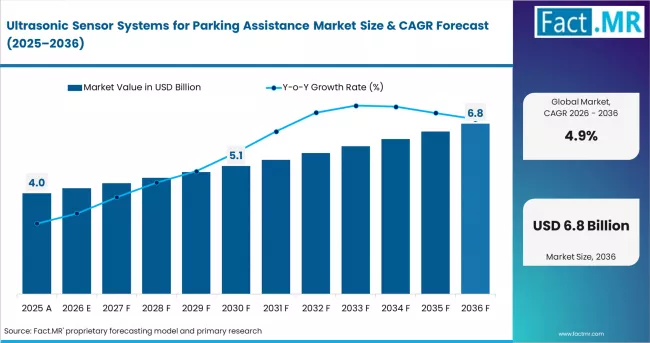
Ultrasonic Sensor Systems For Parking Assistance Market Market Value Analysis | Source: Fact.MR
| Metric | Value |
|---|---|
| Estimated Value in 2026 | USD 4.0 billion |
| Forecast Value in 2036 | USD 6.5 billion |
| Forecast CAGR (2026 to 2036) | 4.9% |
Source: Fact.MR analysis. Updated May 8, 2026
Summary of Ultrasonic Sensor Systems for Parking Assistance Market
- Market Definition
- Ultrasonic sensor systems enable vehicles to detect nearby obstacles using sound waves for safe parking and proximity monitoring.
- Demand Drivers
- Passenger vehicle manufacturers are expanding ADAS integration, increasing ultrasonic sensor deployment in entry and mid-range vehicles.
- Urban congestion and parking challenges are driving demand for automated parking solutions.
- Regulatory safety programs are encouraging inclusion of parking assistance systems as standard features.
- Key Segments Analyzed
- By Application: Park assist systems lead with approximately 42.0% share in 2026.
- By Frequency Range: 20-50 kHz sensors account for approximately 45.0% share in 2026.
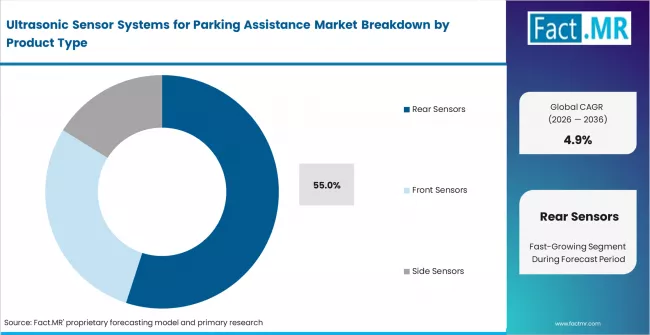
- By Product Type: Rear parking sensors dominate with approximately 55.0% share in 2026.
- Analyst Opinion at FACT.MR
- Shambhu Nath Jha, Senior Analyst at Fact.MR, says ultrasonic sensors will continue to play a key role in low-speed vehicle safety functions such as parking assistance and obstacle detection. Their simplicity, reliability, and cost efficiency support widespread use across vehicle segments. However, long-term value depends on integration with broader ADAS perception systems, where ultrasonic data complements inputs from cameras and radar. This combined approach improves overall detection capability and supports more consistent performance across different driving conditions.
- Strategic Implications
- Develop integrated sensor solutions that combine ultrasonic with vision and radar systems to support broader ADAS perception. This approach improves detection coverage, enhances reliability in low-speed scenarios, and enables smoother interaction between different sensing technologies within vehicle architectures.
- Focus on cost optimization to sustain adoption in mass-market vehicles, where price sensitivity remains high. Efficient design, simplified integration, and scalable production help maintain affordability while supporting required safety performance.
- Expand capabilities toward automated and remote parking applications, where ultrasonic sensors play a central role in close-range detection and maneuver control.
- Methodology
- Market sizing is based on vehicle production data and installation rates of ultrasonic sensors across different vehicle segments and regions.
- Analysis includes OEM sourcing patterns and ADAS adoption trends, highlighting how integration strategies influence demand.
- Forecast incorporates regulatory developments and technological shifts, reflecting how safety requirements and system evolution shape long-term adoption.
Drivers, Restraints, and Opportunities
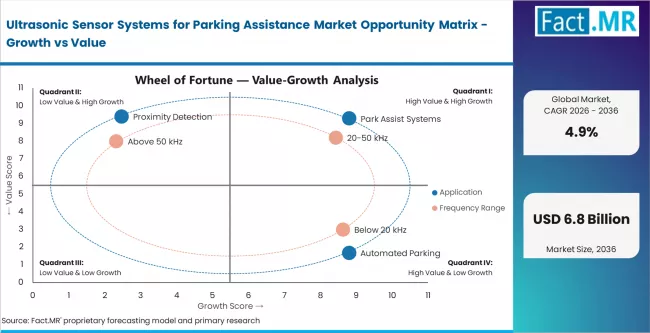
Ultrasonic Sensor Systems For Parking Assistance Market Opportunity Matrix Growth Vs Value | Source: Fact.MR
Fact.MR analysis indicates that the ultrasonic sensor market has reached a mature stage in developed automotive regions, where adoption across passenger vehicles is already widespread. These sensors are now treated as standard safety components, especially for rear parking assistance and low-speed collision prevention. The current market valuation reflects stable demand, as ultrasonic systems continue to support routine driving functions such as parking convenience and obstacle detection. Their cost efficiency and reliability ensure continued use across entry and mid-range vehicle segments.
At the same time, the market is moving toward integrated sensing solutions. Standalone ultrasonic sensors face limited expansion in saturated markets, while newer applications such as automated parking and multi-sensor fusion are creating incremental demand. Integration with cameras and radar improves detection coverage and system performance, though it also increases system complexity. Pricing pressure remains, particularly in cost-sensitive vehicle segments, as OEMs aim to balance feature expansion with affordability.
- Regulatory alignment: Programs such as Euro NCAP are encouraging the inclusion of parking assistance systems, supporting consistent demand across vehicle segments.
- Technology convergence: Ultrasonic sensors are being integrated with cameras and radar to enable advanced parking functions and 360-degree perception systems.
- Emerging market expansion: Growth in vehicle production across Asia Pacific and Latin America is supporting demand for basic parking assistance systems.
Segment Analysis
Ultrasonic Sensor Systems for Parking Assistance Market Analysis by Application
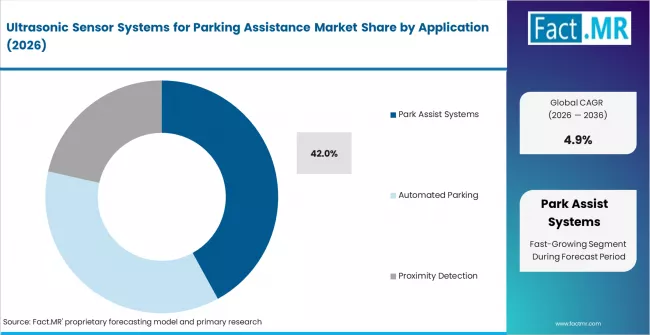
Ultrasonic Sensor Systems For Parking Assistance Market Analysis By Application | Source: Fact.MR
Park assist systems are estimated to hold approximately 42.0% share of the ultrasonic sensor systems market in 2026, supported by their widespread adoption as a standard feature in passenger vehicles. These systems directly address a key driver requirement: reducing collision risk during parking in confined spaces. Their simplicity, cost-effectiveness, and proven reliability make them suitable across vehicle categories, from entry-level to premium models. As urbanization increases and parking spaces become more constrained, the importance of accurate low-speed detection continues to grow. OEMs are also extending park assist functionality into semi-automated and fully automated parking systems, where ultrasonic sensors work alongside cameras and control algorithms. This evolution is strengthening the role of park assist systems as a core component of vehicle safety and convenience features.
- OEM expansion: Valeo increased production capacity for park assist systems in 2024 to meet growing OEM demand and support large-scale deployment across vehicle platforms [1]. This expansion reflects rising integration of parking assistance features across both developed and emerging automotive markets.
- Product innovation: Robert Bosch GmbH introduced enhanced ultrasonic modules with improved detection accuracy and reduced blind spots [2]. These improvements support better obstacle detection and enhance user confidence during parking operations.
- Industry trend: Increasing urbanization and limited parking availability are driving demand for automated parking solutions. This trend is encouraging OEMs to invest in more advanced park assist systems that combine ultrasonic sensing with additional perception technologies.
Ultrasonic Sensor Systems for Parking Assistance Market Analysis by Frequency Range
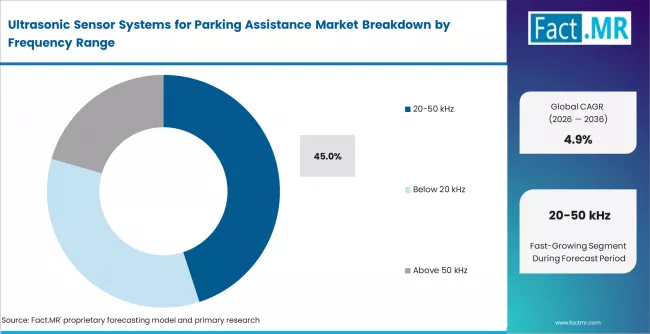
Ultrasonic Sensor Systems For Parking Assistance Market Analysis By Frequency Range | Source: Fact.MR
20-50 kHz sensors are estimated to account for approximately 45.0% share of the market in 2026, as this frequency range provides an optimal balance between detection accuracy, operational range, and cost. These mid-frequency sensors are widely used in automotive applications because they deliver reliable performance across varying environmental conditions, including temperature changes, humidity, and surface variations. Their ability to provide consistent distance measurement without excessive power consumption makes them suitable for large-scale deployment in mass-market vehicles. OEMs favor this range as it supports standardization across vehicle platforms, simplifying integration and reducing design complexity.
- Technology development: Murata Manufacturing launched compact ultrasonic sensors optimized for automotive applications in 2024, improving space efficiency and integration flexibility [3]. These designs support easier incorporation into vehicle structures such as bumpers and side panels.
- Performance advantage: Mid-frequency sensors deliver stable and accurate performance across different weather and operating conditions, ensuring reliability in everyday driving scenarios. This consistency is critical for maintaining user trust in parking assistance systems.
- Market trend: OEMs prefer standardized frequency ranges to simplify system integration, reduce development time, and achieve cost efficiencies across multiple vehicle models and platforms.
Ultrasonic Sensor Systems for Parking Assistance Market Analysis by Product Type
Ultrasonic Sensor Systems For Parking Assistance Market Analysis By Product Type | Source: Fact.MR
Rear parking sensors are expected to hold approximately 55.0% share of the market in 2026, driven by their role as a baseline safety feature in most passenger vehicles globally. These sensors are typically the first level of parking assistance technology adopted by OEMs, providing drivers with alerts about obstacles behind the vehicle. Their widespread inclusion across entry-level and mid-range vehicles ensures consistent demand. Rear sensors are also supported by regulatory requirements in certain regions that mandate rear visibility and safety features, reinforcing their position as a standard component in vehicle design.
- Capacity expansion: Continental AG expanded rear sensor production facilities in 2024 to meet increasing demand from OEMs and support global supply requirements [4]. This expansion highlights the continued importance of rear sensors in vehicle safety systems.
- Adoption trend: Rear sensors are standard in most passenger vehicles, including entry-level models, due to their affordability and effectiveness in reducing low-speed collisions. Their ease of integration further supports widespread use.
- Market dynamic: Increasing safety awareness among consumers and regulatory bodies is driving adoption across emerging markets, where vehicle safety features are becoming more important in purchase decisions.
Regional Analysis
The ultrasonic sensor systems market is analyzed across North America, Europe, Asia Pacific, Latin America, and Middle East & Africa. Regional demand is shaped by automotive production volumes, regulatory frameworks, and ADAS adoption rates. The full report provides market attractiveness analysis across regions and countries.
.webp "Top Country Growth Comparison Ultrasonic Sensor Systems For Parking Assistance Market Cagr (2026 2036)")
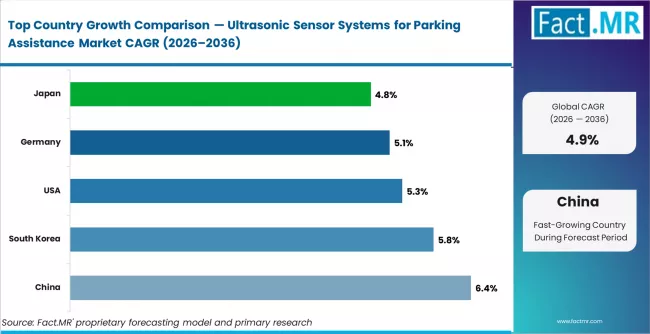
Top Country Growth Comparison Ultrasonic Sensor Systems For Parking Assistance Market Cagr (2026 2036) | Source: Fact.MR
| Country | CAGR (2026-2036) |
|---|---|
| China | 6.4% |
| South Korea | 5.8% |
| United States | 5.3% |
| Germany | 5.1% |
| Japan | 4.8% |
Source: Fact.MR analysis. Updated May 8, 2026
Source: Fact.MR (FACTMR) analysis, based on proprietary forecasting model and primary research
Ultrasonic Sensor Systems For Parking Assistance Market Cagr Analysis By Country | Source: Fact.MR
Asia Pacific
Asia Pacific serves as the global production epicenter for automotive manufacturing and sensor supply chains. Strong OEM presence, high vehicle output, and established electronics manufacturing ecosystems support large-scale deployment of ultrasonic sensor systems. Regional suppliers such as DENSO and Murata Manufacturing benefit from close integration with automakers and advanced component production capabilities.
- China: China leads regional demand, driven by high passenger vehicle production and increasing adoption of ADAS features. The market is projected to grow at a 6.4% CAGR, supported by widespread integration of parking assistance systems across vehicle categories. Government initiatives promoting intelligent and connected vehicle technologies have accelerated adoption, particularly among domestic OEMs. The expansion of electric vehicle production further strengthens demand, as manufacturers integrate multiple sensor systems to enhance safety and user experience. Suppliers that align with high-volume production and cost efficiency can capture significant opportunities in this market. [5]
- South Korea: South Korea shows steady growth supported by advanced automotive manufacturing and strong technology integration capabilities. Demand is expected to expand at a 5.8% CAGR, reflecting continued adoption of ultrasonic sensors in both domestic and export-oriented vehicle production. Korean OEMs are increasingly focusing on advanced parking solutions, including automated and remote parking systems, which rely heavily on precise sensor integration. Strong electronics and semiconductor capabilities further support the development of high-performance sensing solutions.
- Japan: Japan adds a precision-focused dimension to the regional landscape, where adoption is driven by engineering excellence and consistent integration of safety technologies. The market is expected to grow at a 4.8% CAGR, reflecting steady but controlled expansion. Automakers emphasize reliability, accuracy, and seamless system integration, particularly in compact and premium vehicles. Ultrasonic sensors are widely used in advanced parking assistance systems, aligning with Japan’s focus on high-quality vehicle design. Suppliers that meet strict performance and durability standards can maintain stable demand in this market.
North America
Ultrasonic Sensor Systems For Parking Assistance Market Country Value Analysis | Source: Fact.MR
North America represents a mature and technology-driven market, where consumer demand for safety and convenience features continues to support ultrasonic sensor adoption. Buyers in this region expect advanced driver assistance features as part of standard vehicle offerings, encouraging OEMs to integrate sensors across a wide range of models.
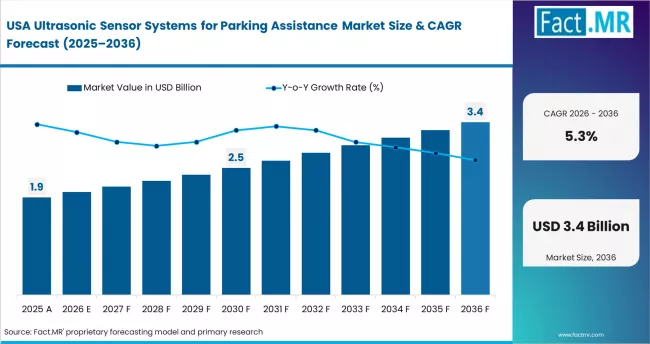
- United States: The United States leads regional demand, with growth projected at a 5.3% CAGR. Adoption is driven by increasing penetration of automated parking systems and strong consumer preference for enhanced safety features. Automakers are integrating ultrasonic sensors into broader ADAS architectures, particularly in mid- and high-end vehicles. Suppliers such as Aptiv and Bosch maintain strong market positions through advanced system integration and long-standing OEM relationships. Demand remains stable as features such as parking assist and proximity detection become standard across vehicle segments.
Europe
Ultrasonic Sensor Systems For Parking Assistance Market Europe Country Market Share Analysis, 2026 & 2036 | Source: Fact.MR
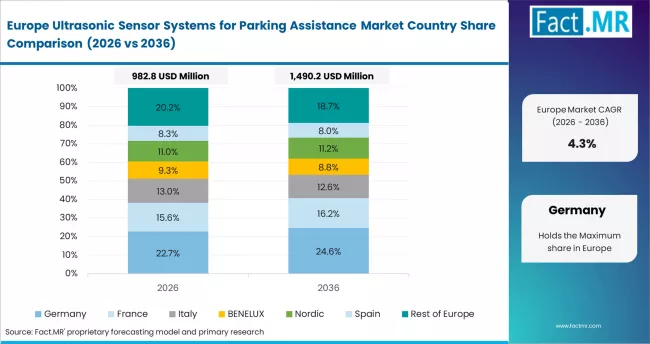
Europe operates as a regulation-driven market where safety standards and compliance frameworks strongly influence adoption of ultrasonic sensor systems. Regulatory requirements are encouraging automakers to integrate ADAS features across vehicle platforms, reinforcing steady demand for sensing technologies.
- Germany: Germany remains a key market, supported by its strong automotive manufacturing base and emphasis on engineering precision. Demand is projected to grow at a 5.1% CAGR, reflecting stable adoption driven by both regulatory compliance and premium vehicle demand. Automakers are incorporating advanced parking assistance technologies, including automated parking systems, which rely heavily on ultrasonic sensors. Suppliers such as Valeo and Continental AG play a central role in supporting OEM integration through high-performance sensing solutions.
FACTMR's analysis of ultrasonic sensor systems for parking assistance market in global regions consists of country-wise assessment that includes China, South Korea, United States, Germany, and Japan. Readers can find detailed insights on regulatory trends, OEM adoption patterns, and technology integration across these markets.
Competitive Aligners for Market Players
The ultrasonic sensor market shows moderate concentration, with a limited group of Tier 1 suppliers accounting for a substantial portion of global output. Competitive positioning depends on cost control, consistent product performance, and the ability to support integration within advanced driver assistance systems (ADAS). Suppliers that can align sensor performance with system-level requirements tend to secure stronger OEM engagement.
Companies such as Bosch, Valeo, and Continental operate with clear structural advantages. Their long-standing relationships with automotive manufacturers support stable order volumes and early involvement in vehicle platform development. Scale plays a central role in their strategy, allowing these firms to manage production costs while maintaining quality standards. Investment in automated manufacturing and sensor calibration capabilities further strengthens their position in high-volume programs.
Demand patterns shift in higher-end applications, particularly in advanced parking assistance systems. These systems require greater sensor density, improved accuracy, and seamless integration with software and control units. Such requirements increase system complexity and raise entry barriers for smaller suppliers. Margins tend to improve in this segment, as OEMs prioritize performance and reliability over cost alone. Suppliers capable of delivering integrated sensing solutions with consistent performance across varied driving conditions are better positioned to capture long-term program opportunities
Key Players
- Valeo
- Bosch
- Continental
- DENSO
- Aptiv
- Murata
Ultrasonic Sensor Systems for Parking Assistance Market by Segments
-
By Application:
- Park Assist Systems
- Automated Parking
- Proximity Detection
-
By Frequency Range:
- Below 20 kHz
- 20-50 kHz
- Above 50 kHz
-
By Product Type:
- Front Sensors
- Rear Sensors
- Side Sensors
-
By End Use:
- Passenger Vehicles
- Commercial Vehicles
-
By Region:
- North America
- United States
- Canada
- Mexico
- Latin America
- Brazil
- Argentina
- Chile
- Rest of Latin America
- Western Europe
- Germany
- France
- United Kingdom
- Italy
- Spain
- Nordic Countries
- BENELUX
- Rest of Western Europe
- Eastern Europe
- Russia
- Poland
- Hungary
- Balkan and Baltic
- Rest of Eastern Europe
- East Asia
- China
- Japan
- South Korea
- South Asia and Pacific
- India
- ASEAN
- Australia and New Zealand
- Rest of South Asia and Pacific
- Middle East and Africa
- Kingdom of Saudi Arabia
- Other GCC Countries
- Turkey
- South Africa
- Rest of Middle East and Africa
- North America
Bibliography
- [1] Valeo, Parking Assistance Systems Production Update, 2024
- [2] Bosch, Ultrasonic Sensor Technology Release, 2023
- [3] Murata Manufacturing, Automotive Ultrasonic Sensor Product Note, 2024
- [4] Continental AG, Sensor Production Expansion Report, 2024
- [5] European Commission, Vehicle Safety Systems Report, 2024
This Report Addresses
- Market intelligence on ultrasonic sensor systems for parking assistance
- Forecast from USD 4.0 billion in 2026 to USD 6.5 billion by 2036
- Growth opportunity mapping across vehicle and regional segments
- Segment-level analysis by application, frequency, and product type
- Competitive strategy assessment of leading suppliers
- Technology tracking and product innovation analysis
- Regulatory impact assessment across key markets
- Delivery in PDF, Excel datasets, and presentation formats
Ultrasonic Sensor Systems for Parking Assistance Market Definition
Ultrasonic sensor systems for parking assistance are electronic sensing devices that use high-frequency sound waves to detect nearby objects and measure distance in real time. These sensors are typically embedded in vehicle bumpers and function by emitting ultrasonic pulses that reflect off surrounding objects. The system calculates the time taken for the echo to return, allowing it to estimate proximity accurately. These systems are widely used in passenger and commercial vehicles to assist drivers in parking, reduce collision risks at low speeds, and support automated parking features. They form a critical part of modern vehicle safety systems, especially in urban driving environments where space constraints are significant.
Ultrasonic Sensor Systems for Parking Assistance Market Inclusions
The report covers global and regional market size estimates and forecasts from 2026 to 2036. It includes segmentation by application, frequency range, product type, and end use. The analysis evaluates demand across passenger and commercial vehicle segments and examines pricing dynamics, OEM sourcing strategies, and supply chain developments. It also includes assessment of technology integration with broader ADAS architectures, regulatory influences, and adoption trends across key automotive markets.
Ultrasonic Sensor Systems for Parking Assistance Market Exclusions
The scope excludes radar, lidar, and camera-based sensing systems unless directly integrated with ultrasonic modules. Industrial ultrasonic applications such as liquid level measurement, robotics, and industrial automation are not included. The report does not cover full autonomous driving platforms or ADAS software stacks. It focuses strictly on ultrasonic sensor hardware used in parking assistance, proximity detection, and low-speed safety applications in automotive systems.
Ultrasonic Sensor Systems for Parking Assistance Market Research Methodology
- Primary Research:Interviews were conducted with automotive OEMs, Tier 1 suppliers, ADAS integrators, and procurement specialists.
- Desk Research:Data sources include automotive production databases, regulatory filings, company reports, and industry publications.
- Market-Sizing and Forecasting:A hybrid top-down and bottom-up model was used, combining vehicle production volumes with sensor penetration rates.
- Data Validation and Update Cycle:Outputs were validated using supplier shipment data, OEM contracts, and cross-referenced regulatory filings.
Segmentation
Scope of Report
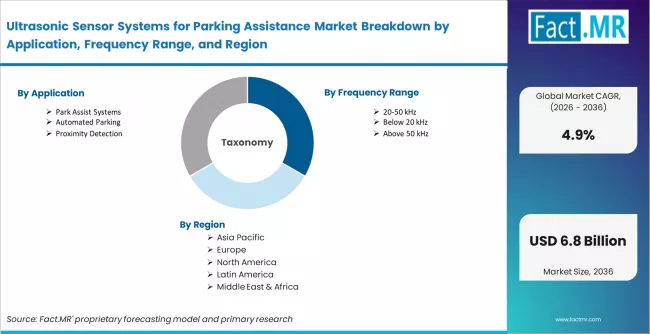
Ultrasonic Sensor Systems For Parking Assistance Market Breakdown By Application, Frequency Range, And Region | Source: Fact.MR
| Attribute | Details |
|---|---|
| Quantitative Units | USD 4.0 billion (2026) to USD 6.5 billion (2036), at a CAGR of 4.9% |
| Market Definition | Ultrasonic sensor systems used in parking assistance, proximity detection, and automated parking applications in passenger and commercial vehicles |
| Application Segmentation | Park Assist Systems, Automated Parking, Proximity Detection |
| Frequency Range Segmentation | Below 20 kHz, 20–50 kHz, Above 50 kHz |
| Product Type Segmentation | Front Sensors, Rear Sensors, Side Sensors |
| End Use Segmentation | Passenger Vehicles, Commercial Vehicles |
| Regions Covered | North America, Europe, Asia Pacific, Latin America, Middle East and Africa |
| Key Companies Profiled | Valeo, Bosch, Continental, DENSO, Aptiv, Murata |
| Forecast Period | 2026 to 2036 |
| Approach | Hybrid top-down and bottom-up model using vehicle production volumes, sensor penetration rates, OEM sourcing, and ADAS adoption trends |
Source: Fact.MR analysis. Updated May 8, 2026
Frequently Asked Questions
How large is the ultrasonic sensor systems for parking assistance market in 2025?
What is the expected market size in 2026?
What will be the market value by 2036?
What is the expected CAGR from 2026 to 2036?
What is driving demand for ultrasonic parking sensors?
Which application segment dominates the market?
Which product type holds the largest share?
Which frequency range is most widely used?
Which region is growing the fastest?
How are ultrasonic sensors used in vehicles?
Are ultrasonic sensors being replaced by cameras or radar?
What is the role of ultrasonic sensors in automated parking?
Which vehicles use ultrasonic parking sensors the most?
What is the key challenge in this market?
What are the future opportunities in this market?
Who worked on this report


Preview the report firsthand - request a free sample
Free SampleGet the brochure for pricing and purchase details
Download PDF