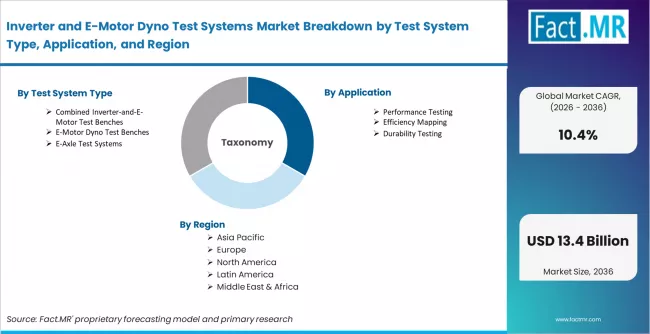
Inverter and E-Motor Dyno Test Systems Market Size, Share, Growth and Forecast (2026 - 2036)

The Inverter and E-Motor Dyno Test Systems Market is segmented by Test System Type (E-Motor Dyno Test Benches, Inverter Test Systems, Combined Inverter-and-E-Motor Test Benches, and E-Axle Test Systems), Application (Performance Testing, Efficiency Mapping, Durability Testing, NVH Testing, Thermal Validation, and End-of-Line Validation), End Use (Automotive OEMs, Tier 1 Suppliers, Independent Test Labs, Research Institutes, and Industrial Drive Manufacturers), and Region. Forecast for 2026 to 2036.

Fact.MR analysis indicates that the inverter and e-motor dyno test systems market is experiencing a validation-versus-speed dynamic. EV propulsion programs are under pressure to shorten development cycles, improve efficiency, and validate higher-speed, higher-voltage, and more software-defined electric drive systems.

Inverter and E-Motor Dyno Test Systems Market Forecast and Outlook By Fact.MR

  • The inverter and e-motor dyno test systems market was valued at USD 4.12 billion in 2025.
  • According to Fact.MR, demand is projected to reach USD 4.58 billion in 2026 and expand to USD 12.34 billion by 2036, reflecting a CAGR of 10.4% during the forecast period.
  • The market is expected to generate an absolute opportunity of USD 7.76 billion between 2026 and 2036, supported by increasing investment in electric propulsion development and validation.
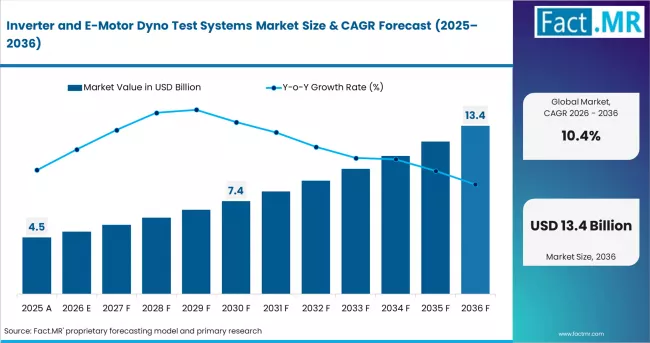
Inverter And E Motor Dyno Test Systems Market Market Value Analysis

Metric Value
Estimated Value in 2026 USD 4.5 billion
Forecast Value in 2036 USD 12.3 billion
Forecast CAGR (2026 to 2036) 10.4%

Summary of Inverter and E-Motor Dyno Test Systems Market

  • Market Definition
    • The market includes inverter and e-motor dyno test systems used for development, validation, endurance, efficiency, NVH, and integrated electric drive testing.
  • Demand Drivers
    • EV production growth is expanding the need for more electric drive development and validation infrastructure.
    • Inverter and e-motor architectures require precise mapping, emulation, and synchronized measurement beyond what simulation alone can provide.
    • Manufacturers increasingly want modular test systems that support thermal, NVH, and high-speed validation within one environment. [3]
  • Key Segments Analyzed
    • By Test System Type: Combined Inverter-and-E-Motor Test Benches lead with approximately 29.4% share in 2026, driven by rising demand for integrated electric-drive validation.
    • By Application: Performance Testing leads with approximately 25.8% share in 2026, supported by the need to map torque, speed, and efficiency across propulsion programs.
    • By Geography: China leads growth at 11.3% CAGR through 2036, supported by EV manufacturing scale and supplier investment intensity. These segment assumptions are aligned with the same structured report flow used in your uploaded reference.
  • Analyst Opinion at Fact.MR
    • Shambhu Nath Jha, Senior Analyst at Fact.MR, opines that the market’s value is increasingly defined by how much testing can be consolidated into one flexible dyno environment. Buyers no longer want isolated benches when integrated electric-drive architectures require synchronized electrical, thermal, and NVH validation under the same workflow. This view is consistent with how AVL and HORIBA describe integrated electric propulsion testing.
  • Strategic Implications
    • Suppliers should deepen integrated inverter-plus-motor workflows rather than competing on isolated dyno hardware.
    • OEMs and Tier 1 suppliers should prioritize synchronized measurement and software-led flexibility before scaling test-cell count alone.
    • Vendors with stronger emulation, automation, and thermal-control capability are better positioned in higher-value EV propulsion programs.
  • Methodology
    • Market sizing uses EV growth, electric-drive validation intensity, and test-bench value across OEM, Tier 1, and lab environments.
    • Analysis includes official supplier materials describing inverter testing, e-motor testing, and integrated multi-domain bench requirements.
    • Forecasts account for higher test complexity, faster development cycles, and stronger preference for integrated electric-drive validation. [4]

Growth is linked to the expanding role of dyno systems across both R&D and industrial production environments. These systems are no longer limited to prototype testing. They are becoming standard infrastructure for validating performance, efficiency, and durability of electric drivetrains under controlled conditions. As EV architectures evolve, testing requirements are becoming more integrated, requiring systems capable of handling multiple components simultaneously. Data from the International Energy Agency indicates that global electric car sales exceeded 17 million in 2024, accounting for more than 20% of total vehicle sales. This scale is driving continued investment in testing infrastructure to support development and production of electric propulsion systems. [1]

China leads with a projected CAGR of 11.3% through 2036, driven by large-scale EV production and continued investment in electric-drive validation infrastructure across OEMs and suppliers. India follows at 10.8%, supported by expanding EV development capacity and increasing demand for integrated inverter and motor testing capabilities. South Korea grows at 10.2%, underpinned by advanced power electronics manufacturing and strong focus on high-performance electric-drive validation. Germany records 9.7%, with growth anchored in engineering-led automotive development and demand for high-precision dyno testing systems. The United States grows at 9.4%, driven by rising investment in EV propulsion development and integrated validation environments.

Segmental Analysis

Inverter and E-Motor Dyno Test Systems Market Analysis by Test System Type
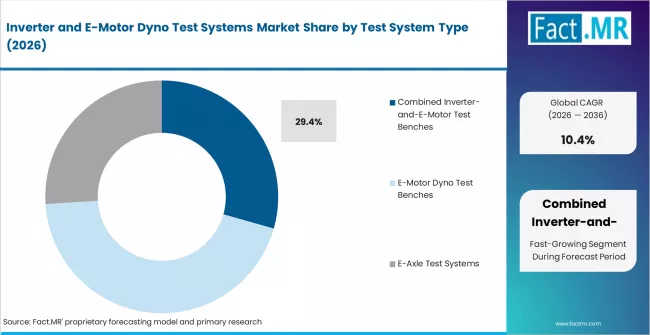
Inverter And E Motor Dyno Test Systems Market Analysis By Test System Type

Based on Fact.MR’s inverter and e-motor dyno test systems market report, combined inverter-and-e-motor test benches are estimated to hold 29.4% share in 2026. This segment leads because test programs increasingly need to evaluate motor and inverter interaction rather than treating each subsystem in isolation. HORIBA’s E-LAB is positioned around integrated testing across motors, batteries, inverters, and fuel cells, while its India facility describes a test bed that evaluates the motor together with the inverter in both motoring and absorption modes. This makes combined systems commercially stronger than single-purpose dynos in many advanced EV development environments.

  • AVL Inverter Test Expansion: AVL introduced a new inverter test system with full test coverage, including real-time e-motor emulation. This reduces the need for a physical motor during inverter validation and improves test flexibility across development stages.
  • HORIBA Integrated E-LAB: HORIBA continues to position E-LAB around integrated testing for motors, inverters, batteries, and fuel cells, supporting higher-value multi-domain validation.
  • Data Synchronization Trend: Supplier content increasingly emphasizes synchronized measurement across multiple domains, reflecting the market’s move toward integrated and information-rich dyno environments.

Inverter and E-Motor Dyno Test Systems Market Analysis by Application
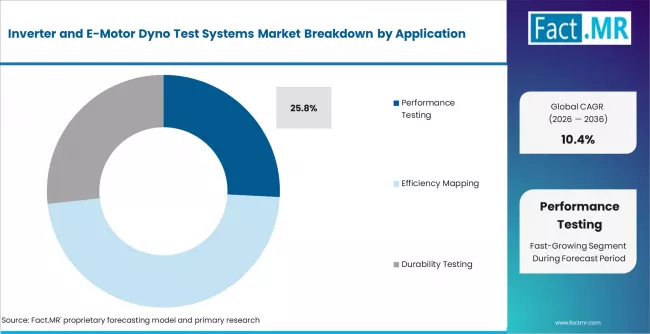
Inverter And E Motor Dyno Test Systems Market Analysis By Application

Based on Fact.MR’s inverter and e-motor dyno test systems market report, performance testing holds approximately 25.8% share in 2026. This segment leads because speed, torque, efficiency, and control behavior still form the core validation set for electric propulsion systems. AVL explicitly positions its e-motor testing around rapid and accurate evaluation of PMSM, ASM, and EESM systems, while its inverter testing solutions emphasize mapping and inverter-behavior analysis. Performance testing remains the commercial anchor because it is required across early development, benchmarking, validation, and production-support phases.

  • HORIBA High-Speed Motor Testing: HORIBA’s high-speed e-motor test equipment references show growing attention to motors operating at very high rpm under controlled thermal and vibration conditions.
  • Integrated Efficiency Mapping: Suppliers continue to position dyno systems around torque-speed-efficiency mapping as the first-line requirement for electric drive development.
  • Thermal and NVH Overlay: Performance testing increasingly overlaps with thermal validation and NVH assessment, especially in integrated development cells.

Drivers, Restraints, and Opportunities
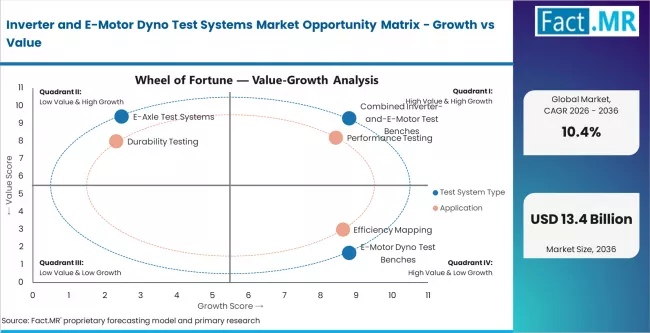
Inverter And E Motor Dyno Test Systems Market Opportunity Matrix Growth Vs Value

Fact.MR analysts observe that the inverter and e-motor dyno test systems market is strongly linked to EV propulsion growth and the increasing technical complexity of electric drive validation. Structural demand is anchored by continued growth in EV sales, expanding electric-drive portfolios, and the need for more precise integrated measurement across electrical, thermal, and NVH domains. The market’s size reflects the fact that test benches are now treated as strategic development infrastructure rather than optional lab assets.

A key restraint remains system complexity and cost. Higher-speed motors, inverter emulation, synchronized measurement, and thermal conditioning all raise integration burden and capital intensity. HORIBA’s materials on high-speed e-motor testing emphasize the challenge of testing up to high rotational speeds with low system vibration, while supplier content points to the growing need to combine multiple measurement domains on the same bench. This increases the technical threshold for both buyers and suppliers.

  • EV Growth: Rising electric vehicle production continues to expand demand for inverter and motor validation infrastructure.
  • Integrated Testing: Buyers increasingly want one bench to support electrical, NVH, thermal, and control-domain validation together.
  • Emulation Opportunity: Real-time e-motor emulation in inverter testing creates room for more flexible and efficient test workflows.

Regional Analysis

The inverter and e-motor dyno test systems market is assessed across Asia Pacific, North America, Europe, Latin America, and Middle East and Africa, covering 40+ countries with demand shaped by EV production scale, electric-drive development intensity, and investment in propulsion test infrastructure. The IEA’s 2025 outlook supports Asia Pacific as the strongest growth region, while North America and Europe remain high-value engineering markets.

Top Country Growth Comparison Inverter And E Motor Dyno Test Systems Market Cagr (2026 2036)

Country CAGR (2026 to 2036)
China 11.3%
India 10.8%
South Korea 10.2%
Germany 9.7%
United States 9.4%

Source: Fact.MR analysis, based on proprietary forecasting model and primary research.
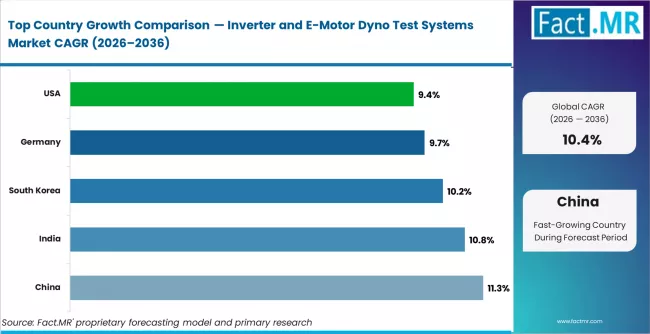
Inverter And E Motor Dyno Test Systems Market Cagr Analysis By Country

Asia Pacific Inverter and E-Motor Dyno Test Systems Market Analysis

Asia Pacific is the primary demand growth region. China, South Korea, Japan, and India anchor regional demand through EV production, battery and powertrain manufacturing, and broader electric-drive industrialization. China and South Korea together dominate much of the large-scale battery and EV manufacturing landscape, while India is gaining relevance as EV and electric-drive development capacity expands from a lower installed base. HORIBA’s India facility reference reinforces the country’s growing test-infrastructure relevance.

  • China: China continues to lead regional demand due to its dominant EV manufacturing base and dense supplier ecosystem. Growth remains strong as manufacturers invest in advanced dyno systems to validate performance, durability, and efficiency of electric-drive components. The market is projected to expand at an 11.3% CAGR, reflecting sustained demand for high-capacity and automated testing solutions integrated into both R&D and production workflows.
  • India: India is emerging as a fast-growing market as EV development and electric-drive manufacturing expand from a lower base. Increasing investment in test infrastructure is supporting the adoption of dyno systems across both OEM and supplier facilities. With demand expected to grow at a CAGR of 10.8%, the market reflects rising need for validation capabilities aligned with global standards. Growth is also supported by local initiatives to strengthen EV and component manufacturing ecosystems.
  • South Korea: South Korea contributes as a high-value market with advanced automotive electronics and strong export-oriented production. The country is expected to record growth near 10.2% CAGR, driven by continuous investment in high-performance testing systems that support next-generation electric-drive development.

Fact.MR’s analysis of Asia Pacific covers China, Japan, South Korea, India, ASEAN, Australia and New Zealand, and Rest of South Asia and Pacific. Includes EV production trends, supplier validation demand, and powertrain test-infrastructure investment.

North America Inverter and E-Motor Dyno Test Systems Market Analysis
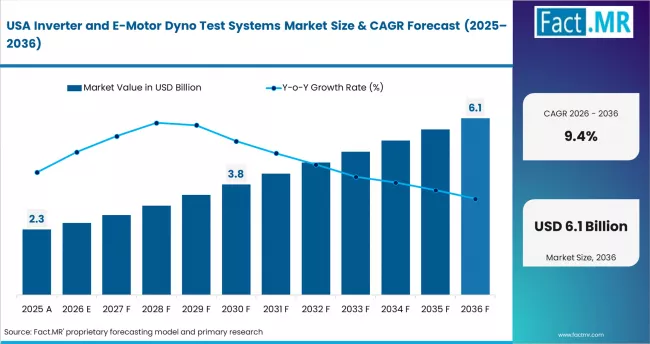
Inverter And E Motor Dyno Test Systems Market Country Value Analysis

North America is a high-value and expanding region. Demand is tied to EV development, domestic powertrain programs, and broader interest in software-defined propulsion validation. The United States remains the core market in this study because of its concentration of automotive development activity, test-lab infrastructure, and supplier investment in electric-drive validation. Vendor materials from AVL and HORIBA reinforce North America’s role as a major market for flexible test systems that can support R&D and validation in one environment.

  • United States: The United States remains the core demand center, supported by concentrated automotive R&D activity and investment in electric-drive validation. Demand is driven by the need for flexible dyno systems that can support both development and production testing within integrated environments. Growth is projected at a 9.4% CAGR, reflecting steady expansion in EV programs and validation requirements.

Fact.MR’s analysis covers the United States, Canada, and Mexico. Includes OEM validation trends, Tier 1 testing demand, and domestic EV development infrastructure.

Europe Inverter and E-Motor Dyno Test Systems Market Analysis
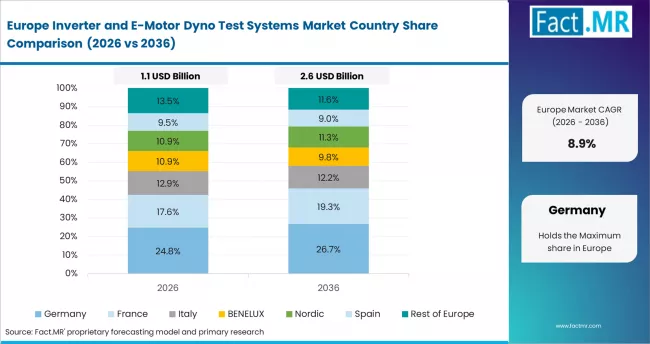
Inverter And E Motor Dyno Test Systems Market Europe Country Market Share Analysis, 2026 & 2036

Europe remains an engineering-intensive and quality-driven market. The region places strong emphasis on integrated test methodology, high-speed motor validation, and synchronized measurement across electrical and NVH domains. Germany leads in this study because of its automotive engineering base, supplier presence, and high-value investment in propulsion test capability. AVL’s European testing footprint and HORIBA’s mobility testing positioning both support Europe’s role as a major center for advanced electric-drive dyno systems.

  • Germany: Germany leads regional demand due to its strong automotive engineering base and significant investment in propulsion testing infrastructure. Manufacturers and suppliers are adopting advanced dyno systems to validate electric-drive performance and ensure compliance with stringent standards. The market is expected to grow at a 9.7% CAGR, reflecting sustained demand for high-performance testing environments.

Fact.MR’s analysis covers Germany, France, the United Kingdom, Italy, Spain, Nordic Countries, BENELUX, and Rest of Western Europe, along with Eastern European markets. Includes engineering-led test demand, supplier capability, and validation investment patterns.

Competitive Aligners for Market Players
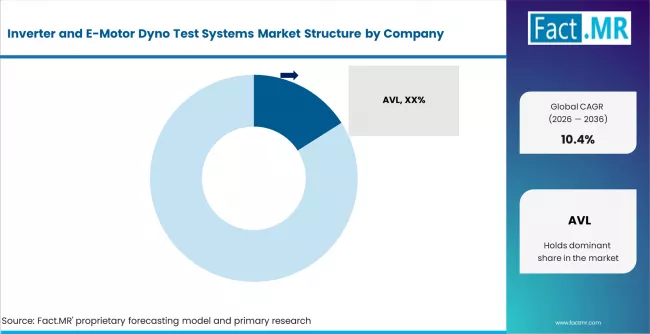
Inverter And E Motor Dyno Test Systems Market Analysis By Company

The inverter and e-motor dyno test systems market is moderately concentrated, with specialized test and automation providers controlling much of the higher-function end of the category. Key players include AVL, HORIBA, Siemens-linked ecosystems, and adjacent test-software and infrastructure providers. These companies benefit from integrated know-how across e-motor testing, inverter emulation, thermal conditioning, automation software, and synchronized data acquisition. AVL states that its broader testing technologies span the propulsion development process, while HORIBA highlights integrated electric drive testing under one platform.

Competitive advantage is defined by modularity, data integration, and the ability to support both standalone and combined electric-drive testing within one scalable platform. Buyers increasingly prefer vendors that can package dynamometer hardware, control software, synchronized measurement, and emulation capability into one test environment rather than stitching together multiple disconnected systems. That keeps the market tilted toward suppliers with proven electric-drive application depth rather than toward generic test-bench builders.

Key Players

  • HORIBA
  • Siemens
  • dSPACE
  • Burke Porter Group
  • Schenck RoTec
  • Kratzer Automation

Bibliography

  • [1] International Energy Agency (IEA). (2025). Global EV Outlook 2025. 2025. iea.org
  • [2] AVL. (2025). Inverter Testing Solutions for E-Mobility Applications. 2025. avl.com
  • [3] HORIBA. (2025). E-LAB: Integrated Testing Solutions for Motors, Batteries, Inverters, and Fuel Cells. 2025. horiba.com
  • [4] HORIBA India. (2025). Automotive Facility with E-Motor Test Bed for Motor Regulation, Performance, Endurance, and Inverter Testing. 2025. horiba.com
  • [5] Siemens. (2025). Electric Vehicle Test Bench Data Synchronization in NVH, Power, and High-Voltage Zones. 2025. siemens.com

Inverter and E-Motor Dyno Test Systems Market by Segments

  • By Test System Type:

    • E-Mtr Dyn Test Benches
    • Inverter Test Systems
    • Cmbined Inverter-and-E-Mtr Test Benches
    • E-Axle Test Systems
  • By Application:

    • Perfrmance Testing
    • Efficiency Mapping
    • Durability Testing
    • NVH Testing
    • Thermal Validatin
    • End-f-Line Validatin
  • By Region:

    • North America
      • United States
      • Canada
      • Mexic
    • Latin America
      • Brazil
      • Argentina
      • Chile
      • Rest f Latin America
    • Western Eurpe
      • Germany
      • France
      • United Kingdm
      • Italy
      • Spain
      • Nrdic Cuntries
      • BENELUX
      • Rest f Western Eurpe
    • Eastern Eurpe
      • Russia
      • Pland
      • Hungary
      • Balkan and Baltic
      • Rest f Eastern Eurpe
    • East Asia
      • China
      • Japan
      • Suth Krea
    • South Asia and Pacific
      • India
      • ASEAN
      • Australia and New Zealand
      • Rest f Suth Asia and Pacific
    • Middle East and Africa
      • Kingdm f Saudi Arabia
      • ther GCC Cuntries
      • Turkey
      • Suth Africa
      • Rest f Middle East and Africa

This Report Addresses

  • Strategic intelligence on inverter and e-motor dyno test demand across EV propulsion development, validation, and production-support workflows.
  • Market forecast from USD 4.58 billion in 2026 to USD 12.34 billion by 2036 at a CAGR of 10.4%.
  • Growth opportunity mapping across integrated e-drive benches, inverter emulation, high-speed motor testing, and synchronized multi-domain measurement.
  • Segment analysis by test system type, application, end use, powertrain type, and automation level.
  • Regional outlook covering Asia Pacific EV manufacturing scale, North American development demand, and Europe’s engineering-led test environment.
  • Competitive analysis of AVL, HORIBA, Siemens-linked ecosystems, and other electric-drive dyno system suppliers.
  • The role of EV growth, inverter behavior testing, and combined thermal-NVH-power validation in driving dyno demand.
  • Why the category is shifting from isolated motor or inverter benches toward integrated electric-drive test environments.

Inverter and E-Motor Dyno Test Systems Market Definition

The market covers dynamometer-based test systems used to evaluate electric motors, inverters, integrated e-drive units, and related propulsion subsystems under controlled laboratory or production-validation conditions. These systems are used for performance mapping, efficiency measurement, durability testing, thermal validation, inverter behavior analysis, and integrated drive-system development. AVL describes these as part of comprehensive e-motor and inverter testing solutions for electric drive systems. [2]

Inverter and E-Motor Dyno Test Systems Market Inclusions

Covers global and regional forecasts from 2026 to 2036. Includes dedicated e-motor dyno benches, inverter-only test rigs, e-motor emulation systems, integrated inverter-plus-motor test systems, thermal conditioning units, automation software, and data-synchronization platforms across automotive and industrial electric-drive validation workflows. AVL, HORIBA, and Siemens all position current solutions around these combined capabilities.

Inverter and E-Motor Dyno Test Systems Market Exclusions

Excludes generic laboratory power analyzers without dyno integration, battery cyclers not positioned for inverter or e-motor testing, and vehicle-level chassis dynamometers unless they are specifically configured for inverter, motor, or integrated e-drive validation. Focus remains on dedicated dyno-based electric propulsion test systems. This boundary is consistent with how current suppliers describe inverter and motor testing platforms.

Inverter and E-Motor Dyno Test Systems Market Research Methodology

  • Primary Research:Interviews with e-powertrain development engineers, dyno-cell managers, inverter-validation teams, Tier 1 propulsion specialists, and test-system integrators across major EV development regions.
  • Desk Research:Uses IEA EV outlook data, AVL testing materials, HORIBA electric-drive testing references, Siemens test-bench measurement content, and company product data from major dyno system suppliers in 2024 to 2025. [5]
  • Market-Sizing and Forecasting:Hybrid model using EV production growth, electric-drive development intensity, OEM and supplier dyno capex allocation, and integrated test-system pricing by application and automation level.
  • Data Validation and Update Cycle:Validated using supplier capability disclosures, electric-drive program expansion trends, and cross-checks against regional EV production and industrial test-infrastructure investment.

Scope of Report

Inverter And E Motor Dyno Test Systems Market Breakdown By Test System Type, Application, And Region

Attribute Details
Quantitative Units USD 4.5 billion (2026) to USD 12.3 billion (2036), at a CAGR of 10.4%
Market Definition Dyno-based test systems used for inverter, e-motor, and integrated electric-drive validation across performance, efficiency, durability, and NVH workflows
Test System Type Segmentation E-Motor Dyno Test Benches, Inverter Test Systems, Combined Inverter-and-E-Motor Test Benches, E-Axle Test Systems
Application Segmentation Performance Testing, Efficiency Mapping, Durability Testing, NVH Testing, Thermal Validation, End-of-Line Validation
End Use Segmentation Automotive OEMs, Tier 1 Suppliers, Independent Test Labs, Research Institutes, Industrial Drive Manufacturers
Powertrain Type Segmentation Passenger EV Powertrains, Commercial EV Powertrains, Hybrid Powertrains, Industrial Electric Drives
Automation Level Segmentation Manual-Assisted Systems, Semi-Automated Systems, Fully Automated Systems
Regions Covered Asia Pacific, North America, Europe, Latin America, Middle East and Africa
Countries Covered China, India, South Korea, Germany, United States, Japan, Brazil, and 40+ countries
Key Companies Profiled AVL, HORIBA, Siemens, dSPACE, Burke Porter Group, Schenck RoTec, Kratzer Automation
Forecast Period 2026 to 2036
Approach Hybrid top-down and bottom-up model using EV growth, electric-drive validation intensity, and integrated dyno-system value across hardware and software layers

- Frequently Asked Questions -

How large is the global inverter and e-motor dyno test systems market in 2025?

The global inverter and e-motor dyno test systems market was valued at USD 4.12 billion in 2025.

What will the market size be in 2026?

Based on Fact.MR analysis, demand for inverter and e-motor dyno test systems is estimated to grow to USD 4.58 billion in 2026.

What is the projected market size by 2036?

The market is projected to reach USD 12.34 billion by 2036, generating USD 7.76 billion in absolute dollar opportunity over the forecast period.

What is the expected CAGR from 2026 to 2036?

Fact.MR projects a CAGR of 10.4% for the global inverter and e-motor dyno test systems market during the 2026 to 2036 forecast period.

Which test system type segment is poised to lead the market?

Combined Inverter-and-E-Motor Test Benches lead with approximately 29.4% share in 2026, driven by rising demand for integrated electric-drive validation.

Which application segment holds the largest share?

Performance Testing leads with approximately 25.8% share in 2026, underpinned by the need to map torque, speed, and efficiency across electric drive programs.

Which country shows the fastest growth?

China leads at 11.3% CAGR through 2036, driven by EV manufacturing leadership and continued powertrain validation investment.

What is driving demand for inverter and e-motor dyno test systems?

Demand is driven by EV production growth, the need for integrated motor-plus-inverter validation, and stronger preference for flexible test benches that can combine performance, thermal, NVH, and emulation workflows in one environment.

What is the key challenge in this market?

The key challenge is managing higher test complexity without turning dyno systems into expensive or slow integration bottlenecks, since buyers increasingly need more synchronized data, higher-speed capability, and broader subsystem coverage from the same bench.

Table of Content

  1. Executive Summary
    • Global Market Outlook
    • Demand to side Trends
    • Supply to side Trends
    • Technology Roadmap Analysis
    • Analysis and Recommendations
  2. Market Overview
    • Market Coverage / Taxonomy
    • Market Definition / Scope / Limitations
  3. Research Methodology
    • Chapter Orientation
    • Analytical Lens and Working Hypotheses
      • Market Structure, Signals, and Trend Drivers
      • Benchmarking and Cross-market Comparability
      • Market Sizing, Forecasting, and Opportunity Mapping
    • Research Design and Evidence Framework
      • Desk Research Programme (Secondary Evidence)
        • Company Annual and Sustainability Reports
        • Peer-reviewed Journals and Academic Literature
        • Corporate Websites, Product Literature, and Technical Notes
        • Earnings Decks and Investor Briefings
        • Statutory Filings and Regulatory Disclosures
        • Technical White Papers and Standards Notes
        • Trade Journals, Industry Magazines, and Analyst Briefs
        • Conference Proceedings, Webinars, and Seminar Materials
        • Government Statistics Portals and Public Data Releases
        • Press Releases and Reputable Media Coverage
        • Specialist Newsletters and Curated Briefings
        • Sector Databases and Reference Repositories
        • Fact.MR Internal Proprietary Databases and Historical Market Datasets
        • Subscription Datasets and Paid Sources
        • Social Channels, Communities, and Digital Listening Inputs
        • Additional Desk Sources
      • Expert Input and Fieldwork (Primary Evidence)
        • Primary Modes
          • Qualitative Interviews and Expert Elicitation
          • Quantitative Surveys and Structured Data Capture
          • Blended Approach
        • Why Primary Evidence is Used
        • Field Techniques
          • Interviews
          • Surveys
          • Focus Groups
          • Observational and In-context Research
          • Social and Community Interactions
        • Stakeholder Universe Engaged
          • C-suite Leaders
          • Board Members
          • Presidents and Vice Presidents
          • R&D and Innovation Heads
          • Technical Specialists
          • Domain Subject-matter Experts
          • Scientists
          • Physicians and Other Healthcare Professionals
        • Governance, Ethics, and Data Stewardship
          • Research Ethics
          • Data Integrity and Handling
      • Tooling, Models, and Reference Databases
    • Data Engineering and Model Build
      • Data Acquisition and Ingestion
      • Cleaning, Normalisation, and Verification
      • Synthesis, Triangulation, and Analysis
    • Quality Assurance and Audit Trail
  4. Market Background
    • Market Dynamics
      • Drivers
      • Restraints
      • Opportunity
      • Trends
    • Scenario Forecast
      • Demand in Optimistic Scenario
      • Demand in Likely Scenario
      • Demand in Conservative Scenario
    • Opportunity Map Analysis
    • Product Life Cycle Analysis
    • Supply Chain Analysis
    • Investment Feasibility Matrix
    • Value Chain Analysis
    • PESTLE and Porter’s Analysis
    • Regulatory Landscape
    • Regional Parent Market Outlook
    • Production and Consumption Statistics
    • Import and Export Statistics
  5. Global Market Analysis 2021 to 2025 and Forecast, 2026 to 2036
    • Historical Market Size Value (USD Million) Analysis, 2021 to 2025
    • Current and Future Market Size Value (USD Million) Projections, 2026 to 2036
      • Y to o to Y Growth Trend Analysis
      • Absolute $ Opportunity Analysis
  6. Global Market Pricing Analysis 2021 to 2025 and Forecast 2026 to 2036
  7. Global Market Analysis 2021 to 2025 and Forecast 2026 to 2036, By Test Type
    • Introduction / Key Findings
    • Historical Market Size Value (USD Million) Analysis By Test Type , 2021 to 2025
    • Current and Future Market Size Value (USD Million) Analysis and Forecast By Test Type , 2026 to 2036
      • Electrical Safety Testing
      • Functional Testing
      • Leak Testing
    • Y to o to Y Growth Trend Analysis By Test Type , 2021 to 2025
    • Absolute $ Opportunity Analysis By Test Type , 2026 to 2036
  8. Global Market Analysis 2021 to 2025 and Forecast 2026 to 2036, By Battery Type
    • Introduction / Key Findings
    • Historical Market Size Value (USD Million) Analysis By Battery Type, 2021 to 2025
    • Current and Future Market Size Value (USD Million) Analysis and Forecast By Battery Type, 2026 to 2036
      • Lithium-ion NMC Packs
      • LFP Packs
      • Hybrid Battery Packs
    • Y to o to Y Growth Trend Analysis By Battery Type, 2021 to 2025
    • Absolute $ Opportunity Analysis By Battery Type, 2026 to 2036
  9. Global Market Analysis 2021 to 2025 and Forecast 2026 to 2036, By Automation Level
    • Introduction / Key Findings
    • Historical Market Size Value (USD Million) Analysis By Automation Level, 2021 to 2025
    • Current and Future Market Size Value (USD Million) Analysis and Forecast By Automation Level, 2026 to 2036
      • Fully Automated Benches
      • Manual-Assisted Benches
      • Semi-Automated Benches
    • Y to o to Y Growth Trend Analysis By Automation Level, 2021 to 2025
    • Absolute $ Opportunity Analysis By Automation Level, 2026 to 2036
  10. Global Market Analysis 2021 to 2025 and Forecast 2026 to 2036, By Region
    • Introduction
    • Historical Market Size Value (USD Million) Analysis By Region, 2021 to 2025
    • Current Market Size Value (USD Million) Analysis and Forecast By Region, 2026 to 2036
      • North America
      • Latin America
      • Western Europe
      • Eastern Europe
      • East Asia
      • South Asia and Pacific
      • Middle East & Africa
    • Market Attractiveness Analysis By Region
  11. North America Market Analysis 2021 to 2025 and Forecast 2026 to 2036, By Country
    • Historical Market Size Value (USD Million) Trend Analysis By Market Taxonomy, 2021 to 2025
    • Market Size Value (USD Million) Forecast By Market Taxonomy, 2026 to 2036
      • By Country
        • USA
        • Canada
        • Mexico
      • By Test Type
      • By Battery Type
      • By Automation Level
    • Market Attractiveness Analysis
      • By Country
      • By Test Type
      • By Battery Type
      • By Automation Level
    • Key Takeaways
  12. Latin America Market Analysis 2021 to 2025 and Forecast 2026 to 2036, By Country
    • Historical Market Size Value (USD Million) Trend Analysis By Market Taxonomy, 2021 to 2025
    • Market Size Value (USD Million) Forecast By Market Taxonomy, 2026 to 2036
      • By Country
        • Brazil
        • Chile
        • Rest of Latin America
      • By Test Type
      • By Battery Type
      • By Automation Level
    • Market Attractiveness Analysis
      • By Country
      • By Test Type
      • By Battery Type
      • By Automation Level
    • Key Takeaways
  13. Western Europe Market Analysis 2021 to 2025 and Forecast 2026 to 2036, By Country
    • Historical Market Size Value (USD Million) Trend Analysis By Market Taxonomy, 2021 to 2025
    • Market Size Value (USD Million) Forecast By Market Taxonomy, 2026 to 2036
      • By Country
        • Germany
        • UK
        • Italy
        • Spain
        • France
        • Nordic
        • BENELUX
        • Rest of Western Europe
      • By Test Type
      • By Battery Type
      • By Automation Level
    • Market Attractiveness Analysis
      • By Country
      • By Test Type
      • By Battery Type
      • By Automation Level
    • Key Takeaways
  14. Eastern Europe Market Analysis 2021 to 2025 and Forecast 2026 to 2036, By Country
    • Historical Market Size Value (USD Million) Trend Analysis By Market Taxonomy, 2021 to 2025
    • Market Size Value (USD Million) Forecast By Market Taxonomy, 2026 to 2036
      • By Country
        • Russia
        • Poland
        • Hungary
        • Balkan & Baltic
        • Rest of Eastern Europe
      • By Test Type
      • By Battery Type
      • By Automation Level
    • Market Attractiveness Analysis
      • By Country
      • By Test Type
      • By Battery Type
      • By Automation Level
    • Key Takeaways
  15. East Asia Market Analysis 2021 to 2025 and Forecast 2026 to 2036, By Country
    • Historical Market Size Value (USD Million) Trend Analysis By Market Taxonomy, 2021 to 2025
    • Market Size Value (USD Million) Forecast By Market Taxonomy, 2026 to 2036
      • By Country
        • China
        • Japan
        • South Korea
      • By Test Type
      • By Battery Type
      • By Automation Level
    • Market Attractiveness Analysis
      • By Country
      • By Test Type
      • By Battery Type
      • By Automation Level
    • Key Takeaways
  16. South Asia and Pacific Market Analysis 2021 to 2025 and Forecast 2026 to 2036, By Country
    • Historical Market Size Value (USD Million) Trend Analysis By Market Taxonomy, 2021 to 2025
    • Market Size Value (USD Million) Forecast By Market Taxonomy, 2026 to 2036
      • By Country
        • India
        • ASEAN
        • Australia & New Zealand
        • Rest of South Asia and Pacific
      • By Test Type
      • By Battery Type
      • By Automation Level
    • Market Attractiveness Analysis
      • By Country
      • By Test Type
      • By Battery Type
      • By Automation Level
    • Key Takeaways
  17. Middle East & Africa Market Analysis 2021 to 2025 and Forecast 2026 to 2036, By Country
    • Historical Market Size Value (USD Million) Trend Analysis By Market Taxonomy, 2021 to 2025
    • Market Size Value (USD Million) Forecast By Market Taxonomy, 2026 to 2036
      • By Country
        • Kingdom of Saudi Arabia
        • Other GCC Countries
        • Turkiye
        • South Africa
        • Other African Union
        • Rest of Middle East & Africa
      • By Test Type
      • By Battery Type
      • By Automation Level
    • Market Attractiveness Analysis
      • By Country
      • By Test Type
      • By Battery Type
      • By Automation Level
    • Key Takeaways
  18. Key Countries Market Analysis
    • USA
      • Pricing Analysis
      • Market Share Analysis, 2025
        • By Test Type
        • By Battery Type
        • By Automation Level
    • Canada
      • Pricing Analysis
      • Market Share Analysis, 2025
        • By Test Type
        • By Battery Type
        • By Automation Level
    • Mexico
      • Pricing Analysis
      • Market Share Analysis, 2025
        • By Test Type
        • By Battery Type
        • By Automation Level
    • Brazil
      • Pricing Analysis
      • Market Share Analysis, 2025
        • By Test Type
        • By Battery Type
        • By Automation Level
    • Chile
      • Pricing Analysis
      • Market Share Analysis, 2025
        • By Test Type
        • By Battery Type
        • By Automation Level
    • Germany
      • Pricing Analysis
      • Market Share Analysis, 2025
        • By Test Type
        • By Battery Type
        • By Automation Level
    • UK
      • Pricing Analysis
      • Market Share Analysis, 2025
        • By Test Type
        • By Battery Type
        • By Automation Level
    • Italy
      • Pricing Analysis
      • Market Share Analysis, 2025
        • By Test Type
        • By Battery Type
        • By Automation Level
    • Spain
      • Pricing Analysis
      • Market Share Analysis, 2025
        • By Test Type
        • By Battery Type
        • By Automation Level
    • France
      • Pricing Analysis
      • Market Share Analysis, 2025
        • By Test Type
        • By Battery Type
        • By Automation Level
    • India
      • Pricing Analysis
      • Market Share Analysis, 2025
        • By Test Type
        • By Battery Type
        • By Automation Level
    • ASEAN
      • Pricing Analysis
      • Market Share Analysis, 2025
        • By Test Type
        • By Battery Type
        • By Automation Level
    • Australia & New Zealand
      • Pricing Analysis
      • Market Share Analysis, 2025
        • By Test Type
        • By Battery Type
        • By Automation Level
    • China
      • Pricing Analysis
      • Market Share Analysis, 2025
        • By Test Type
        • By Battery Type
        • By Automation Level
    • Japan
      • Pricing Analysis
      • Market Share Analysis, 2025
        • By Test Type
        • By Battery Type
        • By Automation Level
    • South Korea
      • Pricing Analysis
      • Market Share Analysis, 2025
        • By Test Type
        • By Battery Type
        • By Automation Level
    • Russia
      • Pricing Analysis
      • Market Share Analysis, 2025
        • By Test Type
        • By Battery Type
        • By Automation Level
    • Poland
      • Pricing Analysis
      • Market Share Analysis, 2025
        • By Test Type
        • By Battery Type
        • By Automation Level
    • Hungary
      • Pricing Analysis
      • Market Share Analysis, 2025
        • By Test Type
        • By Battery Type
        • By Automation Level
    • Kingdom of Saudi Arabia
      • Pricing Analysis
      • Market Share Analysis, 2025
        • By Test Type
        • By Battery Type
        • By Automation Level
    • Turkiye
      • Pricing Analysis
      • Market Share Analysis, 2025
        • By Test Type
        • By Battery Type
        • By Automation Level
    • South Africa
      • Pricing Analysis
      • Market Share Analysis, 2025
        • By Test Type
        • By Battery Type
        • By Automation Level
  19. Market Structure Analysis
    • Competition Dashboard
    • Competition Benchmarking
    • Market Share Analysis of Top Players
      • By Regional
      • By Test Type
      • By Battery Type
      • By Automation Level
  20. Competition Analysis
    • Competition Deep Dive
      • Keysight Technologies
        • Overview
        • Product Portfolio
        • Profitability by Market Segments (Product/Age /Sales Channel/Region)
        • Sales Footprint
        • Strategy Overview
          • Marketing Strategy
          • Product Strategy
          • Channel Strategy
      • FFT Produktionssysteme
      • Digatron
      • Festo
      • Asterisco Tech
      • Unico
      • CustoM
  21. Assumptions & Acronyms Used

List Of Table

  • Table 1: Global Market Value (USD Million) Forecast by Region, 2021 to 2036
  • Table 2: Global Market Value (USD Million) Forecast by Test Type, 2021 to 2036
  • Table 3: Global Market Value (USD Million) Forecast by Battery Type, 2021 to 2036
  • Table 4: Global Market Value (USD Million) Forecast by Automation Level, 2021 to 2036
  • Table 5: North America Market Value (USD Million) Forecast by Country, 2021 to 2036
  • Table 6: North America Market Value (USD Million) Forecast by Test Type, 2021 to 2036
  • Table 7: North America Market Value (USD Million) Forecast by Battery Type, 2021 to 2036
  • Table 8: North America Market Value (USD Million) Forecast by Automation Level, 2021 to 2036
  • Table 9: Latin America Market Value (USD Million) Forecast by Country, 2021 to 2036
  • Table 10: Latin America Market Value (USD Million) Forecast by Test Type, 2021 to 2036
  • Table 11: Latin America Market Value (USD Million) Forecast by Battery Type, 2021 to 2036
  • Table 12: Latin America Market Value (USD Million) Forecast by Automation Level, 2021 to 2036
  • Table 13: Western Europe Market Value (USD Million) Forecast by Country, 2021 to 2036
  • Table 14: Western Europe Market Value (USD Million) Forecast by Test Type, 2021 to 2036
  • Table 15: Western Europe Market Value (USD Million) Forecast by Battery Type, 2021 to 2036
  • Table 16: Western Europe Market Value (USD Million) Forecast by Automation Level, 2021 to 2036
  • Table 17: Eastern Europe Market Value (USD Million) Forecast by Country, 2021 to 2036
  • Table 18: Eastern Europe Market Value (USD Million) Forecast by Test Type, 2021 to 2036
  • Table 19: Eastern Europe Market Value (USD Million) Forecast by Battery Type, 2021 to 2036
  • Table 20: Eastern Europe Market Value (USD Million) Forecast by Automation Level, 2021 to 2036
  • Table 21: East Asia Market Value (USD Million) Forecast by Country, 2021 to 2036
  • Table 22: East Asia Market Value (USD Million) Forecast by Test Type, 2021 to 2036
  • Table 23: East Asia Market Value (USD Million) Forecast by Battery Type, 2021 to 2036
  • Table 24: East Asia Market Value (USD Million) Forecast by Automation Level, 2021 to 2036
  • Table 25: South Asia and Pacific Market Value (USD Million) Forecast by Country, 2021 to 2036
  • Table 26: South Asia and Pacific Market Value (USD Million) Forecast by Test Type, 2021 to 2036
  • Table 27: South Asia and Pacific Market Value (USD Million) Forecast by Battery Type, 2021 to 2036
  • Table 28: South Asia and Pacific Market Value (USD Million) Forecast by Automation Level, 2021 to 2036
  • Table 29: Middle East & Africa Market Value (USD Million) Forecast by Country, 2021 to 2036
  • Table 30: Middle East & Africa Market Value (USD Million) Forecast by Test Type, 2021 to 2036
  • Table 31: Middle East & Africa Market Value (USD Million) Forecast by Battery Type, 2021 to 2036
  • Table 32: Middle East & Africa Market Value (USD Million) Forecast by Automation Level, 2021 to 2036

List Of Figures

  • Figure 1: Global Market Pricing Analysis
  • Figure 2: Global Market Value (USD Million) Forecast 2021-2036
  • Figure 3: Global Market Value Share and BPS Analysis by Test Type, 2026 and 2036
  • Figure 4: Global Market Y-o-Y Growth Comparison by Test Type, 2026 to 2036
  • Figure 5: Global Market Attractiveness Analysis by Test Type
  • Figure 6: Global Market Value Share and BPS Analysis by Battery Type, 2026 and 2036
  • Figure 7: Global Market Y-o-Y Growth Comparison by Battery Type, 2026 to 2036
  • Figure 8: Global Market Attractiveness Analysis by Battery Type
  • Figure 9: Global Market Value Share and BPS Analysis by Automation Level, 2026 and 2036
  • Figure 10: Global Market Y-o-Y Growth Comparison by Automation Level, 2026 to 2036
  • Figure 11: Global Market Attractiveness Analysis by Automation Level
  • Figure 12: Global Market Value (USD Million) Share and BPS Analysis by Region, 2026 and 2036
  • Figure 13: Global Market Y-o-Y Growth Comparison by Region, 2026 to 2036
  • Figure 14: Global Market Attractiveness Analysis by Region
  • Figure 15: North America Market Incremental Dollar Opportunity, 2026 to 2036
  • Figure 16: Latin America Market Incremental Dollar Opportunity, 2026 to 2036
  • Figure 17: Western Europe Market Incremental Dollar Opportunity, 2026 to 2036
  • Figure 18: Eastern Europe Market Incremental Dollar Opportunity, 2026 to 2036
  • Figure 19: East Asia Market Incremental Dollar Opportunity, 2026 to 2036
  • Figure 20: South Asia and Pacific Market Incremental Dollar Opportunity, 2026 to 2036
  • Figure 21: Middle East & Africa Market Incremental Dollar Opportunity, 2026 to 2036
  • Figure 22: North America Market Value Share and BPS Analysis by Country, 2026 and 2036
  • Figure 23: North America Market Value Share and BPS Analysis by Test Type, 2026 and 2036
  • Figure 24: North America Market Y-o-Y Growth Comparison by Test Type, 2026 to 2036
  • Figure 25: North America Market Attractiveness Analysis by Test Type
  • Figure 26: North America Market Value Share and BPS Analysis by Battery Type, 2026 and 2036
  • Figure 27: North America Market Y-o-Y Growth Comparison by Battery Type, 2026 to 2036
  • Figure 28: North America Market Attractiveness Analysis by Battery Type
  • Figure 29: North America Market Value Share and BPS Analysis by Automation Level, 2026 and 2036
  • Figure 30: North America Market Y-o-Y Growth Comparison by Automation Level, 2026 to 2036
  • Figure 31: North America Market Attractiveness Analysis by Automation Level
  • Figure 32: Latin America Market Value Share and BPS Analysis by Country, 2026 and 2036
  • Figure 33: Latin America Market Value Share and BPS Analysis by Test Type, 2026 and 2036
  • Figure 34: Latin America Market Y-o-Y Growth Comparison by Test Type, 2026 to 2036
  • Figure 35: Latin America Market Attractiveness Analysis by Test Type
  • Figure 36: Latin America Market Value Share and BPS Analysis by Battery Type, 2026 and 2036
  • Figure 37: Latin America Market Y-o-Y Growth Comparison by Battery Type, 2026 to 2036
  • Figure 38: Latin America Market Attractiveness Analysis by Battery Type
  • Figure 39: Latin America Market Value Share and BPS Analysis by Automation Level, 2026 and 2036
  • Figure 40: Latin America Market Y-o-Y Growth Comparison by Automation Level, 2026 to 2036
  • Figure 41: Latin America Market Attractiveness Analysis by Automation Level
  • Figure 42: Western Europe Market Value Share and BPS Analysis by Country, 2026 and 2036
  • Figure 43: Western Europe Market Value Share and BPS Analysis by Test Type, 2026 and 2036
  • Figure 44: Western Europe Market Y-o-Y Growth Comparison by Test Type, 2026 to 2036
  • Figure 45: Western Europe Market Attractiveness Analysis by Test Type
  • Figure 46: Western Europe Market Value Share and BPS Analysis by Battery Type, 2026 and 2036
  • Figure 47: Western Europe Market Y-o-Y Growth Comparison by Battery Type, 2026 to 2036
  • Figure 48: Western Europe Market Attractiveness Analysis by Battery Type
  • Figure 49: Western Europe Market Value Share and BPS Analysis by Automation Level, 2026 and 2036
  • Figure 50: Western Europe Market Y-o-Y Growth Comparison by Automation Level, 2026 to 2036
  • Figure 51: Western Europe Market Attractiveness Analysis by Automation Level
  • Figure 52: Eastern Europe Market Value Share and BPS Analysis by Country, 2026 and 2036
  • Figure 53: Eastern Europe Market Value Share and BPS Analysis by Test Type, 2026 and 2036
  • Figure 54: Eastern Europe Market Y-o-Y Growth Comparison by Test Type, 2026 to 2036
  • Figure 55: Eastern Europe Market Attractiveness Analysis by Test Type
  • Figure 56: Eastern Europe Market Value Share and BPS Analysis by Battery Type, 2026 and 2036
  • Figure 57: Eastern Europe Market Y-o-Y Growth Comparison by Battery Type, 2026 to 2036
  • Figure 58: Eastern Europe Market Attractiveness Analysis by Battery Type
  • Figure 59: Eastern Europe Market Value Share and BPS Analysis by Automation Level, 2026 and 2036
  • Figure 60: Eastern Europe Market Y-o-Y Growth Comparison by Automation Level, 2026 to 2036
  • Figure 61: Eastern Europe Market Attractiveness Analysis by Automation Level
  • Figure 62: East Asia Market Value Share and BPS Analysis by Country, 2026 and 2036
  • Figure 63: East Asia Market Value Share and BPS Analysis by Test Type, 2026 and 2036
  • Figure 64: East Asia Market Y-o-Y Growth Comparison by Test Type, 2026 to 2036
  • Figure 65: East Asia Market Attractiveness Analysis by Test Type
  • Figure 66: East Asia Market Value Share and BPS Analysis by Battery Type, 2026 and 2036
  • Figure 67: East Asia Market Y-o-Y Growth Comparison by Battery Type, 2026 to 2036
  • Figure 68: East Asia Market Attractiveness Analysis by Battery Type
  • Figure 69: East Asia Market Value Share and BPS Analysis by Automation Level, 2026 and 2036
  • Figure 70: East Asia Market Y-o-Y Growth Comparison by Automation Level, 2026 to 2036
  • Figure 71: East Asia Market Attractiveness Analysis by Automation Level
  • Figure 72: South Asia and Pacific Market Value Share and BPS Analysis by Country, 2026 and 2036
  • Figure 73: South Asia and Pacific Market Value Share and BPS Analysis by Test Type, 2026 and 2036
  • Figure 74: South Asia and Pacific Market Y-o-Y Growth Comparison by Test Type, 2026 to 2036
  • Figure 75: South Asia and Pacific Market Attractiveness Analysis by Test Type
  • Figure 76: South Asia and Pacific Market Value Share and BPS Analysis by Battery Type, 2026 and 2036
  • Figure 77: South Asia and Pacific Market Y-o-Y Growth Comparison by Battery Type, 2026 to 2036
  • Figure 78: South Asia and Pacific Market Attractiveness Analysis by Battery Type
  • Figure 79: South Asia and Pacific Market Value Share and BPS Analysis by Automation Level, 2026 and 2036
  • Figure 80: South Asia and Pacific Market Y-o-Y Growth Comparison by Automation Level, 2026 to 2036
  • Figure 81: South Asia and Pacific Market Attractiveness Analysis by Automation Level
  • Figure 82: Middle East & Africa Market Value Share and BPS Analysis by Country, 2026 and 2036
  • Figure 83: Middle East & Africa Market Value Share and BPS Analysis by Test Type, 2026 and 2036
  • Figure 84: Middle East & Africa Market Y-o-Y Growth Comparison by Test Type, 2026 to 2036
  • Figure 85: Middle East & Africa Market Attractiveness Analysis by Test Type
  • Figure 86: Middle East & Africa Market Value Share and BPS Analysis by Battery Type, 2026 and 2036
  • Figure 87: Middle East & Africa Market Y-o-Y Growth Comparison by Battery Type, 2026 to 2036
  • Figure 88: Middle East & Africa Market Attractiveness Analysis by Battery Type
  • Figure 89: Middle East & Africa Market Value Share and BPS Analysis by Automation Level, 2026 and 2036
  • Figure 90: Middle East & Africa Market Y-o-Y Growth Comparison by Automation Level, 2026 to 2036
  • Figure 91: Middle East & Africa Market Attractiveness Analysis by Automation Level
  • Figure 92: Global Market - Tier Structure Analysis
  • Figure 93: Global Market - Company Share Analysis

Inverter and E-Motor Dyno Test Systems Market