- Market Value (2025): USD 3.4 Bn
- Estimated Value (2026): USD 3.8 Bn
- Forecast Value (2036): USD 12.7 Bn
- CAGR (2026-2036): 12.7%
What is the Edge Distribution Units Market forecast to be worth by 2036?
USD 3.8 billion in 2026 to USD 12.7 billion by 2036 at a 12.7% CAGR.
- The Edge Distribution Units Market reached USD 3.4 billion in 2025.
- Demand is projected to increase from USD 3.8 billion in 2026 to USD 12.7 billion by 2036.
- The market is forecast to record 12.7% CAGR from 2026 to 2036 as 5G coverage, branch-level AI and micro data-center standardization increase the number of remote sites that require monitored, controllable power.
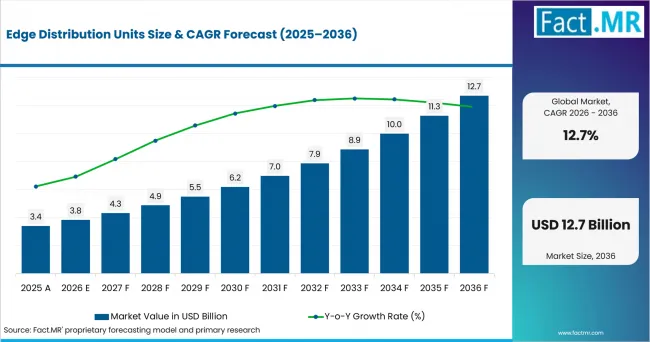
Edge Distribution Units Value Analysis | Source: Fact.MR
What are the defining numbers behind Edge Distribution Units Market growth?
An absolute opportunity of USD 8.9 billion is expected between 2026 and 2036.
- Demand Drivers in the Market
- Distributed applications need local processing with data-center-grade power visibility. The European Commission's Edge Observatory tracks a policy objective of 10,000 climate-neutral and secure edge nodes by 2030.
- Broadband and 5G programs are widening the number of viable edge locations. The U.S. BEAD program provides USD 42.45 billion for high-speed internet infrastructure and adoption.
- Remote sites need fewer truck rolls. Eaton's edge guidance highlights individual outlet switching as a way to reboot faulty devices without sending staff to the location.
- Key Segments Analyzed
- Edge rack PDU represents 31.0% of Unit Type demand in 2026. Edge rack PDUs lead because most distributed compute still terminates in one or a few conventional racks.
- The 10-30 kW band accounts for 32.0% of Power Range demand in 2026. The 10-30 kW range covers the practical center of branch and industrial edge installations.
- Retail and branch edge contributes 29.0% to the 2026 Deployment Site mix. Retail and branch edge leads through the sheer number of dispersed locations.
- Metered holds 25.0% of the Intelligence mix in 2026. Metered units hold the largest share because current and energy visibility provide an immediate operational benefit without the security review and control complexity of remotely switched outlets.
- Analyst Opinion at Fact.MR
- Shambhu Nath Jha, Principal Consultant at Fact.MR, states, “The edge power decision is won at the site level but managed as a fleet. Buyers want a unit that an electrician can install quickly and a remote team can diagnose later. Vendors that combine outlet telemetry, secure switching and consistent device management across hundreds of small locations have a stronger commercial case than suppliers selling an isolated strip.”
- Strategic Implications
- PDU vendors should design fleet management around exceptions, so central operators see overload risk and failed outlets without reviewing every site. Vertiv notes that intelligent PDUs can report energy use in real time and support capacity changes.
- Micro data-center suppliers should pre-integrate power, cooling, security and management. Schneider Electric positions its EcoStruxure Micro Data Center as a single enclosure for commercial and industrial edge settings.
- Channel partners should treat remote reboot and access control as service-saving features. Eaton's edge guidance links outlet switching and secure management with fewer trips to distributed locations.
Singapore's 16.0% CAGR through 2036 is supported by compact 5G-enabled services that create high-value edge sites. The USA reaches 15.4% through its much wider branch and broadband footprint, while France records 13.1% on industrial and public infrastructure programs. Germany is projected at 12.0% through factory edge deployments and the UK at 10.2% as distributed estates modernize gradually.
How does the Edge Distribution Units Market break down by segment?
Energy and load forecasting, Commercial offices, BMS and HVAC telemetry, and Predictive ML
Which Unit Type dominates?
Edge rack PDU: 31.0% share in 2026.
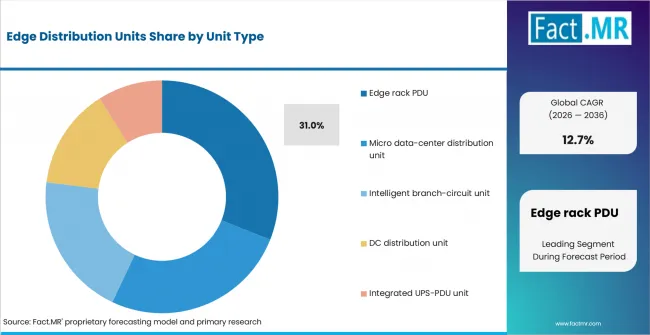
Edge Distribution Units Analysis By Unit Type | Source: Fact.MR
Edge rack PDUs lead because most distributed compute still terminates in one or a few conventional racks. Operators can standardize receptacles, metering and network management without specifying a custom branch board for every location.
Why is 10-30 kW the leading Power Range?
10-30 kW: 32.0% share in 2026.
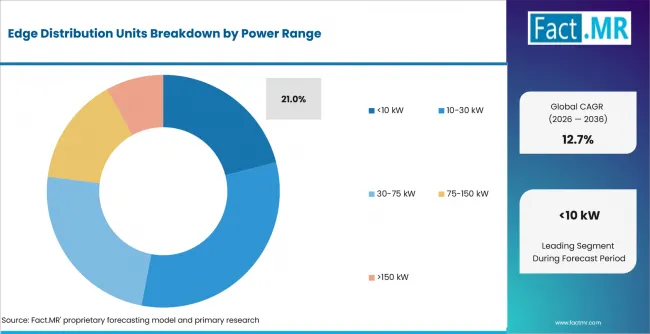
Edge Distribution Units Analysis By Power Range | Source: Fact.MR
The 10-30 kW range covers the practical center of branch and industrial edge installations. It supports several servers, network equipment and local storage while remaining compatible with common room power and compact UPS configurations.
Which Deployment Site creates the most unit demand?
Retail and branch edge: 29.0% share in 2026.
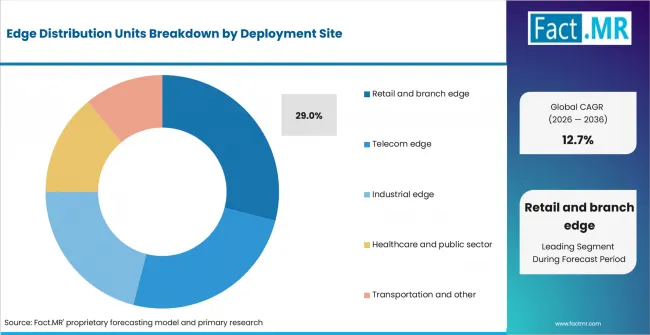
Edge Distribution Units Analysis By Deployment Site | Source: Fact.MR
Retail and branch edge leads through the sheer number of dispersed locations. Payment, video, inventory and customer applications need local uptime, but each site has limited space and little specialist support.
What supports Metered units within Intelligence?
Metered: 25.0% share in 2026.
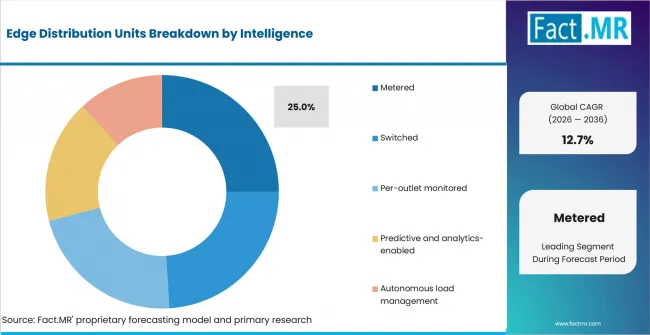
Edge Distribution Units Analysis By Intelligence | Source: Fact.MR
Metered units hold the largest share because current and energy visibility provide an immediate operational benefit without the security review and control complexity of remotely switched outlets. They are often the first step in replacing unmanaged strips.
What is accelerating Edge Distribution Units Market adoption, and what is holding it back?
Adoption is moving from unmanaged branch power to metered and remotely controlled units as edge estates become operationally important. Cybersecurity review, inconsistent site wiring and the economics of servicing many low-value locations remain the main brakes.
Drivers Impact Analysis
|
DRIVER |
(~) % IMPACT ON CAGR | GEOGRAPHIC RELEVANCE | IMPACT TIMELINE |
|---|---|---|---|
| 5G and low-latency applications | +1.8% | Singapore, USA, France, Germany | Short term (<= 2 years) |
| Fleet-wide remote power management | +1.3% | Global | Medium term (2-4 years) |
| Micro data-center standardization | +1.0% | North America, Europe, Asia | Medium term (2-4 years) |
| Branch AI and video workloads | +0.7% | USA, UK, Singapore | Long term (>= 4 years) |
- 5G and low-latency applications: Local processing creates additional powered racks at telecom, healthcare, transport and industrial sites.
- Fleet-wide remote power management: Metering, alarms and outlet control let a small operations team supervise many unmanned rooms.
- Micro data-center standardization: Pre-engineered enclosures turn power distribution into a repeatable specification across site types.
Opportunity Impact Analysis
| OPPORTUNITY | (~) % IMPACT ON CAGR | GEOGRAPHIC RELEVANCE | IMPACT TIMELINE |
|---|---|---|---|
| Secure per-outlet switching | +1.0% | USA, Europe | Short term (<= 2 years) |
| Integrated UPS-PDU edge enclosures | +0.8% | Global | Medium term (2-4 years) |
| Autonomous load shedding | +0.6% | Telecom and industrial sites | Long term (>= 4 years) |
- Secure per-outlet switching: Remote reboot and controlled sequencing can avoid service visits when an application appliance stops responding.
- Integrated UPS-PDU edge enclosures: Factory-validated power paths simplify procurement for customers rolling out the same site pattern many times.
- Autonomous load shedding: Units can preserve the highest-priority compute during a limited-runtime event if policies are tested and locally executable.
Restraints Impact Analysis
| RESTRAINT | (~) % IMPACT ON CAGR | GEOGRAPHIC RELEVANCE | IMPACT TIMELINE |
|---|---|---|---|
| Inconsistent branch wiring and site conditions | -0.8% | Global | Short term (<= 2 years) |
| Cybersecurity review for switched outlets | -0.6% | Public sector, healthcare, industry | Medium term (2-4 years) |
| Low contract value per remote site | -0.5% | Retail and branch estates | Long term (>= 4 years) |
- Inconsistent branch wiring and site conditions: Voltage, grounding, heat and cabinet depth vary across legacy sites, limiting one-size deployment kits.
- Cybersecurity review for switched outlets: A network-accessible power control becomes an operational endpoint that needs identity, logging and patch procedures.
- Low contract value per remote site: Sales and installation costs can overwhelm equipment value unless suppliers aggregate locations into a fleet program
Which countries are scaling the Edge Distribution Units Market through 2036?
- Singapore offers a compact proving ground where healthcare, port and commercial edge services can share mature national connectivity.
- The USA creates the largest site-count opportunity, making device fleet management and channel coverage decisive.
- France links edge hardware to public and industrial digital programs, favoring integrators that can navigate sector requirements.
- Germany emphasizes ruggedness, predictable maintenance and compatibility with factory networks.
- The UK grows through brownfield replacement across small rooms, where installation simplicity carries more weight than maximum power density.
Site counts, technician coverage, connectivity quality and brownfield electrical conditions explain much of the country-to-country variation. The report also covers North America, Latin America, Western Europe, Eastern Europe, East Asia, South Asia & Pacific, Middle East & Africa.
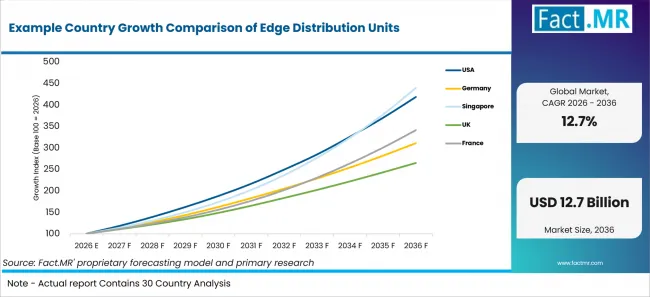
Example Country Growth Comparison Of Edge Distribution Units | Source: Fact.MR
| Country | CAGR (2026-2036) |
|---|---|
| USA | 15.4% |
| Germany | 12.0% |
| Singapore | 16.0% |
| UK | 10.2% |
| France | 13.1% |
What gives the USA market its reach?
15.4% CAGR, supported by distributed broadband, retail and industrial compute.
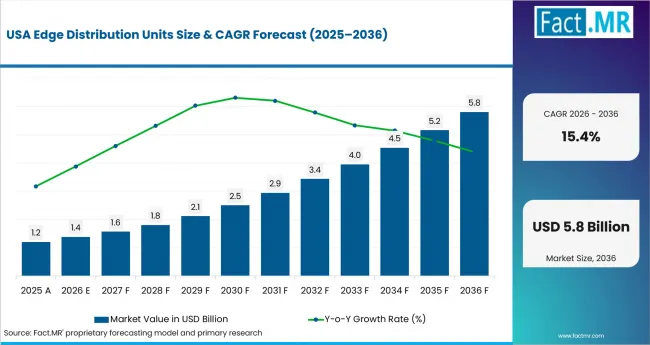
Edge Distribution Units Country Value Analysis | Source: Fact.MR
The USA has a wide edge footprint because latency-sensitive applications are spread across stores, factories, clinics and network sites rather than concentrated in one campus. NTIA's USD 42.45 billion BEAD program supports broadband infrastructure that expands the addressable locations for local compute. Distribution-unit demand follows standardized enclosures where remote reboot, circuit telemetry and secure access can reduce field visits.
How does Germany turn industrial edge into demand?
12.0% CAGR, supported by factory connectivity and regional digital infrastructure.
Germany's edge deployments often sit beside machines, logistics systems and branch operations that need deterministic local response. Bundesnetzagentur reported in June 2025 that 5G accounted for 44% of measured broadband tests, up from 28.5% in the preceding report. The electrical opportunity favors rugged distribution, conservative thermal margins and integration with plant maintenance practices rather than consumer-style plug-and-play hardware.
What is supporting Singapore's 16.0% CAGR through 2036?
16.0% CAGR, driven by 5G-enabled services and compact distributed facilities.
Singapore can connect hospitals, ports, commercial sites and transport assets over short distances, making multi-access edge applications practical at national scale. IMDA and NUHS demonstrated 5G mobile edge computing for rapid access to medical images in November 2025. Space and staffing constraints strengthen the case for compact units with per-outlet visibility, remote switching and integrated environmental alarms.
What shapes the UK's steady adoption?
10.2% CAGR, linked to mobile-data growth and replacement of dispersed IT closets.
The UK opportunity is distributed across telecom, retail and public-service estates with many small rooms that were not designed as data centers. Ofcom's 2026 Mobile Market Review reported that mobile data use increased 495% between 2018 and 2025. Spending is expected to favor manageable replacement packages that add metering and remote control without demanding a full site rebuild.
Where is France building its edge case?
13.1% CAGR, supported by industrial, public-service and 5G infrastructure programs.
France is coupling edge computing with industrial and public digital projects rather than relying on a single hyperscale narrative. A 2025 Direction générale du Trésor call for digital infrastructure projects included edge computing, 5G and IoT among eligible areas. Local integrators can win by packaging branch-circuit protection, power quality and remote management for regulated or operationally dispersed sites.
Who leads the Edge Distribution Units Market?
Vertiv, Schneider Electric, Eaton, Legrand, Rittal and Delta Electronics.
Vertiv leads through Geist rack PDUs, monitoring and a broad critical-infrastructure service network. Its edge position is strongest where customers want power telemetry that connects with wider equipment monitoring.
Schneider Electric competes through APC rack power, UPS systems, EcoStruxure IT and packaged micro data centers. The combined offer fits customers seeking a repeatable enclosure with power, cooling, security and management already coordinated.
Eaton brings rack PDU, UPS and Brightlayer management across edge and enterprise sites. Its remote outlet and environmental-monitoring capabilities address the cost of maintaining locations without resident IT staff.
Legrand participates through intelligent rack power and data-center infrastructure, while Rittal adds enclosures, cooling and preconfigured micro data centers. Delta Electronics contributes power conversion and integrated infrastructure for telecom and industrial edge projects.
Competition is fragmented by site type. Fleet software, connector standards, local service coverage and secure lifecycle management often decide the account after electrical ratings meet the threshold.
Which companies are the key providers?
Key companies include Vertiv; Schneider Electric; Eaton; Legrand; Rittal; Delta Electronics.
- Vertiv
- Schneider Electric
- Eaton
- Legrand
- Rittal
- Delta Electronics
Bibliography
- European Commission. (2026, July 15). European Edge Observatory and secure edge-node deployment objective.
- National Telecommunications and Information Administration. (2025, January 7). Broadband Equity, Access, and Deployment Program.
- Bundesnetzagentur. (2025, June 26). Broadband measurement annual report.
- Infocomm Media Development Authority. (2025, November 27). NUHS demonstrates 5G mobile edge computing for clinical image access.
- Office of Communications. (2026, May 5). Mobile Market Review.
- Direction générale du Trésor. (2025, July 28). Call for digital infrastructure projects including edge computing, 5G and IoT.
- Vertiv. (2023, May 23). Power management for edge data centers with rack power distribution units.
- Vertiv. (2026). What is an intelligent PDU?
- Schneider Electric. (2026). EcoStruxure Micro Data Center.
- Eaton. (2026). UPS buying guide for edge computing solutions.
- Rittal. (2026). RiMatrix Micro Data Center.
This Report Answers
- The report explains how edge distribution units demand is distributed across Unit Type, Power Range, Deployment Site and Intelligence.
- Segment analysis identifies the 2026 leaders and explains their purchase logic: Unit Type: Edge rack PDU at 31.0%; Power Range: 10-30 kW at 32.0%; Deployment Site: Retail and branch edge at 29.0%; Intelligence: Metered at 25.0%.
- Country coverage distinguishes the USA, Germany, Singapore, UK and France by site counts, technician coverage, connectivity quality and brownfield electrical conditions.
- Competitive analysis reviews current positions for Vertiv, Schneider Electric, Eaton, Legrand, Rittal and Delta Electronics.
- Application analysis tests 5G and low-latency applications against the limiting effect of inconsistent branch wiring and site conditions.
What does the Edge Distribution Units Market cover?
Rack and branch-level electrical distribution units designed for distributed compute sites, combining protected power delivery with metering, switching, environmental inputs or remote management.
What is included in the scope?
The scope includes edge rack PDUs, micro data-center distribution units, intelligent branch-circuit units, DC distribution units and integrated UPS-PDU assemblies. Revenue covers metered, switched, per-outlet monitored, analytics-enabled and autonomous load-management configurations.
The assessment covers retail branches, telecom edge nodes, industrial sites, healthcare and public facilities, transportation locations and other distributed compute rooms. Network modules and sensors are included when sold with the power unit.
What is excluded from the scope?
The scope excludes basic residential power strips, facility switchboards, utility distribution and stand-alone UPS systems without an edge distribution function. Server internal power supplies are outside the market.
General device-management software is excluded when sold separately from a distribution unit. Central hyperscale busway and high-capacity room PDUs are counted in dense data-center distribution rather than this edge-focused category.
How Was the Analysis Built?
The analysis draws on 120+ sources, 35+ company portfolios, 25+ countries, and more than 20 industry interviews.
- Primary Research: Interviews cover manufacturers, technology developers, integrators, channel partners, end users and subject-matter experts relevant to this market. Discussions test purchase triggers, specification tradeoffs, implementation barriers, supplier positioning and the conditions required for wider commercial adoption.
- Desk Research: Research covers government statistics, regulatory publications, standards, company announcements, technical studies, trade information and industry associations. Published claims used in the analysis are documented in the bibliography.
- Market Sizing and Forecasting: The sizing approach combines active edge-site counts, rack and branch attachment, average unit value, intelligence mix, replacement cycles and fleet expansion by vertical. Country forecasts incorporate 5G coverage, broadband investment, distributed enterprise estates, labor cost and micro data-center adoption.
- Data Validation and Update Cycle: Findings are triangulated across interviews, public evidence, company activity, policy changes, trade patterns and implementation signals. Updates review product launches, capacity shifts, partnerships, approvals, procurement behavior and material changes in commercial adoption.
What is the report's scope and coverage?
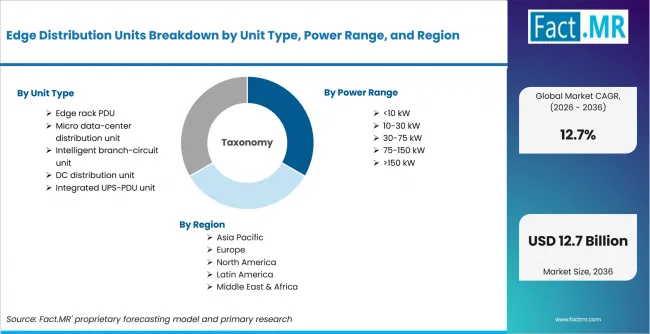
Edge Distribution Units Breakdown By Unit Type, Power Range, And Region | Source: Fact.MR
| Attribute | Details |
|---|---|
| Quantitative Units | USD Billion |
| Market Definition | Rack and branch-level electrical distribution units designed for distributed compute sites, combining protected power delivery with metering, switching, environmental inputs or remote management. |
| Unit Type | Edge rack PDU; Micro data-center distribution unit; Intelligent branch-circuit unit; DC distribution unit; Integrated UPS-PDU unit |
| Power Range | <10 kW; 10-30 kW; 30-75 kW; 75-150 kW; >150 kW |
| Deployment Site | Retail and branch edge; Telecom edge; Industrial edge; Healthcare and public sector; Transportation and other |
| Intelligence | Metered; Switched; Per-outlet monitored; Predictive and analytics-enabled; Autonomous load management |
| Regions Covered | North America; Latin America; Western Europe; Eastern Europe; East Asia; South Asia & Pacific; Middle East & Africa |
| Countries Covered | USA; Germany; Singapore; UK; France |
| Key Companies | Vertiv; Schneider Electric; Eaton; Legrand; Rittal; Delta Electronics |
| Forecast Period | 2026 to 2036 |
| Approach | The sizing approach combines active edge-site counts, rack and branch attachment, average unit value, intelligence mix, replacement cycles and fleet expansion by vertical. Country forecasts incorporate 5G coverage, broadband investment, distributed enterprise estates, labor cost and micro data-center adoption. |