- Market Value (2025): USD 537.2 Mn
- Estimated Value (2026): USD 650 Mn
- Forecast Value (2036): USD 4373 Mn
- CAGR (2026-2036): 21.0%
What is the Edge Packaging Chips Market forecast to be worth by 2036?
USD 650 million in 2026 to USD 4373 million by 2036 at a 21.0% CAGR.
- The edge packaging chips market reached USD 537.2 million in 2025.
- Demand is projected to increase from USD 650 million in 2026 to USD 4373 million by 2036.
- The market is forecast to record 21.0% CAGR from 2026 to 2036 as packaging-equipment builders and brand owners move inspection logic closer to the machine.
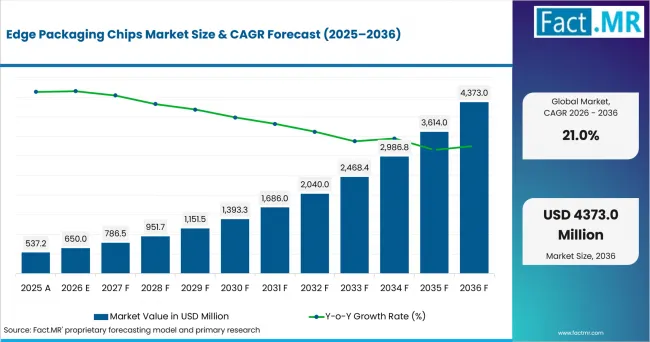
Edge Packaging Chips Market Value Analysis | Source: Fact.MR
What are the defining numbers behind Edge Packaging Chips Market growth?
USD 3,723 million absolute opportunity between 2026 and 2036, led by vision processors, defect inspection and ultra-low-power compute.
- Demand Drivers in the Market
- Packaging OEMs need local inspection compute since high-speed lines cannot wait for remote image processing before rejection decisions.
- Brand-protection teams need chip-level authentication support as traceability planning extends across labels and connected package readers.
- Plant engineers need low-power processors so cameras and machine controllers handle inference without adding heat or cabinet space.
- Quality managers need repeatable defect detection as camera checks move into code reading, seal inspection and product presence control.
- Semiconductor sales and AI infrastructure investment provide broader electronics-demand context. SIA reported in February 2026 that global semiconductor sales reached USD 791.7 billion in 2025, up 25.6%.
- Key Segments Analyzed
- By Chip Type: Vision processors are expected to hold 37.0% share in 2026 since they operate closest to camera-based inspection tasks.
- By Packaging Use: Defect inspection is projected to account for 49.0% share in 2026 as rejects are costly when packs reach downstream handling.
- By Compute Class: Ultra-low-power chips are anticipated to capture 51.0% share in 2026 owing to tight power budgets inside line devices.
- By Deployment: Package-label systems are estimated to represent 50.0% share in 2026 as authentication and serialization tasks move onto connected labels and readers.
- Analyst Opinion at Fact.MR
- Shambhu Nath Jha, Principal Consultant at Fact.MR, states, "Packaging-chip selection is becoming a line-performance decision, not a simple component purchase. Suppliers are expected to prove how a processor behaves with real camera feeds, label data and rejection timing. The best-positioned providers should combine inference speed, secure identity handling and stable software support for OEM integration."
- Strategic Implications
- Chip vendors should publish packaging-line reference designs that pair processors with cameras, label readers and reject signals.
- Packaging OEMs should validate inference latency under real line speeds before choosing MCU AI accelerators or vision processors.
- Brand owners should request authentication and serialization support that protects pack-level data without slowing inspection cycles.
- System integrators should document power, thermal and software-update behavior when edge chips are mounted inside machine enclosures.
The United Kingdom is projected to post 26.8% CAGR through 2036 due to public AI capacity and packaging compliance investment. Japan is anticipated to record 25.9% CAGR as production machinery and electronic parts planning support embedded vision. Germany is expected to reach 17.7% CAGR owing to microelectronics capacity. South Korea is forecast to post 15.6% CAGR with semiconductor export depth, while the USA is estimated to record 14.9% CAGR through electronics investment and traceability needs.
How does the Edge Packaging Chips Market break down by segment?
Vision processors lead Chip Type at 37.0%; ultra-low-power chips lead Compute Class at 51.0%.
Which Chip Type leads?
Vision processors are expected to hold 37.0% share in 2026.
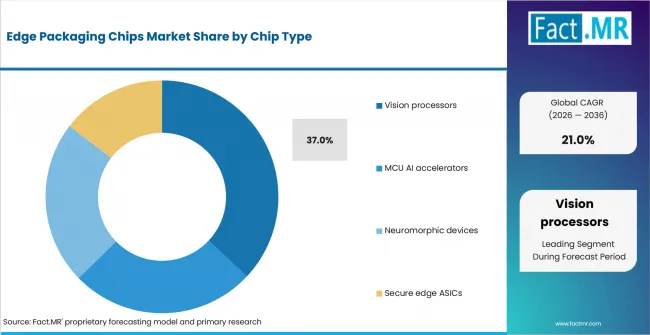
Edge Packaging Chips Market Analysis By Chip Type | Source: Fact.MR
Vision processors lead since packaging inspection starts with image capture. The processor must classify label position, print quality and surface defects quickly enough to trigger rejection while the pack stays on the conveyor.
Ambarella, Inc. expanded its N1 edge GenAI family in January 2025 with the N1-655 SoC, which provides on-chip decoding of 12 simultaneous 1080p30 video streams while concurrently processing multimodal vision-language models and consuming only 20 watts of power. The specification demonstrates high-density local video-processing capability.
What leads the Packaging Use segment?
Defect inspection is projected to account for 49.0% share in 2026.
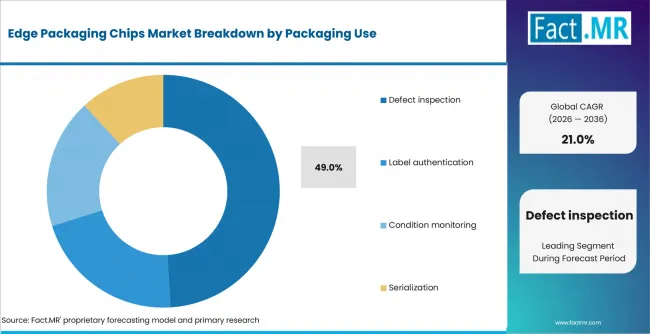
Edge Packaging Chips Market Analysis By Packaging Use | Source: Fact.MR
Defect inspection leads when one unreadable code, wrong label or damaged seal can stop release of a finished batch. Edge chips shorten the decision loop between camera capture and reject actuation.
How does Compute Class shape demand?
Ultra-low-power chips are anticipated to capture 51.0% share in 2026.
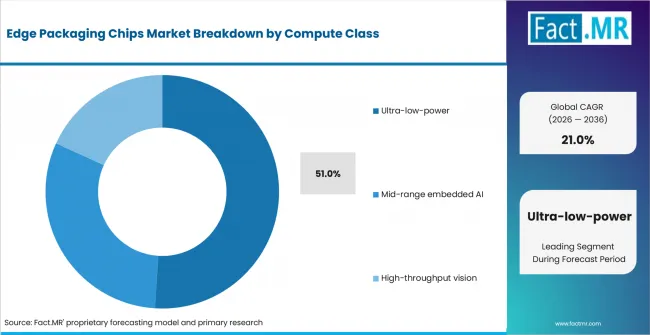
Edge Packaging Chips Market Analysis By Compute Class | Source: Fact.MR
Ultra-low-power chips lead where packaging devices are placed inside compact enclosures near heat and vibration. Lower power use helps processors remain close to sensors without forcing new cooling or cabinet layouts.
Synaptics Incorporated unveiled the Astra SR80 and SRW1500 series of Edge AI MCUs in March 2026. The SRW1500 combines a 200 MHz Arm Cortex-M52 processor with a 200 MHz, 50 GOPS Arm Ethos-U55 NPU for efficient on-device AI inference in connected IoT applications.
What supports Package-label deployment?
Package-label systems are estimated to represent 50.0% share in 2026.
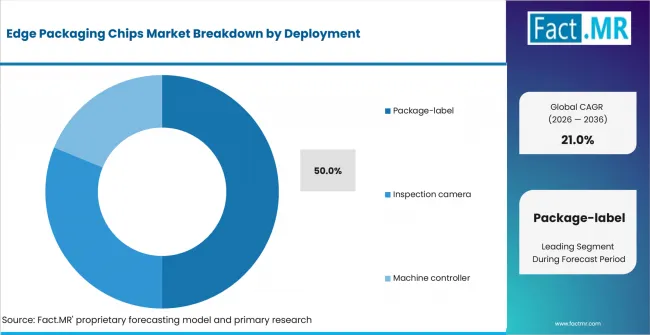
Edge Packaging Chips Market Analysis By Deployment | Source: Fact.MR
Package-label systems lead as labels now carry identity, traceability and brand-protection data. Edge packaging chips let readers validate printed codes or authentication features at the line without sending every decision to a cloud service.
What is accelerating Edge Packaging Chips Market adoption, and what is holding it back?
Demand is expected to rise through local vision inference, traceability checks and low-power packaging automation. Growth is constrained by integration cost, validation work and mixed line equipment.
Drivers Impact Analysis
| DRIVER | (~) % IMPACT ON CAGR | GEOGRAPHIC RELEVANCE | IMPACT TIMELINE |
|---|---|---|---|
| Camera-based defect inspection on packaging lines | +2.4% | Global | Short term (<= 2 years) |
| Traceability and package-label authentication | +1.9% | North America, Europe, East Asia | Medium term (2-4 years) |
| Low-power edge inference for compact machines | +1.5% | Global | Medium term (2-4 years) |
Source: Fact.MR analysis. Updated Aug 24, 2026
- Camera-based defect inspection: Local processors shorten the gap between image capture and rejection, so line speed is less exposed to network delay.
- Traceability and package-label authentication: Serialized packs need consistent code reading and identity checks, especially in food, medicine and premium goods.
- Low-power edge inference: Smaller processors fit into labels, cameras and controllers where space and heat limits restrict larger compute modules.
Opportunity Impact Analysis
| OPPORTUNITY | (~) % IMPACT ON CAGR | GEOGRAPHIC RELEVANCE | IMPACT TIMELINE |
|---|---|---|---|
| Integrated inspection chips for packaging OEMs | +1.6% | North America, Europe, East Asia | Short term (<= 2 years) |
| Secure edge ASICs for authentication labels | +1.2% | Global | Medium term (2-4 years) |
| Vision processors for modular inspection cells | +0.9% | Europe, East Asia | Long term (>= 4 years) |
Source: Fact.MR analysis. Updated Aug 24, 2026
- Integrated inspection chips: OEM-ready processors can reduce integration work when machine builders add vision features to established packaging platforms.
- Secure edge ASICs: Authentication labels create a route for chip suppliers that combine identity checks with low power and tamper-resistant operation.
Restraints Impact Analysis
| RESTRAINT | (~) % IMPACT ON CAGR | GEOGRAPHIC RELEVANCE | IMPACT TIMELINE |
|---|---|---|---|
| Integration cost on mixed packaging lines | -0.8% | Global | Short term (<= 2 years) |
| Validation risk for inspection decisions | -0.6% | North America, Europe | Medium term (2-4 years) |
| Long equipment replacement cycles | -0.4% | Global | Long term (>= 4 years) |
Source: Fact.MR analysis. Updated Aug 24, 2026
- Integration cost on mixed packaging lines: Older labelers, cameras and reject mechanisms may need custom wiring or software before chips deliver measurable value.
- Validation risk for inspection decisions: Brands must prove that edge inference does not miss defects or create false rejects that waste good packs.
- Long equipment replacement cycles: Packaging lines are replaced slowly, so chips often enter through retrofit cameras or controller upgrades first.
Which countries are scaling the Edge Packaging Chips Market through 2036?
The country comparison spans 11.9 percentage points across five profiled markets during 2026 to 2036.
- The UK stays 0.9 percentage point above Japan as AI compute and packaging compliance programs support adoption.
- Japan remains 8.2 percentage points above Germany as production machinery and electronic device planning sustain edge-inference demand.
- Germany stays 2.1 percentage points above South Korea through semiconductor cluster strength and industrial packaging automation.
- South Korea remains 0.7 percentage point above the USA as semiconductor exports support domestic chip and device expertise.
Comparable CAGRs create different entry conditions since packaging chips depend on both semiconductor depth and machine-level adoption. Full report coverage includes North America, Latin America, Western Europe, Eastern Europe, East Asia, South Asia & Pacific, Middle East & Africa.
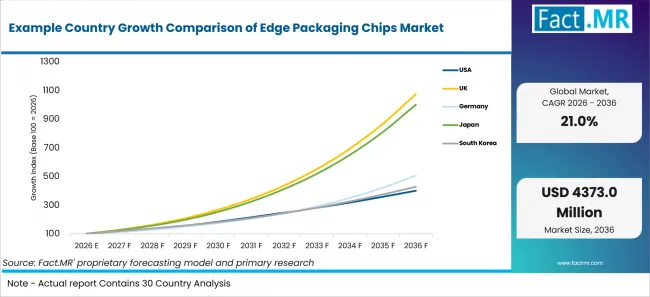
Example Country Growth Comparison Of Edge Packaging Chips Market | Source: Fact.MR
| Country | CAGR (2026-2036) |
|---|---|
| United Kingdom | 26.8% |
| Japan | 25.9% |
| Germany | 17.7% |
| South Korea | 15.6% |
| USA | 14.9% |
Source: Fact.MR analysis. Updated Aug 24, 2026
What supports the United Kingdom’s growth?
26.8% CAGR, supported by AI infrastructure expansion and electronics manufacturing depth.
The United Kingdom is expected to scale through public AI capacity and packaging-compliance pressure. DSIT reported in January 2026 that five AI Growth Zones across Great Britain were generating £28.2 billion in investment and creating more than 15,000 jobs. ONS reported on July 16, 2026, that output in the manufacture of computer, electronic and optical products increased by 2.1% in May 2026. Packaging OEMs are anticipated to use edge chips where inspection cameras need faster local code checks. Retrofit cost remains the main limit when older labelers and reject mechanisms must connect to new controllers.
How does Japan perform?
25.9% CAGR, led by production machinery demand and embedded electronics capability.
Japan is anticipated to grow from embedded electronics depth and demand for compact machine control. METI reported in June 2026 that manufacturers expected production to increase 3.7% in June 2026. The same METI update listed electrical machinery, information and communication electronics equipment, and electronic parts and devices among the categories shaping production movement. These conditions support vision processors and ultra-low-power chips for packaging machines that need camera checks inside tight cabinet space. Conservative qualification cycles are expected to slow controller replacement where plants require long validation records.
What is supporting Germany’s adoption?
17.7% CAGR, supported by microelectronics capacity and industrial automation depth.
Germany is expected to advance through its semiconductor cluster and machinery base. Destatis reported in August 2026 that real new orders in manufacturing rose 3.1% month over month in June 2026, with increases of 12.7% in machinery and equipment and 22.7% in computer, electronic and optical products. At the July 2026 opening of Infineon’s Smart Power Fab in Dresden, Chancellor Friedrich Merz described Silicon Saxony as Europe’s leading semiconductor-manufacturing location and stated that every third chip was produced in the region. The German government separately reported that every third microchip produced in Europe comes from Silicon Saxony. Packaging-machine builders are anticipated to use edge chips to connect defect detection with controller-level feedback. Integration cost remains high when OEMs support many camera brands.
What supports South Korea adoption?
15.6% CAGR, driven by semiconductor export scale and food-industry packaging needs.
South Korea is forecast to benefit from semiconductor scale and food-packaging activity. MOTIR and MSIT reported in January 2026 that Korea’s ICT exports reached USD 264.3 billion in 2025, up 12.4%, while semiconductor exports increased 22.1%. MFDS reported in May 2026 that food-industry production reached KRW 119 trillion in 2025, up 4.3%. These indicators support edge packaging chips where high-volume consumer goods need label verification, serialization and reject control. Adoption is still limited by validation work when defect models must be trained on local artwork.
What supports USA adoption?
14.9% CAGR, led by electronics investment and regulated traceability use cases.
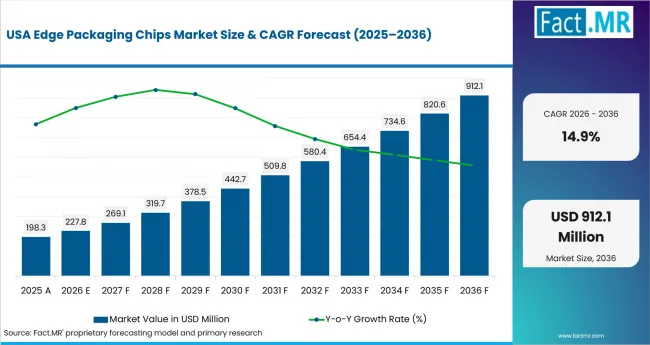
Edge Packaging Chips Market Country Value Analysis | Source: Fact.MR
The USA is estimated to expand through electronics investment and regulated traceability planning. BEA reported in June 2026 that greenfield expenditures in computers and electronics products manufacturing reached USD 2.0 billion in 2025. SIA reported in February 2026 that global semiconductor sales reached USD 791.7 billion in 2025, up 25.6% from 2024. FDA proposed extending the Food Traceability Rule compliance date by 30 months, from January 20, 2026 to July 20, 2028.
Who leads the Edge Packaging Chips Market?
NXP Semiconductors offers edge-AI processors and added Kinara’s discrete neural processing units to its portfolio after completing the Kinara acquisition in October 2025. NXP stated that the acquisition expands its AI-powered edge-system solutions for Industrial & IoT and Automotive applications.
STMicroelectronics announced the Stellar P3E in February 2026, the first automotive MCU with built-in AI acceleration, supported by its Edge AI development ecosystem. Ambarella offers edge-AI SoCs supporting video processing and multimodal inference, while Synaptics offers AI-native Astra MCUs for on-device intelligence. Hailo supplies edge-AI accelerators and vision processors designed for real-time inference across cameras, industrial systems, automotive applications, and other edge devices.
Kinara is treated within NXP for current-provider discussion after NXP completed the acquisition. Competition centers on inference speed, power use, camera integration, authentication support and the ability to document reliable rejection decisions.
Which companies are the key providers?
Key companies include NXP Semiconductors N.V. (including Kinara edge-AI portfolio), including the acquired Kinara portfolio; STMicroelectronics N.V.; Ambarella, Inc.; Synaptics Incorporated; Hailo Technologies Ltd.
- NXP Semiconductors N.V. (including Kinara edge-AI portfolio)
- STMicroelectronics N.V.
- Ambarella, Inc.
- Synaptics Incorporated
- Hailo Technologies Ltd.
Bibliography
- Ambarella, Inc. (2025, January 7). Ambarella expands N1 Edge GenAI family with SoC targeted at on-premise multi-channel VLM and NN processing in under 20 watts.
- Department for Environment, Food & Rural Affairs. (2025, June 27). Extended Producer Responsibility for Packaging: 2025 base fees. GOV.UK.
- Department for Science, Innovation and Technology. (2026, January 29). AI Opportunities Action Plan: One year on. GOV.UK.
- Federal Statistical Office. (2026, August 6). New orders in manufacturing in June 2026: +3.1% on the previous month.
- The Federal Government. (2026, July 2). Weltgrößte Fabrik für Leistungshalbleiter in Dresden eröffnet [World’s largest factory for power semiconductors opens in Dresden].
- Ministry of Economy, Trade and Industry. (2026, March 19). Current survey of production: 2026 interim total computation.
- Ministry of Economy, Trade and Industry. (2026, June 30). Indices of industrial production: Preliminary report for May 2026.
- Ministry of Trade, Industry and Resources & Ministry of Science and ICT. (2026, January 15). ICT exports post record annual performance in 2025.
- NXP Semiconductors N.V. (2025, February 10). NXP agrees to acquire edge AI pioneer Kinara to redefine the intelligent edge.
- Semiconductor Industry Association. (2026, February 6). Global annual semiconductor sales increase 25.6% to $791.7 billion in 2025.
- STMicroelectronics. (2026, February 10). STMicroelectronics introduces the first automotive microcontroller with AI acceleration for edge intelligence.
- Synaptics Incorporated. (2026, March 10). Synaptics expands Astra Edge AI portfolio with SR80 Series for AI-enhanced premium audio and SRW1500 Series for connected distributed intelligence.
- U.S. Bureau of Economic Analysis. (2026, June 10). New foreign direct investment in the United States, 2025.
- U.S. Food and Drug Administration. (2025, August 6). FDA proposes to extend compliance date for Food Traceability Rule and issues new FAQs and other resources.
This Report Addresses
- The report explains where edge packaging chips are used across chip type, packaging use, compute class and deployment environment.
- Segment analysis identifies the leading subsegments and the line-level reasons packaging OEMs prioritize them.
- Country analysis examines the listed markets and the electronics, AI infrastructure or packaging rules shaping adoption.
- Competitive analysis reviews providers across edge AI processors, embedded MCUs, vision SoCs and discrete accelerators.
- Application analysis assesses how latency, power use, code quality and defect rejection influence purchase decisions.
What does the Edge Packaging Chips Market cover?
The Edge Packaging Chips Market covers chips used to bring inference, authentication and inspection logic closer to packaging lines. It includes processors used in cameras, labels, controllers and machine interfaces. Packaging automation solution demand shows how automation spending is tied to line performance.
The assessment covers defect inspection, label authentication, condition monitoring and serialization use cases. It also reflects adjacent movement in edge AI high-bandwidth memory chips where AI workloads move closer to devices and equipment.
What is included in the scope?
The scope includes vision processors, MCU AI accelerators, neuromorphic devices and secure edge ASICs when they are applied to packaging equipment, labels or inspection devices. It also includes chips embedded in automated packaging solutions where local decisions improve code reading or defect rejection.
Included use cases cover package-label devices, inspection cameras and machine controllers. The scope also considers packaging robots when the chip function directly supports packaging inspection or pack-level verification.
What is excluded from the scope?
The scope excludes general AI data-center accelerators, cloud-only inference services, stand-alone packaging machinery without edge chip functions and chips used only for non-packaging electronics. It also excludes barcode printers, sensors and cameras sold without integrated or paired edge inference capability.
General factory analytics software is excluded unless edge chips are part of the packaging-line decision loop. Edge analytics platforms is relevant only where local analytics link directly to a chip-enabled packaging device.
How Was the Analysis Built?
The analysis draws on 120+ sources, 35+ company portfolios, 25+ countries, and more than 20 industry interviews.
- Primary Research: Primary research includes discussions with manufacturers, service providers, technology developers, distributors, end users, procurement teams, and subject-matter experts. These conversations examine purchasing priorities, product adoption, operational challenges, approval requirements, competitive positioning, and the factors that influence wider market acceptance.
- Desk Research: Desk research covers government statistics, regulatory publications, company filings, trade data, technical studies, industry associations, standards, public policy, and other authoritative sources. Every source used in the analysis is documented in the bibliography.
- Market Sizing and Forecasting: Market estimates combine historical performance, demand indicators, pricing and volume trends, segment shares, company participation, country-level growth, adoption patterns, investment activity, and barriers to market expansion.
- Data Validation and Update Cycle: Findings are validated by comparing primary interviews with public data, company activity, regulatory changes, trade patterns, and industry developments. Regular updates review new product launches, capacity changes, partnerships, approvals, procurement trends, and shifts in commercial adoption.
Segmentation
What is the report’s scope and coverage?
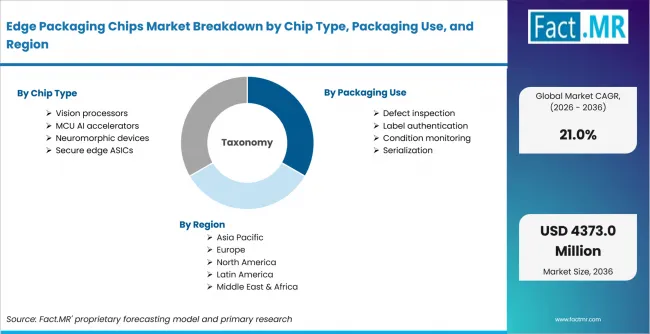
Edge Packaging Chips Market Breakdown By Chip Type, Packaging Use, And Region | Source: Fact.MR
| Attribute | Details |
|---|---|
| Quantitative Units | USD million |
| Market Definition | Edge chips used inside or near packaging equipment to perform local inference, vision processing, label authentication, defect inspection, condition monitoring and serialization support. |
| Chip Type | Vision processors; MCU AI accelerators; Neuromorphic devices; Secure edge ASICs |
| Packaging Use | Defect inspection; Label authentication; Condition monitoring; Serialization |
| Compute Class | Ultra-low-power; Mid-range embedded AI; High-throughput vision |
| Deployment | Package-label; Inspection camera; Machine controller |
| Regions Covered | North America; Latin America; Western Europe; Eastern Europe; East Asia; South Asia & Pacific; Middle East & Africa |
| Countries Covered | USA; United Kingdom; Germany; Japan; South Korea |
| Key Companies Profiled | NXP Semiconductors N.V. (including Kinara edge-AI portfolio), including Kinara portfolio; STMicroelectronics N.V.; Ambarella, Inc.; Synaptics Incorporated; Hailo Technologies Ltd. |
| Forecast Period | 2026 to 2036 |
| Approach | Hybrid top-down and bottom-up approach using packaging automation adoption, machine-vision use, semiconductor developments, country-level electronics indicators and provider portfolio review. |
Source: Fact.MR analysis. Updated Aug 24, 2026
How is the market segmented?
-
By Chip Type:
- Vision processors
- MCU AI accelerators
- Neuromorphic devices
- Secure edge ASICs
-
By Packaging Use:
- Defect inspection
- Label authentication
- Condition monitoring
- Serialization
-
By Compute Class:
- Ultra-low-power
- Mid-range embedded AI
- High-throughput vision
-
By Deployment:
- Package-label
- Inspection camera
- Machine controller
-
By Region:
- North America
- Latin America
- Western Europe
- Eastern Europe
- East Asia
- South Asia & Pacific
- Middle East & Africa
Frequently Asked Questions
How big is the edge packaging chips market in 2026?
What is the CAGR of the edge packaging chips market from 2026 to 2036?
Which chip type leads the edge packaging chips market?
Which packaging use leads the edge packaging chips market?
Who are the leading companies in the edge packaging chips market?
Who worked on this report


Preview the report firsthand - request a free sample
Free SampleGet the brochure for pricing and purchase details
Download PDF