- Market Value (2025): USD 71.9 Bn
- Estimated Value (2026): USD 76.5 Bn
- Forecast Value (2036): USD 142.8 Bn
- CAGR (2026-2036): 6.4%
What is the Electronic Manufacturing Services for Healthcare and Medical Device Market forecast to be worth by 2036?
USD 76.5 billion in 2026 to USD 142.8 billion by 2036 at a 6.4% CAGR.
- The market was worth approximately USD 71.9 billion in 2025, calculated from the supplied 2026 value and 6.4% CAGR.
- Demand is projected to increase from USD 76.5 billion in 2026 to USD 142.8 billion by 2036.
- The market is forecast to create an absolute opportunity of USD 66.3 billion between 2026 and 2036.
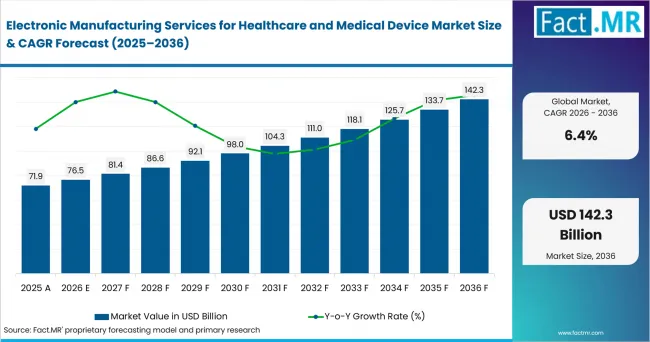
Electronic Manufacturing Services For Healthcare And Medical Device Market Value Analysis | Source: Fact.MR
What are the defining numbers behind Electronic Manufacturing Services for Healthcare and Medical Device Market growth?
An absolute opportunity of USD 66.3 billion is expected between 2026 and 2036.
- Demand Drivers in the Market
- Medical device portfolios are expanding in scale and complexity. The World Health Organization estimates that roughly 2 million kinds of medical devices are available globally across more than 7,000 generic device groups. This breadth increases the need for manufacturing partners that can manage diverse electronics, documentation and production requirements without each OEM building separate internal capacity.
- Regulatory quality requirements are increasing the value of specialized manufacturing systems. The U.S. Food and Drug Administration Quality Management System Regulation became effective on February 2, 2026 and incorporates ISO 13485:2016 into medical device current good manufacturing practice requirements. OEMs therefore place greater weight on suppliers with controlled processes, traceability and documented risk management.
- Diagnostic and connected devices require more complex electronics, including sensors, communication modules, embedded software interfaces and compact circuit assemblies. This raises demand for design-for-manufacturing support, advanced assembly and validated testing before products enter regulated markets.
- Medical device companies are using external manufacturers to move products from design transfer into volume production while controlling capital expenditure. Integrated EMS providers can combine engineering, tooling, procurement, assembly and final testing, reducing the number of handoffs that an OEM must qualify and manage.
- Supply continuity has become a purchasing criterion because component shortages can interrupt patient care. FDA guidance emphasizes early awareness of medical-device supply vulnerabilities. Buyers therefore favour EMS partners with multi-site sourcing, component lifecycle management and documented contingency planning.
- Key Segments Analyzed
- Integrated Manufacturing Services account for 41.0% of Manufacturing Service Type in 2026, supported by demand for one qualified partner across engineering transfer, assembly, testing and lifecycle support.
- Diagnostic Devices hold 43.0% of Medical Device Category in 2026 because imaging, monitoring and in vitro diagnostic systems contain extensive electronic and sensing content.
- Hospitals & Healthcare Providers represent 40.0% of End-use Application in 2026 as they purchase and operate high volumes of diagnostic, monitoring and patient-care equipment.
- Medical Device OEMs account for 42.0% of Customer Category in 2026 because they retain product responsibility while outsourcing specialized production and supply-chain execution.
- Advanced Assembly Technology holds 41.0% of Production Technology in 2026 due to demand for miniaturized, high-density and precisely controlled electronic assemblies.
- Analyst Opinion at Fact.MR
- Shambhu Nath Jha, Senior Consultant at Fact.MR, states, “Medical device OEMs will select manufacturing partners on evidence of process control, design-transfer capability and supply continuity. Scale is useful, but it does not replace traceability or the ability to maintain validated production after component and design changes. Suppliers that connect engineering support with regulated manufacturing are expected to gain a larger share as the market expands from USD 76.5 billion in 2026 to USD 142.8 billion by 2036.”
- Strategic Implications
- EMS providers should organize commercial propositions around device classes and manufacturing workflows rather than broad electronics capability. Buyers need evidence that the supplier can manage the controls relevant to the intended device.
- Suppliers should strengthen component lifecycle monitoring and alternate-source qualification. A design that depends on a single constrained component can create regulatory and production delays when substitution requires revalidation.
- OEMs should involve manufacturing partners before design freeze. Early design-for-manufacturing and design-for-test input can reduce assembly risk and make later scale-up more predictable.
- Pricing should account for validation, traceability and controlled change management. These activities add cost but reduce the probability of non-conformance, field failure and interrupted production.
How does the Electronic Manufacturing Services for Healthcare and Medical Device Market break down by segment?
The market is segmented by Manufacturing Service Type, Medical Device Category, End-use Application, Customer Category and Production Technology.
Why does Integrated Manufacturing Services lead Manufacturing Service Type?
Integrated Manufacturing Services are projected to account for a 41.0% share in 2026.
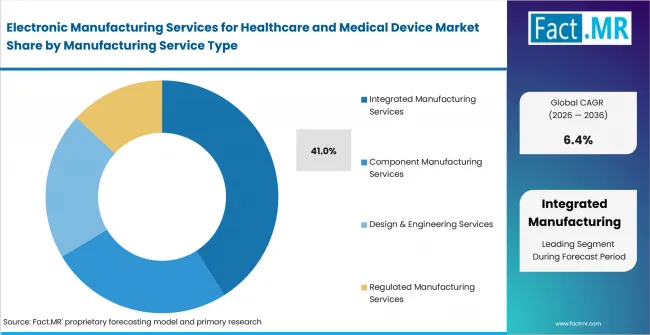
Electronic Manufacturing Services For Healthcare And Medical Device Market Analysis By Manufacturing Service Type | Source: Fact.MR
Integrated services lead because medical device OEMs must coordinate design transfer, component procurement, regulated assembly, testing and product documentation. Using one qualified provider reduces the number of interfaces that require oversight and lowers the risk of incomplete manufacturing records between separate contractors.
The model also supports change control. When a component becomes obsolete or a process requires modification, the same provider can assess sourcing, engineering and validation implications before production resumes. This is more efficient than distributing responsibility across unrelated design and manufacturing suppliers.
Why do Diagnostic Devices lead Medical Device Category?
Diagnostic Devices are projected to account for a 43.0% share in 2026.
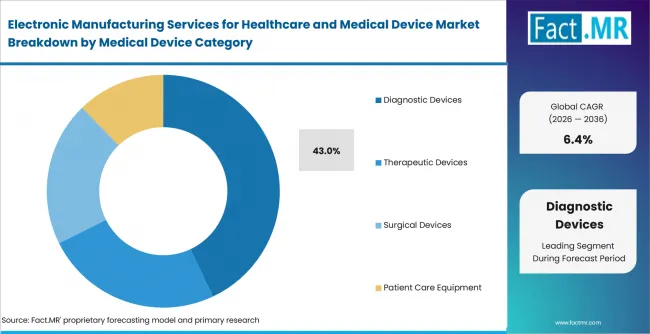
Electronic Manufacturing Services For Healthcare And Medical Device Market Analysis By Medical Device Category | Source: Fact.MR
Diagnostic devices lead because many systems depend on precision electronics and repeatable signal processing. Imaging equipment, laboratory analyzers and point-of-care instruments require circuit assemblies, sensors and calibrated testing that fit established EMS capabilities.
WHO identifies in vitro diagnostics as medical devices that provide information about disease or physiological status. Their purchasing value depends on consistent analytical performance, which increases the importance of controlled assembly and verification. Manufacturing partners that can support electronics integration alongside documented testing are therefore well placed in this category.
Why do Hospitals & Healthcare Providers lead End-use Application?
Hospitals & Healthcare Providers are projected to account for a 40.0% share in 2026.
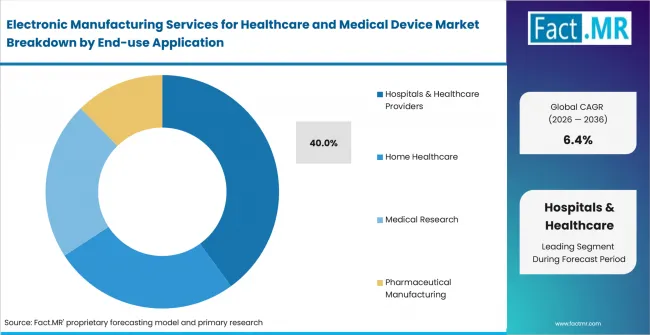
Electronic Manufacturing Services For Healthcare And Medical Device Market Analysis By End Use Application | Source: Fact.MR
Hospitals and healthcare providers lead because they operate broad fleets of diagnostic, monitoring and therapeutic equipment. Replacement demand arises from utilization, technology upgrades and the need to maintain service continuity across clinical departments.
Provider purchasing also influences OEM production planning. Large hospital systems require stable product availability and field support, encouraging device companies to use manufacturing partners that can scale output while maintaining consistent configurations and service parts.
Why do Medical Device OEMs lead Customer Category?
Medical Device OEMs are projected to account for a 42.0% share in 2026.
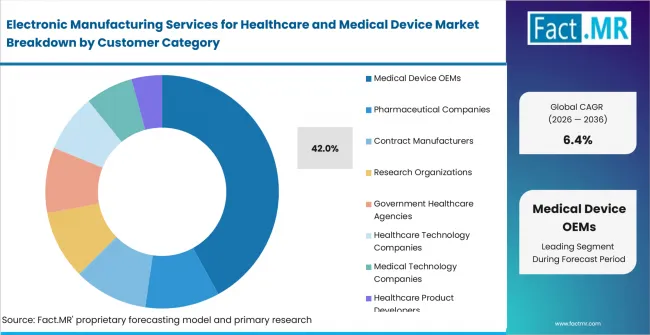
Electronic Manufacturing Services For Healthcare And Medical Device Market Analysis By Customer Category | Source: Fact.MR
Medical device OEMs lead because they own the product architecture and regulatory submission while relying on external specialists for industrialization and production. They require suppliers that can translate design specifications into controlled work instructions, validated processes and traceable manufacturing records.
The FDA requires registered establishments and listed devices to be identifiable within the supply chain. This reinforces the OEM’s need to qualify manufacturing locations and maintain oversight of outsourced operations. EMS providers with established quality systems therefore become long-term operating partners rather than simple assembly vendors.
Why does Advanced Assembly Technology lead Production Technology?
Advanced Assembly Technology is projected to account for a 41.0% share in 2026.
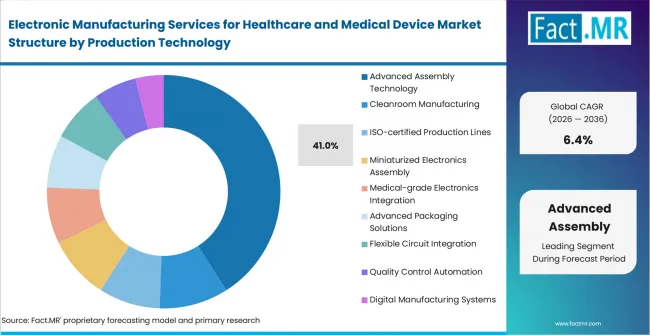
Electronic Manufacturing Services For Healthcare And Medical Device Market Analysis By Production Technology | Source: Fact.MR
Advanced assembly leads because medical electronics increasingly combine dense circuitry, miniaturized sensors and compact interconnects. These designs require precise placement, controlled soldering and inspection methods that are difficult to reproduce through basic assembly lines.
Automation also improves repeatability and creates machine-generated process records. Buyers use these records to investigate deviations and confirm that production remained within defined limits, strengthening demand for automated optical inspection, controlled dispensing and high-density assembly capability.
What is accelerating Electronic Manufacturing Services for Healthcare and Medical Device Market adoption, and what is holding it back?
Drivers Impact Analysis
| Factor | (~) % Impact on CAGR | Geographic Relevance | Impact Timeline |
|---|---|---|---|
| Adoption and integration | +1.6% | Global | Short term (<= 2 years) |
| Regulatory and compliance support | +1.4% | USA; Germany; UK | Short term (<= 2 years) |
| Channel and access expansion | +1.1% | Global | Medium term (2-4 years) |
| Clear specification and documentation | +0.9% | USA; UK; Canada | Medium term (2-4 years) |
| Cost and efficiency gains | +0.6% | Global | Long term (>= 4 years) |
Source: Fact.MR analysis. Updated Aug 7, 2026
Opportunity Impact Analysis
| Factor | (~) % Impact on CAGR | Geographic Relevance | Impact Timeline |
|---|---|---|---|
| Emerging application expansion | +1.0% | Global | Medium term (2-4 years) |
| Premium and specialist positioning | +0.8% | USA; UK; Germany | Medium term (2-4 years) |
| Channel and partner expansion | +0.7% | Global | Long term (>= 4 years) |
| Standards and compliance alignment | +0.5% | USA; Canada; Singapore | Long term (>= 4 years) |
Source: Fact.MR analysis. Updated Aug 7, 2026
Restraints Impact Analysis
| Factor | (~) % Impact on CAGR | Geographic Relevance | Impact Timeline |
|---|---|---|---|
| Cost and complexity | -1.1% | Global | Short term (<= 2 years) |
| Specification and compliance checks | -0.9% | USA; UK; Germany | Short term (<= 2 years) |
| Substitution by lower-cost alternatives | -0.7% | Import-dependent markets | Medium term (2-4 years) |
| Supply chain and pricing pressure | -0.5% | Global | Long term (>= 4 years) |
Source: Fact.MR analysis. Updated Aug 7, 2026
Which countries are scaling the Electronic Manufacturing Services for Healthcare and Medical Device Market fastest?
- USA: The USA has a large regulated device-manufacturing base and a deep network of OEMs, laboratories and specialist suppliers. FDA reported 29,178 registered medical device establishments in fiscal 2025, creating a broad addressable base for outsourced design transfer, assembly and testing.
- Germany: Germany combines Europe’s largest medical technology market with a substantial manufacturing workforce. Its device companies require partners that can support EU quality-system requirements and export production across several regulatory markets.
- Japan: Japan’s healthcare system and medical-device industry create demand for reliable electronics manufacturing, while policy work on international regulatory alignment supports products intended for overseas markets. EMS partners help local developers build quality controls suitable for global commercialization.
- China: China’s electronics supply chain and high-volume manufacturing infrastructure support rapid scale-up of diagnostic and patient-care equipment. Domestic component access and broad assembly capacity strengthen its role in both local production and export programmes.
- UK: The UK is expanding medical-device development and clinical investigation activity. MHRA reported 17% more approved medical-device clinical investigations in 2025 than in 2024, increasing the pipeline of products that may require design transfer and regulated manufacturing.
- Canada: Canada’s medical-technology sector serves a geographically dispersed healthcare system and is closely linked with the U.S. market. Suppliers that can support North American quality requirements and flexible production volumes are positioned to gain demand.
- South Korea: South Korea combines advanced electronics capability with medical-device development. Its semiconductor and precision manufacturing base supports high-density assemblies, sensors and connected-device production for domestic and export customers.
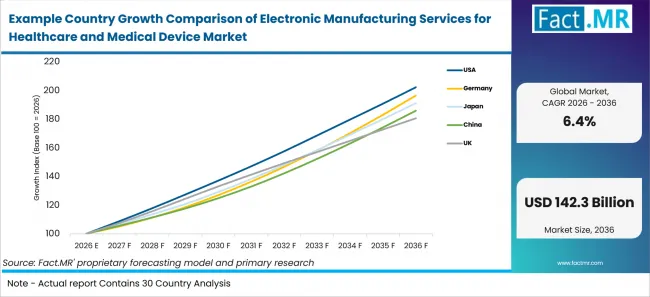
Example Country Growth Comparison Of Electronic Manufacturing Services For Healthcare And Medical Device Market | Source: Fact.MR
| Country | CAGR, 2026-2036 |
|---|---|
| USA | 7.3% |
| Germany | 7.0% |
| Japan | 6.7% |
| China | 6.4% |
| UK | 6.1% |
| Canada | 5.8% |
| South Korea | 5.5% |
Source: Fact.MR analysis. Updated Aug 7, 2026
What is driving USA’s growth through 2036?
The USA is forecast to expand at a 7.3% CAGR from 2026 to 2036.
Growth is supported by the scale of the regulated manufacturing base and the transition to the FDA Quality Management System Regulation. The QMSR incorporates ISO 13485:2016 and places continued emphasis on risk management, design development and documented manufacturing controls.
OEMs that lack sufficient internal production capacity can use qualified EMS partners to implement these controls across design transfer and assembly. Demand is strongest where the contractor can combine engineering support with traceability and multi-site supply continuity.
What is driving Germany’s growth through 2036?
Germany is forecast to expand at a 7.0% CAGR from 2026 to 2036.
Germany is the largest medical technology market in Europe and has the region’s highest absolute medical-technology employment. This concentration of device developers creates recurring demand for prototype industrialization, regulated electronics assembly and export-ready documentation.
EU Medical Device Regulation requirements must be integrated into manufacturer quality systems. German OEMs therefore favour production partners with ISO 13485 capability, controlled supplier management and experience maintaining technical documentation across product changes.
What is driving Japan’s growth through 2036?
Japan is forecast to expand at a 6.7% CAGR from 2026 to 2036.
Japan is supporting greater international alignment in medical-device regulation and overseas expansion by healthcare startups. Products developed for the USA and other markets require manufacturing processes that can satisfy multiple quality and documentation regimes.
Contract manufacturers provide access to advanced electronics production without each emerging company building a full regulated factory. This is particularly relevant for compact diagnostic and monitoring devices that require precise assembly and supplier qualification.
What is driving China’s growth through 2036?
China is forecast to expand at a 6.4% CAGR from 2026 to 2036.
China offers a dense electronics ecosystem spanning components, printed circuit boards, tooling and high-volume assembly. This shortens supplier coordination for device companies moving from prototype to commercial production.
Demand is also supported by local healthcare equipment production and export manufacturing. Buyers increasingly assess whether lower production cost is matched by controlled processes and reliable documentation, creating opportunities for suppliers that combine scale with regulated manufacturing discipline.
What is driving the UK’s growth through 2036?
The UK is forecast to expand at a 6.1% CAGR from 2026 to 2036.
The UK is strengthening its medical-technology pipeline and regulatory routes. Growth in approved clinical investigations expands the number of devices progressing toward production, while the Life Sciences Sector Plan places additional emphasis on medical technology and NHS adoption.
EMS demand arises when developers need to convert trial-stage designs into reproducible production. Contractors that can support low-volume introduction and later scale-up are well suited to the UK’s mix of established manufacturers and innovation-led companies.
What is driving Canada’s growth through 2036?
Canada is forecast to expand at a 5.8% CAGR from 2026 to 2036.
Canada’s device companies often serve domestic healthcare providers while planning access to the larger U.S. market. This increases the value of manufacturing partners familiar with ISO 13485 and North American regulatory documentation.
Flexible production is important because many programmes begin at modest volumes. EMS providers can spread specialized equipment and quality-system costs across several customers, making regulated production more accessible to smaller OEMs.
What is driving South Korea’s growth through 2036?
South Korea is forecast to expand at a 5.5% CAGR from 2026 to 2036.
South Korea’s electronics and semiconductor capabilities support the production of compact medical devices with sensors, displays and wireless connectivity. Existing expertise in precision assembly can be adapted to healthcare applications when supported by device-specific quality controls.
Export-oriented OEMs also need manufacturing records that can support submissions in several markets. EMS suppliers with multilingual programme management and international certification experience can reduce the operational burden of this expansion.
Which companies are the key providers?
Key companies include Jabil Inc.; Flex Ltd.; Benchmark Electronics, Inc.; Sanmina Corporation; TE Connectivity Ltd.; Venture Corporation Limited; Creation Technologies LP; and Plexus Corp.
- Jabil Inc.
- Flex Ltd.
- Benchmark Electronics, Inc.
- Sanmina Corporation
- TE Connectivity Ltd.
- Venture Corporation Limited
- Creation Technologies LP
- Plexus Corp.
Bibliography
- European Commission. (2021). Medical Devices: Guidance on Integrating MDR Requirements into Manufacturer Quality Management Systems. European Union.
- Food and Drug Administration. (2025). Medical Device Supply Chain Vulnerabilities and Their Public Health Impact. U.S. Department of Health and Human Services.
- Food and Drug Administration. (2026). FY 2025 Annual Report on Inspections of Establishments. U.S. Department of Health and Human Services.
- Food and Drug Administration. (2026). Quality Management System Regulation. U.S. Department of Health and Human Services.
- Government of the United Kingdom. (2026). Life Sciences Sector Plan. Department for Science, Innovation and Technology.
- Medicines and Healthcare products Regulatory Agency. (2026). UK Medical Device Testing Hits Record High. Government of the United Kingdom.
- MedTech Europe. (2025). The European Medical Technology Industry in Figures 2025. MedTech Europe.
- Ministry of Health, Labour and Welfare, Japan. (2024). White Paper on Strengthening Japan’s Healthcare Startup Ecosystem. Government of Japan.
- World Health Organization. (2026). Medical Devices. World Health Organization.
- Jabil Inc. (2025). Annual Report for the Fiscal Year Ended August 31, 2025. Jabil Inc.
This Report Answers
- How the market is expected to grow from 2026 to 2036.
- Which supplied segments hold the leading shares in 2026 and why.
- Which listed countries are projected to record the highest growth rates.
- How quality requirements, electronics complexity and outsourcing influence demand.
- How EMS providers compete through regulated manufacturing capability and geographic coverage.
What does the Electronic Manufacturing Services for Healthcare and Medical Device Market cover?
The market covers outsourced electronics engineering and manufacturing services used to produce healthcare equipment and medical devices. It includes design and engineering support, component manufacturing, integrated assembly, regulated production and testing within the supplied segment structure.
What is included in the scope?
The scope includes electronics manufacturing services for diagnostic devices, therapeutic devices, surgical devices and patient-care equipment. It covers production for medical device OEMs and the other supplied customer categories, including advanced assembly, cleanroom manufacturing, ISO-certified production and medical-grade electronics integration.
What is excluded from the scope?
The scope excludes general electronics manufacturing for non-medical products. It also excludes standalone healthcare software, hospital services and individual electronic components sold without a manufacturing-service relationship. Pharmaceutical manufacturing is included only where the supplied end-use taxonomy involves electronics manufacturing for related devices or equipment.
How Was the Analysis Built?
The analysis draws on 120+ sources and 35+ company portfolios. It covers 25+ countries and more than 20 industry interviews.
- Primary Research: Interviews with medical device OEMs, EMS providers, component suppliers, quality and regulatory specialists, procurement teams and healthcare equipment manufacturers examine outsourcing decisions, design-transfer requirements, production volumes and supplier qualification.
- Desk Research: The review covers medical device regulations, quality-system guidance, establishment data, industry statistics, company filings, product portfolios and manufacturing certifications. External sources used in the article are listed in the bibliography.
- Market Sizing and Forecasting: Estimates combine medical-device production, outsourced manufacturing penetration, service mix, average programme value, electronics content and country-level growth. Segment shares and company activity are cross-checked before finalization.
- Data Validation and Update Cycle: Findings are compared across interviews, public regulatory data and company disclosures. Updates account for quality-system changes, capacity investments, acquisitions, component availability and shifts in device production.
Segmentation
What is the report's scope and coverage?
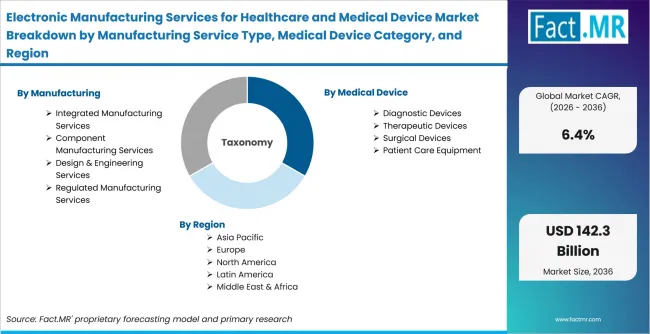
Electronic Manufacturing Services For Healthcare And Medical Device Market Breakdown By Manufacturing Service Type, Medical Device Category, And Region | Source: Fact.MR
| Attribute | Details |
|---|---|
| Quantitative Units | USD billion |
| Market Definition | Outsourced electronics design, manufacturing, assembly, testing and related lifecycle support for healthcare equipment and medical devices |
| Segments Covered | Manufacturing Service Type; Medical Device Category; End-use Application; Customer Category; Production Technology |
| Regions Covered | North America; Latin America; Europe; East Asia; South Asia and Pacific; Middle East and Africa |
| Countries Covered | USA; Germany; Japan; China; UK; Canada; South Korea |
| Key Companies Profiled | Jabil Inc.; Flex Ltd.; Benchmark Electronics, Inc.; Sanmina Corporation; TE Connectivity Ltd.; and others |
| Forecast Period | 2026 to 2036 |
| Approach | Hybrid top-down and bottom-up approach using device production, outsourced manufacturing penetration, service mix, country growth, pricing and company portfolio review |
Source: Fact.MR analysis. Updated Aug 7, 2026
How is the market segmented?
-
By Manufacturing Service Type
- Integrated Manufacturing Services
- Electronic Assembly
- Testing & Validation Services
- Component Manufacturing Services
- PCB Assembly
- Component Sourcing
- Design & Engineering Services
- Product Design Support
- Prototype Development
- Regulated Manufacturing Services
- GMP-compliant Manufacturing
- Regulatory Compliance Support
- Integrated Manufacturing Services
-
By Medical Device Category
- Diagnostic Devices
- Imaging Equipment
- Patient Monitoring Devices
- Therapeutic Devices
- Infusion Pumps
- Respiratory Devices
- Surgical Devices
- Robotic Surgical Systems
- Implantable Electronic Devices
- Patient Care Equipment
- Vital Sign Monitoring Equipment
- Electronic Medical Systems
- Diagnostic Devices
-
By End-use Application
- Hospitals & Healthcare Providers
- Diagnostic Centers
- Clinical Laboratories
- Home Healthcare
- Homecare Providers
- Healthcare Facilities
- Medical Research
- Research Institutes
- Clinical Research Organizations
- Pharmaceutical Manufacturing
- Biopharmaceutical Facilities
- Vaccine Manufacturing Facilities
- Hospitals & Healthcare Providers
-
By Customer Category
- Medical Device OEMs
- Original Equipment Manufacturers
- Medical Device Startups
- Pharmaceutical Companies
- Contract Manufacturers
- Research Organizations
- Government Healthcare Agencies
- Healthcare Technology Companies
- Device Innovators
- Medical Technology Companies
- Healthcare Product Developers
- Global MedTech Firms
- Medical Device OEMs
-
By Production Technology
- Advanced Assembly Technology
- Automated Surface Mount Technology
- Robotic Assembly Systems
- Cleanroom Manufacturing
- ISO-certified Production Lines
- Miniaturized Electronics Assembly
- Medical-grade Electronics Integration
- Advanced Packaging Solutions
- Flexible Circuit Integration
- Quality Control Automation
- Digital Manufacturing Systems
- Real-time Production Monitoring
- Advanced Assembly Technology
-
By Region
- North America
- Latin America
- Western Europe
- Eastern Europe
- East Asia
- South Asia and Pacific
- Middle East & Africa
Frequently Asked Questions
Which Manufacturing Service Type leads the market?
Which Medical Device Category leads the market?
Which End-use Application leads the market?
Which Customer Category leads the market?
Which Production Technology leads the market?
Which country records the highest listed CAGR?
What is the primary driver in this market?
What is the main restraint?
Which companies are included in the market assessment?
Who worked on this report


Preview the report firsthand - request a free sample
Free SampleGet the brochure for pricing and purchase details
Download PDF